Film Review: Wild 90 (dir by Norman Mailer)


Produced, directed, financed by, and starring writer Norman Mailer, 1968’s Wild 90 is incomprehensibly bad.  Words escape me when it comes to describing just how boring and pointless this film.

Over the course of four nights, Mailer and two of his friends were filmed in a shabby apartment.  Norman Mailer played The Prince, a gangster who talks tough and is constantly doing stuff like punching the room’s only hanging lightbulb.  Buzz Farber and Mickey Knox played Cameo and Twenty Years, the Prince’s partners in crime.  Acclaimed documentarian D.A. Pennebaker served as cinematographer, using a hand-held camera to capture the three men as they drank, laughed, fought, and pretended to be gangsters.

The plot of the film is not easy to describe, both because the entire film was improvised and also because the soundtrack is so muddy that it’s often impossible to understand what anyone’s saying.  As far as I can tell, the Prince’s latest criminal scheme has gone south and the Prince and his two cronies are hiding out in the apartment until the heat dies down.  They don’t have much to do, other than drink and exchange profane dialogue.  (The three men do their best to sound like real-life, poetically crude gangsters.  It’s hard to judge how well they do any of that because the dialogue is often incomprehensible.)  Some people drop by the apartment.  Normally, that would liven things up but in this one, everyone just seems like they want to leave before Norman Mailer accidentally punches them.  One man comes in a with a dog that start barking.  Mailer barks back until the dog falls silent.

Making all of this interesting is the fact that, in the 1960s, Norman Mailer was one of America’s leading public intellectuals.  Today, living in the age of influencers, it can be easy to forget that there were once public intellectuals, like Mailer, William F. Buckley, Gore Vidal, John Kenneth Galbraith, and Tom Wolfe, who disagreements were followed by the public and who made headlines when they showed up drunk on the daytime talk shows.  Mailer was an acclaimed and often controversial writer, one who was as famous for his arrogance and his public feuds as for his novels and essays. Mailer was a New York fixture and a Pulitzer Prize winner  He was one of the first writers to suggest that the Left and the Right could be united by a shared belief in individual freedom.  A year after the release of Wild 90, Mailer ran an ill-fated campaign for mayor of New York City.  His slogan was “No more bullshit!” and his campaign, which attracted some attention early on, was ultimately sabotaged by his habit of showing up drunk to his rallies and insulting his supporters.

What he was not was a very good filmmaker.  Wild 90 was Mailer’s first film and it’s a nearly unwatchable disaster.  (At least his later film, Maidstone, had Rip Torn around to liven things up.)  With its low-budget, black-and-white look and it’s DIY aesthetic, Wild 90 may remind some of the Andy Warhol’s Factory films but Warhol (or, if we’re to be absolutely honest, Paul Morrissey) was at least trying to be subversive.  Wild 90, on the other hand, is pure self-indulgence, a chance for Mailer to say, “Look how funny I am!”  Farbar and Knox at least manage to give semi-believable performances.  Mailer continually looks straight at the camera and seems to panic whenever either of his co-stars start to take the attention off of him.  The entire film seems to be Mailer’s attempt to convince everyone that he really was a tough guy.

There is one moment of the film that does work.  The film opens with some gorgeously shabby images of lower Manhattan. Norman Mailer was a proud New Yorker so it’s appropriate that the best part of the film is the part that highlights the city he loved.
Documentary Review: William Shatner’s Mysteries of the Gods (dir by Harald Reinl and Charlie Romine)


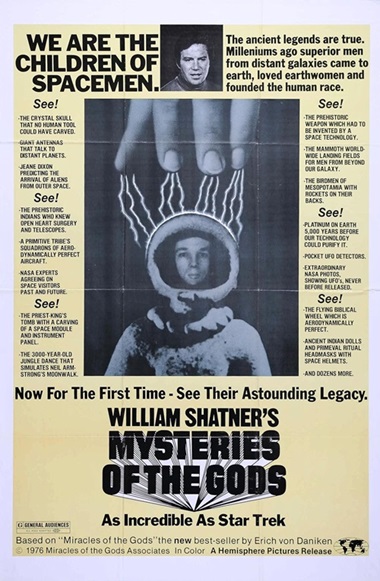
First released in 1976, the German documentary Mysteries of the Gods raises the same questions that were asked by Chariots of the Gods and it offers up the same answers.  How did ancient man build the pyramids?  Aliens!  How were the giant statues of Easter Island moved to their final resting place?  Aliens!  Who created Stonehenge?  Aliens!  Who drew the South American ley lines?  Aliens!  Who took Elijah, Gilgamesh, and Enoch up into the sky?  Aliens!  Who is responsible for religion?  Aliens!

Mysteries of the Gods was made by the same people who did Chariots of the Gods but it’s less a continuation and more of a remake.  The only new thing that Mysteries of the Gods brought to the table was the suggestion that the governments of the world knew about the aliens and that they were, in some cases, working with the aliens.  I’ve already made my feelings about those theories clear.  I’m a skeptic and I’m proud of it.  Still, it’s interesting to wonder what type of advice the aliens would have given the world leaders.  I mean, considering everything that has happened over the past 66 years, it doesn’t appear to be very good advice!

Seriously, tell those dumbass aliens to go home and mess around with their own planet.

When Mysteries of the Gods came over to the United States, it was decided that the film needed a bit more of an American feel to it.  The original’s German narrator would have to go.  But who could replace him?  Who had the gravitas necessary to seriously discuss the theory of ancient astronauts?  Who would draw in the science fiction crowd while possibly still appealing to people who didn’t know much about the history of UFO sightings?  Who would have the proper enthusiasm for the project?  Who was reasonably famous but still enough in need of a paycheck that they would agree to be associated with something as shoddy as Mysteries of the Gods?

We all know the answer to that question.

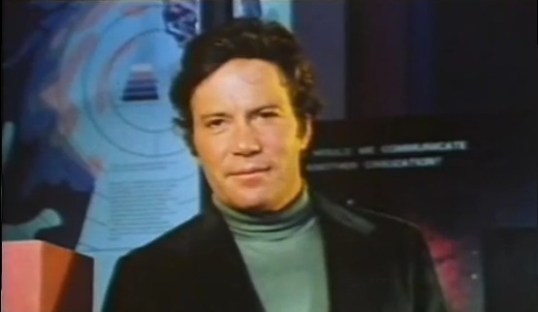
And if the American distributors were going to pay William Shatner to re-record the film’s narration, why not take full advantage of his presence and film some scenes of him interviewing various psychics and scientists?  Why not have him wax rhapsodic about a crystal skull while actually holding the artifact?  Why not have him actually visiting the locations described in the documentary?  Why not put him in a green turtleneck and a black jacket and present him as being the hip face of pseudo-science?  And why not change the title of the film to William Shatner’s Mysteries of the Gods, implying that Shatner himself had something substantial to do with the making of the film?

And let’s give credit where credit is due.  Mysteries of the Gods is a ludicrous documentary that provides even less evidence for its fantastical claim than Chariot of the Gods did.  But the American version of the film is worth watching, just to see William Shatner trying to repress his natural smirk while reciting the film’s overwrought narration.  Shatner appears to be amused by the whole thing and he definitely comes across as being a good sport as he gamely interview a series of crackpots who are all convinced they’ve cracked some sort of alien code.  The film ends on a triumphant note, with psychic Jeanne Dixon telling an excited Shatner that aliens will visit Earth in April of 1977.

Now, you may say that Dixon was incorrect.  There’s no record of aliens coming to Earth in 1977.  Maybe that’s just what they want you to believe!  To quote the Amazing Criswell, can you prove it didn’t happen?

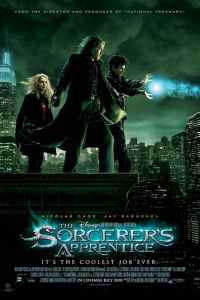
Quick Review: The Sorcerer’s Apprentice (dir. by Jon Turteltaub)


The Sorcerer’s Apprentice may be one of Disney’s better Live Action features. Borrowing from a small segment in Disney’s Fantasia, it builds a pretty cool story and still manages to pay homage to the original in it’s own way. Executive Produced by and starring Nicolas Cage, the film reunites him with his National Treasure director, Jon Turteltaub.

In the Dark Ages, the great wizard Merlin fought a major battle against the evil Morgana (Alice Krige, Star Trek: First Contact). At his side were his three apprentices, Veronica (Monica Bellucci, Beetlejuice Beetlejuice), Horvath (Alfred Molina, Prince of Persia) and Balthazar (Nicolas Cage). When Horvath betrays Merlin, both he and Morgana are defeated, contained in a layer of nesting dolls. Veronica is also part of the doll as she sacrifices herself to keep Morgana at bay. In order for Morgana to be destroyed, however, this can only be done by the Prime Merlinian, a Sorcerer of unimaginable power. To find the Prime Merlinian, Balthazar is given a ring for him to use.

When young Dave Stutler encounters Balthazar in his curio shop, we find that the ring does react to him and he may very well be the Prime Merlinian. Dave accidentally frees Horvath from the nesting doll and is saved by Balthazar before the pair of sorercers are trapped in an urn. 10 Years Pass (to the day), causing an event where both Horvath and Balthazar are freed. Can Balthazar train Dave (Jay Baruchel, Goon) in time to defeat Morgana, especially when Dave’s attentions are more focused on the girl of his dreams, Becky(Teresa Palmer, Netflix’s A Discovery of Witches)?

Thoughout his career, one of Cage’s magical traits is that he fully throws himself into a role. Not so much ‘method’ as maybe a Jeremy Strong (which may be more over the top), but he brings his own style to the mix. There isn’t a Cage character that isn’t enriched by the performances he brings to the table. For The Sorcerer’s Apprentice, he’s slightly subdued, but still carries the moxie he had in fllms like Face/Off, The Rock or even Mandy. He does make for a good father figure in this film.

Of course, the supporting cast is great. Molina makes for a nice villain in Horvath, with Toby Kebbell (Rock-n-Rolla) as an evil apprentice. Baruchel’s performance is pretty similar to what he did for How to Train Your Dragon, which made him perfect for this.

Building off of the National Treasure films, there’s as much humor in The Sorcerer’s Apprentice as there is adventure. After all, we are dealing with a tale of magic and wizards. There’s a cool car chase and a nice final confrontation. The connecting scene to Fantasia is a cute one, with magical brooms and mops trying to clean the workshop was a nice touch. The main theme of the story is just learning to believe in oneself and trust in what you’re capable of.

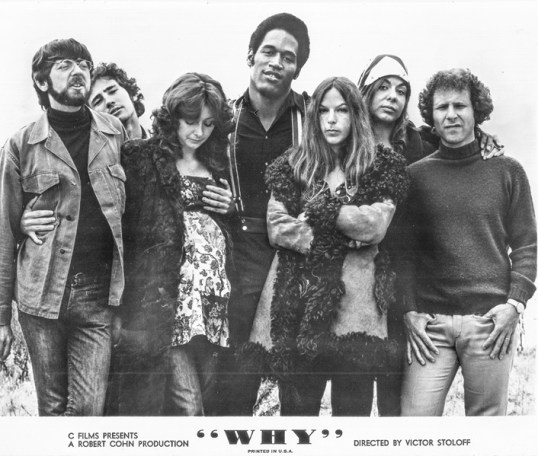
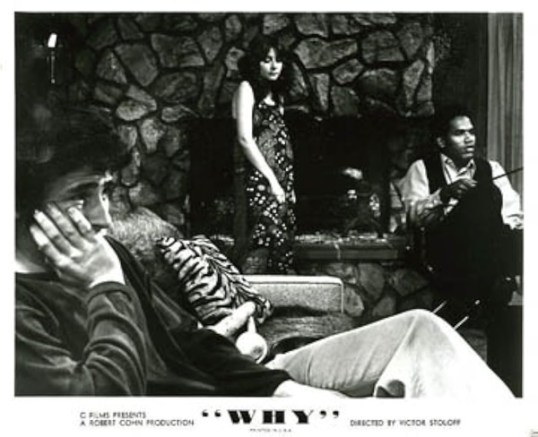
Insomnia Film #67: Why (dir by Victor Stoloff)


What’s an Insomnia File? You know how some times you just can’t get any sleep and, at about three in the morning, you’ll find yourself watching whatever you can find on cable or streaming? This feature is all about those insomnia-inspired discoveries!

If you’re having trouble getting to sleep tonight, you can always go over to either YouTube or Tubi and pull up Why, an obscure film from 1973 that has a semi-interesting cast.

The plot of Why is simple.  Six people gather at their psychiatrist’s mansion for group therapy.  Dr. Peter Carlson (played by Herb Goldberg, an actual psychiatrist) asks the members of the group questions and asks them to do things like try to imagine a moment that made them truly happy.  The members of the group discuss their problems and …. well, that’s pretty much it.

Who is in the group?  Jeannie Berlin plays Gail, a single mother who has been rejected by her family because she had an out-of-wedlock child with a black man.  Cathy Bleich plays Jennifer, who claims to be a teacher but who is also a pathological liar.  Linda Gillen is Christine, a rich teenager who is two-months pregnant and who is implied to be addicted to heroin.  Danny Goldman plays Bill, a suicidal gay man.  Musician Tim Buckley plays musician Glenn, who can’t get over his band breaking up.  And, playing a professional athlete named Bud, is O.J. Simpson.  “I smoke dope,” Bud says at one point before going on to explain why he thinks its important to be a good role model.

Why is an odd film.  It starts out with a lengthy animated sequence (complete with a hippie-style song) and then settles into being a stagey film that feels more like an extended acting exercise than an actual narrative.  It’s a talky film and some of the monologues work while others fall flat.  The best performances are given by Danny Goldman, Tim Buckley, and Linda Gillen but I imagine most people who watch this film will be giving most of their attention to O.J. Simpson, who talks about resenting the pressure to always be perfect.  In the end, there are no real break-throughs and one could argue that makes this the most realistic depiction of therapy ever filmed.

Reportedly, the film start out as a short film starring O.J. Simpson and Tim Buckley that was commissioned by Technicolor to see if video could be transferred to film.  The decision was made to expand the short into a feature.  The actors improvised during rehearsal and those improvs served as the basis for the script.  Again, this will probably be most interesting to people looking for hints into what it was like inside of O.J. Simpson’s head.  (O.J.’s character comes across as being friendly but guarded and quick to get angry about women in general.)

Again, it’s a talky film.  At times, it’s a rather boring film.  Many of the monologues start out strong but they tend to go on and on. Why might cure you of your insomnia.  That said, the film is interesting from a historical point of view.  It’s all very 70s, revealing a group of people trying to navigate a world that was still trying to figure out where they stood in the years immediately following the turmoil of 60s.  The characters have a brand new world ahead of them and none of them know if that’s a good thing or a bad thing.  Some things never change.

Previous Insomnia Files:

  1. Story of Mankind
  2. Stag
  3. Love Is A Gun
  4. Nina Takes A Lover
  5. Black Ice
  6. Frogs For Snakes
  7. Fair Game
  8. From The Hip
  9. Born Killers
  10. Eye For An Eye
  11. Summer Catch
  12. Beyond the Law
  13. Spring Broke
  14. Promise
  15. George Wallace
  16. Kill The Messenger
  17. The Suburbans
  18. Only The Strong
  19. Great Expectations
  20. Casual Sex?
  21. Truth
  22. Insomina
  23. Death Do Us Part
  24. A Star is Born
  25. The Winning Season
  26. Rabbit Run
  27. Remember My Name
  28. The Arrangement
  29. Day of the Animals
  30. Still of The Night
  31. Arsenal
  32. Smooth Talk
  33. The Comedian
  34. The Minus Man
  35. Donnie Brasco
  36. Punchline
  37. Evita
  38. Six: The Mark Unleashed
  39. Disclosure
  40. The Spanish Prisoner
  41. Elektra
  42. Revenge
  43. Legend
  44. Cat Run
  45. The Pyramid
  46. Enter the Ninja
  47. Downhill
  48. Malice
  49. Mystery Date
  50. Zola
  51. Ira & Abby
  52. The Next Karate Kid
  53. A Nightmare on Drug Street
  54. Jud
  55. FTA
  56. Exterminators of the Year 3000
  57. Boris Karloff: The Man Behind The Monster
  58. The Haunting of Helen Walker
  59. True Spirit
  60. Project Kill
  61. Replica
  62. Rollergator
  63. Hillbillys In A Haunted House
  64. Once Upon A Midnight Scary
  65. Girl Lost
  66. Ghosts Can’t Do It

Lisa Reviews An Oscar Nominee: Moonstruck (dir by Norman Jewison)


Nominated for Best Picture of 1987, Moonstruck is a film about love, romance, New York City, and being Italian.

Loretta Castorini (Cher) is a widow and a bookkeeper who lives with her parents, Cosmo (Vincent Gardenia) and Rose (Olympia Dukakis) in Brooklyn.  When her boyfriend, Johnny (Danny Aiello), asks Loretta to marry him, Loretta says yes even though she knows that, while she likes him, she’s not really in love with him.  After he proposes, Johnny reveals that he has to go to Sicily to see his “dying” mother.  He asks Loretta to pay a visit to his estranged brother, Ronny (Nicolas Cage), and invite him to the wedding.  Loretta, a strong believer in family and the importance of following tradition, agrees.

Loretta finds Ronny working in the bakery that he owns.  Ronny is not thrilled to learn that his brother has gotten engaged.  Ronny reveals that he has a wooden hand.  He lost his real hand when he accidentally placed it in a bread slicer while having a conversation with Johnny.  After he lost his hand, Ronny’s then-fiancée left him.  Ronny has never forgiven Johnny for the loss of his hand.  “I lost my hand!  I lost my bride!”  Ronny yells to the heavens.  Loretta, however, immediately understands that Johnny actually hurt his hand to get his fiancée to break up with him.  A conversation at Ronny’s apartment leads to the two of them impulsively sleeping with each other.  The next day, Ronny promises to never bother Loretta again if she agrees to go the opera with him.

What the guilt-stricken Loretta doesn’t know is that her father is having an affair himself and it turns out that Cosmo and Mona (Rose Gilette) enjoy the opera as well.  Meanwhile, Rose finds herself tempted by a lecherous college professor named Perry (John Mahoney).

There’s a lot of stereotypes to be found in Moonstruck.  Of course, passionate Ronny loves the opera.  Of course, the simple but well-intentioned Johnny abandons his fiancée so that he can rush to Sicily to be with his “dying” mother who, it turns out, isn’t dying at all.  Of course, Loretta slaps Ronny and tells him to snap out of it.  (I should note that I’m a fourth Italian myself so I could definitely relate to some of this film.  I’ve never liked opera, though.)  Fortunately, the film’s cast is so perfectly chosen and John Patrick Shanley’s script so adroitly maintains the balance between the broad comedy and the small dramatic moments that it doesn’t matter that all of the characters are a bit stereotypical.  The film comes to a wonderful life.  It’s impossible not love these characters, flaws and all.  Cher and Olympia Dukakis deserved the Oscars that they both won for this film.  Vincent Gardenia deserved the nomination that he received.  Nicolas Cage, Danny Aiello, and John Mahoney were not nominated but they should have been.  In particular, John Mahoney is heart-breaking in his small role, playing the type of lecherous character that most films would have just portrayed as being a cardboard buffoon.  As for Nicolas Cage, Moonstruck is a film that features both his trademark eccentricity and his ability to show the real and vulnerable human being underneath all of the bluster.  Moonstruck is a film about the search for love and the glory of finding it.  It’s a wonderfully romantic film, even if almost all of that love seems to involve infidelity.  As directed by Norman Jewison, Moonstruck not only celebrates falling in love but also celebrates being lucky enough to do so in New York City.  It’s a love letter not just to its characters but to the city as well.

Moonstruck was nominated for Best Picture but it lost to a far more epic production, The Last Emperor.


The Challenger (2015, directed by Kent Moran)


Jaden Miller (Kent Moran, who also directed) is a former honor student who threw away his scholarship to a private school when he got into a fight while defending another student.  Having dropped out of high school, Jaden now works as an auto mechanic in the Bronx.  When he and his mother (S. Epatha Merkerson) are evicted from their crummy townhouse, Jaden tries to make extra money by becoming a professional boxer.  As the “Bronx Boy,” he becomes a local hero and eventually, he wins the chance to challenge the light heavyweight champion of the world (Justin Hartley).

A by-the-numbers boxing movie, The Challenger was the final film of Michael Clarke Duncan and he’s the best thing about the movie.  Duncan plays Duane Taylor, the former boxing trainer who dropped out of the spotlight after one of his boxer threw a fight.  Duane agrees to train Jaden because he has a secret connection to both Jaden and his adoptive mother.  Clarke, with his powerful voice and his infectious laugh, is close-to-perfect in the role and he keeps things interesting, even when the movie sinks into an ocean of cliches.  The Challenger was released thee years after Duncan’s tragic death and the end credits feature behind-the-scenes footage of a friendly Duncan smiling and laughing with the film’s crew.  The movie may be imperfect but it serves as a tribute to a talented actor who passed away too young.

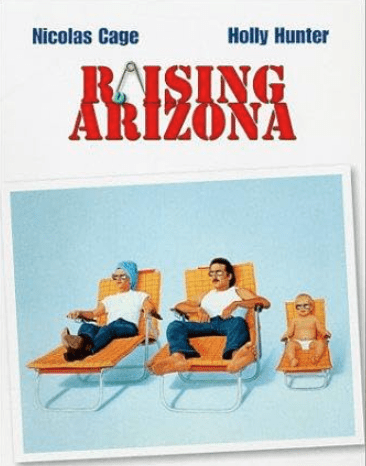
Raising Arizona (Dir Joel & Ethan Coen), Review by Case Wright


Happy Birthday, Nicolas Cage. If you’re an older Millennial or Young Gen X, you saw “Raising Arizona” about 100 times on Showtime and HBO because I believe that it was very inexpensive to license. The film was a hard left turn for the Coen Brothers who had major success with “Blood Simple” – a brutal thriller- that turned all women off to Fat Southern Murderers forever. The Coen thrillers tended to have comedic edge after Raising Arizona, but never just a comedy again- until The Big Lebowski. This film is also responsible for John Goodman. Prior to this film he was in mostly small parts, then after this picture- he became a household name in Roseanne.

Nicolas Cage is a made up name. He is Francis Coppola’s nephew and I can’t fault him for mayonnaising his name because my Italian ancestors did as well. However, I believe that he was trying to hide the Coppola name more than his heritage. Speaking of Italian heritage, try “Groking” “Italian American Jersey Girl” in grok. The lady who appears is beautiful, but doesn’t look like any of my Aunts. I feel that I should advocate for my people- We trend good looking and gave you Pizza Friday! Come on, show some love!

The film’s premise is that H.I. McDonnough (Nicolas Cage) is an ex con who is addicted to robbing the same convenience store again and again and again. This may seem strange, but in another life, I did criminal defense and I had a client who would steal the same jacket from the same store every year. Edwina “Ed” (Holly Hunter) is a cop who processes H.I. again and again. Each time, he flirts with her. His last time as a convict in front of her- her fiancé left her. H.I. realizes that he must go straight to get her love.

After his jail time, he returns as a free man to get his love- “Ed”. It works! They have a great life, but they want a child and yet she can’t conceive. The solution: they will kidnap a baby from the owner of Gallery Furniture! If you were from Texas, you would’ve laughed! They get the kid and are pursued by all sorts of people who want to claim the reward for the kidnapped baby.

This very intricate plot is just the first 30 minutes of the film. It is truly funny. I always felt for these character because good people should have LOTS OF KIDS- as many as possible! They shouldn’t have to pay taxes or anything. This film is special to me for another reason: it is when the Boomers were still young and filled with hope. Now, we are losing them and it hurts. This film is a glimpse of what they were like before the grey and how much they yearned for a good family on their own terms.

IT COULD HAPPEN TO YOU (1994) – Nicolas Cage wins the lottery! Now what about that tip?!


As much as I enjoy writing about movies and talking about movies, I make a living by helping people with their annual income tax filings. That means from around January 15th through April 15th each year, almost every waking hour is spent focused on tax return preparation. While I’m working on these tax returns, I will often play movies or TV shows on one of my computer screens. These aren’t just any movies, though. These are movies or TV shows that make me feel good and help me relax while I’m working so many hours. Over the years, I’ve used movies like THE OTHER GUYS, THE HANGOVER, and ZOMBIELAND. A few years ago, THE ANDY GRIFFITH SHOW was on Prime, and I watched the entire 8 seasons through 3 times during tax season. One genre I hit hard this time of year is romantic films, both comedies and dramas. The main thing I’m looking for is happy endings. My favorite romantic films include NOTTING HILL, RETURN TO ME, HITCH, YOU’VE GOT MAIL, PERSUASION & SENSE AND SENSIBILITY. As a big fan of Nicolas Cage, IT COULD HAPPEN TO YOU, Cage’s 1994 romantic comedy with Bridget Fonda has joined that list over the years as well. Since today, January 7th, 2025, is Nicolas Cage’s 61st birthday, and tax season is coming, I thought I’d write about this charming film!

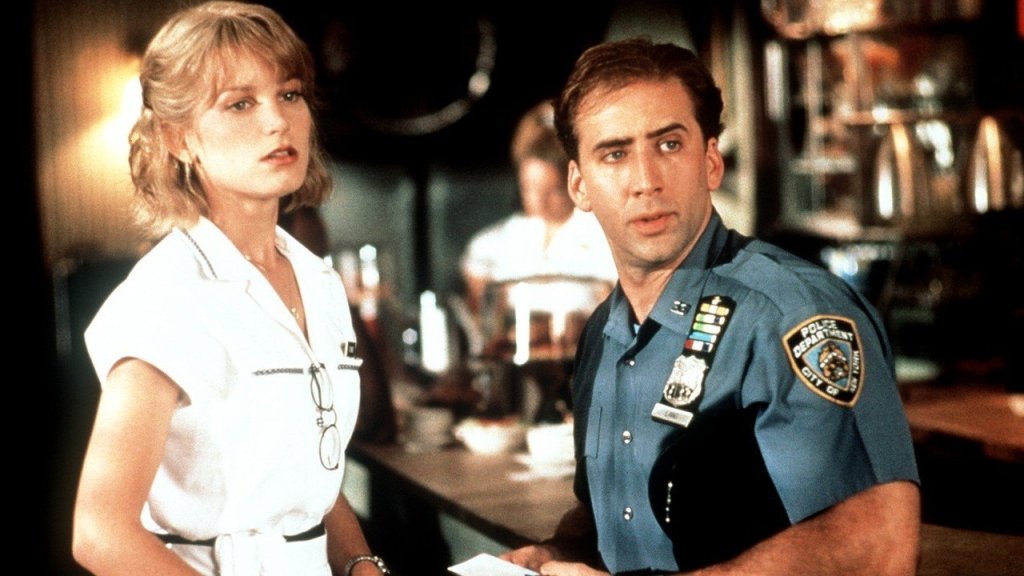
IT COULD HAPPEN TO YOU revolves around Charlie Lang (Nicolas Cage), a New York City cop who seems like an all-around good guy. One day he’s having coffee at a local diner with his partner Bo (Wendell Pierce), when they get a police call. Charlie finds himself without the money to give a proper tip to his waitress, Yvonne (Bridget Fonda), so he improvises on the spot and tells her he has a lottery ticket to be drawn on that very same night. Further, he goes on to tell her if he wins, he’ll split the winnings with her as a tip. The two cops head on out, Charlie happy that he gave her something, and Yvonne, who’s not having a good day anyway, just shakes it off knowing that it’s just another small tip she missed out on. But wouldn’t you know it, on this night the stars all align and Charlie’s number is drawn as a winner. Charlie and his wife Muriel (Rosie Perez) are ecstatic with their win, which amounts to around $4 million. In the middle of their celebration, Charlie remembers his promise to Yvonne and tells Muriel. To say she’s upset is an understatement, and she begs him to stiff the waitress. Charlie is just too honest for that, so he is able to convince Muriel that $2 Million is enough for them to live comfortably on. She begrudgingly agrees, but the fuse has been lit between Charlie and Muriel. The next day, Charlie goes back to the diner and tells Yvonne that they won. At first not believing it’s true, Charlie is able to convince Yvonne that he’s honoring his tip by giving her half of the winnings. We have found out that Yvonne is having severe financial problems, and this “tip” comes as a completely unexpected answer to her prayers. Alls well that ends well, right? As we all know, money can bring out the very best or the very worst in people and we see that play out throughout the rest of the movie. I’ll just put it this way, as Charlie and Muriel grow apart with their newfound money, Charlie and Yvonne grow closer together, bound by this amazing experience. 

It’s all a pretty crazy setup, but IT COULD HAPPEN TO YOU is a movie that I relate to idealistically. I really like Cage and Fonda in their roles. I’d love to be as honest and likable as Nicolas Cage’s character Charlie Lang. He is just a good guy, way down deep. I want to be that kind of guy. And Bridget Fonda’s character Yvonne is also very appealing. She’s presented as a lady going through a lot of personal issues, but who somehow seems to always show a kind and compassionate spirit to everyone around her, especially to others who are struggling. The scene where Charlie convinces her that he really is giving her half the money is quite an uplifting scene. Both of these characters have an honesty and attitude about life that resonates with me. Some people might argue that their characters should have more depth to make them more realistic and less one-dimensional, and they might be right, but I personally enjoy seeing them as just really honest and kind people. 

It should also be pointed out that you have to be able suspend your disbelief to enjoy IT COULD HAPPEN TO YOU. If your movies “have” to be realistic, this is not the movie for you. The entire premise is a fairytale, and the movie should be seen as such. For the movie to work, the good guys have to be really good guys, and the bad guys have to be really bad guys. I’ve mentioned earlier how kind both Charlie and Yvonne are throughout the film, with the money not changing their attitudes about life in any way. If anything, the money allows them to be even more kind and generous to others. Well, money has had the exact opposite effect on Muriel, and we soon learn that $2 Million isn’t enough for her and that the full $4 Million would not have been enough either. At this point, I’m not sure $100 Million would have been enough. In our fairytale story, she can’t be presented as a lady realistically struggling with her husband’s overly generous tip, she has to be presented as extremely selfish and cruel. I mean, how else is the story going to get Charlie and Yvonne together?!

All in all, IT COULD HAPPEN TO YOU works for me. I’ve said many times I’m a sucker for a good romance, and this film fits the bill for me. The main characters warm my heart as they are decent, kind and honest. I like a good fairytale. It’s one of the main reasons I enjoy the movies, and it doesn’t seem like we get enough good fairytales these days. 

Check out the trailer for IT COULD HAPPEN TO YOU below!

And if you’re looking for more awesome information about Nicolas Cage, check out John Rieber’s latest post where he celebrates Cage’s birthday with a movie marathon!

The Eric Roberts Collection: Bonnie And Clyde: Justified (dir by David DeCoteau)


2013’s Bonnie and Clyde: Justified opens with a long-haired Eric Roberts introducing himself as legendary Texas Ranger Frank Hamer.  Speaking straight to the camera, Roberts-as-Hamer warns us against idolizing the notorious Depression-era outlaws Bonnie and Clyde.  They were murderers!, Hamer tells us with all the fervor of a tent revival preacher.

We then flashback to Bonnie (Ashley Hayes) and Clyde (Jim Poole) driving down a country road.  Clyde is behind the wheel.  Bonnie, a redhead like me!, reads aloud her latest poem about what it’s like to be a notorious outlaw.  Suddenly, Hamer and his men appear on the roadside and open fire.

We then start yet another flashback.  15 year-old Bonnie marries good-for-nothing Roy (Julian Brand) while Clyde and his brother Buck (Hagen Mills) steal a truck full of turkeys.  Jump forward to 1929 and Bonnie is unhappily married and working in a diner that we’re told is in Dallas, Texas.  Oddly enough, there’s a lot of mountains in the background.  I live in North Texas and I can assure you that, as much as things have changed here over the past few years, one thing has always remained the same.  There are no mountains in Dallas County.

Eventually, Bonnie meets Clyde, they fall in love, and they rob banks.  At least, that’s what we’re told.  The majority of the film is told through sepia-toned still shots and newspaper headlines.  Clyde attempts to escape from prison but we don’t actually see him do it.  Instead, we just see a headline.  Bonnie and Clyde rob banks but, again, we don’t really see it as much as we hear about it.  Even when people die during the robberies, we don’t really learn the exact circumstances that led to Clyde opening fire.  Ashley Hayes actually gives a good performance as Bonnie and her scrappy interpretation of the character is probably closer to the truth than Faye Dunaway’s.  As for Jim Poole, he’s much better-looking than the real Clyde Barrow and that’s a good thing.  Who wants to watch an ugly bank robber?  There’s a reason why my distant-relation Pretty Boy Floyd remains a legend.  As for the title, you may be wondering what exactly was justified about Bonnie and Clyde.  You can argue that they were justified in doing what they had to do in order to survive during the Great Depression.  Or you can argue that Frank Hamer was justified in ambushing them.  Or you can assume the film was trying to appeal to (or perhaps just tricks) fans of the Justified television series.  Or you can just not worry about it.

This is the story of Bonnie and Clyde on a budget.  It came out in 2013, presumably to coincide with a 4-hour Bonnie and Clyde miniseries that was airing on A&E at the time.  To be honest, you have to respect the nerve of a film about Bonnie and Clyde that doesn’t actually feature much of them doing what they were famous for.  Cheers to director David DeCoteau for sticking with it and giving Eric Roberts top-billing for a cameo appearance.  And cheers to Eric Roberts for just being Eric Roberts.

Previous Eric Roberts Films That We Have Reviewed:

  1. Star 80 (1983)
  2. Blood Red (1989)
  3. The Ambulance (1990)
  4. The Lost Capone (1990)
  5. Love, Cheat, & Steal (1993)
  6. Love Is A Gun (1994)
  7. Sensation (1994)
  8. Dark Angel (1996)
  9. Doctor Who (1996)
  10. Most Wanted (1997)
  11. Wolves of Wall Street (2002)
  12. Mr. Brightside (2004)
  13. Six: The Mark Unleased (2004)
  14. Hey You (2006)
  15. In The Blink of an Eye (2009)
  16. Enemies Among Us (2010)
  17. The Expendables (2010) 
  18. Sharktopus (2010)
  19. The Dead Want Women (2012)
  20. Deadline (2012)
  21. The Mark (2012)
  22. Miss Atomic Bomb (2012)
  23. Lovelace (2013)
  24. The Mark: Redemption (2013)
  25. Self-Storage (2013)
  26. This Is Our Time (2013)
  27. Inherent Vice (2014)
  28. Road to the Open (2014)
  29. Rumors of War (2014)
  30. Amityville Death House (2015)
  31. A Fatal Obsession (2015)
  32. Stalked By My Doctor (2015)
  33. Enemy Within (2016)
  34. Joker’s Poltergeist (2016)
  35. Prayer Never Fails (2016)
  36. Stalked By My Doctor: The Return (2016)
  37. The Wrong Roommate (2016)
  38. Dark Image (2017)
  39. Black Wake (2018)
  40. Stalked By My Doctor: Patient’s Revenge (2018)
  41. Clinton Island (2019)
  42. Monster Island (2019)
  43. The Savant (2019)
  44. Seven Deadly Sins (2019)
  45. Stalked By My Doctor: A Sleepwalker’s Nightmare (2019)
  46. The Wrong Mommy (2019)
  47. Exodus of a Prodigal Son (2020)
  48. Free Lunch Express (2020)
  49. Her Deadly Groom (2020)
  50. Top Gunner (2020)
  51. Deadly Nightshade (2021)
  52. Just What The Doctor Ordered (2021)
  53. Killer Advice (2021)
  54. The Poltergeist Diaries (2021)
  55. The Rebels of PT-218 (2021)
  56. A Town Called Parable (2021)
  57. Bleach (2022)
  58. My Dinner With Eric (2022)
  59. Aftermath (2024)
  60. The Wrong Life Coach (2024)

Film Review: The Great Smokey Roadblock (dir by John Leone)


First released in 1977, The Great Smokey Roadblock tells the story of Elegant John Howard (Henry Fonda).

Elegant is not really his first name.  It’s a nickname, one to let us know that, in the world of independent truckers, John Howard was one of the good guys.  He never crashed his rig.  He never overcharged for a job.  He always arrived on time and in good shape.  John Howard was a good man but then he turned 60 and he got sick.  He spent months in the hospital, unable to work.  His truck was repossessed.  The movie starts with John sneaking out of his hospital room, stealing back his truck, and hitting the road in search of one final job.  Though John says he just wants to make enough money to get his truck back, the truth is that John is terminally ill.  If he’s going to die, he wants to die doing what he loves.  Of course, dying while driving could lead to some trouble for anyone else who happens to be on the road at the time but still, you have to respect John’s determination.  He’s a true American, independent to his core.

(My Dad occasionally made a living driving a truck so perhaps that’s why I’m partial to films like this one.)

John picks up a hitchhiker, a religious young man named Beebo Crozier (Robert Englund).  John picks Beebo up because Beebo was walking through the desert in a suit.  Beebo claims that he’s walking to Florida but John tells him that he can’t do that.  John will drive Beebo to Florida.  Of course, John also expects Beebo to pay for the gas that his truck uses because it’s not like John has any money.  At first, Beebo accuses John of cheating him.  (Henry Fonda cheating someone!?  Perish the thought!)  Soon, however, John has become Beebo’s mentor.

Everyone respects John but no one wants to hire him.  The only offer that John gets is from sleazy Charlie Le Pere (Gary Sandy), who has an agenda of his own.  Finally, John visits his old friend, Penelope (Eileen Brennan).  Penelope is a madam whose brothel has just been closed down.  John agrees to transport Penelope and her girls (including Susan Sarandon) to a new location on the East Coast.  Penelope offers to help John pay the bills.  Elegant John’s a pimp now!  (I was about to say that this seemed like an odd turn-of-events for Henry Fonda but then I remembered that he starred in The Cheyenne Social Club with Jimmy Stewart.)

There’s not really much of a plot to The Great Smokey Roadblock.  John, Beebo, Penelope, and the girls travel from one location to another.  They get thrown in jail by a notoriously corrupt deputy named Harley Davidson (Dub Taylor).  After they escape, they become minor celebrities.  Two counterculture journalists (played by Austin Pendleton and John Byner) show up and help them broadcast their story and the film comes to a halt while Pendleton and Byner exchange what sounds like improvised dialogue.  The police attempt to set up a roadblock to stop Elegant John and his Six Mystery Women.  I guess that’s the Great Smokey Roadblock of the title.

It’s a weird movie, in that the humor is extremely broad and often crude but Henry Fonda is playing a man who is not only terminally ill but who actually looks like he’s terminally ill.  (Henry Fonda himself was reportedly very ill during the filming of The Great Smokey Roadblock.)  As such, it’s a rather melancholy comedy, one in which every joke seems like it might be the last one that Elegant John will ever hear.  In the 70s, not even a trucker comedy could have a happy ending and, as such, The Great Smokey Roadblock feels like a drive-in film for the existential set.  The film’s plot doesn’t really add up to much and is full of plot holes that serve as evidence of a troubled production.  That said, there’s something rather charming about seeing a pre-Nightmare On Elm Street Robert Englund playing a gentle guy who ends up as Henry Fonda’s protegee.  Fonda and Englund play off each other well and their scenes together are the best thing about The Great Smokey Roadblock.