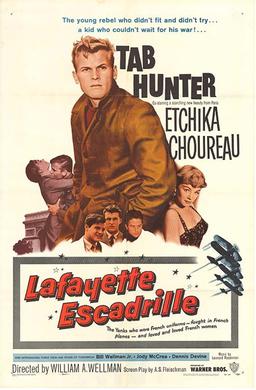
Lafayette Escadrille (1958, directed by William Wellman)


In the days leading up to World War I, spoiled rich kid Thad Walker (Tab Hunter) flees Boston after getting hit with a car theft charge and ends up in Paris.  He befriends a group of American expatriates (including David Janssen, Will Hutchins, Jody McCrea, and William Wellman, Jr.) and eventually joins the French Air Force as a members of the Lafayette Escadrille.  Thad also falls in love with a French prostitute named Renee (Etchika Choureau) and, after Thad strikes a French officer, he goes on the run with her.

I always wonder how many people have watched this film over the years because of the presence of a young Clint Eastwood in the cast, just to discover that he doesn’t get many lines and his character is largely interchangeable with the other young actors playing the members of the Lafayette Escadrille.  This is a Tab Hunter movie, meaning that the action is dominated by Hunter’s sincere but bland screen persona.  Director William Wellman wanted to cast Paul Newman in the lead role and that would have been something to see.  Instead, the studio insisted on Hunter.  They also insisted that Wellman change the film’s ending so that Hunter could survive instead of getting shot down on his very first mission.  William Wellman was so disgusted with the studio that he retired from directing.

What had to make it all especially galling for the director was that Lafayette Escadrille was based on his own life.  His son, William Wellman Jr., plays “Bill Wellman” in the film and Thad was based on actual friend of Wellman’s.  The film was meant to be a tribute to his friends, many of whom did not survive World War I.  Instead, the studio insisted that it be just another Tab Hunter service comedy.  The best scenes are the ones where it’s just Thad and his friends trying to make it through basic training.  Unfortunately, those scenes are overshadowed by Thad on the run.

The film is still there for those of us who enjoy catching future stars.  Clint Eastwood, David Janssen, Tom Laughlin, Will Hutchins, Brett Halsey, and Jody McCrea are all present and accounted for.  Rumor has it that James Garner can spotted in the background but I couldn’t find him and Garner had already co-starred with Brando in Sayonara when this move was made so I doubt he was doing background work.  Tab Hunter’s blandness sinks the production but the rest of the cast would go on to better things.

I review COOGAN’S BLUFF (1968) – starring Clint Eastwood!


Here at The Shattered Lens, we’re looking forward to celebrating the birthday of Clint Eastwood on May 31st. In anticipation, I decided to revisit COOGAN’S BLUFF (1968). 

Clint Eastwood is Coogan, a tough as nails deputy sheriff from Arizona, who’s ordered by his boss, Sheriff McCrea (Tom Tully) to go to New York City and bring back the escaped killer James Ringerman (Don Stroud). When he gets to New York, he’s informed by Lieutenant McElroy (Lee J. Cobb) that Ringerman has overdosed on LSD while in the state’s custody, he’s now in the Bellevue Hospital, and he will not be released to Coogan until the state Supreme Court says so. Stuck in the Big Apple with nothing to do but flirt with probation officer Julie Roth (Susan Clark), Coogan decides to take matters into his own hands and get Ringerman out of the hospital early. He bluffs the attendants at the hospital into turning Ringerman over to him so he can catch the first plane back to Arizona. It seems like a good plan until he’s ambushed by Ringerman’s girlfriend Linny (Tisha Sterling) and his friend Pushie (David Doyle), he gets conked on the head, and he loses both his gun and his prisoner. Now, in trouble with Lieutenant McElroy and Sheriff McCrea, Coogan is ordered back home to Arizona. Determined to get Ringerman at any cost, Coogan stays in the city and leaves a trail of broken hearts and bruised bodies on his way to capturing his man! 

Made in 1968 after Eastwood’s string of excellent spaghetti westerns with Sergio Leone, COOGAN’S BLUFF may be set in contemporary times, but Coogan still seems to be a product of the old west. A big part of the fun is watching him interact with the people of New York City, where everyone is trying to take advantage of him, whether it be the cab driver, the hotel clerk, or the hooker down the hall. When he finally gets to the police station, he sees a building that’s completely overrun with criminals and crazies. He soon finds that Lieutenant McElroy follows the law down to the letter, while he treats the law as more of a set of suggestions on his way to getting the bad guys. This leads to endless frustration and almost gets Coogan arrested multiple times throughout the film as he doesn’t want to deal with all the red tape. One thing that doesn’t change whether Coogan is in Arizona or New York is his success with the ladies. They all swoon and he more than willingly obliges. The only problem for his prospect of true love is the fact that getting his guy always comes first, and he’ll use that sex appeal to get whatever information he needs. One of the main action scenes in this film, the bar fight, is set up ironically when the woman he’s “using” turns the tables and instead sets him up to be pummeled. 

COOGAN’S BLUFF is Eastwood’s first film with director Don Siegel, with whom he’d make DIRTY HARRY a few years later. You can definitely see the genesis of Harry Callahan in Walt Coogan, a man who does whatever it takes to stop criminals, is quick with a whip, and usually pisses off his superiors along the way. In some ways, you could say that Walt Coogan set the mold for the hero of cop films for the next couple of decades! It also has that sense of humor that would be a mark of Eastwood’s cop films. This one includes a funny thread that runs throughout where every person he meets assumes he’s from Texas because he wears a cowboy hat, and he always corrects them that he’s from Arizona. I get this as I always make sure people know that I’m from Arkansas! 

Overall, I really enjoy COOGAN’S BLUFF due mainly to Clint Eastwood’s excellent performance in the lead role. It was a great start to his “post Leone” career and would influence action movie heroes from that point forward. 

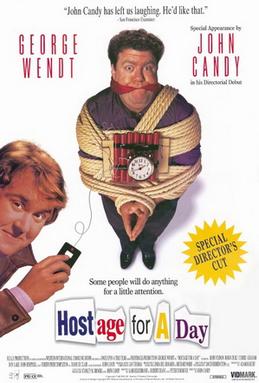
Hostage For A Day (1994, directed by John Candy)


Hostage For A Day is the only film that the much-missed John Candy ever directed.  (It premiered on Canadian television, a few months after his death.)  It’s also one of the only films to feature George Wendt in a leading role, as opposed to being a supporting player.  The film is full of funny people like Don Lake and Robin Duke.  John Vernon plays Candy’s father-in-law.  A lot of talent went into this movie.  It’s too bad that it’s not very good.

Wendt does give a good performance in the lead role.  He plays Warren Kooey, who is depressed on his 41st birthday.  His wife (Robin Duke) has drained their bank account to remodel their house and apparently shag their interior decorator, Hondo (Currie Graham).  No one respects him at work.  Warren’s reflection in the mirror tells Warren that he needs to do something with his life.  Warren decides to fake a hostage situation so that he can collect the ransom.  The problem is that the SWAT team has recently had their budget cut and can’t afford to pay the amount that Warren comes up with.  Then some real kidnappers (led by John Candy, making a very brief appearance) hold him hostage for real.  While this goes on, Wendt continues to talk to his reflection in the mirror and there are a few sweet but out-of-place scenes featuring him reuniting with his childhood sweetheart, Diane St. Clair (Christopher Templeton).

As a director, Candy never seems to be sure what type of film he’s trying to make.  The comedy is broad but Candy also tries to sneak in some sentimental moments and the end results just doesn’t mix well.  He gets some good performances for his cast but the film itself never really comes together.  This was George Wendt’s only starring role and he does a good enough job that I regret he didn’t get bigger roles once Cheers went off the air because, judging by this film, he could have handled them  I just wish this movie was better.

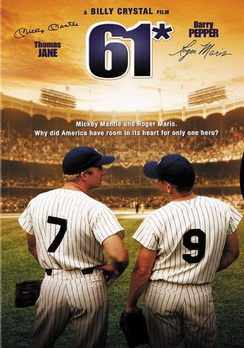
I Watched 61* (2001, Dir. by Billy Crystal)


61* is about two baseball player and two friends who couldn’t seem to be more different.

Roger Maris (Barry Pepper) is an introverted family man who doesn’t like it when reporters show up at his house in search of a story or a quote.  He’s a good ball player, one of the best, but he doesn’t want to be a celebrity.  Mickey Mantle (Thomas Jane) is a larger-than-life personality, a beloved figure on the field and in the dugout.  Mickey loves being famous and the fans love him.  Both Maris and Mantle are members of the New York Yankees.  Because Mantle is struggling with his drinking, he becomes Maris’s roommate when they’re on the road.  In 1961, the two friends both go after Babe Ruth’s record of 60 home runs in a season.  The press presents their season as a battle, a race to see who will be the first to hit the sixty-first home run of the season.  Mantle and Maris, though, are just swinging the bat and making plays.

I really enjoyed 61*, which is a baseball film made by and for people who love baseball.  I liked the contrast between the quiet Maris and the charismatic Mantle.  Even though Maris is a hard worker and a good ballplayer, Mantle is the fan favorite and the one that people actually want to break the record.  I appreciated that Maris and Mantle remained friends even when the press tried to turn them into rivals.  That’s what teamwork is all about.  Barry Pepper and Thomas Jane were great as Maris and Mantle and the movie showed how each man dealt with the stress of possibly breaking Babe Ruth’s record.

(Why is there an asterisk in the title?  Babe Ruth set his record in a season that only had 154 games.  The 1961 baseball season was 8 games longer.  The asterisk was added as a reminder that Maris and Mantle had 8 more games than Ruth did to try to break the record.  Baseball fans understand how important accurate statistics are to a player’s career and a team’s season.)

61* celebrates the way baseball used to be, a game played by athletes who had to depend on skill and teamwork instead of performance enhancing drugs.  The movie opens with Maris’s family watching as Mark McGuire closes in on breaking the record.  McGuire would only briefly hold the record.  He would lose it, for 48 minutes, to Sammy Sosa and then, three years after winning it back, he would lose it a second time to Barry Bonds.  Of course, Roger Maris won the record without using steroids so, as far as I’m concerned, it still belongs to him.

If you’re a baseball fan, 61* is a film that you have to see.

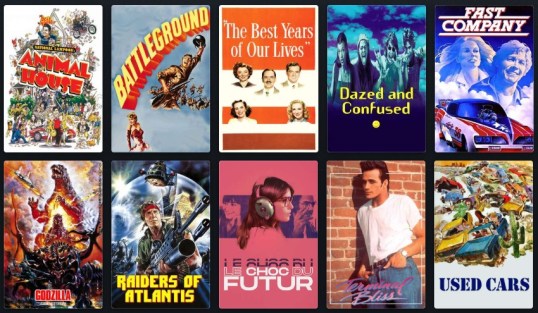
10 Films For The Weekend (5/23/25 Edition)


Here are ten films that I recommend checking out this weekend.  These films are all streaming so, if you’re stuck inside due to weather or crippling depression, give them a shot!

In Memory of My Dad

This Memorial Day is going to be a difficult one for me because it’s also going to be the one-year anniversary of the car accident that eventually led to my Dad passing away last year.  These first two films, I’m recommending in his memory.  One of them was a favorite of movie of his.  The other movie is one that makes me think about him and my mom whenever I watch it.

First off, National Lampoon’s Animal House (1978) was one of my Dad’s favorite movies.  He saw it in theaters when it was first released and, whenever he would come across the film on television, he would get the biggest smile on his face.  I love this film, too.  I reviewed it a few years ago but, for here, I’ll just say that this film works as both the quintessential college comedy and also as a surprisingly touching portrait of friendship.  As Dean Wormer, John Vernon set the standard for heartless authority figures for years to come.  Tim Matheson, Peter Riegert, Tom Hulce, Stephen Furst, Kevin Bacon, Karen Allen, Bruce McGill, James Daughton, Mark McGill, BELUSHI!  For the record, my favorite member of Delta House was always Hoover.  Animal House is currently on Prime. 
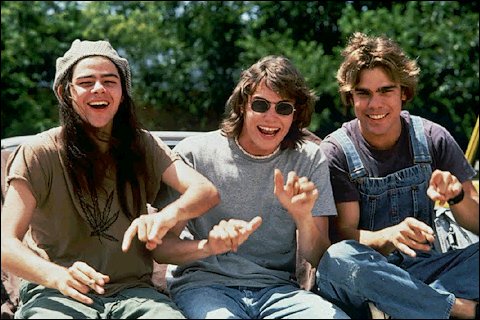
Secondly, I have to mention Dazed and Confused (1993).  Richard Linklater’s portrait of life in 1970s Texas has long been a favorite of mine.  There’s a lot of reasons, from the clever dialogue to the genuinely funny moments to the performances of the truly amazing cast.  Matthew McConaughey may have been the one to become a star but the film is full of great performances, from everyone from Jason London to Parker Posey to Wiley Wiggins and Michelle Burke to Cole Hauser and Ben Affleck to Adam Goldberg and Anthony Rapp to Nicky Katt …. well, you get the idea.  Linklater has sometimes said that he regrets that the film didn’t have more “serious” moments but I think he’s being a bit too hard on himself and the film.  There’s a definite sense of melancholy to Dazed and Confused.  These characters have no idea what’s waiting for them in the future.  This film always makes me think of my Mom and Dad because it’s about their generation.  (My Dad once told me that the film was very accurate.)  Whenever I watch this film, I’m reminded that everyone was young once and, eventually, everyone gets older.  Dazed and Confused is on Prime.

For Memorial Day

Memorial Day is an often misunderstood holiday.  It was first celebrated after the Civil War and it’s meant to be a time to honor those who sacrificed their lives defending the United States.  It’s mean to be a time of sober reflection but that’s not currently our nation’s strong suit.

I’m not a huge fan of war films but I do like Battleground (1949), a simple but moving portrait of a platoon of soldiers fighting during the Battle of the Bulge.  Battleground, made when World War II was a very fresh memory, is a touching and realistic portrait of combat, one that focuses on the humanity of the soldiers involved.  No one is presented as being superhuman or as an indestructible action hero.  Instead, they’re vulnerable, frequently frightened, and often frustrated.  At the same time, they’re also putting their life at risk for their country and battling one of the greatest evils that the world has ever known.  Battleground is a tribute to American soldiers and those who sacrificed their lives to battle the Nazis.  Amongst the ensemble cast, young Ricardo Montalban stands out as a tragic soldier.  For now, Battleground can be viewed on YouTube.

The Best Years Of Our Lives (1946) won the Oscar for Best Picture of 1946 and, while I would have given the Oscar to It’s A Wonderful Life, The Best Years Of Our Lives remains a powerful portrait of returning veterans and their struggle to adjust to life during peacetime.  Fredric March, Dana Andrews, and Harold Russell return from combat and find themselves surrounded by friends and family who have no way of understanding what they experienced while serving their country.  Wonderfully directed by William Wyler and featuring a brilliant cast, The Best Years Of Our Lives is a moving film, one that reminds us that the scars of war don’t disappear once the shooting stops.  The film is streaming on Pluto and Peacock.

For All You Car Fans

The Indianapolis 500 is scheduled for this Sunday.  Personally, I like cars and I like the people who aren’t afraid to drive fast.

Fast Company (1979)  is one of the many 70s films to be made about racing.  It’s certainly not the first to feature William Smith as a driver who loves speed and taking risks.  What sets Fast Company apart is that it was directed by David Cronenberg.  It’s a film that Cronenberg did for the money and it was also the first time that he worked with two important future collaborators, actor Nicholas Campbell and cinematographer Mark Irwin.  Even though there’s not much of Cronenberg’s signature stye here, he does show himself to be an adroit genre director.  The cars are fast, the races are well-shot, and John Saxon shows up as the villain.  Fast Company is on Tubi.
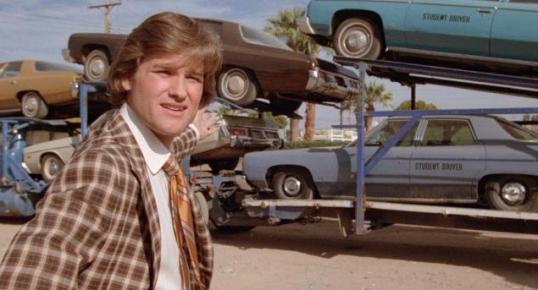
Used Cars (1980), an early film from Robert Zemeckis and screenwriter Bob Gale (who celebrates a birthday tomorrow), is one of my favorite films, a hilarious and shameless comedy that features Kurt Russell, Jack Warden, and Gerrit Graham at their absolute best.  Russell, at a time when he was still struggling to establish himself as something more than a Disney star, gives a wonderful and charismatic performance as a used car salesman with political ambitions.  This film is worth seeing for his suit alone!  Jack Warden plays twin brothers, one good and one bad.  Never look away when Gerrit Graham is in a scene because, even when he’s in the background, he can make you laugh.  This ends with one of the greatest chase scenes ever directed.  Used Cars is on Tubi and you definitely need to watch it if you haven’t already.

Odds and Ends

Of all the films that I’ve ever seen at SXSW, Shock of the Future (2019) remains my favorite.  Starring Alma Jodorowsky as a musician living in 70s Paris, Shock of the Future pays tribute to the female pioneers of electronic music.  Needless to say the soundtrack is wonderful but, beyond that, Shock of the Future is a film that captures the joy that comes from creativity and artistic expression.  It’s a film that will leave you wanting to create something wonderful.  Shock of the Future is on Tubi.

Terminal Bliss (1992) is a portrait of teenagers with too much money, too many drugs, and not much of a conscience.  It’s a film that wears its influences on its sleeve but, at the same time, director Jordan Alan (who was 19 at the time) does a good job of capturing the ennui and detachment that dominates his character’s lives.  This is a flawed film but worth seeing for Luke Perry’s performance as a young sociopath.  After years of only being available in a French-language dub, the English-version of Terminal Bliss is currently on YouTube.

Ruggero Deodato’s Raiders of Atlantis (1983) may not be as well-known as Deodato’s Cannibal Holocaust or The House on the Edge of the Park but it’s still an entertainingly weird mix of Atlantis, Miami Vice, Mad Max, and Raiders of the Lost Ark.  The Atlanteans return to land of the living and, for some reason, they’re riding motorcycles and dressing like wannabe punk rockers.  It makes no sense but Deodato keeps the action moving and the cast is a who’s who of Italian exploitation, featuring Christopher Connelly, Tony King, Ivan Rassimov, Bruce Baron, and George Hilton!  The soundtrack is wonderfully over-the-top.  It can be found on Tubi!

Godzilla vs Destoroyah (1995) is one of the best Godzilla films and, unfortunately, it’s one that often seems to get overlooked.  Godzilla is at his most fearsome and destructive and Destoroyah is a more than worthy opponent.  The members of the Godzilla Task Force all get to wear cute uniforms.  Godzilla vs Destoroyah is available on Tubi.

Have a wonderful weekend!

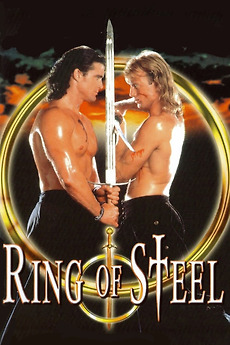
Ring of Steel (1994, directed by David Frost)


After Olympics-bound fencer Alex Freyer (Robert Chapin) accidentally kills his opponent, he is blacklisted from the sport.  His career seems like it’s over until he’s saved from a mugging by the mysterious Man In Black (Joe Don Baker).  The Man In Black says that he’s been watching Alex and he knows that Alex could be “the best.”  The Man In Black isn’t talking about the Olympics, though.  He’s talking about taking part in a series of underground sword fights, know as the Ring of Steel.  Alex is all for it, until he learns how high the stakes actually are.  The Man In Black is determined to keep Alex fighting so he abducts Alex’s girlfriend (Darlene Vogel).

This is one of the many “underground fighting films” that were made in the 90s.  The plot is nothing special but the use of swords instead of fists does add an unexpected spark to the fight scenes.  Robert Chapin, who also came up with the film’s story (and who wrote an original draft of the screenplay that was considerably darker than the film that was eventually made), was a stuntman and an accomplished swordfighter so the fights in Ring of Steel feel authentic and are exciting even if the story is predictable.  Joe Don Baker plays the villain, a character who actually is credited as being “The Man In Black,” and he does a good job tempting Alex to the dark side and then mocking his attempts to escape.  Though I prefer Baker as a hero, he always really threw himself into his villainous roles.

Ring of Steel used to show up on cable when I was a kid.  I always made a point to watch it.  It’s on YouTube now and it’s still an entertaining fight film.

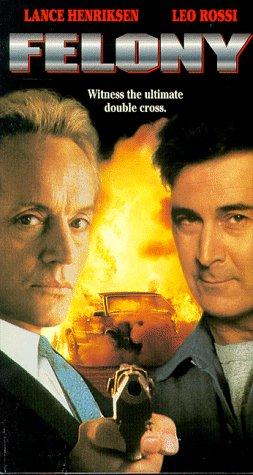
Felony (1994, directed by David A. Prior)


In New Orleans, a drug raid gone wrong leads to eleven cops being gunned down and then blown up.  The disastrous raid was being filmed for a Cops-like reality show  The show’s producer, Bill Knight (Jeffrey Combs) finds himself being pursued through New Orleans by a collection of rogue intelligence agents, cops, and gangsters, all of whom want the tape of the massacre.

It’s a simple direct-to-video premise and the film’s plot hits every chase film cliche, while keeping the action moving at a decent pace.  Bill Knight is not supposed to be a typical action hero.  He’s just a television producer who was in the wrong place at the wrong time.  Yet Knight proves himself to be as indestructible as any Arnold Schwarzenegger hero.  He gets shot, twice.  He falls from a great height.  He crashes through a window.  He repeatedly gets hit over the head.  And yet, his injuries never seem to really slow him down or even hurt that much.  He does hook up with a nurse (Ashley Laurence) but still, it’s hard to believe anyone could take that much punishment and keep running.  Jeffrey Combs, the brilliant star of films like Re-Animator, is miscast as Knight but he’s still always entertaining to watch.

In fact, the cast is the main thing that Felony has going for it.  David Prior was able to assemble a true group of B-movie all-stars.  Lance Henriksen and David Warner are the evil intelligence agents who are determined to kill Knight.  (Warner finally gets to handle a grenade launcher and we’re all the better for it.)  Leo Rossi and Charles Napier are the two New Orleans cops who are investigating the drug raid.  Joe Don Baker is the rogue intelligence agent who dresses like a cowboy and who is trying to clean up everyone else’s mess.  The cast keeps the action moving and there are enough eccentric personalities in this film that it’s always watchable.  I think this might be the only film to feature Joe Don Baker and Lance Henriksen performing opposite each other.  If nothing else, it deserves to be watched for that!

(The cover for Felony features Lance Henriksen and Leo Rossi but not Jeffrey Combs, even though Combs is the lead in the film and Rossi’s role is actually pretty small.  Henriksen also doesn’t have blonde hair in the movie.  There are plenty of double crosses in the movie but I can’t think of any that really qualify as the “ultimate double cross.”)

Even with its miscast lead and its cliche-heavy plot, Felony is what direct-to-video action movies should be all about, fact-paced action and a cast unlike any other,


I Watched Flashing Spikes (1962, Dir. by John Ford)


When infielder Bill Riley (Patrick Wayne) makes an error that costs his team the game, sports columnist Rex Short (Carleton Young) claims that he witnessed Bill being paid off by Slim Conway (James Stewart).  Slim is a former player who was banned from Major League Baseball after he was accused of taking a bribe from a gambler.

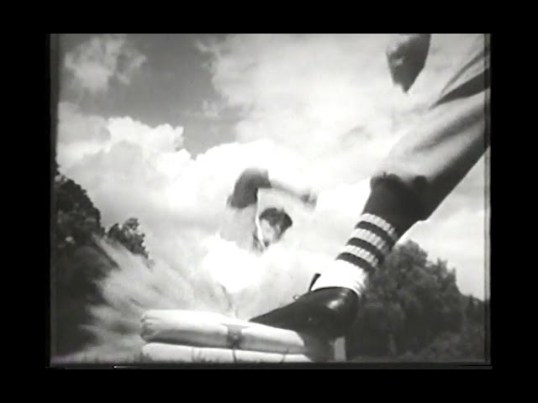
Most the movie is a flashback, showing how Bill first met Slim when Slim was playing for a barnstorming team of former major leaguers.  That was my favorite part of the movie.  Slim and a collection of old, worn-out men stumble out of their bus and even though they might move a little slower and they might need to stretch a little more before swinging a bat, they still show up a cocky team made up of young local players.  Even after the crowd nearly riots when they realize that Slim is one of the players, the old players keep their cool and their eye on the game.  After Bill spikes Slim while sliding into home plate, Bill apologizes.  Slim remembers the young man’s humility and, working with one of the few friends that he has left in the game, Slim helps Bill get his chance in the Majors.

Usually, when my sister yells at me to come watch something because “it’s got baseball!,” I’m prepared for it turn out to just be a movie with one scene of someone holding a bat.  I’m glad that she called me to come watch Flashing Spikes with her because it really is a good and loving celebration of my favorite game.  Even after Slim is treated so unfairly by the press, the League, and even some of the fans, he never stops loving the crack of the bats and the cheers of the crowd.  Flashing Spikes is unabashedly pro-baseball and Slim stands in for every player who was ever unfairly railroaded out of the game by scandal mongers like Rex Short.

Film Review: The Naked Spur (dir by Anthony Mann)


First released in 1953, The Naked Spur is one of the most cynical and downbeat movies that I’ve ever seen.

It’s also one of the most visually beautiful.  Filmed in the Rockies and presented in glorious Technicolor, The Naked Spur is a western that is full of amazing scenery, from green forests to snow-capped mountains to a river that, under different circumstances, would probably be a wonderful place to just sit down and think for a spell.  Director Anthony Mann crafts an image of the American frontier that makes it easy to understand why anyone would want to explore it and build a new life there.  Mann contrasts the beauty of nature with the ugliness of the people who trample across it.

Jesse Tate (Millard Mitchell) is a grizzled and somewhat sickly prospector who runs into a stranger named Howard Kemp (James Stewart).  Kemp is, at first, antagonistic and paranoid but soon, he offers to pay Tate $20 if Tate will help him track down an outlaw named Ben Vandergroat.  Vandergroat, wanted for the murder of a U.S. marshal, is believed to be hiding in the mountains.  In need of the money, Jesse agrees.  Soon, he and Kemp are joined by another wanderer, a recently discharged soldier named Roy Anderson (Ralph Meeker).  From the minute that Roy shows up, it’s obvious that he’s not being totally honest about why he’s wandering around the Rockies.

As for Ben Vandergroat (Robert Ryan), he is indeed hiding in the mountains.  He’s accompanied by Lina Patrch (Janet Leigh), a naive young woman whose late father was one of Ben’s partners-in-crime.  Lina looks up to Ben as a father figure and refuses to believe that he could possibly be guilty of any of the things that he’s been accused of doing.  Ben, meanwhile, manipulates Lina into doing his bidding.

After being captured by Kemp, Jesse, and Roy, Ben proves himself to be far more clever than he initially seems.  After revealing that Kemp isn’t who Jesse assumed him to be, Ben works to try to turn the three men against each other.  There’s a reward on Ben’s head and, after Kemp reluctantly agrees to share the money with Jesse and Roy, Ben mentions that there will be a lot more money if its split two ways instead of three.  Soon, Ben has the three men distrusting each other even more than they already did.  However, Lina finds herself falling in love with Kemp.

The Naked Spur is a great film.  Featuring only five-speaking parts, it plays out like a particularly intense play and every single member of the cast does a great job of bringing the film’s characters to life.  Robert Ryan is coolly manipulative as the cocky Ben while Ralph Meeker is crudely menacing as the untrustworthy Roy Anderson.  Millard Mitchell is, at times, heart-breaking as the sickly prospector.  Janet Leigh reveals the strength underneath Lina’s naive persona.  Of course, the film is stolen by James Stewart, who is convincingly bitter and ultimately rather poignant as Howard Kemp.  Kemp feels like a continuation of the character that Stewart played in Broken Arrow He’s seen the worst that humanity has to offer.  Even in the beautiful Rockies, Stewart’s character cannot escape the ugliness that he’s witnessed firsthand.  Stewart’s performance as that haunted and angry Howard Kemp is one of his best.

The Naked Spur is an intelligent and well-acted western and one of eight movies that Stewart made with director Anthony Mann.  It’s psychological complexity, beautiful scenery, compelling script, and brilliant cast make it a true classic.

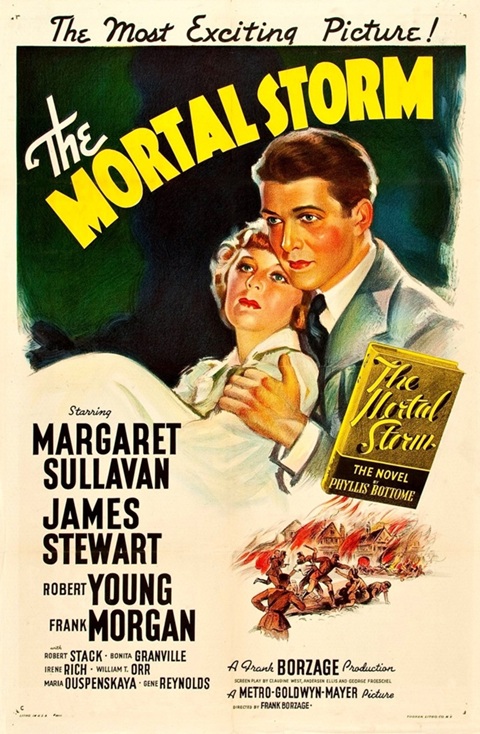
The Unnominated #16: The Mortal Storm (dir by Frank Borzage)


Though the Academy of Motion Picture Arts and Sciences claim that the Oscars honor the best of the year, we all know that there are always worthy films and performances that end up getting overlooked.  Sometimes, it’s because the competition too fierce.  Sometimes, it’s because the film itself was too controversial.  Often, it’s just a case of a film’s quality not being fully recognized until years after its initial released.  This series of reviews takes a look at the films and performances that should have been nominated but were, for whatever reason, overlooked.  These are the Unnominated.

Oh, how this movie made me cry!

Released in 1940, at a time when war was spreading across Europe, Asia, and Africa but the United States was still officially neutral, The Mortal Storm opens on January 30th, 1933.  In the mountains of Germany, near the Austrian border, Professor Viktor Roth (Frank Morgan) is celebrating his 60th birthday.  He starts the day being applauded by his students at the local college.  In the evening, he returns home for a celebration with his family, including wife (Irene Rich), his daughter Freya (Margaret Sullivan), his son Rudi (Gene Reynolds), and his two stepsons, Otto (Robert Stack) and Erich von Rohn (William T. Orr).  Also present are Freya’s fiancé, Fritz (Robert Young) and one of Roth’s students, a pacifist named Martin Breitner (James Stewart).  It’s a joyous occasion and the film takes its time introducing us to Prof. Roth and his extended family.  At first, everyone seems very kind.  They seem like people who most viewers would want to spend time with or live next to….

But then, the family’s maid excitedly enters the room and announces that it’s just been announced that Adolf Hitler is the new chancellor of Germany.  Otto and Erich are overjoyed and head out to celebrate with the other members of the Nazi Youth Leage.  Martin is less happy and excuses himself to return home.  Roth and his wife worry about what this means for people who do not agree with Hitler’s beliefs.  Freya says that they shouldn’t talk politics.  It is jokingly mentioned that Hitler has taken away Roth’s special day but Roth’s young son Rudi says that he’s learned in school that the needs of the individual will never be more important than the needs of the state.  If Hitler wants to take away your day, it’s your duty to give it up or face the consequences.

Based on a 1937 novel, The Mortal Storm was not the first Hollywood production to take a stand against Hitler and the Nazis but it was one of the best.  I say this despite the fact that the film only hints at the fact that Prof. Roth is Jewish, something that was made very clear in the book.  (In the movie, Roth and his wife worry what will happen to “Non-Aryans” and “freethinkers.”)  That said, the film perfectly captures how quickly and insidiously the authoritarian impulse can spread.  The town, which once seemed so friendly, becomes a very dark place as the students at the university put on their swastika armbands and start to hunt down anyone who dissents from the party line.  When Roth says that, as a scientist, he does not believe one race can be genetically superior to another, his students walk out on him.  A local teacher is beaten when he fails to return to the Nazi salute.  When Martin refuses to join the Party, Otto and Erich turn against him despite being lifelong friends.  When Martina and Freya flee for the border, Fritz pursues them.  And even after Prof. Roth is sent to a concentration camp, Otto and Erich continue to follow the orders of Hull (Dan Dailey), the sinister Youth Party Leader.

It’s a powerful film, one that remains just as relevant today as it was when it was first released.  Hull and Erich’s fanaticism would, today, find a welcome home on social media.  The scenes in which the townspeople eagerly threaten to report their former friends and neighbors for failing to salute or show proper enthusiasm for the government have far too many modern day equivalents for me to even begin to list them all.  This film was also the last the James Stewart made with frequent co-star Margaret Sullivan and they both give great performances.  (All-American Jimmy Stewart might seem a strange choice to play a German farmer but he is never less that convincing as Martin, one of the few people in the town not to surrender his principles and beliefs to the crowd.)  The film’s final moments, with the camera panning around the empty Roth home, brought very real tears to my eyes.

Despite being a powerful film, The Mortal Storm was not nominated for a single Oscar.  (Jimmy Stewart did win his only Oscar that year but it was for The Philadelphia Story.)  It’s temping to assume that, at a time when America was still divided about how to react to the war in Europe and when many Americans still remembered the trauma of the first World War, The Mortal Storm was too explicitly political and anti-Nazi to get a nomination but, the same year, The Great Dictator was nominated for Best Picture.  It seems more likely that, in those days when the studios ruled supreme, MGM decided to puts it weight behind The Philadelphia Story rather than The Mortal Storm.

That said, The Mortal Storm was definitely worthy of being nominated, for Picture, Director, Screenplay, Actress (Margaret Sullivan), Actor (Stewart), Supporting Actor (Frank Morgan and Robert Stack), and Supporting Actress (Irene Rich and, in the role of Stewart’s mother, Maria Ouspenskaya).  The film may not have been nominated but it remains a powerful and important work of art.

Previous entries in The Unnominated:

  1. Auto Focus 
  2. Star 80
  3. Monty Python and The Holy Grail
  4. Johnny Got His Gun
  5. Saint Jack
  6. Office Space
  7. Play Misty For Me
  8. The Long Riders
  9. Mean Streets
  10. The Long Goodbye
  11. The General
  12. Tombstone
  13. Heat
  14. Kansas City Bomber
  15. Touch of Evil