
by Robert Bonfils
by Robert Bonfils

By Allen Gustav Anderson

By Earle Bergey

Unknown Artist

by Lou Marchetti
Though he is best known for his many marine paintings, artist Stanley Meltzoff started his career as a commercial illustrator and did work for several pulp publishers. Below are just a few examples of his work:


Unknown Artist
(Thank you, Lisa Marie, for covering for me last week!)

Tomorrow, Erin will be back and running this feature so I’m going to share one final image.
I’m not sure who took the picture above. A lot of sites incorrectly credit Otto Bettmann. I nearly made the mistake of crediting old Otto myself. However, Otto was not a photographer. Otto was an archivist and the picture above was a part of his collection. But regardless of who took the picture, it’s an iconic image.
Two more things to say:
First off, I have to say thank you to Erin for trusting me with Artwork of the Day. When I first told her that I’d be willing to fill in for her while she spent this week cataloging our mom’s doll collection, I’m sure that there was a part of her that worried I’d use it as an excuse to spend the whole week posting Degrassi screenshots. I’ve seen firsthand the amount of time and thought that Erin puts into finding and selecting each day’s image. But she took a chance on me and I had a lot of fun doing it!
Secondly, from me and everyone else here at the Shattered Lens: HAPPY BIRTHDAY, ARLEIGH!
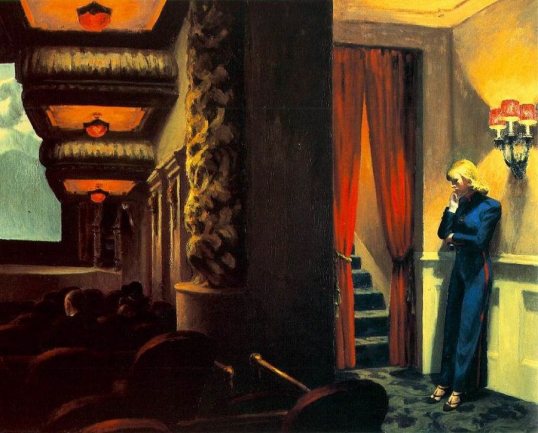
New York Movie (1939, Edward Hopper)
I could never work in a movie theater.
Don’t get me wrong. I love movies, as anyone who has spent any time reading this site should know. I consider both the Alamo Drafthouse and the Dallas Angelika to be a second home. But, even if I didn’t have a degree and I was totally alone in the world and I desperately needed a job, I could never work at either one of them. I would be scared that, if I did, the act of going to the movies would lose its magic. My love of film would be destroyed by the drudgery of employment. (For that same reason, I could also never work in a book store.)
That’s something that I find myself thinking about as I look at Edward Hopper’s New York Movie. As a writer, it’s impossible for me to look at any painting or photograph without immediately trying to turn it into a short story. While the theater’s the audience is sucked into the fantasy of cinema, the usher stands to the side and appears to be lost in thought. Much as I’ve looked at John French Sloan’s Movies, Five Cents and subsequently spent hours considering who the woman in the audience is looking at, New York Movie has inspired me to spend hours wondering what the usher is thinking about while the audience watches the movie. Is she bored or is she sad? Is she thinking about the movie or the audience or about what she’s going to do when she gets off work? Does she like the movie, does she hate the movie, or has she reached the point where she doesn’t even notice the movie?
Edward Hopper’s best known work was Nighthawks, that famous painting of four people in an all-night diner. Hopper’s model for New York Movie‘s usher was his wife, Jo, who posed under a lamp outside of their apartment.
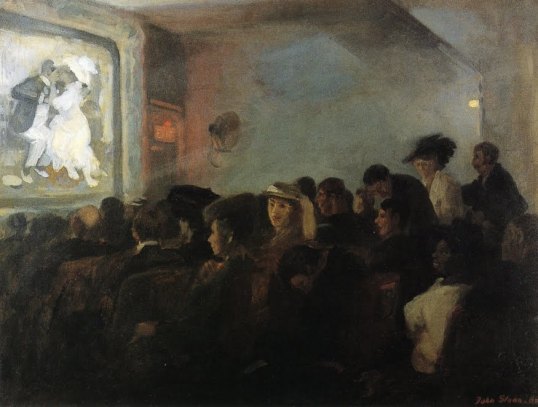
Movies, Five Cents (1907, John French Sloan)
How long have movies been an important part of life? Well, consider this. The painting above, John French Sloan’s Movies, Five Cents, was painted in 1907! It depicts what most of us, up until a few years ago, would have considered to be a fairly modern scene. A group of people sit in a theater and watch a movie. Well, almost all of them are watching. The center of the painting is the one woman who is not watching the movie but who instead appears to be staring straight at the observer. Is she watching us or has she caught us watching her?
Of course, today, things are changing. There are so many new ways to watch movies that it’s hard not to feel that the whole ritual of going down to a theater to see the latest release will soon be as passé as dial-up internet or having a landline phone. Right now, you look at this painting and you marvel at the very idea of being able to see a movie for five cents. In the future, we may find ourselves marveling at the idea of actually leaving the house to watch a film. We may look at this painting and say, “This painting reminds me of what it was like when movie theaters still existed.” And then our children will say, “What’s a painting?”
That’s life.
Til then, I love this painting. Movies, Five Cents is a prime example of the Ashcan School of art. Inspired by socialism and Marxism and all that stuff, The Ashcan School rebelled against both impressionism and academic realism and instead, attempted to capture scenes of real life, especially among the poor. John French Sloan was one of the leading artists in the Aschan School and he remained a fervent socialist for his entire life.
Is there a political subtext to Movies, Five Cents? Honestly, who cares? I’m more interested in trying to figure out what movie they’re watching. It looks romantic!


