My weekend was full of sleep, coughing and just vegetating in front of my bedroom tv as I tried to get better from my bout of the cold and flu. For some reason or another AMC channel decided to hold a mini-marathon of David Fincher’s classic neo-noir thriller, Seven, and I must say that I probably saw all three straight showings before sleep finally took over. It surely made for some very unusual, drug-induced dreams.
I’ve always seen Seven as Fincher at his most exploitative best. If there was ever a modern grindhouse exploitation film of the past twenty years I would have to consider Seven as one of them. From start to finish the film just felt grimy and made one feel dirty just for having seen it. Take away all the gloss and veneer afforded Fincher due to modern film technology and techniques this film was grindhouse to its core. No better scene exemplifies and solidifies Seven as a grindhouse exploitation film than it’s shocking, nihilistic ending which bucked traditional Hollywood happy ending (or at least and ambiguous one).
It’s been made famous due to the powerful performances from the three leads who dominate the scene. It is almost played off like a stage play with some gorgeous camera work from cinematographer Darius Khondji switching from Morgan Freeman to Kevin Spacey to Brad Pitt with mathematical precision as the scene unfolds through very strong dialogue by screenwriter Andrew Kevin Walker.
The performances shown by Spacey is both chilling and otherworldly as the sociopathic John Doe urging Pitt’s Det. Mills to become wrath and punish him for his sin of envy. Looking helpless and desperate is Freeman’s Det. Somerset trying to talk some sense and decency to the rapidly unraveling Mills who has just learned that what is inside the box he’s been screaming for is his wife’s head.
The fact that the unfolded and ended the way it did honors the grindhouse sensibilities of past exploitation films where the good guys never always win and even when they do it’s at a very heavy cost to the victor. This climactic ending to Seven is so nihilistic that when the film was first shown in 1995 many walked out grumbling at such a dark and heavy ending. Where was the Hollywood happy ending everyone was so used to. There was no cavalry charging last second to save the day. No deus ex machina intervening to show that Mill’s wife was still alive. No, Fincher and crew knew they had something special in their hands and went full tilt to see it through.
It’s no wonder I still consider Seven to be David Fincher’s best film to date.
If there was a film which deserved better when it first came out in 2003 it would be Peter Weir’s epic adaptation of the Patrick O’Brian seafaring novels starring the character of Capt. Jack Aubrey. It was just bad luck on the part of Weir’s film that it came out the same year and month as the juggernaut that would sweep through not just the box-office for the 2003 holiday season, but all through the award-season. If Master and Commander: The Far Side of the World had only come out a year later there’s a great chance it would’ve been the frontrunner for 2005 Academy Awards for Best Picture, Best Director, Best Adapted Screenplay and many more. But the juggernaut that was Peter Jackson’s Lord of the Rings: The Return of the King would not be denied after two previous years when Jackson and his magnum opus were passed over.
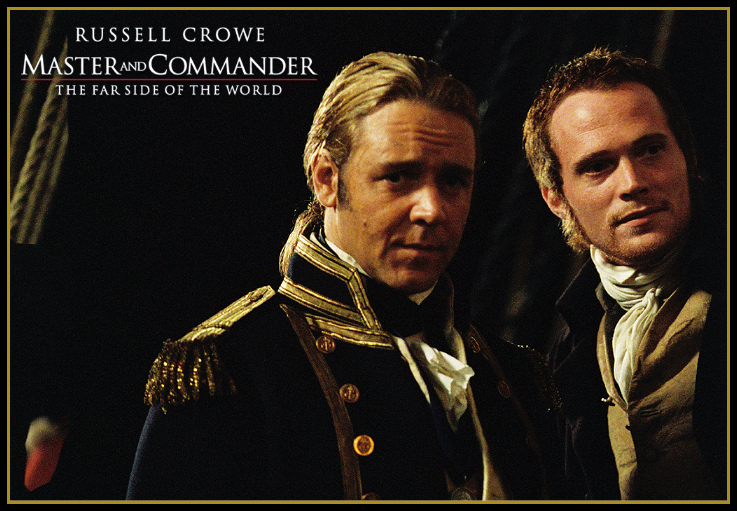
To say that Peter Weir was at the top of his game with Master and Commander would be an understatement. Working from a script written by Weir himself and John Collee, the film would take several episodes from the Patrick O’Brian Aubrey-Maturin novels and combine them to make a coherent and thrilling period piece that rarely ever get made anymore. This was epic filmmaking at its finest with Weir’s direction keeping the long-running time of the film from becoming too tedious. Yet, he was also able to keep the film from becoming one battle setpiece following another. There was enough of a balance between the quiet storytelling, especially between the characters of Capt. “Lucky” Jack Aubrey (played by Russell Crowe in what had to be his best role ever) and his close friend and ship’s doctor Stephen Maturin (Paul Bettany matching Crowe scene for scene) to keep the film grounded in reality.
Master and Commander is set during the Napoleonic Wars when France and England battle it out on land and in the high seas. On one side is the HMS Surprize captained by Jack Aubrey which patrols the sea lanes from French privateers looking to attack and loot the rich English whaling ships to help fund Napoleon’s ambitions. The film is actually a cat-and-mouse thriller wrapped around a character piece as Aubrey’s ship and crew, outgunned and less armored than the French frigate Acheron it has come across during its patrol, must not just try and survive but find a way to beat it’s larger opponent. It’s during the quiter scenes in-between sea engagements that the film actually becomes stronger. We see life onboard the HMS Surprize as being quite harsh and primitive and not so glamourous as past films about sailing life would have audiences believe. The film shows how this harsh life for volunteers and press-ganged crew ratings creates a strong bond of fellowship amongst the crew members that when they believe someone is jeopardizing their lives they quickly turn on that individual. But it’s through the near-dictatorial handling of his crew which keeps both ship and crew from devolving into mutiny. Crowe does a great job of giving Jack Aubrey that balance of ruthless taskmaster whose word is law onboard, but also gives his captain that bon vivant flair which when used accordingly makes Aubrey a hero to the very men he has to lord over.
This benevolent dictator was balanced out by Bettany’s Dr. Maturin who acts not just as the scientific counter to Aubrey’s militaristic personality, but also as the conscience of the ship who looks first to the crew’s well-being. This dynamic between Crowe and Bettany kept the film anchored and stabilized as we see the long-standing friendship between these two get tested not just by the crisis they find themselves in but also the vast ideological differences between the military man and the scientist. Yet, despite all their problems and difference when things became rough the two would settle it amicably and concentrate on their shared task with their bond of friendship intact and much stronger after.
The film doesn’t shirk it’s thrills as Master and Commander provides audiences with some of the most thrilling and accurate portrayal of naval combat during the Napoleonic era. There are no steel-hulls or rapid-fire guns. The engagements between the HMS Surprize and the Acheron were all brutal affairs from the first time the latter ambushes Aubrey’s ship early in the film to the final battle which sees not just ship-to-ship fighting but boarding actions as the crew of the Surprize attempt a desperate gamble to take the fight to the bigger French privateer. It’s a testament to Weir’s direction that even through the chaotic nature of each battle he’s able to keep each scene easy to follow and allow for main characters to stand out for audiences to recognize.
It’s a shame that the film didn’t succeed in the box-office more than it did. Master and Commander: The Far Side of the World showed that there was still old-school epic filmmaking left in Hollywood with filmmakers willing to tell a grand story with bigger-than-life characters on a broad canvas. The fact that it took an even more epic film to surpass Peter Weir’s film shouldn’t detract from this film’s accomplishments.
Last night saw the release of the latest (most likely the final) trailer for Jon Favreau’s sci-fi and western mash-up called Cowboys & Aliens.
There’s some new scenes shown in this latest trailer some of which were first shown earlier this month at WonderCon 2011. There’s less of the comedic aspect shown in the past trailers. The usage of Audioslave’s “Show Me How To Live” was a nice touch.
There’s not much else to say other than the film sold me fully at WonderCon 2011 so this latest trailer is just icing on the cake. With three more months to go before it finally sees it’s release there’s going to be a lot of hype surrounding this film and it better live up to it.
Cowboys & Aliens is still set for a July 29, 2011 release.
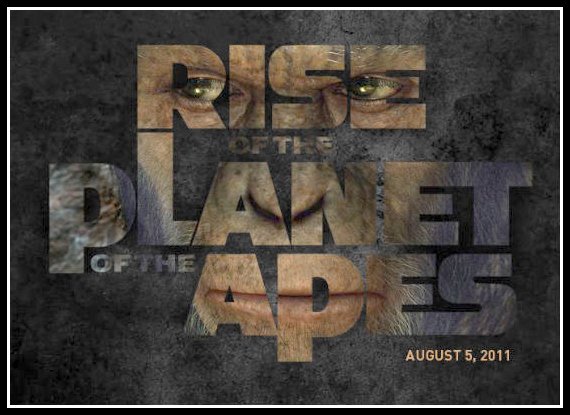
The franchise which seemed to have been left for dead by Tim Burton’s attempt to reboot it in 2001 looks to try and make another go at it again ten years later. Tim Burton will not be anywhere near this reboot and instead will be in the hands of British newcomer Rupert Wyatt.
Rise of the Planet of the Apes (originally called Rise of the Apes which I actually prefer) looks to reboot the franchise by taking the origjnal Conquest of the Planet of the Apes ffrom 1972 and using that as the foundation for this reboot’s plot. It will star his Highness himself, James Franco, with Peter Jackson-regular Andy Serkis playing the role of ape leader, Caesar.
This film seems to have the full backing of Jackson’s WETA Digital to create all the apes in the film digitally. There won’t be any prosthetics and make-up work with this film unlike the previous ones. While some may think this is a bad idea I actually think WETA Digital’s work in creating total CG-characters in the past pretty much heads above other FX-shops (and I include Industrial Light & Magic). From the trailer the apes look quite realistic and even Caesar himself look very real.
Time and the film’s release will tell if this reboot will have a better reception than Tim Burton’s film. I, myself, am looking forward to it since of all the Apes film of the past it was always Conquest that remained my favorite of all of them.
Rise of the Planet of the Apes is set for an August 5, 2011 release.
With the recent passing of filmmaker Sidney Lumet I’ve gone through some of the films of his I’ve come to see as favorites of mine. One film which always came to the forefront whenever I spoke about Lumet as a filmmaker is his directorial film debut in 1957 with his adaptation of 12 Angry Men. Of all his films this is the one which I always go back to time and time again. Part of me is somewhat biased in regards to this film since I was part of a class reading of the original teleplay and played the role of Juror #3.
The scene in the film which I love the most has to be when Juror #8 (played with calm assurance by Henry Fonda) and Juror #3 (played with seething rage by Lee J. Cobb) finally get into it after a very long deliberation in trying to find a consensus on the guilt or innocence of the defendant in their case. I love how in this scene everything that’s right about the American jury system was being upheld by Juror #8. How the guilt or innocence of the defendant should come down to just the facts of the case and combing through all the testimony. How emotions and personal feelings and bias should never enter the equation. It is a person’s life in their hands and it is a responsibility too great to leave it to emotions to find the verdict.
This scene also shows the darker side of the American jury system in that there will be, at times, people chosen to preside as a juror in a case will come in with emotional baggage and a hidden agenda which clouds their decision making. They don’t look at the facts and testimony at hand but at what they believe to be true no matter what the facts may say otherwise. this is how the jury system becomes twisted and becomes part and parcel to the notion that justice is never truly blind but always colored by human frailties and prejudices.
Even 54 years since the films first premiered it still holds a powerful effect on me and those who sees it for the first time. It helps that you have a master filmmaker in Sidney Lumet guiding an exceptional cast of actors. One could come to the conclusion that the audience has the angel on one shoulder with Juror #8 and the devil on the other with Juror #3. All in all, a great scene that always stays with me long after the film has ended.
To cap off the day I decided to take a lead from my favorite spring and summer past-time (baseball) and give everyone a double-header. The latest song of the day is actually two of them. While they’re really a single melody they’re done in two diverging ways that fit in with Joe Wright’s modern fairy tale action film, Hanna.
Once again these songs are from The Chemical Brothers who everyone by now have heard composed the score for Hanna. They did such a magnificent job scoring this film that I wouldn’t be surprised if they’re asked to do more of it in the future. I will admit that I actually like they’re work on Hanna than what Daft Punk did for Tron: Legacy. The songs I picked are called “The Devil Is In The Details” and “The Devil Is In The Beats” respectively.
The first song is a charming little melody that sounds like it’s being played on a calliope. It really underscores the fairy tale aspect of the film and Hanna’s own Grimm’s fairy tale like journey from the frozen wilderness of Finland to the rundown carnival (looking like something out of Bizarro World Grimm’s fairy tale) to end the film. This melody also becomes a sort of leitmotif for whenever Hanna became endangered from the assassins hired by her nemesis, Marissa Veigler, to chase her down. The leader of this group will begin to whistle this tune when they’ve caught onto Hanna’s trail.
The second song is a more aggressive version of this fairy tale melody done in the only way The Chemical Brothers know how. “The Devil Is In The Beats” is twists, distorts, remixes and adds a funky bassline to the original “The Devil Is In The Details” but without losing the original calliope tone. This version I liken to a fairy tale story seen through the eyes of someone tripping out on acid or LSD.
Both songs fit in well in the scenes they complement and just shows how well both filmmaker Joe Wright and The Chemical Brothers were on the same wavelength when it came to telling the story of Hanna.
Sad news came across the news wire this morning as it was confirmed that one of the most esteemed filmmaker in America has passed away at the age of 86. Sidney Lumet was considered by many as one of the best filmmakers of all-time. He definitely is one of the best, if not the best, American filmmaker of all-time.
Lumet was quite prolific as a filmmaker since he began to work behind the camera starting in 1957 with the classic drama 12 Angry Men and ending with his most recent work in 2007 with Before the Devil Knows Your Dead. In between these two films he would direct another 43 films with all of them received positively by critics and audiences everywhere. He was the consummate professional and never waited for the perfect project to come along. He always went into a film project because he either liked the script or, barring being in one which didn’t have a script he liked, it had actors he wanted to work with or he wanted to test his abilities as a filmmaker with new techniques.
Sidney Lumet began his career directing Off-Broadway plays and summer stock productions. He would soon move into directing tv shows in 1950. It would be his time as a tv director where turn-arounds between episodes were so short that a director had to work quite fast that he would earn the reputation as a filmmaker who didn’t spend too much time shooting too many takes of a scene. Lumet became known as a filmmaker who would shoot one to two takes of a scene and move onto the next. Another tool he learned as a tv director that served him well once he moved into film was to rehearse for several weeks with his actors the script before starting up actual production behind the camera.
It was in 1957 when he finally moved into filmmaking with 12 Angry Men (itself previously a teleplay for a TV drama) which would catapult him into prominence in the film community. The film was well-received and still considered by many as one of the most influential films of its kind as it highlighted social injustice in a time when such themes were not considered profitable by studios and the people who ran them. This was the film which would help build the foundation of Lumet’s filmmaking-style as he would continue to use filmmaking as a way to tell the audience about social injustices not just in his preferred film location of New York, but in America and the world, in general. Some of the best films in American history were done by him during the 1970’s when he would take the chaos and public distrust of long-standing public institutions in the US and crafted three of the finest films of the 70’s and America as it was during that decade with Serpico, Dog Day Afternoon and Network.
Sidney Lumet’s legacy as a filmmaker will continue to inspire young filmmakers long after his passing. He was a man who looked at filmmaking as an artform and not just a way to entertain the audience. His films never talked down or pandered to the very general public who watched them unlike some of the filmmakers working in the industry today. His legacy as being the consummate “actor’s director” meant that one didn’t need to be dictatorial with his cast and crew to create a great piece of filmmaking. That there were other ways to make a film and do it in such a way that everyone were still able to give their best without being alienated to do so.
My very first experience when it came to Sidney Lumet had to have been watching his Cold War classic, Fail-Safe, in high school history and it was one of those films which got me looking at film as something more than a form of entertainment. Here was a film that was entertaining but also one so well-made and acted that it’s ideas and themes were not lost. It opened up my eyes to the possibility of film as a medium that could be used to teach, raise issues to debate in society and highlight both the good and the bad of the human experience.
Sidney Lumet has made such an impact not just on those who were fans of films and grow up to become players in the industry, but also those people who would work in other fields of life whether they were lawyers, judges, police officers or politicians (professionals he would use over and over in his films throughout his career). Even Supreme Court Justice SOnia Sotomayor would look at Lumet as an inspiring figure in convincing her that she made the correct choice in choosing law as the path for her professional life.
I find it one of the most fitting tribute for Sidney Lumet that his time as a filmmaker and doing what he enjoyed doing the most became inspirational for people of all color, stripe and creed. This was a man who didn’t just take from the public but gave back just as much in the end. America has truly lost one of its best artists.
Tonight I saw what would probably end up as one of the top films of 2011. I am talking about Joe Wright’s modern fairy tale, Hanna, and starring one of the industry’s finest young actress in Saoirse Ronan in the title role. The latest “song of the day” comes directly from this film which was fully scored by British electronica duo, The Chemical Brothers.
“Container Park” arrives close to the end of the second act of the film and perfectly accompanies one of the film’s best action sequences. The Chemical Brother’s give this song a very heavy and deep bassline which set’s the rhythm for the whole sequence. They begin the song very subtly with just a hint of dissonance creeping into the dark fairy tale-like melody. I just loved how they were able to combine not just the fairy tale aspect of the film, but also add in that sense of danger with subtle use of distortion and dissonance to unbalance the original melody.
This song went perfectly well with the action sequence it complemented and it was halfway through the song that I realized (like all of the music in this film) that the bassline was setting up the rhythm of the action itself. I saw this clip at WonderCon 2011 and the song was the same and as I look back to that clip to seeing the clip as part of the whole film I was impressed how The Chemical Brothers’ score for this film was very instrumental in setting up each scene and not just becoming background music.
“Container Park” is just one of several great songs from the Hanna soundtrack by The Chemical Brothers. First there’s the wonderful, cover-filled soundtrack for Sucker Punch and now this full-on electronica score for Hanna. It’s been a very good year, so far, for soundtracks and I do believe we’ve got more excellent examples coming down the pipeline.
Above is the original song used in the film while below is a remix done by the duo and found on the film’s website. The latter has been extended, but I really don’t see too much of a difference between the two other than their running times.
Watching Ninja Assassin made me think about how much film and special effects technology has advanced to the point that the ways people can die in a film really is only limited by the imagination of the filmmakers involved. My new choice for “Scenes I Love” may make me come across as some gorehound, violence-loving neanderthal (the first two are actually correct but the third is false since I’m homo sapiens), but I love this scene I have chosen because it’s so over-the-top yet holds many truths to the events happening therein.
Rambo was Sylvester Stallone’s attempt to restart the Rambo franchise and to a certain extent he does so. The film was better than the third one and in terms of storytelling was equal to the second one and just a tad short of the original film. It’s a film one will not write to the Academy about, but Stallone brings back the franchise to what made it popular in the first place. He brought the character of John Rambo back to being the self-destructive, self-loathing, war-scarred veteran who just wants to be left alone to live his miserable life, but always gets dragged into one good-intentioned crusade after another.
This scene happens right at the very end and one could say it’s the film’s climactic eruption of testosterone. Rambo literally explodes Burmese soldiers’ bodies through his effective use of a .50 caliber heavy machine gun (and those who think the gun’s effect on people’s bodies was over-the-top…those people would be wrong. That is exactly what a .50 caliber round does to a body. It doesn’t do a body good) and some help from the people he’s trying to rescue. It’s hard not cheer Rambo in this scene after watching these very same soldiers massacre an entire Burmese village, raping captured young women and bayonet little kids before throwing them into a hut’s raging fire.
This scene also shows why the Rambo films have been labeled as nothing but mindless violence trying to make itself to be something profound (he is killing the bad people and trying to save those who are defenseless). I always though this franchise was just about one very angry guy who may or may not be right in the head, but who definitely has a weird sense of right and wrong. Not to mention very good at killing massive amounts of people in very messy ways.
There’s a part halfway in this scene where the higher-than-though leader of the Christian missionary group (who had earlier in the film lectured Rambo for being too violent in saving his and his people’s lives) played by Paul Schulze sees the carnage happening all around him and decides to go all caveman on one soldier who killed one of his congregation. A part of me actually smirked at this part. I knew that no matter how well-intentioned, principled and civilized a man thinks he is there’s something primal deep down inside that wants to commit violence.
There comes around a few films every year which I end up enjoying despite how awful it is to most everyone. I’m a major fan and follower of all things grindhouse and for some grindhouse means it was made during the late 60’s and through most of thru the 70’s. I always thought of grindhouse as a state of mind. I mean I like to believe that’s why Robert Rodriguez and Quentin Tarantino make the films that they make (all of them grindhouse films at heart if not execution). So, it happens that in 2009 there was one film which was panned universally by critics and mainstream audiences everywhere. It was the second film by Wachowski Brothers protege James McTeigue. He was the same director who made the impressive V for Vendetta film adaptation (I still believe to this day that the Wachowski Brothers had a hand in directing that adaptation).
When word came down that he was going to do a modern ninja film which included Sho Kosugi (he practically was the star of most, if not all, of the best-known ninja grindhouse flicks of the 70’s and 80’s) there was no doubt that this film would rock. The heightened anticipation for this martial arts extravaganza would turn out to be more a whimper than a bang. James McTeigue’s Ninja Assassin became one of 2009’s worst films of the year and part of me don’t agree with how most people viewed it.
The story for this film was quite simple. Former ninja assassin tries hiding from his former ninja clan and it’s badass ninja leader (played by badass ninja-man himself, Sho Kosugi). The part of this former ninja was played by Korean singing pop sensation who went by the name Rain. He got the lead part for this film due to the Wachowski Brothers and uber-action producer Joel Silver having been impressed seeing his work on the Wachowski Brothers’ very-maligned and misunderstood live-action take on the classic Japanese anime series, Speed Racer. The brothers and Silver saw a start on the rise in their midst and decided to make a film around Rain. The fact that the film ended up being Ninja Assassin must’ve been one reason why we haven’t heard of him in the US since.
Still, Rain did a good enough job as the blank-faced, albeit master of the ninja arts, Raizo. He was chosen because he looked the part, moved like the part and probably powers that be thought him being shirtless half the time would bring in the huge J-pop and K-pop demographic. Again, the producers might have been reaching a bit much when they were developing Ninja Assassin.
The rest of the film is Raizo being chased by his former clan, having flashbacks of his time as a child being trained by the Ozuna ninja clan to become their top assassin, then back to the present trying to kill as many ninja as possible, while avoiding getting killed himself. Believe me when I say that the blood and body parts rain down like dismembered bodies were on sale at Wal-Mart and everything was tagged “Entire Stock Must Go!”.
Ninja Assassin will live and die through it’s action sequences and despite the heavy use of CGI-blood the action in this film were pretty good. There’s the usual slo-mo tricks the Wachowski Brothers have become well-known for and it seems like their protege have learned from them well. I actually thought that the ultra-violent and very gory action scenes is why this film reminded me of past martial arts grindhouse flicks. Those were also very bloody and violent. It was as if the filmmakers of those film were telling McTeigue that the more blood and violence the merrier.
I would mention that the film had some good performances from the non-ninja roles played by Naomie Harris and Ben Miles, but I’d be lying. Their work here was passable and just needed to fill the slow and dialogue-heavy gaps in-between ninja butchering. These non-ninja butchering scenes actually slowed the film down. I do believe that if they were replaced with more ninja butchering hapless Interpol security agents and vice versa then Ninja Assassin would’ve turned out a hundred times better. Sometimes mindless gory violence is better than wince-inducing dialogue and exposition.
From the sound of this review one would think that I didn’t like Ninja Assassin. Part of me doesn’t like this film, but the part of my brain which understands the nature of grindhouse flicks loved this film because of the very awful things people say about it. This is a film which was so bad that it passed the point of awfulness and became entertaining in its very own way. I mean this film definitely felt like a Sho Kosugi ninja flick but of the digital age. I always believed that no matter the era and no matter how advanced film techniques get there will always be filmmakers out there who go about in a serious manner to create a good film, but despite their best intentions and plans the overall execution and final product don’t live up to their expectations. In a way, that’s what most grindhouse films tend to be in the end. Films made with the best in mind but got lost in its very own grandiose plans to come out batshit nuts on the other side.
PS: Those wondering how ninja having no guns can take on militayr-trained agents in tactical armor wielding the latest in assault rifles. Well, who needs a Heckler&Koch G36 assault rifle when one can throw shuriken as fast as an assault rifle. In the end, Ninja vs. SWAT makes for a badass, mindless climactic battle scene.



 Through the Shattered Lens