A Quickie With Lisa Marie: These Boots Are Made For Walkin’ (performed by Nancy Sinatra)


These Boots Are Made For Walkin’ is one of my favorite songs, one of those that is perfect for making either an entrance or an exit.  There’s probably not a day that passes without this song playing somewhere in the back of my head.

Written by Lee Hazelwood, this song has been recorded by everyone from Jessica Simpson to Megadeth but I prefer the version that made it famous, Nancy Sinatra’s.

Plus, the video for Nancy’s version cracks me up because, if you look real closely, one the dancers has got a run in her hose. *

—-

*Actually, as I sit here typing this on my lunch break, so do I.

A Quickie With Lisa Marie: The Robe (dir. by Henry Koster)


As part of my mission to view every film — good or bad — ever nominated for best picture, I spent last night watching 1953’s The Robe (which was nominated for best picture but lost to From Here To Eternity.)  The Robe is an old school biblical epic, the type of film that used to regularly get nominated for best picture but which you don’t see much of anymore.  If you’re wondering why that genre hasn’t stood the test of time, I’d suggest watching The Robe.

Richard Burton stars as Marcellus, a womanizing Roman centurion who falls in love with young, pure noblewoman Diana (Jean Simmons).  Unfortunately, Diana is set to marry the decadent Caligula (Jay Robinson).  (Yes, that Caligula…)  Burton’s rivalry with Caligula leads to him being reassigned to Jerusalem where he not only witnesses the crucifixion but also wins Jesus’ robe in a dice game.  However, Marcellus soon finds himself being haunted by nightmares of the crucifixion and he discovers that he can’t even wear the robe without having a seizure.  His slave, Demetrius (played by musclebound Victor Mature) has secretly become a Christian and steals The Robe before disappearing into the Holy Land.  As Marcellus, who believes that only by destroying the robe can he free himself from his guilt, searches for Demetrius, he is reunited with Diana and, since this is an old school biblical epic, he also ends up converting as well.  Unfortunately, he does all this around the same time that Caligula becomes Emperor and (in this film if not in actual history) begins to persecute the early Christians.

The Robe was the first film to made in “Cinemascope” and, while that may have been an amazing development back in 1953, when watched today, it’s obvious how much of the film is really just made up of filler designed to show off the new process.  Again, it may have been amazing at the time but today, it just seems like a slow movie.  Even more importantly, The Robe itself is so reverent and respectful of its subject that it’s just not that interesting.  Speaking as a nonbeliever, I’ve still sometimes feel that a lot of contemporary films make it a point to ridicule Christians because they’re an easy target.  Unlike a certain other world-wide religion, most Christians aren’t going to blow you up just because you featured an image of Jesus in your movie.  However, movies like The Robe were not only extremely reverent and respectful but they went out their way to let you know how reverent and respectful they were being.  The result is a film that lack any hint of nuance or anything that might actually challenge the audience.  It’s like Avatar with Jesus. 

Since he’s best known for being an alcoholic and marrying Elizabeth Taylor, Richard Burton might seem like an odd choice to play an idealistic Christian martyr.  And, quite frankly, he is.  Throughout the film, he’s visibly uncomfortable and, quite frankly, he didn’t have the legs necessary to pull off the ancient Roman look either.  Jean Simmons is also stuck playing a stock character — the virtuous maiden.  As with a lot of the old school biblical epics, the lead characters are so boring that you can’t help but feel they had more fun as pagans.  Meanwhile, poor Victor Mature wanders through the film struggling to show anything resembling emotion.   I mean, he tries so hard that its impossible not to like him.  At the very least, The Robe proves that any film featuring Victor Mature will have some sort of camp value. 

(As I watched The Robe, I kept thinking about a comment that Groucho Marx supposedly made.  Apparently, he said he wouldn’t watch any movie starring Victor Mature because “I won’t watch any movie where the guy’s tits are bigger than the girl’s.”)

The Robe does feature some interesting supporting performances from several wonderful B-movie character actors.  Jay Robinson is obviously having the time of his life playing the Emperor Caligula.  Robinson’s version isn’t quite as effective as Malcolm McDowell’s but Robinson is a  lot more fun to watch.  Richard Boone is effectively slovenly in the role of Pilate and there’s a nice little throw-away scene where Pilate absent-mindedly washes his hands twice.  Meanwhile Ernest Thesiger (who played Dr. Pretorious in the Bride of Frankenstein) is an oddly benevolent Emperor Tiberius while Michael Rennie, the alien from the original The Day the Earth Stood Still, plays none other than St. Peter.  Even Jeff Morrow (from This Island Earth) has a small role.

Like most of the old school Hollywood biblical epics, The Robe seems pretty hokey when viewed today and I get the feeling it probably seemed hokey when it was first released back in 1953.  Still, I remember that my Grandma Meehan used to love to watch these movies whenever they would show up on television.  She would have deep theological debates with the images that flickered across the screen.   I can still remember spending multiple Easters listening to her argue with The Ten Commandments.  I don’t know if Grandma ever saw The Robe but I do know that she believed that the Holy Tunic was presently located in France and not at the Cathedral of Trier in Germany.  Seriously, you did not want to question her on this point. 

To be honest, watching this type of film is always an odd experience for me.  Up until recently, I described myself as a “fallen Catholic” and I always felt so proud of myself afterward.  I could spend hours telling you why I no longer believed in the faith of my childhood and I could get quite smug about it.  I guess I still can but, as of late, I’ve discovered that humility goes well with a lack of faith.  I’ve also been forced to admit that when you’re raised Catholic, you’re a Catholic for life regardless of whether you believe in the Holy Trinity or not.  If pressed, I guess I’d call myself “an agnostic Catholic.”  I’m the type of nonbeliever who still feels the need to go to confession after a long weekend.  It’s not so much that I doubt my doubt as much as I wish that I could still go back to a time in my life when I actually could have faith without feeling like I was in denial.  So, even as I openly scoff at these films, there’s always that small part of my heart that wants to embrace the film in all of its simplistic and hokey glory.

That said, it’s also true that The Robe is a lot easier to resist than a film like Pasolini’s The Gospel According to Saint Matthew or, for that matter, The Exorcist.

A Quickie With Lisa Marie: Crossfire (dir. by Edward Dmytryk)


I recently decided that I wanted to watch and review every single movie ever nominated for the Academy Award for best picture.  As part of that mission, I recently rewatched one of my favorite also-rans, 1947’s Crossfire.

Crossfire is a message movie disguised as a B detective flick.  A group of soldiers who have just returned from World War II decide to get together for a drink.  At the bar, they run into a civilian named Joseph Samuels (Sam Levine).  The soldiers end up going back to Samuels’s apartment and the next morning, Samuels is found dead.  Obviously, he was killed by one of the soldiers but which one.  Suspicion falls on the meek (and missing) Floyd Bowers (Steve Brodie) but police detective Finlay (Robert Young) and Sgt. Peter Keeley (Robert Mitchum) both (correctly) suspect that Samuels was actually murdered by the far more outspoken and imposing Montgomery (Robert Ryan).  It quickly becomes obvious that Montgomery is an anti-Semite who killed Samuels solely because he was Jewish.  However, neither Finlay or Keeley can prove it.  The film quickly becomes a darkly intense duel between these three men as Finlay and Keeley attempt to trick Montgomery into implicating himself while Montgomery attempts to further frame Bowers for the murder.

Before Crossfire, director Edward Dmytryk specialized in making low-budget “B” movies and he brings that noir, near-grindhouse sensibility to Crossfire.  As a result, Crossfire is a one of those rare “message” films that is actually entertaining.  Only a few times does the film start to feel preachy and luckily, Robert Mitchum is there being his usual cynical self.  If anyone could deflate the pompous nature of the mid-40s message movie, it was Robert Mitchum.  The film says, “Love one another.”  Mitchum replies, “Baby, I just don’t give a damn,” and he keeps things from getting too heavy-handed.  Mitchum is one of three Roberts to star in this film.  Robert Young plays the police inspector with just the right amount of world-weary indignation while Robert Ryan is a force of nature as the film’s brutal murderer.  Don’t get me wrong.  You can pretty much peg Ryan as a killer from the first minute he shows up on-screen.  If Mitchum and Young smartly underplay their roles, Ryan goes the exact opposite direction.  He’s an obvious brute but he’s also totally believable.  You look at his character and it’s not difficult to imagine him passing the collection plate at Westboro Baptist Church.  As well, Crossfire also features an excellent supporting term by one of my favorite noir actresses, the great and wonderful Gloria Grahame.  She plays Bowers’ married girlfriend and gives a compellingly, real performance that suggests that maybe Hollywood in the 40s wasn’t quite as clueless as we all like to assume.

Crossfire was nominated for Best Picture of 1947 but it lost to another film about anti-Semitism, Elia Kazan’s Gentleman’s Agreement.  (Oddly enough, both Kazan and Dmytryk would end up naming names during the McCarthy Era.)  Like Gentleman’s Agreement, Crossfire was based on a novel.  However, in the original novel, the victim was not Jewish but instead was gay.  However, back in the 1940s, the Hollywood Production Code specifically forbade any open depiction of homosexuality and so, the crime went from being motivated by homophobia to anti-Semitism.

6 Trailers For Your Oscar Hangover


Now that the Oscars are over with, it’s time for another installment of Lisa Marie’s Favorite Grindhouse and Exploitation Trailers.

1) The Sicilian Connections (1972)

Since we’re coming down off the Oscars, I’ll start this latest edition off with the trailer for The Sicilian Connection, an Italian rip-off of 1971 best picture winner, The French Connection.  I haven’t seen the actual movie but I love the music that plays in the background of this trailer.

2) Dirty Gang (1977)

This is another Italian crime flick.  This trailer is worth it to just see that wonderful credit “Tomas Milian as Trash.”

3) Trouble Man (1972)

Tomas Milian may have been Trash but Robert Hooks was Trouble.

4) Q: The Winged Serpent (1982)

I’m so happy to include this trailer because I think Arleigh will love it.  David Carradine and Richard Roundtree fight a prehistoric something-or-an0ther.  Michael Moriarty’s in this which can only mean that this is a Larry Cohen film.

5) Dawn of the Mummy (1980)

“Egypt…a nice place to visit but would you want to die there?”  Not surprisingly, this is an Italian film that was released in the wake of Dawn of the Dead and Zombi 2.

6) The Crippled Masters (1979)

I kinda feel that this trailer runs a little bit long but then again, I’m not big into Kung Fu films that don’t star Uma Thurman.  Still, this is one of those pure grindhouse trailers that has to be seen to be believed. 

What Lisa Watched Last Night: The 83rd Annual Academy Awards


Last night, I watched the 83rd Annual Academy Awards.
Why Was I Watching It?

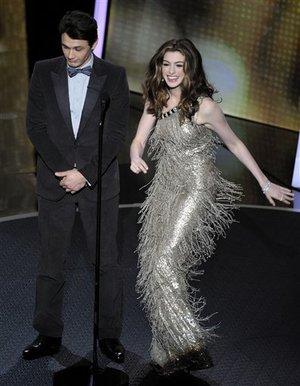
Why was I watching it?  I was watching it because I love awards shows.  I love them in all of their tacky, silly glory.  I was watching for the clothes, the celebrity meltdowns, and the infamous acceptance speeches.  I was watching because James Franco is hot and Anne Hathaway is adorable.  I was watching because I loved Black Swan and I was only mildly impressed with the Social Network.  I was watching because, as a film lover, my year starts and ends with the Oscar ceremony.  You boys have got your super bowl.  I’ve got my Academy Awards.

What Was It About

This year, the big question was would best picture be taken by the Social Network or by the King’s Speech.  I predicted that the Social Network would win and I was wrong.  The Academy gave best picture to The King’s Speech which, unlike Black Swan (my personal choice for best picture), is a film that is very easy to love.  Don’t get me wrong.  I loved The King’s Speech and, seeing as how I wasn’t exactly a huge fan of The Social Network, I can’t complain about the Academy’s decision (though apparently almost everyone else can).

By the way, as far as my Oscar predictions went, I ended up going 15 for 22.  I correctly predicted all of the categories except for Best Picture, Best Director, Best Original Screenplay, Best Foreign Language Film, Best Editing, Best Costume Design, and Best Cinematography.  So, in other words, I correctly predicted all of the awards except for the ones that actually mattered.  However, I am proud to say that, as the broadcast started, I predicted that it would last for 3 hours and 15 minutes and by God, I was right.

So there.

What Worked

Roger Ebert called last night’s ceremony the worst he had ever seen so I guess it’s no surprise that I actually enjoyed it.  I certainly felt it was an improvement over last year’s ceremony which was pretty boring except for when Kathryn Bigelow won best director.  There weren’t any endless tributes, self-congratulatory speeches about how important the film industry is for the survival of the world, and we didn’t have to sit through any pre-scripted, awkward banter between poorly matched presenters. 

As for the hosts, James Franco appeared to have mentally checked out before the show actually started but he was nice to look at.  Anne Hathaway, meanwhile, was a bundle of nervous energy and you know what?  I would have been too.  For the first time in my history of watching the Oscars, I could actually relate on a personal level to what was happening on the stage.  I’ll take the charming awkwardness of Franco and Hathaway over Hugh Jackman any day.  Ebert disagrees.  He apparently tweeted that Kevin Spacey should host.  And, if I ever felt like spending three and a half hours watching some smug jackass singing Under the Sea, I’d agree with him.

I liked the opening film montage, which featured Hathaway and Franco going into Alec Baldwin’s dreams in order to learn how to host the show.  If nothing else, it paid tribute to just how much of a cultural phenomenon Inception actually was last year.  (At the same time, it also pointed out just how ludicrous it is that Christopher Nolan — who is hot along with being a genius, by the way — was not nominated for best director.)

Probably my favorite presenters were Mila Kunis and Justin Timberlake.  Kunis looked great and Timberlake won my heart all over again by announcing that he was actually Banksy.

The In Memoriam Tribute was actually pretty touching this year and I think a lot of that has to do with the fact that the audience has finally figured out how inappropriate it is to break out into applause in the middle of it.  A lot of viewers were apparently angered that Corey Haim wasn’t included.  Personally, I was disappointed (but not surprised) to see that Jean Rollin was left out.

For me, the best acceptance speech came from David Seidler as he accepted his Oscar for writing The King’s Speech.  His speech touched me as a former stutterer but on top of that, he delivered it with just the right amount of humility and humor.  Aaron Sorkin could learn a thing or two from Mr. Seidler.

Finally, I said earlier that I was hoping for just one upset win to keep things interesting and, to my surprise, the show provided me one when Tom Hooper beat David Fincher for best director.  Even among those who expected the King’s Speech to take best picture, the general assumption seemed to be that Fincher would win best director.  Personally, I think Fincher would have won best director except for the fact that people tended to think of The Social Network as being an Aaron Sorkin film as opposed to a David Fincher film.  In all of the preliminaries leading up the Oscars (the Golden Globes, the critics awards), the emphasis was always put on Sorkin’s screenplay as opposed to Fincher’s direction.  David Fincher was almost treated as an after thought and, as a result, Tom Hooper won best director.

(Of course, personally, I was rooting for Darren Aronofsky.)

Of the nominated films, Black Swan was my favorite, followed by 127 Hours, Inception, Winter’s Bone, and the King’s Speech.  I thought The Social Network was a good film but certainly not a great film and, to be honest, I’ve come to resent being told again and again by various online, self-appointed film gurus that my refusal to unconditionally love The Social Network is somehow an indication of a character defect on my part.  Seriously, some of these Social Network partisans make the Avatar people look tolerant by comparison.  I’m sure these people have spent last night and today ranting their little hearts out about how the Academy sucks and how The Social Network is clearly the greatest film ever made.  And to them, all I can say is get over it.  If you were watching the Academy Awards because you seriously felt that the awards actually mean anything, then you’ve obviously still got a lot of growing up to do.

That said, I make no apologies for being ticked off over the award for Best Feature Documentary but more about that below.

What Didn’t Work

Well, I’ll get the big one out of the way first.  This was the only time I actually got angry while watching last night’s show.  I’m talking, of course, about Inside Job winning best documentary.  This upset me even though I had actually predicted that Inside Job would defeat Exit Through The Gift Shop.  My objection comes down to this — Inside Job was the Capt. Hindsight of documentaries this year.  Inside Job was basically a documentary that told us what we already know and then encouraged us to pat ourselves on the back for agreeing.  In a year that was actually a pretty good one for documentaries, Inside Job was the least challenging of all of the nominees and therefore, I guess it’s not a shock that it won.  Meanwhile, Exit Through The Gift Shop — a film which should have been nominated for best picture — was ignored.

Add to that, I was really hoping for a chance to see how Banksy would accept the award or if he would even show up at all (or if he would turn out to be Justin Timberlake).  Instead, I got the director of Inside Job going, “You know, nobody’s been arrested for the bad economy yet.”  Well, if that’s what you think should happen then go to talk to the people who make and enforce laws.  But you’re on an awards show, buddy.  And if you think anyone watching an awards show is going to take action just because of some comment you weakly muttered during your acceptance speech, then you really are out of touch with reality.

We were reminded one too many times that we were watching “the young and hip Oscars.”  The young and hip Oscars would not have featured Celine Dion singing.

I really wish the Oscars would stop trying to force some artificial “theme” on each year’s ceremony.  This year, they took time to celebrate “the greatest films” of Oscar Past.  The problem, of course, is that most of the greatest films of Oscar past didn’t win best picture.  Usually, they ended up losing to movies like How Green Was My Valley, The Greatest Show on Earth, and Crash.

Aaron Sorkin won best adapted screenplay as we all knew he would and, as usual, he came across as smug and condescending during his acceptance speech.  The whole, “Daddy’s an Oscar winner now…” thing would have been touching if not for the fact that it’s been used at least once at every single Oscar ceremony in history.

Trent Reznor did not say, “I want to fuck you like an animal” while accepting his award for scoring The Social Network.  However, I must say, Trent cleans up well.

Technically, yes, James Franco was not real impressive as co-host.  The general consensus on twitter was that he was stoned but I can’t say too much against him because he’s James Franco.  Even when he showed up in drag, he was still James Franco.  I know some people looked at Franco last night and thought, He’s not even trying.  I looked at Franco and thought, yum…..

“Oh my God!  Just Like Me!” Moments

There were a few and most of them had to do with Anne Hathaway.  Most of the comments on twitter concerning Hathaway’s performance as host were not kind but I don’t care.  I love her and I think her lack of polish was actually rather adorable.  If I was hosting the Oscars, I would probably take a few moments to brag about my dress as well.  I know I’d certainly probably start giggling at random moments.  I also know that I’d probably get a little bit annoyed with James Franco’s lack of commitment to the show as well but you know what?  I’d still get all sorts of naked with him after the show because he’s James Franco and he just does things to me.

(If anything, last night’s show proved that the difference between a hot guy and all other guys is that a hot guy can get away with it.)

My other big “Oh my God!  Just like me!” moment came when Melissa Leo won for best supporting actress for the Fighter and dropped the F-bomb on national TV.  I would so do that too.  I mean, it’s an Oscar!  God knows what I’d end up saying if I ever got one.

Lessons Learned:

I’ve seriously got a thing for James Franco.
A Quickie With Lisa Marie: One Million Years B.C. (directed by Don Chaffey)


So, last night, I was talking Oscar fashion over on twitter and, at one point, I somehow ended up promising that if I was ever nominated for an Oscar, I would wear an outfit based the fur bikini that Raquel Welch wore in the 1966 film One Million Years B.C.  Well, everyone seemed to think that this was a pretty good idea on my part but it made me realize that I’ve never actually seen this movie.  As I was already planning on going to Fry’s to buy the Criterion edition of Fish Tank, I decided to buy One Million Years B.C. as well.  When I returned home, I kinda watched it.

I say “kinda” because One Million Years B.C. is probably one of the most draggy movies ever made and my mind wandered considerably whenever there wasn’t a dinosaur on-screen.  The movie opens with a really pompous sounding narrator who explains 1) that One Million Years B.C. was a long time ago and 2) not much else.  I mean, honestly, Mr. Narrator, I could have figured out we were dealing with prehistory just from the fact that there’s a bunch of dinosaurs wandering around.  Anyway, the movie itself is about a caveman (played by a nicely rugged actor named John Richardson) who is exiled from his own savage tribe but who eventually ends up with Raquel Welch’s tribe.  But then his new tribe gets sick of him and decides to exile him as well.  This time, Welch goes off with him and they eventually join Richardson’s old tribe which then goes to war with Welch’s old tribe and then finally, a volcano explodes.  Oh, and there’s a lot of dinosaurs wandering around as well.  On rare occasions, they attack the cave people but, for the most part, they just put out the same aloof vibe as my cat does right after he eats.

Most of the film’s dinosaurs were created through stop motion animation and they’re fun to watch.  However, for me, what truly made the film was a giant turtle that pops up about 30 minutes in.  It’s trying to make its way back to the ocean and, for its trouble, a bunch of little cave people insist on throwing spears at it.  But the turtle just kinda looks back at them and shrugs.  What a cool turtle!

There’s a certain type of viewer — and we all know the type — who will complain that One Million Years B.C. commits the sin of 1) having dinosaurs existing at the same time of cavemen and 2) having all the different dinosaurs living together at the exact same time.  And to those people, I think it’s high time that everyone just finally says, “Shut the fuck up.”  I mean, seriously, instead of nitpicking every little cinematic detail, why don’t you concentrate on losing some weight before you drop dead of a heart attack? 

Just a suggestion.

Oddly enough, this film has a weird connection to the James Bond film series in that, on the basis of their work here, both John Richardson (who also starred in Mario Bava’s classic Black Sunday) and Raquel Welch came close to being cast in On Her Majesty’s Secret Service.  However, the roles ended up going to George Lazenby and Diana Rigg instead.  (Welch was also nearly cast as a Bond girl in Diamonds are Forever.)   Though neither Welch nor Richardson ever became a part of the 007 franchise, Robert Brown (who plays Richardson’s father here) later played the role of M in a handful of Bond films.

Lisa Marie’s Oscar Predictions


The Oscars are tomorrow and I know I’ll be watching it and tweeting about it over on my twitter page.  That’s assuming, of course, that twitter doesn’t go all screwy and spend the entire night putting up that cute little picture of the fail whale.

Anyway, I guess I’m a bit overdue in posting my predictions of what and who will actually win tomorrow.  I guess that’s because this year’s Oscar race looks to be one of the most predictable ever.  Don’t get me wrong.  I like quite a few of the nominees and Black Swan is a contender for my favorite film of all time.  It’s just that this year, the winner’s are so predictable. 

Let’s be honest, we don’t watch the Oscars because we really think that the best film or performer is going to win.  We watch the Oscars for all of the WTF moments and acceptance speech breakdowns.  We watch the Oscars because we want to see something weird happen, like a shocking upset win that leaves us all outraged and shaking our heads.

This year, though, the only suspense seemed to center around the Best Documentary category.  Will Exit Through The Gift Shop win and if it does, will Banksy be there to accept it?  And if he is there, will he wear a monkey mask while accepting it?

Anyway, here’s my list of predictions.  These are the movies and performers that I think will win.  They’re not necessarily who and what I personally would want to win.  (That list can be found here.)

Best Picture: The Social Network

Best Actor: Colin Firth, The King’s Speech

Best Actress: Natalie Portman, Black Swan

Best Supporting Actor: Christian Bale, The Fighter

Best Supporting Actress: Melissa Leo, The Fighter

Best Director: David Fincher, The Social Network

Best Adapted Screenplay: The Social Network

Best Original Screenplay: The Kids Are All Right

Best Animated Film: Toy Story 3

Best Foreign Language Film: Buitiful

Best Art Direction: Alice in Wonderland

Best Cinematography: True Grit

Best Costume Design: The King’s Speech

Best Documentary Feature: The Inside Job (bleh)

Best Editing: Black Swan

Best Makeup: The Wolf Man

Best Original Score: The Social Network

Best Original Song: “We Belong Together” from Toy Story 3

Best Sound Editing: Inception

Best Sound Mixing: Inception

Best Visual Effects: Inception

Film Review: Black Demons (directed by Umberto Lenzi)


(Hi!  This is actually a review that I wrote a while ago for an anthology of B-movie reviews that a “friend” of mine was planning on self-publishing.  Much like this site, the book would be made up of different reviewers giving each film their own individual spin.  We were going to call it Dinner and a Cannibal Movie.  I came up with that title, by the way.  Unfortunately, the project was eventually abandoned but not before I’d written a handful of reviews.  Here’s one of the shorter ones, for Umberto Lenzi’s Black Demons.  Oh, and be warned: Because of the nature of the project it was written for, this review is full of spoilers.)

Black Demons.

My ex-roommate Kim and I have a long-standing argument concerning this film.  I claim that it’s an Umberto Lenzi zombie film that was made in 1991, long after Italian zombie cinema had run its course.  It is also my contention that we saw this movie in October of 2004.  Admittedly, we were performing our own private pagan ritual during most of the film’s 90-minute running time but we still paid enough attention to not be impressed by it.  Kim, on the other hand, argues that we never watched Black Demons and that, furthermore, there is no such film as Black Demons.  I suspect that a combination of her own rather prodigious liberal guilt and the film’s own utter banality has led her to repress the memory of it in much the same way as the protagonist of a Dario Argento thriller will often forget a key detail of a murder he has witnessed.

            Black Demons tells the story of five young people who find themselves on the bad end of some black magic.  For reasons that are never really made all that clear (largely because the entire cast has a bad habit of mumbling their dialogue), English Kevin is in Brazil with his American girlfriend, Jessica.  Tagging along with them is Jessica’s half-brother, a morose young man who is recovering from a nervous breakdown and who has the rather unfortunate name of Dick.  Along with having a vaguely incestuous relationship with Jessica (whether this was intentional on Lenzi’s part or just a case of bad acting is up for debate), Dick is also fascinated by black magic and has a tendency to wander off by himself a lot.  This leads to a lot of scenes of Kevin and Jessica repeatedly shouting, “Dick!  Dick!” as they search for him.  This provided both me and Kim a lot of giggly amusement if nothing else.

            Anyway, Dick attends a black magic ceremony that he records on audio tape and then proceeds to obsessively listen to whenever the movie needs an excuse to bring on a few zombies.  The morning after the ceremony, our threesome’s jeep breaks down out in the middle of nowhere.  Luckily, two hikers – Jose and his girlfriend, Sonya – come along and invite everyone to spend the night at Jose’s villa.  As luck would have it, there’s a big cemetery located right behind the villa and idiot Dick decides to play his little audio tape right in the middle of it. 

            (I think Kim may have exclaimed, “God, what a dick,” at this point but she denies it along with the movie itself.)

            Needless to say, this causes six zombies to rise from their graves and the usual hilarity follows.  It turns out that these zombies were, in life, African slaves who rebelled against their white masters and were put to death as a result.  Their eyes were plucked out as they died, though this doesn’t seem to keep them from being able to see once they come back to life.  It turns out that the mission of these six black zombies is to kill six white people to even the score.  Unfortunately, most of this is explained by Jose who has such an incredibly thick accent that it is next to impossible to understand a word he says.  Therefore, the plot may actually be a bit more complex than I realize.

            Though, I doubt it.

            As Kim and I immediately realized, the zombies need to kill six white people.  Yet there are only five white people in the film.  Whether this was a case of lazy writing or maybe an actor walked off the film at the last minute, I do not know.  However, Lenzi ingeniously handles this problem by killing an anonymous, never-seen white guy offscreen and then having our heroes hear about it on the radio.  Still, you have to wonder why these zombies, seeking vengeance for being slaves in their past life, would only feel the need to kill six white people.  Sure, it works out in the sense that there are six zombies and this way they only have to kill one person apiece.  But still, it seems like they’re letting the white race off a little bit easily here.  Indeed, if the solution to all of the world’s racial strife is simply to kill off the five, uninteresting losers in this film, then I have to side with the zombies on this one.

            Unfortunately, Kevin and Jessica aren’t willing to sacrifice themselves for world harmony and insist on surviving until the end of the movie.  Kevin eventually figures out that the zombies can be stopped by a well-thrown Molotov cocktail.  How exactly he figured this out isn’t really clear.  Perhaps he saw it in another, better zombie film.  (Like Lucio Fulci’s Zombie 2, for instance.  Unfortunately, beyond the Molotovs, the bad acting of the female lead, and a grisly fetish for showing eyeballs getting damaged, these two films have little in common.)  Kevin’s plan works though not before the tragic ends of Sonya, Jose, the phantom sixth white guy, and yes, even Dick.  Leaving behind a bunch of smoldering slaves, Jessica and Kevin flee the villa for a world still torn apart with racial strife and anger.  Thanks a lot, guys!

            Almost all good horror is to be found in subtext.  Such as, Dracula may be pretty intimidating with his fangs and his blood drinking and all, but it’s as a symbol of unbridled lust and secret fantasies that he’s been able to become and remain an icon for over a century.  And while Frankenstein might be frightening to look at, his true power comes from being a sign of what happens when man attempts to play God.  In an admittedly less literary vein, what else is a truly scary slasher but proof positive over how little control we truly have over our own future?  Strictly on paper, Black Demons should be a film awash in powerful subtext.  After all, these zombies wouldn’t even exist if they hadn’t been enslaved and treated like property by the ancestors of the film’s heroes.  In a world that is still struggling (and failing) to deal with the legacy of racism, a film in which a bunch of slaves come back to life and seek vengeance on only whites should have quite a bit to say.   Perhaps if Black Demons had been directed by Fulci or Deodato, it would have done just that.  However, this film was directed by Umberto Lenzi which means that it ends with Kevin assuring Jessica that their nightmare is over with the camera ominously (and, quite frankly, obscenely) pans over to a bunch of black children playing on the side of the road, basically equating those living children with a bunch of bloodthirsty, vengeful zombies on the basis of the color of their skin.  Whether Lenzi realized what he was doing or not, this one camera movement manages to be a hundred times more offensive than anything found in Cannibal Apocalypse.

Perhaps, in this case, Kim had the right idea.

Song of the Day: Battle Without Honor or Humanity (by Tomoyasu Hotei)


To me, one of the most iconic sequences in 21st century cinema comes towards the end of Quentin Tarantino’s Kill Bill, Volume One.  I’m talking about the scene in which Tokyo crime boss O-ren (played by Lucy Liu) walks through the House of Blue Leaves, flanked on either side by her bubble gum-chewing bodyguards.  While there’s a lot that makes  this scene memorable (the slow-mo staging, Liu’s regal yet fierce persona), what I always remember first when I think about this scene is the song playing on the soundtrack.

Of course, I’m talking about Tomoyasu Hotei’s Battle Without Honor or Humanity.  Though the song was not originally written for Kill Bill, it seem to almost perfectly epitomize volume one of Tarantino’s masterpiece.  Yes, it’s over-the-top and shamelessly excessive.  Yet, much like the best of the grindhouse films that inspired Tarantino, it’s performed with such an undeniable artistry that it’s impossible not to get drawn into it.

Whenever I’m out grocery shopping or walking to my office at the start of my workday, I always imagine that this is the song playing in the background.  It definitely brings a little stride to my step.

(The song has other uses as well.  A month ago, I wanted to perform a little impromptu dance for a friend of mine.  This is the song that I ended up dancing to because I knew that, with this song backing you up, it’s impossible not to look good doing whatever you might happen to be doing.)

I Love You, Canada! And here’s six trailers to prove it…


 I think I’ve been a little bit too hard on Canada as of late.  I mean, sure — our northern neighbor did give us Paul Haggis and Vermont.  However, Canada also gave us Degrassi: The Next Generation, Jason Reitman, Atom Egoyan, David Cronenberg, Denys Arcand, and my friend Lindsay Dianne.  So, I’m here to say right now: I love Canada!  And in order to show that love, this week’s edition of Lisa Marie’s Favorite Grindhouse and Exploitation Trailers is dedicated to films produced up in Canada.

1) Sudden  Fury (1975)

I’ve never seen this movie and I don’t know much about it beyond the fact that it was made in Canada.  Looking at the cast list at the end of the trailer, I don’t see any familiar names.  But the trailer fascinates me because it somehow manages to be intriguing and dull at the same time. 

2) Rats (1982)

I haven’t actually seen  this one either and I’m kind of glad for that because seriously, I am scared to death of rats.  I remember this one time when I was little, I was visiting my grandpa’s place in Arkansas and he lived in this big  three-story house out in the country.  And I was sitting out back in this swing when suddenly, this rat jumped out of  a  third story window and it landed right next to the swing and broke its neck and died with its tail twitching as I watched.  I still have nightmares about that.  Anyway, this film is apparently not to be confused with Bruno Mattei’s Rats: The Nights of Terror. 

3) Humongous (1983)

This is one of the several million slasher films that ended up being made in Canada by American film companies looking for a tax shelter.  Just imagine how much shorter the trailer would have been in the movie had simply been called Huge.  Incidentally, the film was directed by Paul Lynch, the same guy who did the original Prom Night.

4) Fast Company (1979)

Arleigh would never let me live it down if I did a post and didn’t include a trailer for a David Cronenberg film.  So, here you go.  Now, to be honest, this trailer is only interesting if you know that 1) it’s for a film directed by David Cronenberg and that 2) he made this in between making Rabid and The Brood.  Now I know that this trailer probably screams out, “David Cronenberg just needed the work,” but Cronenberg has actually spoken with a good deal of fondness about  this film.  I personally haven’t seen it but I guess if anyone could somehow make a movie about drag racing exciting, it would be David  Cronenberg.

5) Videodrome (1983)

Here’s a more representative example of what we think about when  we think about Cronenberg.

6) Out of the Blue (1980)

Originally, I was going to end this with the 2 Cronenberg films but then I remembered that Dennis Hopper’s Out Of The Blue was a Canadian production and there were simply no way I couldn’t end with that film.  Out of the Blue is, quite simply put, one of the greatest films ever made.  I’ve been meaning to write a review of it for a while now but it’s been difficult for me to know where to begin because, in many ways, viewing Out of the Blue was as much of a personal experience for me as watching Black Swan.