What Lisa Marie Watched Last Night: Cyberbully (directed by Charles Biname)


It’s been a while since I posted a What Lisa Marie Watched Last Night, which is unfortunate because these are some of my favorite posts to write.  If nothing else, they give me an excuse to use this site to extol the virtues of a good Lifetime movie.  Well, last night, I watched a made-for-TV movie that belonged on Lifetime, despite the fact that it actually premiered on ABC Family.  The name of this film is Cyberbully and it doesn’t have much in common with Larry Clark’s Bully.

Why Was I Watching It?

After you see the same commercial about fifty times, you really don’t have much choice but to watch.  That’s why commercials work.  However, I am happy to say that I did stand up to the forces of relentless advertising by DVRing the movie and watching it on my own time.  So there.

What Was It About?

So, there’s this teenage girl (played by Emily Osment) who gets a laptop for her birthday and her mother (Kelly Rowan) foolishly allows Osment to spend hours surfing the web unsupervised.  So, Osment joins this social site called Clickster which is supposed to be like Facebook but, from what they showed onscreen, really looked a lot more like MySpace.  And I mean the MySpace of today and not the cool MySpace that we all used to brag about being on.

Anyway, somebody hacks Osment’s Clickster Account which leads to Osment getting a reputation for being a slut and soon all the rich girls in high school are giving her a hard time and then somebody sets up a fake account as some boy from another school and eventually, Osment tries to commit suicide and her mom ends up blaming it all on a lack of governmental regulation.

What Worked?

It’s difficult to really criticize this film, despite the fact that — like a lot of films about cyberbullying — it was obviously made by people who don’t really understand how the Internet works or how teenagers view the world.  The people who made the film obviously had their hearts in the right place and the film’s ultimate message was a pure and sincere one.  It was obvious that a lot of the film’s plot was inspired by the true life of case of Megan Meier, a 13 year-old girl who committed suicide after being cyberbullied in much the same way as the character played by Emily Osment in this film.  The case of Meier was so tragic that I can still not write about it without getting tears in my eyes. 

The film was actually pretty well-acted, especially by Osment and Kay Panabaker, who plays Osment’s best friend.

Most importantly, the film didn’t allow its good intentions to keep it from going totally and completely over the top in a few key moments.  Perhaps the moment that most made me forget about the film’s good intentions and just enjoy it on a camp level was when Osment, struggling to open up a child-proof bottle of pills, screams, “I CAN’T GET THE TOP OFF!”

What Didn’t Work?

Okay, maybe this wasn’t a big moment but it’s something I noticed and it really gnawed at me.  When Osment first finds herself being bullied, she responds by calling one of the bullies a “bitch” online and then her mom finds out and goes, “No, you cannot be mean just because other people are being mean,” and as the film goes on, it becomes apparent that we’re meant to agree with her.  But seriously, some day, I’m going to have a daughter and if she ever gets in trouble for calling a bully ” a bitch,” you better believe I’m going to stand behind my daughter 100%.  Actually, I’ll probably call the bully a bitch first.

When I saw that scene, I immediately flashed back to what my mom once told me when I came home from school crying because of some mean girls.  She sat me down, explained to me the importance of keeping my thumb on the outside whenever I made a fist, and then said, “Lisa Marie, if those putas de mierda try to make you cry, you break their nose.” 

Now, I have to be honest — despite the fact that I now knew how to make a fist, I still had no idea how to use that fist to break someone’s nose.  I doubt I have the upper body strength to pull that off anyway.  But, regardless of whether it was good advice, it was what I needed to hear at that time because, at the very least, it let me know that I had someone in my corner and, even more importantly, it assured me that I was the victim and not to blame.

Anyway, back to Cyberbully, the main problem with this film is that after one hour or so, the movie’s storyline becomes far too much of a PSA for its own good.  Unfortunately, the PSA isn’t for bullies to reconsider their actions or for the victims of bullies to know that “it gets better.”  Instead, the PSA tries to convince us that we can wipe out bullying by passing legislation, getting the government involved, and doing the whole activist thing, as if 1) bullying is an activity that can be regulated as opposed to just a really ugly expression of human nature and 2) we can actually trust the government to make life better for anyone. 

This is one of those films where, at the end of the film, the entire school stands up to the bully and basically bullies her into being a nicer person.  Honestly, it seems like it would be a lot more helpful for all these anti-bullying films to just say that being a teenager sucks, it’s going to suck for a long time, but if you get through it, you’ll have the pleasure of seeing everyone who bullied you get fat and miserable.  Instead, we get these false visions of humanity in which the entire world will have your back just because you’re in the right.  That’s all very uplifting but what are you going to do once you realize that the world, for the most part, doesn’t even know you exist?

“Oh my God!  Just like me!” Moments

Well, the entire film was about silly girls acting over dramatic so there were … ahem … there were a few just like me moments.  Well, more than a few. 

Perhaps the biggest just like me moment was due to the fact that I had my e-mail, Facebook and MySpace accounts hacked by an ex-boyfriend once and he changed all of my statuses to something slutty (well, more slutty and definitely lacking my trademark sense of postmodern humor) and sent out a mass e-mail under my name that read, “I want to fuck you madly.”  (If nothing else, that made me the most popular girl in the Art History study group for a week or two.)  Anyway, I ended up deleting every account I had, getting a restraining order on the guy, and spending the next two years being very paranoid and untrusting.  So, in other words, don’t be a cyberbully because it seriously fucks people up.

Lessons Learned:

Be kind and remember that there’s a human being reacting to everything you say.  Also, some pill bottles are more difficult to open than others.  But mostly the be kind part.

Lisa Marie Goes To Rio (dir. by Carlos Saldahna)


Rio is one of those films that I missed when it had it’s initial run at the theaters.  However, last week, I finally got a chance to see it at the “dollar” theater.  Now, I have to admit that I consider the dollar theater to be something like the sixth ring of Hell and, before the movie started, I posted the following to twitter: “Wow, there’s a lot of ugly and obese children in this theater.”  And indeed, that was the case.  What I forgot to mention is that a lot of them were there with equally ugly and obese parents, the types who talked loudly through the film in accents that carried the dual twang of ignorance and stagnation.  Despite the surroundings though, I found Rio to be a perfectly pleasant little animated film.

Rio is the story of Blu (voice by Jesse Eisenberg), a blue macaw who, though originally from Brazil, has grown up in Minnesota and, as a result, has never learned how to fly.  Blu returns to Brazil with his owner (Lesley Mann) so that he can mate with another macaw, Jewel (Ann Hathaway) and keep the species from dying out.  However, things don’t go exactly as planned as 1) Jewel is more interested in escaping captivity than in mating and 2) both Rio and Jewel are abducted by a psychotic Cockatoo named Nigel (Jermaine Clement).  Nigel works for a bunch of poachers and soon Jewel and the flightless Blu find themselves on the run, looking for their owner while the Rio Carnaval goes on all around them. 

As one of my old theater teachers one said about me, Rio “is not without a certain fun charm.”  The film’s storyline of neurotic animals getting lost in an exotic locale and eventually finding the strength to believe in themselves is pretty much standard animation fare but the action moves along quickly and the movie takes full advantage of the whole Rio mystique.  The film’s animators create the Rio de Janeiro that everyone hopes they’ll discover if they ever make it down to Brazil.  Perhaps most importantly, Rio is child-appropraite without ever being so childish as to inspire adults to start drinking while the little ones laugh.

The voice actors all do a pretty good job distinguishing their individual characters.  Jesse Eisenberg is perfectly neurotic as Blu while Anne Hathway’s vocals are properly headstrong as Jewel.   The real stand-out here is Jermaine Clement of Flight of the Conchords. Clement, with his deep, wonderfully dramatic voice, brings a lot of flair to the villainous Nigel and, despite being a psycho Cockatoo, quickly became an audience favorite.  Though the human bird owners don’t get much to do, Leslie Mann and Rodrigo Santoro are so endearing that you actually wish they had more screen time.  On the other hand, if, like me, you found George Lopez to be grating before seeing Rio, this film isn’t going to do much to change your mind.  (Lopez, not surprisingly, plays the know-it-all bird who helps Blu and Jewel make their way through Rio.)

As I watched Rio, I realized just how spoiled we all got last year as far as animated films were concerned.  Last year, I got a chance to see Toy Story 3, How To Train Your Dragon, Shrek Forever After, A Town Called Panic, The Illusionist, Megamind, and Despicable Me.  It was, in many ways, a banner year for cinematic animation.  With the exception of Rango, there haven’t been any animated films so far that can really compare with what we were given last year.  As a result, it’s easy to be dismissive of a straight-forward, relatively simple family film like Rio.  That’s unfortunate because, taken on its own terms, Rio is a perfectly enjoyable way to spend 90 minutes.  Just don’t go into it expecting to see Toy Story 3 and you’ll be fine.

6 Trailers of Separation


Hi there!  Welcome to the latest edition of Lisa Marie’s Favorite Grindhouse and Exploitation Trailers.

1) Ghost Town (1988)

Let’s start things out with this film from 1988.  I haven’t seen this film but the trailer has a certain silly charm to it and how can’t you enjoy the use of the fake lightning special effect?  Plus, those finger nails screeching across the car — Agck!  Freaky.

2) Blue Sunshine (1976)

This is one of my favorite movies.  Basically, a bunch of hippies take some really powerful acid in 1968 and then, eight years later, they end up having the worst flashback ever!  To say that Zalman King gives an “interesting” performance as the film’s hero is a bit of an understatement.

3) Road Games (1981)

“Jamie Lee Curtis is…Hitch.”  Well, that would probably explain why she was destined to end up hitchhiking.  Seriously, parents — give it some thought before you give your child any old name.  Anyway, Road Games was director Richard Franklin’s follow-up to Patrick and it’s one of the better slasher films of the early 80s.

4) The Dungeonmaster (1985)

Oh my God, this looks like a bad movie.  The trailer, however, is just so silly and kinda endearing in the way that it seems to desperately be saying, “No, it’s not as bad as it looks!  Look — we have ice people!”

5) Conquest (1983)

All I need to say here is that this film was directed by the one and only, Lucio Fulci.

6) Maniac Cop (1988)

Finally, let’s end this latest edition with Bruce Campbell, shall we?  This is the trailer for William Lustig’s Spinell-free Maniac Cop.

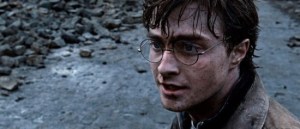
Film Review: Harry Potter and the Deathly Hallows — Part 2 (dir. by David Yates)


Well, we all knew it would have to end someday and now, it’s over.  The Harry Potter film series, which began way back in 2001, is concluding right now in a theater near you.  On Friday night, me, Jeff, my sister Erin, and our friend Evelyn went down to the AMC Valley View and we saw Harry Potter and the Deathly Hallows, Part 2. 

The cinematic story of Harry Potter is over and yes, I did cry as I watched it end.  I didn’t just cry because of the movie, though the movie itself is one of the best of the year and it has one of those wonderful endings that just makes it impossible to remain dry-eyed.  No, I cried because — with this film — an era of my life is truly over.  

When the first Harry Potter film came out, I was only 16 and still trying to deal with the fact that I had been diagnosed as being bipolar just a few weeks earlier.  I felt alone and broken and destined to spend the rest of my life on the outside looking in.  The three hours that I spent watching Harry Potter and the Sorcerer’s Stone were three hours when I didn’t have to worry about suddenly bursting into tears and having everyone around me worrying about whether or not I was actually taking my hated medication.  For three hours, I could escape to another world where those who were different were celebrated precisely because they were different.  For three hours, I could imagine that just maybe I had a special purpose for existing too and maybe I had benevolent wizards and witches looking out for me too.  And I’m sorry if all that sounds trite in retrospect but, when you’re 16 and you think you’re too damaged to love, anything that gives you hope and pleasure in the present is a precious treasure.

Over the years, I eventually came to realize that being bipolar was hardly a curse and, as I matured and grew up and discovered new things, there was always a Harry Potter film either playing or about to come out.  Whether I was escaping high school, graduating college, or dealing with just every good or bad thing that makes up life, Harry Potter — this character who I first met (in book form) when I was 13 — was always there.  So, at the risk of sounding overdramatic, the end of Harry Potter is the end of a chapter of my life.

One final personal note: As I watched Harry Potter and the Deathly Hallows, Part Two, I had three dolls (or action figures, as boys insist on calling them) in my purse.  These dolls — Harry, Hermione, and Ron — came out around the same time as the second Harry Potter film and my mom (who collected dolls) ordered them off of Ebay three years ago, shortly before she entered the hospital for the final time.  Now, my mom was not a huge fan of the Harry Potter series but she knew that I loved it and that’s why she made those dolls her final gift to me.

And those are some of the reasons why I found myself crying as I watched the finale of Harry Potter.  However, there’s another reason why I cried and that’s that this is just a great film and the perfect conclusion to the series.

Essentially, Harry Potter and the Deathly Hallows, Part Two starts up immediately after the conclusion of Part One.  Dobby is dead, Lord Voldemort (a wonderfully neurotic Ralph Fiennes) and the Death Eaters are intent on destroying everything, and Severus Snape (Alan Rickman, wonderful as always) is in charge of Hogwarts.  After spending the first part of Deathly Hallows as fugitives, Harry Potter, Ron Weasley, and Hermione Granger (Daniel Radcliffe, Rupert Grint, and Emma Watson) return to Hogwarts to take a final stand against Voldemort.  Things end in a surprisingly bloody battle (this film is not for children) that leaves several characters dead and ultimately reveals that one wizard wasn’t the saint we always assumed he was while another is revealed to be the secret hero of the entire series.

Let’s get one question out of the way right now: will non-Harry Potter fans be able to follow this film?  Uhmmm…no.  Sorry.  Then again, why would a non-Harry Potter fan be at a film called Harry Potter and The Deathly Hallows Part Two anyway?  I mean, seriously, if you’re just going to film because everyone else is doing it than who are you to bitch anyway?  This is what you non-Harry Potter fans need to do.  Stop reading this review.  Go watch the previous Harry Potter films.  Watch them in order.  Take your time because Deathly Hallows is going to be in theaters for a while.  And then, once you’ve become immersed in the story, go see how it all concludes.  And then come back here and read rest of this review.

Okay, so is everybody up to date?

Cool.

One of the more interesting features of the Harry Potter series is that so many different directors (each with his own definite, individual style) have been involved in bringing these films to the screen.  Among Harry Potter fans, hours can literally be spent debating the merits (and weaknesses) of Chris Columbus, Alfonso Cuaron, Mike Newell, and David Yates.  My own theory is that each director was perfectly suited for each film he directed.  The audience-friendly vision of Chris Columbus was what the first two films needed, just as Prisoner of Azkaban needed Cuaron’s far darker vision and Mike Newell’s attention to character made Goblet of Fire one of the best of the Harry Potter films.  And while David Yates may not be as well-known (or critically acclaimed) as Newell or Cuaron, he brings exactly the right tone to Harry Potter and the Deathly Hallows, a perfect combination of spectacle and humanity.  It is to Yates’ credit that the scenes in which the characters simply talk to each other are just as compelling as the dramatic sequences where Voldemort and the Death Eaters attack Hogwarts.  Yates understands that this material could easily come across as silly or childish and to his credit, he never allows the audience to simply dismiss this film as a lot of blathering about wands and CGI magic.  As opposed to other directors who have given us summer blockbusters, Yates takes his film seriously.

And, fortunately, so does his cast.

One of the great pleasures of the Harry Potter series is that it’s given American audiences the chance to discover (and rediscover) some of the great British character actors and a lot of them show up (some for only a matter of minutes) here in the finale.  Maggie Smith, Jim Broadbent, Julie Walters, Robbie Coltrane, Gary Oldman, John Hurt, David Thewlis, Emma Thompson, and Jason Isaacs all put in appearances.  Kelly MacDonald has a great scene playing a ghost, Helena Bonham Carter is perfect as the evil Bellatrix Lestrange, and Alan Rickman is brilliantly ambiguous as Severus Snape.  (And yes, Snape’s actions are explained in this film and yes, I did cry.)

Ralph Fiennes plays so many villains that I now find myself expecting him to show up killing people in every movie I see.  He’s like a British Christopher Walken.  Still, it’s easy to take an actor like Fiennes for granted.  For the entire Harry Potter series to work, Lord Voldemort can’t just be an ordinary villain.  He’s got to be the sum total of all things evil and deadly.  You’ve got to believe that people would be scared to speak his name.  Great heroes need a great villain and Fiennes’ Voldermort is a great villain.

Ultimately, however, the true credit for the success of the Harry Potter series belongs to three actors who have literally grown up on the movie screen — Daniel Radcliffe, Rupert Grint, and Emma Watson.  The producers are fortunate indeed that the cute kids that they cast over a decade ago have all grown up to be talented, attractive, and likable actors.  If the first part of Harry Potter and the Deathly Hallows seemed to showcase both Grint and Watson (almost to Radcliffe’s expense), part 2 is most definitely centered on Harry Potter.  That doesn’t mean that Watson and Grint aren’t good in this film.  They are and they get to share one of the best movie kisses of 2011.  (As well, for those who keep count, Grint says “Bloody Hell,” three times in the film.)  But, for obvious reasons, this film is all about Harry and Radcliffe’s performance as Harry.  It’s a challenge for Radcliffe and it’s a challenge that he more than succeeds at conquering.  As the film ended, I realized that I was sad to know that the adventures of Harry Potter were done but I was excited to see what the future will hold for Radcliffe, Grint, and Watson. 

Incidentally, Harry Potter and the Deathly Hallows Part 2 has been released in both 3-D and 2-D.  We saw the 3-D version and if you have any knowledge of how I feel about 3-D (and how motion sick I tend to get while watching 3-D films) then that should show you just much I love the Harry Potter series.  I loved it so much that I was even willing to overlook my hatred of 3-D.  The 3-D here (which was added after the film has already been filmed) doesn’t really add much to the movie.  There were a few cool moments where I was all like, “Look, I can reach out and grab a piece of Voldemort,” but otherwise, the 3-D was a negligible factor as far as the overall film was concerned.

Still, there was one interesting thing about the 3-D.  The theater we saw the movie in was half-way empty.  At the same time, the neighboring theater — in which the 2-D version was playing — had a line of people waiting to get in.  They were not only waiting to see the 2-D version, they were waiting to see a showing that wouldn’t even begin until a full 90 minutes after the 3-D version started.  I mention this because, in the wake of Avatar, so many people have taken it for granted that 3-D is the future of movies and soon, as long as a film is in 3-D, we won’t have to worry about the difficult stuff like an interesting plot or compelling characters.  However, 3-D has become an overexposed gimmick.  For every film like Cave of Dreams that uses 3-D to craft an actual artistic statement, there’s a 1,000 films like Priest which use 3-D just because it’s an easy way to trick sucks into spending an extra dollars to see a crappy film. 

What so many filmmakers seem to forget is that the majority of film goers are not looking for 3-D.  We’re just looking for a good film.  And sometimes — like with Harry Potter and the Deathly Hallows — we get lucky and we find a great film.

(Oh, and one last thing: I know everyone always expects me to claim to be just like Hermione but actually, I’ve always related more to Ginny Weasley.  Like her, I’m the youngest of four siblings, I’ve got red hair, and I always get my man, in the end.)

Spike Lee To Direct Oldboy Remake


If Spike Lee wasn’t controversial enough on his own, he’s now going to be directing a remake of one of the more rabidly beloved films to come out of South Korea in the 21st Century, Park Chan-wook’s Oldboy.

I have to admit that this is the type of news that always inspires, within this movie lover, mixed feelings.  On the one hand, Spike Lee is a far better director that a lot of people want to admit and he has shown the ability to make films within several different genres.  On the other hand, you have to wonder why Oldboy needs to be remade in the first place.  One need only read Arleigh’s review of the original to see just how highly most viewers thought of the original.

For me, the real question is this — will Spike Lee be truly reimagining the material or will he just be making the same film again, just this time without subtitles?

(I can see the tag line now: “Just as good as the original, now requiring less reading!”)

Will Spike Lee’s remake be a Departed-style remake or a Girl With The Dragon Tattoo-style remake?

Hopefully, if nothing else, this news will at least encourage people (like me) to seek out and watch the original and make up their mind for themselves.

Let’s Second Guess The Academy: 1998 Best Picture Nominees


Hi and welcome to this week’s edition of Let’s Second Guess The Academy.  Previously, we reconsidered the best picture nominees for both 1990 and 1994.  This week, we jump forward 4 more years to consider the race for best picture of 1998.

1998 saw one of the greatest upsets in Academy history when Shakespeare in Love was named best picture over Steven Spielberg’s Saving Private Ryan.  Even after more than a decade, this decision remains a controversial one.  Some people — including this site’s founder — will tell you that Saving Private Ryan was robbed.  Others, like my sister Megan, loved Shakespeare in Love so much that they still have the sepia-toned movie poster hanging in their house.  And then there are people like me who will tell you that Shakespeare was better than Ryan but Thin Red Line was better than Shakespeare and that, finally, Elizabeth is the best of them all.

So, looking back with the benefit of hindsight (I love that word!), which of 1998’s best picture nominees would you have voted for?

And here’s the part of Let’s Second Guess The Academy that I really love — if none of the five actual nominees had been released in 1998, which other films would you have nominated in their place?  You can vote for up to 5 films.

(If the 2nd poll isn’t showing up on your browser, please click here and you will be redirected to it.)

The Evil That 6 Trailers Do


Hi.  I may be on the road at the moment but I wouldn’t ever let that stop me from providing everyone with the latest edition of Lisa Marie’s favorite grindhouse and exploitation trailers.

1) The Evil That Men Do (1984)

I haven’t seen this film but I love Shakespeare.

2) Satan’s Bed (1965)

Speaking of the evil that men do, this sexploitation film from Michael and Roberta Findlay is pretty rough even by today’s standards.  Don’t watch this if you’re easily offended.  If you are easily offended, just remember that ten years after making this film, Michael Findlay was decapitated by a rotating helicopter blade.

3) Moving Violation (1976)

On a slightly less disturbing note, here’s the trailer for Moving Violation.  The film is actually a bit more odd than you might guess from just the trailer.

4) The House By The Cemetery (1981)

From the great Lucio Fulci comes this film, the third part of The Beyond trilogy.  This film gave me nightmares the first few times I saw it.

5) Macon County Line (1974)

This is one of the most financially succesful films of all time and apparently, it extended the life of the Southern drive-in by a good decade or so.  It’s actually a pretty good movie.

6) Telefon (1977)

Finally, let’s end things how we started — with Charles Bronson killing people.

A Quickie With Lisa Marie: Kill The Irishman (dir. by Jonathan Hensleigh)


Jonathan Hensleigh’s fact-based gangster film Kill The Irishman had a brief (and limited) theatrical run earlier this year and received generally mixed reviews.  I myself didn’t see it in the theaters but instead, caught it OnDemand a few weeks ago and I was genuinely surprised to discover that this film, while far from being perfect, is also hardly the simple Goodfellas rip-off that I had originally been led to suspect.  Instead, Kill The Irishman is a somewhat flawed but ultimately quite rewarding David-and-Goliath story about a real-life David who was known as “the Irishman.”

Kill The Irishman tells the true story of Danny Greene (played by Ray Stevenson), an Irish-American gangster who went from being a corrupt union boss to challenging the Sicilian mafia’s dominance of the criminal underworld of Cleveland, Ohio.  In 1977, Greene became, for a brief period of time, a media celebrity when he survived several assassination attempts while fighting a war for control of the Cleveland rackets.  As the film both informs and shows us, this violent, underground war led to a total of 35 bombings, all designed to kill either Greene or one of his allies.  By surviving these attacks, Greene briefly appeared to be indestructible and seemed to be on the verge of reviving the long-dormant Irish mafia. 

As a film, it takes a while for Kill The Irishman to really click.  From the start director Hensleigh shows a real feel for capturing the feel of a once great city slowly dying but the 1st half of the movie still threatens to get bogged down in all the clichés of the modern gangster film — there’s a bit too much clunky narration from Val Kilmer (who sleepwalks through his role as a fictional police detective who grew up with Greene) and a few too many montages set to old rock tunes.  It’s all watchable enough and there’s a few memorable sequences (my favorite being the early scenes of Greene on the job, slaving away under an oppressive sun) but on the whole, it just feels like the 100th low-budget remake of Goodfellas.  The highlight of this part of the film is Christopher Walken’s typically eccentric yet genuinely sinister performance as an early Greene mentor-turned-enemy.

However, once Greene goes on his own and starts to blow up every inch of Cleveland, the film comes into its own and establishes its own rough identity.  Hensleigh proves to be very adept at orchestrating chaos and, with the entire Mafia out to kill him, Greene goes from just being a thug to being a true underdog.  It’s impossible not to root for him and, much like the film, it’s here where Ray Stevenson comes into his own.  For the 1st half of the film, Stevenson seems like an adequate but uninspired choice for the role of Danny Greene.  However, once Cleveland starts exploding around him, Stevenson comes into his own.  He not only captures Greene’s cocky defiance but, as the film reaches its inetivable conclusion, he also captures Greene’s own growing paranoia and fear.  By the end of the film, Stevenson has given a performance that has masterfully juggled pride and regret, defiance and fear.  Regardless of whether it’s an accurate statement about the real Danny Greene, Ray Stevenson makes his version into a true tragic hero.

Along with Stevenson’s anchor of a performance and Walken’s scene-stealing characterization, Kill the Irishman is filled with familiar mob movie character actors, most of whom contribute some nicely realized turns as the various members of the Cleveland underworld.  Tony Lo Bianco, Mike Starr, and Paul Sorvino are all convincingly brutish as the leaders of the local Mafia and Vincent D’Onofrio is wonderfully flamboyant as Greene’s one Italian ally.  My personal favorite supporting performance came from character actor Robert Davi who was almost a little bit too believable as a cold-blooded murderer.  Not to get too specific here but if I ever happen to hire a professional assassin, I hope he looks like Robert Davi.

I have to admit that one reason why I ultimately enjoyed this flawed but worthwhile film is because I’ve always wished that I could have been a member of the Irish mafia.  (I wanted to be like Maggie from Gangs of New York and use my fingernails to rip open throats.)  For many of us Irish-Americans, there’s just this romance to the whole idea of the Irish Mafia and we’re always looking for evidence that the organization wasn’t, more or less, wiped out by the Italians.  (Fortunately, I happen to be a fourth Italian along with being a fourth Irish so the St. Valentine’s Day Massacre is a smidgen less traumatic for me).  If nothing else, the Irish mafia epitomizes two things that every true Irish-American knows to be true: 1) the Irish will never stop fighting no matter how intimidating the odds and 2) we’re all ultimately doomed regardless.  Kill the Irishman may not be a perfect film but it’s a fitting tribute to a better kind of criminal.

Scenes I Love: The Shining (dir. by Stanley Kubrick)


Today’s scene I love is from Stanley Kubrick’s 1980 horror masterpiece The Shining.  No matter how many times I see that film, it still scares me and, for whatever the reason, the two little girls standing in that hallway scare me the most.  Here they are.

2011: The Year In Film So Far


Greetings from the former home of the Flying Spaghetti Monster, Crossville, Tennessee!  Yes, Jeff and I are on our way back to Texas.  It’s been a wonderful vacation but I have to admit, I’m looking forward to seeing a movie at the Plano (or Dallas) Angelika on Sunday.  I’m not sure which movie but, as long as it’s a movie, I’ll be a happy girl.

That’s because I love movies.  Movies are what I schedule my life around.  My birth certificate says I was born in 1985 but I know that I was born in the year of Brazil, Prizzi’s Honor, Blood Simple, and After Hours.  If each year can be judged by the quality of the films then how is 2011 looking now that we’ve reached (and passed) the halfway mark?

Right now, as I sit here in this hotel room in my panties and my beloved Pirates shirt, I’d say 2011 is shaping up to be an average year.  There’s been a few films that I loved and there’s been a few that I’ve absolutely despised but for the most part, this year is shaping up to be comfortable and rather bland. 

Much as I did last year at this time, I’m going to take a few minutes to mention a few high points (and low points) of 2011 so far.  Agree?  Disagree?  Make your opinion known.

Best Film (So Far): Hanna, without a doubt.  Joe Wright’s stylish thriller hasn’t gotten half the acclaim that it deserves.  Runners-ups: The Cave of Forgotten Dreams, Incendies, Jane Eyre, Kill The Irishman, Of Gods and Men, Red Riding Hood, Sucker Punch, The Source Code, Super, 13 Assassins, The Tree of Life, Win Win, X-Men: First Class

Best Male Performance of the Year (so far): Paul Giamatti in Win Win.  Runners up: Bobby Cannavale in Win Win, Joseph Gordon-Levitt in Hesher, Matthew McConaughey in The Lincoln Lawyer, and Rainn Wilson in Super.

Best Female Performance Of The Year (so far): Sairose Ronan in Hanna. Runners up: Lubna Azabal for Incendies, Ellen Page for Super, Amy Ryan for Win Win, and Mia Wasikowska for Jane Eyre.

Best Ending (so far): The charmingly low budget zombie film that runs over the end credits of Super 8.

Best Horror Film (so far): Insidious.

Most Underrated Film Of The Year (so far): A tie, between Sucker Punch and Red Riding Hood.  Red Riding Hood, as a matter of fact, was so underrated that I had to see it a second time before I really appreciated it.

Best Bad Film: Beastly.  Silly but kinda fun in a really, really odd sort of way.

Worst Film of The Year (so far): The Conspirator, a bore of a movie that was apparently filmed through a filter of grime.  Runners up: Priest, The Beaver, Battle L.A. (sorry Arleigh, Leonard, and Erin), Season of the Witch, Your Highness, and The Green Lantern.

Biggest Example of A Missed Opportunity This Year (So Far): The Adjustment Bureau, which could have been a great Eternal Sunshine Of The Spotless Mind-type of film but instead, turned out to be just another predictable and shallow example of new age triteness.

The Get-Over-It Award For The First Half Of 2011: The Conspirator, a film that attempts to be relavent by using the 19th Century to comment on political issues from 2006.

My Prediction For Which Film Will Be The Most Overrated Of 2011: Last year, I predicted The Social Network and, surprise surprise, I was right.  In fact, the folks at AwardsDaily.com are still bitching about how The Social Network lost best picture to The King’s Speech.  (By the way, a few other choice pieces of wisdom from Awards Daily: The Beaver is Jodie Foster’s best film ever and only elitists should be allowed to comment on film.)  This year, I’m going to predict that the most overrated film of 2011 will be the unnecessary remake of The Girl With The Dragon Tattoo.

My Prediction For What Will Be The Worst Film Of 2011: The winner here is another remake — Rod Lurie is remaking Straw Dogs and this time, he’s setting it in the South.  You know what?  Go back to Vermont and fuck yourself ragged, you dumbass, blue state elitist.  

So, that’s 2011 so far.  There’s still quite a few films that I’m looking forward to seeing: Another Earth, The Debt, Don’t Be Afraid of the Dark; Tinker, Tailor, Soldier, Spy; Hugo, and most of all, Harry Potter and the Deathly Hallows, Part 2.