Appreciating Ray Bradbury’s The Martian Chronicles


the-martian-chroniclesFirst published in 1950, Ray Bradbury’s The Martian Chronicles is a collection of 28 short stories about humans exploring and colonizing Mars while those left behind on Earth destroy each other in a never-ending atomic war.  When I first read it back in middle school, it blew my mind.  When I reread it this weekend, I discovered that it still holds up.  65 years after first being published, The Martian Chronicles is still a classic of American literature.

When Ray Bradbury died in 2012, many obituaries called him a “science fiction writer.”  Bradbury always resisted that label, saying in one interview, “First of all, I don’t write science fiction. I’ve only done one science fiction book and that’s Fahrenheit 451, based on reality. It was named so to represent the temperature at which paper ignites. Science fiction is a depiction of the real. Fantasy is a depiction of the unreal. So Martian Chronicles is not science fiction, it’s fantasy. It couldn’t happen, you see? That’s the reason it’s going to be around a long time – because it’s a Greek myth, and myths have staying power.”  There is very little science to be found in The Martian Chronicles.  Humans travel between Earth and Mars via rockets and the trip only takes a matter of days.  Characters frequently ride boats down the water-filled Martian canals.  Humans have little trouble breathing on Mars and only occasionally complain about the thin atmosphere.  Bradbury is not interested in Mars as a real place.  Instead, he uses Mars as a way to explore what humanity would do if given a second chance.

The humans who come to Bradbury’s Mars all have one thing in common.  All of them are fleeing an imperfect Earth.  Some, like the members of the first three expeditions, come to Mars as explorers.  Some, like the troubled Jeff Spender, seek to learn from Martian civilization.  Others, like Sam Parkhill, come to Mars to make money.  Fathers Peregrine and Stone come to Mars in search of a new world in which to spread the word of God.  Mr. Stendahl comes to Mars to escape government oppression.  Others come to escape the wars of Earth.  Throughout The Martian Chronicles, characters deal with issues that are just as relevant today as they were in 1950.  Bradbury’s vision of human society is not a positive one, especially when compared to his Martians.

martianchronicles2All of the short stories are linked by the human characters’ struggle to come to terms with Martian society.  After killing the members of the first three expeditions, the Martian race is wiped out by chicken pox, a disease that did not exist on Mars until the arrival of the humans.  Only a few survive and go into hiding, watching as human move into their old cities and set up their own civilization.  Ghost-like, the Martians and their dead society haunt every story in The Martian Chronicles.

There are a few stories in The Martian Chronicles that have not aged well.   The Silent Towns, in which a man named Walter Gripp is horrified to discover that one of the last women left on Mars is overweight, is a mean-spirited and unpleasant story to read.  But the collection’s best stories — And The Moon Be Still As Bright, The Third Expedition,  Usher II, The Off Season, The Million-Year Picnic, Night Meeting, and especially There Will Come Soft Rains — still hold up as entertaining and thought-provoking works of speculative fiction.

In 1980, The Martian Chronicles was turned into a miniseries.  I will be watching and reviewing it later this week.

Film Review: The Greatest (1977, dir by Tom Gries and Monte Hellman)


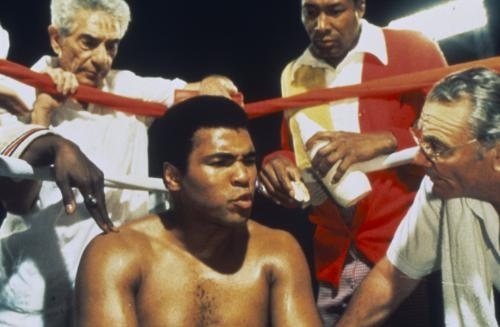
the_greatest_1977_portrait_w858The Greatest opens with 18 year-old Cassius Clay (played by Chip McAllister as a teenager and, as an adult, by Muhammad Ali himself) winning the light heavyweight gold medal at the 1960 Rome Olympics.  Returning home to Kentucky, Clay discovers that not even a gold medal can protect him from racism.  Angered after a restaurant refuses to serve him and his friend, Clay throws his gold medal into the Ohio River.  Under the training of Angelo Dundee (Ernest Borgnine), Clay turns pro and defeats Sonny Liston (Roger E. Mosley) for the heavyweight championship.  Inspired by Malcolm X (James Earl Jones), Clay also joins the Nation of Islam and changes his name to Muhammad Ali.  As heavyweight champion, Ali battles not only his opponents in the ring but racism outside of it.  The Greatest follows Ali as he loses his title for refusing to be drafted and concludes with the famous Rumble in the Jungle, where Ali won the title back from George Foreman.

Sadly, Muhammad Ali has never been the subject of a truly great feature film.  Even Michael Mann’s Ali failed to really capture the mystique that made Ali into such an iconic figure.  The Greatest is interesting because Ali plays himself.  Unfortunately, The Greatest proves that Ali may have been a great showman but he was not a natural actor.  You only have to watch the scene where Ali tries to hold his own with Robert Duvall to see just how stiff an actor Muhammad Ali really was.  Ali’s best scenes are the ones where he is trash talking his opponents or training.  The film opens with Ali jogging while George Benson sings The Greatest Love Of All, a scene that is made all the more poignant when you compare the athletic and confident Muhammad Ali of 1977 with the frail, Parkinson’s stricken Ali of today.

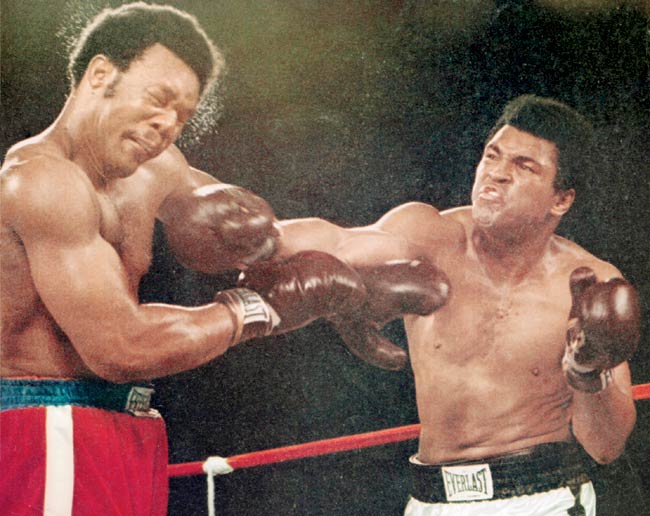
29Muhammad-Ali-1Instead of recreating any of Ali’s legendary fights, The Greatest instead uses actual footage of the matches.  The real life footage is the best part of the film.  After all these years, Ali’s fights against Sonny Liston, Joe Frazier, Ken Norton, and George Foreman remain exciting to watch.  Otherwise, The Greatest is too episodic and low budget to do justice to Muhammad Ali’s story.

If you want to see a truly great film about Ali and his legacy, watch the 1996 documentary When We Were Kings, 2009’s Facing Ali or 2013’s The Trials of Muhammad Ali.  Ali is such an iconic figure that it may be impossible for any feature film to properly do justice to his life and legacy.  These three documentaries come close.

(Director Tom Gries died during the filming of The Greatest.  The movie was completed by Monte Hellman.)

In Praise of Easy Rider’s Captain America


1969 was a watershed year for both America and the movies.  While the war in Viet Nam dragged on and turmoil raged at home, movie audiences watched as two generations of Fondas appeared in movies about the American dream.  In Sergio Leone’s Once Upon A Time In The West, Henry Fonda played Frank, a gunslinger so ruthless that he shoots a child during his first scene.  In They Shoot Horses, Don’t They?, daughter Jane Fonda played a woman struggling to survive the Great Depression.  And, in Easy Rider, Peter Fonda played Captain America.

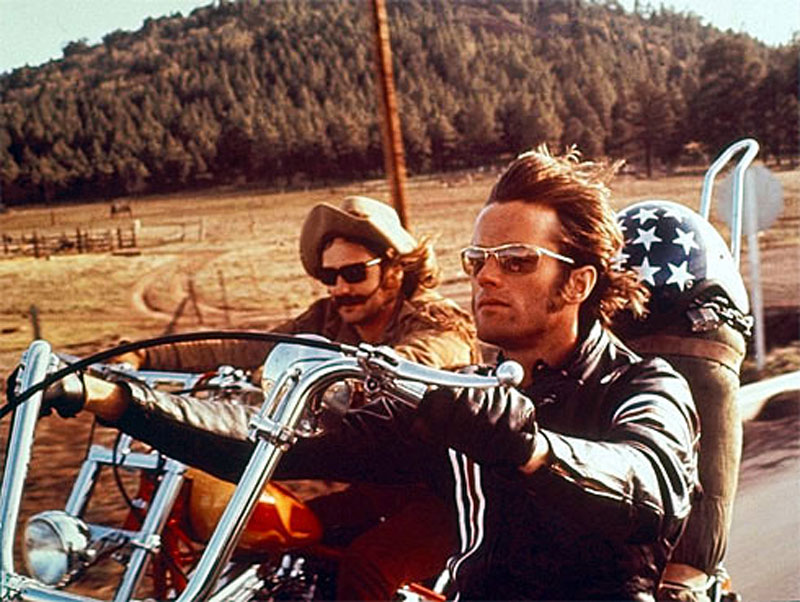
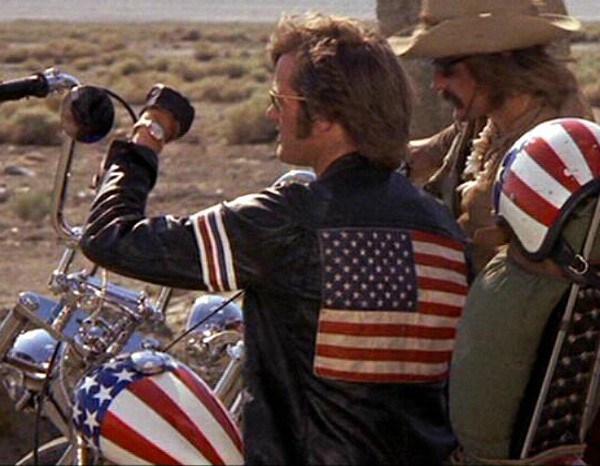
Peter FondaThe Captain America of Easy Rider should not be mistaken for the super soldier played by Chris Evans.  Instead, this Captain America is actually Wyatt Williams, a motorcycle rider who is planning on going to Mardi Gras with his friend Billy (Dennis Hopper, who also directed).  Wyatt is nicknamed Captain America because he wears a leather jacket with an American flag on the back.  It is an appropriate nickname because Wyatt represents everything that is good about America.

When we first meet Captain America, he and Billy are engaged in a business transaction, bringing to mind the old saying that the business of America is business.  They are selling cocaine to none other than Phil Spector.  Taking Spector’s money, Wyatt stuffs it into a plastic tube that he keeps hidden in his motorcycle’s fuel tank.  It is no coincidence that the fuel tank is decorated with the stars and bars.

Peter-Fonda-and-Dennis-Hopper-in-Easy-RiderHaving made their money, Wyatt and Billy ride across the country to celebrate.  At the start of their journey, Wyatt takes off his watch and leaves it on the ground, declaring that time has no meaning to a man who has freedom.  If you replaced their motorcycles with horses, there would be little to distinguish Wyatt and Billy from the American outlaws who might show up in an old Henry Fonda western.

On their way to New Orleans, Wyatt and Billy interact with many different people.  If the always paranoid and nervous Billy represents America’s worst impulses, Wyatt represents the best.  When Wyatt and Billy eat dinner with a rancher and his family, Wyatt alone appreciates what the rancher has accomplished and says, “You’ve got a nice place. It’s not every man that can live off the land, you know. You do your own thing in your own time. You should be proud.”  When they later stop off at a ramshackle hippie commune, Wyatt is the one who says, in the best tradition of American optimism, that “They’ll make it.”

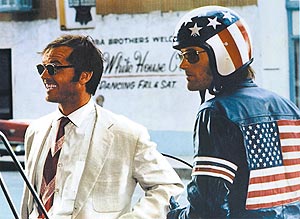
EasyRider2When they stop to pick up a hitchhiker and then later when alcoholic lawyer George Hanson (Jack Nicholson) joins them on their trip, it’s always Wyatt who volunteers to share his bike.  (Billy always rides alone.)  Whenever they stop for the night, it is always the generous Wyatt who offers to share his grass with whomever is traveling with them.  When George smokes for the first time, Wyatt is the one who teaches him.  It is the stoned George who tells Wyatt and Billy that they represent freedom.

It is only after George is beaten to death by a group of rednecks that Wyatt loses his optimistic outlook and his generous spirit.  George’s death opens Wyatt’s eyes in much the same way that the turmoil of the 1960s did for the rest of America.  After George’s murder, Wyatt loses his faith in himself.  When he and Billy reach New Orleans, Mardi Gras is a letdown.  When he takes the acid that was given to him by the hitchhiker, Captain America’s journey becomes a bad trip both figuratively and literally.

0603-peter-fonda-and-easy-riderjpg-b0f5351afb0a53df_mediumWhile Billy insists that they had a great time in New Orleans (in much the same way that some insist that America is just as strong a nation as it has ever been), Wyatt knows the truth.  “We blew it,” Wyatt says, speaking for the entire nation.

Despite his mistakes and despite having blown it, Wyatt, much like America itself, remains good at heart.  When Captain America dies at the end of the film, it is because he is trying to protect his friend Billy.  In the best American tradition, he sacrifices himself to protect another.

This Independence Day, let us all take a few moment to appreciate Wyatt Williams, the man known as Captain America.

Wyatt Williams (aka Captain America) RIP

Wyatt Williams (aka Captain America) RIP


4 Shots From 4 Films: Enter the Dragon, Lady Snowblood, Black Belt Jones, Three The Hard Way


Everyone, at some point in his life, has wanted to learn karate.  The films featured below are a big reason why.

4 SHOTS FROM 4 FILMS

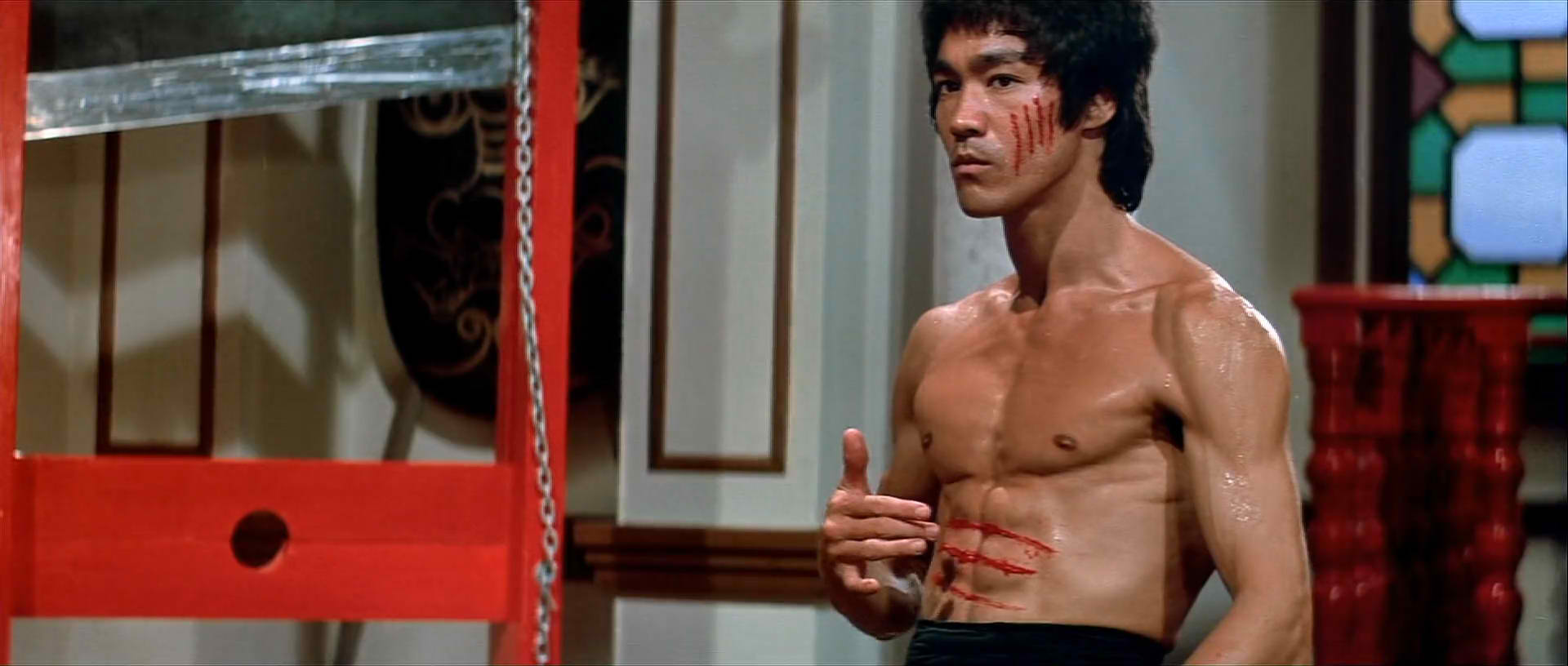
Enter the Dragon (directed by Robert Clouse, 1973)

Enter the Dragon (directed by Robert Clouse, 1973)

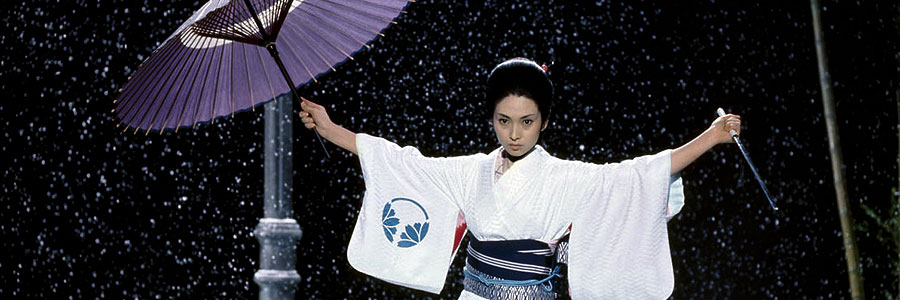
Lady Snowblood (directed by Toshiya Fujita, 1973)

Lady Snowblood (directed by Toshiya Fujita, 1973)

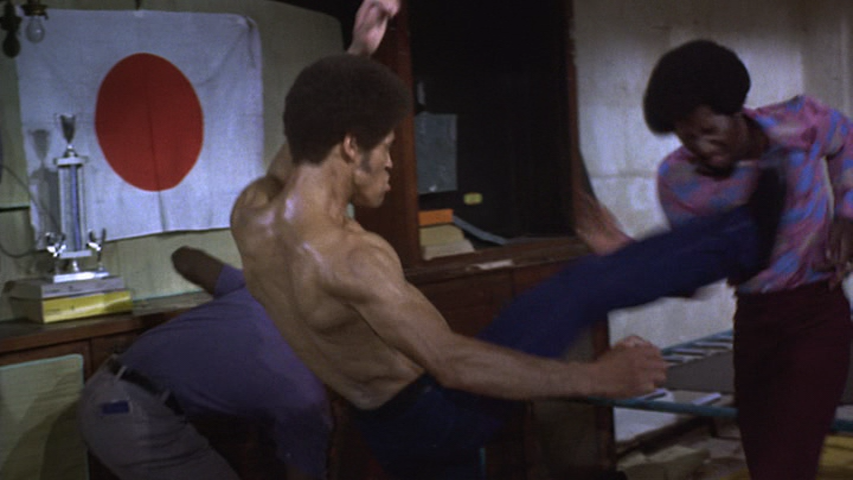
Black Belt Jones (directed by Robert Clouse, 1974)

Black Belt Jones (directed by Robert Clouse, 1974)

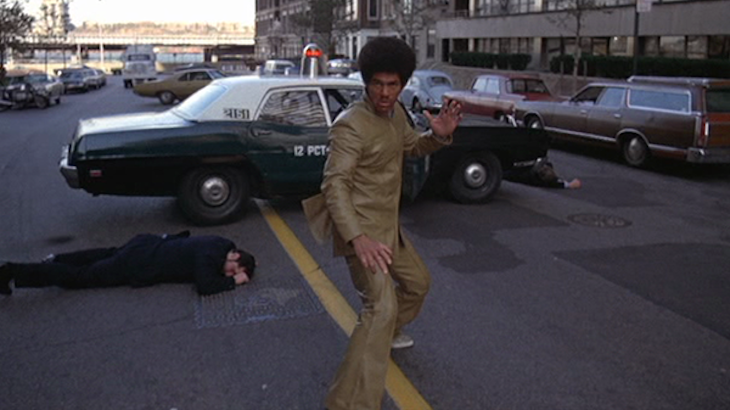
Three The Hard Way (directed by Gordon Parks, Jr., 1974)

Three The Hard Way (directed by Gordon Parks, Jr., 1974)


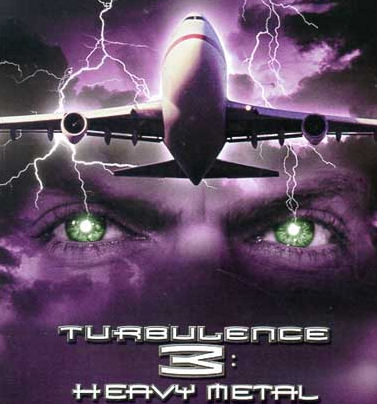
All Hail Slade Craven! A Look At Turbulence 3: Heavy Metal


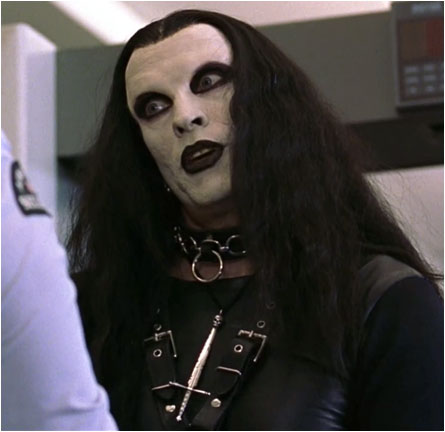
Slade Craven, the hero of Turbulence 3

Slade Craven, the hero of Turbulence 3

The first Turbulence was a 1997 box office flop that starred Lauren Holly as a flight attendant who must defeat Ray Liotta and land an airplane.  Turbulence 2 was a 1999 direct-to-video release that starred Craig Sheffer as an engineer who must defeat a terrorist and land an airplane.  2001’s Turbulence 3 reuses the special effects footage from the first Turbulence and features Craig Sheffer in a different role but otherwise, it is a completely unrelated to the first two films.  This time, John Mann plays a rock star who must defeat a terrorist and land an airplane.

Slade Craven is a death rocker who, with his white makeup and his long black hair, is an obvious stand-in for Marilyn Manson.  Like Marilyn in his prime, Slade Craven is a controversial artist whose music is critical of religion.  Unlike Marilyn Manson (whose video for Sweet Things Are Made Of This still has the power to shock), the one Slade Craven music video that we see mostly features Slade stumbling around a high school basement and petting a dog.  Marilyn Manson sang about the beautiful people.  Slade Craven’s biggest hit is Love Gun.

Slade Craven has announced his retirement.  His final concert, complete with pyrotechnics and a working electric chair, will be held on an airplane, while the plane is flying from California to Canada.  Only 40 of his most devoted fans will be allowed on the plane but “10 million people” will be watching via the miracle of the Internet.  (Everything about the internet was still exotic in 2001.)

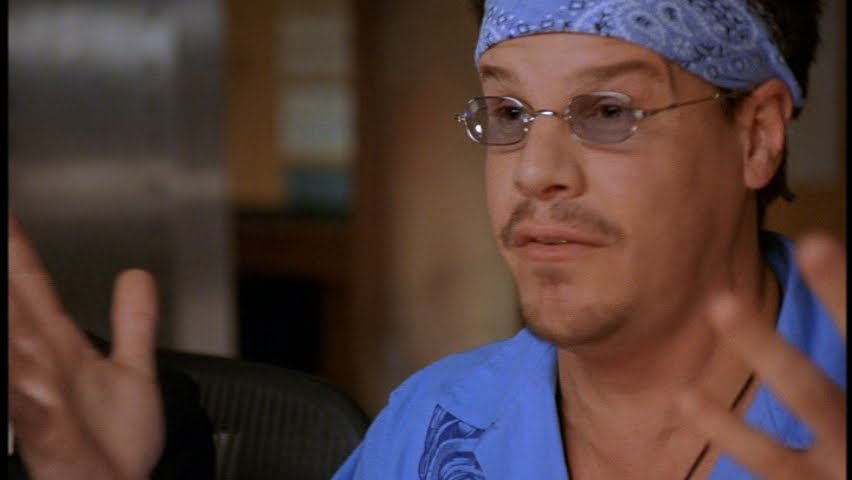
This is what a hacker looked like in 2001.

This is what a hacker looked like in 2001.

On the ground, hacker Nick Watts (Craig Sheffer) is illegally watching the concert when FBI agent Kate Hayden (Gabriella Anwar) shows up to arrest him.  However, before Kate can put on the handcuffs, they notice that something strange is happening on the plane.  Someone has just murdered the band’s manager and has locked Slade in the first class restroom.  A man disguised to look like Slade shoots a co-pilot and announces that he’s going to crash the plane into a cursed cemetery in an area of East Kansas that is so unholy that “even the pope refuses to fly over it.”  The crash will not only be seen by the 10 million people watching on the internet but it will also unleash Satan into the world.

With the help of Nick and Kate, Slade frees himself from his restraints and becomes a hilariously unlikely action hero.  Not only does Slade have to defeat his doppelgänger and the other Satanists on the plane but, after the remaining pilot (Rutger Hauer!) is revealed to be a part of the conspiracy, Slade has to land the plane on his own.  Luckily, Nick has an old NES flight simulator that he can use to help talk Slade down.  “We’re all going to rock and roll!” Slade tells the passengers as he pulls on the throttle.  Meanwhile, on the ground, Kate rewards Nick by handcuffing him and then walking towards the bedroom while unbuttoning her blouse.  Nick hops after her.

Also, on the ground, Joe Mantegna plays an FBI agent.  All of the scenes with Mantegna take place in two locations, suggesting that Mantegna filmed all of his scenes in a day or two.  Turbulence 3 proves that it is impossible to hear Mantegna’s voice without picturing Fat Tony.

Of all the films about heavy metal singers fighting terrorists and landing airplanes, Turbulence 3 might be the best.  All credit belongs to John Mann’s Slade Craven who rocks every day, parties every night, and beats up terrorists all of the time.  Slade Craven proves the nobody saved the world like a shock rocker.  Sadly, there has never been a Turbulence 4.  I would love to see the further adventures of Slade Craven.

turbulence-3-poster

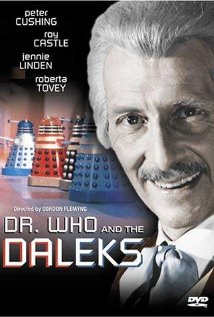
What if Peter Cushing Had Played The Doctor: A Look at Dr. Who And The Daleks


MV5BMjA5MDE3MDI5MV5BMl5BanBnXkFtZTcwNjU3NTgxMQ@@._V1_SY317_CR5,0,214,317_AL_When the long-running British science fiction show Doctor Who premiered over 50 years ago, it was originally envisioned as being a serialized educational program for children.  Each serial would see The Doctor (William Hartnell), his granddaughter Susan (Carole Ann Ford), and teachers Ian (William Russell) and Barbara (Jacqueline Hill) traveling via TARDIS to a different historical period and interacting with real-life figure like Marco Polo and the Emperor Nero.  The first serial, An Unearthly Child, featured the Doctor and his companions going back to prehistoric times and teaching cavemen how to make fire.

However, the show’s second serial forever changed the direction of the series.  Written by Terry Nation, The Daleks introduced viewers to a race of militaristic aliens who, because they had nearly destroyed their planet in a nuclear war, could only exist inside of a tank-like shell.  Devoid of all emotion except for hate, the Daleks were best known for their shrill battle cry of “EXTERMINATE!”  Despite being defeated and apparently destroyed at the end of the serial, The Daleks returned to face the Doctor many times and the show itself shifted its focus away from teaching history lessons and instead became the show that we all know and love today.

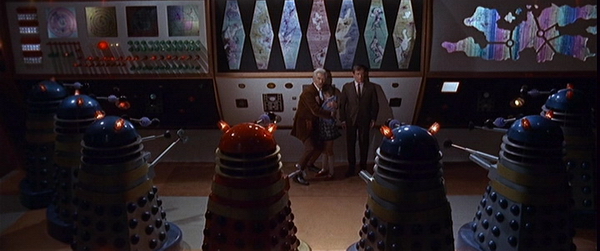
Dr-Who-and-the-Daleks-Poster-by-Tim-DoyleAt its height, the popularity of the Daleks rivaled that of the Doctor and his companions.  In 1965, when Amicus Productions produced the first Doctor Who feature film, it was a no-brainer that it would feature the Daleks.  With a few key changes (mostly to the character of the Doctor and his companions), Dr. Who and the Daleks recreates the plot of Terry Nation’s original serial.  The Doctor (played by Peter Cushing), his granddaughters, Barbara (Jennie Linden) and Susan (Robert Tovey), and Barbara’s boyfriend Ian (Roy Castle) go to the planet Skaro, where they help the peace-loving Thals battle the war-obsessed Daleks.

Beyond selling the rights to the story, the BBC had nothing to do with the film’s production.  Amicus obviously geared the film towards children, perhaps not understanding that, though Doctor Who may have started out as a kid’s show, the program itself had become much more adult as it grew in popularity.  Hoping to make a film that could appeal to a wider (read: American) audience than the original TV show, Amicus changed a few key details.  As a result,  for fans of the original show, Dr. Who and the Daleks is a true oddity.  It provides an alternative vision of what Doctor Who could have been.

One change that did work is that, at a time when Doctor Who was still being broadcast in black-and-white, Dr. Who and the Daleks was in color.  Visually, the film has a pop art feel, full of primary color and featuring locations that feel like low-budget version of the villainous lairs that Ken Adam used to design for the James Bond films.  This was the first time that the Daleks had been seen in Technicolor and the show even appropriated the film’s Dalek color-scheme when color episodes started to air in 1970.

Dr-Who-The-Daleks-2

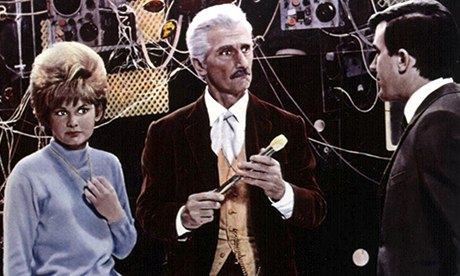
Other changes do not work quite as well.  The Daleks’ famous “EXTERMINATE” battle cry is never heard.  The show’s beloved theme music has been replaced with an uninspired score from veteran Amicus composer Malcolm Lockyer.  While the TARDIS still looks like a blue police box and is bigger on the inside than the outside, the sleek control console and the familiar grinding noise are both gone.  Instead, the inside of the TARDIS is a cluttered mess of loose wires and flashing lights.  The Doctor now has two granddaughters and, undoubtedly in order to appeal to children, Susan is much younger than she was in the television series.  As well, in the television series, Ian was a science teacher who had no fear of standing up to The Doctor.  The film’s Ian is clumsy and used mostly for broad comic relief.

Dr. Who & the Daleks films tillThe biggest change is to the character of the Doctor himself.  For fans of the series, there is no bigger pet peeve than when unfamiliar critics refer to the main character as being “Dr. Who.”  True fans know that the show’s title is a question and not a statement.  No one knows the Doctor’s true name or his exact age.  What they do know is that Doctor is a Time Lord from Gallifrey and that he stole his TARDIS.  Whenever the Doctor’s body suffers too much damage, he regenerates into a new body (and a different actor).

Of course, in 1965, the Time Lords had yet to be officially introduced.  The name “Gallifrey” had never been uttered on the television show.  The Time Meddler, which was the first serial to introduce another member of the Doctor’s race, only aired a month before the release of Dr. Who and the Daleks.  On the TV series, William Hartnell was still playing the First Doctor and it would be another two years before the character would regenerate for the first time.  When Dr. Who and the Daleks was released, all that was known of the Doctor was that he was an alien and no one knew his true name.

Even those two facts are ignored in Dr. Who and the Daleks.  Instead of being the abrasive alien that Hartnell played on the show, the film’s Doctor is portrayed as being a brilliant but absent-minded inventor who is very much a human being.  The film also establishes early that his last name really is Who, with Ian regularly addressing him as “Dr. Who.”  We never learn his first name.  Maybe it was Larry.

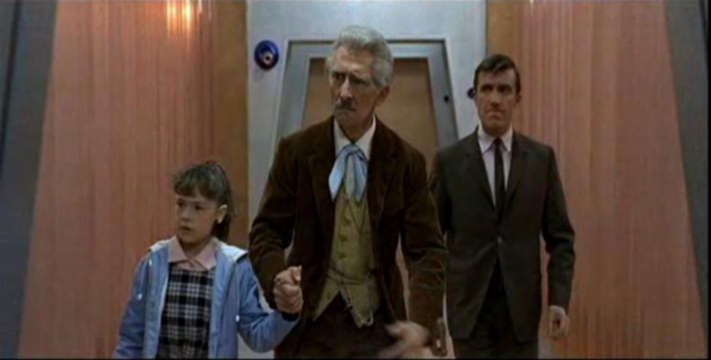
Dr-Who-and-the-Daleks-Dr-Who-4Dr. Who was played by Peter Cushing, who Amicus felt would be a bigger box office draw than William Hartnell.  Cushing does a good job playing his version of the character and it’s interesting to compare his kindly performance to both his better known work for Hammer and George Lucas and William Hartnell’s ruthless interpretation of the character.  Cushing regularly goes back to save the life of Castle’s cowardly Ian.  Hartnell would have just let him die.

Though the film bombed in North America (where, at the time, Doctor Who was still unknown) it did will enough in the UK to lead to a sequel, Daleks — Invasion Earth: 2150 A.D.  When the sequel failed at the box office, plans for future movies starring Peter Cushing as the Doctor were abandoned.  That was probably for the best.  If the Amicus films had been a success, they could have changed the direction of Doctor Who just as surely as Terry Nation did when he first introduced the Daleks.  Doctor Who could have reverted to being a show for children instead of becoming the show that it is today.

Still, it is hard not to wish that Peter Cushing could have gotten to play the Doctor in a “real” Doctor Who film.  After all, Christopher Lee would have made a great Master.

Dr Who and the Daleks (13)

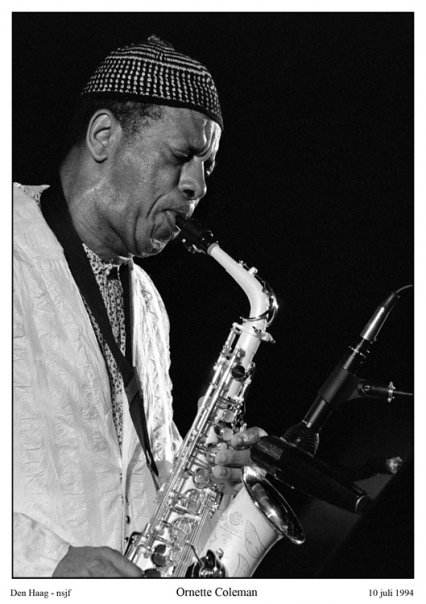
In Memory of Ornette Coleman


Ornette Coleman

On Thursday morning, jazz legend Ornette Coleman died.  He was 85.

My father loves jazz and I grew up listening to a soundtrack that included Miles Davis, Charlie Parker, John Coltrane, and Ornette Coleman.  Out of all of them, Coleman was his favorite.  As he would always say, no one else sounded like Ornette Coleman.

Ornette Coleman spent a lifetime reinventing both himself and jazz.  A tireless innovator and a fearless experimenter, Ornette Coleman returned jazz to its improvisational roots.  With his 1961 album Free Jazz: A Collective Improvisation, he not only popularized a new approach to jazz but gave it a name as well.  As Coleman himself once said, “For me, being an innovator doesn’t mean being more intelligent, more rich, it’s not a word, it’s an action.”

Rest in peace, good gentleman.

The Measure of a Man: The Life and Career of Rocky Balboa


rocky-and-apollo-02

Have you heard the rumor?

Rocky Balboa, also know as the Italian Stallion and the former heavyweight champion of the world, is going to die.
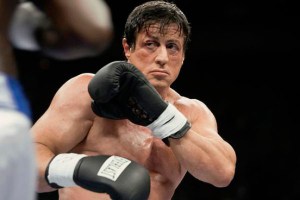
2013Rocky_SylvesterStallone_PA-14110031250713At least that is what some people think after reading the official plot synopsis of the upcoming boxing film Creed.  Here is the press release from MGM and Warner Brothers:

From Warner Bros. Pictures and Metro-Goldwyn-Mayer Pictures comes award-winning filmmaker Ryan Coogler’s “Creed.” The film explores a new chapter in the “Rocky” story and stars Academy Award nominee Sylvester Stallone in his iconic role. The film also reunites Coogler with his “Fruitvale Station” star Michael B. Jordan as the son of Apollo Creed.

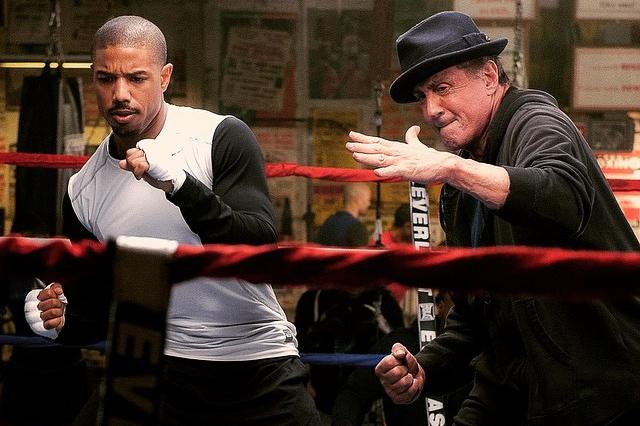
Adonis Johnson (Jordan) never knew his famous father, world heavyweight champion Apollo Creed, who died before he was born. Still, there’s no denying that boxing is in his blood, so Adonis heads to Philadelphia, the site of Apollo Creed’s legendary match with a tough upstart named Rocky Balboa.

Once in the City of Brotherly Love, Adonis tracks Rocky (Stallone) down and asks him to be his trainer. Despite his insistence that he is out of the fight game for good, Rocky sees in Adonis the strength and determination he had known in Apollo—the fierce rival who became his closest friend. Agreeing to take him on, Rocky trains the young fighter, even as the former champ is battling an opponent more deadly than any he faced in the ring.

With Rocky in his corner, it isn’t long before Adonis gets his own shot at the title…but can he develop not only the drive but also the heart of a true fighter, in time to get into the ring?

Sylvester-Stallone-creedMany have interpreted that to mean that, while training Adonis, Rocky will be battling cancer.  With the exception of the first one and Rocky V, every installment in the Rocky franchise has featured a character either dying or coming close.  Since Paulie will apparently not be appearing in Creed, that leaves Rocky himself as the most likely candidate to tragically pass away before or after the big fight.  In death, Rocky would not only pass on his legacy Adonis Creed but Sylvester Stallone would pass on the Rocky franchise to Ryan Coogler and Michael B. Jordan.

With his days possibly numbered, I decided to take a look back at Rocky Balboa’s amazing career.

Rocky (1976)

Sylvester Stallone was just another out-of-work actor when, one night in 1975, he saw a little known boxer named Chuck Wepner go 15 rounds against the reigning heavyweight champion, Muhammad Ali.  Inspired by the fight, Stallone wrote the first draft of Rocky in three days.  When he sold his script, he did so with one condition: that he be allowed to play Rocky Balboa.  You know the rest of the story: Directed by John G. Avildsen, Rocky became a huge box office hitwon the Oscar for best picture of the year, and made Sylvester Stallone into an unlikely star.
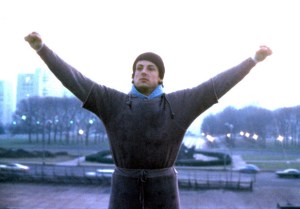
618_movies_rocky_10Rocky Balboa is an aging boxer and a collector for Philadelphia loan shark, Tony Gazzo (Joe Spinell).  The current heavyweight champion, Apollo Creed (Carl Weathers), is scheduled to fight a match in Philadelphia in honor of America’s bicentennial.  When his opponent injures his hand, Apollo decides to give a local boy a chance and the unknown Rocky gets a once-in-a-lifetime shot at the title.  Nobody gives Rocky a chance, except for Rocky.  With the help of grizzled trainer Mickey (Burgess Meredith) and alcoholic best friend, Paulie (Burt Young), Rocky prepares for the fight.  After a training montage (the first of many) that ends with Rocky running up the steps of the Philadelphia Museum of Art, Rocky shocks everyone by going the distance against Apollo.  Though he loses by a split decision, Rocky wins both his self-respect and the love of Paulie’s sister, Adrian (Talia Shire).

Rocky holds up as one of the best boxing movies ever made and it set the standard by which almost all future underdog sports movies have been judged.  Rocky may have ended with Rocky ready to take off his gloves and concentrate on his life with Adrian but the box office demanded that Rocky get another once-in-a-lifetime shot.

Rocky II (1979)

The first Rocky may have ended with Apollo saying there would be no rematch and Rocky replying that he did not want one but the film’s box office success said otherwise.  In Rocky II, Apollo is stung by criticism over how he nearly lost his first fight against Rocky and demands a rematch.  At first, Rocky refuses but, with no prospects and a wife, son, and alcoholic brother-in-law to support, Rocky finally agrees to a rematch.  What follows is largely a repeat of the first film, except this time Rocky has a lot more fans following him through the streets of Philadelphia during his training montage and Rocky actually wins the fight, becoming the heavyweight champion of the world.
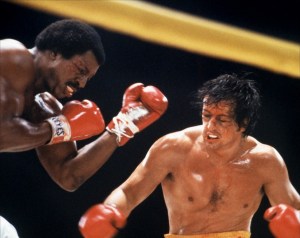
rocky-ii-1979-01-gThe best thing about Rocky II is that it fleshes out the character of Apollo.  No longer is he just the cocky villain from the first film.  Instead, he is revealed to be a proud man, a fierce competitor, and a worthy opponent. Though he may lose the final fight, Apollo regains the respect that he sacrificed as the end of the first film.

Rocky II is also notable for being the first film in the franchise to be directed by Sylvester Stallone.  Stallone would direct all of the subsequent installments, with the exception of the John G. Avildsen-directed Rocky V.

Rocky III (1982)
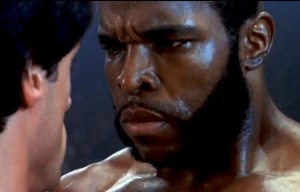
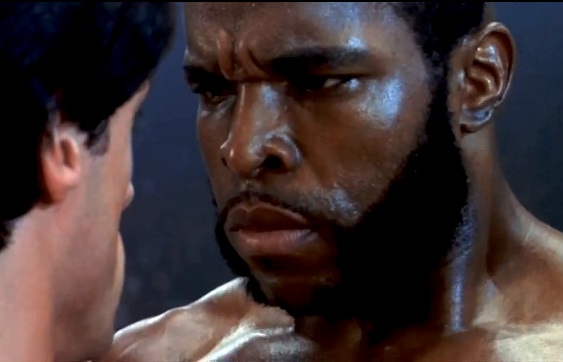
mr-t-plays-clubber-in-rocky-iiiRocky III has the best opening of the franchise.  While Rocky does commercials and trades jokes with Kermit and Miss Piggy on The Muppet Show, Clubber Lang (Mr. T) relentlessly trains and savagely knocks out every opponent that he faces in the ring.  The premise of the first two films has been reversed.  Now, Rocky is the overconfident champion who does not take his latest fight seriously while Clubber Lang is the challenger who is hungry for victory.  Clubber has the “eye of the tiger” and is determined to win.  Rocky is busy doing charity events with Hulk Hogan and bailing alcoholic freeloader Paulie out of jail.

Rocky III features the first death of the franchise, when Clubber shoves Mickey so hard that Mickey ends up having a heart attack and dying almost immediately after Clubber defeats Rocky and becomes the new heavyweight champion of the world.  As if Rocky needed another reason to demand a rematch, Mickey’s death makes it personal.  Unfortunately, Rocky has lost his hunger.  He no longer has the eye of the tiger.

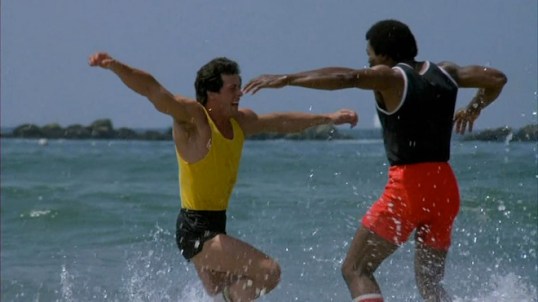
Fortunately, Rocky’s former rival, Apollo Creed, is there to help him get it back.  Taking over as Rocky’s trainer, Apollo gets the former champion back into fighting shape.  This means that it is time for a training montage!  This one ends with a great moment in bromance history as Rocky and Apollo embrace while jumping up and down in the ocean.

2009654-rocky_iii_l_oeil_du_tigre_1983_07_gRocky III ends with what may be the best fight in the history of the franchise.  It is also the only fight to be shown straight from beginning to end, without jumping to future rounds.  From the start of the fight, it is obvious that Clubber is stronger than Rocky but, taking a page from the rope-a-dope strategy that Muhammad Ali used on George Foreman in Zaire, Rocky knows that Clubber is so aggressive that he will tire himself out before the end of the fight.  Once Clubber has exhausted himself, Rocky sends him down to the canvas.

At the end of the film, Rocky and Apollo square off one last time to see who is truly the best boxer.  The film ends before the first punch is thrown and we never find out who won.  I like to think that it was Apollo, if just because I know what is going to happen to him in Rocky IV.

Rocky IV (1985)
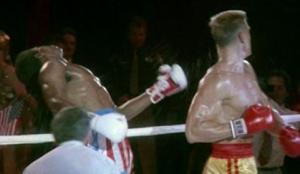
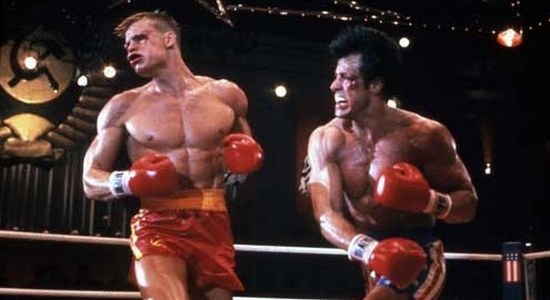
Ivan_kills_ApolloHaving defeated every contender in the U.S., it only made sense that Rocky’s next opponent would come from the evil empire itself, the Soviet Union.  But before Rocky could battle Ivan Drago (Dolph Lundgren), someone had to die.  This installment’s sacrificial victim was none other than Apollo Creed.  Apollo dies in the ring, beaten to death by the robotic Russian.  Of all the deaths in the Rocky franchise, Apollo’s was the most shocking and the most traumatic.  After Apollo falls face forward onto the mat, his body is still twitching even as Ivan says, “If he dies, he dies.”

Knowing that he should have been in the ring instead of Apollo, Rocky challenges Drago to a rematch, to be held in Moscow on, of all days, Christmas.  Leaving behind his mansion, his son, and his robot (yes, Rocky owns a robot in this one), Rocky goes to Siberia and that means that it is time for a training montage!  While Drago trains with machines and shoots steroids, Rocky trains by chopping wood and running in the snow.
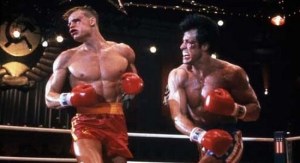
lXRPTbIt’s a tough fight.  At first, Drago does not even seem to feel Rocky’s punches.  The Soviet audience (including someone who looks a lot like Mikhail Gorbachev) chants Drago’s name.  Just like in Philadelphia, Rocky refuses to go down.  The crowd starts to chant Rocky’s name.  When Drago’s manager demands that he win the fight in the name of communism, Drago shouts that he does not fight for the Soviet Union, he fights for himself.  Finally, with seconds left in the final round, Rocky knocks Drago out.
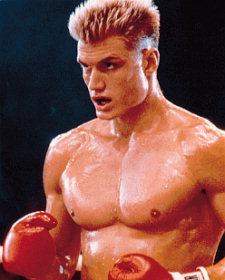
Lundgren_Ivan_DragoAs a bloody Drago looks on, Rocky literally wraps himself in an American flag and gives a speech.  Rocky thanks the Americans and the Soviets for supporting him and then says, “”If I can change, and you can change, then everybody can change!”  Gorbachev stands and applauds.  Is it just a coincidence that, four years later, the Berlin Wall fell and the Cold War ended?

Rocky IV may be the best remembered of all of the Rocky films.  Ivan Drago was Rocky’s greatest and most imposing opponent and it is not surprising that, despite killing Apollo, he still has a strong fan base.  Unlike Clubber Lang, Ivan is a cold and methodical machine.  Rocky’s improbable win over him is not just a victory for America but a victory for humanity as well.

Rocky V (1990)

Is Rocky V canonical?  A lot of fans consider this to be the weakest film in the franchise.  Despite writing the film’s screenplay, Sylvester Stallone reportedly hates Rocky V and ignored it when he made Rocky Balboa.
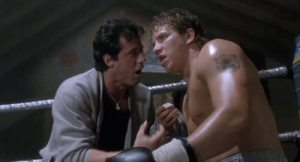
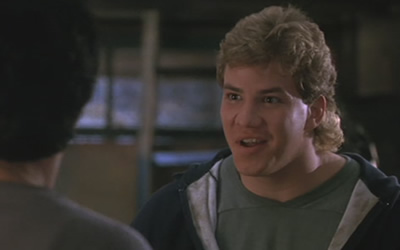
rocky-5Rocky V starts with Rocky retiring after being told that his battle with Drago has left him with permanent brain damage.  Paulie, proving once again that he’s the worst best friend that anyone could hope for, loses all of Rocky’s money.  Rocky, Adrian, and Rocky, Jr. (now played by Sage Stallone) move back to the old neighborhood.  Following in the footsteps of Mickey and Apollo, Rocky trains a mulletheaded young boxer named Tommy Gunn (Tommy Morrison).  Instead of a training montage, we get a fight montage as Tommy becomes a champion but rejects Rocky’s management and signs with Don King George Washington Duke (Richard Gant).  Tommy and Rocky eventually face off in a street fight.  Originally, the plan was for Rocky to die at the end of the fight but, fortunately, someone in production realized that nobody would want to see Rocky Balboa beaten to death by Tommy Morrison.
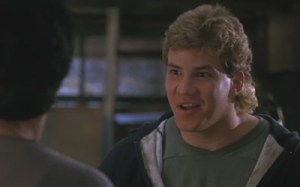
551-3Tommy Morrison was a real-life boxer.  Rocky V was his only film role and he’s almost too convincing as the dim-witted Tommy Gunn.  In the real world, Tommy Morrison was suspended from boxing in 1996 when he tested positive for HIV.  He spent the rest of his life loudly insisting that the test was a false positive and trying to make a comeback.  He was 44 years old when he died of AIDS in 2013.

Rocky V suffers because Tommy Gunn and George Washington Duke cannot begin to compare to great Rocky opponents like Clubber Lang and Ivan Drago.  However, Rocky V does feature one of the franchise’s best endings.  Rocky and Rocky, Jr. jog up the steps of the Philadelphia Museum of Art and, father and son together, they finally decide to enter the building and discover what’s inside.

Rocky Balboa (2006)

After the critical and box office failure of Rocky V, it seemed like Rocky Balboa had retired for good.  However, after 16 years of well-deserved retirement, Rocky followed the path of George Foreman, Larry Holmes, and Riddick Bowe and decided to make a comeback.

guide_cemeteryAs Rocky Balboa begins, Rocky is a widower and owns an Italian restaurant named Adrian’s, where he spends most of his time telling patrons stories about his fighting career.  He is estranged from his son, who now wants to be called Robert and is played by Milo Ventimiglia, but Rocky still has his best friend Paulie.  If not for Rocky, Paulie would probably be living in a cardboard box.  After a computer simulation suggests that Rocky, in his prime, could have defeated the reigning heavyweight champion, Mason Dixon (Antonio Tarver), Rocky comes out of retirement for one last fight.  With the help of Apollo’s former trainer, Duke (Tony Burton), Rocky proves that he can still go the distance, even though he ultimately loses the fight in a split decision.

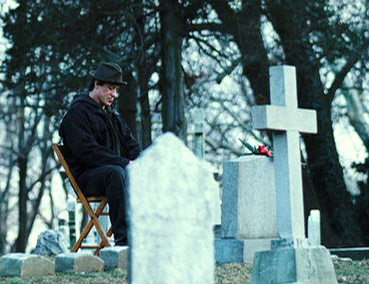
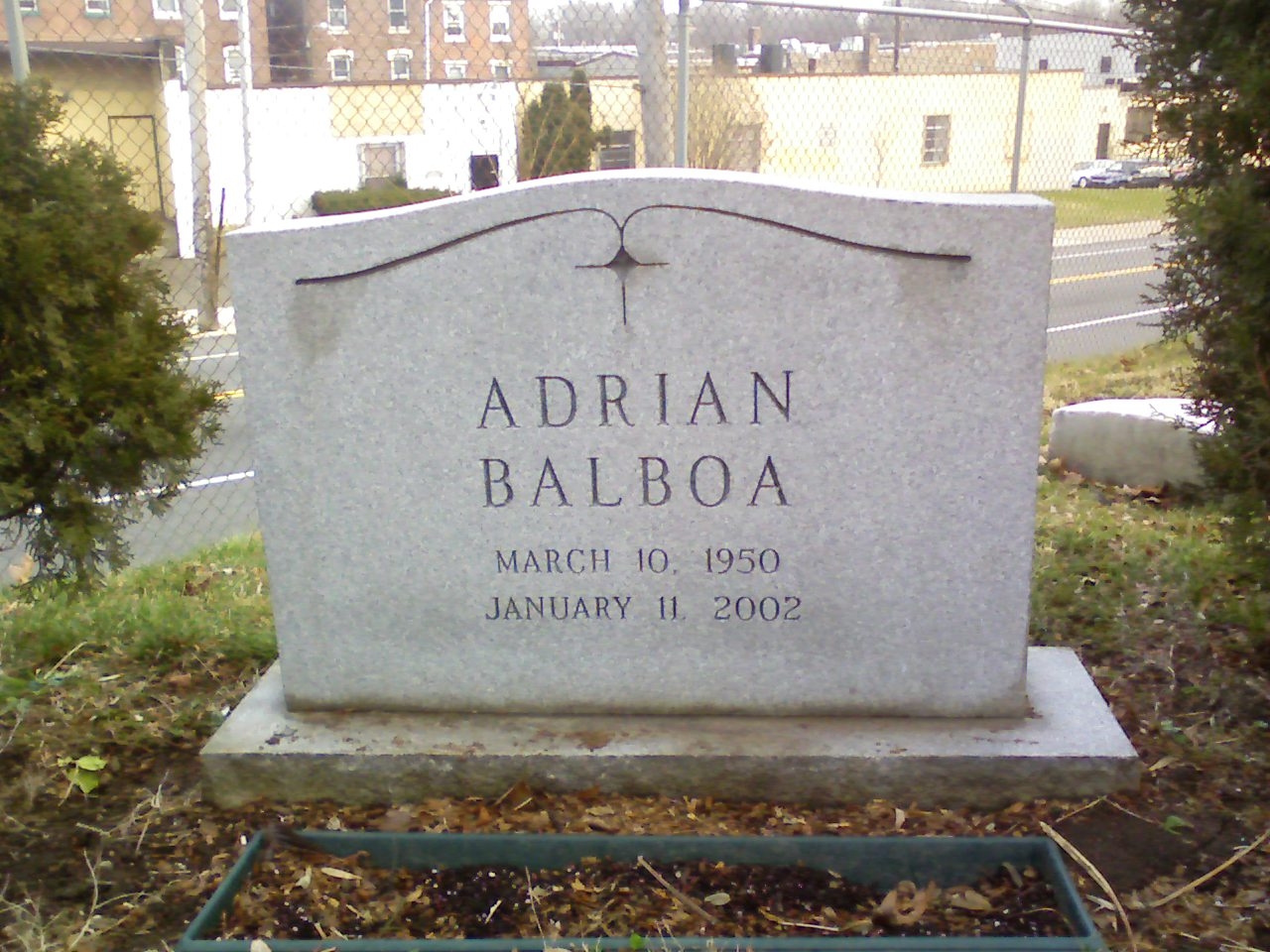
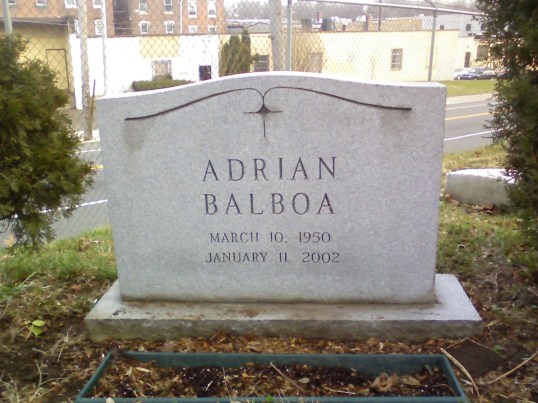
At the start of the film, Adrian has been dead for four years.  However, her ghost haunts the film.  Rocky regularly visits her grave and the film ends with him at her grave and saying, one last time, “Yo Adrian, we did it.”  Stallone may be the battered face of the Rocky franchise but Talia Shire was the heart.  Though she’s only seen in flashback, Rocky Balboa is a tribute to the way that Talia Shire brought Adrian to life.

Sentimental and nostalgic, Rocky Balboa felt like the perfect way to end the franchise.  However, Rocky will be returning for at least one more fight when Creed is released on November 25th.
01070815061

In Praise of Mad Max: Fury Road’s Crazy Guitar Guy


Mad Max: Fury Road opened this weekend and, taking in 45 million at the box office and maintaining an amazing 98% rating at Rotten Tomatoes, it has thrilled both critics and audiences.  From George Miller’s breakneck direction to Charlize Theron’s performance as a one-armed warrior queen, there is much to praise about Mad Max: Fury Road.   For many, though, the best part of the film is the “crazy guitar guy.”

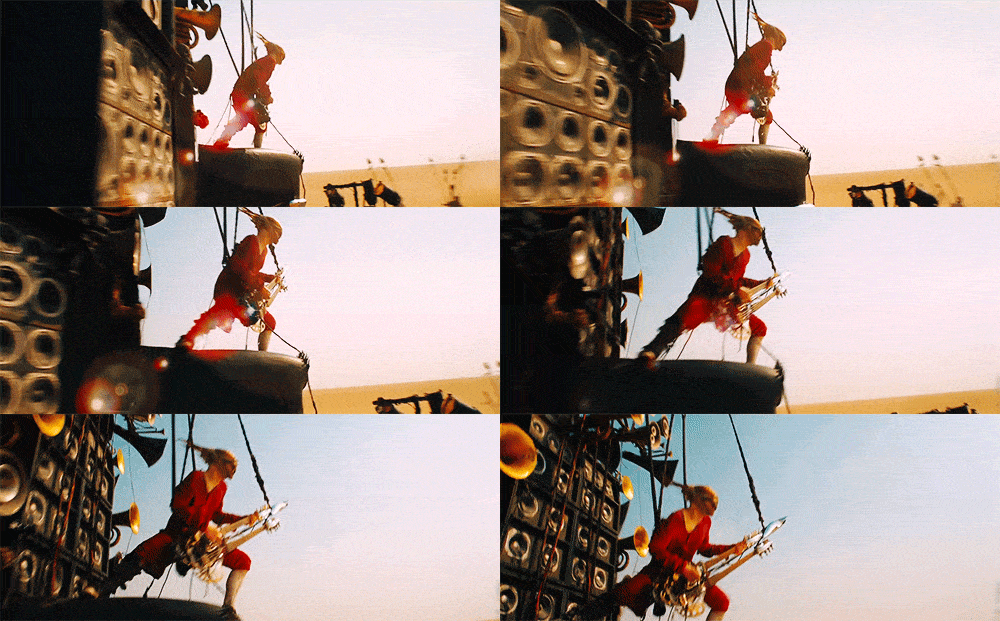
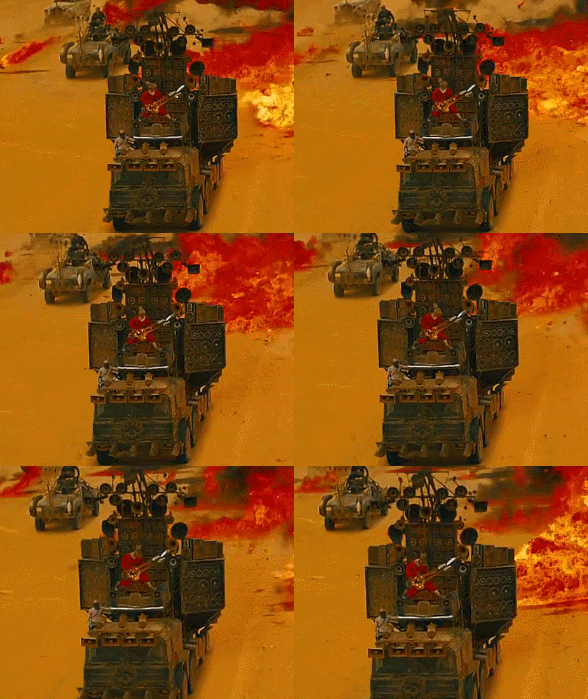
iotaIf you have seen Max Max: Fury Road, you know exactly who I am talking about.  He is the red jumpsuit-wearing, masked man who plays a mean guitar and wields a flamethrower at the same time.  When the War Boys chase Furiousa and Max across the desert, he is a passenger on a massive truck.  On the back of the truck, drummers pound away.  On the front of truck, he dangles above a stack of speakers and amplifiers while playing a double-neck guitar that is also a flame thrower.  Though he is known to many as simply being the crazy guitar guy, his character has a name.  He is Coma, the Doof Warrior.  In just one weekend, he has become a cult hero.

iOTA

iOTA

The Doof Warrior is played by Australian musician and theatrical actor, iOTA (born Sean Hape).  In an interview with Yahoo Movies, iOTA describes the Doof Warrior as being “a post-apocalyptic drummer boy.”  From the drummer boys who played and often died on Civil War battlegrounds to the modern-day soldiers who blasted Rock the Casbah during the Invasion of Iraq, music and war have always gone together.  The Doof Warrior’s heavy metal riffs are the perfect battle music for Mad Max‘s hyper-masculine War Boys.

Why, in a film full of crazy characters and exciting moments, has the Doof Warrior become so popular?  The most obvious answer is that he looks cool and he has a flamethrower.  However, another reason is that we know nothing about him.  For all the attention that he has received, the Doof Warrior is only onscreen for a handful of minutes and he has no dialogue.  Miller and iOTA worked out an elaborate backstory for the Doof Warrior but none of it is revealed in the movie.  Much like Boba Fett in The Empire Strikes Back (and before the character was ruined with Attack of the Clones), the Doof Warrior remains an enigma who can be whatever we want or need him to be.

Iota3Beyond that, the Doof Warrior is living the fantasy of everyone who has ever played air guitar or spent hours debating whether James Hetfield or Kirk Hammett is the better guitarist.  Anyone who has ever taken a guitar lesson has fantasized about watching an audience go mad while listening to his music.  The War Boys may be going to war but the Doof Warrior is playing the greatest concert of his life.  No wonder that, even when he is in the middle of a battle, the Doof Warrior never stops playing.

So, before his legacy is tarnished by bad fanfic and tumblr overexposure, let us take a minute to raise a glass to the coolest character in the coolest film of the year, the one and only Doof Warrior.

iota2


What If Aytekin Akkaya Played Captain America?


3devadamThough he may be the most successful, Chris Evans is not the first actor to have played the role of Captain America.  As befits a character that has been around since World War II, Cap has been played by several different actors over the years.  Before Chris Evans and the character became a part of the Marvel Cinematic Universe, the role was played by Matt Salinger.  Before Matt Salinger, there was Reb Brown.  Before Reb Brown, there was Ayetkin Akkaya.  Before Aytekin Akkaya, there was Dick Purcell and…

Wait!  Aytekin who!?

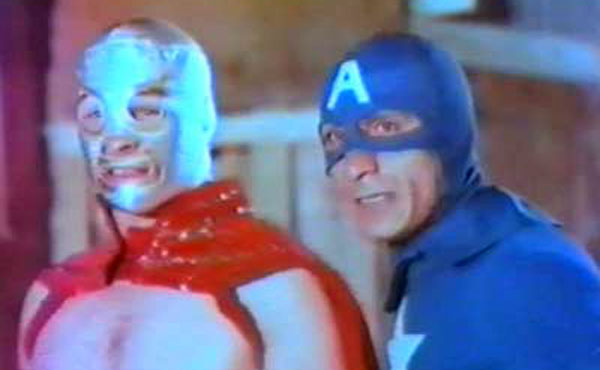
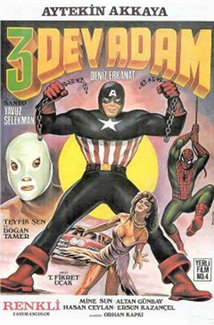
Aytekin Akkaya is the actor who played Captain America in the Turkish film, 3 Dev Adam (also known as Three Mighty Men, Turkish Spider-man, and Turkish Captain America and Santo vs. Spider-Man).   Produced in an alternative universe where there is no such thing as copyright law, 3 Dev Adam is perhaps the strangest Captain America film that you will ever see.

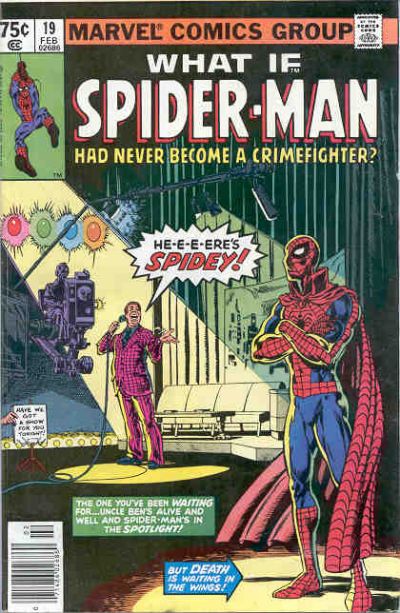
What_If-_Vol_1_193 Dev Adam reminds me of the old Marvel series, What If?  What If showed what would have been the result if certain events in Marvel continuity had happened differently.  A typical issue would have a title like What If Ben Parker Had Not Died or What If Magneto Killed Professor Xavier or What If Rob Liefeld And Jim Lee Had Not Been Hired For Heroes Reborn?  Regardless of the question, the answer was almost always that a hero would have turned into a villain and everyone would be dead by the end of the issue.  3 Dev Adam could have easily been called What If Spider-Man Was A Psychotic Serial Killer?

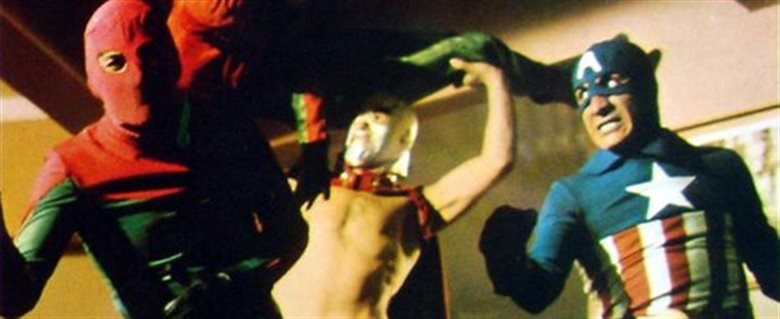
The film opens with a screaming woman being buried up to her neck in sand.  An evil criminal demands information from her and, when he does not get it, he has her killed with a boat propeller.  Who is this psycho?  None other than your friendly neighborhood Spider-Man!  However, this Spider-Man is not Peter Parker or Miles Morales.  He is not even Ben Reilly.  This Spider-Man is a serial killer who steals valuable antiques, sells them to collectors, and then buys them back with counterfeit money.  He does not climb walls or listen to his spidey sense.  Instead of shooting webs, he attacks with a switchblade.  Instead of making jokes and worrying about Aunt May, this Spider-Man laughs and feeds one incompetent subordinate to a hungry gerbil.  This Spider-Man has no Mary Jane Watson or Gwen Stacy in his life.  Instead, he has a girlfriend named Nadia.  When he has sex with her, they are watched by three laughing puppets.
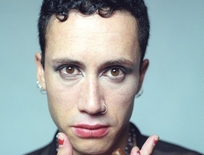
3DEV+2Spider-Man has committed numerous murders in Istanbul.  The police are powerless to stop him so the authorities ask for international help.  The United States sends Captain America and his girlfriend Julia.  Mexico sends famous wrestler Santo.  When the three of them first show up at the Istanbul airport, a snippet of the score from Diamonds Are Forever is heard, reminding us that almost everything in this movie has been stolen.

There are some differences between the Captain that we all know and the Captain played by Aytekin Akkaya.  Akkaya’s Captain America does wear a red, white, and blue costume but he does not carry a shield and his mask does not have wings on either side of his head.  This Captain is trained in karate and has no trouble killing people.  He also enjoys hanging out in strip clubs, which is something that you would never catch the MCU’s Cap doing.  As far as personality is concerned, this Captain America has more in common with Robert Downey, Jr’s Iron Man than with the character played by Chris Evans.

3-dev-adamCaptain America and Santo’s strategy for stopping Spider-Man consists of standing around and waiting for Spider-Man and his goons show up.  They then fight until Spider-Man either escapes or dies.  It turns out that this Spider-Man does have one additional superpower.  Whenever he dies, a new Spider-Man appears nearby and continues fighting.  This leads to a climax where Cap kills Spidey in a number of gruesome ways, just to have a new Spider-Man materialize and laugh at him.  By the end of the film, the screen is littered with dead Spider-Men.
3 Dev Adam is such a strange film that it is almost impossible to review.   If you have ever wanted to see Captain America and Spider-Man fight to the death (over and over again), this is the film for you.  As for Aytekin Akkaya, 3 Dev Adam was the only time that he ever played Captain America.  But anyone who has seen 3 Dev Adam will never forget him.

splash_780