Review: Miami Vice (dir. by Michael Mann)


Michael Mann has always been in the forefront of experimenting and trying out new film techniques and styles to tell his stories. 2003’s Collateral was a veritable masterpiece of directing of a modern, urban noir. He even made Tom Cruise very believable as a sociopathic character. In 2006, Michael Mann followed up Collateral with another trip down the darkside of the law and crime. Taking a concept he made into a cultural phenomenon during the mid 80’s, Mann reinvents the show Miami Vice from the pastel colors, hedonistic and over-the-top drug-culture Miami of the 1980’s to a more down, dirty and shadowy world of the new millenium where extremes by both the cops and the criminals rule the seedy, forgotten side of the city.

Michael Mann’s films have always dealt with the extremes in its characters. Whether its James Caan’s thief character Frank in Thief, the dueling detective and thief of Al Pacino and Robert DeNiro in Heat, up to Foxx and Cruise’s taxi driver and assassin in the aforementioned Collateral. They all have had one thing in common. They’re individuals dedicated to their chosen craft. Professional in all respect and so focused to doing their job right that they’ve crossed the line to obsession. It is this obsession and how it governs everything they do which almost makes it into their own personal form of drug.

This theme continues in Mann’s film reboot of his TV series Miami Vice. The characters remain the same. There’s still the two main characters of Vice Detectives Sonny Crockett and Ricardo Tubbs. This time around these titular characters were played by Colin Farrell (in a look that echoes Gregg Allman more than Don Johnson) and Jamie Foxx. From the first moment the first scene suddenly appears all the way through to the final fade to black in the end of the film, the audience was thrust immediately into the meat of the action. Mann dispenses with the need for any sort of opening credits. In fact, the title of the film doesn’t appear until the end of the film and the same goes for the names of all involved. I thought this was a nice touch. It gave the film a stronger realism throughout.

The film’s story was a mixture of past classic episodes rolled into one two-hour long film with the episode “Smuggler’s Blues” being the main influence on the story. The glamour and glitz that were so prevalent in the original series does show up in the film, but it’s not used too much that it turned the characters of Crockett, Tubbs and the rest of the cast into caricatures. The glamour seems more of a thin veneer to hide the danger inherent in all the parties involved. These people were all dangerous from the cops to the criminals. There’s a lot of the so-called “gray areas” between what makes a cop and what makes a criminal. Mann’s always been great in blurring those lines and in showing that people on either side of the line have much more in common than they realize.

Miami Vice‘s story doesn’t leave much for back story exposition for the main leads. Michael Mann takes the minimalist approach and just introduces the characters right from the beginning with nothing to explain who they were outside of the roles they played — whether they were law-enforcement or drug dealers. The script allows for little personal backstory and instead lets the actors’ performance show just what moves, motivates and inspires these characters. Again, Jamie Foxx steals the film from his more glamorous co-star in Colin Farrell. Farrell did a fine job in making Crockett the high-risk taking and intense half of the partnership, but Foxx’s no-nonsense, focused intensity as Tubbs was the highlight performance throughout the film.

The rest of the cast do a fine job in the their roles. From Gong Li as Isabella, the drug-lord’s moll who also double’s as his organization’s brains behind the finances to Luis Tosar as the mastermind drug kingping Arcángel de Jesús Montoya. Tosar as Montoya also does a standout performance, but was in the screen for too less a time. Two other players in the film I have to make mention of were John Ortiz as Jose Yero who was Montoya’s machiavellian spymaster and Tom Towles in a small, but scary role as the leader of the Aryan Brotherhood gang hired by Yero to be his Miami enforcers. Both actors were great in their supporting role and more than held their own against their more celebrated cast mates.

This film wouldn’t be much of a police crime drama if it was all talk and no action. The action in Miami Vice comes fast and tight. Each scene was played out with a tightness and intensity which prepped the audience to the point that the violence that suddenly arrives was almost a release. Everyone knew what was coming and when the violence and action do arrive it goes in hard and fast with no use of quick edits, slow-motion sequences or fancy camera angles and tricks like most action films. Instead Michael Mann continues his theme of going for realism even in these pivotal moments in the film.

The shootouts doesn’t have the feel of artificiality. The gunshots inflicted on the people in the film were brutal, violent and quick. The camera doesn’t linger on the dead and wounded. These scenes must’ve taken only a few minutes of the film’s running time, but they were minutes that were executed with Swiss-like precision. The final showdown at an empty lot near the Miami docks was organized chaos with the scene easy to follow yet still keeping a sense of anarchy to give the whole sequence a real sense of “in the now”.

The look of the film was where Mann’s signature could be seen from beginning to end. He started using digital cameras heavily in Collateral. His decision to use digital cameras for that film also was due to a story mostly set at night. The use of digital allowed him to capture the deepest black to off-set the grays and blues of Los Angeles at night. Mann does the same for Miami Vice, but he does Collateral one better by using digital cameras from beginning to end. Digital lent abit of graininess to some scenes, but it really wasn’t as distracting as some reviewers would have you believe. In fact, it made Miami Vice seem like a tale straight out of COPS or one of those reality police shows.

Michael Mann stretches the limits of what his mind and technology could accomplish when working in concert. Mann’s direction and overall work in Miami Vice could only be described as being as focused and obsessive over the smallest detail as the characters in his films. This is a filmmaker who seem to want nothing but perfection in each scene shot.

With Miami Vice, Michael Mann has done the unthinkable and actually made a film adaptation of a TV show look like an art-film posing as a tight police drama. Everyone who have given the film a less than stellar review seem to have done so because Mann didn’t use the 80’s imagery and sensibilities from the original show. There were no pastel designer clothes and homes. There was no pet alligator and little friendly banter and joking around. Mann goes the other way and keeps the mood deadly serious. This was very apropo since the two leads led mortally dangerous lives as undercover agents who could die at the slightest mistake. The fun and jokes of the original series would’ve broken the mood and feel of this film. I, for one, am glad Mann went this route and not paid homage to the original series. This some saw as a major flaw, but I saw it as the main advantage in keeping Miami Vice from becoming a self-referential film bordering on camp.

Miami Vice was a finished product thats smart, stylish, and innovative crime drama. This was a film that people would either love despite some of the flaws, or one people would hate due to not being like the original TV series. Those who decide to skip watching Miami Vice because of the latter would miss a great film from one of this generation’s best directors. Those who do give this version of Miami Vice a chance would be rewarded with a great tale of cops and criminals and the obsession they have in their set roles.


That Insidious Trailer


A new horror film called Insidious is due to open on the 1st of April and, as a result, I’ve been inundated with the trailer lately.

This trailer leaves me curious.  I have a feeling that the movie’s going to be a big disappointment (for one thing, it’s rated PG-13 which is usually not a good sign when it comes to horror films) but the trailer has its moments.  So, unless Insidious is just an elaborate April Fool’s joke, I’ll be there to see it when it opens.

Video Game Power Rankings


Recently, as I settled myself into my cheap office chair, I realized that there was a stack of 360 games which was sitting on the table between my actual workspace (computers, etc.), and the TV with the 360 hooked up to it. My mouth twisting in annoyance, I inspected these games, determining which ones needed to go where on ‘the rack’. The rack is where games go to die after they’ve escaped immediate interest, especially in a climate like March of 2011… a climate in which new games are constantly being released.

A few games went on the rack. Others, I knew, had to stay out. Why? Because they’re go-to games. They’re games I need on-demand. This is 2011. If it takes me longer than 20 seconds to achieve video game bliss, I am doing it wrong. But it did get me thinking. What games are sitting on top of that stack? Which ones does Steam claim I’m addicted to? Which PC games are relevant enough to where I actually keep track of their DVDs?

So I thought, why not talk about video games the way I talk about sports? Why not have a power poll? After all, there are games which dominate my time, and those which do not. Not all of the games which occupy my attention are new. Not all of them are critically acclaimed. Not even all of them I would take the time to review (unless someone really wanted me to, I guess. I can probably write 2,000 words about any video game at this point). But these games do share a certain quality which sets them above and beyond the average title. These are games that I actually want to keep playing. Some games might make the list, from time to time, simply because I need to finish them in order to write a review (or, from a more fiscally responsible standpoint, mail them back to Gamefly) … but not all. Not even most. That stack which remains ever at my fingertips is video gaming bliss.

At least, today, it is. Tomorrow, who knows? So I thought I would share a few titles from ‘the stack’. You can think of that as a metaphor from now on. It represents the sum total of my gaming experience, from 360 titles through Steam downloads. These are the kind of games that I’d think about, for a flickering flame of an instant before slapping myself back to reality, turning down sex for. These are games which I can disappear into, and later boast about the accomplishments rather than hanging my head in shame over the time-sink. I think that’s enough adieu. Let’s agree to stop for now, shall we? Instead, let’s dive into the power poll, in reverse order…

8. Call of Duty: Black Ops – Not nearly the time-sink that it used to be. This reduction in attention has nothing to do with the game itself – which is still pretty fun – but rather due to the inundation of new games forcing their way in. If I had to pick just one multiplayer game to jump into with my friends, it would still be this one… but I’m not sure there’s any reason to play Black Ops solo right now.

7. Command and Conquer: Red Alert 3 – Steam tells me that I love this game, and that I’ve spent prohibitive amounts of time playing it. Unfortunately in this case, Steam is right. I actually had never picked up RA3 on its retail release, but I was unable to refuse Steam’s recent sale on latter-day C&C products. I was hooked pretty much on entry, through a combination of nostalgia and longing for a legitimate RTS release. Ever since I burned out on StarCraft II for no discernible reason, I’ve been looking for another strategy game to fill the void. I guess this one is it. At least, for now.

6. Civilization 5 – A perennial power-poll contender. The Civ series is a fall-back position for me. Anytime I hunger for immersion and a way to kill a two-hour-block, I fall back on this series. Ever since I embraced the latest incarnation over Civilization IV it’s been a no-brainer.

5. Bulletstorm – As I’ve stated before, this is a great game. I’m just not sure how replayable it really is. Given time, I’m sure I could play through the single player again and love every instant of the carnage… but in the meantime, the lack of variety in the multiplayer mode has this one shelved behind some of the newer titles, and some of my perennial all-stars.

4. Marvel vs. Capcom 3: Fate of Two Worlds – The DLC for Jill Valentine and Shuma Gorath is hideously overpriced. That having been said, having Jill back in the fold has totally re-ignited my interest in the game. I now play it as a kind of bridge between other more ‘serious’ games. I remain terrible at multiplayer MvC3. If you want easy winds, challenge me.

3. League of Legends – Continuing their unending trend of new champions, game state patches, and new content, Riot Games continues to impress with their tactical multi-player smash. I’m sure the microtransactions in this game are making everyone involved rich, too… which bothers me only in that I’m not involved in the collection of cash.

2. MLB 2K11 – I play two sports games every season; MLB 2KXX and Madden NFL. I will sometimes also trot out NCAA Football… but not often. Anyway, the latest version of MLB 2K isn’t exactly a re-invention of the wheel. We’ve known the rules of major league baseball since 1898, and Bud Selig remains as committed to stagnation as ever. There’s not a ton of new features to be desired in this latest incarnation, but the graphics are even better than ever, and the pitching and hitting controls are as good as I could conceive of a way to make them. There isn’t much to hate in this latest title.

1. Dragon Age II – Immersive doesn’t begin to cover this one. I’ve heard a lot of the complaints about this game… and my succinct retort would probably be something like: “I love this game. I hate listening to reason. So let’s not discuss it.” Frankly, that, and the enormity of what I have to say about this title, are the core reasons that I haven’t tried to review it yet. Fear not… thoughts are forthcoming… but I suppose after a certain point a true review doesn’t do anyone any good.

Initially, I had intended to make this a ten-game feature.. .but then I figured, why push it? These are the games that currently snare me. I’m playing them a lot. If you don’t know them, they might be worth checking out, and I’m certainly open to discussion. Also, if anyone wants to suggest new games to me that you’d desperately like to see reviewed, or that you think I’d really like… well… don’t be a stranger.

Song of the Day: Rogue Heart from Dragon Age 2 (by Inon Zur and Aubrey Ashburn)


The latest pick for “song of the day” happens to come from a game I just completed playing a first playthrough. The game is BioWare’s latest and the first sequel to their critically-acclaimed fantasy rpg game, Dragon Age: Origins. This time the song is what I would call the “Lelianna’s Song” of Dragon Age 2.

“Rogue Heart” is the song which begins playing once the end credits for Dragon Age 2 begins. The song is once again composed by the same composer who did the music for the first game, Inon Zur. Inon Zur brings back singer Aubrey Ashburn to handle the song. If there was ever a song which I say truly encompassed the relationship of the character I created and played through in the game, Lisamarie Hawke, it would be this song. It’s not just typified the character but the relationship she had with one of the party members that was recruited. The pirate rogue Isabela (the character artwork in the video is Isabela) would be Lisamarie’s companion the moment the two met and would see the game right through to its climactic and ominous ending.

It’s only appropriate that both Lisamarie Hawke and Isabela were rogues thus this song fit them like bodyhugging gear. The game was better than I thought and I would say the same to its accompanying soundtrack and “Rogue Heart” is another example why rpg soundtracks always typified the best of any game soundtracks.

Poll: Lisa Marie Submits To Your Will


Last year, I gave up control to the reader of the site and you know what?  I kinda liked it in a sneaky, dirty little way.  So I figured, why not do it again?

Of course, I’m sure you’ve already guessed that I’m referring to my What Movie Should Lisa Marie Review poll.  This is the poll that led to me reviewing Anatomy of a Murder. 

Here’s how it works.  Earlier today, I put on a blindfold and then I randomly groped through my DVD collection until I had managed to pull out ten movies.  I then promptly stubbed my big toe on the coffee table, fell down to the floor, and spent about 15 minutes cursing and crying.  Because, seriously, it hurt!  Anyway, I then took off the blindfold and looked over the 10 movies I had randomly selected.  Two of them — Dracula A.D. 1972 and A Blade in the Dark — were movies that I had already reviewed on this site.  So I put them back and I replaced them with two movies of my own choosing — in this case, Eternal Sunshine of the Spotless Mind and The Unbearable Lightness of Being.

Between now and next Sunday (March 27th), people will hopefully vote in this poll.  On Sunday, I will watch and review whichever movie has received the most votes.  Even if that movie turns out to be Incubus. *shudder*  (Have I mentioned how much I love Eternal Sunshine of the Spotless Mind?)

Now, of course, there’s always the possibility that no one will vote in this poll and I’ll end up looking silly.  Those are the risks you take when you set up an online poll.  However, I have a backup plan.  If nobody votes, I will just spend every day next week shopping for purses at Northpark Mall and then blogging about it.  And by that, I mean blogging every single little detail.  So, it’s a win-win for me.

Anyway, here’s the list of the 10 films:

1) Barbarella — From 1968, Jane Fonda plays Barbarella who flies around space while getting molested by …. well, everyone.  Directed by Roger Vadim.

2) Barry Lyndon — From 1975, this best picture nominee is director Stanley Kubrick’s legendary recreation of 18th-century Europe and the rogues who live there.

3) Caligula — Yes, that Caligula.  From 1979, it’s time for decadence, blood, and nudity in the Roman Empire.  Starring Malcolm McDowell, Helen Mirren, Peter O’Toole, John Gielgud, John Steiner, and Theresa Ann Savoy.

4) Eternal Sunshine of the Spotless Mind — Oh my God, I love this movie.  Jim Carrey breaks up with Kate Winslet and deals with the pain by getting his mind erased by Tom Wilkinson, Mark Ruffalo, Kirsten Dunst, and an amazingly creepy Elijah Wood.

5) Incubus — From 1969, this low-budget supernatural thriller not only stars a young William Shatner but it also features the entire cast speaking in Esperanto.  For.  The.  Entire.  Movie.

6) Inland Empire — If you want to give Lisa nightmares, you can vote for David Lynch’s disturbing 3-hour film about lost identity, sexual repression, human trafficking, and talking rabbits.

7) Kiss Me Deadly — From 1955, this Robert Aldrich-directed cult classic features hard-boiled P.I. Mike Hammer and a host of others chasing after a mysterious glowing box and accidentally destroying the world in the process.

8 ) Mandingo — From 1975, this infamous little film is a look at slavery, incest, and rheumatism in the pre-Civil War South.  Starring James Mason, Ken Norton, Perry King, and Susan George.  Supposedly a really offensive movie, one I haven’t sat down and watched yet.

9) Sunset Boulevard — From 1950, hack screenwriter William Holden ends up the kept man of psychotic former screen goddess Gloria Swanson.  Directed by Billy Wilder.

10) The Unbearable Lightness of Being — From 1988, Philip L. Kaufman’s adaptation of Milan Kundera’s classic novel (one of my favorite books, by the way) features Daniel Day-Lewis, Juliette Binoche, and Lena Olin having sex and dealing with ennui.  After I first saw this movie, I insisted on wearing a hat just like Lena Olin did.

Everyone, except for me, is eligible to vote.  Vote as often as you want.  The poll is now open until Sunday, March 27th.

(Edit: Voting is now closed but check below for the results! — Lisa)

Oh dear…Dylan Dog: Dead of Night trailer


I’m not, by any stretch of the imagination, a comic book reader and there’s really only been four comics that I’ve ever actively made it a point to track down and/or read.  One was Strangers in Paradise, which I was introduced to by my first college roommate, who told me that she was my Katchoo.    Secondly, there was an old comic book series from the 70s called Tomb of Dracula that Jeff loves.  The entire series has been collected in four trade paperbacks and, last Christmas, I ordered all four of them.  Of course, since I ordered them all in August (patience and impulse-control not being my strong suit), I had a lot of time to read through them before wrapping them up and giving them away.  (And, to my surprise, I enjoyed them in all of their platform shoed glory.)  Third, there’s The Walking Dead which Arleigh introduced me to.  And finally, there’s Dylan Dog.

I haven’t read a lot of Dylan Dog, largely because it’s an Italian comic and English translations aren’t easy to come across.  (And apparently, when an American company did try to reprint the series in English, they ended up getting sued by the estate of Groucho Marx.)  So, I can’t claim to be an expert on Dylan Dog because almost all of my information about this series comes second-hand.  Honestly, if you asked me to tell you about Dylan Dog, I could probably give you the Wikipedia equivalent of an answer (i.e., that Dylan Dog is a private investigator in London who deals with super natural cases.)

Why does Dylan Dog fascinate me?  Well, some of it is because of what I’ve heard about it from sources that I trust.  I hate that answer because it sounds so flakey and simple-minded but luckily, that’s not the only reason.  There’s also the fact that Dylan Dog’s investigative partner is a guy named Groucho who looks (and apparently acts) just like Groucho Marx.  The other is that Dylan Dog was created by the same author — Tiziano Scalvi — who is responsible for inspiring one of the greatest movies ever made, Michele Soavi’s Dellamorte Dellamore.  In fact, Dellamorte Dellamore started off as an attempt to make a Dylan Dog film and the film’s main character had appeared — in a supporting role — in Dylan Dog.  From what I’ve heard, Dellamorte Dellamore — with its use of the paranormal as a metaphor for alienation and other deeper philosophical concerns — captured the sensibility of Dylan Dog

Finally, one of my favorite authors — Umberto Ecco — is on record as saying, “I can read the Bible, Homer, or Dylan Dog for several days without being bored.”

So, that’s why I raised an eyebrow when I came across the trailer for Dylan Dog: Dead of Night while looking up grindhouse movie trailers on youtube.

And then I watched the trailer and that eyebrow quickly went down.

Number one, no Groucho.  That already indicates that this is a compromised film.  Number two, I may not be able to “read” Dylan Dog but I can look at it well enough to know that Dylan Dog is not a firing-two-guns-at-once type of hero.  Number three — New Orleans?  Bleh.  I’m officially bored with movies that try to be “colorful” by filming in New Orleans.  Number four, Taye Diggs?  I’m sorry but any series that could inspire Dellamorte Dellamore deserves better than New Orleans and Taye Diggs.

Dylan Dog: Dead of Night is scheduled to be released in the U.S. on April 29th, 2011.

Bleh.

Six Trailers of the Supermoon


Picture of supermoon taken by Erin Nicole Bowman

Apparently, as I sit here in my underwear and glasses, the Earth is about as close to the moon as it will ever get.  Because of that, the moon is huge out in the night sky.  Or at least that’s what I’m hearing.  It looks pretty normal to me but anyway, this is being referred to as being “Supermoon.”  I’m not sure why.  If I stood less than an inch from your face, would that suddenly make me Super Lisa? 

But anyway, this weekend’s slightly intoxicated edition of Lisa Marie’s Favorite Grindhouse and Exploitation Trailers is dedicated to Supermoon.

1) Werewolves on Wheels (1971)

Of course, a gigantic full moon would bring a werewolf film with it.  This is one of the thousand or so biker films to come out in the late 60s and early 70s.  These films were interesting mostly from the point of view of how they mixed other genres with the biker conventions.  Werewolves on Wheels did it with lycanthrophy.

2) Werewolf of Washington (1973)

Actually, since it’s a supermoon, we better include two werewolf-themed trailers.  This is for the Werewolf of Washington, starring Dean Stockwell.  For some reason, I’ve actually got several copies of this on DVD (I think this is one of those films that somehow found its way into the public domain) but I’ve yet to actually sit down and watch it.  I think my hesitation has to do with the fact that it appears to be a political satire and it was made in the 70s.  That sounds like a combination for boredom, to be honest.

3) Psych-Out (1968)

Before Dean Stockwell could become a werewolf, he had to serve as Jack Nicholson’s hippie guru in Richard Rush’s Psych-Out.

4) The Shooting (1967)

But before Jack Nicholson could become a hippie, he was a sinister gunman in Monte Hellman’s existential grindhouse western, The Shooting.  The Shooting, which co-stars Warren Oates and Millie Perkins, is an unacknowledged classic and a movie that I’m going to have to review one of these days.  Perkins, by the way, was married to none other than Dean Stockwell.

5) Cockfighter (1974)

And then, 7 years later, Hellman, Oates, and Perkins reunited to make an odd little film called Cockfighter.  This is another film I have to review though I also have to say that, as a former country girl who has actually seen a few cockfights, cockfighting is right up there with dogfighting as far as sickening sadism is concerned.*

6) Macon County Line (1974)

And, of course, while some people in the south were going to cockfights, others were apparently getting killed by redneck lawmen in films like the ’74 classic, Macon County Line.

In honor of Supermoon, I’m going to include two extra trailers.  Seriously, don’t ever doubt that Lisa loves you.

7) The Education of Sonny Carson (1974)

While rural audiences (probably made up of people I’m distantly related to) spent 1974 cheering police brutality and animal cruelty, urban grindhouse audiences were enjoying films like this one.

8 ) Bloody Moon (1981/2)

Finally, since we’re under a supermoon, here’s the trailer for Jesus Franco’s infamous (and frequently banned) slasher Bloody Moon.  I haven’t seen Bloody Moon (copies aren’t that easy to find) but seriously, the involvement of Jesus Franco tells me all I probably need to know.**

—–

*If you’ve got a cock, use it to spread love, not hate.

** Well, we’ll see about that.  I just ordered a copy off of Amazon.

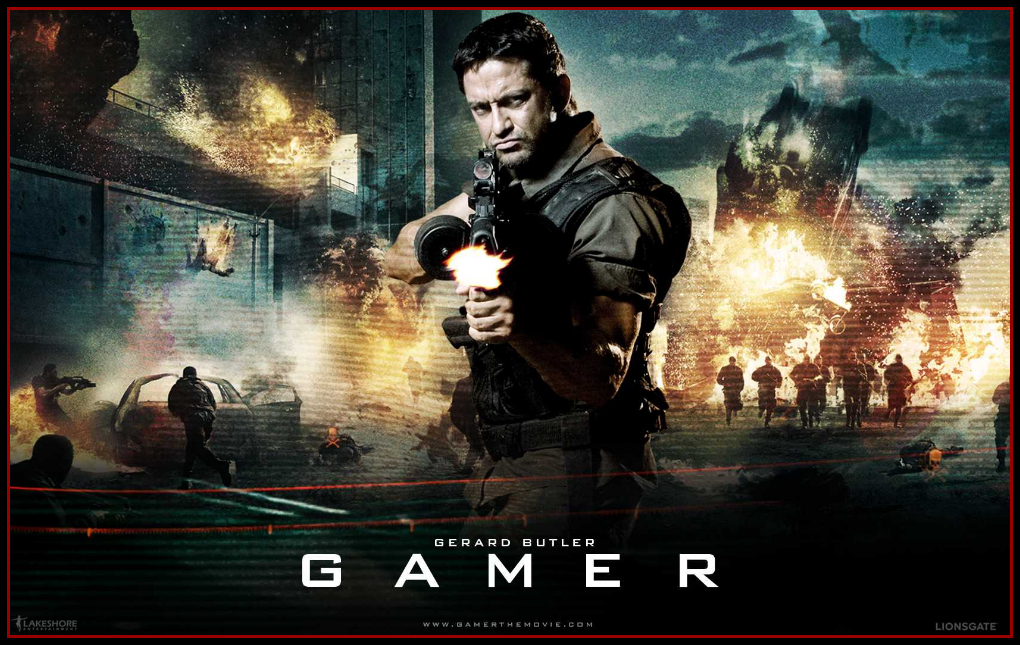
Review: Gamer (dir. by Neveldine/Taylor)


No one will ever mistake the writer-director duo of Neveldine/Taylor (Mark Neveldine and Brian Taylor) as the next Coen Brothers, but they definitely have made their mark in creating entertaining films which some have called exploitative, pandering to the lowest common denominator and exercises in excess. Maybe these critics are right, but they also seem to view the films by these two filmmakers through the narrow-minded lens of their elistist and so-called cineaste sensibilities. They won’t be the next Coen Brothers but they’re way ahead of other so-called filmmaker duos such as The Spierig Brothers (Undead and the pretentious and awful Daybreakers) or The Strause Brothers (AvP: Requiem and the awful Skyline). They came onto the scene with their cult classic action thrillers Crank and it’s sequel, Crank: High Voltage.

Their third film took the gaming influences so inherent in their first two films (which for all intents and purpose were video games that happened to be film) and went the next step. Gamer is all about a near-future world where two games with on-line social media foundations have become the rage of the entertainment world. One is a game called “Society” that looks to be the nightmare evolution of privacy advocates everywhere to the on-line virtual world Second Life and The Sims. It is the other game in this film which makes up the foundation of the film’s plot. “Slayers” takes the ultra-popular multiplayer on-line experiences of games such as Call of Duty and HALO to the next level by allowing gamers to actually control real people (inmates sentenced to death) to act as their avatars in a real-life battlefield arena with real weapons and real deaths.

These games which have become the obsession of hundreds of millions of people worldwide are the brainchild of the film’s antagonist. Michael C. Hall plays the creator of these games and his performance looks to combine the sociopathic charm of his Dexter character with that of Steve Jobs is the latter was openly honest about his douchebag tendencies. Playing his opposite is the character of Kable who happens to be the reigning champion of the game Slayers and who knows a secret that could tear down the billion-dollar empire created by Castle. Gerard Butler plays the desperate but very capable inmate Kable who just wants to survive past the final match and earn his freedom thus return to his wife and young daughter on the outside.

Gamer posits the question of how far are we willing to go to experience realism in our games and entertainment. With the game Society people pay to be able to control other people in a social setting (albeit in a controlled area). These so-called avatars will do anything and everything their real-life controllers tell them to do. In the film these avatars get paid to become virtual slaves and with most people signing up for the job being the socially desperate. Their situation is not so dissimilar from the condemned inmates who populate the game Slayers. The film hits the audience with a sledgehammer that these virtual entertainments have become popular worldwide because people have stopped looking at these “volunteers” as real people. Morality has been replaced by the need for instant gratification by way of these virtual on-line systems.

The film doesn’t make any apologies for the heavyhanded delivery of it’s message and also doesn’t skimp on the entertainment side of the equation. Neveldine/Taylor have shown that they have a certain flair for creating visual chaos and action on the screen. Their unique visual style does look like something out of a video game especially those from hyperrealistic shooters such as Call of Duty and its ilk. The filmmakers have always accomplished the high-quality visual look of their films despite the low to modest budget given to them by the studios they’re working for. Gamer is no exception and the film benefits from the decision by these two filmmakers to continue working with the Red One digital cameras thus allowing them to add in the visual effects right into the shot scenes the very same day of shooting.

It’s this very style of hi-tech guerrilla filmmaking which makes Neveldine/Taylor this current era’s Cormans. Unlike most low-budget filmmakers they don’t use the size of their budget to dictate how their films turn out visually, aurally and narratively. The first two this film succeeds in ways that makes an audience think the film was higher budgeted than it really was. The third would depend on the viewer whether the film succeeds or not. For those who seem intent on viewing every film as if they were made to be worthy of high awards and accolades would probably dismiss and hate this piece of exploitation cinema. Gamer succeeds in a narrative sense because it delivers on the promise of telling a story about a world where free will has been seconded to control in the need of a population in search of a the next virtual playground. It’s a heady premise that has been explored in past films such as the Matrix Trilogy and another film similar to this one which came out weeks later in Surrogates.

Gamer doesn’t have the philosophical and existential sermoning in combination with futuristic action sequences as the Wachowski Brothers’ trilogy, but it does have the same visceral action DNa as those three films and also more entertaining than the Bruce Willis vehicle Surrogates. This film will appeal to the very people who it condemns as sheep to the rising tide of on-line control in entertainment, but then that’s what all exploitation films tend to do best. Cater to the very people it uses as examples of what’s wrong in society and build an entertaining film around them and what they represent.

The film’s cast revolves around Gerard Butler and Michael C. Hall and the roles they play. Whether its Amber Valletta playing Kable’s desperate wife who has sold herself to become a controllable avatar in Society to try and earn enough to get her young daughter back or to Logan Lerman playing the role of Simon the gamer who controls Kable during the Slayer matches. They all do enough with their roles to keep their characters from becoming less than one-notes. Again, for some having a film with characters that are quite basic and one-note might make for a bad film, but when put into context of the story being told they’re quite good and needed to become motivators for Butler’s character.

In the end, Neveldine/Taylor have made a modern day exploitation and grindhouse film in Gamer without having to resort to the visual tricks used in the Rodriguez/Tarantino grindhouse homage film Grindhouse. A film doesn’t need to have film scratches, overexposed film stock, scratchy audio track or missing film reels to be grindhouse. It just have to espouse the very nature of the films which made up the kind of films which became prime example of grindhouse/exploitation cinema. Gamer won’t win any awards, but I suspect that more people who saw it were entertained by it’s blatant, in-your-face entertainment than would normally admit to it. It’s a film that has cult status and guilty pleasure written all over it.

Plus, this film is definitely worth at least a curiosity viewing if just to see the musical number performed by Michael C. Hall at the climactic sequence near the end of the film. I don’t think any film has ever combined gratuitous violence, musical dance numbers using bloodied death row inmates and Michael C. Hall singing Frank Sinatra’s “Ive Got You Under My Skin“. That sequence alone is worth a rental or Netflix Instant streaming.

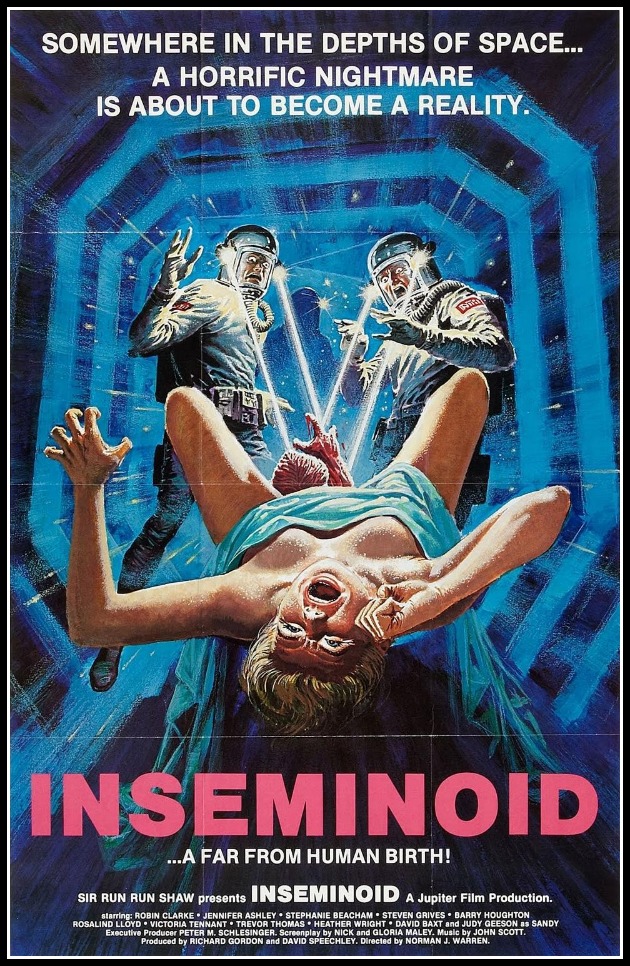
The Daily Grindhouse: Inseminoid (dir. by Norman J. Warren)


The latest daily grindhouse comes straight out of the UK from the early 80’s. It’s a sci-fi horror flick which came about as part of the exploitation wave of Alien rip-offs and imitation of the past several years since Ridley Scott’s scifi-horror masterpiece stormed through Hollywood. While it’s director, Norman J. Warren and it’s producers do not think it’s grindhouse or an exploitation film of any stripe I beg to differ.

Inseminoid (renamed for a U.S. release as Horror Planet) screams grindhouse right from that title alone. It’s a film about a group of scientists landing on an unknown and desolate planet in search of evidence that an alien civilization existed once upon a time on the planet. The whole thing was either filmed inside a studio-built spacecraft set or in a cavern complex near the studio in the UK. It’s once one of the scientists (as always with grindhouse horror it happened to be a female scientists) has become impregnated by a remnant of the planet’s long-dead civilization that the horror truly begins.

It’s that very scene of rape and alien impregnation which got this film labeled as a “video nasty” in the UK which made it’s release on video near-impossible to make without editing out that pivotal scene early in the film. That scene also got the flick compared to another grindhouse scifi-horror released the same year by low-budget auteur Roger Corman called Galaxy of Terror. Outside of both films using a rape scene by alien means the two films really had nothing in common plot-wise so I think the filmmakers of Inseminoid and Galaxy of Terror just happened to think of a similar idea at the same time.

This film is not great or even good, but like all true grindhouse the people involved in the film took their roles and task seriously to try and make the best film their budget allowed them to. It’s not a horrible film and when seen now it’s actually quite a fun little scifi-horror flick that showed a glimpse into an era of cheap, exploitation films that would last well into the late 80’s.

Song of the Day: High Roller (performed by the Crystal Method)


A few days ago, I used to the song of the day feature to highlight the Crystal Method’s Trip Like I Do.  And in that post, I mentioned that Trip Like I Do makes me drive too fast.  Well, there’s another song off of the Crystal Method’s Vegas CD that I always make it a point to listen to while driving and that is High Roller.  If Trip Like I Do makes me slam down on the accelerator, High Roller makes me slow down and watch the world collapse around me.

(Clicking on the video below will redirect you to YouTube and the acual song.  I apologize for that — usually, I hate elitist, communistic bullshit like that but I really like this song.)