Here’s The Trailer for The Florida Project!


The Florida Project is the latest film from Sean Baker, who was responsible for last year’s acclaimed Tangerine.

The Florida Project, which was critically acclaimed at Cannes, has a much larger budget than Tangerine, a bigger star (in the form of Willem DaFoe), and some very real Oscar hopes.  Let’s just hope that A24 doesn’t get so busy promoting The Florida Project, Baker, and DaFoe that they end up forgetting about The Disaster Artist and James Franco.

Spread the wealth around!

Here’s the trailer for The Florida Project!


Lisa’s Early Oscar Predictions for August!


To see how my thinking has progressed, be sure to check out my predictions for January, February, March, April, May, June, and July!


Best Picture

Call Me By Your Name

Darkest Hour

Detroit

The Disaster Artist

Dunkirk

The Florida Project

Goodbye Christopher Robin

The Greatest Showman

Logan

Wonderstruck


Best Director

Sean Baker for The Florida Project

Kathryn Bigelow for Detroit

Michael Gracey for The Greatest Showman

Christopher Nolan for Dunkirk

Joe Wright for Darkest Hour


Best Actor

Chadwick Boseman in Marshall

Willem DaFoe in The Florida Project

Hugh Jackman in The Greatest Showman

Gary Oldman in Darkest Hour

Donald Sutherland in The Leisure Seeker


Best Actress

Judi Dench in Victoria and Abdul

Kirsten Dunst in Woodshock

Frances McDormand in Three Billboards Outside of Ebbing Missouri

Emma Stone in Battle of the Sexes

Meryl Streep in The Papers


Best Supporting Actor

Steve Carell in Battle of the Sexes

James Franco in The Disaster Artist

Armie Hammer in Call Me By Your Name

Will Poulter in Detroit

Patrick Stewart in Logan


Best Supporting Actress

Penelope Cruz in Murder on the Orient Express

Holly Hunter in The Big Sick

Melissa Leo in The Novitiate

Julianne Moore in Wonderstuck

Margot Robbie in Goodbye Christopher Robin


Lisa’s Early Oscar Nominations for July


With each passing month, the Oscar race becomes just a little bit clearer.  We are still a few months away from the true Oscar season but a few contenders have emerged.

My predictions are below.  Previously, my predictions were all based on wishful thinking and instinct.  Well, there’s still a lot of wishful thinking to be found below but, at the same time, the festival season is providing a guide and there are some early reviews that have started to come in.  I’ve never been a 100% correct in my predictions and I doubt this year is going to be any different.  (For one thing, I always predict 10 best picture nominees, even though that’s close to being a mathematical impossibility under the current Academy rules.)

One final note: Some day, the Academy will get over their resistance to Netflix and streaming.  I don’t think that’s going to happen this year, though.  I kept that in mind while considering the chances of such heavily hyped (and, for that matter, less heavily hyped) contenders as Mudbound and The Meyerowitz Stories.

Anyway, here are my predictions for July!  Be sure to check out my predictions for January, February, March, April, May, and June as well!

Best Picture

Call Me By Your Name

Darkest Hour

Detroit

The Disaster Artist

Dunkirk

The Florida Project

Goodbye Christopher Robin

The Greatest Showman

Logan

Wonderstruck

Best Director

Sean Baker for The Florida Project

Kathryn Bigelow for Detroit

Michael Gracey for The Greatest Showman

Christopher Nolan for Dunkirk

Joe Wright for Darkest Hour

Best Actor

Chadwick Boseman in Marshall

Willem DaFoe in The Florida Project

Hugh Jackman in The Greatest Showman

Gary Oldman in Darkest Hour

Donald Sutherland in The Leisure Seeker

Best Actress

Judi Dench in Victoria and Abdul

Kirsten Dunst in Woodshock

Frances McDormand in Three Billboards Outside of Ebbing Missouri

Emma Stone in Battle of the Sexes

Meryl Streep in The Papers

Best Supporting Actor

Steve Carell in Battle of the Sexes

James Franco in The Disaster Artist

Armie Hammer in Call Me By Your Name

Will Poulter in Detroit

Patrick Stewart in Logan

Best Supporting Actress

Penelope Cruz in Murder on the Orient Express

Holly Hunter in The Big Sick

Melissa Leo in The Novitiate

Julianne Moore in Wonderstuck

Margot Robbie in Goodbye Christopher Robin


Film Review: Basquiat (dir by Julian Schnabel)


Basquiat.  I love this movie.

I Shot Andy Warhol was not the only 1996 film to feature Andy Warhol as a character.  He was also a prominent supporting character in Basquiat.  In this film, he’s played by David Bowie and Bowie gives a far different performance than Jared Harris did in I Shot Andy Warhol.  Whereas Harris played Andy as a detached voyeur, Bowie’s performance is far more sympathetic.  (Of course, it should be noted that Harris and Bowie were playing Andy Warhol at very different points in the artist’s life.  Harris played the younger, pre-shooting Warhol.  Bowie played the older, post-shooting Warhol.)

Then again, it’s not just Andy Warhol who is portrayed more positively in Basquiat than in I Shot Andy Warhol.  The entire New York art scene is portrayed far more positively in Basquiat.  Whereas I Shot Andy Warhol was a film about an outsider who was destined to forever remain an outsider, Basquiat is a film about an outsider who becomes an insider.  On top of that, Basquiat was directed by a fellow insider, painter Julian Schnabel.

The film itself is a biopic of Jean-Michel Basquiat (very well played by Jeffrey Wright), the graffiti artist who, in the 1980s, briefly became one of the superstars of the New York art scene.  However, it’s less of a conventional biopic and more of a meditation on what it means to be an artist.  Throughout the film, Basquiat looks up to the New York skyline and sees a surfer riding a wave across the sky.  The image itself is never explicitly explained.  We never learn why, specifically, Basquiat visualizes a surfer.  But then again, that’s what makes the surfer a perfect symbol of Basquiat’s artistic sensibility and talent.  It’s a reminder that, while we can appreciate an artist’s work, only the artist can truly understand what that work is saying.  All attempts to try to explain or categorize art are as pointless as trying to understand why that surfer is in the sky.  Ultimately, the why is not as important as the simple fact that the surfer is there.

The film follows Basquiat as he goes from living on the streets to being a protegé of Andy Warhol’s and, until he overdosed on heroin, one of the shining lights of the New York art scene.  Along the way, Basquiat struggles to maintain a balance between art and the business.  In one of the key scenes of the film, an empty-headed suburbanite (Tatum O’Neal) looks at Basquiat’s work and whines that there’s too much green.  She just can’t handle all of that green.

Basquiat’s friendship with Andy Warhol provides this film with a heart.  When Bowie first appears — having lunch with a German art dealer played by Dennis Hopper — one’s natural instinct is to assume that Bowie as Warhol is stunt casting.  However, Bowie quickly proves that instinct to be wrong.  As opposed to many of the actors who have played Andy Warhol over the years, Bowie gives an actual performance.  Instead of resorting to caricature, Bowie plays Warhol as being mildly bemused by both his fame and the world in general.

Basquiat also develops a close friendship with another artist.  Gary Oldman may be playing a character named Albert Milo but it’s obvious from the moment that he first appears that he’s playing the film’s director, Julian Schnabel.  If there was any doubt, Schnabel’s studio stands in for Milo’s studio.  When Milo shows off his work, he’s showing off Schnabel’s work.  When Albert Milo introduced Basquiat to his parents, the nice old couple is played by Julian Schnabel’s actual parents.  It’s perhaps not surprising that Albert Milo is presented as being one of the most important and popular artists in New York City.  In a film full of bitchy characters, Albert Milo is unique in that literally everyone likes and respects him.  And yet Gary Oldman gives such a good and heartfelt performance that you can’t hold it against the character that he happens to be perfect.  There’s a small but touching scene in which Albert Milo and his daughter share a dance in front of one of Schnabel’s gigantic canvases.  Of course, Milo’s daughter is played by Julian Schnabel’s daughter.

The entire cast is full of familiar actors.  Willem DaFoe appears as a sculptor.  Christopher Walken plays a hilariously vapid interviewer.  Courtney Love plays a groupie.  Benicio Del Toro plays Basquiat’s best friend.  Parker Posey shows up as gallery owner Mary Boone.  Michael Wincott plays Rene Ricard, the somewhat infamous art critic who was among the first to celebrate the work of both Basquiat and Schnabel.  For once, the use of familiar actors does not sabotage the effectiveness of the film.  If anything, it helps to explain why Basquiat was so determined to make it.  There’s a magical scene where a then-unknown Basquiat peeks through a gallery window and sees Andy Warhol, Albert Milo, and Bruno Bischofberger.  However, the film’s audience sees David Bowie, Gary Oldman, and Dennis Hopper.  What both Basquiat and the audience have in common is that they’re both seeing bigger-than-life stars.

Basquiat is an often magical and poignant film and I absolutely love it.

A Movie A Day #67: Animal Factory (2000, directed by Steve Buscemi)


Edward Furlong is Ron Decker, a spoiled 18 year-old from a rich family who is arrested and sent to prison when he’s caught with a small amount of marijuana.  Being younger and smaller than the other prisoners, Ron is soon being targeted by everyone from the prison’s Puerto Rican gang to the sadistic Buck Rowan (Tom Arnold).  Fortunately, for Ron, prison veteran Earl Copen (Williem DaFoe) takes him under his wing and provides him with protection.  Earl is the philosopher-king of the prison.  As he likes to put it, “This is my prison, after all.”  If he can stay out of trouble, Ron has a chance to get out early but, with Buck stalking him, that’s not going to be easy.
Based on a novel by ex-con Edward Bunker, Animal Factory was the second film to be directed by Bunker’s Reservoir Dogs co-stars, Steve Buscemi.  Though it was overlooked at the time, Animal Factory is a minor masterpiece.  Taking a low key approach, Buscemi emphasizes the monotony of prison life just as much as the sudden bursts of violence and shows why someone like Ron Decker can go into prison as an innocent and come out as an animal.  DaFoe and Furlong give two of their best performances as Earl and Ron while a cast of familiar faces — Danny Trejo, Mickey Rourke, Chris Bauer, Mark Boone Junior — make up the prison’s population.  Most surprising of all is Tom Arnold, giving Animal Factory‘s best performance as the prison’s most dangerous predator.

Film Review: Finding Dory (dir by Andrew Stanton)


finding_dory

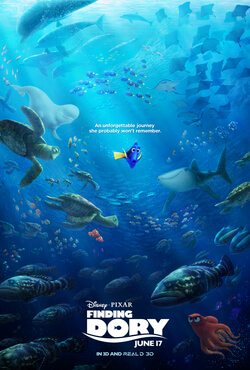
Finding Dory, the latest film from Pixar, tells the story of Dory (Ellen DeGeneres), a regal blue tang (for our readers in Vermont, that’s a fish) who suffers from short-term memory loss.  You may remember her from Pixar’s previous movie about fish, Finding Nemo.  In that movie, she helped a clownfish named Marlin (Albert Brooks) find his son, Nemo (voiced, in Finding Dory, by Hayden Rolence).  In the sequel, it’s Marlin and Nemo who are now helping Dory to find her parents.

Dory has spent years searching for her parents.  Of course, it would be easier if she didn’t suffer from short-term memory loss.  It seems that every time she sets out to track her parents down, she ends up getting distracted and forgets what she was doing.  However, while helping to teach a class about migration, Dory has a sudden flashback to her parents (voiced, quite charmingly, by Eugene Levy and Diane Keaton).  She sets out once again, determined to find her parents.  This time, Marlin and Nemo are accompanying her.  As Dory continually frets, she’s can’t do it alone because she can’t remember directions.

Though her memories are fuzzy and her flighty nature leads to some conflict with Marlin (who is just as cautious and overprotective of Nemo as he was in the first film), Dory eventually finds her way to where her parents were last seen.  And, in doing so, Dory discovers that she and her parents originally lived at a water park, the California Marine Life Institute.

(One of my favorite parts of the film is that apparently, Sigourney Weaver recorded several greetings and other messages that are played continuously over the Institute’s PA system.  “Hello, I’m Sigourney Weaver and welcome to the Marine Life Institute.”  Dory becomes convinced that Sigourney Weaver is some sort of God-like being who is leaving personal messages for her.  At one point, Dory exclaims, “A friend of mine, her name’s Sigourney, once told me that all it takes is three simple steps: rescue, rehabilitation, and um… one other thing?”)

Since this is a Pixar movie, Dory meets the usual collection of oddball and outcast sealife at the Institute, all of whom help her out while overcoming their own insecurities, providing properly snarky commentary, and hopefully bringing a tear or two to the eyes of even the most jaded of viewers.  Finding Dory is full of familiar voices, everyone from Idris Elba to Bill Hader to Kate McKinnon.  But, for me, the most memorable of all the voices (with the exception of Ellen DeGeneres herself) was Ed O’Neill’s.  O’Neill brought Hank, the bitter but ultimately good-hearted seven-legged octopus, to poignant life.  I imagine that, should there be another sequel, it will be called Finding Hank.

Finding Dory continues the annual tradition of Pixar films making me cry.  Finding Dory is an incredibly sweet and truly heartfelt movie but, at the same time, it’s also an extremely witty comedy.  This is one of those Pixar films where the joy comes not only from looking at the amazing animation but also from listening to truly clever dialogue being delivered by some of the best voice actors around.  DeGeneres does such a great job bringing Dory to life that, as the movie ended, my first instinct was to run out and buy a regal blue tang of my very own.  But then I read an article on Wikipedia, which explained why I shouldn’t do that.

(Basically, blue tangs may look cute but they have big, scary spikes that can cut up your hand.  As well, they don’t do well in captivity.  So, if you’re planning on getting a Dory of your very own, you might be better off just rewatching this movie…)

It’ll make you laugh.  It’ll make you cry.  Finding Dory is another great film from Pixar.

Film Review: Nymphomaniac Vol. I & II (2013, dir. Lars Von Trier)


IMG_9689

I’ll try and keep this short, unlike the movie, which if you watch the director’s cut as I did, comes out to about five and a half hours. Once you’ve sat through something like Jacques Rivette’s Out 1 (1971), which comes out to a little over twelve hours, this isn’t much. Also, despite what I’m going to say about it, it’s problems don’t come from it’s length. A lot of movies damage themselves by going past two hours, but not this one. The length really wasn’t an issue for me.

I’m also not going to pick out all the little stupid things like you see me do with Hallmark movies. Yes, Stellan Skarsgard says the Christian church split up in 1054 into Roman Catholic and Orthodox, but it actually fractured a long time before that break. Or the onscreen text, which you would expect in a Godard film. Especially when Skarsgard brings up Fibonacci numbers. That probably only ticked me off because I went through about nine years of college level computer science and really don’t want to hear about Fibonacci numbers ever again. Also, there’s a scene where she makes one attempt to have sex with black guys. It kind of reminded me of that “documentary” from the early 1970’s called Black Love. It’s there to mention that men are homophobic, but she is implicitly homophobic since sex with a woman is never brought up in this sex addict film. Von Trier also whips out the Two Kinds Of People In The World cliche, but it only makes sense if everyone is right handed. Well, let’s talk about the movie.

First, if you’re a fan of Lars Von Trier, then it’s a no brainer. This movie is for you. Don’t hesitate to watch it. If you are like me and love Breaking The Waves (1996), then this has similar material, but it’s not even remotely as moving. If you were offended by Dogville (2003) like I was, then don’t worry, this isn’t offensive stuff. It’s just boring.

The movie is about a girl named Joe (Charlotte Gainsbourg) who recounts her life as a self proclaimed nymphomaniac to Seligman (Stellan Skarsgad). The movie cuts back and forth between the actual story and then Seligman’s thoughts on it. Kind of like sitting in on a therapy session if it were being conducted by college students in a debate class. And that’s where this film’s biggest issue is for me. A lot of the analysis feels pedestrian or the kind of thing you would expect in a college paper written by a student who hopes the teacher will be impressed. And at times its almost like argument for arguments sake. Like when you’re in a class and a topic is tossed out for discussion. The topic may actually be rather simple, but people keep trying to throw things in to pad out the conversation to fill the class time. A lot of the dialogue feels like that sort of thing.

The story begins when she is a little girl and takes us up to the events that led Seligman to find her in the alley outside of his place at the beginning of the film. Her father is played by Christian Slater who I think does a good job. His British accent may be a problem for you, but it wasn’t for me. Neither was it a problem for me with Shia LaBeouf’s character who is a male presence in Joe’s life pretty much throughout the film. The accent was a problem for me with Uma Thurman’s character though.

There’s a point where Joe just starts referring to the men in her life by letters. She casually tosses them around. During one of these scenes, Uma Thurman shows up as the wife of one of the guys who’s there with Joe along with their kids in tow. The scene is supposed to start a little funny, then get really uncomfortable as it keeps going. Like when Thurman asks if she can show her kids the “whoring bed”. The problem for me was the accent. If they had just let her speak normally, then it would have worked, but it was a voice that at this point in her career is obviously not her’s and I can’t suspend disbelief. So the scene was just hilarious to me. Especially when she actually screams. That made me think of Julianne Moore in Map To The Stars (2014), which also had me laughing.

This film has been dismissed as porn or on the flip side, played up for showing so much. People especially like to mention that the sex is unsimulated. Well, it really doesn’t count in my book if that isn’t Shia LeBeouf’s penis, which it isn’t. They use CGI to graft porn actors genitalia onto some of the actors. So it’s not anything to brag about. Is it porn? Far from it. Anybody who tells you that has no idea what they are talking about. It probably comes closest to an exploitation movie at best in that department.

I said I wouldn’t pick out little flaws, but there’s a big one I have with the title and her consistently referring to herself as either a nymphomaniac or being addicted to sex. She’s not really addicted to sex. She’s addicted to sex like someone who only smokes Marlboro is addicted to cigarettes, but won’t smoke any other brand. She’s like that. She’ll take penetration by a penis, give a blow job, and poorly dabbles in S&M. That’s really it. She’s rather discriminating about what she’ll do. Another analogy is like when someone says they’re a cinephile, but that means to them that they love watching highly acclaimed foreign films. An addiction to something broad like movies or sex means you’re indiscriminate. However, I get why Von Trier sticks with the term nymphomaniac because the movie does have a reason to make sure the apparent love of sex and guilt about it is explicitly associated with a female character. The ending depends on it.

The only thing that was kind of noteworthy to me was how the way the movie is shot changes in the final part of the film. It’s divided into chapters and in the last one Von Trier either shot it to get film grain and over exposed lights or did it in post processing. I think it was probably a reference to a movement in film he was involved in back in the 1990’s called Dogme 95. You can watch something like Thomas Vinterberg’s The Celebration (1998) and it will look similar.

Honestly, it’s not a bad movie, but it’s really for people who like Von Trier stuff. If you like his stuff, see it. If you don’t, definitely skip it. If you’re totally new, then don’t start here. Begin with Breaking The Waves and Europa (1991) before wading into films like The Idiots (1998), Dancer In The Dark (2000), Dogville, and beyond.

Shattered Politics #78: American Dreamz (dir by Paul Weitz)


Americandreamz

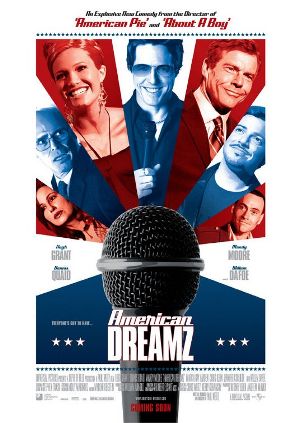
Nothing ages worse than heavy-handed satire and, if you need proof of that, just try watching the 2006 film American Dreamz.  American Dreamz is a satire of two things that are no longer exactly relevant, the presidential administration of George W. Bush and Simon Cowell-era American Idol.

Dennis Quaid plays President George W. Bush Joseph Stanton.  Stanton has just been reelected to a second term.  One morning, he impulsively decides to read a newspaper for the first time in his life and he ends up having a nervous breakdown.  “The world isn’t black-and-white,” he declares, “Instead, it’s gray.”  Sinking into a deep depression, Stanton isolates himself from the American people and his approval rating starts to plunge.  His evil Chief of Staff (William DaFoe, made up to look like Joe Biden but, I’m assuming, meant to be Dick Cheney) comes up with a plan to restore Stanton’s popularity.  President Stanton will serve as a guest judge on his favorite television show, American Idol American Dreamz!

(To be honest, I think Obama would be more likely to show up as a guest judge than Bush.)

The host of American Dreamz is a self-loathing Englishman named Martin Tweed (Hugh Grant).  Tweed hates both the show and himself.  Early on in the film, he’s literally seeing begging for American Dreamz to be canceled.  However, American Dreamz is the number one show in the country and the show must go on.

Along with President Stanton, the latest season of American Dreamz features a group of contestants who all have dramatically compelling backstories.  Sally Kendoo (Mandy Moore) emerges as a favorite, largely do to her ability to manipulate the camera and the fact that her well-meaning but simple-minded boyfriend (Chris Klein) was wounded in Iraq.

Oh wow — reality shows manipulate reality and contestants are rarely as innocent as they seem!?

Tell me more, American Dreamz!

Also competing on American Dreamz is Omer (Sam Golzari), a former jihadist who proved to be too clumsy to take part in the various propaganda videos being shot by his terrorist cell.  Omer was sent to America, where his love for show tunes eventually landed him on American Dreamz.  With the finale rapidly approaching, Omer has been instructed to blow both himself and the President up on national TV.

The satire of American Dreamz really wasn’t all that sharp when the film was first released and now, 9 years later, it feels even weaker.  Quaid and Grant both give good performances but the film’s attempts at humor largely fall flat because they’re all so predictable.  It’s not exactly mind-blowing to say that reality TV is fake or that politics has a lot in common with show business.  The film attempts to add some bite to its message by ending with a surprisingly dark twist but it’s just not enough.  Even a dark ending has to be earned.


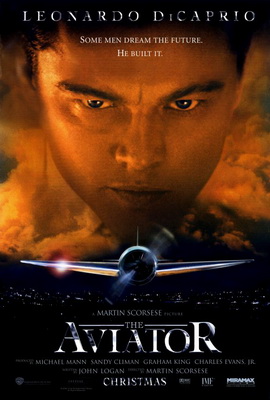
Shattered Politics #74: The Aviator (dir by Martin Scorsese)


The_Aviator_Poster

“The way of the future.” — Howard Hughes (Leonardo DiCaprio) in The Aviator (2004)

As I recently rewatched the 2004 best picture nominee, The Aviator, I realized that, in the film’s scheme of things, Ava Gardner was far more important than Katharine Hepburn.  (Or, perhaps it would be more appropriate to say that Kate Beckinsale’s Ava Gardner was far more important than Cate Blanchett’s Katharine Hepburn.)

Over the course of the film, both Hepburn and Gardner are involved with billionaire-turned aviator-turned film director Howard Hughes (Leonardo DiCaprio).  Throughout the film, Katherine is portrayed as being flighty, pretentious, and overdramatic.  There’s a lot of dark humor to the scene where Katherine breaks up with Howard, largely because Katharine is incapable of not acting as if she’s making a film.  Her every word is so carefully rehearsed that you have to agree when Howard says that she’s incapable of not giving a performance.  Ava, on the other hand, is always direct.  She has a sense of humor.  She has no trouble telling Howard off.  Whereas Katharine put on airs of being an incurable romantic, Ava tells Howard flat out that she doesn’t love him and is only using him to forward her career.

But, while Katharine Hepburn gets more screen time, it’s Ava Gardner who actually saves Howard’s business.  Towards the end of the film, after Howard has had a nervous breakdown and has locked himself in a hotel room, it’s Ava who suddenly shows up, cleans him, and dresses him.  She’s the one who gives Howard the strength to leave his room and to face down the corrupt senator (Alan Alda) who is investigating his business.

Of course, Howard Hughes is best known for once being the world’s richest recluse.  In the 1960s, Howard locked himself away in a hotel room in Las Vegas and spent the next decade laying naked in bed and watching television.  The Aviator doesn’t deal with this period of Howard’s life but it’s full of scenes where we catch glimpses of Howard’s future.  Throughout the film, we watch as Howard obsessively washes his hands.  We watch as he gives precise instructions on how even the simplest of tasks are to be accomplished.  We watch as he grows increasingly paranoid about the germ-filled outside world.  The film suggests that Howard’s obsessive compulsive disorder both served to make him a great engineer and a great filmmaker while, at the same time, ultimately destroying him.

The Aviator was the second film that DiCaprio made with Scorsese.  And, as bad as DiCaprio may have been in Gangs of New York, he’s absolutely brilliant in The Aviator.  As a character, Howard Hughes has so many quirks and tics that it would have been easy for DiCaprio to go overboard.  Instead, he gives a surprisingly subtle performance.  And, even more importantly as far as I’m concerned, he actually sounds authentically Texan when he speaks.

In many ways, much of The Aviator reminds me of Gangs of New York.  Both films are gorgeously produced period epics that try to cover a lot of material.  Both films are absolute cat nip for history nerds like me.  But, whereas Gangs of New York leaves one feeling vaguely dissatisfied, The Aviator actually improves with subsequent viewings.  Whereas the action in Gangs had no center, The Aviator revolves around Howard and the actor playing him.

While the Aviator starts off with Howard making movies and romancing Katharine Hepburn, it’s at its best when Howard appears before a committee chaired by Sen. Owen Brewster (Alan Alda) and passionately defends both himself as an engineer and a businessman and the right of innovators everywhere to freely pursue their passion.  The film suggests that Brewster was bribed by Howard’s main business rival, Juan Trippe (Alec Baldwin, in unapologetic villain mode), and it’s hard not to applaud when Howard stands up for himself.

Speaking of which, it’s odd, so soon after reviewing Alan Alda in The Seduction of Joe Tynan, to see Alda playing a far less ethical politician in The Aviator.  That said, Alda’s corrupt performance in The Aviator is a hundred times better than his cutesy work in Joe Tynan.  If anything, Alda gives a performance here that will remind everyone of why they don’t care much for their congressman.

The Aviator was nominated for best picture but it lost to the far more low-key Million Dollar Baby.  Scorsese would have to wait until the release of The Departed for one of his films to finally win best picture.

A Few Very Late Thoughts On Wes Anderson’s The Grand Budapest Hotel


grand-budapest-hotel

It took me a while to come around to appreciating The Grand Budapest Hotel.

When I first saw Wes Anderson’s latest film, way back in March, I have to admit that I was somehow both impressed and disappointed.  The film’s virtues were obvious.  Ralph Fiennes gave a brilliant lead performance as Gustave, the courtly and womanizing concierge of the Grand Budapest Hotel.  As played by Fiennes, Gustave came to represent a certain type of old world elegance that, I’m assuming, died out long before I was born.  As is typical of Anderson’s film, The Grand Budapest Hotel was visual delight.  Even when the film’s convoluted storyline occasionally grew self-indulgent, The Grand Budapest Hotel was always interesting and fun to watch.

At the same time, I had some issues with The Grand Budapest Hotel.

One of the major ones — and I will admit right now that this will seem minor to some of you — is that halfway through the film, a cat is killed.  The evil Dimitri Desgoffe von Taxis (Adrien Brody) is attempting to intimidate a nervous lawyer, Kovacs (Jeff Goldblum).  Kovacs’s owns a cat and, at one point, Dimitri’s henchman, Jopling (Willem DaFoe), tosses the cat out of a window.  Kovacs runs to window and sees his dead cat splattered on the sidewalk below…

And this is when the audience in the theater laughed and I got very angry.

To me, there was nothing funny about killing that man’s cat.  But the more I’ve thought about it, the more that I’ve come to realize that my reaction had more to do with the audience than the film.  The film was not saying that the cat’s death was funny.  The film was saying that Dimitri and Jopling were evil and dangerous, as their actions throughout the film would demonstrate.  It was the audience that decided, since Grand Budapest Hotel is full of funny moments and has the off-center style that one has come to expect from Wes Anderson, that meant every scene in the film was meant to be played strictly for laughs.  The fact of the matter is that a typical Wes Anderson film will always attract a certain type of hipster douchebag.  They were the ones who loudly laughed, mostly because they had spent the entire movie laughing loudly in order to make sure that everyone around them understood that they were in on the joke.

But that’s not the fault of the film.  Despite what you may have heard and what the Golden Globes would have you believe, The Grand Budapest Hotel is not a comedy.  For all the deliberately funny and quirky moments, The Grand Budapest Hotel is actually a very serious film.  For all of the slapstick and for all of Ralph Fiennes’s snarky line readings, The Grand Budapest Hotel ultimately ends on a note of deep melancholy.

When I first saw The Grand Budapest Hotel, it seemed like it was almost too quirky for its own good.  And, to be honest, I could still have done without some of Anderson’s more self-indulgent touches.  The sequence at the end, where Gustave, who has been framed for murder, gets help from a series of his fellow hotel concierges started out funny but, as everyone from Bill Murray to Owen Wilson put in an appearance, it started to feel less like the story of Gustave and more like the story of all of Wes Anderson’s famous friends.

However, the more I’ve thought about it (and The Grand Budapest Hotel is a film that I’ve thought about a lot over the past year), the more I’ve realized that the quirkiness is only a problem if you made the mistake of thinking that the film is meant to be taken literally.

The more I thought about it, the more obvious it became that the most important scenes in The Grand Budapest Hotel were to be found at the beginning and the end of the film.

The film opens with a teenage girl sitting in front of the grave of a great author.  She opens a book and starts to read.

As soon as the girl starts to read, we flashback 29 years to 1985 where the author (Tom Wilkinson) sits behind his office desk and starts to talk about the time that he visited the Grand Budapest Hotel.  

We flashback again to 1969, where we see how the author (now played by Jude Law) met the owner of the Grand Budapest Hotel, a man named Zero (played by F. Murray Abraham).  Over dinner, Zero tells the author the story of how he first came to the Grand Budapest and how he eventually came to own the hotel.

And again, we go back in time, this time to 1932.  We see how the young Zero (Tony Revolori) first met and came to be the protegé of Gustave (Ralph Fiennes).  We see how Gustave taught Zero how to be the perfect concierge.  Eventually, Gustave would be framed for murdering a guest, Zero would meet and fall in love with Agatha (Saoirse Ronan), and then Zubrowska (the fictional Eastern European country in which this all takes place) would be taken over by fascists who would eventually claim the hotel as their own.

After the story of Gustave, Zero, and Agatha has been told, we suddenly flash forward to the author talking to Zero and then to the old author telling the story to his grandson and then finally back to the teenage reader sitting in the cemetery.

In other words, the Grand Budapest Hotel may be the story of Zero but we’re experiencing it through the memories of the author as visualized by the reader.  Gustave, Zero, and the entire Grand Budapest Hotel are not just parts of a story.  Instead, they become symbols of an old way of life that, though it may have been lost, still exists in the memories of old travelers like the author and the imaginations of young readers like the girl in the cemetery.

As I said at the start of this, I was vaguely disappointed with The Grand Budapest Hotel when I first saw it but, perhaps more than any other movie that I saw last year, this has been a film that I haven’t been able to get out of my mind.  Having recently rewatched the film on HBO, I can also attest that both The Grand Budapest Hotel and Ralph Fiennes’s performance not only hold up on a second viewing but improve as well.

I still stand by some of my original criticisms of The Grand Budapest Hotel.  I still wish that cat had not been thrown out the window, even though I now understand that Anderson’s main intent was to show the evil of Dimitri and Jopling.  And I still find some of the cameos to be jarring, precisely because they take us out of the world of the film.

But you know what?

Despite those flaws, The Grand Budapest Hotel is still a unique and intriguing film.  When I sat down tonight and made out my list of my top 26 films of 2014, I was not surprised that Grand Budapest Hotel made the list.  But I was a little bit surprised at how high I ended up ranking it.

But then I thought about it and it all made sense.

The-Grand-Budapest-Hotel-580