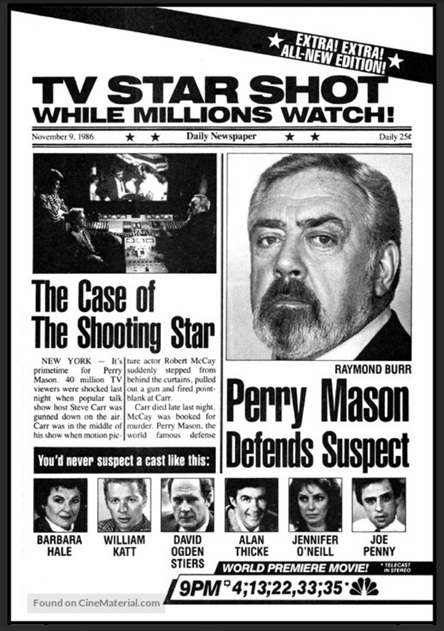
Actor Robert McCay (Joe Penny) decides that it would be hilarious to shoot talk show host Steve Carr (Alan Thicke) on live television. McCay thinks that the gun is loaded with blanks but, before he goes on the show, someone slips a live round into the gun. McCay kills Steve Carr and there are a million witnesses who see him do it. Time to call in Perry Mason (Raymond Burr)!
The third Perry Mason movie isn’t as good as the first two. Shooting someone on television as a joke and then leaving the studio immediately afterwards is a really stupid thing to do. As my sister pointed out while we were watching, even if Robert McCay wasn’t guilty of premeditated murder, he was probably guilty of negligent homicide for not bothering to double check whether or not there was a live round in the gun. McCay goes right back to shooting his movie, even while he’s on trial for murder. As for the trial, it was ridiculous. How many people can confess under cross examination in one trial? “Mistrial!” my sister yelled whenever Perry pulled one of his stunts and I agreed.
Paul (William Katt) teams up with a photojournalist (Wendy Crewson) and his investigation somehow leads to him playing a priest in a cheap vampire movie. For once, Perry didn’t give Paul a hard time about anything. Maybe he realized Paul’s scenes were the best part of The Case of the Shooting Star.
Claire (Michelle Pfeiffer) is a former cellist who is still struggling to recover from a serious car accident and who has been at loose ends ever since her daughter left for college. Claire’s husband, Norman (Harrison Ford), is a scientist and a college lecturer. After their neighbor, Mary (Miranda Otto), disappears, Claire becomes convinced that Mary’s husband (James Remar) did something to her. Claire also becomes convinced that Mary’s ghost is trying to contact her, by appearing in the lake and filling the bathtub up with water whenever Claire isn’t looking. Norman tells Claire that she’s imagining things and pushes her to see a therapist. As Claire investigates, she discovers that Norman knows more than he’s letting on.
What Lies Beneath is a long and drawn-out ghost story that Robert Zemeckis made because he had time to kill while the filming of Cast Away was on hiatus so Tom Hanks could lose weight and grow a beard. That this movie was not a personal project for Zemeckis is reflected in his direction, which is surprisingly impersonal for a Zemeckis film. The film is a showcase for Michelle Pfeiffer, who gives a good performance as the emotionally fragile Claire and holds the film’s many disparate elements together. Harrison Ford sometimes seems disinterested but his casting still pays off when Norman gets to say and do some things that you normally would never expect Harrison Ford to do.
I remember seeing this in a theater in 2000 and being surprised by the ending. Looking back on it today, I just can’t believe that I sat through the entire movie.
Hi there and welcome to October! This is our favorite time of the year here at the Shattered Lens because October is our annual horrorthon! For the past several years (seriously, we’ve been doing this for a while), we have celebrated every October by reviewing and showing some of our favorite horror movies, shows, books, and music. That’s a tradition that I’m looking forward to helping to continue this year!
Let’s get things started with 1982’s Mazes and Monsters!
Based on a best-seller by Rona Jaffe, Mazes and Monsters tell the story of some college students who enjoy playing a game called Mazes and Monsters. Now, I realize that Mazes and Monsters may sound a lot like Dungeons and Dragons but they are actually two separate games. One game takes place in a dungeon. The other takes place in maze, got it?
When the players decide to play the game in some nearby caves, it causes the newest member of the group (Tom Hanks — yes, Tom Hanks) to snap and become his character. Convinced that he’s living in a world full of monsters and wizard, Hanks runs away to New York. How does that go? During a moment of clarity, Hanks calls his friends and wails, “There’s blood on my knife!”
It’s all fairly silly. There was a moral panic going on about role playing games when this film was made and this film definitely leans into the panic. But, in its own over-the-top way, it works. If you’ve ever wanted to see Tom Hanks battle a big green lizard, this is the film for you. And I defy anyone not to tear up a little during the final scene!
From 1982, here is MazesandMonsters! Happy Horrorthon!
Welcome to Retro Television Reviews, a feature where we review some of our favorite and least favorite shows of the past! On Thursdays, I will be reviewing In The Lion’s Den, which aired on CBS in 1987. The entire show is currently streaming on YouTube!
Episode 1.1 “Pilot”
(Dir by James Burrows, originally aired on September 4th, 1987)
When she lived in New York City, Dana (Wendy Crewson) had an apartment, a boyfriend, and a job working as a producer on a very successful game show. But then she got fired and everything changed. Now, she has moved to San Antonio so she can work as the new associate producer of Lion’s Den, a PBS program featuring a lion puppet named Maynard.
The man behind the puppet is Keith (Dennis Boutsikaris), an infamously temperamental actor who, every day, announces that he’s quitting show business and storms off the set. Previously, it was up to Jerry (Jack Blessing) to coax Keith into returning to the set and shooting the show. But now that Jerry has a job with Steven Spielberg, it’s up to Dana to keep Keith happy.
Despite having hired her, Keith does not know who Dana is when she shows up on the set. He proceeds to re-interview her for the job, which means leering at her legs and trying to convince her to hug the puppet. Keith, I think, was meant to come across as being a charming rogue but, every time he talked to Dana, I had flashbacks to interviewing for jobs after college and all of the guys who stared at my chest and legs while I explained my passion for art history. Keith is a creep and the fact that he’s only nice when he’s talking through Maynard does nothing to change that.
It’s an eventful first day for Dana. One of the show’s sponsors (played by Fred Applegate) offers to allow Dana to rent his house but it soon turns out that he’s a bit of a sleaze. A neurotic writer (Brian Backer) fears that he’s going to lose his job because he wrote a script about football. (“I hate football!” Keith yells. Good luck living in Texas.) Proving the everyone had to start somewhere, Marcia Gay Harden plays the receptionist who helps Dana get out of having to talk to her ex-boyfriend. (“She’s meetin’ Willie Nelson.”) Harden plays the role with a Texas accent and, while it’s definitely exaggerated, she does a good job with it overall. (A quick check with Wikipedia revealed that, though born in California, Harden spent time in Texas when she was growing up and graduated from the University of Texas.) Eventually, Keith throws his daily tantrum and Dana has to find her own way to keep him from quitting show business.
The main problem with the pilot is that Keith is too much of a jerk. It’s hard to really care about someone who throws a tantrum every day, is abusive to his coworkers, and how uses an adorable puppet to sexually harass a woman who hasn’t even figured out where she’s going to be living in her new city. Personally, I think Dana should have quit as soon as Maynard demanded a hug.
And audiences agreed. This pilot aired once and that was it for In The Lion’s Den.
For today’s horror on the lens, we’ve got the 1982 made-for-TV movie, Mazes and Monsters!
Mazes and Monsters! Sounds pretty scary, doesn’t it? Well, have no fear. Mazes and Monsters is just a role-playing game, one that definitely should not be mistaken for Dungeons and Dragons despite the fact that it’s exactly the same as Dungeons and Dragons. Except, of course, for the fact that one game takes place in a dungeon and the other takes place in a maze.
A group of rich kids love playing Mazes and Monsters but, when they take it a step too far, it leads to the newest member of their group having a nervous breakdown, fleeing to New York City, and fighting demons that only he can see. Our delusional hero is played by an actor named Tom Hanks. Hey, whatever happened to him?
Anyway, Mazes and Monsters is kind of silly. You’re going to get sick of Chris Makepeace’s hats pretty quickly. It imagines a world where the most popular and attractive kids on campus just can’t wait to pretend to be clerics and magic users. And yet, in its own melodramatic way, the film works. If you’ve ever wanted to see Tom Hanks stab a green demon, this is the film to watch! This was one of Tom Hanks’s first roles and he already looks a little bit too old to play a college student but his trademark likability is already evident. When Tom has a moment of clarity and desperately announces that “THERE’S BLOOD ON MY KNIFE!,” it’s impossible for your heart not to ache for him a little. Finally, as over-the-top as the moral panic about the possibility of LARPers going crazy in New York may be, the ending actually is surprisingly effective.
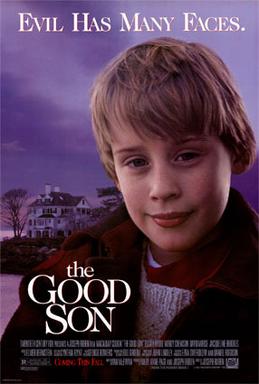
“Hey, Mark, don’t fuck with me,” 12 year-old Henry (Macaulay Culkin) says to his cousin Mark (Elijah Wood) in The Good Son‘s signature scene. But fuck with him Mark does because Mark knows that evil exists and that Henry’s evil. Henry killed his brother and he tries to kill his sister, Connie (Quinn Culkin), by throwing her onto thin ice. When Mark, whose mother has recently died, decides that Henry’s mother, Susan (Wendy Crewson), is going to be his new mom, Henry gets jealous and tells Mark that he would rather kill Susan than allow her to have another son. Eventually, Mark and Henry both end up dangling from a cliff with Susan holding onto them. Susan has to decide who to save, her evil son or the distant relation that she barely knows. She makes her choice and the camera lingers on the corpse of the less fortunate child on the rocks below. For most mothers, it probably wouldn’t even be a difficult decision. Of course you would save your own child! But Susan has to think about it. Maybe she can see the future and knows that Elijah Wood has the Lord of the Rings to look forward to while Macaulay is destined for something much different.
The Good Son caused a lot of controversy when it came out in 1993, not because it was about a murderous child but because that murderous child was played by the then-biggest star in America. How would people who loved watching Macaulay seriously injure two burglars react to watching Macaulay kill people? The movie actually did well at the box office but it also revealed that the Macaulay Culkin was a limited actor. Elijah Wood was a good actor but Mark still comes across like a little creep. Trying to steal his cousin’s mother? What did he think was going to happen?
Finally, The Good Son was written by Ian McEwan, of all people. In McEwan’s defense, he only wrote the first draft and that was long before Macaulay Culkin was miscast as Henry. Apparnetly, Macaulay’s father and manager, Kit Culkin, demanded that his son be cast as a psycho murderer before he would allow Maccaulay to appear in Home Alone 2. I guess Kit thought making his son look evil would be a good career movie. If only someone had been willing to say, “Hey, Kit Culkin, don’t fuck with the movie.”
You may remember that this film, a remake of the 70s vigilanteclassic, came out last March and critics literally went insane attacking it. That it got negative reviews wasn’t necessarily a shock because the movie was directed by Eli Roth and he’s never been a favorite of mainstream critics. Still, it was hard not to be taken aback but just how enraged the majority of the critics appeared to be. Seriously, from the reviews, you would have thought that Death Wish was not just a bad movie but a crime against nature.
Of course, a lot of that was due to the timing of the film’s release. The film was released less than a month after the shootings at Stoneman Douglas High School in Florida. At the time the film first came out, the country was in the midst of a daily diet of anti-second amendment rallies and David Hogg. Many critics accused Death Wish of being a commercial for the NRA. Others branded the film as being right-wing propaganda. In fact, the criticism was so harsh that it was hard not to feel that the critics were essentially taking Death Wish far more seriously than it took itself.
If anything, Death Wish is a big, glossy, and rather silly movie. Bruce Willis stars as Dr. Paul Kersey. Paul is a peace-loving man. We know this because he refuses to get into a fight with a belligerent parent at a soccer game. He’s also an emergency room doctor, the type who pronounces a policeman dead and then rushes off to try to save the life of whoever shot him. No one in the movie suspects that Paul would ever become a vigilante but we know that there’s no way he can’t eventually end up walking the streets with a loaded gun because he’s played by Bruce Willis. When Paul backs down from the fight at the soccer game, Willis delivers his dialogue with so much self-loathing that we just know that, once Paul gets back home, he’s going to lock himself in the basement and start yelling at the walls, Stepfather-style.
Eventually, criminals break into Paul’s house and shoot both his wife (Elisabeth Shue) and his daughter (Camila Morrone). His wife dies. His daughter ends up in a coma. Paul spends a day or two in shock and then he promptly gets a gun and starts shooting criminals. Eventually, this brings him into conflict with the same criminals who attacked his family! Meanwhile, two detectives (Dean Norris and Kimberly Elise) look at all the dead bodies piling up around them and just shrug it off. At one crime scene, Norris is happy to grab a slice of pizza.
And really, that’s it. It sounds simple because it is simple. There is absolutely no narrative complexity to be found in Death Wish, which is why, in its own cheerfully crude way, the film totally works. In real life, of course, vigilante justice is not the solution and the death penalty is often unfairly applied but, from the moment the opening titles splash across the screen, Death Wish makes clear that it has no interest in real-life and, throughout its brisk running time, it literally seems to be ridiculing anyone in the audience who might be worried about the moral ramifications of a citizen gunning down a drug dealer.
Death Wish is a big extravagant comic book. It takes Paul one scene to go from being a meek doctor to being an expert marksman and, when Paul dispatches one criminal by dropping a car on him, Roth lays on the gore so thick that he almost seems to be daring us to take his film seriously. By that same token, Paul kills a lot of people but at least they’re all really, really bad. In fact, the criminals are so evil that you can’t help but suspect that Roth is poking a little bit of fun at the conventions of the vigilante genre. Even the fact that Willis wanders through the entire film with the same grim expression on his face feels like an inside joke between the director and his audience.
The critics were right when they called Death Wish a fantasy but they were wrong to frame that as somehow being a flaw. It’s a cartoonishly violent and deeply silly film and yet, at the same time it’s impossible not to cheer a little when Paul reveals that he’s been hiding a machine gun under his coffee table. It’s an effective film. Eli Roth delivers exactly what you would expect from a film about Bruce Willis killing criminals in Chicago. It may not be a great film but it works.
I ask because I’m debating how much information I should share in this review. Room came out a few months ago and I’ve been late in reviewing it because watching the film was such an emotionally overwhelmingly experience that I wasn’t sure where to begin. Now, all of this time has passed and I’m in a hurry to review this film because it’s obviously going to be nominated for some Oscars on Thursday morning and I’m wondering how much I can reveal without spoiling the movie.
It’s always tempting to say “Spoilers be damned!” but I’m not going to do that this time. Room is a great film and it’s one that deserves to be discovered with a fresh mind. I imagine that many people who missed the film the first time will see it once Brie Larson has been nominated for Best Actress. Out of respect for those people, I am going to hold off from going into too much detail about the film’s plot.
Of course, this means that, if you haven’t seen the film, you’re going to have to have a little bit of faith in me. You’re going to have to trust me. When I tell you that this is an amazing film that will take you by surprise, you’re just going to believe me. Because if I ruin those surprises … well, then they won’t be surprises anymore, will they?
When I first heard all the Oscar talk swirling around Room, my initial instinct was to make a joke about Tommy Wiseau finally getting the credit he deserves. But then I saw Room and, within a few minutes of the film, I was in tears. It’s hard for me to think of any other film this year that made me cry as much as Room.
Room is narrated by Jack (Jacob Tremblay), a 5 year-old boy whose hair is so long that he is frequently mistaken for being a girl. Jack lives in a filthy room with Ma (Brie Larson). The tiny room has only a toilet, a sink, a bed, a small kitchen area, and a cheap television. There’s also the small closet where Jack sleeps and a skylight in the ceiling. As quickly becomes apparent from his narration, Jack has never been outside of the room. All he knows about the outside world comes from TV and the stories told to him by Ma.
Occasionally, a nervous man named Old Nick (Sean Bridgers) enters the room. Whenever Old Nick shows up, Ma orders Jack to hide in the closet. However, even in the closet, Jack listens to Ma and Nick talking in the room. Ma talks about how Nick kidnapped her when she was 17. Nick talks about how he has recently lost his job and may not be able to continue to take care of his two prisoners. Fearful for her life, Ma humors the self-pitying Nick. Nick, meanwhile, plays the victim and complains about how difficult it is to keep her and Jack prisoner. It quickly becomes apparent that Jack is Nick’s child.
Now that Jack is five, Ma knows that he’s old enough that she can tell him about her plan to escape from Nick. However, escaping means exposing Jack to a world that he’s never experienced and that Ma fears she no longer remembers.
Meanwhile, Ma’s parents wonder what has happened to their missing daughter. (It’s from her parents that we learn that, much like a character played by fellow Oscar contender Jennifer Lawrence, Ma’s name is Joy.) Ma’s mother, Nancy (Joan Allen), is now divorced from Joy’s emotionally repressed father (William H. Macy). Nancy is now married to the kind and appealingly disheveled Leo (Tom McCamus). However, still hoping that her daughter will someday return, Nancy hasn’t even touched Joy’s old bedroom.
Finally, the opportunity comes for Ma and Jack to escape and…
…and that’s all I can tell you without spoiling the film. Room is an emotionally exhausting film, one that will make you cry but which will also leave feeling strangely hopeful for the future. Brie Larson gives a courageously vulnerable and emotionally raw performance as Joy while Jacob Tremblay is perfectly cast as Jack. Since Larson and Tremblay are both getting a lot of attention as possible Oscar nominees, I want to take a few minute to single out one member of the cast who, so far, has been overshadowed. Tom McCamus doesn’t have a lot of screen time but he makes the most of every second he gets, turning Leo into the ideal father figure.
Room made me cry and cry and I can’t wait to see it again.
It’s amazing the things that you find when you randomly search the DVD section of Half-Price Books. For instance, I found a very cheap DVD of the 1982 made-for-TV film Mazes and Monsters and I simply had to buy it.
Why?
Well, just look at the cover above. Look at the ominous castle. Look at the shadowy dragons flying around it. Look at that Shining-style maze. Look at the ominous tag line: “Danger lurks between fantasy and reality.” And especially be sure to look at Tom Hanks gazing serenely over it all.
“Wow,” I thought, “Tom Hanks fights a dragon? This is something that I’ve got to see!”
Well, there are no dragons in Mazes and Monsters. There are a few monsters but they’re only briefly seen figments of Tom Hanks’s imagination. The film is about a group of college students who obsessively play an RPG called Mazes and Monsters. When one of the students (an annoying genius who wears wacky hats and is played by an actor with the surprisingly poetic name of Chris Makepeace) suggests that they play Mazes and Monsters “for real” in some caverns near the college, it leads to Robbie (Tom Hanks) have a mental breakdown. Soon, Robbie is convinced that he’s actually a monk. He breaks up with his girlfriend because he doesn’t want to violate his vow of celibacy. (Of course, the real fantasy is that a college student obsessed with playing Mazes and Monsters would have a girlfriend in the first place but anyway…) He keeps seeing imaginary minotaurs lurking in the shadows. Finally, he runs off to New York on a quest to find “the great Hall.” It’s up to his friends to find him and hopefully impart an important lesson about the dangerous reality of RPG addiction.
Or something.
Listen, to be honest, if not for Tom Hanks, there would be no reason to watch Mazes and Monsters. It’s poorly acted. It’s written and directed with a heavy hand. There’s some nice shots of downtown New York City but otherwise, it’s visually drab.
But, because Tom Hanks is in it and he’s playing a role that demands that he go totally over-the-top in his performance, Mazes and Monsters is totally worth watching. If you’ve ever wanted to see Tom Hanks wander around New York City while dressed like a monk, this is the film for you. If you’ve ever wanted to see Tom Hanks start to tremble while explaining that, as a monk, he’s not allowed to kill minotaurs, this is the movie for you. Most of all, if you’ve ever wanted to see Tom Hanks shrieking, “THERE’S BLOOD ON MY KNIFE!” while standing in an old school phone booth, this is definitely the movie for you!
Seriously.
Considering that Tom Hanks is currently viewed as being some sort of elder statesman of American film (and, even more importantly, Hanks seems to view himself as being some sort of national treasure), there’s something oddly satisfying about seeing him before he became THE Tom Hanks. It’s good to be reminded that, at one time, he was just another young actor doing his best in a crappy made-for-TV movie.






 Through the Shattered Lens