Retro Television Review: St. Elsewhere 1.21 “Baron von Munchausen”


Welcome to Retro Television Reviews, a feature where we review some of our favorite and least favorite shows of the past! On Fridays, I will be reviewing St. Elsewhere, a medical show which ran on NBC from 1982 to 1988.  The show can be found on Hulu and, for purchase, on Prime!
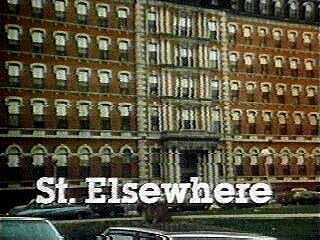
This week’s episode is a much better Dr. Craig episode than last week’s.

Episode 1.21 “Baron von Munchausen”

(Dir by Victor Hsu, originally aired on April 19th, 1983)

Anthony Rizzo (Louis Giambalvo) seems like a nice guy.  He’s admitted to the hospital with complaints of stomach pain and a high fever.  Dr. Morrison can’t find anything wrong with him but he does notice that Rizzo has a lot of scars.  Rizzo explains that he’s had a lot of surgeries over the course of his life and he’s got a story to go with each one of them.  Morrison brings in Ehrlich for a consult.  Ehrlich, who loves to perform surgery, suggests opening Rizzo up and doing an exploratory.  Morrison thinks it’s too early for that,  Rizzo, however, loves the idea.  Rizzo then proceeds to die on the operating table.

Ehrlich is shaken.  Morrison is angry.  However, Westphall and Craig take one look at the case and deduce that Rizzo suffered from Munchausen’s Syndrome.  For whatever reason, he was addicted to going to the hospital and having surgery.  He knew all the tricks, from using a light blub to make it look like he had a fever to pricking his finger with a needle to convince the doctors that there was blood in his urine.  It turns out that he died because of the drugs that he had been taking to help him fake his symptoms.  Both Morrison and Ehrlich are relieved to learn that Rizzo’s death was not their fault.

“So, Ehrlich lost his first patient today,” Craig says to Westphall.  “It won’t be his last.”

This was a good episode for Dr. Craig, especially after all that nonsense last week.  When Westphall finds himself in need of a doctor to speak to a group of inner city medical students, he is horrified to discover that Mark Craig is the only one available.  Craig accepts, saying that Westphall should have asked him earlier.

Westphall’s concerns are justified.  Dr. Craig is opinionated, wealthy, and more than a little prejudiced against …. well, everyone.  “My ancestors came here on the Mayflower!” Craig is quick to say.  And yet, the students love him, specifically because he doesn’t pretend to be anything that he isn’t.  Unlike Westphall, who tries give an inspiring pep talk, Craig is open about the reality of practicing medicine in what this episode refers to as being “the ghetto.”  When asked if his medical student son will be working in a ghetto clinic, Craig replies, “Why would he?”  Craig gets a standing ovation from the students, which felt like a bit much but whatever.  It was nice, for once, to see the show admitting that Craig’s blunt honesty can sometimes be more effective than Westphall’s noncommittal style of encouragement.

Afterwards, in a wonderfully acted scene, Craig asked Westphall why people don’t seem to like him,  Westphall shrugs and then says that Craig can be arrogant, rude, prejudiced, intolerant of other worldviews …. “Thank you, Donald,” Craig cuts him off.

Meanwhile, back at the hospital, a crazy woman (Micole Mercurio) is sent to the psych ward after threatening to kill Nurse Daniels.  (No, leave Shirley alone!)  Dr. Wendy Armstrong, who is one of the worst characters on this show, promptly discharges the woman and lets her leave the hospital.  “She threatened to kill me!” Shirley says while Wendy shrugs, unconcerned.  Fiscus also proves to be of no help, as he is once again feeling attracted to Kathy Martin.

Finally, Dr. White goes to a drug addict support group and walks out when things get too emotional.  Booo!  Dr. White is even worse than Dr, Armstrong!

This was a good episode.  Next week, the season finale!
Lisa Marie Reviews An Oscar Winner: The Graduate (dir by Mike Nichols)


Hello darkness, my old friend….

After watching 1967’s The Graduate, I defy anyone to listen to Simon and Garfunkel sing about the darkness without immediately picturing a young-looking Dustin Hoffman (he was 30 when the film was made but he was playing 22) standing on a moving airport walkway with a blank expression on his face.

If you don’t picture that, maybe you’ll picture Dustin Hoffman floating in a pool, wearing dark glasses and barely listening to his parents asking him about graduate school.

Or maybe you’ll remember him driving his car across the Golden Gate bridge.  Or perhaps sitting at the bottom of his pool with a scuba mask on.  Or maybe you’ll see him awkwardly standing at the desk in the lobby of a fancy hotel, trying to work up the courage to get a room.  Or maybe you’ll just see him and Katharine Ross sitting at the back of that bus with a “what do we do now?” expression on their faces.

(Supposedly, that expression was not planned and was just a result of the shot running longer than expected.)

Ah, The Graduate.  Based on a novel by Charles Webb, Buck Henry’s script remains one of the quotable in history.  “Mrs. Robinson, you’re tying to seduce me …. aren’t you?”  “Plastics.”  “Elaine!”  Myself, I have an odd feeling of affection for the line “Shall I get the cops?  I’ll get the cops.”  Perhaps that’s because the line is delivered by a young and uncredited Richard Dreyfuss, appearing in his second film and adding to the film’s general atmosphere of alienation.

Alienation is the main theme of The Graduate.  As played by Hoffman, Benjamin Braddock feels alienated from everything.  He was a track star.  He was a top student in high school and college.  Now, he’s just a college graduate with no idea what he wants to do with the rest of his life.  One can argue, of course, that Braddock brings a lot of his alienation on himself.  He can be a bit judgmental, even though he’s the one who is having an adulterous affair with Mrs. Robinson (Anne Bancroft) while also falling for Mrs. Robinson’s daughter, Elaine (Katharine Ross).  His parents (William Daniels and Elizabeth Wilson) can be overbearing but it’s possible they have a point.  Is he planning on spending the rest of his life floating in their swimming pool?  Benjamin says that he just needs time to finally relax.  After being pushed and pushed to be the best, he just wants time to do what he wants to do before his life becomes about plastics.  When I first saw this movie, I was totally on Benjamin’s side.  Now, as I’ve gotten older, I’ve started to understand where his parents were coming from.  Still, it’s hard not to feel that Benjamin deserves at least a little bit of time to enjoy himself.  That’s what Mr. Robinson (Murray Hamilton) thinks, at least initially.

Mrs. Robinson is the most interesting character in the film, a force of chaos who lives to disrupt the staid world around her.  She’s bored with her marriage and her conventional but empty lifestyle so she has an affair with Benjamin.  Later, she grows bored with Benjamin and his desire to “just talk” for once and she moves on from him.  Benjamin and Elaine are both likable and you find yourself wishing the best for them but Mrs. Robinson is the character who you really remember.  Mrs. Robinson grew up without losing her sense of rebellion.  One doubts that Benjamin and Elaine are going to do the same.

A portrait of American suburbia and 60s alienation, The Graduate would prove to be one of the most influential social satires ever made.  A box office hit, it was nominated for seven Academy Awards.  It was nominated for Best Picture, Best Director (Mike Nichols), Best Actor (Dustin Hoffman), Best Actress (Anne Bancroft), Best Supporting Actress (Katharine Ross), Best Adapted Screenplay (Buck Henry and Calder Willingham), and Best Cinematography (Robert Surtees).  The Simon and Garfunkel songs that set the film’s mood were, for the most part, not eligible.  (Only Mrs. Robinson was written specifically for the film.)  I would argue that the film deserved to be nominated for its editing as well.  In the end, the film only won one Oscar, for Mike Nichols.  But, regardless of what awards it won or lost, The Graduate‘s legacy lives on.


Retro Television Review: The Chadwick Family (dir by David Lowell Rich)


Welcome to Retro Television Reviews, a feature where we review some of our favorite and least favorite shows of the past!  On Sundays, I will be reviewing the made-for-television movies that used to be a primetime mainstay.  Today’s film is 1974’s The Chadwick Family!  It  can be viewed on YouTube.

Who are the Chadwicks?

They’re a family living in San Francisco.  They claim to be an average middle class family but, as has apparently been typical of television since its very first broadcast day, they live in a way that can only be explained by having a good deal of wealth.

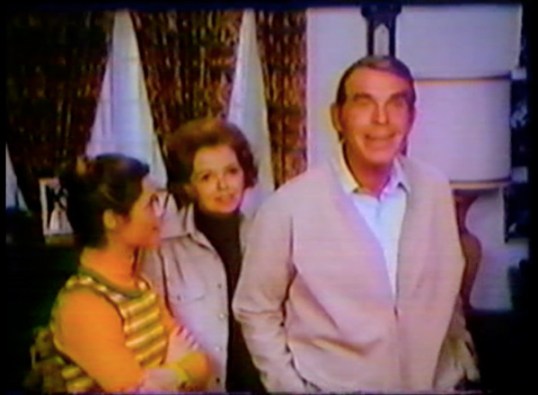
Consider this: Patriarch Ned Chadwick (Fred MacMurray) is a prominent newspaper columnist who writes so well that a mere column from him can settle a potential labor strike.  A national magazine has noticed the power of Ned’s words and they’ve offered him a job.  They want to turn him into a national figure.  The only catch is that he and his wife (Kathleen Maguire) would have to leave their beloved San Francisco and move to Chicago.  There’s no ocean in Chicago, as Ned puts it.  Sure, it would mean more money but who needs money when you’re a fabulously wealthy couple pretending to be middle class?

Moving would also mean leaving behind their children, all of whom have dramas of their own to deal with.  Tim (Stephen Nathan) is a college student, struggling to make the grade.  Lisa (Jane Actman) is engaged to Lee (Frank Michael Liu) and, for some reason, decides that it would be a good idea to tell her future mother-in-law that her desire for a long engagement is “bad chop suey.”  (Lee’s family is Chinese.)  Eileen (Lara Parker) is pregnant and her husband worries this will sabotage their support for “zero population growth.”  And Joan (Darleen Carr) is having to deal with the fact that her charismatic and fun-loving husband, Duffy (a young Barry Bostwick), is seriously ill and might even die before he can finish teaching Ned how to play the bagpipes.  Like all middle class people, Duffy owns his own airplane.

This is one of those movies that was obviously meant to serve as a pilot for a weekly television series and it’s easy to imagine Ned handing out wisdom to his kids on a weekly basis as they tried to navigate their way through the 70s.  Fred MacMurray gives off a nice grandfatherly vibe as Ned, so much so that it’s hard to believe that he’s the same actor who brought to life memorable heels in Double Indemnity, The Caine Mutiny, and The Apartment.  Unfortunately, the rest of the cast is not as memorable as MacMurray, largely because their roles are underwritten and their characters never feel like more than caricatures.  Barry Bostwick acts up a storm as Duffy but the fact that he’s listed as being a “special guest star” in the opening credits pretty much gives away his fate from the start.  As for Lisa, I usually like any character who shares my name but how much sympathy can you have for someone dumb enough to use a phrase like “bad chop suey” while speaking to her Chinese future in-laws.  Indeed, it was kind of weird how everyone in the family seemed to be totally comfortable with making jokes about Lee being Chinese and speaking with an accent.  One has to wonder how Lee felt about that.

Anyway, as far as I know, The Chadwick Family has no further adventures but their sole outing will live forever thanks to YouTube.

Retro Television Review: The Astronaut (dir by Robert Michael Lewis)


Welcome to Retro Television Reviews, a feature where we review some of our favorite and least favorite shows of the past!  On Sundays, I will be reviewing the made-for-television movies that used to be a primetime mainstay.  Today’s film is 1972’s The Astronaut!  It  can be viewed on YouTube!

NASA has successfully landed a man on Mars!  The entire world watches as Col. Brice Randolph (Monte Markham) makes his way across the Martian surface.  However, suddenly, the signal goes out.  Viewers are assured that this is the sort of thing that happens all the time with interstellar travel.  What they don’t know is that the signal went down because Brice suddenly died.  While the surviving members of the mission return to Earth, NASA tries to figure out how to keep anyone from finding out what happened to Brice.  NASA director Kurt Anderson (Jackie Cooper) knows that the President wants to cut the budget and the death of an astronaut would probably provide the perfect excuse for taking money away from NASA and canceling the Mars program.

Anderson’s solution is to recruit a substitute.  Eddie Reese (Monte Markham) has a slight resemblance to Brice, one that can be perfected through plastic surgery.  While the mission returns from Mars, Eddie goes through a crash course to teach him how to talk, walk, and think like Col. Brice Randolph.  Eddie is told that he’ll have to be Brice until the NASA scientists can figure out what led to Brice’s death.  Once they do know what went wrong with the mission, Eddie will have to go into NASA’s version of the witness protection.

Eddie proves to be a quick learner and it helps that he, like so many others, looked up to Brice.  However, while Eddie can fool almost everyone else, he cannot fool Brice’s wife, Gail (Susan Clark).  When Eddie actually treats Gail with kindness and shows sympathy for her nervous condition, she realizes that there’s no way that Eddie is actually her husband.  Apparently, Brice was not quite the saintly figure that the public believed him to be.  Eddie and Gail soon fall in love for real but when NASA finally discovers what led to Brice’s death, it looks like their new life together might be over as abruptly as it begun.

The Astronaut is a low-key conspiracy …. well, I hesitate to call it a thriller.  There’s little of the things that one typically associated with a conspiracy thriller.  There’s no black helicopters.  There’s no shadowy assassins.  There’s no army of men walking around in black suits.  Instead, there’s just a bunch of nervous bureaucrats who are desperate to keep the rest of the world from discovering just how much they screwed up.  As played by Jackie Cooper, the head of NASA isn’t so much evil as he’s just way too devoted-to-his-job for his own good.  In many ways, this is probably one of the most realistic conspiracies ever portrayed on film.

In the end, The Astronaut is a portrait of two lonely people who find love in the strangest of circumstances.  Susan Clark and Monte Markham make for a likable couple and the viewer really does hope that things will work out for them.  What this film lack in conspiracy thrills, it makes up for in human drama.  It appealed to both my romantic and my rabid anti-government sides.  What more could one ask?

Horror on the Lens: Bloodlust! (dir by Ralph Booker)


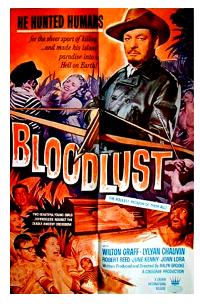
In this 1961 version of The Most Dangerous Game, two vacationing couples find themselves trapped on a tropical island and hunted by the insane Dr. Albert Balleau (Wilton Graf).  Dr. Balleau loves to hunt people.  Why, you could even say that Dr. Balleau has a …. BLOODLUST!

Anyway, this is an undeniably low-budget film and it’s kind of silly but that’s actually what makes it watchable.  There’s a thousand different versions of The Most Dangerous Game out there but this is the only one to feature Robert Reed, the dad from The Brady Bunch, being hunted through the jungle.  If you’re like me and you think that Mike Brady was an authoritarian fascist, this film is for you.

Enjoy!

https://www.youtube.com/watch?v=nYZLvPQO8j0

Framed (1975, directed by Phil Karlson)


Revenge can be brutal, especially when you’ve been framed.

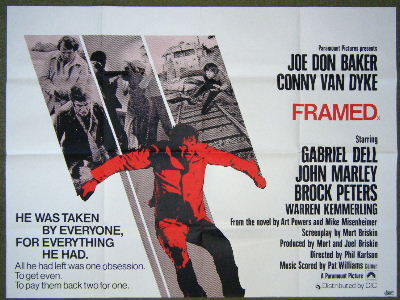
Joe Don Baker plays Ron Lewis, a surly nightclub owner and gambler who wins a small fortune, witnesses a crime, and nearly gets shot all in the same night.  When he reaches his house, he’s planning on calling the police but he’s confronted in his own garage by a sheriff’s deputy who tries to kill him!  In a lengthy and brutal scene, Ron beats the deputy to death and gouges out his eyes.  Even though Ron was only acting in self-defense, he’s charged with murder.  Told that there is no way that he’ll be able to win an acquittal, Ron pleads guilty to a lesser charge and is sent to prison for four years.

While he’s in prison, Ron befriends a mob boss (John Marley, who famously woke up with a horse’s head in his bed in The Godfather) and the boss’s number one hitman, Vince (Gabriel Dell).  While Ron is in prison, a group of men assault his girlfriend (country singer Conny Van Dyke) and tell her not to ask any questions about the events that led to Ron being framed.

After serving his sentence and getting into numerous fights with the guards, Ron is finally released.  When Vince shows up and tells Ron that he’s been hired to kill him, the two of them team up with an honest deputy (Brock Peters) and set out to find out why Ron was set up and to get revenge.

Framed is a brutal movie, Ron and his friends hold nothing back in their quest to get revenge.  Whether he’s shooting a man in cold blood or hooking someone up to a car battery in order to get information out of him, there’s little that Ron won’t do and the movie lingers over every act of violence.  Several pounds overweight and snarling out of his lines, Joe Don Baker may not be a conventional action hero but he’s believable in his rage.  He’s the ultimate country boy who has been pushed too far and now he doesn’t care how much blood he has to get on his hands.  However, because Baker does seem more like an ordinary person than a Clint Eastwood or a Charles Bronson-type, he retains the audience’s sympathy even as he splashes blood all over the screen.  As violent as his action may be, they always feel justified.

Baker’s performance and the believable violence are the film’s biggest strengths.  It’s biggest weakness is a plot that revolves around an elaborate conspiracy that doesn’t always make sense and some notably weak supporting performances.  Ron’s revenge may be brutal but it takes a while to get there and the first hour gets bogged down with Ron’s struggle to adjust to life in prison.  John Marley does a good job as Ron’s prison mentor but then he abruptly disappears from the movie.

Before making Framed, Baker and director Phil Karlson previously collaborated on Walking Tall.  Framed is far more violent than that film was but its plot doesn’t hold together as well.  However, if you’re just looking for a violent action film that features Joe Don Baker doing what he does best, Framed delivers.

30 Days Of Noir #18: C-Man (dir by Joseph Lerner)


At the center of the 1949 film, C-Man, is a man named Cliff Holden (Dean Jagger).  When we first see Cliff, he’s cheerfully walking down the street in New York City, looking pretty happy underneath his new fedora.

And really, why shouldn’t Cliff be happy?  He’s a U.S. Customs agent!  He investigates crimes and tracks down smugglers and, perhaps most importantly, his best friend is a customs agent as well!  Who wouldn’t want to work with their best friend, right?  Anyway, Cliff eventually reaches his office and he discovers that nobody else appears to share his good mood.  For that matter, Cliff’s step losing its cheerful spring when he finds out that his best friend has been …. MURDERED!

His friend was investigating the theft of a very valuable necklace.  The Treasury Department has reason to believe that an international criminal named Matt Royal (Rene Paul) will be smuggling that necklace into the United States.  Looking to not only avenge his friend but also protect the reputation of the United States, Cliff takes over the case.  Using the name William Hannah, he flies out to Europe so that he can then board the same plane that Royal will be taking to the States.

While Cliff/William is waiting at the airport, he meets a Swiss woman, named Kathe van Bourne (Lottie Elwin), who is flying to New York so that she can be reunited with her fiancée, Joe.  However, after they board the plane, Kathe is suddenly taken ill.  Luckily, there’s a doctor on the plane, a courtly gentleman named Doc Spencer (John Carradine).  Spencer takes Kathe to the back of the plane to examine her and, while no one’s looking, he hides the necklace underneath a bandage that he wraps around her head.

Back in New York, Royal is pulled off the plane and thoroughly searched.  When it’s discovered that he doesn’t have the necklace, Cliff realizes what has happened.  However, Kathe has already been taken off in an ambulance and, when Cliff goes to Joe’s apartment, he discovers that Joe has been murdered….

C-Man is a film that kind of sneaks up and takes you by surprise.  That it was an extremely low-budget production is obvious from the minute the movie starts.  The black-and-white images are grainy.  The sets are small and sparsely furnished.  The whole film has a rather cheap and ragged feel, as if it might burst into flame and dissolve at any moment.  And yet, that low-budget feel works perfectly for the story that C-Man is telling.  Despite the oddly cheery narration that’s provided by Dean Jagger, this is a sordid tale about people on the fringes of society.  Watching C-Man feels like taking a trip to all of the places that most tourists would never want to visit during their trip to New York City.  For instance, when Cliff searches for the alcoholic Doc Spenser, his search leads him from one liquor store to another and it’s obvious that some of the desperate souls that Cliff passes on the streets weren’t actors.

Gail Kubick’s pounding and relentless score adds to the film’s overall dreamlike feel and Joseph Lerner’s direction is just quirky enough to keep things interesting.  (When one character is bludgeoned to death, the film suddenly starts to spin as if the viewer has become trapped in the killer’s madness.)  Dean Jagger seems a bit miscast as a the tough customs agent but the actors playing the criminals are all properly menacing.  Harry Landers, as the most violent of the jewel thieves, makes a particularly threatening impression.

All in all, C-Man is a surprisingly effective poverty row noir.

A Movie A Day #238: Lawman (1971, directed by Michael Winner)


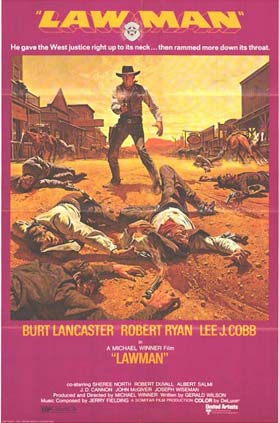
In the 1880s, Jared Maddox (Burt Lancaster) is the marshal of the town of Bannock.  After a night of drinking and carousing leads to the accidental shooting of an old man, warrants are issued for the arrest of six ranch hands.  Maddox is determined to execute the arrest warrants but the problem is that the six men live in Sabbath, another town.  They all work for a wealthy rancher (Lee J. Cobb) and the marshal of Sabbath, Cotton Ryan (Robert Ryan), does not see the point in causing trouble when all of the men are likely to be acquitted anyway.  Maddox doesn’t care.  The law is the law and he does not intend to leave Sabbath until he has the six men.
Lawman starts out like a standard western, with a stranger riding into town, but then it quickly turns the western traditions on their head by portraying Marshal Maddox as being a rigid fanatic and the wealthy rancher as a morally conflicted man who does not want to resort to violence and who continually tries and fails to convince Maddox to leave.  In the tradition of Sergio Leone and Sam Peckinpah, there are no real heroes to be found in Lawman and, even when Maddox starts to reconsider his strict adherence to the law and refusal to compromise, it is too late to prevent the movie from ending in a bloody massacre.  Since Lawman was made in 1971, I initially assumed it was meant to be an allegory about the Vietnam War but then I saw that it was directed by Michael Winner, a director who specialized in tricking audiences into believing that his violent movie were deeper than they actually were.

Even if Lawman never reaches the heights of a revisionist western classic like Pat Garrett and Billy the Kid, it is still pretty good, with old pros Lancaster, Ryan, Cobb, and Albert Salmi all giving excellent performances.  The cast is full of familiar faces, with everyone from Robert Duvall to Richard Jordan to Ralph Waite to Joseph Wiseman to John Beck showing up in small roles.  In America, Winner is best remembered for his frequent collaborations with Charles Bronson.  Chuck is not in Lawman, though it seems like he should have been and Lee J. Cobb’s rancher is named Vincent Bronson.  Winner would not make his first film with Charles Bronson until a year later, when he directed him in Chato’s Land.

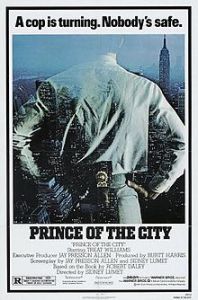
A Movie A Day #30: Prince of the City (1981, directed by Sidney Lumet)


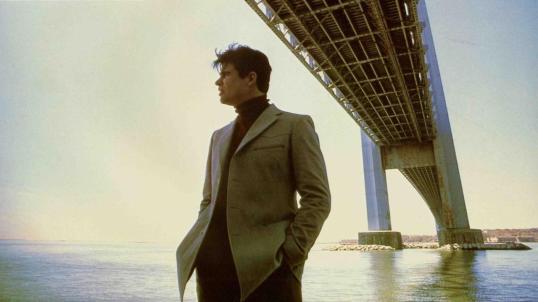
220px-prince_of_the_city_foldedIn 1970s New York City, Danny Ciello (Treat Williams) is a self-described “prince of the city.”  A narcotics detective, Ciello is the youngest member of the Special Investigations Unit.  Because of their constant success, the SIU is given wide latitude by their superiors at the police department.  The SIU puts mobsters and drug dealers behind bars.  They get results.  If they sometimes cut corners or skim a little money for themselves, who cares?
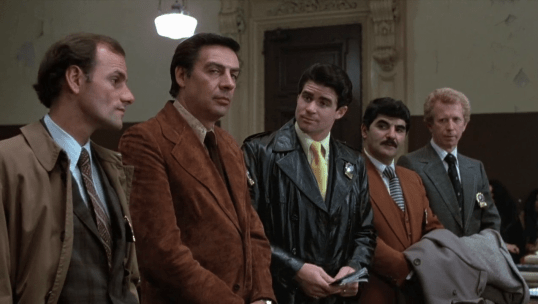
It turns out that a lot of people care.  When a federal prosecutor, Rick Cappalino (Norman Parker), first approaches Ciello and asks him if he knows anything about police corruption, Ciello refuses to speak to him.  As Ciello puts it, “I sleep with my wife but I live with my partners.”  But Ciello already has doubts.  His drug addict brother calls him out on his hypocrisy. Ciello spends one harrowing night with one of his informants, a pathetic addict who Ciello keeps supplied with heroin in return for information.  Ciello finally agrees to help the investigation but with one condition: he will not testify against anyone in the SIU.  Before accepting Ciello’s help, Cappalino asks him one question.  Has Ciello ever done anything illegal while a cop?  Ciello says that he has only broken the law three times and each time, it was a minor infraction.

For the next two years, Ciello wears a wire nearly every day and helps to build cases against other cops, some of which are more corrupt than others.  It turns out that being an informant is not as easy as it looks.  Along with getting burned by malfunctioning wires and having to deal with incompetent backup, Ciello struggles with his own guilt.  When Cappalino is assigned to another case, Ciello finds himself working with two prosecutors (Bob Balaban and James Tolkan) who are less sympathetic to him and his desire to protect the SIU.  When evidence comes to light that Ciello may have lied about the extent of his own corruption, Ciello may become the investigation’s newest target.

prince-of-the-city

Prince of the City is one of the best of Sidney Lumet’s many films but it is not as well-known as 12 Angry Men, Dog Day Afternoon, Network, Serpico, The Verdict, or even The Wiz.  Why is it such an underrated film?  As good as it is, Prince of the City is not always an easy movie to watch.  It’s nearly three hours long and almost every minute is spent with Danny Ciello, who is not always likable and often seems to be on the verge of having a nervous breakdown.  Treat Williams gives an intense and powerful performance but he is such a raw nerve that sometimes it is a relief when Lumet cuts away to Jerry Orbach (as one of Ciello’s partners) telling off a district attorney or to a meeting where a group of prosecutors debate where a group of prosecutors debate whether or not to charge Ciello with perjury.

Prince of the City may be about the police but there’s very little of the typical cop movie clichés.  The most exciting scenes in the movie are the ones, like that scene with all the prosecutors arguing, where the characters debate what “corruption” actually means.  Throughout Prince of the City, Lumet contrasts the moral ambiguity of otherwise effective cops with the self-righteous certitude of the federal prosecutors.  Unlike Lumet’s other films about police corruption (Serpico, Q&A), Prince of the City doesn’t come down firmly on either side.

(Though the names have been changed, Prince of the City was based on a true story.  Ciello’s biggest ally among the investigators, Rick Cappalino, was based on a young federal prosecutor named Rudy Giuliani.)

Prince of the City is dominated by Treat Williams but the entire cast is full of great New York character actors.  It would not surprise me if Jerry Orbach’s performance here was in the back of someone’s mind when he was cast as Law & Order‘s Lenny Briscoe.  Keep an eye out for familiar actors like Lance Henriksen, Lane Smith, Lee Richardson, Carmine Caridi, and Cynthia Nixon, all appearing in small roles.

Prince of the City is a very long movie but it needs to be.  Much as David Simon would later do with The Wire, Lumet uses this police story as a way to present a sprawling portrait of New York City.  In fact, if Prince of the City were made today, it probably would be a David Simon-penned miniseries for HBO.

image-w1280

Horror on TV: Twilight Zone 3.12 “The Jungle”


TheTwilightZoneLogo

Along with starting each day of October with a horror film here at the Shattered Lens, we’re going to end each day with a horror-themed television show.

While I had previously caught a few episodes of the Twilight Zone during one of the annual holiday marathons on SyFy, I didn’t truly appreciate the show until I first exchanged e-mails with my friend in Australia, Mark. Among other things, Mark expressed a very eloquent appreciation for The Twilight Zone and that inspired me to watch quite a few episodes that have been uploaded to YouTube and Hulu. Along with being an essential piece of television history, the best episodes of the Twilight Zone remain watchable and entertaining 50 years after they were first broadcast.

Considering the esteemed place that the Twilight Zone continues to occupy in American culture, it seems appropriate to feature it during Horror Month here at the Shattered Lens.

The Jungle, which first aired on December 1st, 1961, is a personal favorite of mine. A businessman returns to New York from Africa. While in Africa, he upset a local witch doctor. Though the businessman, at first, laughs off the possibility that he may be cursed, it soon turns out that he’s wrong. There’s a lesson to this episode and here it is: Don’t piss off a witch doctor.

When I first saw this episode, the final scene caused me to have nightmares!

(By the way, I’m embedding this episode from Hulu. Sadly, you will have to deal with commercials. However, it’s really a great episode!)

(It has also come to my attention that some browsers do not work with embedded Hulu vidoes.  Seriously, the internet is so frustrating!  If the embedded video is not appearing on your browser, you should be able to watch this episode on Hulu.  Here’s the link — http://www.hulu.com/watch/440777.  I apologize for the inconvenience but still, it is a really good episode!)