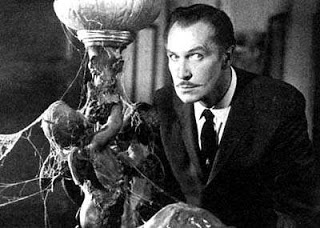
Horror Movie Review: The Fall of the House of Usher (dir by Roger Corman)


The 1960 film, The Fall Of The House of Usher, opens with Phillip Winthrop (Mark Damon) riding his horse across a desolate landscape.

There’s a foreboding mansion in the distance but what the viewer immediately notices is that the land around the mansion looks almost post-apocalyptic.  Even though the film is set in the 1800s, the misshapen trees and the high winds all bring to mind a film set in a nuclear-scarred world, the type where you expect to find radioactive mutants hiding behind every tree and rock.

Phillip is a young aristocrat who is traveling to the home of the Usher family.  He is engaged to marry Madeleine Usher (Myrna Fahey) but, as soon as he arrives at the mansion, her older brother, Roderick (Vincent Price, with no mustache and blonde hair), informs Phillip that he will never be allowed to marry Madeleine.  Roderick explains that the Usher family is cursed and he even takes Phillip on a tour of Usher family history, showing him a series of truly hideous paintings of past Ushers.  One Usher was a murderer.  Another Usher was blackmailer.  An Usher wearing a pirate’s cap is identified as being a slave trader.  The Ushers are cursed, with each family member destined to become insane.  Roderick’s mission is to bring the Usher bloodline to a close and that means that Madeleine cannot marry.

Phillip disagrees, especially when the sickly Madeleine herself says that she wants to escape from her seemingly mad brother.  With the house itself continually shaking as if it’s on the verge of collapsing, Phillip becomes determined to take Madeleine away.  Roderick tries to warn him not to.  Even the friendly butler, Bristol (Harry Ellerbe), encourages Phillip to give up.  But Phillip remains stubborn and determined.  However, when Madeleine suddenly collapses and dies, it appears that Phillip’s plans to marry her are at an end.  But is Madeleine truly dead?

Based on a short story by Edgar Allan Poe, this was, at the time, the most expensive film that Roger Corman and American International Pictures had ever made.  (It was also their first color film.)  Of course, the budget was still just $300,000 and the Usher mansion was largely constructed out of props that were borrowed from other films.  That said, the film had a name star and, with its vivid colors and its fiery finale, it certainly looked like a big-budget film.  This film marked the first collaboration between Vincent Price and Roger Corman and it was a box office success, making  a million dollars at a time when a million dollars really meant something..  Corman and Price would go on to do several other Poe adaptations together, all of which were distinguished by Price’s villainous performances and Corman’s pop art visuals.

Seen today, The Fall of the House of Usher can seem to be a bit slow.  With only one location and a cast of only four actors, it often feels a bit stagey.  Mark Damon is rather stiff as Phillip.  (One can see why he abandoned acting to become a producer.)  But Vincent Price’s performance as Roderick Usher continue to entertain, with Price delivering every line of dialogue with his trademark aristocratic archness.  There’s nothing subtle about Price’s performance but Price’s tendency to overact perfectly matched Corman’s vivid visuals and it’s interesting to watch a hyperactive Price performance paired with the type of dull performance that Mark Damon offers up.

The fiery finale still packs a certain punch and, watching it, one can see why Corman and Price said, “Let’s do this again!”  The Fall of the House of Usher (which is also available on some streaming sites as simply House of Usher) remains an enjoyable macabre Halloween treat.
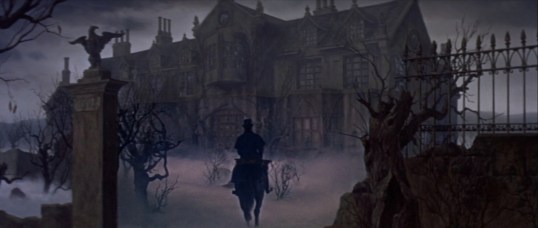
House of Usher (1960, dir by Roger Corman, DP: Floyd Crosby)


Vincent Price Recites The Tell-Tale Heart!


Earlier today, I featured Christopher Lee reading The Fall of the House of Usher.

Here to continue to spread the Halloween spirit is Vincent Price, performing The Tell-Tale Heart.  This is from 1970 and was a part of a PBS special called An Evening With Edgar Allan Poe.

Insomnia File #64: Once Upon A Midnight Scary (dir by Nell Cox)


What’s an Insomnia File? You know how some times you just can’t get any sleep and, at about three in the morning, you’ll find yourself watching whatever you can find on cable or streaming? This feature is all about those insomnia-inspired discoveries!

If you were having trouble getting to sleep last night, you could have gone over to YouTube and watched 1978’s Once Upon A Midnight Scary.

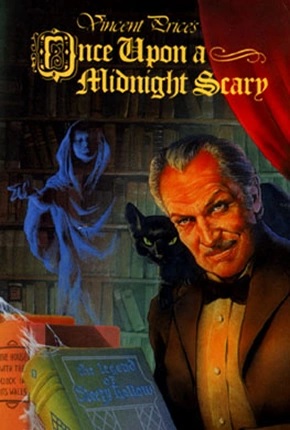
Made for CBS and featuring Vincent Price as the sardonic, cape-wearing host, Once Upon A Midnight Scary was a special designed to encourage young viewers to pick up a book and read.  Price introduced three different stories, each centering around ghosts and each based on a book.  In the first story, based on the book The Ghost Belonged To Me, a young farmboy discovers a ghost hiding in a barn and becomes a hero when the ghost warns him about an impending disaster.  The second story is an adaptation of The Legend of Sleepy Hollow and it features Rene Auberjonois as a rather neurotic Ichabod Crane, who finds himself being pursued by the headless horsemen.  The third and longest story is an adaptation of The House With A Clock In Its Walls, featuring Severn Darden and a rather annoying child actor.

One thing you immediately notice about this show is that the special doesn’t actually reveal how any of the stories end.  Instead, each story is basically a recreation of the most exciting or interesting parts of the larger story but, whenever it appears that we’re heading for a conclusion, Vincent Price suddenly appears and says, “What happened next, you ask?  Read the book!”  This special basically casts Vincent Price as the world’s most devilish book salesman and while that might be annoying if you’re watching the special because you want to see how the stories turn out, it’s a lot of fun if you’re just watching the show to watch Vincent Price act like Vincent Price.  Vincent is not in the special as much as you might want but he still shows off his unique charm.  It’s impossible to be in a bad mood while watching Vincent Price.

Previous Insomnia Files:

  1. Story of Mankind
  2. Stag
  3. Love Is A Gun
  4. Nina Takes A Lover
  5. Black Ice
  6. Frogs For Snakes
  7. Fair Game
  8. From The Hip
  9. Born Killers
  10. Eye For An Eye
  11. Summer Catch
  12. Beyond the Law
  13. Spring Broke
  14. Promise
  15. George Wallace
  16. Kill The Messenger
  17. The Suburbans
  18. Only The Strong
  19. Great Expectations
  20. Casual Sex?
  21. Truth
  22. Insomina
  23. Death Do Us Part
  24. A Star is Born
  25. The Winning Season
  26. Rabbit Run
  27. Remember My Name
  28. The Arrangement
  29. Day of the Animals
  30. Still of The Night
  31. Arsenal
  32. Smooth Talk
  33. The Comedian
  34. The Minus Man
  35. Donnie Brasco
  36. Punchline
  37. Evita
  38. Six: The Mark Unleashed
  39. Disclosure
  40. The Spanish Prisoner
  41. Elektra
  42. Revenge
  43. Legend
  44. Cat Run
  45. The Pyramid
  46. Enter the Ninja
  47. Downhill
  48. Malice
  49. Mystery Date
  50. Zola
  51. Ira & Abby
  52. The Next Karate Kid
  53. A Nightmare on Drug Street
  54. Jud
  55. FTA
  56. Exterminators of the Year 3000
  57. Boris Karloff: The Man Behind The Monster
  58. The Haunting of Helen Walker
  59. True Spirit
  60. Project Kill
  61. Replica
  62. Rollergator
  63. Hillbillys In A Haunted House

Horror Film Review: The Raven (dir by Roger Corman)


“Shall I ever see the rare and radiant Lenore again?” — Dr. Erasmus Craven (Vincent Prince)

“How they Hell should I know?” — Dr. Adolphus Bedlo (Peter Lorre)

This exchange comes from Roger Corman’s 1963 film, The Raven, and it pretty much epitomizes the film.  Very loosely based on the poem by Edgar Allan Poe, The Raven was one of the many Poe adaptations that Corman did with Vincent Price.  As opposed to the other films in Corman’s Poe cycle, The Raven was a flat-out comedy, one that parodied the other films in the cycle.  Reportedly, Peter Lorre improvised his response to Vincent Price’s question about Lenore.  In fact, Lorre improvised a good deal of his performance and his jokes sometimes even took Corman by surprise.  As a result and despite the fact that Richard Matheson did write a script for the film, The Raven is one of those films that feels like it was made up while the camera was rolling.

The Raven is a film about three sorcerers who are always fighting and arguing with each other.  Dr. Erasmus Craven (Vincent Price) spends his time mourning the late Lenore.  The evil Dr. Scarabus (a frail-looking Boris Karloff) has his own castle where he lives with the ghost of the late Lenore (Hazel Court).  Dr. Adolphus Bedlo (Peter Lorre) is a sarcastic ne’er-do-well who saw Lenore in Scarabus’s castle and was transformed into a talking raven as a result.

In raven form, Dr. Bedlo flies over to Craven’s castle and convinces Craven to transform him back into human form.  After informing Craven that Scarabus has Lenore’s ghost in his castle, the heart-broken Craven decides to head over to Scarabus’s castle and get some answers.  Accompanying the group is Craven’s daughter, Estelle (Olive Sturgess) and Bedlo’s son, Rexford (Jack Nicholson, looking somewhat lost in the role of a boring young man).

At the castle, Scarabus puts on an act of being a friendly and gracious host but the opposite soon turns out to be true.  In fact, the entire castle is full of secrets and it quickly turns out that hardly anyone — with the exception of Estelle and Rexford — are who they actually claim to be.  It leads to a battle in magic between Craven and Scarabus.  I nearly described their battle as being “epic” but that’s probably not the right world.  It’s epic by the standards of Roger Corman but actually, the big battle is just as jokey as the rest of the film.

The Raven is definitely not a film that’s meant to be taken seriously.  One gets the feeling that Corman knew that the presence of Price, Karloff, and Lorre would make the film a success no matter what the film was like so he decided to have some fun with it.  (Price and definitely Lorre appear to have been in on the joke while Karloff was perhaps a bit less so.)  To be honest, the film’s only earnest moments come courtesy of Oliva Sturgess and Jack Nicholson but, because Nicholson is Nicholson, you watch those earnest moments waiting for Rexford to arch an eyebrow or flash that devilish grin.  Unfortunately, he doesn’t.  Jack is pretty boring here.

The Raven, if we’re going to be honest, is probably too jokey for its own good but it’s still hard to resist the charm of Price, Lorre, and Karloff.  The film is a chance to see three horror icons acting opposite each other and, as a result, it’s a fun film for horror fans.  Vincent Price breaks the fourth wall at the end of the film and it’s hard not to love it.

Horror Scenes That I Love: Vincent Price in Masque of the Red Death


Today’s horror star is the great Vincent Price.

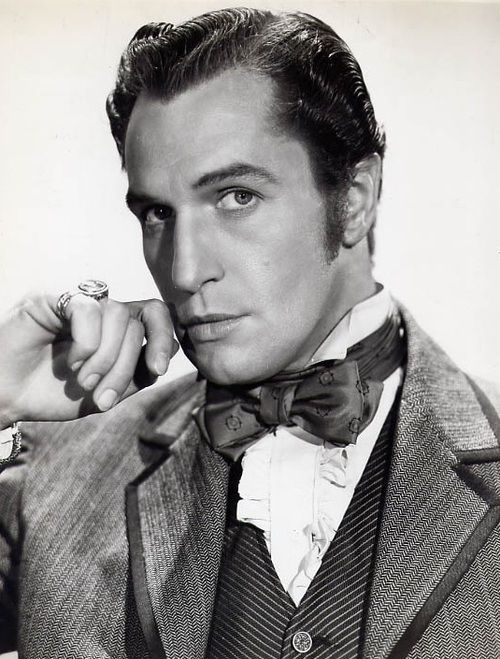
Born in Missouri and blessed with both an aristocratic profile and a resonant voice, Vincent Price started his career as a romantic leading man before eventually before finding more success a character actor.  Starting in the late 40s and continuing until his death in 1993, Price was a beloved horror icon, bringing his witty presence to several different horror films.

Price always cites Roger Corman’s Edgar Allan Poe adaptations as being amongst his favorite of the horror films in which he appeared.  In this scene from 1964’s The Masque of the Red Death, Vincent Price delivers a monologue on the meaning of terror as only he could.

Horror Film Review: The Tingler (dir by William Castle)


The 1959 film, The Tingler, opens with a middle-aged man standing on a stage and speaking directly to the audience.

“I am William Castle, the director of the motion picture you are about to see. I feel obligated to warn you that some of the sensations—some of the physical reactions which the actors on the screen will feel—will also be experienced, for the first time in motion picture history, by certain members of this audience. I say ‘certain members’ because some people are more sensitive to these mysterious electronic impulses than others. These unfortunate, sensitive people will at times feel a strange, tingling sensation; other people will feel it less strongly. But don’t be alarmed—you can protect yourself. At any time you are conscious of a tingling sensation, you may obtain immediate relief by screaming. Don’t be embarrassed about opening your mouth and letting rip with all you’ve got, because the person in the seat right next to you will probably be screaming too. And remember this—a scream at the right time may save your life.”

When this film was first released in 1959, William Castle wasn’t lying in this warning.  Certain audience members would feel the tingling sensation of fear because some theaters agreed to wire certain seats with buzzers that, when activated, would give the viewer a tingling sensation.  Castle also arranged for certain theaters to fake an attack by the film’s monster, complete with the houselights coming up, a woman screaming and pretending to faint, and the voice of Vincent Price encouraging everyone in the audience to scream because “the Tingler is loose in the theater!”

Uhmm …. that sounds like fun.  When it comes to William Castle’s gimmicks, there’s a lot of documentation concerning what Castle arranged but there’s not as much documentation about how people reacted to being buzzed while watching a movie.  Hopefully, everyone screamed, played along, and had fun.  Personally, I probably would have left the theater during the chaos and snuck into a showing of Anatomy of a Murder.

As for the film, it stars the great Vincent Price as Warren Chapin, a pathologist who is investigating the source of fear.  As he explains to his colleague, Dave Morris (Dwayne Hickman), he believes that the tingling that people feel at the base of their spine is actually a living creature that is formed by fear.  The only way to kill the creature is to scream.  If you don’t scream, the creature will eventually snap your spine.  Well, I guess you better scream then.

Anyway, Dr. Chapin confronts his wife Isabel (Patricia Cutts) over the fact that she’s cheating on him.  He pulls a gun on her and, as she begs for his life, he fires.  She collapses but fear not!  The gun was loaded with blanks and Dr. Chapin just wanted to scare her so that he could x-ray her back and see if the Tingler was forming on her spine.  Dr. Chapin is overjoyed when the Tingler shows up on x-rays but now, he needs to bring a Tingler into the real world….

(I’m not sure why you would want a Tingler but whatever….)

One of Chapin’s friends is Ollie Higgins (Philip Coolidge) who owns a movie theater with his wife, Martha (Judith Evelyn).  Martha is deaf and mute and therefore cannot scream.  When Ollie deliberately frightens her, the Tingler appears on her spine and snaps it.  At the subsequent autopsy, Chapin is able to remove the Tingler from Martha’s spine.  The Tingler, which is a giant centipede that likes to crawl up people’s legs, gets loose and needless to say, all tingling heck breaks out.

Wow, this is a silly film!  There’s is absolutely nothing frightening about a plastic centipede being pulled across the screen by wires.  But, at the same time, it’s a Vincent Price film and Vincent knew exactly how to play his mad-but-not-evil scientist, delivering his lines with the perfect combination of snark and melodrama.  This film came out the same year as another Castle/Price collaboration, The House on Haunted Hill.  It’s nowhere near as good as The House on Haunted Hill but The Tingler is still a lot of fun in its silly way.  It won’t make you scream from fright but you might laugh really loudly.

Horror Scenes I Love: Peter Lorre in Tales of Terror


Born in what is now Slovakia, Peter Lorre began his acting career in Europe, appearing on the stage and making quite an impression when he starred in Fritz Lang’s M.  When the Nazis came to power, Lorre was one of the many film artists who left Germany.  At first, he moved to France but, in 1934, he set sail for the United States and continued his career in Hollywood.  A popular character actor, Lorre appeared in such classic films as The Man Who Knew Too Much, The Maltese Falcon, Mad Love, Arsenic and Old Lace and Casablanca.  Though his role in Casablanca was small, he still played a key role when he gave Rick the letters of transit.

He also appeared in several horror films, often opposite his good friend Vincent Price and Boris Karloff.  In this scene from 1962’s Tales of Terror, Lorre and Price challenge each other to a wine-drinking contest.


Horror On The Lens: House On Haunted Hill (dir by William Castle)


The original The House on Haunted Hill is a classic and one that we make it a point to share every Halloween.  And since October is now halfway over, now seems like the perfect time to do so!

Be sure to check out Gary’s review by clicking here!

Enjoy Vincent Price at his best!

Horror on the Lens: The Bat (dir by Crane Wilbur)


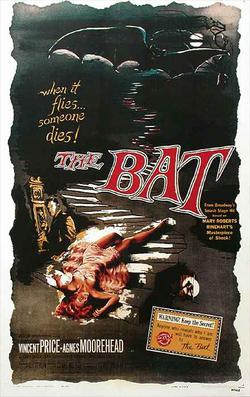
Today’s Horror on the Lens is 1959’s The Bat.  A simple case of bank embezzlement leads to a murder that may or may not be connected to a series of other murders that are apparently being committed by a mysterious killer known as “The Bat.”  The Bat is said to have no face and steel claws and, needless to say, everyone in town is worried about becoming the next victim.

Who is the Bat?  Is Dr. Malcolm Wells (Vincent Price), the shady scientist whose work has led to him doing experiments on bats?  Is it Victor Bailey (Mike Steele), the bank clerk who is a prime suspect in the embezzlement case?  Is it the butler (John Sutton) with a secret past?  Could it even be one of the cops (Gavin Gordon and Robert B. Williams) who has been tasked with capturing The Bat?  Can mystery novelist Cornelia van Gorder (Agnes Moorehead) solve the mystery before becoming The Bat’s next victim!?

The Bat is based on a play and it’s definitely a bit stagey but when you’ve got performers like Agnes Moorehead and Vincent Price onscreen, it really doesn’t matter.  The Bat is an entertaining and atmospheric mystery, featuring a Vincent Price playing another one of his charmingly sinister cads.

Enjoy!

6 Non-Horror Roles Of Vincent Price


Vincent Price could have been Ashley Wilkes.

That may sound strange today, the idea of horror icon Vincent Price playing the courtly and handsome Ashley Wilkes in Gone With The Wind.  But, when Price came to Hollywood in the late 30s, it actually seemed like ideal casting.  Before he became known as a horror actor, the Missouri-born Price was known for being a handsome stage actor who specialized in playing romantic parts.  Though Price would become best-known for his horror films, he was capable of much more and he also appeared in much more.

Here are just six of Vincent Price’s memorable non-horror performances!

  1. Robert Wade in Service de Luxe (1938)

At the age of 27, Vincent Price made his film debut in this romantic comedy, playing Robert Wade.  Robert Wade is a young man from Albany who comes to New York City because he is trying to raise money that he can then use to build and perfect a new tractor.  It’s in New York that he meets and eventually falls in love with a life coach named Helen Murphy (Constance Bennett).  Helen is relieved to discover that the earnest Robert is someone who doesn’t need a life coach to tell him how to live his life …. or design a tractor as the case may be!  This is a rather slight film but, in his film debut, Price is charming and handsome.

2. Vital Dotour in The Song of Bernadette (1943)

In this Oscar-nominated film, Price has a key role as the prosecutor who looks into the claims that a girl named Bernadette (Jennifer Jones) has experienced visions of the Blessed Virgin Mary.  Though the role does carry some hints of the type of work that lay in Price’s future, it’s still a far cry from his later horror roles and Price brings some needed nuance to a characters who, in lesser hands, could have just been a flat-out villain.

3. Shelby Carpenter in Laura (1944)

Perhaps the best-known and most-regarded of all of Price’s non-horror films, Laura features Price in the role of the good-for-nothing, wealthy boyfriend of Laura (Gene Tierney).  When Laura is (incorrectly) believed to have been murdered, Shelby Carpenter is one of the more obvious suspects.  Price is wonderfully sleazy in the role of Shelby.

4. William Gibbs McAdoo in Wilson (1944)

Vincent Price doesn’t really get to do much in this epic biopic of America’s worst President but it’s still amusing to see the instantly recognizable Price as Wilson’s son-in-law and wannabe successor, William G. McAdoo.

5. Baka In The Ten Commandments (1956)

Perhaps the worst of all the villains to be found in The Ten Commandments, Baka’s cruelty ends only when he’s killed by Charlton Heston’s Moses.  Price truly does a wonderful job turning Baka into a villain who can be despised by all viewers.

6. Nicholas Maranov in The Whales of August (1988)

In one of his final roles, Price played a charming Russian who visits two elderly sisters (Lillian Gish and Bette Davis) at the seaside vacation home in Maine.  After decades of being typecast as a horror actor, Price showed off his considerable charm and wit in this role and received a nomination for Best Supporting Actor from the Independent Spirit Awards.