Horror Film Review: Drácula (dir by George Melford)


drac

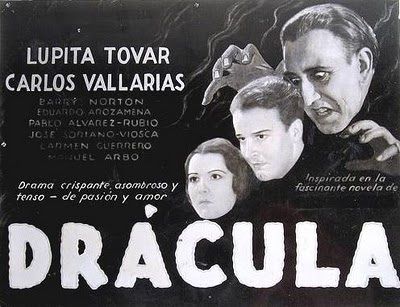
One of the wonderful oddities of film history is that, in 1931, Universal produced not one but two versions of Dracula.  There’s the version that we all know, the one with Bela Lugosi.  And then there was the Spanish language version.

It was a common practice during the early days of the sound era for the studios to concurrently shoot Spanish-language versions of their films.  In the case of Dracula, the cast and the crew for the Spanish version would shoot at night, after Lugosi, Edward van Sloan, Dwight Frye, and everyone else had gone home.  The crew and the actor cast as Dracula, Carlos Villarias, were allowed to watch the dailies, with Villarias being specifically told to model his performance as much on Lugosi’s as possible.

Most of the early Hollywood’s Spanish films have been lost but Drácula has survived.  In fact, among some horror critics, it’s become a bit trendy to declare that the Spanish language version is superior to the English version.  While I was preparing for our annual October horrorthon, I decided to watch Drácula and see for myself.

In some ways, Drácula is indeed superior.  The film uses the same script as the English version and was filmed on the same sets.  But visually, it’s a far more interesting film.  Because director George Melford (who was quite an acclaimed silent film director) had a chance to watch Dracula‘s dailies, he also had the benefit of hindsight when it came to making decisions regarding lighting and camera angles.  If the English language Dracula suffers because its stationary camera work makes it feel like a filmed stage play, the Spanish-language Drácula feels like a real movie.

As well, there’s a passion to the Spanish language Drácula, a passion that often seems to be missing from the English language version.  The English language version often seems to be going out of its way not to offend — the screen fades to black whenever Dracula starts to bite anyone, Jonathan Harker and Mina Seward are both portrayed rather dully, and, with the exception of Lugosi, Dwight Frye, and Edward van Sloan, everyone seems to be a bit too restrained in their performances.

Perhaps because it was specifically being filmed for foreign distribution, the Spanish language Drácula is far less restrained.  We see what Dracula actually does to his victims.  We see Eva and Lucia’s ecstatic reactions to being bitten by the vampire.  As oppose to Dracula, where everyone was very proper and very covered, Drácula embraces cleavage and moaning in the same way that, 20 years later, would make Hammer Studios famous.  The actors in Drácula are far more passionate, emotional, and sensual than their English-language counterparts.  They’re far more … well, Spanish.  Spanish is an exciting language and it’s pretty much impossible for someone speaking it to be boring.

But, unfortunately, Drácula fails where it matters most.  In the role of the count, Carlos Villarias never exhibits the charisma that we associate with the best Draculas.  I get the feeling that he was mostly cast because he bore a passing resemblance to Bela Lugosi.  Since he was instructed to imitate Lugosi, that’s what his performance comes across as being.  While Villarias does a better Lugosi imitation than that guy that Ed Wood used in Plan Nine From Outer Space, it’s still just an imitation.

And unfortunately, you really can’t have a good Dracula film unless you have a good Dracula.  In a perfect world, we would have a combination of the two versions, with Bela Lugosi starring in the Spanish version.  However, we live in an imperfect world but at least it’s a world where we can watch both Dracula and Drácula.

dracula-spanish-language

Trailer: Oldboy (Red Band)


OldboyRemake

Today saw the release of the red band trailer for the remake of Park Chan-wook’s classic neo-noir Oldboy. This remake by Spike Lee already looks to pay homage (or imitate) the look and feel of Park’s adaptation of the Japanese manga of the same name by Garon Tsuchiya and Nobuaki Mineshigi. We see quick glimpses of the hallway fight scene and a montage of the main character’s 20 years spent locked up in an unknown hotel room.

There’s a great chance for Spike Lee to make this remake his very own by using the Park film as a template but not as gospel. The Park adaptation itself took some liberties with the story told in the manga. Lee and the screenplay by Protosevich could do same to allow this Oldboy a chance to stand on its own instead of becoming another Gus Van Sant Psycho.

Though I wouldn’t mind to see what Lee has in mind as Josh Brolin’s character’s first choice of a meal once getting out.

Quickie Review: Field of Dreams (dir. by Phil Alden Robinson)


“The one constant through all the years, Ray, has been baseball. America has rolled by like an army of steamrollers. It has been erased like a blackboard, rebuilt and erased again. But baseball has marked the time.” — Terence Mann

I have always been a fan of baseball. I would say that baseball has been the one thing which has always remained constant for me throughout the years. Other sports may be flashier, faster and more violent, but baseball I’ve always equated as part of America’s national identity. This is why 1989’s Field Of Dreams by Phil Alden Robinson continues to resonate for me and for legions of baseball fans everywhere.

The film is based off of the W.P. Kinsella’s novel, Shoeless Joe, and tells the story of one Ray Kinsella and his titular field of dreams. It’s a film which sees Ray not just building a baseball field in his field of corn despite financial problems bringing him and his family closer to losing everything, but it also sees him traveling across the country to find a reclusive writer in Terence Mann (J.D. Salinger in the novel). It’s afilm which offers an insight to what makes baseball and the American identity so intertwined as the film finally offers Ray a chance to finally realize that the very baseball field he has built in his cornfield has granted many a second chance to realize their dream. For this film that dream is to be able to play baseball once more and this second chance becomes important to the ghosts of baseball’s past who have fallen from baseball’s grace through a scandal which had them banned from the game they love.

I’ve never been a big Kevin Costner fan, but his work in this film as Ray Kinsella showed me why people saw in him talent as an actor and not just a pretty face up on the screen. His real-life love for baseball shows in his performance as Ray whose own love for baseball becomes a personal journey for redemption and reunion with a father who also shared his love for the sport. The performances by Amy Madigan as Ray’s supportive wife was quite good and allowed the character not to be eclipsed by Costner’s excellent work as Ray. Even James Earl Jones as the writer Terence Mann gives the film a level of gravitas which just added to the film’s intimate yet epic nature. But it’s the breakout performance by Ray Liotta as the ghost of baseball great Shoeless Joe Jackson. Liotta’s screentime was limited to mostly in the latter part of the film, but his presence dominated every moment he was on the screen.

Field of Dreams has been called just a good baseball film by some, but for many people who have seen and loved it see it as more than just a film about baseball. It’s a film that shows Americana at it’s best and most nostalgic. Shows how one sport has become such a positive influence on the relationship between children and their fathers. It’s a film that dares to show genuine affection and love to the idea of letting someone follow their dream despite many outside influences and obstacles trying to get in their way. There’s a reason the film was nominated for an Oscar Best Picture. Even voters who are so used to rewarding films that look at the darker and more depressing side of the human condition could see the inherent quality in a film which looks at the brighter and more hopeful side of the equation.

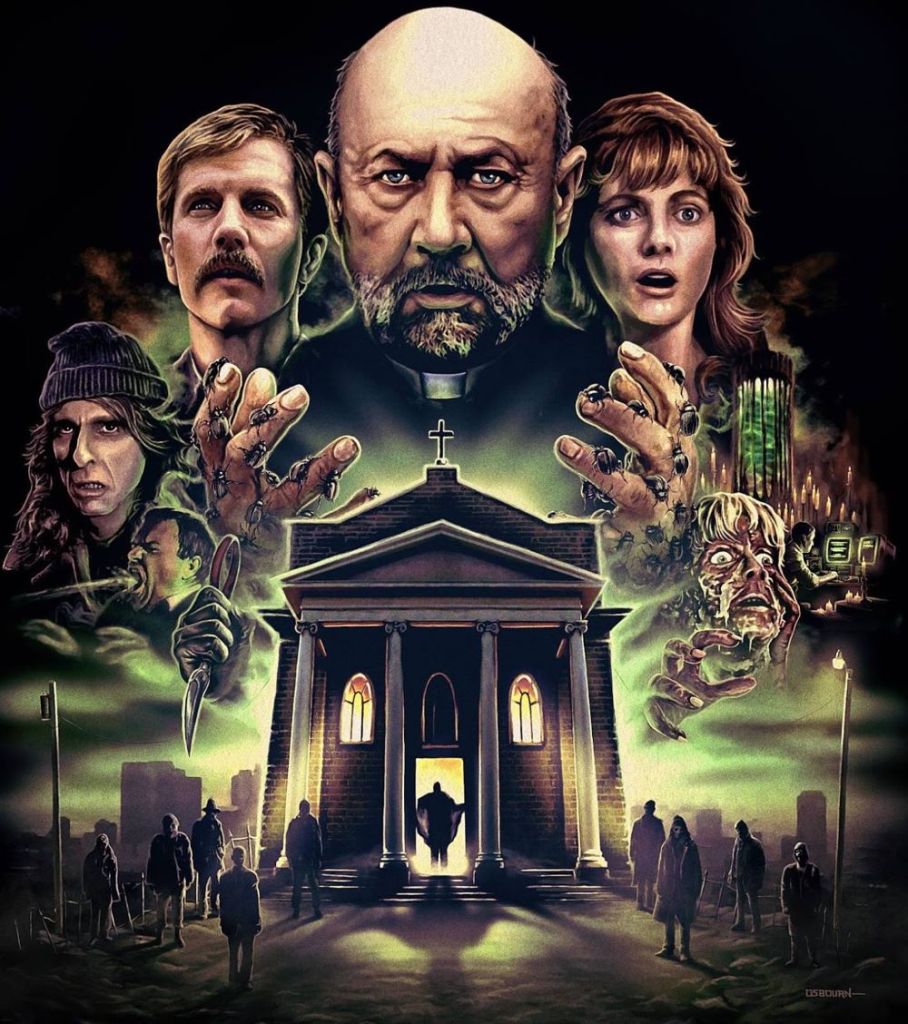
Horror Review: Prince of Darkness (dir. by John Carpenter)


“Say goodbye to classical reality, because our logic collapses on the subatomic level… into ghosts and shadows.”

John Carpenter’s Prince of Darkness is a criminally underrated entry in his canon—a blend of philosophical, apocalyptic horror and supernatural mystery that’s as unsettling as it is deliberately strange. Released in 1987, the film often gets eclipsed by Carpenter classics like The Thing and In the Mouth of Madness. Even so, it stands out as a unique organic link between science-driven paranoia and cosmic horror—the sort of film that grows on you as you unravel its layers.

The setup is simple but immediately offbeat: In a derelict Los Angeles church, Father Loomis (Donald Pleasence, always at his nervous best) stumbles on a swirling green cylinder hidden away in the basement. Loneliness and age hang over Loomis as he realizes this is no mere relic but possibly the essence of absolute evil—the literal embodiment of Satan. Sensing he’s in over his head, the priest reaches out to Professor Birack (Victor Wong), a physicist whose rational mindset is quickly tested by the uncanny. Birack arrives with a diverse team of grad students and lab techs, each bringing curiosity, skepticism, and just enough personality to keep things lively.

What starts as an academic investigation quickly goes off the rails. Strange, shared dreams trouble the researchers—fragmented transmissions from the future, warning of disaster in unsettling, VHS-glitch style. Meanwhile, the area outside the church transforms into a kind of urban wasteland: homeless people, gripped by an unseen force, stumble with zombie-like intent, trapping the group inside. Inside, members fall prey to unsettling phenomena, from unexplained possession to increasingly grotesque violence. There’s a sense that the evil in the cylinder isn’t content to simply stay put—and the combination of supernatural implication and scientific uncertainty gives everything a persistent, gnawing tension.

Carpenter directs the film with measured, stifling precision. His color palette—rotting yellows, bruised greens, washed-out sunlight—creates a perpetually uneasy mood. He uses slow tracking shots and carefully composed frames to ratchet up suspense, and the score (co-composed with Alan Howarth) pulses with ominous synths that buzz beneath all the dialogue, making even the film’s quieter moments feel restless and charged with threat. Compared to the gooey spectacle of The Thing, the terror in Prince of Darkness is more metaphysical—less visible monsters, more eroding reality.

Sound and image work together to keep the audience on edge: moments of unsettling silence are punctuated by visual oddities, like swarms of bugs or the warped geometry of the church’s shadows. The group’s scientific attempts to decode the evil—a jumble of quantum theory, apocalyptic Christian lore, and unsettling mathematics—do more to ramp up anxiety than offer answers. Carpenter seems to delight in ambiguity; the revelations never clarify so much as deepen the void, giving shape to a primordial kind of fear.

The film’s most iconic device is its recurring nightmare sequence, where the group—cut off from the world—witnesses a cryptic, shadowy figure emerging from the church, broadcast as a tachyon transmission from the future. It’s classic Carpenter: deeply unsettling, oddly hypnotic, and open to any number of interpretations. The blending of science fiction and theological horror feels fresh and ambitious, and it’s fair to say these sequences alone have ironically kept the film alive in horror culture discussions and remixes.

The cast, featuring Pleasence and Wong, manages the film’s shifts in tone—moving from banter about theoretical physics to genuine terror with surprising ease. The grad students are likable enough for you to root for, especially Lisa Blount and Jameson Parker, who carry the emotional brunt as things collapse. Alice Cooper’s cameo as a silent, menacing street dweller further anchors the film’s reputation for “unexpected creepy” in the best way possible.

While there are flashes of gore—possessions, injuries, even some memorable stabbings—Carpenter resists making violence the centerpiece. The real horror here is psychological: paranoia, loss of agency, and the collapse of foundational beliefs. Where The Thing was about trusting (or not trusting) your friends, Prince of Darkness is about grappling with a world where even faith and science seem powerless and interchangeable in the face of the unknown.

Thematically, this is Carpenter at his most cerebral and bleak. The notion that neither faith nor science can adequately tackle the unfathomable echoes Lovecraft, yet Carpenter grounds it all in urban decay and deadpan dialogue rather than Gothic flourish. The questions get bigger—what good is faith if truth is poisonous, and what does science matter against a force older than logic? Dialogue about quantum uncertainty and theological paradoxes isn’t there to solve anything, but to make everything less secure.

If the film has a flaw, it’s that its pacing feels deliberately patient—some might say slow. Tension accumulates gradually, and you’re invited to sit in the discomfort as the group loses sleep, loses one another, and loses touch with reality. As the stakes escalate, the line between dream and waking life shreds, leading to an ending that’s haunting, ambiguous, and deeply open-ended. There’s no neat wrap-up or cathartic victory—only trauma, unsolved terror, and a lingering sense that evil never really left, just waited.

It’s this refusal to explain or comfort that gives Prince of Darkness its lasting cult appeal. Carpenter puts cosmic pessimism front and center: knowledge itself stands as a kind of curse, and both faith and reason bend beneath the weight of mystery. Rather than offer solutions, the movie warns about the dangers of peeling back reality’s surface—a theme that’s only grown more unsettling in the years since it was made.

Watching Prince of Darkness now, the film may not fit everyone’s idea of a fun Friday-night scarefest. But if you want horror that’s slow, dense, and sticks with you, this is essential viewing. Carpenter delivers a bleak, hypnotic nightmare about what happens when explanations fail—when the universe itself seems ready to swallow us whole. Whether you’re a die-hard genre fan or someone looking for something different, Prince of Darkness is cult horror at its most unshakable—proof that the scariest stories are often those that leave their deepest secrets unexplained.

Scenes I Love: Despicable Me


For some reason the CG-animated film Despicable Me has been replaying in my head all afternoon and night. Most of the scenes looping in my mind focuses on the youngest girl, Agnes. Whether she’s exclaiming “Three Sleepy Kittens!” or passing out from holding her breath the film just won’t leave my head. The one scene I really love from Despicable Me involves Gru taking the girls to the carnival fair.

Agnes, of course, ends up having the scene I remember best in this entire sequence. She sees one of those stuffed unicorn toys at a booth and she just has to have it because it’s so fluffy that she could die. The carnival barker ends up trying to cheat the girls from winning the fluffy unicorn, but thanks to Gru and one of his weaponized inventions Agnes wins her unicorn and my ice-cold heart.

All I can say about this scene that I love is: “IT’S SO FLUFFY!!!”

Quickie Review: The Last Starfighter (dir. by Nick Castle)


The Last Starfighter was a nice little sci-fi action movie which was revolutionary when it was released due to it’s use of an early version of CGI-effects. For 1984, the special-effects was quite new and showed just what was possible in the years to come.

The film itself was a fun and simple sci-fi actioner which owes a lot to the arcade shooters which were popular during the 80’s. Even the main plotline of the film was pretty much about a video game sent by a benevolent space-faring Rylan Star League looking to find a few good Starfighters to save their federation from the danger that was Zur and the Ko-Dan Armada. Lance Guest plays Alex Rogan whose only past-time at the trailer-park, where he lives with his mother and younger brother, is his girlfriend Maggie Gordon (played by 80’s genre favorite Catherine Mary Stewart) and constantly playing a video game called The Last Starfighter. Alex’s expert skills in beating the game brings about a new wrinkle in his hum-drum life which seems to be going nowhere. A seeming con-man of a salesman by the name of Centauri (played with gusto and energy by Robert Preston) comes out of nowhere and gives him an offer and opportunity that is out of this world.

The rest of the film brings about Alex’s reluctance to join the Star League as a Starfighter and pilot of the Gunstar fighter. He thinks it’s all a mistake and that he wasn’t signing up for some sort of intergalactic war that may just kill him. Like most action movies Alex will have an epiphany of what his role and destiny must be and, with some reluctance, finally takes the challenge by the controls and goes off to fight Zur and the Ko-Dan Armada with his lone Gunstar and his trusty navigator and all-around lizardman mentor, Grigg (played with equal parts seriousness and fun by Dan O’Herlihy).

For those like me who grew up during the 80’s and enjoyed watching these simple but fun sci-fi films The Last Starfighter was quite the blast from the past which still delights and entertains despite the corny dialogue and cheesy effects. The CGI-effects of the Gunstar and the Ko-Dan Armada looks dated but I still can’t take my eyes off the screen whenever these early looking CG effects come on. The acting is pretty standard B-movie quality with everyone seeming to have fun with the premise and giving it their all. There’s nothing to write the Academy about but in the end the performances do just enough to make the audience like the characters.

The Last Starfighter was quite the underrated scifi action film which should’ve done better than it did when it first came out. It’s since gained a cult following on video and always a welcome sight whenever it comes on cable. The film might seem dated compared to the super advanced CGI-effects laden blockbusters we have now but it still entertains the people who grew up watching it as kids and who have grown up since.

Cowboys & Aliens Teaser Trailer


Who would’ve thought that a comic book named Cowboys & Aliens will end up being one of the most anticipated tentpole films for the Summer of 2011. It’s a fun little book from Platinum Studios created by Scott Mitchell Rosenberg and written by Fred Van Lente and Andrew Foley with the artwork done by one Luciano Lima. The premise of the comic book is literally about cowboys and aliens. With the latter attempting to enslave humanity during the 1870’s and starting with the Wild West. In their plans for world conquest are a band of cowboys and Indians who band together despite their many conflicts and issues to combat a shared and greater threat.

The film was announced prior to the release of Favreau’s Iron Man 2 and was a surprising one. Many insiders thought he was a shoo-in to helm the planned Avengers film for Marvel, but instead he chose this project instead.

To say that Cowboys & Aliens steamrolled into production with so many heavyweights behind it would be an understatement. Favreau was already in the director’s chair and producing the project behind the scenes were giants of the industry like Steven Spielberg, Brian Grazer and Ron Howard. The cast roped in for the film was also quite impressive with Daniel Craig taking on the lead role with Olivia Wilde, Harrison Ford, Clancy Brown, Keith Carridine, Walton Goggins and Paul Dano supporting Craig.

The very first teaser trailer has been released and could be seen above. While the trailer only shows only a little bit it does confirm that it will have cowboys and, from the brief glancing images, aliens. Cowboys & Aliens has a tentative release date of July 29, 2011 and joins other comic book-based films for that summer like Thor, Captain America and Green Lantern.

It will be interesting to see if Favreau keeps the bulk of the books storyline in the film or will he just loosely base the story on the books. One thing for sure, he and his crew have a tall order to try and tell this story and do it well enough that it stands out amongst the many comic book blockbusters and sequels set to appear in the same season. This film could be a real fun, action-adventure or it could easily turn into the second coming of Wild, Wild West. Here’s to hoping it’s the former and not the latter.

Skyline Trailer


I wasn’t able to attend this year’s Comic-Con, but those who did and saw clips from this under-the-radar alien invasion film from the Strause Brothers came away impressed by what they saw. This particular film may be the Zombieland of 2010.

Skyline looks like your typical alien invasion flick with highly-advanced and even more highly-aggressive beings from another world wreaking havoc on the planet with their massive and very cool-looking ships. This one is made by the Strause Brothers who last made the sequel, Aliens vs. Predator: Requiem which was better than I thought it would be. It was still a bad film, but at least the brothers were able to inject some insane fun in the proceedings unlike it’s predecessor.

This second offering from the brothers look to do the same for their version of the alien invasion and this time around the setting centers on Los Angeles and not New York. The film looks to have tentacles (anime fans rejoice) in addition to huge hovering ships destroying city blocks and smaller ships taking on humanity’s armed forces. From what I could gather the acting and dialogue will not be the highlights of the film, but if they keep those at the barest minimum then this little-gem from this year’s Comic-Con may just be one of the best times in the theaters this year.

Del Toro and Cameron to Climb “The Mountains of Madness”


It looks like the unnamed horror project Guillermo Del Toro was quite coy about during this past week’s San Diego Comic-Con may turn out to be one of his dream projects finally getting a chance to be up on the big-screen. Mike Fleming over at Deadline has reported that Del Toro’s next directing project since leaving The Hobbit will indeed be his long-gestating project to adapt H.P. Lovecraft’s classic scifi novella, At The Mountains of Madness.

He will not be going alone in this project as best buddy and confidant James Cameron has also joined Del Toro on his dream project as producer. Fresh off of the humngous success of Avatar has made Cameron the King of Hollywood once again and his name and clout should be able to give Del Toro the necessary muscle to get Universal not just to move the project forward but give Del Toro the budget he wants and the hands-off treatment he works best under.

Fleming also reports that the film will be in 3D which makes sense with Cameron being on-board and someone who can give Del Toro all the assistance he needs with the 3D tech Cameron has developed from his work with Avatar. The fact that Cameron will let his name be used in the promoting of the film speaks volumes as Cameron is known to be very choosy as to which projects he lends his name out to that he doesn’t direct.

There will be some moans and groans to the mention of 3D. Del Toro has never dismissed 3D, but didn’t see himself as having a particular project that worked best with it. Like any visually-gifted filmmaker, Del Toro knows how to use the tools of his trade both new and old so I don’t think Cameron’s 3D film-tech will be something he wouldn’t want to try out. Plus, if there was ever a story to be adapted onto the big-screen that would not just work well with Cameron’s 3D tech but also look beautiful it would have to be a Lovecraft tale and especially one with a setting and plot that’s not just epic but cosmic in scale. From the massive vistas of the non-Euclidean structures of the Elder Gods to the Plateau of Leng which may or may not have been the base for Cthulhu and his Star-spawns. Plus, we can’t forget the amorphous beings the “Shoggoths” which definitely would become even more terrifying in 3D.

I really hope that this project moves forward and with the speed with which Del Toro works I won’t be surprised if during San Diego Comic-Con in 2011 we get to see good footage of the film as a sneak-peek for a 2012 release.

Source: Deadline