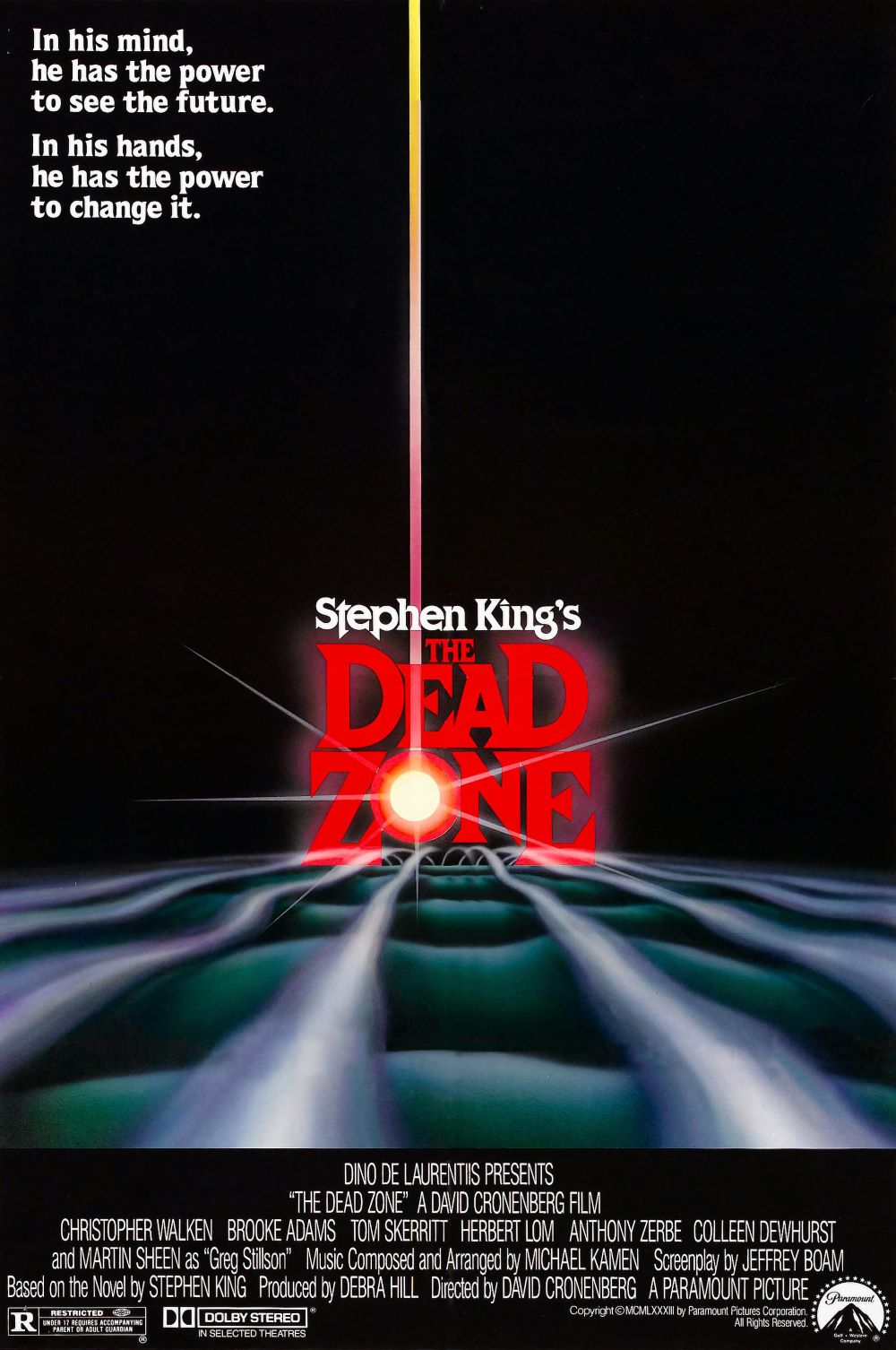
Horror Review: The Dead Zone (dir. by David Cronenberg)


“Bless me, Father, for I have sinned. I had the power… and I tried to prevent what I saw.”Johnny Smith

In 1983, David Cronenberg adapted Stephen King’s The Dead Zone with a distinctive emphasis on mood, morality, and psychological depth rather than traditional horror spectacle. The film follows Johnny Smith (Christopher Walken), a small-town schoolteacher whose life transforms irrevocably after a traumatic car accident leaves him in a five-year coma. Upon awakening, Johnny discovers he possesses psychic abilities that allow him to see the past and future by touch. Rather than a gift, this power becomes a heavy burden, isolating him and forcing him into wrenching moral choices.

Cronenberg’s direction is meticulous and deliberately restrained. The film’s muted color palette and stark winter landscapes visually echo Johnny’s emotional isolation and the fragility of human existence. His careful, often gliding camera movements create a mounting sense of quiet dread, while minimalistic sound design underscores moments of revelation with haunting subtlety. This subdued style elevates the film’s psychological impact, transforming it into a thoughtful and melancholy meditation on the cost of harrowing knowledge.

Significantly, The Dead Zone marks a departure from Cronenberg’s signature body horror. Instead of the grotesque physical transformations and visceral mutations that characterize much of his other work, here Cronenberg turns inward. The real horror lies in the malleability of the mind and the elusive nature of perception—how reality, memory, and the future are unstable constructs that can shift and fracture under psychic strain. This thematic focus on the impermanence and distortion of mental reality touches on some of Cronenberg’s deepest artistic fascinations.

The restrained treatment of body horror in The Dead Zone previews the director’s later, more psychologically driven films such as A History of ViolenceEastern Promises, and A Dangerous Method, where character studies and narrative depth take precedence over startling visuals. In this early pivot, Cronenberg demonstrates that his mastery lies not only in visual spectacle but in probing the profound emotional and moral dilemmas faced by his characters. The vision-focused horror here is cerebral and grounded, rooting supernatural phenomena in human frailty and ethical complexity.

Christopher Walken’s nuanced portrayal is the emotional heart of the film. He captures Johnny’s vulnerability, weariness, and profound solitude, portraying a man burdened by a cursed knowledge that isolates him from the world. Martin Sheen plays Greg Stillson, the ambitious and morally bankrupt politician whose rise Johnny must foretell and who embodies the film’s central threat. The supporting cast, including Brooke Adams as Johnny’s lost love Sarah and Tom Skerritt as Sheriff Bannerman, delivers compelling and authentic performances that humanize the film’s intimate, small-town environment.

Several changes from King’s novel sharpen the film’s thematic focus. The novel’s sprawling plot, including a serial killer subplot and a brain tumor storyline symbolizing Johnny’s mortality, is pared down or omitted. Despite this trimming, the serial killer element retained in the film remains chilling and effective. It highlights the darker repercussions of Johnny’s psychic gift and injects a tangible sense of dread, reinforcing the psychological weight Johnny carries. This subplot grounds the supernatural within a disturbing reality, illustrating the violent and tragic circumstances Johnny must grapple with as part of his burden.

The concept of the “dead zone” itself shifts in meaning. Originally, the term referred to parts of Johnny’s brain damaged by the accident, blocking certain visions. Cronenberg reinterprets it as a metaphor for the unknown and unknowable parts of the future—the gaps in psychic clarity that allow for free will and change. This subtle shift reshapes the narrative toward a more ambiguous, hopeful meditation on destiny and human agency.

Compared to King’s novel, Cronenberg’s Johnny is more grounded and isolated. The novel frames Johnny’s struggle within a broader spiritual and fatalistic context, highlighted by the looming presence of a brain tumor and a nuanced exploration of hope versus resignation. The film, by contrast, focuses on the emotional and moral fatigue induced by Johnny’s psychic gift, emphasizing his loneliness and reluctant responsibility rather than supernatural destiny.

Walken’s restrained, haunting performance strips away mythic grandeur to reveal a deeply human character. The film’s narrowed narrative tightens focus on Johnny’s internal anguish and his difficult ethical choices, making his plight intimate and richly relatable.

On a thematic level, The Dead Zone contemplates fate, free will, and sacrifice. Johnny’s psychic abilities act as a draining, almost chthonic force, transforming him into a reluctant prophet who is tasked with intervening in grim futures at great personal cost. The film’s bleak winter setting visually reflects Johnny’s alienation, while its deliberate pacing highlights the exhaustion and heartbreak that comes with such knowledge.

Ultimately, Cronenberg’s The Dead Zone goes beyond supernatural thriller conventions. It is a profound meditation on empathy, sacrifice, and the human condition—where the greatest horrors are internal, and the cost of knowledge is both psychic and emotional. Johnny Smith emerges as a tragic, flawed figure wrestling with unbearable burdens.

Cronenberg’s direction and the impeccable performances make The Dead Zone a standout in King adaptations. The film’s enduring impact lies in its rich thematic texture, its moral ambiguity, and its unflinching exploration of human frailty, all conveyed through a director shifting skillfully from physical body horror to psychological and existential terror. The film remains as haunting and resonant now as it was upon release, a testament to the synergy of Cronenberg and King’s extraordinary talents.
Wild Rovers (1971, directed by Blake Edwards)


In Montana, Walter Buckman (Karl Malden) runs his ranch with an iron hand, warning his neighbor, Hansen (Sam Gilman) not to even think of allowing his sheep to graze on his land.  Walter has two sons, hot-headed John (Tom Skerritt) and the laid back and good-natured Paul (Joe Don Baker).  When Walter learns that two of his ranch hands — aging Ross Bodine (William Holden) and young Frank Post (Ryan O’Neal) — have robbed a bank and are heading down to Mexico, he sends John and Paul to bring them back.  Walter is a big believer in the law and he’s not going to allow any of his people to get away with breaking it.

Ross is a veteran cowboy, who only robbed the bank after Walter withheld his pay to cover the damage of a saloon fight between Ross and Hansen’s men.  Frank is the wilder of the two.  He looks up to Ross and Ross is protective of Frank, even if he has a hard time admitting it.  Ross and Frank are heading down to Mexico so Ross can retire in peace.  Instead of going straight to Mexico, though, they make the mistake of stopping by a small town so Frank can play a little poker and visit the town’s brothel.

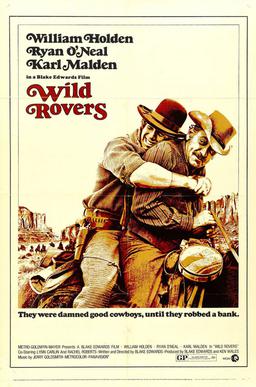
Wild Rovers was Blake Edwards’s attempt to make an epic, revisionist western and he includes plenty of shots of the sun setting over the mountains as well as several violent shoot-outs that are shot in Peckinpah-style slow motion.  Unfortunately, the story itself isn’t really strong enough to support Edwards’s ambitions and all of the shots of the countryside, while nice to look at, don’t really add up too much.  Wild Rovers was also a troubled production, with MGM slashing Edwards’s original three-hour film down to 106 minutes and advertising it with a poster featuring O’Neal hugging Edwards from behind, making the film look like a buddy comedy in the style of Butch Cassidy and the Sundance Kid (or an early version of Brokeback Mountain) as opposed to a violent and elegiac western.  (In 1986, a director’s cut was released, which ran for 136 minutes.)  If you only know Blake Edwards from his Pink Panther movies, the grim and tragedy-filled Wild Rovers will come as a surprise.

One thing that Wild Rovers does have going for it is a good cast.  William Holden and an energetic Ryan O’Neal are a solid team and Karl Malden, Tom Skerritt, Rachel Roberts, James Olson, and Moses Gunn all give good performances too.  This movie also provides Joe Don Baker with a sympathetic role and he’s very likable as the laid back Paul Buckman.  It’s not the type of role that Baker often got to play and it’s obvious that a lot of scenes between John and Paul were cut from the film but, in the truncated version, Joe Don Baker’s Paul Buckman becomes the moral center of the film’s story.

Wild Rovers was a disappointment at the box office, one of many that Edwards suffered in the 70s before he and Peter Sellers brought back Inspector Clouseau.

March True Crime: The Hunt For The Unicorn Killer (dir by William A. Graham)


Who started Earth Day?

There are a lot of names that get mentioned.  Some people give all the credit to U.S. Senator Gaylord Nelson of Wisconsin, who was  an environmentalist before it was trendy and who proposed a day-long “teach-in” in 1970.  (According to Norman Mailer, Hunter Thompson, and Gary Hart, Gaylord Nelson was also George McGovern’s personal pick for his running mate in 1972 but ultimately, Nelson didn’t get the spot because it was felt people would make fun of his first name.  Considering how things went with Thomas Eagleton, one imagines that McGovern probably ended up wishing he had the courage to go with his first instinct.)  A peace activist named John McConnell also proposed the idea of an Earth Day in 1969 but there’s some debate whether his proposed Earth Day became the actual Earth Day.  Like all things, many people have taken credit for the idea behind Earth Day.

Ira Einhorn was one of those people.  A prominent member of Pennsylvania’s counter-culture, Einhorn was a self-styled New Age environmentalist and he did speak at the first Earth Day event in Philadelphia.  Einhorn went on to become a prominent guru, providing his services to several corporations that were looking to shake off their stodgy image.  He led protests against nuclear energy.  He wrote articles about CIA duplicity.  He was, for a while, a popular figure and, due to his last name, he was nicknamed “The Unicorn.”  He always claimed that he was instrumental in starting Earth Day but the organizers behind the event have always been quick to say that he had little do with it.

It’s understandable that the people behind Earth Day would rather not be associated with Ira Einhorn.  Einhorn presented himself as being a quirky, fun-loving hippie but, in private, he was known for having both a violent temper and a misogynistic streak.  In 1977, Einhorn’s ex-girlfriend, Texas-born Holly Maddux, disappeared.  In 1979, her mummified remains were found in a box that Einhorn kept in his closet.  Arrested for her murder and defended in court by future U.S. Sen. Arlen Specter, Einhorn claimed that he was innocent and that he had no idea how Holly Maddux ended up in his closet.  (He suggested the CIA might be responsible.)  With the help of his wealthy friends, Einhorn fled the United States and ended up in Europe.  He lived in Europe for nearly 20 years until he was finally arrested in France.  Einhorn’s claim that he was being framed for his anti-nuclear advocacy found a sympathetic audience amongst certain members of the French intellectual community.  Eventually, though, Ira Einhorn was extradited to Pennsylvania.  He spent the rest of his life in prison, eventually dying in 2020.  To the end, he had his supporters despite the fact that he was clearly guilty.

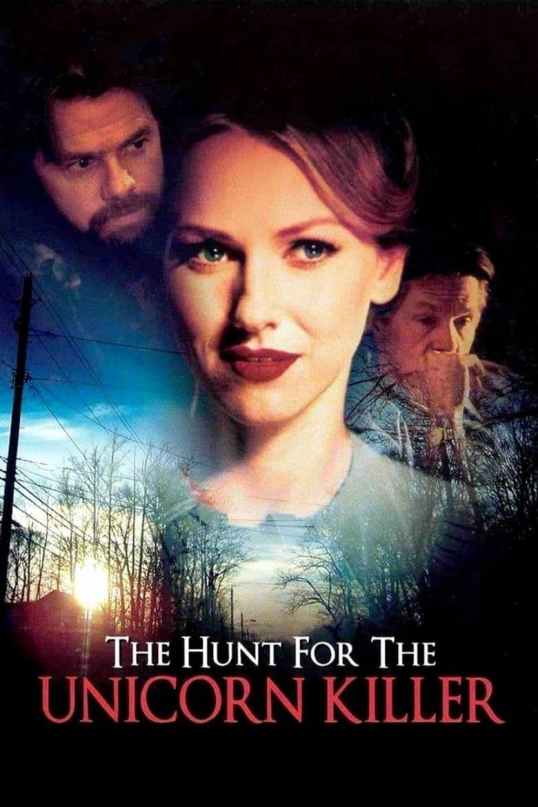
Made for television in 1999, The Hunt For The Unicorn Killer tells the story of Ira (Kevin Anderson), Holly (a pre-Mulholland Drive Naomi Watts), and Holly’s father, Fred (Tom Skerritt).  It does a good job of telling the disturbing story of Ira Einhorn and it features good performances from its main stars.  Tom Skerritt especially does a good job as a father determined to get justice for his daughter.  The film shows how so many of Ira’s friends rationalized his actions, not wanting to admit that their nostalgia for the 60s and the counterculture was blinding them to the monster in their midst. It’s a portrait of how one evil man was able to take advantage of the idealism of others.

The Hunt For The Unicorn Killer‘s original running time was 163 minutes and it was aired over two nights.  It was later edited down to 90 minutes for syndication.  The uncut version is available on YouTube and that’s definitely the one to see.

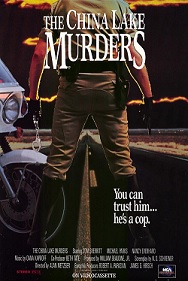
The China Lake Murders (1990, directed by Alan Metzger)


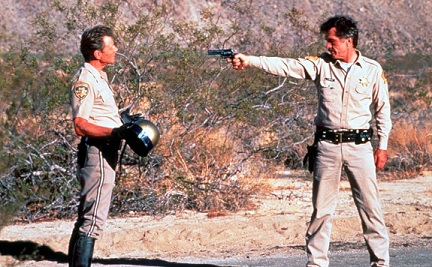
Officer Donnelly (Michael Parks) of the Arizona Highway Patrol has snapped.  One day, he doesn’t show up for roll call and instead drives out to the desert.  Sometimes, he pulls people over and tells them that they’ve violated a traffic law.  Sometimes, he stops to help a stranded motorist.  Every encounter ends with Donnelly killing someone.  When Donnelly reaches the town of China Lake, he flirts with a waitress (Lauren Tewes) and befriends Sheriff Sam Brodie (Tom Skerritt).  Brodie is investigating the mystery of why so many people are turning up dead in the desert and he slowly comes to realize that his new friend is the one responsible.

The China Lake Murders was produced by the USA Network and it used to air regularly throughout the 90s.  For a while, it held the record for the highest rated basic cable film.  One reason why so many people would watch it whenever it aired was because the movie started out with a warning that it contained strong violence and some sexual content.  That warning was all that it took to convince most people to watch the movie.  While the sexual content is tame (we see someone’s bare back at one point), the violence is indeed strong. 

So is the performance of Michael Parks, who plays Donnelly as the ultimate nightmare cop.  In many ways, Donnelly epitomizes everything that people hate about the police.  He’s a bully who hides behind his uniform and his badge.  The movie never explains why Donnelly suddenly snapped but watching him, it’s easy to guess that he’s always been a sadist.  He channeled his cruelty into law enforcement and now that he’s crossed the line and is killing random people, he still believes that his uniform will protect him.  Tom Skerritt, on the other hand, is the epitome of what most people would hope a cop would be, fair-minded and more concerned with helping the community than controlling it.

The China Lake Murders is a little slow.  Since it’s revealed early on that Parks is the killer, there’s not much suspense during the middle section of the film.  Things pick up, though, when Skerritt and Parks finally go after each other.  The two veteran actors bring a lot of gravitas to their roles and their final confrontation does not disappoint.

Lisa Reviews A Palme d’Or Winner: M*A*S*H (dir by Robert Altman)


With the Cannes Film Festival underway, I have been watching some of the past winners of the prestigious Palme d’Or.  On Thursday night, Jeff and I watched the winner of the 1970 winner of the Grand Prix (as the Palme was known at the time), Robert Altman’s M*A*S*H.

There are, of course, three versions of M*A*S*H.  All three of them deal with the same basic story of Dr. Hawkeye Pierce and his attempts to maintain his sanity while serving as a combat surgeon at the 4077th Mobile Army Surgical Hospital during the Korean war.  All three of them mix comedy with the tragedy of war.  However, each one of them takes their own unique approach to the material.

The one that everyone immediately thinks of is the old television series, which ran for 11 seasons and which can be found on Hulu and on several of the retro stations.  The television series starred Alan Alda as Hawkeye.  I’ve watched a handful of episodes and, while the episodes that I’ve seen were undeniably well-acted and well-written and they all had their heart in the right place, the show’s deification of Hawkeye can get to be a bit much.  Not only is Hawkeye the best surgeon at the 4077th, he’s apparently the best surgeon in all of Korea.  In fact, he may be the best surgeon on the entire planet.  Not a single thing happens in the camp unless Hawkeye is somehow involved.  When a nurse is killed by a landmine in one episode, the focus is not on the other nurses but instead on how Hawkeye feels about it.  When bombs are falling too close to the camp, the focus is again only on Hawkeye and how much he hates the war.  If you didn’t already know that he hated the war, Hawkeye will let you know.  Wish Hawkeye a good morning and he’ll yell at you about how many people are going to be wounder by the end of the day.  Even when one agrees with Hawkeye, the character’s self-righteousness can be a bit much.

Less well-known is the first version of M*A*S*H, a short and episodic novel that was published in 1968.  The novel was written by Dr. Richard Hornberger, who actually had served in Korea at a M*A*S*H unit and who reportedly based Hawkeye on himself.  The book is a rather breezy affair.  Reading it, one can definitely tell that it was inspired by someone telling Hornberger, “Your stories about Korea are so funny and interesting, you should write them down!”  The book avoids politics, reserving most of its ire for military red tape.  Hornberger was a Republican who so disliked Alan Alda’s interpretation of Hawkeye that, when he wrote a sequel to M*A*S*H, he included a scene in which Hawkeye talked about how much he enjoyed beating up hippies.

And then there’s the version that came in between the book and the television series, the 1970 film from Robert Altman.  The film retains the book’s episodic structure while also throwing in the anti-war politics that would define the television series.  (Though the film was set in the 50s, Altman purposefully made no attempt to be historically accurate because he wanted it to be clear that this film was more about Vietnam than Korea.)  From its opening, the film announces its outlook, with shots of helicopters carrying severely wounded (possibly dead) soldiers to the camp while a song called Suicide is Painless plays on the soundtrack.  The song was written by director Robert Altman’s fourteen year-old son, Mike.  Reportedly, it took Mike five minutes to come up with the lyrics.  When the instrumental version of the song was later used as the theme song for the television series, Mike Altman made over a million dollars in royalties.

The film opens with Hawkeye Pierce (Donald Sutherland) and Duke Forrest (Tom Skerritt) arriving at the 4077th MASH in a stolen jeep and it ends with them getting sent home in the same jeep.  Though Duke is set up to be a major character, he soon takes a backseat to another surgeon, the unfortunately nicknamed Trapper John (Elliott Gould).  Much as with the television series, the movie centers around Hawkeye and Trapper John’s antics.  When they’re not in the operating room, they’re drinking, carousing, and playing pranks that are far more mean-spirited than anything the television versions of the characters would have ever done.  (Indeed, the book and movie versions of Hawkeye probably would have hated Alan Alda’s Hawkeye.)  Unlike the television version of Hawkeye, the film’s Hawkeye is not the best surgeon in Korea.  In fact, he’s not even the best surgeon at the 4077th.  (That honor goes to Trapper.)  Instead, he’s just one of many doctors on staff.  They’re rotated in and then, at the end of their tour, they’re rotated out.  Hawkeye loses as many patients as he saves.  The film’s doctors are not miracle workers, nor are they crusaders.  Instead, they are overworked, neurotic, often exhausted, and frequently bored whenever there aren’t any wounded to deal with.  The film emphasizes that the doctors are as professional inside the Operating Room as they’re rambunctious outside of it.  Unlike the television series, Hawkeye doesn’t joke while working.  He’s usually too busy trying to stop his patients from bleeding to death to tell jokes or to complain about the war that brought them to the OR.

Indeed, the film version of M*A*S*H communicates its anti-war message not through indignant speeches but instead through bloody imagery.  The operating room scenes don’t shy away from showing the ugliness of war and they are occasionally so visceral that they almost seem to shame the audience for have laughed just a few minutes earlier.  One of the film’s more famous (and controversial) sequences features Hawkeye driving Frank Burns (Robert Duvall) to insanity by crudely taunting him about his affair with head nurse Margaret Houlihan (Sally Kellerman).  Burns attacks Hawkeye, a response that actually seems rather justified even if it is played for laughs.  A scene of Burns being driven out of the camp in straitjacket is followed by a close-up of a geyser of blood erupting from a wounded soldier’s throat.  It’s a jarring transition but one that makes a stronger anti-war statement than any self-righteous monologue would have.  While Hawkeye and Trapper are taunting Burns and Margaret, soldiers are still being sent off to die.

The humor in M*A*S*H is often brutally misogynistic.  Margaret is described as being “a damn good nurse” but is continually humiliated because she believes in maintaining military discipline.  One can disagree with her emphasis on following all of the proper regulations while also realizing the Hawkeye and Trapper’s treatment of her is unreasonably cruel.  The scene where Trapper and Hawkeye expose her while she’s taking a shower is especially difficult to watch and there’s no way to justify their actions.  It’s frat boy humor, the type of stuff that you would expect from a bunch of former college football players, which is what we’re told Hawkeye and Trapper are.  (That, of course, is another huge difference between the film and television versions of the characters.)  That said, it’s debatable whether or not were supposed to find either Hawkeye or Trapper to be heroic or even likable.  As a director, Robert Altman shied away from making films with unambiguous heroes or villains.  Just as Margaret could be a “damn good nurse” and a “regular army clown” at the same time, Hawkeye can be both a dedicated doctor and a bit of a jerk.

After 90 minutes of bloody operating room scenes and Trapper and Hawkeye making crude jokes, M*A*S*H suddenly becomes a sports film as the the 4077th plays a football game against their rivals, the 325th Evac Hospital.  The change of tone can be a bit jarring but it’s perhaps the most important sequence in the film.  For a few hours, the doctors bring “the American way of life” to Korea and the end result is a game that’s played for money and which is only won through cheating and deception.  (Future blaxploitation star Fred Williamson made his film debut as the ringer who the 4077th recruits for the game.)  For all of the broad comedy of the game, it’s followed by a shot of the doctors playing poker while a dead soldier is transported out of the camp, wrapped in a white sheet.  Football may provided a distraction.  The money may have provided an incentive.  But the war continued and people still died.

Much of M*A*S*H‘s humor has aged terribly but the performances still hold up and the anti-war message is potent today.  Though Sutherland and Gould are undeniably the stars of the film, M*A*S*H is a true ensemble film, full of the overlapping dialogue and the small character performances that Robert Altman’s films were known for.  One reason why the film works is because it is an immersive experience, the viewer truly does feel as if they’ve been dropped in the middle of an operating field hospital.  Though Hawkeye and Trapper may be at the center of the action, every character, from the camp’s colonel to the lowliest private, seems to have their own story playing out.  This a film where paying attention to the little things happening in the background is often more rewarding than paying attention to the main action.  I particularly liked the performances of David Arkin as the obsequies Staff Sergeant Vollmer and Bud Cort as Pvt. Warren Boone.  Boone, especially, seems to have an interesting story going on in the background.  The viewer just has to keep an eye out for him.  Also be sure to keep an eye out for Rene Auberjonois, who reportedly improvised one of the film’s best-known lines when, after Margaret demands to know how Hawkeye reached a position of authority in the army medical corps, he deadpanned, “He was drafted.”

One of the first major studio films to be openly critical of the military and the war in Vietnam, M*A*S*H won the Palme d’Or, defeating films like Investigation of a Citizen Above Suspicion and The Strawberry Statement.  Unlike many Palme winners, it was also a box office success in the United States.  Though controversial, it received an Oscar nomination for Best Picture.  However, unlike the Cannes jury, the Academy decided to honor a different film about war, Patton.

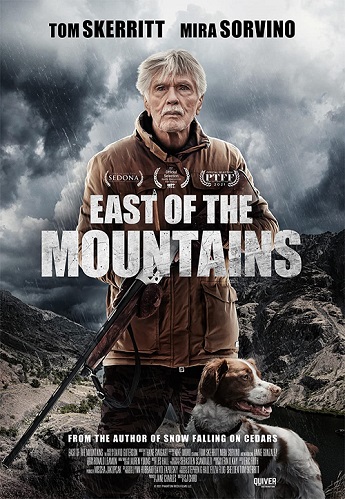
Film Review: East of the Mountains (dir by SJ Chiro)


Sometimes, a good film just sneaks up on you.

That was certainly the case with me and East of the Mountains, an independent film which came out last September.   I have to admit that the film completely slipped past me when it was initially released.  In fact, I didn’t even know that the film existed until it was nominated for Best Motion Picture Drama by the Satellite Awards in December.  I wasn’t alone in that.  I remember when the Satellite nominations were announced, there were a lot of people who looked at the list of nominees and, upon seeing an unfamiliar title mixed in with West Side Story, The Power of the Dog, and Don’t Look Up, said, “East of what?”

Because I’m always on the lookout for an overlooked gem, I rented East of the Mountains on Prime. I watched it yesterday.  My initial reaction was that it was a well-made film, featuring both pretty scenery and an excellent lead performance from veteran actor Tom Skerritt.  (Skerritt is also credited as being an executive producer on the film.)  I appreciated that, in a time when so many film feels as if they’re at least ten minutes too long, East of the Mountains was a remarkably short film.  It only needed 79 minutes to tell its simple but effective story and it didn’t waste a single one of them.  At the time, I also thought that the film’s direction was perhaps a bit too low-key for the film to really work.  I thought it was a good film but I also thought it was one that I would probably forget about in a day or two.

Instead, the opposite has happened.  East of the Mountains has stuck with me.  Even as I sit here typing, I can still picture the film’s final few scenes in my head.  That’s the type of film that East of the Mountains is.  It’s a film that sneaks up on its audience, capturing their attention so subtly that it’s not until several hours later that they realize that they’re still thinking about the film.

Based on a novel by David Guterson, East of the Mountains is a character study.  Tom Skerritt plays Ben Givens.  Ben is a retired doctor and a veteran of the Korean War.  He lives in Seattle.  His wife has passed away.  He’s estranged from his brother.  His daughter is busy with a family of her own.  Ben’s only companion is his dog, Rex.  When he tells his daughter (played by Mira Sorvino) that he’s planning on going bird hunting for the weekend, she’s concerned.  She knows that her father has been depressed.  She also knows that Ben has recently been diagnosed with cancer.  Ben assures her that he just wants to see his “old stomping grounds” one last time but his daughter worries that Ben may be planning on never coming back.

She’s not wrong.  Since we’ve already seen Ben pressing the barrel of a rifle against his forehead, we know that she has every reason to be concerned about his plans.  Ben is considering ending it all, east of the mountains where he grew up, fell in love, and experienced his happiest moment.  However, from the minute that Ben sets off on what he plans to be his final hunting trip, fate seems to be determined to keep him alive.  After his SUV breaks down, he’s given a ride by a mountain climbing couple and their love reminds Ben of when he first met the woman who he would eventually marry.  After a run-in with a half-crazed mountain man, Ben loses his prized rifle, the one that was given to him by his father and which Ben planned to use to end his own life.  After an unexpected dog fights leads to Ben taking Rex to the local animal hospital, he meets a young veterinarian who can tell that Ben needs someone to talk to.

The plot is rather simple but Tom Skerritt’s performance brings the story a certain depth that it might not otherwise possess.  It would be easy to sentimentalize a character like Ben or to portray him as being flawless.  Instead, Skerritt plays Ben as someone who is genuinely well-meaning and naturally kid but who also can occasionally be a bit self-absorbed.  Watching Ben, one can understand why his brother is estranged from him, which makes their eventual, if rather prickly reunion all the more poignant.  (Ben’s brother is well-played by an actor named Wally Dalton.  He and Skerritt play off of each other with such skill that it’s hard to believe that they actually aren’t brothers.)  The viewer hopes that Ben will find what he needs to find in order to achieve some sort of peace for himself, even if Ben himself doesn’t always seem to be quite sure what that possibly mythical thing would be.

Skerritt’s performance here is comparable to Robert Redford’s turn in All Is Lost, with the main difference being that Ben is far more lost than even Reford’s unnamed sailor.  However, much like the sailor in All is Lost, it’s impossible to look away from Ben’s journey.  It’s also tempting to compare Skerritt’s performance to Rchard Farnsworth’s Oscar-nominated turn in David Lynch’s The Straight Story.  (Indeed, the scene between Skerritt and Dalton is comparable to the final scene between Farnsworth and Harry Dean Stanton.)  Much like Farnsworth in Lynch’s film, Tom Skerritt may move slowly but the viewer is always aware of his mind working.

East of the Mountains may sound like a depressing or heavy-handed film but actually it’s not.  If anything, it’s life-affirming.  The audience is right alongside Ben, learning with him that the world is not as terrible a place as he had convinced himself it was.  In the end, the viewer cares about Ben and worries about what his ultimate fate will be.  The film’s ending sneaks up on you and it stays with you afterwards.

There is one scene involving a dog fight that is difficult to watch but otherwise, East of the Mountains is a simple but poignant film that deserves more attention than it’s received.

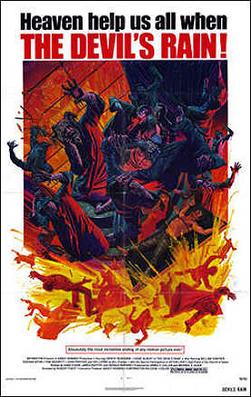
Horror Film Review: The Devil’s Rain (dir by Robert Fuest)


https://www.youtube.com/watch?v=HAfio1Qht3c

Was I the only one who was relieved that William Shatner didn’t die this week?

Seriously, when I heard that the 90 year-old Shatner was going to be taking a trip on one of the Amazon rockets, I was really worried.  First off, you’re taking a 90 year-old into space.  Secondly, you’re doing it with a rocket that people don’t really know that much about.  And third, that 90 year-old is a cultural icon and one who probably played no small role in causing people like Jeff Bezos and Elon Musk to become obsessed with conquering space in the first place.  With the exception of George Takei, everyone loves William Shatner.  (And, at this point, Takei’s constant sniping about Shatner is coming across as being just a little bit petty.  Move on, George!  People love you, too.)

As I watched Shatner land back on Earth, I found myself thinking about The Devil’s Rain, a film from 1975 that starred William Shatner as a man whose exploration of the unknown led to a far less triumphant result.   

In this film, Shatner plays Mark Preston, a youngish man who lives on ranch with his father (George Sawaya) and his mother (Ida Lupino).  For some reason, the Preston family owns a book that is full of evil magic.  Satanic high priest Jonathan Corbis (Ernest Borgnine) wants the book and when the Prestons refuse to hand it over, he makes it his mission to destroy them.  He gets things started by turning Mark’s father into a weird, waxy zombie who melts in the rain.  Not wanting the same fate to befall the rest of the family, Mark grabs the book and heads to a desert ghost town that has been taken over by Corbis and his followers.  Mark never returns.

Mark’s older brother, Tom (Tom Skerritt) then shows up in town, searching for Mark.  Accompanying him are his wife (Joan Prather) and a paranormal researcher (Eddie Albert).  Tom discovers that Corbis is transforming his followers into zombies who have no memories and who exist only to …. well, I’m not sure what the point of it all is but I guess it basically comes down to Corbis needing something evil to do.  Not only has Mark become one of his Corbis’s followers but, if you keep an eye out, you might spot a very young John Travolta in the background.  This was Travolta’s film debut.  According to the end credits, the character he plays is named Danny.  Danny Zuko, perhaps?  That would serve him right for making Sandy doubt herself.

The Devil’s Rain is one of the many low-budget movies that William Shatner did between the end of the Star Trek TV show and the start of the Star Trek movies.  It’s a bit of an disjointed film, as I think any film starring William Shatner and Tom Skerritt as brothers would have to be.  Skerritt gives a very laconic performance, playing his character as if he was the star of a Western.  Shatner, meanwhile, does that thing where he randomly emphasizes his words and gets the full drama out of every sentence and facial expression.  But, as much as Shatner overacts, you can’t help but enjoy his performance because he’s William Shatner and that’s what he does.  The same is true of Ernest Borgnine, who overacts in his role just as much as you would expect Ernest Borgnine to overact when cast as an evil cult leader.  For that matter, Eddie Albert isn’t exactly subtle as the paranormal researcher.  Don’t even get me started on Keenan Wynn, playing yet another small town sheriff.  Let’s just say that, with the exception of Tom Skerritt, the cast of The Devil’s Rain is not necessarily full of actors noted for their restraint.  That said, there’s something rather charming about everyone’s attempts to steal every scene in which they appear.

The Devil’s Rain is a deeply silly film but that doesn’t make any sense but it’s hard not to get caught up in it.  Even if the fact that this film is perhaps your only opportunity to see John Travolta melt on screen isn’t enough to make you watch, Shatner vs. Borgnine with Skerritt approaching in the distance is just too entertaining to resist!  Thankfully, Shatner survived appearing in this film and revitalized his career through a combination of Star Trek movies and Canadian tax shelter flicks.  He’s a survivor.  In fact, I guess I shouldn’t have been surprised that, even at the age of 90, Shatner has no trouble going into space.  William Shatner’s going to be around forever.

Film Review: Top Gun (dir by Tony Scott)


Oh, where to even begin with Top Gun?

First released in 1986, Top Gun is a film that pretty much epitomizes a certain style of filmmaking.  Before I wrote this review, I did a little research and I actually read some of the reviews that were published when Top Gun first came out.  Though it may be a considered a classic today, critics in 1986 didn’t care much for it.  The most common complaint was that the story was trite and predictable.  The film’s reliance on style over substance led to many critics complaining that the film was basically just a two-hour music video.  Some of the more left-wing critics complained that Top Gun was essentially just an expensive commercial for the military industrial complex.  Director Oliver Stone, who released the antiwar Platoon the same year as Top Gun, said in an interview with People magazine that the message of Top Gun was, “If I start a war, I’ll get a girlfriend.”

Oliver Stone was not necessarily wrong about that.  The film, as we all know, stars Tom Cruise as Pete “Maverick” Mitchell, a cocky young Navy flyer who attends the TOPGUN Academy, where he competes with Iceman (Val Kilmer) for the title of Top Gun and where he also spends a lot of time joking around with everyone’s favorite (and most obviously doomed) character, Goose (Anthony Edwards).  Maverick does get a girlfriend, Charlie (Kelly McGillis), but only after he’s had plenty of chances to show both how reckless and how skilled he can be while flying in a fighter plane.  Though the majority of the film is taken up with scenes of training and volleyball, the end of the film does give Maverick a chance to prove himself in combat when he and Iceman end up fighting a group of ill-defined enemies for ill-defined reasons.  It may not be an official war but it’s close enough.

That said, I think Oliver Stone was wrong about one key thing.  Maverick doesn’t get a girlfriend because he started a war.  He gets a girlfriend because he won a war.  Top Gun is all about winning.  Maverick and Iceman are two of the most absurdly competitive characters in film history and, as I watched the film last weekend, it was really hard not to laugh at just how much Cruise and Kilmer got into playing those two roles.  Iceman and Maverick can’t even greet each other without it becoming a competition over who gave the best “hello.”  By the time the two of them are facing each other in a totally savage beach volleyball match, it’s hard to look at either one of them without laughing.  And yet, regardless of how over-the-top it may be, you can’t help but get caught up in their rivalry.  Cruise and Kilmer are both at their most charismatic in Top Gun and watching the two of them when they were both young and fighting to steal each and every scene, it doesn’t matter that both of them would later become somewhat controversial for their off-screen personalities.  What matters, when you watch Top Gun, is that they’re both obviously stars.

“I’ve got the need for speed,” Tom Cruise and Anthony Edwards say as they walk away from their plane.  The same thing could be said about the entire movie.  Top Gun doesn’t waste any time getting to the good stuff.  We know that Maverick is cocky and has father issues because he’s played by Tom Cruise and Tom Cruise always plays cocky characters who have father issues.  We know that Iceman is arrogant because he’s played by Val Kilmer.  We know that Goose is goofy because his nickname is Goose and he’s married to Meg Ryan.  The film doesn’t waste much time on exploring why its characters are the way they are.  Instead, it just accepts them for being the paper-thin characters that they are.  The film understands that the the most important thing is to get them into their jets and sends them into the sky.  Does it matter that it’s sometimes confusing to keep track of who is chasing who?  Not at all.  The planes are sleek and loud.  The men flying them are sexy and dangerous.  The music never stops and the sun never goes down unless the film needs a soulful shot of Maverick deep in thought.  We’ve all got the need for speed.

In so many ways, Top Gun is a silly film but, to its credit, it also doesn’t make any apologies for being silly.  Instead, Top Gun embraces its hyperkinetic and flashy style.  That’s why critics lambasted it in 1986 and that’s why we all love it in 2020.  And if the pilots of Top Gun do start a war — well, it happens.  I mean, it’s Maverick and Iceman!  How can you hold it against them?  When you watch them fly those planes, you know that even if they start World War III, it’ll be worth it.  If the world’s going to end, Maverick’s the one we want to end it.


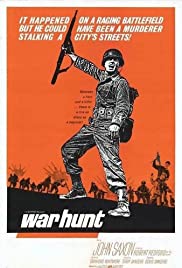
War Hunt (1962, directed by Denis Sanders)


In the last days of the Korean War, Pvt. Roy Loomis (Robert Redford) is assigned to an infantry unit that’s serving on the front lines.  Loomis is an idealist who believes in always doing the right thing and who believes that he’s truly fighting for the American way of life in Korea.  The company’s commander (Charles Aidman) is more cynical.  As he explains it, the job of the soldiers is not to win the war.  Their job is to stall the advance of the enemy long enough to let the politicians and the diplomats get what they want out of a peace settlement.  The soldiers are merely there to be sacrificed.

Loomis soon finds himself in conflict with Pvt. Endore (John Saxon).  Endore spends his night sneaking around behind enemy lines, killing soldiers, and gathering intelligence.  No one goes with Endore on these missions and Endore makes it clear that he doesn’t want to have anything to do with the other solders in the unit.  Because Endore usually returns with valuable intelligence, he’s allowed to do what he wants but it becomes clear that gathering intelligence is not what motivates Endore.  Endore loves war and killing.  In the United States, he would probably be on death row.  In Korea, at the height of the war, he’s a valuable asset.

Charlie (Tommy Matsuda) is an orphan boy who has been adopted as the company’s mascot.  Both Loomis and Endore have a bond with Charlie.  Loomis wants Charlie to go to an orphanage after the war so that he can hopefully be adopted and maybe brought over the United States.  Endore, however, plans to stay in Korea even after the war ends and he wants to keep Charlie with him.  He wants to turn Charlie into as efficient a killing machine as he is.

This low-budget but effective anti-war film may be best known for featuring Robert Redford in his first starring role but the film is stolen by John Saxon, who is frighteningly intense as Endore.  Endore is so in love with war that he continues to fight it even after the Armistice is declared.  Saxon plays him like a cool and calculating predator, a natural born killer.  He’s an introvert who rarely speaks to the other members of the company.  Even though he helps them by killing the enemy before the enemy can kill them, it’s clear that Endore doesn’t really care about the other members of the unit.  He just cares about killing.  He’s close to Charlie because Charlie is too young to realize just how dangerous Endore actually is.

Along with Saxon and Redford, War Hunt also features early performances from Tom Skerritt, Sydney Pollack, and Francis Ford Coppola.  (Coppola, who goes uncredited, plays an ambulance driver.)  Pollack and Redford met while they were both acting in this film and Pollack would go on to direct Redford in several more films.  One of those films, The Electric Horseman, would reunite Redford and Saxon.  Again, they would play adversaries.

Last night, when I heard John Saxon had died, I tried to pick his best performance.  I know that most people know him from his horror work and his role in Enter the Dragon.  Those are all good performances but, for me, Saxon was at his absolute best in War Hunt.


Horror on TV: Kolchak: The Night Stalker 1.7 “The Devil’s Platform” (dir by Alan Baron)


Tonight’s episode of Kolchak: The Night Stalker is a fun one!

In this episode, Kolchak investigates a series of mysterious deaths that seem to involve one very ambitious politician (played by Tom Skerritt).  Kolchak’s investigation leads him to believe that not only has the politician made a deal with the devil but that the politician also has the ability to transform himself into a killer dog!

Agck!

That’s Chicago-style politics for you,  I guess.

This episode originally aired on November 15th, 1974.

Enjoy!

http://www.youtube.com/watch?v=YC394BrBmGw