Film Review: The Straight Story (by David Lynch)


Released in 1999, The Straight Story is one of the greatest films ever made about America.

Alvin Straight (Richard Farnsworth) is an elderly veteran of World War II.  He lives in Iowa, a kind but rather taciturn man who doesn’t have time for doctors and would rather live on his own terms.  That said, when his daughter (Sissy Spacek) finally does manage to drag Alvin to a doctor, he’s told to stop smoking and to start using a walker to get around.  Alvin refuses, though he does start using two canes.  Alvin is an old man.  He’s lived a long time and, in his opinion, he knows best about what he needs to do.

For instance, when Alvin hears that his long-estranged brother Lyle (Harry Dean Stanton), has had a stroke, Alvin decides that he need to go Wisconsin to see him.  The only problem is that Alvin can barely see and he can’t walk and there’s no way anyone is going to give him a car or even a driver’s license.  His solution is to ride a lawnmower from Iowa to Wisconsin.

It’s based on a true story and if The Straight Story sounds like a film that will make you cry, it is.  Richard Farnsworth was terminally ill when he was offered the role of Alvin and he accepted because he admired Alvin’s determination to live life his own way.  As portrayed in the film, Alvin is not one to easily betray his emotions.  He grew up as a part of that stoic generation.  He saw his share of violence and death while he was serving during World War II and one gets the feeling that his attitude has always been that, if he could survive that, he can survive anything.  (The closest Alvin gets to becoming openly emotional is when he meets another veteran in a bar and it becomes obvious that the two of them share a bond that, as people who seen and survived war, only they can really understand.)  Farnsworth so completely becomes Alvin Straight that it’s easy to forger that he was a veteran actor who had a long career before starring in The Straight Story.  Alvin may not show much emotion but Farnsworth communicates so much with just the weariness in his eyes and his slow but determined gait that we feel like we know everything about him.

The film follows Alvin on his way to Wisconsin.  Along the way, he meets various people and, for the most part, they’re all good folks.  Even the runaway hitchhiker (Anastasia Webb) turns out to be a kind soul.  When Alvin momentarily loses control of his lawn mower, a group of stranger run out to help him.  They don’t know who he is or why he was riding his lawnmower down the street.  All that matter is that, at that moment, he’s a person who needs help.  The Straight Story celebrates both the beauty and the people of America.  It’s one of the most sincere and life-affirming films ever made, one that contains not a trace of cynicism and which is all the better for it.  And while many people might be shocked to discover that this film was directed by David Lynch, the truth of the matter is that a strong love for America and Americana runs through all of Lynch’s films.  Lynch was an artist who believed that people could surprise you with their kindness and that’s certainly the case with The Straight Story.

The Straight Story was the only one of David Lynch’s films to receive a G-rating.  It was also the only film that Lynch made for Disney.  It’s interesting to look at Lynch’s filmography and see this heartfelt and deeply touching film sitting between Lost Highway and Mulholland Drive.  But The Straight Story really does feature David Lynch at his best.  It also reveals him as a filmmaker who could do something unexpected without compromising his signature vision.  There’s a lot of beautiful, Lynchian images in The Straight Story.  But there’s also a lot of heart.
Film Review: Eraserhead (dir by David Lynch)


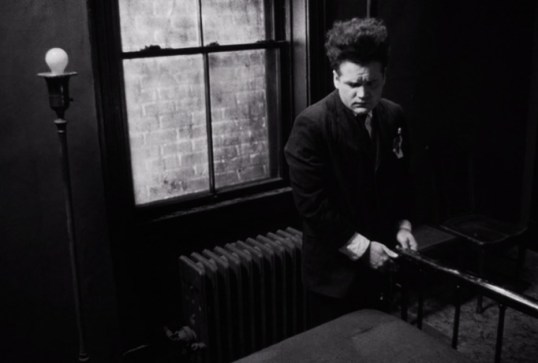
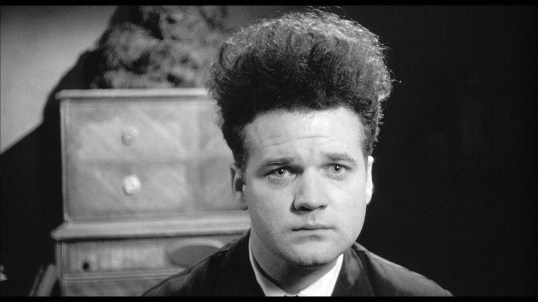
Jack Nance in David Lynch’s Eraserhead

I’ve been thinking about Eraserhead ever since I first heard the news about David Lynch’s passing.

Filmed in harsh but beautiful black-and-white and first released in 1977 (after a production period that lasted for seven years), Eraserhead tells the story of Henry Spencer (Jack Nance), an awkward young man who has the haircut that gives the film it’s name and who wanders through the film like an alienated character in a Kafka story.  He lives in an industrial landscape and almost every scene seems to have the sound of machinery droning away in the background.  He lives in an dark apartment and it appears that there’s a woman living in a radiator who sings that, “In heaven, everything is fine,” while stomping on sperm creatures.  Occasionally, a mysterious woman in the hallway talks to him.  Henry doesn’t seem to have a job or any sort of interests.  He doesn’t really have much of a personality.  Jack Nance, who would go on to become a member of David Lynch’s regular ensemble, has a permanently dazed expression on his face.  It’s hard not to feel sorry for Henry, even if he isn’t quite sympathetic.  In Heaven, everything is fine but in Henry’s world, it’s much different.

Henry has a girlfriend named Mary X (Charlotte Stewart).  Mary lives with her parents in an apartment near the train tracks.  When Henry goes over to her place for dinner, her father shows off how he can’t feel anything in his arm.  Eating a piece of chicken becomes awkward when it appears to be alive and bleeding.  Mary seems to have some sort of seizure.  Mary’s mother informs Henry that Mary has had a mutant baby and Henry must take care of it.  The baby (represented by a grotesque puppet) has no arms or legs or, it would appear, skin.  It cries constantly, despite Henry’s attempts to care for it.  The baby is the only truly sympathetic character in the film.

Eraserhead is often described as being a film that’s difficult to understand but, by Lynch standards, it’s not that hard to figure out.  Lynch himself said that the film was fueled by his own anxiety over being a father and, throughout the film, Henry tries to take care of the baby but everything he does just makes things worse.  As is often the case with Lynch’s film, many viewers get caught up in wondering why when they should just be paying attention to what happens.  Why is the baby a mutant?  Because it is.  Why does Henry live in the middle of an industrial park?  Because he does.  Who is the scarred man who appears at the start of the film and who apparently pushes the levers that lead to Mary’s pregnancy?  Again, it’s less important who he is and more important that he’s there and now, Henry is a father despite being woefully unprepared.  Even if the viewer learned the scarred man’s identity (or if Henry even learned of his existence), it wouldn’t change Henry’s situation.  (Technically, of course, the man is Sissy Spacek’s husband and frequent Lynch collaborator, Jack Fisk.)  Eraserhead is a visually surreal film but it’s also an very emotionally honest one.  Henry may be stuck in, as Lynch once put it, a “dream of dark and disturbing things,” but his fears and his anxiety are portrayed realistically  That emotional honesty is something that would appear in all of Lynch’s work and it’s why he was one of our most important filmmakers.

Sadly, David Lynch is now gone.  So is Jack Nance.  But their work will live on forever.

Eraserhead (1977, dir by David Lynch, DP: Frederick Elmes, Herbert Cardwell)

Robert Englund as Han Solo? A Little May 4th Trivia


Can you imagine how things might have played out if Robert Englund had played Han Solo?

It’s not as far-fetched as it might sound.  In his autobiography, Hollywood Monster: A Walk Down Elm Street with the Man of Your Dreams, Englund mentions that he was one of the many actor who, in 1975, auditioned for a role in the first Star Wars film.  It’s often forgotten that, before he became famous as Freddy Krueger in A Nightmare In Elm Street, Englund was a busy character actor who had roles in several big studio productions in the 70s.  He was definitely a part of the “new Hollywood” that included people like George Lucas, Steven Spielberg, and Jon Milius.

Though Englund doesn’t go into much detail, he does say that he read for the roles of both Han Solo and Luke Skywalker.  At the time, Englund didn’t feel that he was right for either role and he went back to his apartment under the correct impression that he would not be cast.  However, he did feel that his friend and then-roommate Mark Hamill would be a good pick for Luke Skywalker and Englund writes that he encouraged Hamill to try out for the role.

Would Mark Hamill have been cast if Robert Englund hadn’t told him about the audition?  Probably.  Given that Star Wars was Lucas’s follow-up to the very popular American Graffiti, it’s probable that every struggling young actor in Hollywood was hoping to audition.  As well, Hamill was not totally unknown to George Lucas, having early read for a role in American Graffiti.  Still, it’s nice to think that, long before he was cast as Freddy Krueger, Robert Englund may have played a role in casting one of the most successful films of all time.

What would Robert Englund have been like as Han Solo?  He definitely would not have been as grouchy as Harrison Ford’s Han.  Indeed, one of the striking things out about Englund’s pre-Nightmare career was how he was usually cast as friendly characters who were almost shy.  Englund would have been friendlier and rather eccentric Han Solo but I think he would have been entertaining in his way.

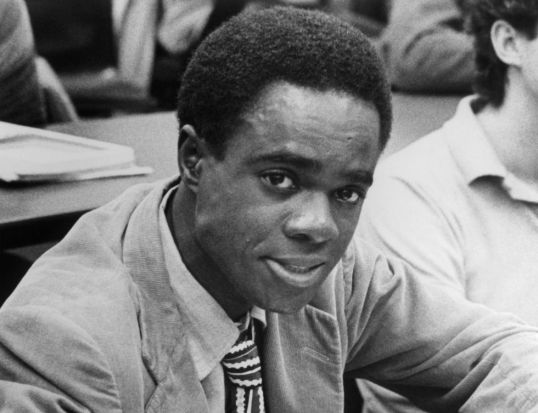
Because of the film’s success, it can be a bit difficult to know who was actually considered for a role in Star Wars.  Lucas has said that he originally wanted to cast Black actor Glynn Turman as Han Solo but he feared audiences would not accept the possibility of an interracial romance between him and Leia, even in a galaxy far away.  (Lucas’s regret over that decision is one of the things that led to the casting of Billy Dee Williams as Lando Calrissian.)  The film’s IMDb trivia page insists that everyone from Al Pacino to Bill Murray to Marlon Brando to Chevy Chase was considered for the role of Han Solo and I have to say that this is a case where I doubt the accuracy of the IMDb.  Harrison Ford, who had originally been hired only to read with people at the auditions, eventually got the role despite telling Lucas, about the script, “You can type this shit but you can’t say it.”

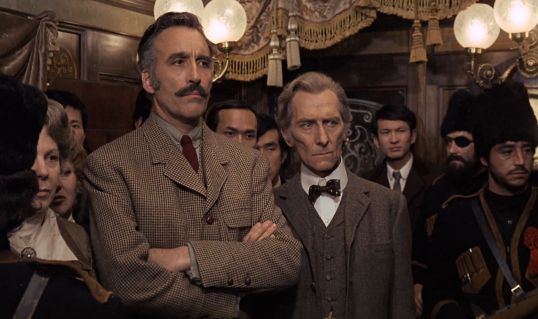
In several interviews, Christopher Lee expressed regret at having turned down the role of Grand Moff Tarkin, which was instead played by Lee’s best friend Peter Cushing.  Interestingly enough, Cushing was also one of Lucas’s choices for Obi-Wan Kenobi so it’s easy to imagine a universe in which Star Wars reunited two Hammer films legends, along with setting box office records.

Famously, Lucas held joint-auditions with his friend Brian De Palma.  De Palma was casting Carrie and just about everyone who read for one of the films also read for the other.  Reportedly, William Katt came close to getting the role of Luke before instead being cast as Carrie’s doomed prom date.  Amy Irving was also a strong contender for Leia, before instead ending up as Sue Snell in De Palma’s film.  Some source that that Sissy Spacek also read for Leia, though I’ve also read that Spacek was not a part of the joint-auditions.  That’s one thing about collecting trivia about classic films.  It’s often hard to know what’s true and what’s just wishful thinking.

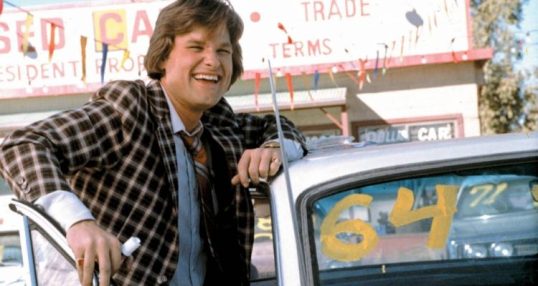
I should mention that another strong contender for Han Solo (and reportedly Luke as well) was Kurt Russell.  It’s actually easy to imagine Kurt Russell as Han and, just as with Englund, it leads to an intriguing game of what if.  Would Kurt Russell have gone on to have Harrison Ford’s career if he had been cast in Star Wars?  Would Russell have gone to play Indiana Jones and Jack Ryan if he had been cast as Han Solo and would Harrison Ford have ended up helping the President to Escape from New York?  Or is it just as possible that Star Wars have not worked without the chemistry of Harrison Ford, Carrie Fisher, and Mark Hamill?  Would a Kurt Russell, Amy Irving, and William Katt version of Star Wars captured the imagination of audiences?

It’s a question to which there is no real answer, a bit like wondering if The Godfather would have been as big a hit if it had starred George C. Scott, Martin Sheen, and Burt Reynolds.  Still, it’s interesting to consider.

Horror Scenes That I Love: Sissy Spacek in Carrie


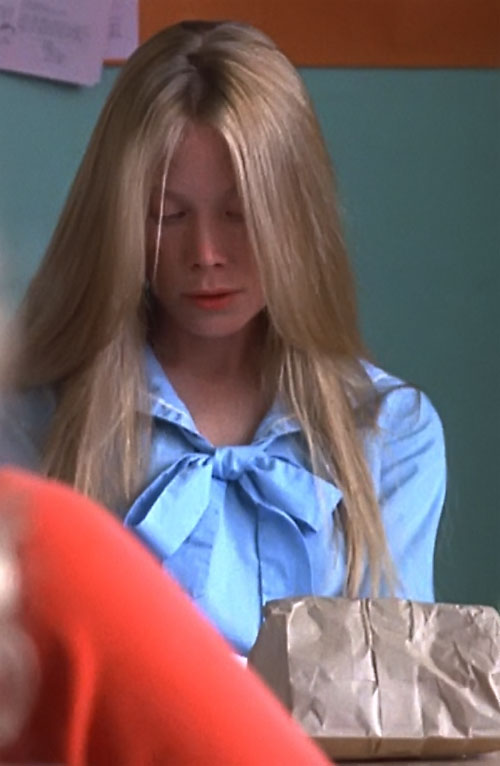
Sissy Spacek hasn’t appeared in many horror movies but the one in which she did appear is such a classic and Spacek’s performance was so strong that she qualifies as a horror icon regardless.  In 1976, Sissy Space played poor and victimized Carrie White, the shy high school student who ended up burning down the prom.  Her performance became one of the few horror performances to be Oscar-nominated and Carrie launched a series of Stephen King adaptations.

In one of the best scene from the film, Carrie is forced to deal with both an insensitive principal and a brat on a bicycle.

Horror Scenes That I Love: Piper Laurie in Carrie


So far, this month, I’ve been doing these horror scenes that I love in alphabetical order based on who was featured in the scene.  Originally, today was going to be devoted to Boris Karloff but, last night, I read the news that the great Piper Laurie had passed away at the age of 91.

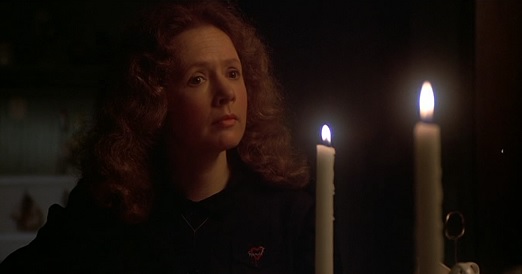
Have no doubt that Boris Karloff will be honored tomorrow but, for today, I would be remiss if I didn’t pay tribute to Piper Laurie.  Piper Laurie often said that, when she read the script for 1976’s Carrie, she at first didn’t understand the story’s tone until she realized that Margaret White was meant to be as comedic as she was frightening.  Piper Laure’s performance as Carrie’s mother resulted in an Oscar nomination and it also revived Laurie’s career.  (Laurie had semi-retired from Hollywood following her previously Oscar-nominated work in The Hustler.)

In the scene below, Margaret makes one last attempt to keep Carrie from going to the prom.  Her line, “They’re all going to laugh at you” comes back to haunt Carrie in a very big way.

One final bit of Piper Laurie horror trivia: In 1959, when Alfred Hitchcock was casting Psycho, Piper Laurie was his second choice, behind Janet Leigh, for the role of Marion Crane.

18 Days of Paranoia #15: Marie (dir by Roger Donaldson)


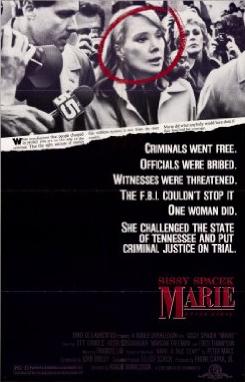
The 1985 film, Marie, tells a true story.

(In fact, the film’s official title is Marie: A True Story, just in case there was any doubt.)

The film opens in Tennessee, in the early 70s.  Marie Ragghianati (Sissy Spacek) has left her alcoholic and abusive husband and is now living with her mother and trying to raise three children, one of whom is chronically ill, on her own.  Though she manages to win a scholarship to Vanderbilt University, she quickly discovers that having a degree does not necessarily translate into getting a job.  However, while Marie was a student, she became acquainted with Eddie Sisk (Jeff Daniels), a seemingly friendly lawyer who now has a job as the counsel for the newly elected governor of Tennessee, Ray Blanton (Don Hood).  Marie goes to see Eddie and she soon finds herself working in the governor’s office.

With Eddie’s support, Marie rises up through the ranks.  Of course, he does get a little bit annoyed whenever Marie asks him why the governor is so eager to offer clemency to certain criminals.  At first, Eddie claims that it’s because the governor is against the death penalty and he doesn’t want to send anyone to die in “Old Sparky.”  Later, Eddie claims that it’s because the state has been ordered to do something about prison overcrowding.  And finally, Eddie admits that, on occasion, it’s done as a political favor.  It appears that some of the children of Tennessee’s wealthiest families have a really bad habit of getting arrested for some very serious crimes.

Eventually, there’s an opening on the state parole board and Eddie recommends that Marie be appointed the board’s new chairperson.  As Eddie explains it, the governor wants to put a Democrat on the board and he wants to appoint a woman.  (Despite the governor’s insistence that he wants to bring more women into state government, the film makes it clear that the Blanton administration was essentially a boys club.)  Marie agrees and soon, she’s making over a hundred dollars a day!  (That was apparently an unusual thing in the 70s.)

No sooner has Marie moved into her new position than she is informed that some of the governor’s aides have been selling pardons.  When Marie goes to Eddie about the situation, his charming facade disappears as he gets angry with her and accuses her of trying to ruin his career.  When rumors get out that she may have gone to the FBI, Marie becomes a pariah.  The governor demands her resignation, which she refuses to give.  She finds herself being followed by strange cars and harassed by the police.  (At one point, she is arrested for drunk driving despite being sober.)  Meanwhile, people start to show up dead.

When Blanton fires Marie on trumped-up corruption charges, she decides to take the governor to court.  Fortunately, Marie is friendly with a lawyer named Fred Thompson.  The future U.S. Senator and presidential candidate plays himself in this film and he gives such an authoritative performance that he went on to have a busy career as a character actor whenever he wasn’t running for or serving in office.

Marie is a strangely disjointed film.  On the one hand, you’ve got Sissy Spacek, Fred Thompson, and Jeff Daniels all giving excellent performances and you’ve also got an inspiring true story.  On the other hand, the film attempts to combine so many different genres that it sometimes feels as if you’re watching multiple films at once.  The film starts out as the story of a single mom trying to restart her life and then it becomes a workplace drama as Marie has to deal with gossip about her relationship with Eddie and hostile co-workers like fellow board member Charles Traughber (Morgan Freeman, in a small role that would probably be forgettable if it was filled by anyone other than Morgan Freeman).  Then it becomes a courtroom drama, with Fred Thompson cross-examining witnesses and giving final arguments.  Meanwhile, at the same time, it’s also a political thriller in which two men are brutally murdered before they can testify against the governor.  And then finally, it’s also a crime drama as detectives try to track down a career criminal who has friends in the governor’s office.  It’s a film of many good parts but those parts don’t always seem to easily fit together and the end result is somewhat awkward whole.

(Interestingly enough, some of the film’s moments that seem as if they’re most likely to be fictionalized are actually based on fact.  For instance, two men who could have brought down Blanton were mysteriously murdered at the same time that Marie was suing the state.)

In the end, Marie doesn’t really come together but it has a good cast and a good lesson: Never trust a politician.

Other Entries In The 18 Days Of Paranoia:

  1. The Flight That Disappeared
  2. The Humanity Bureau
  3. The Private Files of J. Edgar Hoover
  4. The Falcon and the Snowman
  5. New World Order
  6. Scandal Sheet
  7. Cuban Rebel Girls
  8. The French Connection II
  9. Blunt: The Fourth Man 
  10. The Quiller Memorandum
  11. Betrayed
  12. Best Seller
  13. They Call Me Mister Tibbs
  14. The Organization

6 Good Films That Were Not Nominated For Best Picture: The 1970s


David Niven at the 1974 Oscars

Continuing our look at good films that were not nominated for best picture, here are 6 films from the 1970s.

Dirty Harry (1971, dir by Don Siegel)

“Well, I’m all torn up about his rights….” Detective Harry Callahan (Clint Eastwood) says after being informed that he’s not allow to torture suspects for information.  Unfortunately, in this case, the Academy agreed with all the critics who called Harry a menace and this classic and influential crime film was not nominated.  Not even Andy Robinson picked up a nomination for his memorably unhinged turn as Scorpio.

Carrie (1976, dir by Brian DePalma)

The Academy liked Carrie enough to nominate both Sissy Spacek and Piper Laurie for Best Actress and Best Supporting Actress, respectively.  The film itself, however, went unnominated.  It’s enough to make you want to burn down the prom.

Suspiria (1977, dir by Dario Argento)

In a perfect world, Goblin would have at least taken home an Oscar for the film’s score.  In the real world, unfortunately, Argento’s masterpiece was totally snubbed by the Academy.

Days of Heaven (1978, dir by Terence Malick)

If it were released today, Terence Malick’s dream-like mediation of life during the depression would definitely be nominated.  In 1978, perhaps, the Academy was still not quite sure what to make of Malick’s beautiful but often opaque cinematic poetry.

Halloween (1978, dir by John Carpenter)

“The night he came home!” should have been “The night he went to the Oscars!”  The film received no nominations and it’s a shame.  Just imagine Donald Pleasence winning for his performance as Loomis while John Carpenter racked up almost as many nominations as Alfonso Cuaron did this year for Roma.

Dawn of the Dead (1978, dir by George Romero)

If the Academy wasn’t willing to nominate Night of the Living Dead, there was no way that they would go for the film’s longer and bloodier sequel.  But perhaps they should have.  Few films are cited as an inspiration as regularly as Dawn of the Dead.

Up next, in about an hour, the 1980s!


Horror Scenes That I Love: Carrie Destroys The Prom


Today’s horror scene that I love comes from 1976’s Carrie.

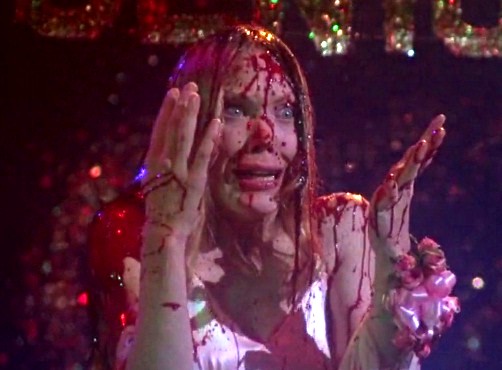
This scene starts out on a note of happiness with Carrie (Sissy Spacek) and Tommy (William Katt) being named as Queen and King of the Prom.  Things, however, get a bit ominous when Sue (Amy Irving) notices that bucket of pig’s blood and Nancy Allen and John Travolta hanging out underneath the stage.  Things get even worse when the coach (Betty Buckley) refuses to listen to Sue and tosses her out of the gym.

And then suddenly, there’s blood everywhere and Piper Laurie’s chanting, “They’re all going to laugh at you …. they’re all going to laugh at you….”

Is everyone really laughing at Carrie?  I believe some of them are.  Norma is definitely laughing because I think the shot of the coach laughing is included to let us know that some of the laughter is strictly in Carrie’s mind.  Nothing about the character would lead us to suspect that the coach would laugh.  In fact, seeing as how the coach just threw out Sue, it’s debatable whether she would even be back among the crowd by the time the pig’s blood came down.

(Plus, would everyone be laughing even with Tommy, the most popular kid in school, lying dead on the stage?)

Anyway, regardless of whether they were all laughing or not, we all know what happens next!

Lisa’s Oscar Predictions For October


And now, we take a short break from TSL’s annual horrorthon to bring you Lisa Marie’s Oscar predictions for October!

Be sure to check out my predictions for January, February, March, April, May. June. July, August and September!

Best Picture

Black Panther

Boy Erased

Can You Ever Forgive Me?

First Man

Green Book

If Beale Street Could Talk

The Mule

Roma

A Star is Born

Vice

Best Director

Damien Chazelle for First Man

Bradley Cooper for A Star Is Born

Alfonso Cuaron for Roma

Peter Farrelly for Green Book

Barry Jenkins for If Beale Street Could Talk

Best Actor

Christian Bale in Vice

Bradley Cooper in A Star is Born

Clint Eastwood in The Mule

Robert Redford in Old Man and the Gun

John C. Reilly in Stan & Ollie

Best Actress

Glenn Close in The Wife

Lady Gaga in A Star is Born

Felicity Jones in On The Basis of Sex

Nicole Kidman in Destroyer

Melissa McCarthy in Can You Ever Forgive Me?

Best Supporting Actor

Mahershala Ali in Green Book

Timothee Chalamet in Beautiful Boy

Bradley Cooper in The Mule

Sam Elliott in A Star is Born

Michael B. Jordan in Black Panther

Best Supporting Actress

Claire Foy in First Man

Nicole Kidman in Boy Erased

Regina King in If Beale Street Could Talk

Sissy Spacek in Old Man and the Gun

Michelle Yeoh in Crazy Rich Asians