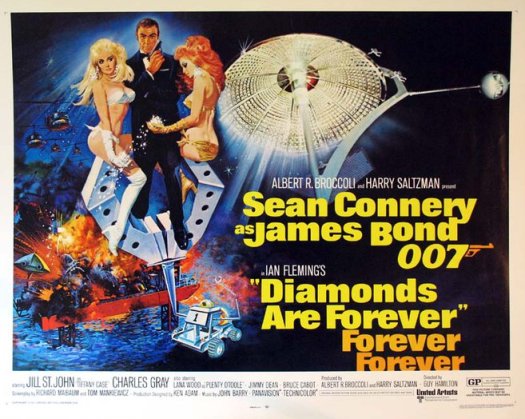
The Return of 007: Sean Connery in DIAMONDS ARE FORVER (United Artists 1971)


gary loggins's avatarcracked rear viewer

007 fans all over the world cheered when Sean Connery returned to the role that made him famous in DIAMONDS ARE FOREVER, the 6th James Bond screen outing. Connery left the series in 1967 (YOU ONLY LIVE TWICE), and was replaced by George Lazenby for 1969’s ON HER MAJESTY’S SECRET SERVICE. Lazenby was actually pretty good, if a bit boring, but he was one-and-done, choosing not to be typecast as cinema’s most famous spy (how’d that work out, George?). Producers Albert Broccoli and Harry Saltzman offered Connery an unprecedented $1.25 million dollars to come back, which the smart Scotsman snapped up in a heartbeat… who wouldn’t? Well, except for George Lazenby.

The opening sequence has Bond searching the globe to fins Ernst Stavro Blofeld, SPECTRE’s megalomanical leader who ordered the death of Bond’s wife in the previous movie. 007 hunts down his arch nemesis and ends his villainous career in…

View original post 538 more words

My Favorite Spy: Sean Connery as James Bond in GOLDFINGER (United Artists 1964)


gary loggins's avatarcracked rear viewer

For my money, GOLDFINGER is the ultimate James Bond movie, serving as the blueprint for spy sagas to come. The action begins right off the rip as a scuba diving 007 infiltrates an oil refinery in an unnamed Latin American country, plants some plastique explosives, and changes into a tux as the whole shebang blows, then attends to some “unfinished business” with a beautiful Latina who sets him up to be killed by a bad guy, electrocuting his foe in a tub and wittily remarking “shocking, positively shocking” – all before the opening credits roll and Shirley Bassey belts out the immortal title tune by Anthony Newley and Leslie Bricusse!

Our Man Bond is then off to Miami to meet with his CIA pal Felix Leiter. He’s put on the trail of one Auric Goldfinger, a legit gold bullion dealer suspected of illegal activities. The avaricious Goldfinger isn’t above running…

View original post 607 more words

Lisa Reviews An Oscar Nominee: The Longest Day (dir by Ken Annakin, Andrew Marton, Bernhard Wicki, Gerd Oswald, and Darryl F. Zanuck)


As my sister has already pointed out, today is the 73rd anniversary of D-Day.  With that in mind, and as a part of my ongoing mission to see and review every single film ever nominated for best picture, I decided to watch the 1962 film, The Longest Day!

The Longest Day is a pain-staking and meticulous recreation of invasion of Normandy, much of it filmed on location.  It was reportedly something of a dream project for the head of the 20th Century Fox, Darryl F. Zanuck.  Zanuck set out to make both the ultimate tribute to the Allied forces and the greatest war movie ever.  Based on a best seller, The Longest Day has five credited screenwriters and three credited directors.  (Ken Annakin was credited with “British and French exteriors,” Andrew Marton did “American exteriors,” and the German scenes were credited to Bernhard Wicki.  Oddly, Gerd Oswald was not credited for his work on the parachuting scenes, even though those were some of the strongest scenes in the film.)  Even though he was not credited as either a screenwriter or a director, it is generally agreed that the film ultimately reflected the vision of Darryl F. Zanuck.  Zanuck not only rewrote the script but he also directed a few scenes as well.  The film had a budget of 7.75 million dollars, which was a huge amount in 1962.  (Until Steven Spielberg’s Schindler’s List, The Longest Day was the most expensive black-and-white film ever made.)  Not only did the film tell an epic story, but it also had an epic length.  Clocking in at 3 hours, The Longest Day was also one of the longest movies to ever be nominated for best picture.

The Longest Day also had an epic cast.  Zanuck assembled an all-star cast for his recreation of D-Day.  If you’re like me and you love watching old movies on TCM, you’ll see a lot of familiar faces go rushing by during the course of The Longest Day.  American generals were played by actors like Robert Mitchum, Robert Ryan, Henry Fonda, and John Wayne.  Peter Lawford, then the brother-in-law of the President of the United States, had a memorable role as the Scottish Lord Lovat, who marched through D-Day to the sounds of bagpipes.  When the Allied troops storm the beach, everyone from Roddy McDowall to Sal Mineo to Robert Wagner to singer Paul Anka can be seen dodging bullets.  Sean Connery pops up, speaking in his Scottish accent and providing comic relief.  When a group of paratroopers parachute into an occupied village, comedian Red Buttons ends up hanging from the steeple of a church.  When Richard Beymer (who is currently playing Ben Horne on Twin Peaks) gets separated from his squad, he stumbles across Richard Burton.  Among those representing the French are Arletty and Christian Marquand.  (Ironically, after World War II, Arletty was convicted of collaborating with the Germans and spent 18 months under house arrest.  Her crime was having a romantic relationship with a German soldier.  It is said that, in response to the charges, Arletty said, “My heart is French but my ass is international.”)  Meanwhile, among the Germans, one can find three future Bond villains: Gert Frobe, Curt Jurgens, and Walter Gotell.

It’s a big film and, to be honest, it’s too big.  It’s hard to keep track of everyone and, even though the battle scenes are probably about an intense as one could get away with in 1962 (though it’s nowhere near as effective as the famous opening of Saving Private Ryan, I still felt bad when Jeffrey Hunter and Eddie Albert were gunned down), their effectiveness is compromised by the film’s all-star approach.  Often times, the action threatens to come to a halt so that everyone can get their close-up.  Unfortunately, most of those famous faces don’t really get much of a chance to make an impression.  Even as the battle rages, you keep getting distracted by questions like, “Was that guy famous or was he just an extra?”

Among the big stars, most of them play to their personas.  John Wayne, for instance, may have been cast as General Benjamin Vandervoort but there’s never any doubt that he’s playing John Wayne.  When he tells his troops to “send them to Hell,” it’s not Vandervoort giving orders.  It’s John Wayne representing America.  Henry Fonda may be identified as being General Theodore Roosevelt II but, ultimately, you react to him because he’s Henry Fonda, a symbol of middle-American decency.  Neither Wayne nor Fonda gives a bad performance but you never forget that you’re watching Fonda and Wayne.

Throughout this huge film, there are bits and pieces that work so well that you wish the film had just concentrated on them as opposed to trying to tell every single story that occurred during D-Day.  I liked Robert Mitchum as a tough but caring general who, in the midst of battle, gives a speech that inspires his troops to keep fighting.  The scenes of Peter Lawford marching with a bagpiper at his side were nicely surreal.  Finally, there’s Richard Beymer, wandering around the French countryside and going through the entire day without firing his gun once.  Beymer gets the best line of the film when he says, “I wonder if we won.”  It’s such a modest line but it’s probably the most powerful line in the film.  I wish The Longest Day had more scenes like that.

The Longest Day was nominated for best picture of 1962 but it lost to an even longer film, Lawrence of Arabia.

A Movie A Day #60: Outland (1981, directed by Peter Hyams)


outlandIt’s High Noon in space!

In the future, Marshal O’Neil (Sean Connery) has been hired, by Conglomerates Amalgamated, to enforce the law on a mining outpost that’s located on one of the moons of Jupiter.  Why are all the miners going crazy, taking off their spacesuits, and exploding?  Are they being hypnotized by that big red spot on Jupiter?  Or is the mining supervisor, Sheppard (Peter Boyle), forcing his workers to take amphetamines that cause them to have psychotic episodes?  O’Neil suspects the latter so Sheppard summons three intergalactic gunslingers to come and kill the marshal.  With no one, except for the outpost’s doctor (Frances Sternhagen), willing to stand behind him, O’Neil must stand up to three gunmen by himself.

The comparison between High Noon and Outland is obvious but the movie also owes much to Alien.  With its corrupt corporation, claustrophobic sets, and its blue-collar space workers, Outland seems like it could be taking place in the same movie universe as the Alien movies.  Like a lot of the films that Peter Hyams has directed, Outland is ambitious but slow.  It is never as much fun as something like Moon Zero Two.  The best thing about Outland is Sean Connery, convincingly cast as Gary Cooper in space.

6 James Bond Films That Should Have Been Nominated For Best Picture


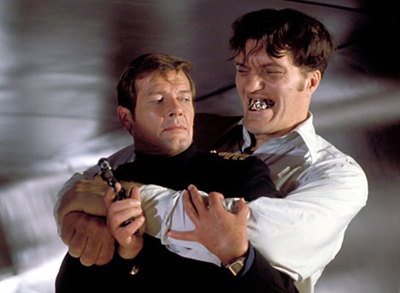
James Bond and Jaws

Other than a few song nominations (and wins) and the occasional technical mentions, the Academy has tended to snub the James Bond franchise.

However, I love the Bond films so here are 6 times that I think 007’s latest adventure should have been nominated for best picture!

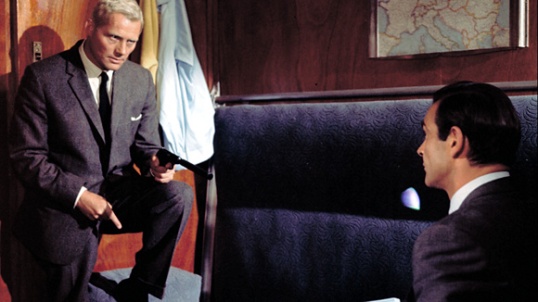
From Russia With Love

  1. From Russia With Love (1963)

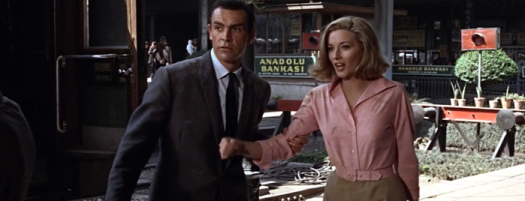
I not only think that From Russia With Love should have been nominated for best picture, I also think that it should have won.  This film featured Sean Connery at his best and it’s one of the few Bond films to work not only as an adventure but as a romance as well.

Skyfall

2. Skyfall (2012)

I’m not a huge fan of Daniel Craig’s interpretation of the character.  If Connery was Killer Bond and Roger Moore was Charming Bond, Craig often seems to be Whiny Bond.  That said, Skyfall was not only one of the best Bond films but one of the best films of 2012 as well.

The Spy Who Loved Me

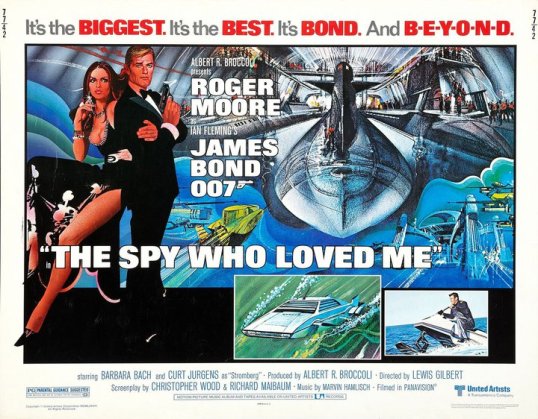
3. The Spy Who Loved Me (1977)

Nobody does it better!  Not only was this Roger Moore’s best Bond film but it’s a wonderful piece of pop art.

on_her_majestys_secret_service1

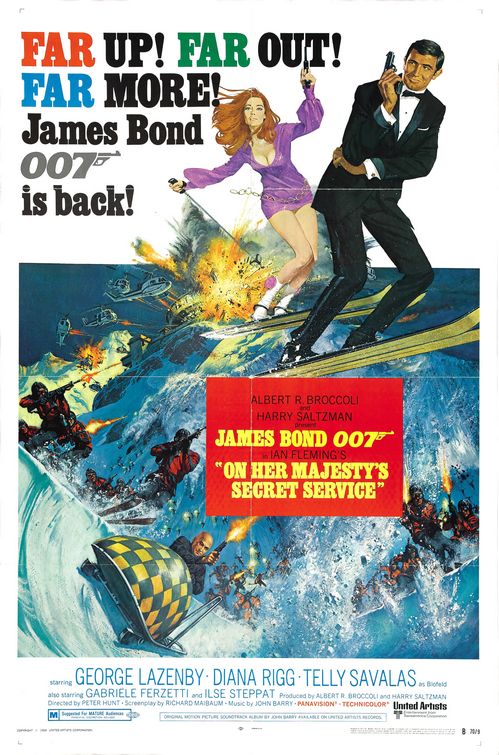
4. On Her Majesty’s Secret Service (1969)

This is one of the most underrated of all of the Bond films.  Ignore all the gossip over how George Lazenby came to play James Bond and you’ll discover that it is a Skyfall for the 60s.

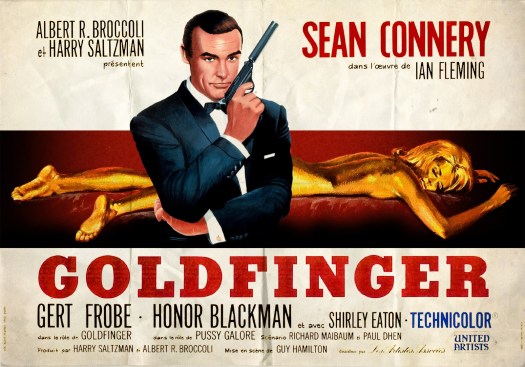
goldfinger-movie-poster-1964-1010189635

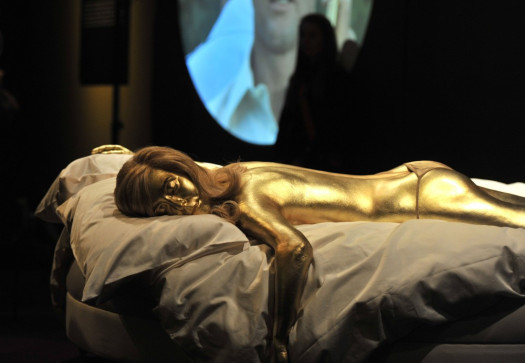
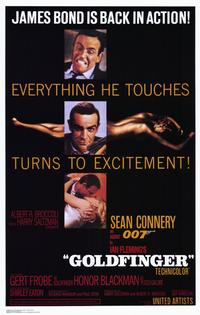
5. Goldfinger (1964)

“No, Mr. Bond, I expect you to die!”  Goldfinger is over the top perfection.

LiveandLetDie

6. Live and Let Die (1973)

Live and Let Die will probably never be acclaimed as the other Bond films but I don’t care.  I love it.  It’s the closest the Bond franchise ever came to achieving the anything-goes insanity of a classic grindhouse film.

Will a James Bond film ever receive a best picture nomination?  Normally, I’d say no.  But Mad Max: Fury Road changed the rules (for the better).  Given the right Bond, the right director, the right story, and the right year, who knows what could happen?


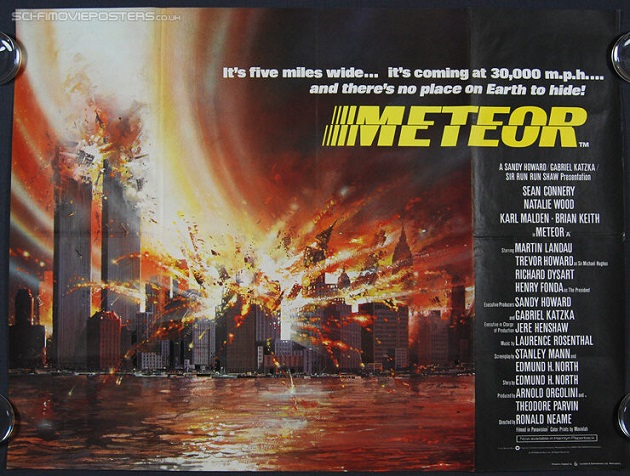
METEOR is a Crashing Bore (AIP 1979)


gary loggins's avatarcracked rear viewer

meteor1

American-International Pictures had gotten pretty fancy-schmancy by the late 70’s. The studio was leaving their exploitation roots behind and branching out to bigger budgeted films like FORCE TEN FROM NAVARONE, LOVE AT FIRST BITE, and THE AMITYVILLE HORROR, with bigger name stars for marquee allure. Toward the end of 1979 they released METEOR, a $16 million dollar, star-studded, special-effects laden, sci-fi/ disaster film spectacle that bombed at the box-office and contributed to the company’s demise.

meteor2

Coming at the tail end of the disaster cycle, METEOR is formulaic as hell. Take a group of well-known stars (Sean Connery, Natalie Wood , Karl Malden , Brian Keith , Martin Landau, Henry Fonda ), give them a disastrous menace to combat (in this case a five-mile wide meteor hurtling toward Earth), add some conflict (US/USSR Cold War relations), and some scenes of destruction, and voila! instant disaster movie! Unfortunately, by 1979 audiences had already grown tired…

View original post 403 more words

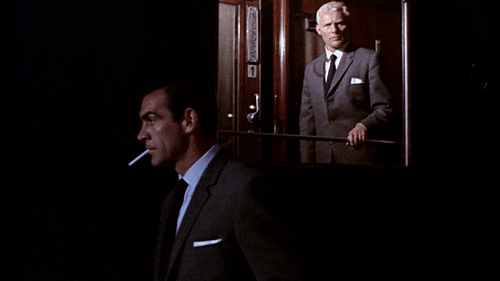
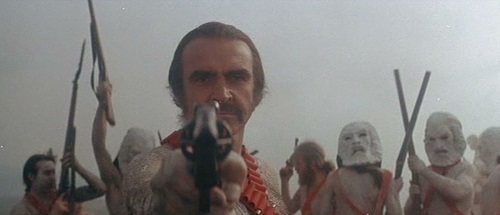
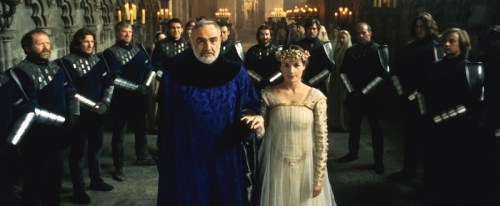
4 Shots From 4 Films: From Russia With Love, Zardoz, Highlander, First Knight


4 Shots From 4 Films is just what it says it is, 4 shots from 4 of our favorite films.  As opposed to the reviews and recaps that we usually post, 4 Shots From 4 Films is all about letting the visuals do the talking.

This edition of 4 Shots From 4 Films is dedicated to Sean Connery, on the occasion of his 85th birthday!

4 Shots From 4 Films

From Russia With Love (1963, directed by Terrence Young)

From Russia With Love (1963, directed by Terrence Young)

Zardoz (1974, directed by John Boorman)

Zardoz (1974, directed by John Boorman)

Highlander (1986, directed by Russell Mulcahy)

Highlander (1986, directed by Russell Mulcahy)

 First Knight (1995, directed by Jerry Zucker)

First Knight (1995, directed by Jerry Zucker)

Review: A Bridge Too Far (dir. by Sir Richard Attenborough)


1977 a bridge too far

“Well, as you know, I always felt we tried to go a bridge too far” — Lt. Gen. Frederick Browning

With the recent passing of Sir Richard Attenborough I decided to bring up one of the films which first brought his name to my attention. I was quite the young lad when I first saw Attenborough’s epic war film A Bridge Too Far. I would say that it was one of my earlier memories of watching a film with my father who was a major fan of war films. One could say that I got my appreciation and love for the genre from him.

A Bridge Too Far was adapted from the Cornelius Ryan book of the same name which depicted from start to finish the disastrous World War II battle known as Operation Market Garden. The film states that the Allied landings at Normandy, France in the summer of 1944 had the German forces reeling and on the verge of collapse. With Eisenhower having to choose between competing plans to chase Hitler’s forces right into Berlin from his two best generals in George S. Patton and Bernard Montgomery, the film already lays down something that’s become synonymous with military disasters throughout history. Political expediency and pressure on Eisenhower led to an operation that was never attempted in military history and one which required every aspect of the operation to go according to plan for it to work. As the film would show this was not meant to be.

The film begins with the operation’s early days as Allied commanders rush to put Montgomery’s plan to drop 35,000 paratroopers behind German lines in occupied-Netherlands in order to capture and hold key bridges until Allied armored forces arrived to reinforce them. It’s a daring plan that the Attenborough films with a obvious confidence and enthusiasm, but also one that already showed some nagging doubts from field commanders who would be in the thick of the fighting if intelligence reports were inaccurate. One could almost say that Attenborough was making the film a sort of anti-war message which was a rarity when it came to Hollywood and and film industry depicting the events of World War II at the time.

While the film does explore that very anti-war theme throughout it’s really a by-product of how the battle itself unfolds and shown to the viewers that might give one such an idea. Yet, in the end A Bridge Too Far was a much more complicated film to just be labeled as an anti-war film. Yes, the battle itself was a disaster for the Allied forces of American, British and Polish soldiers involved, but despite the political bumbling and military arrogance of those who command from behind a desk, the film actually does a great job of showing that bond soldiers earn when confronted with the horrors of battle.

Attenborough and producer Joseph E. Levine pulls together an all-star cast for the film with names such as Sean Connery, Edward Fox, Robert Redford, Michael Caine and Laurence Olivier just to name a few. Films such as A Bridge Too Far rarely get made anymore in this day and age. The cast itself is part of the reason why the film still holds up to scrutiny decades after it’s release. While all-star casts such as this seemed to have been common place before the 1980’s it still looked like a daunting task for Attenborough to manage so many Hollywood stars and veteran British actors. Every character from Hopkin’s Col. Frost, Connery’s Gen. Urquhart and Redford’s Maj. Cook get to shine in their sections of the film as their individual stories about the battle all tie-in together to show just how complicated the events that they were filming truly turned out to be.

At times, one almost could feel overwhelmed by the amount of recognizable names and faces that come across the screen, yet Attenborough and producer Levine were able to juggle not just the logistics of the film’s screenplay, but the egos and reputation of the very stars who would become the backbone of the film.I think in a lesser filmmaker A Bridge Too Far could easily have turned into the very Operation Market Garden it was trying to depict.

It’s a film that never celebrates the concept of war itself, but actually shows that war remains a bloody and chaotic affair that relies not just on planning and execution but on the whims of lady luck. While Attenborough’s film never reached the sort of iconic status that another Cornelius Ryan adapted film has attained in The Longest Day, it does remain the more powerful of the two as it doesn’t just explore the historical event as a sort of academic exercise, but as an exploration of that old military adage of “No plan survives contact with the enemy”.

So, in the end I recommend that those looking to watch and experience the earlier directorial works of Sir Richard Attenborough should check out A Bridge Too Far. It remains to this day one of his more underappreciated films especially when compared to his later more acclaimed films like Gandhi, Chaplin and Shadowlands.

James Bond Review: Never Say Never Again


With the release of the latest James Bond yarn, Skyfall, imminent, the Shattered Lens has been looking back at every single James Bond film ever created – the entire history of the franchise. Today’s selection for review is 1983’s Never Say Never Again. Unlike the overwhelming majority of the franchise, this film was not produced by EON productions, but rather by an independent studio. It is an adaptation of Ian Fleming’s Thunderball, much like the 1965 film that shares the novel’s name. It also marks the return of Sean Connery to portray the film’s lead, 00-agent James Bond, 12 years after appearing in Diamonds Are Forever.

I have to say, when I entered into reviewing this film I was certain that I had seen it before, but it took only ten minutes or so of film action before I realized that this film, somehow, had completely flown under my radar.

I have to say, it does not make a strong first impression. We don’t get a cold open with Bond, but rather launch directly into the credit sequence with what I have to admit may be the worst opening theme song of the entire franchise. I haven’t even posted it here, I’m so embarrassed by it, but I’m sure a quick youtube search will yield some results. It’s lengthy, slow, and weirdly incongruous with what proves to be a fairly action-packed Bond adventure.

The story here is sort of needlessly complicated. Addressing the long lapse between Connery appearances as bond, M (Edward Fox) notes that he has recalled James Bond to service against his will, and that after failing a routine training exercise, that Bond is in unacceptable physical condition. His first assignment? To proceed to a health spa to be placed on an exercise and dietary regimen to bleed all of the toxins out of his system, with a strong implication that Bond’s behaviour and mind-set are as much of a problem as his physical condition. While at the spa, of course, Bond becomes privy to a strange interaction between the beautiful nurse Fatima Blush (Barbara Carrera) and an accomplice with a bandaged face, one Jack Petachi (Gavan O’Herlihy). The duo spot Bond, and attempt to have him assassinated, but 007 is able to overcome the assassin and lives to fight another day.

We learn that both Blush and Petachi are agents of the infamous terrorist organization, SPECTER, headed by Ernst Stavros Blofeld (Max Von Sydow). In a convoluted plot, Jack Petachi will use a surgically implanted false eye to replicate the retinal scan of the President of the United States. Using this eye, he is able to arrange for two nuclear warheads to be placed aboard cruise missiles. Using strategically positioned transmitters, SPECTER’s agents then guide the launched missiles remotely, driving them into the sea where their agents can retrieve the nuclear weapons. With the warheads, Blofeld plans to hold the world hostage, forcing world governments into paying an annual tribute to SPECTER, or risk the annihilation of world cities in nuclear fire. Soon after, Jack Petachi is murdered by Fatima Blush, who throws a snake into his speeding vehicle, causing him to lose control and crash through a wall. She then plants a bomb in the vehicle and blows him sky high.

Responding to the crisis presented by SPECTER, M reluctantly reinstates the 00-agents, including James Bond. Bond is immediately assigned to track down the missing warheads.

From there, we’ll travel from the Bahamas, home of SPECTER agent Maximillian Largo (Klaus Maria Brandauer)’s massive yacht, Flying Saucer. Bond meets Domino Petachi, Jack Petachi’s sister, and Largo’s lover (Kim Basinger) and comes into conflict with both Fatima Blush and Largo himself. Bond will chase Largo from the Bahamas to France, into the Mediterranean, and out to the Middle East, with help from noted CIA agent Felix Leiter (Bernie Casey). The action sequences, once they get rolling in the second half of the movie, don’t really let up, and take us to an underwater finale where Domino finally kills Largo in revenge for the needless death of her brother.

For all that this film does right, I have to confess that this was definitely not my favourite James Bond film. The pacing seemed brutally uneven for much of the film, with the action sequences spaced too far apart. The film does spend a little effort winking and nodding at the earlier Connery Bond films, probably in part because Never Say Never Again was not developed by the franchise’s principle producers, EON. Although this film is a far cry from the extremely gadget and superscience-y Bond films that dot the landscape after Connery’s original departure, there is a definitively 80s quality to this film – especially in the film’s score, which at times is loud and invasive, and other times oddly subdued – which prevents it from ever fitting right in with the other Connery films.

The performances are pretty good all around. Sean Connery himself might never have taken a 12 year vacation from playing 007, the women around him are beautiful, and Brandauer is a flamboyant villain in the classic Bond style. Max Von Sydow is excellent in presenting yet another take on supervillain Ernst Blofled, though I thought he was more or less wasted in a very limited role.

If you are waxing nostalgic and just can’t live without one more trip with Connery as James Bond, you probably won’t find this film disappointing. Something about it never really struck a chord with me, however, and I came away thinking of it as a bit of a slog.

Join us tomorrow as we continue our odyssey through the history of James Bond with the slightly-silly but always-fun Octopussy. Until then, against my better judgment, I’ll leave you with the theme song to Never Say Never Again … remember what I said about the music score before you chance it though!

James Bond Review: Diamonds Are Forever (dir. by Guy Hamilton)


I think it’s a well-known fact that the Austin Powers series was spoofing the spy film of the 60’s and 70’s with it’s main target for laughs being the iconic James Bond character and his international adventures of action and intrigue. The James Bond films with each successive entry became more and more fantastic as the megalomania of each new villain became more and more cartoonish and over-the-top and the gadgets themselves started entering the realm of science-fiction (for that time and era, at least) and back-of-the-comic-book ingenuity. I think the tipping point for the series that took James Bond from action thriller to spoofing it’s own past was with Sean Connery’s last official film as James Bond with Diamonds Are Forever.

To say that Sean Connery was truly getting tired and bored with playing the character James Bond on the big screen would be an understatement. His previous Bond entry with You Only Live Twice showed him pretty much disinterested with the role and one would almost think he was phoning in his performance. After that film Connery had announced his retirement from playing Bond, but after George Lazenby also retired from the role after just one film Connery was soon back for one more ride on the James Bond train.

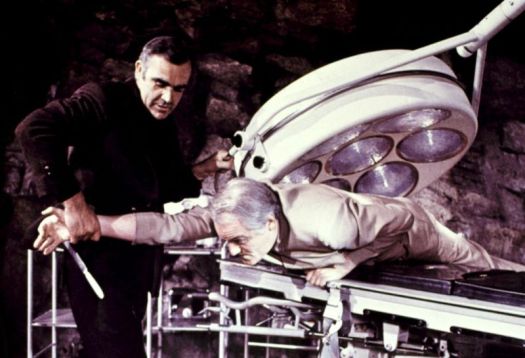
Diamonds Are Forever once again pits James Bond against his arch-nemesis, the leader of SPECTRE and feline connoisseur, Ernst Blofeld. This time around the role of Blofeld was played by the actor Charles Gray and the film does a good job in explaining why the character has been played by so many different actors in each entry he appeared in. It is in this early sequence in the film that we begin to see that this latest James Bond entry had jumped the shark when it came to trying to keep things even remotely believable. It’s the film’s biggest flaw an, at the same time, what made it such an interesting, fun ride.

Even the plot of the film owes more to the spoofs of the Blofeld character by way of the Austin Powers films as Bond must try to stop SPECTRE from using smuggled South African diamonds from being used to create  weaponized satellite with a massive “laser” that SPECTRE will use to destroy the nuclear arsenal of every superpower then auction off the rights to be the only nuclear power to the highest bidding country. It’s pretty much the the basic foundation of what would be the plot for the first Austin Powers, but with this film filmmaker Guy Hamilton still tried to treat the script as something that was of the serious Bond when it was more 60’s camp through and through.

Diamonds Are Forever may be the weakest of all the Connery Bond films, but it’s groovy sensibilities that celebrated the 60’s (despite the film having been made in 1971) psychedelic, swinging lifestyle poked fun at Bond’s predilection as a suave and charismatic womanizer that wouldn’t have looked out of place in a 60’s love-in. Even the action sequences was something that looked more humorous than thrilling whether it was Bond escaping SPECTRE henchmen on a moon buggy to the inept duo assassins Mr. Wint and Mr. Kidd looked more at home in an action comedy than a series that was known for serious action.

I would be remiss to not mention that this was the only time the Bond series had a redhead as a Bond Girl in the vivacious form of Jill St. John as Tiffany Case. I would also like to think that the other Bond Girl in the film, played by Lana Wood (Natalie Wood’s younger sister), was also a redhead but I’m not entirely sure since most audiences probably didn’t pay too close attention to Plenty O’Toole’s hair color. Either way this would be the only Bond film that would cast what fellow writer Lisa Marie calls the 2%.

Diamonds Are Forever might not have been the sort of return Sean Connery envisioned for himself when he agreed to return as James Bond after taking a film off, but then again this wouldn’t be the first time he would retire from the role only to come back again. Yet, despite all it’s flaws (there were many of them) the film does entertain though probably not in the way it’s filmmakers hoped it would. I do believe that it was this film that finally brought in Roger Moore as the next Bond, but also convinced the film’s producers to tailor the Bond films using some of the humorous aspect of Diamonds Are Forever but tempered to accompany the action in the story.

James Bond will soon return in Live And Let Die….