Rest in Peace, Robert Carradine. The veteran character actor and son of John Carradine (as well as brother of Keith and half-brother of David) has passed away at the age of 71.
Most of the articles about his death describe him as being “Lizzie Maguire star Robert Carradine.” Robert Carradine, however, had a long career and it started long before Lizzie Maguire. Eternally youthful, he was still playing teenagers when he was in his 30s. (Let’s just say that he was a bit old to be a college freshman in Revenge of the Nerds.) Robert appeared in his share of 70s exploitation films but he also appeared in films directed by Hal Ashby, Walter Hill, and Martin Scorsese.
In fact, one of Carradine’s first roles was in Scorseses’s 1973 masterpiece, Mean Streets. Here he is, sharing an unforgettable scene with his brother David.
Revenge of the Nerds captures the wild, unfiltered spirit of 1980s college comedies, blending underdog triumph with over-the-top raunchiness that feels both nostalgic and awkwardly dated today. Released in 1984, this Jeff Melman-directed flick stars Robert Carradine and Anthony Edwards as Lewis and Gilbert, two freshmen nerds who face relentless bullying from the jock-dominated Alpha Beta fraternity at Adams College. What starts as a straightforward tale of misfits fighting back evolves into a chaotic mix of pranks, parties, and questionable morals, making it a polarizing watch that still packs a punch for fans of the era’s humor.
The story kicks off with Lewis and Gilbert arriving full of optimism, only to have their dreams torched—literally—when the Alpha Betas accidentally burn down their dorm during a hazing gone wrong. Relocated to a rundown gym with other campus outcasts, the nerds band together under the banner of Tri-Lam, turning their rejection into fuel for clever retaliation. From panty raids to talent show showdowns, the film barrels through a series of escalating antics, peaking at the Greek Games where brains battle brawn in absurd competitions like tricycle races and tug-of-war twists. It’s pure 80s escapism, with a runtime under 100 minutes that keeps the energy high and the laughs coming in rapid-fire succession, even if not every gag is a home run.
The nerd ensemble steals the show, each character a walking stereotype brought to vivid life. Carradine’s Lewis is the slick-talking instigator with a knack for schemes, while Edwards’ Gilbert provides the earnest heart, delivering a pivotal speech about acceptance that gives the movie unexpected emotional depth. Curtis Armstrong as Booger delivers unforgettable gross-out moments, from belching symphonies to shameless flirtations, and Larry B. Scott’s Lamar brings flamboyant athletic flair that subverts expectations. The jocks, led by Ted McGinley’s smug Stan, serve as perfect foils—arrogant, muscle-bound villains who embody the era’s macho excess. Supporting turns, like Julia Montgomery’s Betty navigating boyfriend drama, John Goodman’s boorish Coach Harris, or Bernie Casey’s wise U.N. Jefferson, add layers to the campus power struggle.
Humor-wise, Revenge of the Nerds leans hard into juvenile territory: fart jokes, streaking, and wild panty raid sequences filmed with hidden cameras that push boundaries even for the time. The film’s climax involves Lewis impersonating Stan to woo Betty, a plot point that plays as triumphant revenge but lands as deeply problematic through today’s lens, highlighting consent issues amid the cheers. Similarly, the sorority spying and casual objectification reflect 80s attitudes toward women and minorities that feel crass now, contributing to its mixed modern reception. Yet, these elements are balanced by genuine camaraderie among the nerds, fostering a sense of belonging that resonates as a counter to real-world bullying.
Technically, the movie holds up as a product of its time. The soundtrack, featuring the iconic title track by The Rubinoos and funky cues during party scenes, amps up the fun, while practical effects like the nerds’ gadget-filled house add quirky charm. Cinematography emphasizes the divide between polished frat row and the nerds’ scrappy turf, with wide shots of campus chaos underscoring the rebellion. Written by Tim Metcalfe, Steve Zacharias, and Jeff Buhai, the script zings with quotable lines—”We are the sons of the sons of bitches”—and smartly flips the slobs-vs-snobs formula by rooting for the geeks.
Culturally, Revenge of the Nerds helped define the “nerd pride” archetype, paving the way for films like PCU and influencing pop culture’s embrace of geek culture from The Big Bang Theory to Marvel dominance. It spawned three sequels, a musical adaptation, and endless references, cementing its place as a time capsule of Reagan-era college life—rowdy, rebellious, and unapologetically politically incorrect. For balance, its strengths lie in infectious energy, memorable characters, and a pro-outsider message, but weaknesses include uneven pacing in setup scenes and humor that too often punches down rather than up.
The film continues the trend of 80s raunchy teen comedies first popularized by Bob Clark’s Porky’s, ramping up the gross-out gags and frat-house antics while shifting the focus to nerd empowerment over sexual hijinks. The nerds’ talent show finale, uniting misfits in a joyous medley, delivers pure catharsis, proving brains and heart can topple bullies. It’s not flawless—some jokes bomb, and the ending rushes a bit—but its scrappy spirit endures for those who grew up quoting Booger’s lines or cheering Tri-Lam’s win. Fans of Animal House or Old School will find familiar thrills, while modern audiences might prefer the cleaner satire of The Good Place. Ultimately, Revenge of the Nerds earns a solid recommendation with caveats: a rowdy good time if you roll with the 80s vibe, but skip if consent gags are deal-breakers.
1992’s The Player tells the story of Griffin Mill (Tim Robbins).
It’s not easy being Griffin Mill. From the outside, of course, it looks like he has the perfect life. He’s a studio executive with a nice house in Hollywood. He’s young. He’s up-and-coming. Some people, especially Griffin, suspect that he’ll be the president of the studio some day. By day, he sits in his office and listens to pitches from respected screenwriters like Buck Henry. (Henry has a great idea for The Graduate II!) During the afternoon, he might attends dailies and watch endless takes of actors like Scott Glenn and Lily Tomlin arguing with each other. Or he might go to lunch and take a minute to say hello to Burt Reynolds. (“Asshole,” Burt says as Griffin walks away.) At night, he might go to a nice party in a big mansion and mingle with actors who are both young and old. He might even run into and share some sharp words with Malcolm McDowell.
But Griffin’s life isn’t as easy as it seems. He’s constantly worried about his position in the studio, knowing that one box office failure could end his career. He fears that a new executive named Larry Levy (Peter Gallagher) is after his job. Two new screenwriters (Richard E. Grant and Dean Stockwell) keep bugging him to produce their downbeat, no-stars anti-capitol punishment film. His girlfriend (Cynthia Stevenson) wants to make good movies that mean something. Even worse, someone is sending Griffin threatening notes.
It doesn’t take long for Griffin to decide that the notes are coming from a screenwriter named Dave Kahane (Vincent D’Onofrio). Griffin’s attempt to arrange a meeting with Dave at a bar so that Griffin can offer him a production deal instead leads to Griffin murdering Dave in a parking lot. While the other writers in Hollywood mourn Dave’s death, Griffin starts a relationship with Dave’s artist girlfriend (Great Scacchi) and tried to hide his guilt from two investigating detectives (Whoopi Goldberg and Lyle Lovett). Worst of all, the notes keep coming. The writer, whomever they may be, is now not only threatening Griffin but also seems to know what Griffin did.
After spend more than a decade in the industry wilderness, Robert Altman made a critical and commercial comeback with The Player. It’s a satire of Hollywood but it’s also a celebration of the film industry, featuring 60 celebrities cameoing as themselves. Everyone, it seems, wanted to appear in a movie that portrayed studio execs as being sociopathic and screenwriters as being whiny and kind of annoying. The Player both loves and ridicules Hollywood and the often anonymous men who run the industry. Largely motivated by greed and self-preservation, Griffin may not love movies but he certainly loves controlling what the public sees. In the end, only one character in The Player sticks to her values and her ideals and, by the end of the movie, she’s out of a job. At the same time, Griffin has a social life that those in the audience can’t help but envy. He can’t step out of his office without running into someone famous.
The Player is one Altman’s most entertaining films, with the camera continually tracking from one location to another and giving as a vision of Hollywood that feels very much alive. Tim Robbins gives one of his best performances as Griffin Mill and Altman surrounds him with a great supporting cast. I especially liked Fred Ward as the studio’s head of security. With The Player, Altman mixes melodrama with a sharp and sometimes bizarre comedy, with dialogue so snappy that the film is as much a joy to listen to as to watch. That said, the real attraction of the film is spotting all of the celebrity cameos. (That and cheering when Bruce Willis saves Julia Roberts from certain death.) Altman was a director who often used his films to explore eccentric communities. With The Player, he opened up his own home.
Though the Academy of Motion Picture Arts and Sciences claim that the Oscars honor the best of the year, we all know that there are always worthy films and performances that end up getting overlooked. Sometimes, it’s because the competition too fierce. Sometimes, it’s because the film itself was too controversial. Often, it’s just a case of a film’s quality not being fully recognized until years after its initial released. This series of reviews takes a look at the films and performances that should have been nominated but were, for whatever reason, overlooked. These are the Unnominated.
“Honorable men go with honorable men.” — Giovanni Cappa
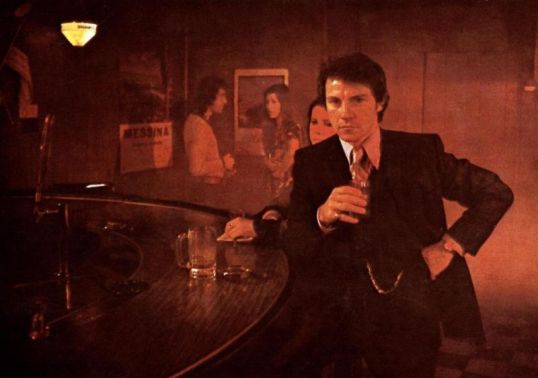
1973’s Mean Streets is a story about Little Italy. The neighborhood may only be a small part of the sprawling metropolis of New York but, as portrayed in this film, it’s a unique society of its very own, with its own laws and traditions. It’s a place where the old ways uneasily mix with the new world. The neighborhood is governed by old-fashioned mafiosos like Giovanni Cappa (Cesare Danova), who provide “protection” in return for payment. The streets are full of men who are all looking to prove themselves, often in the most pointlessly violent way possible. When a drunk (David Carradine) is shot in the back by a teenage assassin (Robert Carradine), no one bothers to call the police or even questions why the shooting happened. Instead, they discuss how impressed they were with the drunk’s refusal to quickly go down. When a soldier (Harry Northup) is given a party to welcome him home from Vietnam, no one is particularly shocked when the solider turns violent. Violence is a part of everyday life.
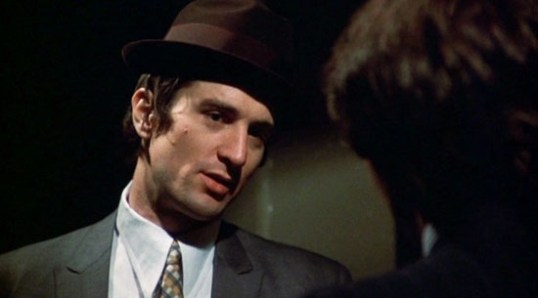
Charlie Cappa (Harvey Keitel) is Giovanni’s nephew, a 27 year-old man who still lives at home with his mother and who still feels guilty for having “impure” thoughts. Charlie prays in church and then goes to work as a collector for Giovanni. Giovanni is grooming Charlie to take over a restaurant, not because Charlie is particularly talented at business but just because Charlie is family. Giovanni warns Charlie not to get involved with Teresa (Amy Robinson) because Teresa has epilepsy and is viewed as being cursed. And Giovanni particularly warns Charlie not to hang out with Teresa’s cousin, Johnny Boy (Robert De Niro). Johnny Boy may be charismatic but everyone in the neighborhood knows that he’s out-of-control. His idea of a good time is to blow up mailboxes and shoot out street lamps. Charlie, who is so obsessed with sin and absolution that he regularly holds his hand over an open flame to experience the Hellfire that awaits the unrepentant sinner, finds himself falling in love with Teresa (though it’s debatable whether Charlie truly understands what love is) and trying to save Johnny Boy.
Charlie has other friends as well. Tony (David Proval) runs the bar where everyone likes to hang out and he seems to be the most stable of the characters in Mean Streets. He’s at peace with both the neighborhood and his place in it. Meanwhile, Michael (Robert Romanus) is a loan shark who no one seems to have much respect for, though they’re still willing to spend the afternoon watching a Kung Fu movie with him. Michael knows that his career is dependent on intimidation. He can’t let anyone get away with not paying back their money, even if they are a friend. Johnny Boy owes Michael a lot of money and he hasn’t paid back a single dollar. Johnny Boy always has an excuse for why he can’t pay back Michael but it’s obvious that he just doesn’t want to. Charlie realizes that it’s not safe for Johnny Boy in Little Italy but where else can he go? Brooklyn?
Mean Streets follows Charlie and his friends as they go about their daily lives, laughing, arguing, and often fighting. All of the characters in Mean Streets enjoy a good brawl, despite the fact that none of them are as tough as their heroes. A chaotic fight in a pool hall starts after someone takes offense to the word “mook,” despite the fact that no one can precisely define what a mook is. The fights goes on for several minutes before the police show up to end it and accept a bribe. After the cops leave, the fight starts up again. What’s interesting is that the people fighting don’t really seem to be that angry with each other. Fighting is simply a part of everyday life. Everyone is aggressive. To not fight is to be seen as being weak and no one is willing to risk that.
Mean Streets was Martin Scorsese’s third film (fourth, if you count the scenes he shot before being fired from The Honeymoon Killers) but it’s the first of his movies to feel like a real Scorsese film. Scorsese’s first film, Who’s That Knocking On My Door?, has its moments and feels like a dry run for Mean Streets but it’s still obviously an expanded student film. Boxcar Bertha was a film that Scorsese made for Roger Corman and it’s a film that could have just as easily been directed by Jonathan Demme or any of the other young directors who got their start with Corman. But Mean Streets is clearly a Scorsese film, both thematically and cinematically. Scorsese’s camera moves from scene to scene with an urgent confidence and the scene where Charlie first enters Tony’s bar immediately brings to mind the classic tracking shots from Goodfellas, Taxi Driver, and Casino. One gets the feeling that Pete The Killer is lurking somewhere in the background. The scenes between Keitel and De Niro are riveting. Charlie attempts to keep his friend from further antagonizing Michael while Johnny Boy tells stories that are so long and complicated that he himself can’t keep up with all the details. Charlie hold everything back while Johnny Boy always seems to be on the verge of exploding. De Niro’s performance as Johnny Boy is one that has been duplicated but never quite matched by countless actors since then. He’s the original self-destructive fool, funny, charismatic, and ultimately terrifying with his self-destructive energy.
Mean Streets was Scorsese’s first box office success and it was also the film that first brought him widespread critical acclaim. However, in a year when the totally forgotten A Touch of Class was nominated for Best Picture, Mean Streets did not receive a single Oscar nomination, not even for De Niro’s performance. Fortunately, by the time Mean Streets was released, De Niro had already started work on another film about the Mafia and Little Italy, The Godfather Part II.
Though the Academy of Motion Picture Arts and Sciences claim that the Oscars honor the best of the year, we all know that there are always worthy films and performances that end up getting overlooked. Sometimes, it’s because the competition too fierce. Sometimes, it’s because the film itself was too controversial. Often, it’s just a case of a film’s quality not being fully recognized until years after its initial released. This series of reviews takes a look at the films and performances that should have been nominated but were, for whatever reason, overlooked. These are the Unnominated.
First released in 1980, The Long Riders is one of the many films to tell the story of the James/Younger Gang.
A group of former Confederate guerillas who became some of the most notorious bank robbers to roam post-Civil War America and who were based in Missouri, the brothers who made up the James/Younger Gang were hunted by the Pinkertons and beloved by the citizens who viewed them as being 19th Century Robin Hoods. Following a disastrous attempt to rob a bank in Northfield, Minnesota, the Younger brothers were captured by the government while Jesse and Frank James made it back to Missouri. Jesse was shot in the back by Bob Ford while Frank subsequently surrendered to authorities and made a good living on the lecture circuit.
The Long Riders tells the story of the gang, from their first encounter with the heavy-handed Pinkertons to the Northfield raid to Frank’s eventual surrender. Director Walter Hill both celebrates the legend of the James/Younger Gang while also emphasizing that all the members of the gang were also individual humans who had their strengths and their flaws. Hill emphasizes the idea of the gang being a group of post-war rebels, still fighting a war against a government that is more interested in protecting banks than looking after people. The Long Riders deconstructs the legend while also celebrating it.
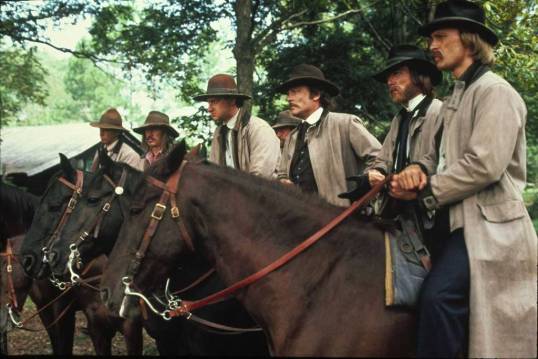
The main thing that sets The Long Riders apart from other films about the James/Younger Gang is the fact that the brothers are played by actual brothers. David, Keith, and Robert Carradine plays the Youngers. Randy Quaid plays Clell Miller while Dennis Quaid assumes the role of the cowardly Ed Miller. Nicholas and Christopher Guest make a memorably creepy impression as Charley and Bob Ford. And finally, Jesse and Frank James are played by James and Stacy Keach. (The Keaches also worked on the film’s script). And while Stacy is definitely the more charismatic of the Keach brothers, the film makes good use of James’s rather stoic screen presence. While the rest of the gang enjoys the outlaw life, James Keach’s Jesse is rigid, serious, and ultimately too stubborn and obsessive for his own good.
Now, the casting might sound like a gimmick but it works wonderfully. When Clell chooses the gang over Ed, it carries an emotional weight because we’re watching real brothers reject each other. The comradery between the Carradines carries over to the comradery between the Youngers and it also informs their occasional rivalry with the better known James brothers. While it is Stacy Keach and David Carradine who ultimately dominate the film, every brother in the cast makes a strong impression. Also giving a memorable performance is Pamela Reed as a defiantly independent Belle Starr, who loves David Carradine’s Cole Younger but marries Sam Starr (James Remar). The knife fight between Carradine and Remar is one of the film’s highlights, as is the violent and disastrous attempt to rob the bank in Northfield.
The Long Riders is an exciting and ultimately poignant western but sadly, it received not a single Oscar nomination, not even for the stunning cinematography or Ry Cooder’s elegiac score. Fortunately, just like the legend of the James/Younger Gang, The Long Riders lives on.
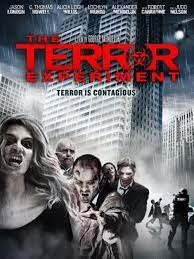
At the Houston Federal Building, a disgruntled domestic terrorists sets off a bomb that not only rocks the building but also unleashes a government-designed nerve gas that turns anyone exposed to it into an animalistic, rage-fueled zombie who attacks everyone that they see. Soon, the building is full of former friends and co-workers who are now obsessed with ripping each other to shreds. The few people who were not exposed to the nerve gas are hiding on the top floor. Under the reluctant leadership of Cale (Jason London), they try to figure out how to escape from the building.
Meanwhile, on the outside, Police Chief Grosso (C. Thomas Howell) and Fire Chief Lohan (Lochlyn Munro) attempt to rescue as many people as they can before the building is blown up. The scientist on the scene (Robert Carradine) sees all of this as a research opportunity while a sinister government agent (Judd Nelson) conspires to keep word about what has happened from reaching the public.
With its images of suit-and-tie wearing madmen trying to kill everyone in the building, The Terror Experiment may seem like it would have much in common with The Belko Experiment (which came out a few years after Terror Experiment) but actually, The Terror Experiment is mash-up of Die Hard and 28 Days Later, with Jason London and Lochlyn Munro filling in for Bruce Willis and Reginald Veljohnson. With its frequent scenes of formerly normal people suddenly going mad and turning into homicidal maniacs, The Terror Experiment has its effective moments and Jason London does the best that anyone probably could with the role of the film’s reluctant hero. But the film also suffers because you never really get to know who any of these people were before they were trapped in the building and there aren’t really any emotional stakes to whether or not they’ll manage to get out. As well, the scenes outside the building often fill like filler that was included so that some “name” actors could be recruited to appear in the film. Howell, Carradine, and Nelson are all fine in their roles but the only thing they add to the movie is an opportunity to recreate the one of the most crowd-pleasing moments from the finale of Die Hard.
The Terror Experiment is occasionally diverting but it’s hard not to feel that it never really reaches its potential.
On tonight’s episode of The Hitchhiker, Robert Carradine plays a corrupt diplomat in France whose life falls apart when all of his dark secrets are revealed. This is another Hitchhiker episode in which The Hitchhiker takes an obvious glee in revealing the hypocrisy of someone who holds himself up as being moral and perfect. Keep an eye out for Lucio Fulci’s favorite actress, Catriona MacColl, in the role of Carradine’s long-suffering wife!
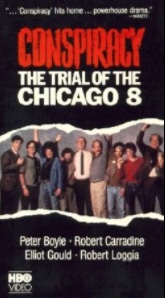
The year is 1969 and, in an Illinois courtroom, 8 political radicals stand accused of conspiring to disrupt the 1968 Democratic Convention. The prosecution is putting the entire anti-war movement on trial while the defendants are determined to disrupt the system, even if it means being convicted. The eight defendants come from all different sides of the anti-war movement. Jerry Rubin (Barry Miller) and Abbie Hoffman (Michael Lembeck) represent the intentionally absurd Yippies. Tom Hayden (Brian Benben) and Rennie Davis (Robert Carradine) are associated with the Students for a Democratic Society. Bobby Seale (Carl Lumbly) is one of the founders of the Black Panthers while David Dellinger (Peter Boyle) is a longtime peace activist. John Friones (David Kagan) and Lee Weiner (Robert Fieldsteel) represent the common activists, the people who traveled to Chicago to protest despite not being a leader of any of the various organizations. Prosecuting the Chicago 8 are Richard Schulz (David Clennon) and Tom Foran (Harris Yulin). Defending the 8 are two radical lawyers, Leonard Wienglass (Elliott Gould) and William Kunstler (Robert Loggia). Presiding over the trial is the fearsome and clearly biased Judge Julius Hoffman (David Opatoshu).
Conspiracy: The Trial of the Chicago 8 is a dramatization of the same story that inspired Aaron Sorkin’s The Trial of the Chicago 7 but, of the two films, it’s Jeremy Kagan’s The Trial of the Chicago 8 that provides a more valuable history lesson. By setting all of the action in the courtroom and recreating only what was said during the trial, director Jeremy Kagan and his cast avoid the contrived drama that marred so much of Sorkin’s film. Kagan trusts that the true story is interesting enough to stand on its own. Kagan includes documentary footage from the convention protest itself and also interviews with the people who were actually there. While Kagan may not have had the budget that Sorkin did, his film has the authenticity that Sorkin’s lacked. Kagan also has the better cast, with Michael Lembeck and Barry Miller both making Abbie Hoffman and Jerry Rubin into something more than the mere caricatures that they are often portrayed as being.
The Trial of the Chicago 8 was a film that Jeremy Kagan spent a decade trying to make. When he first tried to sell the idea behind the film to CBS in 1976, Kagan had Marlon Brando, Walter Matthau, George C. Scott, and Dustin Hoffman all willing to work for scale and take part in the production. CBS still passed on the project, saying that no one was interested in reliving the 60s. It wasn’t until 1987 that Jeremy Kagan was finally able to revive the film, this time with HBO. It actually worked out for the best because, with HBO, there was no need to try to come up with a “clean” version for the language that was used in the courtroom or in the interviews with the actual participants. The defendants could be themselves.
Though it has been overshadowed by Sorkin’s subsequent film, The Trial of the Chicago 8 is the definitive film about what happened in the aftermath of the the 1968 Democratic Convention.
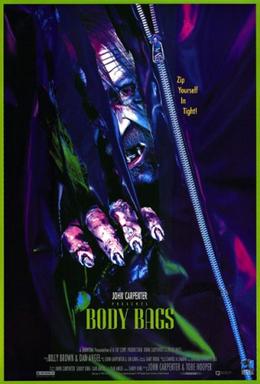
An odd but mildly likable film, that’s the best description of Body Bags.
Originally, Body Bags wasn’t even meant to be a film. Instead, in 1993, Showtime wanted to do a horror anthology show, one that would mix comedy and chills in the style of HBO’s Tales From The Crypt. Three episodes were filmed. Two were directed by John Carpenter. The other was directed by Tobe Hooper. Robert Carradine, Stacy Keach, and Mark Hamill all agreed to appear on the show. That’s an impressive collection of talent but, for whatever reason, Showtime decided not to pursue Body Bags as a series. So the three episodes were strung together in an anthology film. Linking the stories was a warp-around segment where Carpenter played a coroner and Tobe Hooper and Tom Arnold played morgue attendants!
Now, it must be said that John Carpenter probably made the right decision when he decided to become a director instead of an actor. That said, what Carpenter lacked in acting technique, he made up for with unbridled enthusiasm. Carpenter appears to be having a blast playing an old style horror host. Who can blame him? In fact, I would say one the most appealing things about John Carpenter as a personality is that he always seems to be truly enjoying himself, regardless of all the crap that he’s had to put up with in Hollywood.
As for the segments …. well, they’re uneven. That’s not really a shock. Part of the problem is that, because they weren’t originally envisioned as all airing together, a lot of ideas and story points are repeated from segment to segment. The first segment is about a serial killer. The second segment is about a transplant. The third segment is about both a transplant and a serial killer. It gets a bit repetitive.
Carpenter directed the first two segments, The Gas Station and Hair. The Gas Station is a bit too simple for its own good. Robert Carradine is a serial killer who harasses a woman at a gas station. That’s pretty much it. Carradine gives a good performance ad Halloween fans will get a laugh out of a reference to Haddonfield but there’s not much else going on. Hair is a bit better. Stacy Keach plays a businessman who gets a hair transplant, just to discover that the hair is extraterrestrial in origin. Hair is clever and playful, like an above average episode of The Twilight Zone. Keach plays his role with the right mix of comedic outrage and genuine horror.
The third segment is called Eyes and it was directed by Tobe Hooper. Mark Hamill plays a baseball player who is losing his eyesight as the result of a car accident. He gets an eye transplant. At first, everything seems fine but soon, he’s having visions of himself murdering people! It turns out that the eye once belonged to a serial killer. You can guess where this is going but Mark Hamill really throws himself into the role and Tobe Hooper’s direction is appropriately intense.
Body Bags is a pretty minor entry in the filmographies of two great directors but, at the same time, it’s enjoyable in its own silly way. There’s a likable goofiness to John Carpenter’s wrap-around segment and it lets us know that we shouldn’t take any of this too seriously. Watch it for your own amusement.
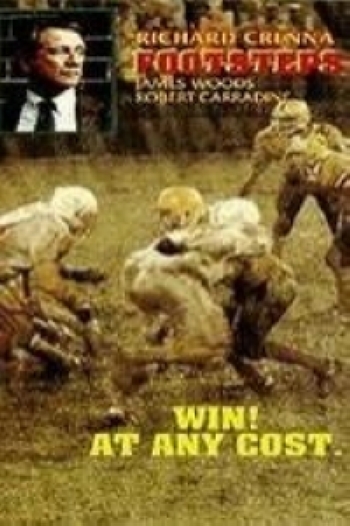
Paddy O’Connor (Richard Crenna) is a former football player-turned-coach whose record of success has been overshadowed by his own arrogance and heavy drinking. O’Connor has such a bad personal reputation that he’s found himself unemployable. Only one man is willing to give him a chance. Jonas Kane (Clu Gulager) played football with Paddy and he’s now coaches for a small college. Kane may not like O’Connor but he knows that O’Connor might be the key to turning around his team’s fortunes and, at the same time, saving Kane’s job. Kane hires O’Connor to serve as a his defensive coordinator.
At first, O’Connor’s cockiness rubs people the wrong way. It’s not until O’Connor moves offensive player J.J. Blake (Bill Overton) to defense that the team starts to win. And once the team stars to win, everyone’s problems with O’Connor disappear. Kane can only watch helplessly as O’Connor moves in on his girlfriend (Joanna Pettet), knowing that he owes his job to O’Connor remaining at the school.
However, when Blake gets a concussion, O’Connor is forced to decide whether or not to let him play. Boosters like Bradford Emmons (Forrest Tucker) want Blake to play, regardless the risk. The NFL scouts, who are looking for the next number one pick, want to see Blake on the field. Blake says he wants to play but O’Connor can tell that he’s lying about the extent of his injury. With everyone breathing down his neck and a syndicate of gamblers pressuring O’Connor to shave points so that the spread pays off, O’Connor has to decide what to do.
Though this made-for-TV movie may not be as well-known as some other films, it’s one of the best movies ever made about college football. Though it may be short (only 74 minutes), it still examines all of the issues that have always surrounded college football. Despite not getting paid for their efforts, the players risk serious and permanent injury during every game, just on the slight hope that they might someday make it to the NFL. The coaches, who are supposed to be looking after the players, are more interested in padding out their win-loss record and hopefully moving onto bigger and better-paying jobs. Meanwhile, aging alumni and boosters demand that the team win at all costs, regardless of what happens to the men on the field. Footsteps intelligently explores all of those issues and suggests that the risks are ultimately not worth the rewards.
Along with an intelligent script, Footsteps is helped by a talented cast. Crenna and especially Gulager both give excellent performance as the two rival coaches. Al Lettieri (Sollozzo from The Godfather) plays one of the gamblers. Beah Richards plays Blake’s mother, who makes the mistake of believing O’Connor when he says that he’s going to always have Blake’s best interests at heart. Ned Beatty has a small role as another assistant coach who is forced to make an important decision of his own. Keep an eye out for Robert Carradine and James Woods, both of whom have tiny roles.
As far as I know, Footsteps has never officially been released on DVD. I saw it late one night on the Fox Movie Channel.


 Through the Shattered Lens