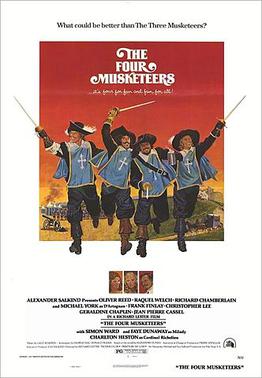
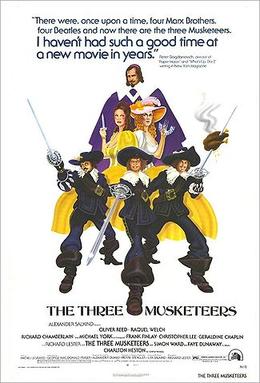
The Three Musketeers (1973, directed by Richard Lester) and The Four Musketeers (1974, directed by Richard Lester)


In 1973, director Richard Lester and producer Ilya Salkind decided to try to get two for the price of one.

Working with a script written by novelist George McDonald Fraser, Lester and Salkind had assembled a once-in-a-lifetime cast to star in an epic film adaptation of Alexandre Dumas’s The Three Musketeers.  Michael York was cast as d’Artagnan, the youthful swordman who goes from being a country bumpkin to becoming a King’s Musketeer.  His fellow musketeers were played by Oliver Reed, Richard Chamberlain, and Frank Finlay.  Faye Dunaway and Christopher Lee were cast as the villains, Milady and Rochefort.  Charlton Heston played the oily Cardinal Richelieu.  Geraldine Chaplin played Queen Anne while Simon Ward played the Duke of Buckingham.  Comedic relief was supplied by Roy Kinnear as d’Artagnan’s manservant and Raquel Welch as Constance, d’Artagnan’s klutzy love interest.  The film was a expensive, lushly designed epic that mixed Lester’s love of physical comedy with the international intrigue and the adventure of Dumas’s source material.

The only problem is that the completed film was too long.  At least, that’s what Salkind and Lester claimed when they announced that they would be splitting their epic into two films.  The cast and the crew, who had only been paid for one film, were outraged and the subsequent lawsuits led to the SAG ruling that all future actors’ contracts would include what was known as the Salkind clause, which stipulates that a a single production cannot be split into two or more films without prior contractual agreement.

But what about the films themselves?  Both The Three Musketeers and The Four Musketeers are currently available on Tubi.  I watched them over the weekend and, of the many films that have been made out of Dumas’s Musketeer stories, Richard Lester’s films are the best.  Lester captures the swashbuckling spirit of the books while also turning them into two films that are easily identifiable as Lester’s work.  There’s a lot physical humor to be found in Lester’s adaptation, especially during the first installment.  d’Artagnan runs through the streets of Paris, convinced that he has been insulted by the haughty Rochefort.  d’Artagnan manages to get challenged to three separate duels, all to take place on the same day.  After his first swordfight as a member of the Musketeers, d’Artagnan tries to tell the men that he wounded about an ointment that will help them with their pain.  Raquel Welch also shows a genuine flair for comedy as Constance, which makes her fate in the second film all the more tragic.

For all the controversy that it caused, splitting the story into two films was actually the right decision.  If The Three Musketeers is an enjoyable adventure film, The Four Musketeers is far more serious.  In The Four Musketeers, Oliver Reed’s melancholic Athos steps into the spotlight and his story of his previous marriage to the villainous Milady casts his character in an entirely new light.  In The Four Musketeers, the combat is much more brutal and the humor considerably darker.  Likable characters die.  The Musketeers themselves commit an act of extrajudicial brutality that, while true to Dumas’s novel, would probably be altered if the film were made today.  From being a naive bumpkin in The Three Musketeers, The Four Musketeers finds d’Artgnan transformed into a battle weary soldier.

The cast is fabulous.  This is a case of the all-star label living up to the hype.  Oliver Reed, Frank Finlay, and Richard Chamberlain all seems as if they’ve been riding and fighting together for decades.  Christopher Lee plays Rochefort as being an almost honorable villain while Faye Dunaway is a cunning and sexy Milady.  What truly makes the film work, though, is the direction of Richard Lester.  Lester stay true to the spirit of Dumas while also using the material to comment on the modern world, with the constant threat of war and civil uprising mirroring the era in which the films were made.  Interestingly enough, Richard Lester first became interested in the material when Ilya Salkind reached out to the Beatles to try to convince them to play the Musketeers.  While the Beatles were ultimately more interested in a never-produced adaptation of The Lord of the Rings, Richard Lester was happy to bring Dumas’s characters to life.

Both The Three Musketeers and The Four Musketeers are currently on Tubi, for anyone looking for a truly great adventure epic.

Richard Chamberlain – Allen Quartermain, Toshiro Mifune & Charles Bronson!


When I was a kid, I loved the movie KING SOLOMON’S MINES (1985) with Richard Chamberlain and Sharon Stone, along with its follow up ALLAN QUARTERMAIN AND THE LOST CITY OF GOLD (1986). These movies don’t really hold up very well these days, but that does not change the fact that they still hold a special place in my heart. That was during my “Indiana Jones” phase and I wanted to watch any movie with adventurers in jungles. ROMANCING THE STONE (1984) is one of those types of movies that really does hold up; THE FURTHER ADVENTURES OF TENNESSEE BUCK (1988), not so much. While we were watching King Solomon’s Mines, I remember my parents telling us kids that Chamberlain was in a miniseries called THE THORNBIRDS, but I’ve never watched it. It intrigued me though. TV miniseries were a big thing in the 70’s and early 80’s and Chamberlain was a king of the TV miniseries age. I discovered that even further when I became obsessed with Toshiro Mifune. I discovered his great miniseries SHOGUN (1980) that also starred Chamberlain. 

As an obsessed Charles Bronson fan, I also discovered that they starred together in an episode of the TV series DR. KILDARE (pictured above). He also worked with Bronson in the film A THUNDER OF DRUMS (1961). Richard Chamberlain may not be one of my all time favorite actors, but he was a part of my life growing up and he worked with my favorite actor of all time a couple of different times. That feeling of nostalgia causes me to mourn his loss. It’s like a part of me is now gone. RIP, Richard Chamberlain. Thanks for sharing your talent with us. 

10 Oscar Snubs From The 1960s


Ah, the 60s. Both the studio system and the production code collapsed as Hollywood struggled to remain relevant during a time of great social upheaval. The Academy alternated between nominating films that took chances and nominating films that cost a lot of money. It led to some odd best picture lineups and some notable snubs!

1960: Psycho Is Not Nominated For Best Picture and Anthony Perkins Is Not Nominated For Best Actor

To be honest, considering that the Academy has never really embraced horror as a genre and spent most of the 60s nominating big budget prestige pictures, it’s a bit surprising that Psycho was actually nominated for four Oscars.  Along with being nominated for its production design and its cinematography, Psycho also won nominations for Alfred Hitchcock and Janet Leigh.  However, Anthony Perkins was not nominated for Best Actor, despite giving one of the most memorable performances of all time.  The film literally would not work without Perkins’s performance and, considering that Perkins pretty much spent the rest of his career in the shadow of Norman Bates, it’s a shame that he didn’t at least get a nomination for his trouble.  Psycho was also not nominated for Best Picture, despite being better remembered and certainly more influential than most of the films that were.

1962: The Man Who Shot Liberty Valance Is Almost Totally Snubbed

The Man Who Shot Liberty Valance was not totally snubbed by the Academy.  It received a nomination for Best Costume Design.  But still, it deserved so much more!  John Ford, James Stewart, John Wayne, Lee Marvin, Vera Miles, and the picture itself were all worthy of nominations.  Admittedly, 1962 was a year full of great American films and there was a lot of competition when it came to the Oscars.  Still, The Man Who Shot Liberty Valance definitely deserved a best picture nomination over the bloated remake of Mutiny on the Bounty.  Today, if the first Mutiny on the Bounty remake is known for anything, it’s for Marlon Brando being difficult on the set.  But The Man Who Shot Liberty Valance is still remembered for telling us to always print the legend.

1964: From Russia With Love Is Totally Snubbed

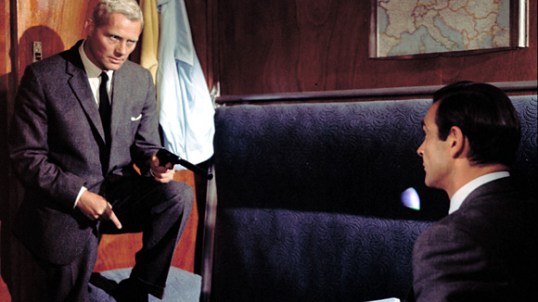
The same year that the Academy honored George Cukor’s creaky adaptation of My Fair Lady, it totally ignored my favorite James Bond film.  From Russia With Love is a Bond film that works wonderfully as both a love story and a thriller.  Sean Connery, Lotte Lenya, Robert Shaw, and Terence Young all deserved some award consideration.  From Russia With Love was released in the UK in 1963.  In a perfect world, it would have also been released concurrently in the U.S., allowing From Russia With Love to be the film that gave the the Academy the chance to recognize the British invasion.  Instead, Tom Jones was named the Best Picture of 1963 and From Russia With Love had to wait until 1964 to premiere in the U.S.  It was snubbed in favor of one of old Hollywood’s last grasps at relevance.

1964: Slim Pickens Is Not Nominated For Best Supporting Actor

Playing three separate roles, Peter Sellers dominates Dr. Strangelove: Or How I Learned To Stop Worrying And Love The Bomb.  But, as good as Sellers is, the film’s most memorable image is definitely Slim Pickens whooping it up as he rides the bomb down to Earth.  George C. Scott and Sterling Hyaden also undoubtedly deserved some award consideration but, in the end, Pickens is the one who brings the film to life even as he helps to bring society to an end.

1967: In Cold Blood Is Not Nominated For Best Picture

In Cold Blood, though not a perfect film, certainly deserved a nomination over Dr. Doolittle.  In Cold Blood is a film that still has the power to disturb and haunt viewers today.  Dr. Doolittle was a box office debacle that was nominated in an attempt to help 20th Century Fox make back some of their money.

1967: Sidney Poitier Is Not Nominated For Best Actor For In The Heat Of The Night

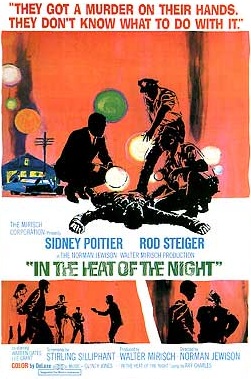
In 1967, Sidney Poitier starred in two of the films that were nominated for Best Picture but somehow, he did not pick up a nomination himself.  His restrained but fiercely intelligent performance in In The Heat Of The Night provided a powerful contrast to Rod Steiger’s more blustery turn.  That Poitier was not nominated for his performance as Virgil Tibbs truly is one of the stranger snubs in Academy history.  (If I had to guess, I’d say that the Actors Branch was split on whether to honor him for In The Heat of the Night or Guess Who’s Coming To Dinner or even for To Sir With Love and, as a result, he ended up getting nominated for none of them.)

1968: 2001: A Space Odyssey and Planet of the Apes Are Not Nominated For Best Picture

Neither one of these classic science fiction films were nominated for Best Picture, despite the fact that both of them are far superior and far more influential than Oliver!, the film that won that year.

1968: The Good, The Bad, and the Ugly Is Totally Ignored

Not even Ennio Morricone’s score received a nomination!

1968: Petulia Is Totally Snubbed

Seriously, I don’t know what was going on with the Academy in 1968 but it seems they went out of their way to ignore the best films of the year.  Richard Lester’s Petulia is usually cited as one of the definitive films of the 60s but it received not a single Oscar nomination.  Not only did the film fail to receive a nomination for Best Picture but Richard Lester, George C. Scott, Julie Christie, Shirley Knight, Richard Chamberlain, and the film’s screenwriters were snubbed as well.

1969: Easy Rider Is Not Nominated For Best Picture

Yes, I know.  Easy Rider is a flawed film and there are certain moments that are just incredibly pretentious.  That said, Easy Rider defined an era and it also presented a portrait of everything that was and is good, bad, and timeless about America.  The film may have been produced, directed, and acted in a drug-razed haze but it’s also an important historical document and it was also a film whose success permanently changed Hollywood.  Certainly, Easy Rider’s legacy is superior to that of Hello, Dolly!

Agree? Disagree? Do you have an Oscar snub that you think is even worse than the 10 listed here? Let us know in the comments!

Up next: It’s the 70s!

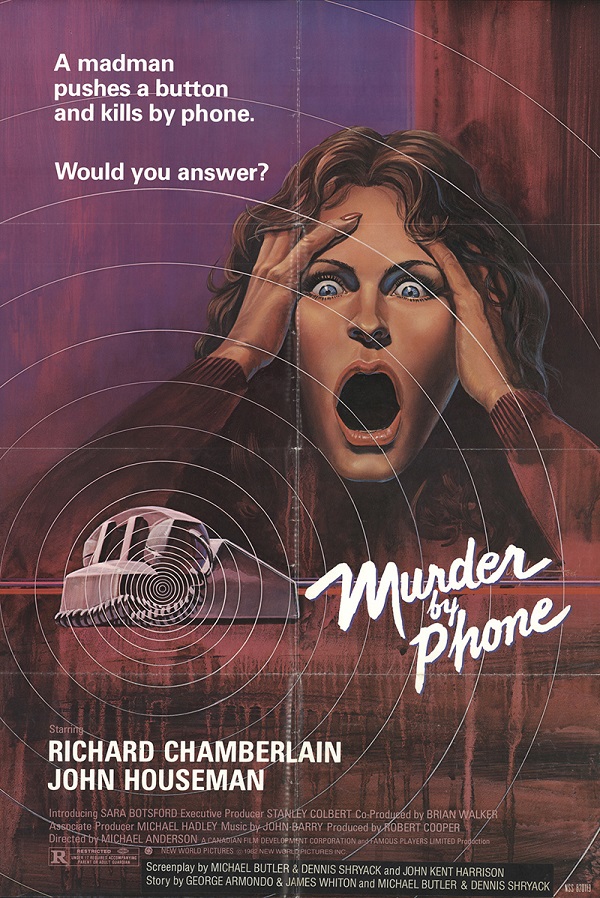
Murder by Phone (1982, directed by Michael Anderson)


Here’s a movie that will make you thankful for the death of landline phones.

People across Toronto are answering phones and blowing up.  Someone has created a device that can send a blast of electricity through the phone line.  The blast is so powerful that it causes hemorrhaging before it blows its victim off of their feet and then melts their phone.  The first victim is a woman who makes the mistake of answering a pay phone.  (It was 1982.  Pay phones were very popular with the youngsters.)  Her college professor (Richard Chamberlain!) decides to investigate her death.  Helping him, for at least a few scenes, is his mentor (John Houseman!!).

Chamberlain and Houseman were serious actors so who knows why they’re in this largely tepid thriller.  But present they are and one of them eventually makes the mistake of answering his phone and seeing a legitimate actor have to pretend to die in such a stupid way almost makes the movie worth the trouble of watching.

Despite all of the killer phone stuff, Murder by Phone is pretty slow and the murderer turns out to be pretty boring.  I only watched it because it was directed by Michael Anderson, who also directed The Martian Chronicles, which I’m planning on reviewing tomorrow.  He also directed a legitimate Best Picture winner (Around the World in 80 Days) and Logan’s Run so he had it in him to do a better job with the promising material in Murder By Phone than he did.  Instead of going all out with the science fiction elements, Anderson directed the movie like it was an episode of a cop show.  It’s disappointing because the story really had potential to be something better.  When it comes to movies about killer phone calls, the top prize still goes to Telefon.

The movie is also known as Bells, which sounds even worse than Murder By Phone.

Julius Caesar (1970, directed by Stuart Burge)


In ancient Rome, under the direction of Cassius (Richard Johnson), several members of the Senate conspire to kill Julius Caesar (John Gielgud), believing that his death is the only way to preserve the Republic.  Even Caesar’s longtime friend, Brutus (Jason Robards), is brought into the conspiracy.  Unfortunately for the conspirators, after Caesar’s murder, Mark Antony (Charlton Heston) gives his famous speech asking the Romans to lend him their ears and the Roman citizens turn against Caesar’s murderers and instead look to Antony and Octavius (Richard Chamberlain) to lead them.

This was the first adaptation of William Shakespeare’s play to be filmed in color and the assassination of Caesar was portrayed much more graphically than in previous productions.  By the end of the attack, Caesar has been stabbed so many times and there’s so much blood on screen that it doesn’t seem like he should even have the strength to say, “Et tu, Brute?”  Despite the then-modern innovations, this version still feels creaky and stiff.  When Caesar makes his appearance on the Ides of March, all of the conspirators actually stand in a neat line while Caesar enters the Senate.  When Mark Anthony and Brutus make their speeches, the extras playing the Roman citizens looked bored and disinterested.

For most viewers, the appeal of this version of Julius Caesar will be for the cast, which was considered to be all-star in 1970.  Along with Gielgud, Robards, Heston, Johnson, and Chamberlain, the cast also features Robert Vaughn as Casca, Christopher Lee as Artemidorous, Jill Bennett as Calpurnia, and Diana Rigg as Portia.  Surprisingly, it’s Jason Robards, the Broadway veteran, who struggles with Shakespeare’s dialogue, delivering his lines flatly and without much emotion.  Meanwhile, Charlton Heston steals the entire film as Mark Antony, nailing Antony’s funeral oration and proving himself to be much more clever than the conspirators had originally assumed.  (Of course, Mark Antony was the Charlton Heston of his day so I guess it shouldn’t be too much of a surprise that Heston is perfect in the role.)  I also liked Diana Rigg’s performance in the small role of Portia and Robert Vaughn’s devious interpretation of Casca.

Though he plays Caesar here, John Gielgud previously played Cassius in the 1953 version of Julius Caesar, the one with James Mason and Marlon Brando.  That is still the version to watch if you want to see the definitive adaptation of Julius Caesar.

Allan Quatermain and The Lost City Of Gold (1987, directed by Gary Nelson)


Having previously discovered and escaped King Solomon’s mines, Allan Quatermain (Richard Chamberlain) and Jesse Huston (Sharon Stone) are now living in a domestic bliss in Africa.  They’re planning on eventually returning to America so that they can get married but it turns out that Allan has one more quest that he has to complete before he can truly settle down.

When Allan receives information that his long last brother is not only still alive but has also discovered a fabled Lost City of Gold, Allan sets out to discover the city for himself.  Traveling with Jesse and an old friend named Umslopogaas (James Earl Jones!), Allan makes his way across the Sahara, survives a battle with a group of native, and manages to find both the city and his brother!

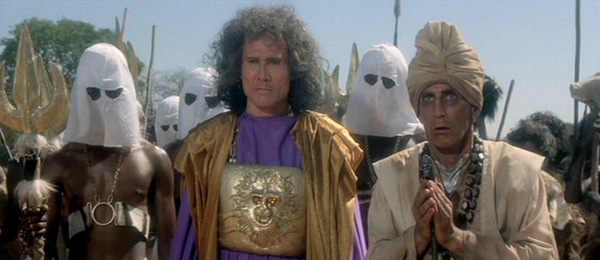
However, all is not well in the City of Gold.  Queen Nyelptha (Aileen Marson) is on the verge of going to war with Queen Sorais (Cassandra Peterson, a.k.a Elvira, Mistress of the Dark!!).  Manipulating both of the queens is the evil high priest, Agon (Henry Silva!!!!).  To save the City of Gold and his future marriage, Allan will first have to figure out a way to defeat Agon.

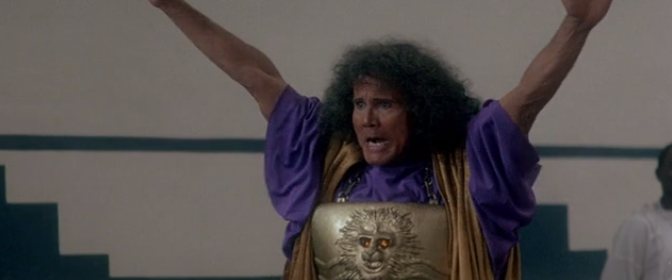
Allan Quatermain and the Lost City Of Gold was filmed back-to-back with King Solomon’s Mines.  The two films were released within a year of each other and, while King Solomon’s Mines was a minor box office success, Allan Quatermain and the Lost City of Gold was not.  I wasn’t expecting much when I watched the film but, believe it or not, Allan Quatermain and the Lost City of Gold is not that bad.  It’s a definite improvement on King Solomon’s Mines.  Richard Chamberlain is more believable as Quatermain in the sequel and he and Sharon Stone share the minimum amount of chemistry to be somewhat believable as a couple in love.  If that sounds like I’m damning with faint praise, it’s still an improvement over King Solomon’s Mines, where the two of them often seemed as if they couldn’t stand to be anywhere near each other.  Best of all, Allan Quatermain and the Lost City of Gold has Henry Silva in a ridiculous costume and that automatically makes the film worth watching.

Henry Silva, everyone.

Like King Solomon’s Mines, Allan Quatermain and The Lost City of Gold adds a large dose of intentional humor to its adventure story.  Fortunately, the comedy here is better executed than in the previous film.  There’s less mugging on Chamberlain’s part and some of the dialogue is genuinely amusing.

Of course, Allan Quatermain and The Lost City of Gold is not without its flaws.  This is a low-budget Cannon film that often tries too hard to duplicate the success of the Indiana Jones films without ever showing much understanding of what made those films successful in the first place.  Allan Quatermain and the Lost City of Gold can’t hold a candle to the classic adventure films of the past.  But, for a low-budget Cannon film starring Richard Chamberlain as a rugged, jungle explorer, it’s actually a lot of fun.

Plus, did I mention Henry Silva?

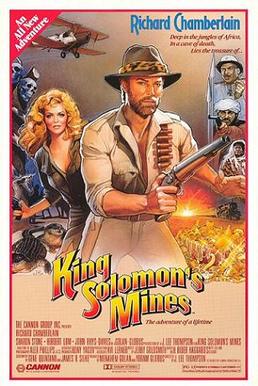
King Solomon’s Mines (1985, directed by J. Lee Thompson)


After her archaeologist father disappears while searching for the fabled mines of King Solomon, Jesse Houston (Sharon Stone) hires famed explorer Allan Quartermain (Richard Chamberlain) to help her find him.  After walking around in the jungle and exploring a nearby village, Allan and Jesse discover that her father has been kidnapped by a German military expedition who want to use King Solomon’s treasure to fund their war effort.  Working with the Germans is Allan’s old enemy, Dogati (John Rhys-Davies).  Allan and Jesse find themselves in a race against time to find the mines before the Germans.  Along the way, they steal an airplane, fight German soldiers on a train, and nearly get cooked alive in a giant cauldron.

Because this is a Cannon film and it was made at the height of Indiana Jones’s popularity and it stars John Rhys-Davies and it has a score that sounds like it was written by someone trying too hard to be John Williams, you might be tempted to think that King Solomon’s Mines is a rip-off of Raiders of the Lost Ark.  However, there are some crucial differences between Raiders and King Solomon’s Mines.  For instance, Raiders of the Lost Ark took place during World War II.  King Solomon’s Mines takes place during World War I.  Raiders of the Lost Ark had angels that melted a man’s face.  King Solomon’s Mines has a lava pit that makes you explode if you fall into it.  Raiders of the Lost Ark has a big fight in an airfield while King Solomon’s Mines has a big fight at an airfield …. well, wait, I guess they do have a few things in common.

Probably the biggest difference between Raiders of the Lost Ark and King Solomon’s Mines is that Raiders had Harrison Ford and Karen Allen while King Solomon’s Mines has to make due with Richard Chamberlain and Sharon Stone.  (If the imdb trivia section is to be believed, Sharon Stone was cast because Menahem Golan mistook her for Kathleen Turner.)  Along with generating zero romantic sparks, neither Chamberlain nor Stone come across as if they’ve ever even seen a jungle, much less explored one.  The only time that the two of them are credible as anything other than actors slumming on Cannon’s dime is when they’re yelling at each other.  There’s also a scene where they’re trying to steal an airplane and Chamberlain tells Stone to “reach between your legs and grab it.”  That was funny, I guess.

Along with trying to be an adventure, King Solomon’s Mines also tries to be a comedy.  As a general rule, Cannon films are great when they’re unintentionally funny but not so much when they actually try to be funny.  The film’s idea of comedy is Richard Chamberlain having to do an impromptu jig while someone shoots at his feet.  Add in a healthy dose of casual racism as Allan and Jesse run into a tribe in Africa who want to cook them in a giant stew pot and you’ve got a film so bad that you’ll hardly believe it could have been produced by the same people who gave us Delta Force, which is, of course, the greatest film ever made.

Golan and Globus had enough confidence in King Solomon’s Mines that they shot a sequel before the first film was even released.  Tomorrow, I will force myself to watch and review Allan Quartermain and The Lost City of Gold.  And, after that, I’ll probably go sit in a corner and think about what I’ve done.

Horror on TV: Thriller 1.8 “The Watcher” (dir by John Brahm)


For tonight’s televised horror, we have another episode of the Boris Karloff-hosted anthology series, Thriller!

In this episode, a religious fanatic in a named Freitag (Martin Gabel) lives in a resort community and targets young people who he believes have failed to live up to his standards.  His latest targets are played by Olive Sturgess and Richard Chamberlain.  This is actually a rather grisly little episode.  With its theme of religious hypocrisy, I can only imagine how people reacted when it was first aired on November 1st, 1960.

Enjoy!

TV Review: Twin Peaks: The Return Parts Three and Four (dir by David Lynch) (SPOILERS)


David Lynch as Gordon Cole

It seems appropriate that there should be a picture of David Lynch at the top of this recap.  There’s a lot of good things to be said about the third and fourth “parts” of Twin Peaks but ultimately, these two hours are all about Lynch and his unique vision.

This is especially true of the first 20 minutes of Part 3.  This is Lynch at his best.  Unconcerned with the traditional rules of narrative, Lynch creates an extended nightmare, one that sticks in your head long after the show itself has moved on.

Much as how Eraserhead started in space, with a hideously scarred man pushing and pulling the levers that eventually created that film’s mutant baby, Part 3 opens with Dale Cooper (Kyle MacLachlan) falling through darkness, plunging into a purple cloud.  When Cooper lands, it’s in a purple-tinted world that immediately made me think of the final scene in Lucio Fulci’s The Beyond.

Cooper is standing outside a house, looking out over what appears to be a purple ocean.  When Cooper enters the house, he finds a woman.  She is wearing a red dress and her eyes are sewn shut.  The first time I saw this, I assumed that the woman was meant to be Ruth Davenport, mostly because Ruth was found without eyes.  However, Ruth is not listed in the end credits.  For that matter, neither is the eyeless woman.
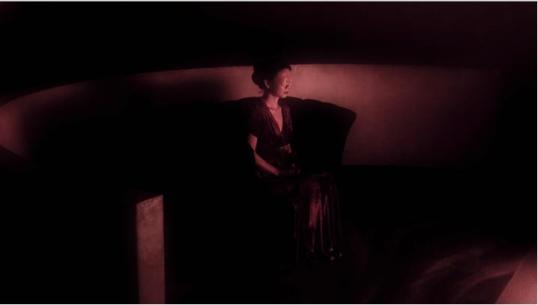
Cooper asks where they are but the woman cannot speak.  Perhaps she has lost her tongue, as well as her eyes.  Suddenly, someone starts to pound on the door.  The woman holds her finger to her lips, telling Cooper to be silent.

Cooper sees what appears to be a safe on the wall but, when he tries to approach it, the blind woman steps in front of him and pushes him back.  As the pounding continues, the woman leads Cooper to another door and then up a ladder.

And suddenly, Cooper and the woman are standing in outer space.  The house has now become a satellite, hovering in the star-filled sky.  As the pounding continues on the soundtrack, the woman tries to speak but Cooper cannot understand what she’s saying.  Suddenly, the woman pulls down a lever, apparently electrocuting herself before falling off the satellite and disappearing into space.

Suddenly, Cooper sees the face of Major Garland Briggs (Don S. Davis) floating underneath him.  “Blue Rose,” Briggs says.

(In Twin Peaks: Fire Walk With Me, it was suggested that the FBI refers to paranormal cases as being “Blue Rose cases.”)

Cooper reenters the satellite.  He finds himself back in the house.  There is now a second woman and those familiar with the show will recognize her as being played by Phoebe Augustine, the same actress who played Ronette Pulaski in the earlier seasons of the show.  If Augustine playing Ronette here?  It’s hard to say.  Her character is listed as being “American Girl.”  Cooper does not seem to recognize her but, then again, he also hesitated before recognizing Laura Palmer during Part One.  Being in the Black Lodge for 25 years can’t be good for one’s memory.

Cut to Doppelganger Cooper, driving down a South Dakota highway.  At the same time that the real Cooper is once again approaching the safe in the Space House, Doppelganger Cooper is having a seizure while driving.

In the Space House, American Girl/Ronette says, “When you get there, you will already be there.”

The pounding starts again.

“You better hurry,” American Girl/Ronette says, “my mother’s coming.”

Suddenly, Cooper is sucked into the safe, with only his shoes being left behind in the Space House.

In South Dakota, Doppelganger Cooper flips his car, crashing into a mountain.  Doppelganger Cooper survives but suddenly, he starts to throw up.  He puts his hand over his mouth and then sees the red curtains of the Black Lodge appearing before his car.

In an empty house located the Rancho Rosa development in Nevada, a dorky guy named Dougie Jones (Kyle MacLachlan) has just paid a prostitute named Jade (Nafessa Williams).  While Jade takes a shower, Dougie puts on a mustard yellow suit jacket and, judging by how ugly it is, I’m guessing that Dougie must be in real estate.  (Perhaps he works for Rancho Rosa, selling people suburban houses in the middle of the desert.)  Suddenly, Dougie grabs his stomach and collapses to the floor.

What follows is one of the grossest scenes ever as we cut back and forth between Dougie and the Doppelganger vomiting.  Seriously, this was one of the most grotesquely realistic vomiting scenes that I have ever seen.  I averted my eyes and covered my ears!  It was so gross.

At the same time that Dougie vanishes from the house, the red curtains in front of the Doppelganger’s car also vanishes.  But the Doppelganger is too busy throwing up to notice.  Again, I have to admit that I averted my eyes during most of this.  (I also realize that both Dougie and the Doppelganger were throwing up their essences, the stuff that allowed them to pretend to be human.  I don’t care.  The only thing I hate more than vomiting is watching other people vomit.)

Dougie is in the Black Lodge.  MIKE (Al Strobel) doesn’t appear to be too happy to see him.  MIKE explains that someone manufactured Dougie.  I’m assuming that the Doppelganger created Dougie so that, if Cooper ever escaped from the Black Lodge, he would take over Dougie’s existence instead of the Doppelganger’s.  “That’s weird,” Dougie says, as he his hand wastes away.  Then Dougie’s head vanishes, replaced by a black cloud of smoke.

Back at the house, another black cloud comes out of an electrical outlet.  Soon, the cloud forms into Cooper.  Cooper lies on the floor, next to Dougie’s vomit (ewwww!) until Jade yells at him that they have to get out of the house.

Apparently in a state of shock, Cooper silently follows Jade out of the house.  After being locked away in the Black Lodge, it appears that Cooper no longer quite remembers how to be human.  Or maybe he’s not really human at all anymore.  All I know is that he’s acting strange and, as brilliant as Kyle MacLachlan is, I do kind of hope the old Cooper returns at some point soon.

Because Dougie/Cooper doesn’t have his car keys (though he does still have his room key from the Great Northern), Jade gives him a ride into Vegas.  Two gangster types watch as Jade drives off.  One of them has a rifle.  The other has a bomb.  Apparently, they work for someone to whom Dougie’s owes money.  Because Cooper leans down to pick up his room key, the one with the rifle does not spot him in Jade’s car.  The other places the bomb under Dougie’s car, which is still sitting outside of the empty house.

While this happens, a woman — listed in the credits as being “Drugged-Up Mother” and played by Hailey Gates — is shouting “One one nine!  One one nine!” while her son watches on the couch.

In South Dakota, two troopers approach the Doppelganger’s car.  One of them catches whiff of the vomit and collapses to the ground, physically ill.

At the Twin Peaks Sheriff’s Department, Hawk (Michael Horse), Andy (Harry Goaz), and Lucy (Kimmy Robertson) look through all the evidence that was collected in the Palmer case.  Andy says that he and Lucy can’t find out what’s missing.  “If it’s here,” Hawk replies, “how can it be missing?”

As Hawk recites what the Log Lady told him — that something is missing and that the way he’ll find it has to do with his heritage — Lucy freaks out when she spots an empty box of chocolate bunnies.  Many years ago, Lucy ate the bunny.

“Do chocolate bunnies have something to do with your heritage?” Andy earnest asks.

“IT’S NOT ABOUT BUNNIES!” Hawk snaps.  Then, “Is it about the bunny? …. No, it’s not about the bunny.”

Meanwhile, off in the middle of nowhere, Dr. Jacoby (Russ Tamblyn) spray paints the ladders that were delivered to him at the start of Part One.

In Vegas, Jade drops Dougie/Cooper off at a casino.  Dougie/Cooper has been reduced to just repeating back phrases that other people say to him but no one seems to notice.  Still, when Jade tells Dougie/Cooper that he can “go now,” Dougie/Cooper has a flashback to Laura Palmer (Sheryl Lee) saying the same thing.

The casino, with its combination of glitz and the grotesque, brings out the best in Lynch.  As Dougie/Cooper wanders through the casino — which is populated by typical Lynchian characters — he notices that he can see the red curtains of the Black Lodge floating over certain slot machines.   Cooper pulls the levers, hitting jackpot after jackpot.  As the coins flood out of the machines, Cooper announces, “HELLO!”  Why?  Because he heard another gambler do it.  Dougie/Cooper is learning how to be human again.

When Dougie/Cooper walks away after having won another jackpot, leaving all of his coins on the floor, one old woman considers taking the coins for herself but then glances up at the camera on the ceiling — “and the eye in the sky watches us all,” to quote Casino — and thinks better of it.  Instead, she just asks Cooper to tell her which machines are about to hit.  She calls him Mr. Jackpot, which is kinda sweet.

Meanwhile, in Philadelphia, the FBI is meeting and — oh my God!  It’s Gordon Cole (David Lynch), Albert Rosenfield (Miguel Ferrer), and Tamara Preston (Chrysta Bell).  (Preston will be familiar to anyone who has read Mark Frost’s The Secret History of Twin Peaks.)

They start out discussing a senator who has been accused of murdering his wife.  The senator says that he knows who did it but he can’t reveal the name because of “national security reasons.”  (Since this is taking place in 2014, I’m going to continue the Casino theme and assume that the senator was creepy old Harry Reid.)

Cole is more interested in hearing about the murders of Sam and Tracey in New York City.  It turns out that the cameras caught a picture of that demonic creature in the glass box.

Suddenly, a call comes in.  Cooper has been found and he’s in a South Dakota prison and … oh shit!  That’s not Cooper!  We know that’s the Doppelganger!  Regardless, Cole announces that he, Albert, and Tamara are going to South Dakota.  Albert says he can’t wait to see Mount Rushmore.

“The absurd mystery of the strange forces of existence,” Albert tells Tamara.  “How about a truck load of valium?”

Cut to The Cactus Blossoms, performing at the Roadhouse and announcing that Part Three is over.
Part Four opens with Dougie/Cooper still hitting jackpots and still chanting, “Hello!”  When the old woman who has been following him around hits a jackpot of her own, a small smile comes to Cooper/Dougie’s lips.

A friend of Dougie’s, Bill Shaker (Ethan Suplee), approaches and he and Dougie have a thoroughly superficial conversation.  Dougie/Cooper asks where his home is.  Bill assures him that he lives at Lancelot Court, in a house with a red door.  The house, Bill says, is near Merlin’s Market.  As Cooper/Dougie leaves to get a cab, Bill says, “I hope he’s okay.”

“I don’t think he’s okay,” Bill’s wife, the wonderfully named Candy Shaker (Sara Paxton) says.

Before Dougie/Cooper can leave to find the house with the red door, he is dragged to the office of the vaguely threatening casino manager (David Dastmalchian).  The manager gives Dougie/Cooper his winnings and then asks if he wants anything — like “companionship” — for the night.  “Think of us as your home away from home,” he says.  When Dougie/Cooper repeats that he wants to go home (his real home), the manager arranges for him to ride in a limo.

(It pays to be a winner.)

As the limo drives down Lancelot Court, the driver (Jay Larson) says that it might be hard to spot a red door at night.  However, he then sees the door and oh my God, is it ever red!  Dougie gets out of the limo and seems unsure what to do.  Fortunately, his wife — Janey-E (Naomi Watts) — comes out of the house and starts hitting him.  Apparently, Dougie has been missing for three days.  He even misses his son’s birthday party!  (Perhaps significantly, as everyone stands outside the house, an owl flies overhead.)

Fortunately, once they’re inside the house, Janey-E sees just how much money Dougie/Cooper won at the casino.

“Don’t tell me you hit the jackpot!” Janey-E says.

“Mr. Jackpot,” Dougie/Cooper says, pointing at himself.

“There’s enough here to pay them back!” Janey-E continues as she looks at the money, “This is the most wonderful day of my life!”

“Of my life,” Dougie/Cooper says.

“Yes,” Janey-E replies.

At FBI Headquarters, Cole has a meeting chief of staff Denise Bryson (David Duchovny).  Cole tells Denise about finding Cooper and says he’s going to South Dakota.  Denise is concerned about Cole traveling with Tamara.  “I know your profile, Gordon,” Denise explains, “Female agent.  Early 30s.”

“I’m old school,” Cole replies, “you know that.”

Cole reminds Denise that he defended her when she first transitioned.  He told everyone who had a problem with her to “Fix their hearts — or die!”

At the Twin Peaks Sheriff’s Department, Sheriff Frank Truman (Robert Forster) enters the front lobby, which causes Lucy to scream and faint.  Apparently, Lucy was confused because she has just been talking to Frank on the phone and she can’t understand how Frank could be in two places at once.  Andy attempts to explain to her how cell phones work.  “You’re so good at your job,” Andy says, “in every other way…”

At the Sheriff’s Department, we learn a few interesting things:

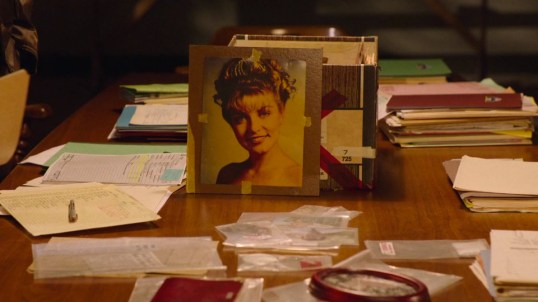
First off, Bobby Briggs (Dana Ashbrook), former drug dealer and murderer, is now a deputy, one who specializes in watching for drug dealers sneaking across the Canadian border.  (That’s something that Bobby should know a bit about.)  He also has gray hair and he cries when he sees a picture of Laura in the conference room.

Secondly, Major Garland Briggs died in a fire, a day after being the last person to see Dale Cooper.  (Presumably, Major Briggs actually saw Doppelganger Cooper.)

Third, Lucy and Andy’s son has grown up to be Wally Brando (Michael Cera).  Wally is a motorcycle enthusiast who has spent the last few years riding across the country.  Wally dresses like Marlon Brando in The Wild One and delivers a hilariously nonsensical monologue that is largely made up of pretentious references to different Brando roles.  What makes Wally’s scene so wonderful is the combination of Cera’s Brandoesque scenery chewing and Robert Forster’s deadpan reaction.

The next morning, in Vegas, Dougie/Cooper still can’t figure out how to do anything.  After spending 25 years in limbo, even urination is a new and scary experience for him.  Even when MIKE appears to tell him that he was tricked into leaving the Lodge and that either Dougie/Cooper and the Doppelganger must die, Dougie/Cooper looks confused.  Still, his son — the oddly named Sonny Jim (Pierce Gagnon) — is amused when his father eats breakfast with a tie wrapped around his head.

In South Dakota, the police investigating the murder of Ruth Davenport are shocked to discover that they can not access the identity of the owner of the finger prints that they took off of the male Joe Doe.  Apparently, it’s top secret.  “Military authorization required.”

Meanwhile, Cole, Albert, and Tamara are driving out to the South Dakota prison.  During the car ride, Cole complains that they’re not anywhere near Mount Rushmore but, luckily, Albert has brought a picture for him.  Meanwhile, Tamara has to ride with her head leaning out of the window because she gets car sick.

(I sometimes get car sick too.  That’s one reason why I never sit in the back seat.  I share your struggle, Tamara!)

At the prison, Cole, Albert, and Tamara meet with Warden Murphy (James Morrison).  When it is mentioned that the Doppelganger was throwing up poison, Murphy says, “Must have eaten locally.”  I love that line!

Anyway, the meeting with the Doppelganger doesn’t go well.  The Doppelganger, having thrown up whatever it was that allowed him to act human, is now speaking in a stiff and halting tone.  The Doppelganger claims that he’s spent the last 25 years working undercover for Philip Jeffries.  Haltingly, he says that he needs to be released so that Gordon can “debrief” him.  Stiffly, the Doppelganger attempts to give Gordon the thumbs up sign.

After the meeting, Cole and Albert agree that something was off about “Cooper.”  They agree that there’s one woman who can tell them if it’s really Cooper in prison.  Cole asks if Albert still knows where she lives.

“I know where she drinks,” Albert replies.

Who could Albert be talking about?  Audrey Horne?  Or maybe Sarah Palmer?  Sarah, after all, is psychic and appears to still have a drinking problem.

We’ll find out next week!  Until then, Parts 3 and 4 — along with Parts 1 and 2 — will continue to haunt my thoughts and dreams.

Twin Peaks on TSL:

  1. Twin Peaks: In the Beginning by Jedadiah Leland
  2. TV Review: Twin Peaks 1.1 — The Pilot (dir by David Lynch) by Lisa Marie Bowman
  3. TV Review: Twin Peaks 1.2 — Traces To Nowhere (directed by Duwayne Dunham) by Jedadiah Leland
  4. TV Review: Twin Peaks 1.3 — Zen, or the Skill To Catch A Killer (dir by David Lynch) by Lisa Marie Bowman
  5. TV Review: Twin Peaks 1.4 “Rest in Pain” (dir by Tina Rathbone) by Leonard Wilson
  6. TV Review: Twin Peaks 1.5 “The One-Armed Man” (directed by Tim Hunter) by Jedadiah Leland
  7. TV Review: Twin Peaks 1.6 “Cooper’s Dreams” (directed by Lesli Linka Glatter) by Lisa Marie Bowman
  8. TV Review: Twin Peaks 1.7 “Realization Time” (directed by Caleb Deschanel) by Lisa Marie Bowman
  9. TV Review: Twin Peaks 1.8 “The Last Evening” (directed by Mark Frost) by Leonard Wilson
  10. TV Review: Twin Peaks 2.1 “May the Giant Be With You” (dir by David Lynch) by Leonard Wilson
  11. TV Review: Twin Peaks 2.2 “Coma” (directed by David Lynch) by Jedadiah Leland
  12. TV Review: Twin Peaks 2.3 “The Man Behind The Glass” (directed by Lesli Linka Glatter) by Jedadiah Leland
  13. TV Review: Twin Peaks 2.4 “Laura’s Secret Diary” (dir by Todd Holland) by Lisa Marie Bowman
  14. TV Review: Twin Peaks 2.5 “The Orchid’s Curse” (dir by Graeme Clifford) by Lisa Marie Bowman
  15. TV Review: Twin Peaks 2.6 “Demons” (dir by Lesli Linka Glatter) by Leonard Wilson
  16. TV Review: Twin Peaks 2.7 “Lonely Souls” (directed by David Lynch) by Jedadiah Leland
  17. TV Review: Twin Peaks 2.8 “Drive With A Dead Girl” (dir by Caleb Deschanel) by Lisa Marie Bowman
  18. TV Review: Twin Peaks 2.9 “Arbitrary Law” (dir by Tim Hunter) by Lisa Marie Bowman
  19. TV Review: Twin Peaks 2.10 “Dispute Between Brothers” (directed by Tina Rathbone) by Jedadiah Leland
  20. TV Review: Twin Peaks 2.11 “Masked Ball” (directed by Duwayne Dunham) by Leonard Wilson
  21. TV Review: Twin Peaks 2.12 “The Black Widow” (directed by Caleb Deschanel) by Leonard Wilson
  22. TV Review: Twin Peaks 2.13 “Checkmate” (directed by Todd Holland) by Jedadiah Leland
  23. TV Review: Twin Peaks 2.14 “Double Play” (directed by Uli Edel) by Jedadiah Leland
  24. TV Review: Twin Peaks 2.15 “Slaves and Masters” (directed by Diane Keaton) by Lisa Marie Bowman
  25. TV Review: Twin Peaks 2.16 “The Condemned Woman” (directed by Lesli Linka Glatter) by Leonard Wilson
  26. TV Review: Twin Peaks 2.17 “Wounds and Scars” (directed by James Foley) by Lisa Marie Bowman
  27. TV Review: Twin Peaks 2.18 “On The Wings of Love” (directed by Duwayne Dunham) by Jedadiah Leland
  28. TV Review: Twin Peaks 2.19 “Variations on Relations” (directed by Jonathan Sanger) by Lisa Marie Bowman
  29. TV Review: Twin Peaks 2.20 “The Path to the Black Lodge” (directed by Stephen Gyllenhaal) by Lisa Marie Bowman
  30. TV Review: Twin Peaks 2.21 “Miss Twin Peaks” (directed by Tim Hunter) by Leonard Wilson
  31. TV Review: Twin Peaks 22.2 “Beyond Life and Death” (directed by David Lynch) by Lisa Marie Bowman
  32. Film Review: Twin Peaks: Fire Walk With Me (dir by David Lynch) by Lisa Marie Bowman
  33. Here’s The Latest Teaser for Showtime’s Twin Peaks by Lisa Marie Bowman
  34. Here’s The Newest Teaser for Showtime’s Twin Peaks by Lisa Marie Bowman
  35. 12 Initial Thoughts About Twin Peaks: The Return Parts One and Two by Lisa Marie Bowman
  36. This Week’s Peaks: Parts One and Two by Ryan C. (trashfilm guru)
  37. TV Review: Twin Peaks: The Return Parts One and Two (dir by David Lynch) by Lisa Marie Bowman
  38. 4 Shots From 4 Films: Special Twin Peaks Edition by Lisa Marie Bowman
  39. This Week’s Peaks: Parts Three and Four by Ryan C. (trashfilm guru)
  40. 14 Initial Thoughts About Twin Peaks: The Return Part Three (dir by David Lynch)
  41. 10 Initial Thoughts About Twin Peaks: The Return Part Four (dir by David Lynch)


Horror Film Review: The Last Wave (dir by Peter Weir)


ThelastwaveFor whatever reason, I’ve lately found myself very much enjoying films about the end of the world.  Who knows why.  Maybe it’s because I’m dreading having to sit through another election year.  Seriously, if the world just ended now, we could all be saved a lot of trouble.

Add to that, the weather’s been weird this year (and please do not take that statement to mean that I want to hear about climate change because seriously, that crap bores me to death).  We got hit by snow earlier in the year.  (I live in Texas, where snow is a big deal.)  It rained more than usual during spring.  Summer started late but when it did, it was hot and dry and there was not a rain cloud to be seen.  Two days ago, out of nowhere, it started raining and right now, we are under a flash flood warning.  Since I believe that existence is random chaos with no rhyme or meaning, I don’t necessarily think there’s any huge meaning behind the strange weather.  But still…

The 1977 film The Last Wave is all about strange weather and, in many ways, it’s the perfect film to watch while you’re stuck inside, waiting for the rain to stop.  (Watch it with Take Shelter and have a watery apocalypse double feature.)  The film opens in the Australian outback.  The sky is blue and clear.  And yet the children at a small schoolhouse hear thunder rumbling in the distance.  When it suddenly starts to pour down rain, the kids are excited.  Their soaked teacher manages to herd them back into the schoolhouse.  As the teacher struggles to calm the children down, we suddenly hear something pounding down on the schoolhouse’s tin roof.  Suddenly, the windows are shattering as huge chunks of ice crash through them.  Looking outside, the teacher is confronted with the sight of torrential rain, gigantic hail, and a perfectly blue and cloudless sky.

Meanwhile, in Sydney, three Aborigines are accused of murdering a fourth outside of a bar.  Assigned, by legal aid, to defend them is David Burton (Richard Chamberlain), a complacent upper middle class attorney.  Since David usually deals with tax law, he doesn’t understand why he has been assigned the case.  However, he take is because he feels a strange link to one of the accused men, Chris Lee (David Gulpilil).

Much like Michael Shannon in the previously mentioned Take Shelter, David has been visions and dreams in which he sees the world flooded.  As he researches the case, he begins to suspect that he may be seeing visions of the future….

Well-acted and visually stunning, The Last Wave is a thought-provoking meditation on nature of reality, the end of the world, the “old ways” vs the “new ways,” and whether or not humanity is even worth saving.  On top of all that, it features an absolutely brilliant final scene!

All in all, it’s not a bad way to pass the time on a rainy afternoon.