
The Daily Grindhouse: Death Has Blue Eyes (dir by Nico Mastorakis)


Death Has Blue Eyes

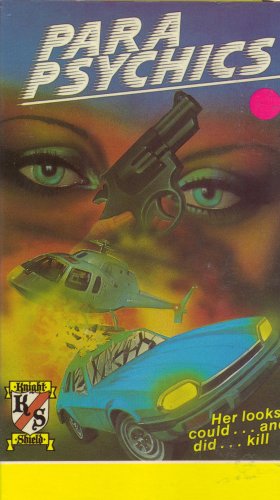
Just in case you needed proof that I will literally watch and review anything, here’s a few thoughts on an extremely obscure Greek thriller, which was first released in 1976.  As often happened with exploitation films in the 70s, this movie was released under several different names.  It’s original Greek title was To koritsi vomva.  Apparently, in England, it was known as The Para Psychics, which is truly a hideous title.  I prefer the American title, Death Has Blue Eyes.

So, maybe you’re wondering how exactly it was that I ended up watching a totally unknown (and unsung) Greek thriller that was filmed long before I was even born.  The trailer for Death Has Blue Eyes was included on the first volume of 42nd Street Forever, an amazingly fun and entertaining compilation of grindhouse movie trailers.  (I imagine that I’m not alone in counting 42nd Street Forever as my introduction to the anything goes aesthetic of the grindhouse.)

Check out the trailer below!

I have to admit that this trailer became something of an obsession of mine.  Some of it, of course, was the music.  And some of it was because every second of the trailer screamed out “low-budget 1970s.”  But, beyond that, I loved this trailer because it contained so many scenes and yet it still told me absolutely nothing about the film.  Seeing as how there were very little information about Death Has Blue Eyes online, I would watch the trailer and I would try to figure out how all of the random scenes fit together.

I could tell, of course, that the film was an action movie.  It was also obvious that the film featured a woman with psychic powers and that she could apparently blow up tents and kill men in bowling alley.  Just as obviously, the two men — one dark-haired and one blonde — were trying to protect her from an evil organization.

But, beyond that, I found myself obsessing on the odd scenes of the two men and the woman on the beach.  Why, I asked myself, were they on that beach?  And why, in a few shots, did both the woman and the blonde guy have such dark circles under their eyes?  Why was their skin so much more pasty and white on the beach than it was in the rest of the trailer?  Why was the blonde guy laughing like a maniac as the tide came in?  Why did the dark-haired guy appear to look so shocked when he saw the blonde guy and the woman dancing?  Why were they dancing on the beach in the first place?  And why, while the mysterious woman looked on with a mournful expression, were the two men fighting in the ocean?

Could it be, I wondered, that the three of them were dead?  And maybe the beach was purgatory?  Perhaps that explained why the blonde guy was laughing.  Maybe he had been killed after opening that briefcase full of money.  Maybe he was laughing at the fact that, as soon as he became rich, he lost his life and found himself on Purgatory Beach.  All that trouble to get all the money and here was betrayed, dead, and in purgatory.  No wonder he couldn’t stop laughing.

And what about that briefcase full of money?  Obviously, this was a heist film.  The two men must have been friends until they both fell in love with the same psychic woman.  And then, after the heist and the fireworks show, the two men turned against each other.  They fought.  They died.  And they ended up in purgatory.

Yes, I thought to myself, that had to be it!

And, as soon as I figured that out, I knew that I had to see Death Has Blue Eyes.  I mean, how often do you get to see a film that so perfectly combines film noir with Catholic theology as the trailer for Death Has Blue Eyes?  Death Has Blue Eyes was obviously a forgotten classic, waiting for one brave red-headed film blogger to defend it!  And if that film blogger has mismatched eyes and loved to dance, all the better!

Unfortunately, it was not easy to see Death Has Blue Eyes.  There’s a few old (and expensive) VHS copies floating around but the film has never been released on DVD or Blu-Ray.  (I am lucky enough to have an old VHS player, as all good lovers of film and history should!)  However, a year ago, someone was good enough to upload Death Has Blue Eyes to YouTube and I finally got to see it!
51NAQXY0RvL

And all I can say is that my version is sooooo much better.

I was right about the film being an action film that featured two guys protecting a blonde with psychic powers.  But I was totally wrong about purgatory.  In fact, when I saw how the beach scenes were actually used in he film, I got angry because my version was so much better!

(Because the film contains a lot of nudity and some violence and I don’t want our little site to get in trouble, I’m not going to embed the video here.  But if you want to watch the film on YouTube, click here!)

Anyway, as for the film, it tells the story of Bob (Peter Winter) and Ches (Hristos Nomikos), who are two con artists who make a living by seducing older women and pretending to be guests at expensive hotels.  After Ches’s latest cougar victim kicks them out of her home, they find themselves homeless.  But then, they’re hired to serve as bodyguards for Christine (Maria Aliferi).  Christine is a powerful psychic who witnessed a political assassination.  Because she can read minds, she knows both who the assassin was and who he was working for!

The rest of the film is basically a nonstop collection of car chases, exploding tents, and random assassins.  (What’s odd is that Christine can blow people up by merely looking at them and yet, she still needs bodyguards.)  It doesn’t make a bit of sense and the two “heroes” are incredibly unlikable but, because it’s such a product of its time, the film is oddly watchable.  It’s terrible and there’s no purgatory but it’s still probably the only film ever made about two gigolos hired to protect a blonde with ESP from a bunch of motorcycle-riding assassins.

That said, I still think my version of the film is better!

Check out some footage below, along with listening to a bit of the film’s score.  As I said, it’s all very 70s.

Film Review: The Gift (dir by Joel Edgerton)


The_Gift_2015_Film_Poster1

Because of the nature of The Gift, this post is going to contain minor spoilers.  There’s no way to talk about what makes the film work so brilliantly without giving away a few plot points.  Such is the nature of the beast and all that.  So, if you don’t want to deal with spoilers, allow me just to say this: Go see The Gift.  See it tonight.  See it tomorrow.  See it this weekend.  But, definitely — go see it!

(And if anyone tells you that The Gift is not worth seeing than that person is not really your friend and you need to start hanging out with a better class of people.)

Ryan has already reviewed The Gift and, having watched the film earlier today, I agree with everything that he had to say.  That’s why I am happy to add my voice to his and encourage you to see The Gift.  With this week pretty much dominated by ruminations on the colossal failure of The Fantastic Four and the upcoming weekend guaranteed to be dominated by the release of both Straight Outta Compton and The Man From UNCLE, there’s a definite risk that The Gift is going to get lost in the shuffle.

And that’s unfortunate.  Much like the thematically similar Unfriended, The Gift comes disguised as a conventional thriller but, once you start to unwrap it, you discover that there are layers and layers of subtext and The Gift is actually one of the best and most thought-provoking films of the year.

Like many great Lifetime films, The Gift opens with a married couple living a deceptively wonderful life.  Simon (Jason Bateman) is friendly and charming and appears to be on the verge of getting a big promotion at work.  He and his wife, Robyn (Rebecca Hall), appears to be happy and in love.  They have also got a friendly dog named Mr. Bojangles and they’ve just moved into a beautiful new house.  After spending the last few years in Chicago, they’ve relocated to Simon’s home state of California.  They’re looking forward to starting a family.  Everything’s perfect.

And then, while out shopping for furniture, they run into Gordo (Joel Edgerton).  Gordo explains that he went to high school with Simon.  (At first, Simon swears to his wife that he doesn’t even remember Gordo but that soon proves to be false.)  The socially awkward Gordo starts to send Simon and Robyn progressively more and more extravagant gifts.  After Simon tells Robyn that Gordon was known as Weirdo in high school, Robyn starts to feel sorry for Gordo and insists that Simon try to be friendly towards him.  Simon, however, remains weary of Gordo and his intentions.  At first, it seems like Simon is just being cautious but, as the film unfolds, we discover that Simon has his own reasons for wanting to avoid his old classmate.

The more Gordo tries to insert himself into Simon and Robyn’s life, the more we start to see the cracks behind their “perfect” marriage.  Robyn, it turns out, had previously suffered a miscarriage and has a history of abusing prescription medicine.  Meanwhile, it’s revealed that, behind Simon’s fast smile, there lies a condescending control freak.  (Gordo mentions that Simon ran for senior class president on a “Simon says” platform.)

There’s more to Simon and Gordo’s relationship than either one of them is initially willing to admit.  In high school, Simon was a bully and Gordo was his number one victim.  That Gordo wants revenge on Simon should not be surprising.  That’s obvious from the trailer.  No, the genius of the film is to be found in the way that it subtly reveals that, as an adult, Simon is still as much of a jerk and a bully as he was in high school.  He’s just gotten a lot better at hiding it. The same traits that made Simon a bully in high school have helped him to find material success in the real world.   When Gordo reeneters his life, Simon can no longer hide who he really is.  Gordo is not just his former victim.  Gordo is proof of what lies underneath Simon’s perfect facade.  When Robyn finally convinces Simon to apologize to Gordo, Simon cannot do so convincingly because he’s not so much sorry as he’s just inconvenienced.  When Gordo refuses to accept the apology, Simon’s mask falls away and he reveals his true nature, setting up the film’s devastating conclusion.

(I’m not going to spoil how the film ends but I will tell you that it left me breathless and stunned.  It’s not a happy ending but it is absolutely the right ending for the story that’s being told.  As both the film’s director and writer, Joel Edgerton deserves a lot of credit for staying true to the movie’s theme.)

Rebecca Hall is well-cast as Robyn but, ultimately, the film is dominated by the performances of Jason Bateman and Joel Edgerton.  (Interestingly enough, both Bateman and Edgerton are made up so that they superficially resemble each other, allowing Gordo to literally become the personification of Simon’s ugly side.)  Edgerton transforms Gordo into a character who is both scary and pathetic at the same time.  Meanwhile, Jason Bateman — oh, where to begin?  For the longest time, it’s been impossible for me to look at Bateman without flashing back to that scene in Juno where he hit on Ellen Page.  Now, however, I don’t think I’ll ever be able to look at Jason Bateman without hearing him yell, “Accept my apology!”  Jason Bateman has played a lot of less-than-sympathetic characters but Simon … well, Simon may be the worst.  As an actor, Jason Bateman deserves a lot of credit for not shying away from revealing the truth about Simon.  It takes courage to play such an unlikable character and talent to make that character compelling even when the viewer can’t stand him.

The Gift is an excellent and thought-provoking thriller, the type of film that will both make you jump with fright (I screamed during a certain shower scene and that’s all I’ll say about that) and leave you with much to think about after the end credits roll.

It’s a film that you need to see now.

A Quickie With Lisa Marie: Killer Mermaid (dir by Milan Todorovic)


91BKhDN7ssL._SL1500_

Killer Mermaid!

That’s a great title, isn’t it?  Originally, the title of this 2014 film from Serbia was Nymph.  However, by the time it reached Netflix, it had become Killer Mermaid.  And really, everything you need to know about this movie is right there in that title.  It’s a movie about a mermaid that kills people.  If you have a strong desire to see a movie about a mermaid that kills people, Killer Mermaid is for you.  If you don’t have that desire, then you’re probably not going to be reading this review.

Killer Mermaid takes place in Montenegro.  Two American tourists — Kelly (Kristina Klebe) and Lucy (Natalie Burn) — are visiting their old friend Alex (Slobodan Stefanovic) and his girlfriend Yasmin (Sofija Rajovic).  (Just in case we forget that Kelly and Lucy are Americans, Lucy wears American flag shorts.)  At first, they do typical Americans-in-Europe things.  Kelly attempts to confront some past childhood trauma.  Lucy sleeps with Alex and then worries about Yasmin finding out.  They meet and flirt with Bobban (Dragan Micanovic), a local who looks a lot like Lost‘s Henry Ian Cusick.

And then they make plans to spend a day on a nearby island and exploring an abandoned old military fortress.  They do this despite a local fisherman, Niko (Franco Nero!), telling them that it’s a terrible idea because the fortress was built by evil Nazis and anyone who explores it is destined to die a terrible death.

“Ha!”  the tourists say, “We’re too young and American to die in Montenegro!  Now, let’s go to the remote island with some guy that we’ve only known for 12 hours…”

Ignoring Niko, they go out to the island and … well, you can probably guess what happens.  There’s a mysterious caretaker (Miodrag Krstovic) wandering around the fortress.  He’s protecting something very important to him and, if that means he has to kill some tourists, so be it.

What is the caretaker protecting?  Well, you can probably guess from the title of the film.  There’s a mermaid (Zorana Kostic Obradovic, who has a fantastically evil smirk) living in the waters around the island and she’s a killer.  Whenever she sings, Alex, Bobban, and the caretaker all go into a state of zombiefication.  As women, Kelly, Lucy, and Yasmin are all immune to the mermaid’s song but it really doesn’t matter because, even with that advantage, no one is anywhere close to being smart enough to survive a horror movie.  Just the fact that they ended up on that island in the first place should tell you all you need to know about the intelligence of the characters in Killer Mermaid…

But that’s okay because, with the exception of Niko and maybe Bobban (depending on whether or not you had a crush on Lost‘s Desmond Hume), you really don’t care enough about any of these characters to get upset over their impending doom.  This film is all about the killer mermaid.  It takes her a while to show up and she doesn’t get any lines but she still dominates the entire film.  Say what you will about the script and some of the performances, the filmmakers went to the trouble to give us a believable and viscous mermaid.

Killer Mermaid works far better than it should.  Yes, it’s pretty much your standard killer monster movie but the film looks good and the mermaid is an impressive monster.  While it may never make sense for everyone to have headed off for that island in the first place, the film still makes good use of the atmospheric location.  Add to that, Killer Mermaid delivers exactly what it promises.

And, of course, you’ve got Franco Nero as Niko!  Now, I have to admit that I didn’t recognize Franco when he first showed up.  He’s made up to look as weather-beaten as possible and Nero downplays his trademark charisma, playing Niko as a haunted and emotionally withdrawn man.  To be honest, it’s a far better performance than you would probably ever expect to see in a film called Killer Mermaid but, then again, that’s always been the case with Nero.  He’s always good, no matter how bad some of his movies may occasionally be.  As I’ve said in the past, any movie can be saved by a random Franco Nero appearance and that’s certainly the case with this one.

(That said, it’s hard to imagine that any film will ever top the exhilarating oddness of Franco Nero’s cameo as Jesus in The Visitor.)

That’s Killer Mermaid for you.  It’s exactly what you think it is but, with that in mind, it’s entertaining enough.

And it’s currently available on Netflix!

Film Review: Mission: Impossible — Rogue Nation (dir by Christopher McQuarrie)


Rebecca FergusonEarlier tonight, Jeff and I saw Mission: Impossible — Rogue Nation and now I’m pretty sure that I’m developing huge girl crush on actress Rebecca Ferguson.

She plays Ilsa Faust, a former operative for M.I.6. who is now somehow involved with a shadowy terrorist organization known as The Syndicate.  And while Ilsa may only be a supporting character (because, after all, this is a Mission Impossible film and therefore, Tom Cruise’s Ethan Hunt is unquestionably the star), she dominates every scene that she’s in.  Whether she’s escape the scene of an attempted assassination while wearing a dress that is simply to die for or rescuing Ethan Hunt from certain death, Ilsa Faust is a woman who kicks ass, takes no prisoners, and looks great while she’s doing it.  As much as I love Scarlett Johansson as Natasha Romanoff, Ilsa Faust is my new espionage role model.

The movie attempts to suggest that there’s some sexual chemistry between Ilsa and Ethan.  Oddly enough, there’s not.  Tom Cruise looks good and he gives a confident and likable performance but, as a character, Ethan comes across as being almost asexual.  He seems to be attracted to only intrigue and danger.  And yet, that lack of authentic romantic chemistry actually works to the film’s advantage.  Ilsa is never reduced to merely being a love interest.  Instead, she’s an equal to Ethan throughout the entire film.

Of course, Ilsa has secrets of her own.  Everyone in Mission: Impossible — Rogue Nation has a secret.  The film opens with the IMF being disbanded and its operatives being absorbed into the CIA.  When the CIA director (Alec Baldwin, in full jerk mode) orders Ethan to stop investigating the Syndicate, Ethan goes underground and continues his activities in secret.  His allies (Jeremy Renner, Ving Rhames, and the great Simon Pegg) can only help him in secret.  The origins of the Syndicate turn out to be the biggest secret of all.  There are so many secrets in Rogue Nation that it’s sometimes hard to keep track of them all but, again, that works to the film’s advantage.  It keeps the audience off-balance.  You never know when someone’s going to suddenly pull out a gun and start shooting or rip off a mask and reveal themselves to be someone else.

Rogue Nation is an entertaining action film.  The stunts are spectacular and the set pieces are exciting and enjoyably over the top.  (There’s a scene where Ethan Hunt has to change out a security card while holding his breath underwater and I literally watched it through my fingers.)  I wouldn’t suggest trying to read too much into the film and yet, at the same time, Rogue Nation does capture the paranoid times in which we live. The film manages to both condemn the excesses of government while celebrating the toys that make those excesses possible.  The average film goer may not be able to do all of the things that Ilsa and Ethan can do but we all know what it’s like not to trust authority.

That’s what makes Solomon Lane, the main villain played by Sean Harris, such an interesting character.  I know that some reviewers have complained that Lane’s role was underwritten but I have to disagree.  Lane may not be as verbose as the typical spy movie villain but I appreciated the fact that he remained somewhat enigmatic up to the conclusion of the film.  He never made the mistake of over explaining his evil plan and accidentally giving the IMF team extra time in which to defeat him.  (Solomon Lane obviously learned his lesson from watching countless would-be world conquerors accidentally allow James Bond to get the better of them.)  Lane may be ruthless and evil but he’s also a revolutionary who is outraged by some of the same things that the rest of us are outraged by.  This brings a welcome hint of ambiguity to the film.

Though it never quite reaches the lunatic highs of either Kingsman or Furious Seven, Rogue Nation is still an enjoyable and effective action movie.  Undoubtedly, Ethan and the IMF team will return in another installment.  Here’s hoping that Ilsa Faust gets a spin-off of her very own.


Lisa Watches An Oscar Winner: Mrs. Miniver (dir by William Wyler)


Mrs_Miniver_poster

Mrs. Miniver, which won the Academy Award for Best Picture of 1942, is often treated somewhat dismissively by film historians.  The film tells the story of the Minivers, an upper middle class British family whose peaceful lives are changed forever by the start of World War II.  When the film initially went into production, the U.S. was still a neutral country.  As shooting commenced, the U.S. edged closer and closer to entering the war and, as a result, the script was continually rewritten to make Mrs. Miniver even more pro-British and anti-German than before.  The finished film was released four months after the attack on Pearl Harbor, by which point Mrs. Miniver had gone from being domestic drama to being both a celebration of British resilience and the Allied war effort.  “If the Minivers can do it,” the film told audiences, “why can’t you?”  As a result, Mrs. Miniver is often described as being merely effective propaganda.

Well, Mrs. Miniver may indeed be propaganda but it’s amazingly effective propaganda.  I recently DVRed it off of TCM and I have to admit that, as a result of those previously mentioned film historians, I wasn’t expecting much.  But I was in tears by the end of the film.  Yes, World War II has long since ended.  And yes, I could watch the movie and see all of the tricks and the heavy-handed manipulations that were employed to get the desired emotional response from the audience but it didn’t matter.  The film is so effective and so well-acted that you’re willing to be manipulated.

(Of course, it helps that there’s not much nuance to World War II.  As far as wars go, WWII was as close to a fight between good and evil as you can get.  If you can’t celebrate propaganda that was designed to defeat the Nazis, then what can you celebrate?)

As for the film itself, Greer Garson plays Kay Miniver, matriarch of the Miniver Family.  Her husband, Clem (Walter Pidgeon) is a successful architect.  When we first meet Kay and Clem, the only thing that they have to worry about is the annual village rose show.  (Henry Travers — who everyone should love because he played Clarence in It’s A Wonderful Life — plays the eccentric stationmaster who is determined to win with his rose.)  However, that all changes when they go to church and the vicar (Henry Wilcoxin) announces that Great Britain has declared war on Germany.

Life changes.  Soon, Kay must hold her family together while bombs are falling from the sky.  When Clem is away, helping out with the Dunkirk evacuation, Kay comes across a wounded German flyer (Helmut Dantine) in her garden.  The flyer demands that Kay give him food and when she does, he snarls that the Third Reich will be victorious.  He then passes out from his injuries, allowing Kay to take his gun and call the police.  (Reportedly, this scene was rewritten and reshot several times, with the German becoming progressively more hateful with each new version.)

Kay’s son, Vincent (Richard Ney), joins the Royal Air Force.  He also falls in love with Carol Beldon (Theresa Wright), the daughter of the aristocratic Lady Beldon (Dame May Whitty).  Over the concerns of Lady Beldon, Carol marries Vincent and she becomes the second Mrs. Miniver.  They do so, despite knowing that Vincent will probably be killed before the war ends.

Of course, there is tragedy.  People who we have come to love are lost, victims of the German onslaught.  Throughout it all, the Minivers (and, by extension, the rest of Great Britain) refuse to give into despair or to lose hope.  The film ends with them singing a hymn in a church that no longer has a roof and listening as the vicar tells them why they will continue to fight.

And yes, it’s all very manipulative but it’s also very effective.  I did cry and the film earned those tears.  In many ways, Mrs. Miniver is perhaps most valuable as a time capsule.  It’s a film about World War II that was actually made during the war and, as such, it provides a window into the attitudes and culture of the time.  But, if the film is valuable as history, it’s also just as valuable as a well-made melodrama.

I’m not sure if I would say that Mrs. Miniver deserved to defeat Kings Row for best picture of 1942.  But it’s still an undeniably good film.

Lisa Watches An Oscar Nominee: The Little Foxes (dir by William Wyler)


Little_foxesThat Bette Davis was an amazingly talented actress is something that we all already know.

However, she has become such an iconic figure that I think that it’s easy to forget just how versatile she could be.  She was ferocious in Of Human Bondage.  She was poignant in Dark Victory.  She was majestic in All About Eve.  Even when she eventually ended up appearing in stuff like Burnt Offerings, she still managed to command the screen.  Of course, nobody played evil with quite the style and power as Bette Davis at her prime.  And if you ever have any doubt about that fact, I would suggest watching the 1941 Best Picture nominee, The Little Foxes.

Based on a play by Lillian Hellman, The Little Foxes is a dark Southern melodrama that takes place in 1900.  The once mighty Hubbard Family has fallen on hard times.  Brothers Benjamin (Charles Dingle) and Oscar (Carl Benton Reid) have inherited their father’s money and Oscar has made himself even more wealthy by marrying the poignant alcoholic Birdie (Patricia Collinge).  However, when Oscar and Benjamin decide that they want to build a cotton mill, they discover that, even with their own fortunes, they are still $75,000 short.

They turn to their sister, Regina (Bette Davis).  As quickly becomes obvious, Regina is a hundred times more intelligent and clever than either one of her brothers.  However, because she’s a woman, Regina was not considered to be a legal heir to their father’s fortune.  As a result, after his death, she was left penniless.  In order to survive, Regina had to marry the wealthy but sickly Horace (Herbert Marshall).  When Regina asks Horace for the $75,000, Horace refuses.  He wants nothing to do with either one of her brothers.

With the reluctant help of Oscar’s son, Leo (Dan Duryea), the brothers steal the money straight from Horace’s bank account.  Regina, however, finds out about the theft and schemes to blackmail her two brothers….

For the majority of the film, you are totally on Regina’s side.  Despite the fact that Regina is ruthless and obviously taking advantage of Horace’s weakened state, you find yourself making excuses for her.  Her brothers are both so sleazy and greedy and Regina is so much smarter than her idiotic siblings that the film occasionally feels like a dark comedy.  It’s fun watching her get the better of them and you find yourself assuming (and hoping) that Regina will somehow be redeemed by the end of the movie.

And then it happens.

Aware of both Regina’s scheme and the fact that she never loved him, Horace announces that he’s going to change his will and he’s going to leave his entire fortune to their daughter, Alexandra (Teresa Wright, in her Oscar-nominated film debut).  He also tells Reginia that he’s going to say that he lent Leo the money, which would make it impossible for her blackmail scheme to work.

It’s while they’re arguing that Horace suddenly suffers a heart attack.  And as Horace struggles to climb up a staircase so that he can get his medicine, Regina calmly sits in a chair and shows not a hint of emotion as he dies.  It’s such an unexpected and effective moment, largely because Bette Davis’s performance was so good that it kept both the viewer and Horace from realizing just how monstrous Regina truly was.

It’s hard to think of any contemporary actress who could so totally and believably embody a character of Regina Gibbons.  It takes courage to commit so fully to playing such an evil and hateful character.  Bette Davis had that courage and her performance alone makes The Little Foxes worth watching.

Lisa Watches An Oscar Winner: The Best Years Of Our Lives (dir by William Wyler)


The_Best_Years_of_Our_Lives_film_poster

I’ve seen The Best Years Of Our Lives on TCM a few times.  There’s a part of me that always wishes that this film was dull, in the way that many best picture winners can be when watched through modern eyes, or in any other way overrated.  The Best Years Of Our Lives won the Academy Award for Best Picture of 1946 and in doing so, it defeated one of my favorite films of all time, It’s A Wonderful Life.  A part of me would love to be able to say that this was one of the greatest injustices of cinematic history but, honestly, I can’t.    The Best Years Of Our Lives is an excellent film, one that remains more than worthy of every award that it won.

Best_Years_of_Our_Lives_01_bar

The film deals with veterans returning home from World War II and struggling to adjust to life in peacetime.  That’s a topic that’s as relevant today as it was back in 1946.  If there’s anything that remains consistent about human history it’s that there is always a war being fought somewhere and the man and women who fight those wars are often forgotten and abandoned after the final shot has been fired.  The returning veterans in The Best Years Of Our Lives deal with the same issues that our soldiers have to deal with today as they return from serving in Iraq and Afghanistan.

The Best Years Of Our Lives follows three veterans as they return home to Boone City, Ohio.  As they try to adjust to civilian life, their loved ones struggle to adjust to them.

 Teresa Wright and Dana Andrews

Teresa Wright and Dana Andrews

Fred Derry (played by Dana Andrews) is a self-described former soda jerk.  (To be honest, I’m really not sure what a soda jerk was but it doesn’t sound like a very fun job.)  During the war, he was a captain in the air force.  He returns home with several decorations and few marketable skills.  During the war, he was good at bombing cities but there’s not much that can be done with that skill during peacetime.  Nearly penniless, Fred takes a job selling perfume at a department store.  He spends his days trying to control her temper and not give into his frustration.  At night, he’s haunted by nightmares of combat.

Teresa Wright and Virginia Mayo

Teresa Wright and Virginia Mayo

Meanwhile, his wife, Marie (Virginia Mayo), finds herself resenting the fact that Fred has come home.  She married him while he was in flight training and, as quickly becomes obvious, she’s less enamored of Fred now that he’s just another civilian with a low-paying job.  (She continually begs him to wear the uniform that he can’t wait to take off.)  The Best Years Of Our Lives is a film full of great performances but Virginia Mayo really stands out.  I have to admit that, whenever I watch this film, I find myself envious of her ability to both snarl and smile at the same time.

Teresa Wright, Myrna Loy, Fredric March, and Michael Hall

Teresa Wright, Myrna Loy, Fredric March, and Michael Hall

Al Stephenson (Fredric March) was a bank loan officer who served as an infantry sergeant.  (It’s interesting to note that the educated and successful Al was outranked by Fred during the war.)  Al returns home to his loving wife, Milly (Myrna Loy), his daughter Peggy (the beautiful Teresa Wright), and his son, Rob (Michael Hall).  At first, Al struggles to reconnect with his family and he deals with the tension by drinking too much.  Rehired by the bank, he approves a risky loan to a fellow veteran.  After the bank president (Ray Collins, a.k.a. Boss Jim Gettys from Citizen Kane) admonishes Al, Al gives a speech about what America owes to its returning veterans.

Meanwhile, Peggy has fallen in love with Fred.  When Milly and Al remind her that Fred is (unhappily) married, Peggy announces, “I am going to break that marriage up!”  It’s a wonderful line, brilliantly delivered by the great Teresa Wright.

Harold Russell

Harold Russell

Marriage is also on the mind of Homer Parrish (Harold Russell).  A former high school quarterback, Homer was planning on marrying Wilma (Cathy O’Donnell) as soon as he finished serving in the Navy.  During the war, he lost both his hands and now he’s returned home with metal hooks.  Homer locks himself away from the world.  When he finally does talk to Wilma, it’s to show her how difficult life with him will be.  Wilma doesn’t care but Homer does.

Harold Russell won an Academy Award for his performance here.  Russell was not a professional actor.  Instead he was a veteran and a real-life amputee.  Watching his performance today, it’s obvious that Russell was not an experienced actor but the natural charm that enchanted the Academy still shines through.

Harold Russell, Dana Andrews, and Fredric March

Harold Russell, Dana Andrews, and Fredric March

It’s been nearly 70 years since The Best Years Of Our Lives was first released but it remains a powerfully honest and surprisingly dark film.  All three of the veterans deal with very real issues and, somewhat surprisingly, the film refuses to provide any of them with the type of conventional happy ending that we tend to take for granted when it comes to movies made before 1967.  As the film concludes, Fred is still struggling financially.  Homer is still adjusting to life as an amputee.  Al is still drinking.   All three have a long road ahead of them but they’re all making progress.  None of them will ever be the same as they were before the war but, at the same time, they’re all working on making new lives for themselves.  They haven’t given up.  They haven’t surrendered to despair and, the film suggests, that is triumph enough.

The Best Years Of Our Lives is a great film and a great best picture winner.  It’s just a shame that it had to be released the same year as It’s A Wonderful Life.

What Lisa Watched Last Night #133: Patient Killer (dir by Casper Van Dien)


Last night, I watched another Lifetime premiere, Patient Killer!

Why Was I Watching It?

Well, the obvious answer is because it was on Lifetime and, like all good people, I’m kind of obsessed with the movies that they show on Lifetime.  However, I also watched it because it was directed by Casper Van Dien (who has already appeared in two of my favorite films of the year — Avengers Grimm and Sharktopus vs. Whalewolf) and it apparently featured Patrick Muldoon playing a stalker.  Patrick Muldoon is always a lot of fun whenever he’s bad.

(Derek Morris, my collaborator over at Primetime Preppie, has never quite forgiven Patrick for breaking up Kelly and Zack on Saved By The Bell.)

What Was It About?

Four years ago, therapist Victoria Wrightmar (Victoria Pratt) got too close to one of her patients and, as a result, Dylan McNalt (David Chokachi) committed suicide.  Despite the fact that Victoria has found success as a hypnotherapist, dream interpreter, and author, she is still haunted by Dylan’s death.

One day, a new patient enters her office.  Blaire Bennett (Barbie Castro) has been having nightmares and, when it turns out that she’s been suppressing memories that are similar to those that afflicted Dylan, Victoria once again starts to get too close to another patient.

However, it’s not just Blaire that Victoria has to deal with.  Her boyfriend, Jason (Casper Van Dien), has anger issues.  Another one of her patients, Derek (Patrick Muldoon), has become dangerously obsessed with her.  Both her mentor (Richard Burgi) and her administrative assistant (Stacey Dash) might have secrets of their own.  And, as strange things start to happen and those around her are threatened, a menacing police detective (Antoni Corone) enters her life as well.

Is Victoria being stalked or is she going crazy herself?  And is this movie called Patient Killer because the killer is a patient or because the killer likes to take his time?  To find out, you’ll have to watch the movie!

What Worked?

On twitter, Patrick Muldoon speculated that he would never get another date after people saw his performance as unstable Derek.  Personally, I think Muldoon was too hard on himself.  He did a really good job, finding the perfect balance between being threatening and being pathetic.  As a result, his character was both scary and sympathetic.  It looked like he had a lot of fun playing Derek and he was a lot of fun to watch.

And really, the same thing can be said about Patient Killer as a film.  It was an entertaining and enjoyably over-the-top thriller.

I loved both Victoria’s office and Blaire’s house.  Both locations were wonderfully decorated and a real delight to look at.  I’ve always said that one of the best thing about Lifetime films is getting to see where everyone works and lives and that was definitely the case with Patient Killer.

Actually, the entire film was a delight to look at.  Bernard Salzmann’s cinematography filled the frame with a combination of vibrant colors and menacing shadows.  This movie featured one of the best sunsets ever to appear on the Lifetime network.

While the film’s deliberate pace may not have been for everyone, I actually rather liked it and I felt it occasionally gave the film a surreal, almost dream-like feel.  In the end, Patient Killer felt like the Lifetime version of a classic David Lynch film noir.  (The score even sounded similar to Angelo Badalamenti’s classic Mulholland Drive score.)

What Did Not Work?

As far as I’m concerned, it all worked!

“Oh my God!  Just like me!” Moments

As someone has plenty of experience in the administrative assistance field, I totally related to the character played by Stacey Dash.

Lessons Learned

Never go to the office without a taser.  (Watch the movie and it’ll make sense.)

What Lisa Watched Last Night #132: His Secret Family (dir by Michael Feifer)


Last night, I watched the latest Lifetime original movie, His Secret Family!

Lifetime-movie-His-Secret-Family-2-July-2015

Why Was I Watching It?

Last Friday, I not only cried and cried while watching the finale of Degrassi but I also attended a blue moon party that was held in downtown Dallas.  Needless to say, I spent most of Saturday recovering and we all know that the best way to recover from a crazy night is by watching the latest Lifetime original movie!

What Was It About?

Oh my God, poor Haylie Duff!  Earlier this year, she played a woman named Sarah who married a murderer in Til Death Do Us Part.  In His Secret Family, she again plays a woman named Sarah and, once again, she is married to a murderer!  Of course, in this case, her husband is not just a murderer.  He’s got another wife, another family, and another really big house.  It turns out that Sarah is actually the secret wife.

David O’Donnell plays the husband.  When he’s with Sarah, he claims that his name is Jason Goodman.  When he’s with his other family, he uses the name David Marcus.  So is it Jason or David?  Well, regardless of his actual name, he’s more than a little insane.  When he realizes that it’s simply too expensive to support Sarah and their son, Brandon, David decides to both vanish and to frame Sarah for murder.

However, Sarah happens to be best friends with the detective (Parker Stevenson) working her case.  Even though she’s a major suspect in a murder investigation, he allows her to leave town so she can go up to Santa Monica and track down her husband.

Oh, and did I mention that Brandon needs a bone marrow transplant?  And that only David is a match?

What Worked?

This movie was fun in a “how much more batshit insane can this movie get” sort of way.  It wasn’t just that David/Jason was a bigamist with rage problems.  No, this movie also made his a sociopath who coldly refused to do anything to save his son’s life.  Perhaps the film’s best scene was when Sarah confronted David about his secret life, just to have David calmly respond, “Do I know you?”  David O’Donnell was obviously having a lot of fun playing such an insane character and, as a result, he was a lot of fun to watch.

Add to that, since David had two families, he also had two houses.  And seriously, they were both totally to die for!  One thing that I love about Lifetime movies is that everyone owns a big house and the inside of the house is always so incredibly clean and tasteful.  For a hyperorganized germaphobe like me, a Lifetime house would be the equivalent of paradise.  And this film had two of them!

What Did Not Work?

The whole film was full of plot holes and while I usually say that it’s not necessary for a Lifetime movie to make sense, some of the holes in this case were rather deep.  For instance, I could believe that David would end up with two families.  And I could buy that David would eventually realize that it’s cheaper to only have one family.  But, with all that in mind, I never quite understood the whole point of David trying to frame Sarah for murder.  David was already easy enough to hate without tossing in a random murder.  If anything, David just seemed to making things unnecessarily complicated.

“Oh my God!  Just like me!” Moments

Much like Sarah, I often find myself driving to different towns and claiming to be a real estate agent just so I can take a tour of a nice house.  It’s fun!

Lessons Learned

Secrets, secrets are no fun.  Secrets, secrets hurt someone.

Film Review: Vacation (dir by Jonathan Goldstein and John Francis Daley)


Vacation_poster

Oh, what sweet Hell is this?

I have definitely seen worse movies than Vacation but it’s hard to think of one that left me as annoyed.  As I watched this movie, I found myself wondering how anyone could have made as many wrong decisions while directing one comedy.  Then I remembered that this film had two directors and I was left even more annoyed.  Seriously, couldn’t one of these two credited directors look at the footage and say, “Wow, we’re making a really crappy, unfunny, and mean-spirited comedy.  Maybe we should reconsider the tone of some of these scenes.  Maybe we should just abandon this all together…”

This film is a reboot of the old Vacation movies that Chevy Chase used to make in the 80s and 90s.  (Christmas Vacation is the one that everyone loves but there were others as well.)  In the original Vacation movies, Chase played Clark Griswold.  Clark would always try to take his family on the perfect vacation and would slowly lose his mind as his best laid plans always crashed into a wall of chaotic reality.  The original Vacation films were all uneven but likable, largely because Clark seemed to be so sincere in his madness.

In Vacation, Ed Helms plays Clark’s son, Rusty Griswold.  Rusty is all grown up and living in the suburbs.  He has a job as a pilot for a cheap airline.  He’s married to Debbie (Christina Applegate), who was known as Debbie Do Anything in college.  He has two sons and they’re both annoying.  James (Skyler Gisondo) is overly sensitive and plays guitar.  Kevin (Steele Stebbins) is a psychopath who is constantly bullying his older brother and dropping F-bombs every chance he gets.  (A little kid saying “Fuck,” is only funny the first few times you hear it.  After the 20th time, it just gets boring.)  James sings self-pitying songs.  Kevin continually tries to murder his brother by putting a plastic bag over his head.

Rusty wants to take his family to Walley World, the same destination that Clark wanted to visit in the original Vacation.  This involves driving across the country in an Albanian car that’s always on the verge of exploding.  Along the way, they stop off at various locations and have adventures.

And not all of the adventures are bad.  Occasionally, the film is saved by a funny cameo.  Charlie Day shows up as a suicidal river guide and he’s genuinely funny.  You find yourself wishing that he had a bigger role.  And then there’s a scene where Rusty and Debbie attempt to have sex at the Four Corners and are caught by cops from four different states, all of whom promptly start to argue about who has jurisdiction.

But those scenes are the exception.  For the most part, Vacation is just a parade of uninspired scatological humor and missed opportunities.  When Rusty and the family drop in on his sister Audrey (Leslie Mann) and her well-endowed husband, Stone (Chris Hemsworth), Rusty spends a lot of time talking about how Audrey and Stone are politically conservative.  Once they arrive at Audrey’s home, we are shown a picture of Stone hanging out with Charlton Heston but, otherwise, Stone and Rusty’s political differences are never mentioned again.  And don’t get me wrong — I wasn’t particularly looking forward to having to sit through a political argument between Ed Helms and Chris Hemsworth.  But still, why set up a joke if you’re too lazy to include the punch line?

Of course, the main problem is that you just don’t care about these Griswolds.  As characters, they’re all pretty unlikable and therefore, you really don’t care if their vacation is a success or not.  Poor Christina Applegate!  After holding her own against Will Ferrell, Steve Carell, Paul Rudd, and David Koechner in both Anchorman films, she’s given nothing to do here, beyond being the punchline in a few misogynistic jokes about being wild before marrying Rusty.

As weak as all the characters are, Rusty is the main problem.  He can’t handle the fact that his wife has had more sexual partners than he has.  He can’t discipline his youngest demon child.  He has absolutely no good advice to give to his oldest son.  When Rusty drags them across the country to Walley World, it’s not because he wants them to have a good vacation but because he wants to recreate a memory from his childhood.  If Chevy Chase’s Clark was always unhinged but sincere, Rusty Griswold is just an asshole and it’s impossible to care about him.  It doesn’t help that Ed Helms, as talented as he may be, has a neediness to him that can be amazingly off-putting whenever he’s cast in a lead role.  He always seems to be trying way too hard to convince the audience to love him.

Incidentally, Rusty and the family do make time to visit Grandpa Clark.  Chevy Chase looks even worse than he did on Community and it’s all pretty boring.

My advice would be to take a vacation from seeing Vacation.