Holiday Scenes That I Love: The U.S. Postal Service Proves The Existence of Santa Claus in Miracle on 34th Street!


Is there a Santa Claus?

Well, if you’ve ever seen the original 1947 Miracle on 34th Street than you already know the answer.  There is a Santa Claus and he looks exactly like Edmund Gwenn!

In this scene, Kris Kringle is on trial.  He swears that he is Santa Claus.  The prosecution claims that not only isn’t he Santa Claus but Santa doesn’t exist at all.  Fortunately, it’s the U.S. Post Service to the rescue!

Miracle on 34th Street is true Christmas classic and I hope you enjoy this holiday scene that I love.

(The remake with Richard Attenborough is also pretty good, as long as you can ignore the fact that Mara Wilson grew up to be one of the most annoying people on the planet.)

Cleaning Out The DVR Yet Again #41: Lady Snowblood (dir by Toshiya Fujita)


(Lisa recently discovered that she only had about 8 hours of space left on her DVR!  It turns out that she’s been recording movies from July and she just hasn’t gotten around to watching and reviewing them yet.  So, once again, Lisa is cleaning out her DVR!  She is going to try to watch and review 52 movies by the end of 2017!  Will she make it?  Keep checking the site to find out!)

snowblood-press9.tif

On Oct. 23rd, I recorded the classic martial arts/revenge film, Lady Snowblood!

There’s a scene, in Lady Snowblood, in which a drunk gambler sobs as he begs the white-clad Yuki Kashima (Meiko Kaji) to spare his life.  He says that he’s sorry that he raped her mother.  He’s sorry that he took part in the murders of both Yuki’s half-brother and her mother’s husband.  He points out that years have passed and he has changed.  He now has a daughter of his own.  It wasn’t even his idea to attack Yuki’s mother.  He was forced to take part.

And while the gambler begs, Yuki stares down at him without a hint of emotion.  Though the audience may feel conflicted because the gambler sounds sincere in his remorse and it’s obvious that his life, in the years after his crimes, has been difficult, Yuki shows no compassion.  There are no tears from her.  Instead, she tells him, “An eye for an eye,” before slashing him to death.

There’s another scene in which Yuki discovers that another one of her targets has attempted to escape her vengeance by committing suicide.  As Yuki stares at the hanging body, she realizes that her target’s heart is still beating.  With one quick slice of her sword, Yuki chops the body in half.  The blood pouring onto the floor sounds like rain drops tapping on a tin roof.

And finally, when Yuki discovers that another target has died before she got a chance to track him down, she goes to a cemetery and destroy his tombstone.

In short, Yuki is a killing machine, one who dispenses vengeance with style and flair.  She was literally born, bred, and trained solely for the purpose of dispensing violent justice.  After her mother was raped and watched as her husband and son were brutally murdered, she was sent to prison.  It was there that she had an affair with a prison guard, specifically out of the hope that she would conceive and give birth to a child of vengeance.

First released in 1973, Lady Snowblood is perhaps best known for being a major influence on the Kill Bill films but it’s also one of the best revenge films ever made.  Stylishly directed and relentlessly paced, Lady Snowblood is almost a ballet of violence, with the grace of Yuki’s movements emphasized almost as much as their bloody results.  Though Yuki’s grim determination is often frightening, it’s also impossible not to admire her.  Her only job is to dispense vengeance and she’s the best at what she does.  And since she’s a woman who, for the most part, is killing evil men in an oppressively patriarchal society, her actions soon become about more than mere revenge.  With each slice of her sword and drop of blood spilled, Yuki is taking vengeance for not just her mother but for every other woman as well.

If anyone ever hurt me or anyone I loved, I would want Yuki on my side.

If I could be any revenge-seeking movie character, I would want to be Yuki.

I would want to be Lady Snowblood.

Cleaning Out The DVR Yet Again #40: Melinda (dir by Hugh A. Robertson)


(Lisa recently discovered that she only had about 8 hours of space left on her DVR!  It turns out that she’s been recording movies from July and she just hasn’t gotten around to watching and reviewing them yet.  So, once again, Lisa is cleaning out her DVR!  She is going to try to watch and review 52 movies by the end of 2017!  Will she make it?  Keep checking the site to find out!)

melinda

I recorded Melinda off of TCM on November 13th.

First released in 1972, Melinda is technically a murder mystery.  Frankie J. Parker (Calvin Lockhart, giving a brilliant performance) is a popular radio DJ in Los Angeles.  When we first see Frankie, he’s driving his expensive sportscar through a poor neighborhood.  It’s a neighborhood that he knows well but, as opposed to those around him, he’s made it out.  He’s handsome, slick, and more than a little arrogant.  When he arrives at a local gym, he looks at himself in a mirror and says, “I shouldn’t say it … but I am a pretty motherfucker.”  Frankie’s a student in a taekwondo class taught by Charles Atkins (Jim Kelly).  Charles gives Frankie a hard time about not giving back to the community.  Frankie blows off his concerns.  To be honest, we really should dislike Frankie but he’s so damn charming.  As played by Calvin Lockhart, Frankie has one of those irresistible smirks, the type of the lights up the screen.

One night, Frankie meets the mysterious Melinda (Vonetta McGee) and spends the night with her.  He thinks that it’s just going to be another one night stand but Melinda tells Frankie that he has the potential to be more than he realizes.  Touched, Frankie goes to work and resolves to be a better person.  Then he returns home and discovers that Melinda has been murdered!

The rest of the film deals with Frankie’s attempts to discover who murdered Melinda.  It turns out that Melinda had underworld connections and mob boss Mitch (Paul Stevens) is desperate to recover something that Melinda had in her possession when she died.  But honestly, the whole murder subplot is a MacGuffin (if you want to get all Hitchcockian about it).  Ultimately, Melinda is a character study of Frankie Parker and how, over the course of solving Melinda’s murder, he learns that there’s more to life than just looking out for himself.

Though Melinda was obviously made to capitalize on the blaxploitation craze of the early 70s, it’s actually far more low-key than most of the better known films in the genre.  (Or, at least it is until the karate-filled finale.)  Perhaps because it was directed by a black man and written by noted black playwright Lonne Elder III, Melinda is far more interested in exploring what makes its characters who they are, as opposed to just putting a gun in their hand and having them shoot up the screen.  Frankie Parker emerges as a fascinating character.

Mention should also be made of the performance of Rosalind Cash, who plays Terry, Frankie’s ex.  Cash gets an absolutely amazing scene where, while attempting to convince a bank employee that she’s Melinda so that she can get into Melinda’s safe deposit box, she tells off a rude teller.  It’s such a good scene and Cash delivers her lines with such fury that you find yourself forgetting that the teller was actually correct in her suspicion that Terry wasn’t actually who she said she was.

Melinda is probably one of the best films that hardly anyone has ever heard of.  Keep an eye out for it.

Cleaning Out The DVR Yet Again #39: Where The Boys Are (dir by Henry Levin)


(Lisa recently discovered that she only has about 8 hours of space left on her DVR!  It turns out that she’s been recording movies from July and she just hasn’t gotten around to watching and reviewing them yet.  So, once again, Lisa is cleaning out her DVR!  She is going to try to watch and review 52 movies by the end of 2017!  Will she make it?  Keep checking the site to find out!)

wheretheboysare

Before I talk about the 1960 film Where The Boys Are, I’m going to admit something.  Nearly a month ago, I started this mission to clean out my DVR.  I had 52 films to review and I said that I’d have it all done by Thanksgiving.  Of course, I failed to take into account that Thanksgiving is a holiday and, when you’re celebrating a holiday, that doesn’t always leave time to write 52 reviews.  So, I gave myself until the end of the first week of December.  And that’s when I realized that 52 reviews is not a small amount of work.  Especially if you want to make them decent reviews, as opposed to just posting a few sentences.  So, I’m abandoning all of my arbitrary deadlines.  I’ve got 14 more movies to review and I really hope that I’ll be done by the end of the year.  Maybe I will be, maybe I won’t…

But, seriously, I really hope that I am!

Anyway, now that I’ve cleared that up, let’s go to Where The Boys Are!

Released in 1960, Where The Boys Are was one of the first spring break films and it set the template for many films that would follow.  Because it is a piece of history, it’s one of those films that seems to regularly pop up on TCM.  It last aired on TCM on November 13th.  That’s when I recorded it.

Where The Boys Are tells the story of four girls who go to college in Maryland.  When we first see them, they are trudging across a snowed-in campus and there’s a distinct lack of handsome men around.  We listen as Merritt Andrews (Delores Hart) debates her far older professor about whether or not a girl should be “experienced” before getting married.  The professor thinks that all girls should wait for marriage.  Merritt disagrees.  What makes this scene interesting is that it’s almost totally done in euphemism.  Merritt never says sex.  Instead, she says making out and the professor has to ask her to explain what that means.

I mean …. 1960, amirite?

Anyway, it’s spring break so Merritt and her friends go down to Ft. Lauderdale.  After all … that’s where the boys are!  All of the girls have their own defining characteristic.  Merritt is the leader of the group, an intellectual with an I.Q. of 138.  Tuggle (Paula Prentiss) is smart and no-nonsense.  She’s a self-described “good girl” and her hope is to be a “baby-making machine.”  She intimidates some men because she stands 5’10.  Angie (Connie Francis) is athletic and naive.  And then there’s Melanie (Yvette Mimieux), who overcomes her insecurity and loses her virginity as soon as they arrive in Florida (though, of course, this is all handled via euphemism).

Over the course of spring break, all four of the girls meet a man or two.  Merritt meets Ryder (George Hamilton), who is not only an Ivy League student but has a tan to die for.  Ryder it turns out is very experienced (the film doesn’t seem to have the same issue with men being experienced as it does with women) and Merritt is forced to consider whether she’s really as ready for sex as she claims.  Melanie also hooks up with an Ivy Leaguer but it quickly becomes obvious that, despite going to Yale, Franklin (Rory Harrity) is a total heel.  (Oh, how you will hate Franklin.)  Tuggle finds herself competing for the attention of TV (Jim Hutton).  And Angie falls for a myopic jazz musician, Basil (Frank Gorshin).

Watching Where The Boys Are was an odd experience.  It’s an extremely dated film and it’s hard to believe that its euphemistic sex talk and extremely modest swimsuits were ever considered to be controversial.  There’s a hilarious scene where the girls are getting ready for their dates by changing into dresses that look more appropriate for cotillion than a night in Ft Lauderdale.  Needless to say, nobody is seen smoking weed or skinny dipping or doing any of the other stuff that we’ve come to take for granted as far as spring break films are concerned.  (That said, I get the feeling that both TV and Basil may have been stoned.  But definitely not Ryder.  From the minute Ryder shows up, you know he’s going to end up running a successful business and probably serving as an advisor in the Trump White House.)

There are a lot of jokes about people getting drunk, however.  It’s nice to see that, even in 1960, college students on Spring Break couldn’t hold their liquor.  I also found it interesting that not only did almost everyone in Where The Boys Are smoked but most of them looked really cool doing it.  In fact, I’d say that this film was probably the best advertising for cigarettes that I’ve ever seen.

For the most part, Where The Boys Are is a hit-or-miss comedy that’s distinguished by perfect casting.  Even though the film itself was dated, I felt that I could relate, in one way or another, to all of the girls.  Hart, Prentiss, Mimeux, and even Francis captured universal emotions and feelings in their performances and their friendship felt very true.

About 70 minutes into the film, Where The Boys Are takes a very serious turn and the film actually ends on a rather melancholy note, a reminder that not even a somewhat light weight comedy could escape the harshly judgmental morality of the time.  The sudden shift in tone took me by surprise but the film actually handled it well.  I just wish that it didn’t feel as if the filmmakers were punishing our characters for questioning the dictates of society.

On a final note, it’s interesting to note that Delores Hart, who played the sexually free thinking Merritt, later gave up her film career and became a nun.

So much for where the boys are.

Cleaning Out The DVR Yet Again #38: The Baby (dir by Ted Post)


(Lisa recently discovered that she only has about 8 hours of space left on her DVR!  It turns out that she’s been recording movies from July and she just hasn’t gotten around to watching and reviewing them yet.  So, once again, Lisa is cleaning out her DVR!  She is going to try to watch and review 52 movies by the end of Thursday, December 8th!  Will she make it?  Keep checking the site to find out!)

poster_of_the_movie_the_baby

On October 30th, I recorded The Baby off of TCM.

First released back in 1973, The Baby is a seriously strange little movie.  It’s about a 21 year-old man named Baby (played by David Manzy).  Why is he called Baby?  Because he lives in a crib.  And he wears a diaper that occasionally needs changing.  And he sounds exactly like a baby.  (Whenever he opens his mouth, the sound of an actual baby is dubbed in.)  When he’s alone with his babysitter, he eagerly sucks on her breast, half-nursing and half-perving.

Baby is the only son of Mrs. Wadsworth (Ruth Roman, giving a chillingly evil performance).  Mrs. Wadsworth was abandoned by her husband shortly after Baby was born and the film implies that she’s taken a lot of her hatred towards her ex out on her son.  Despite not liking her son, Mrs. Wadsworth is determined to hold onto him.  She gets a weekly welfare check from the state.  The money is supposed to be used to take care of Baby but Mrs. Wadsworth uses it to take care of herself and her two daughters.

Who are her daughters?  Alba Wadsworth (Suzanne Zenor) is an implied nymphomaniac who has a way with a cattle prod.   Germaine Wadsworth (Marianna Hill) is an actress and model who, it’s suggested, has incestuous designs on her brother.

That’s right — they’re a messed up family!  However, they do throw great parties, the type that are full of all the typical characters who you would expect to appear in a low-budget film from 1973.  Hippies, hipsters, aspiring disco dancers, they all show up.  Michael Pataki shows up as well!  You my not know the name but if you’re a fan of 70s exploitation films like me, you’ll immediately recognize Michael Pataki.

In order to continue receiving money from the government, the Wadsworths have to impress their case worker.  They’ve moved through several social workers and, for the most part, they’ve survived by being so strange that no one wants to spend too much time dealing with them.  However, their case has just been assigned to Ann Gentry (Anjanette Comer) and she actually takes an interest in Baby and his life with the Wasdworths.

Ann says that she thinks Baby could benefit from going to a special school.  The Wadsworths suggest that she mind her own business.  Ann, however, has no intention of doing that.  Ann refuses the give up on giving Baby a chance at a better life.

Sounds heart-warming, right?

Well, no.

At first, Ann seems like just another concerned do-gooder.  But, at the film progresses, we start to suspect that Ann might have some secrets of her own.  We’re told that she lost her husband in a car accident but the details are left intentionally vague.  What we do know is that Ann lives in a huge house with her mother-in-law (Beatrice Manley Blau) and we find ourselves wondering why, if her husband is gone, are the two of them still living together.

We also fin ourselves wondering: Does Ann have Baby’s best interests in mind?  For that matter, does anyone?

Being a 70s movie, it all ends with a violent home invasion that’s followed by a surprise twist.  The twist caught me totally off-guard and forced me to reconsider everything that I had previously seen.  It was shocking, it was borderline offensive, it was just a little bit ludicrous, and it was rather brilliant in its odd way.

The same can be said for The Baby as a whole.  This is one weird movie and you’ll never see another like it.  For that reason alone, The Baby is worth seeing at least once.

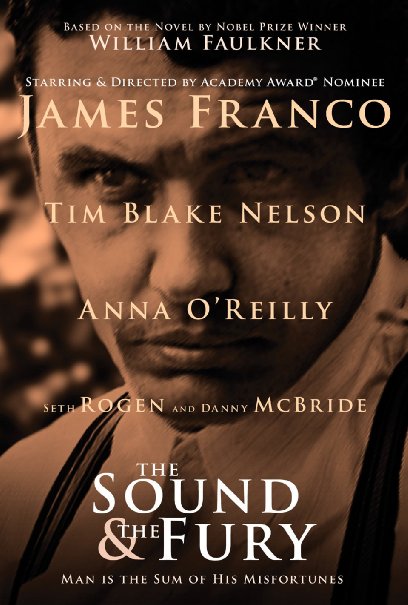
Cleaning Out the DVR Yet Again #37: The Sound and the Fury (dir by James Franco)


(Lisa recently discovered that she only has about 8 hours of space left on her DVR!  It turns out that she’s been recording movies from July and she just hasn’t gotten around to watching and reviewing them yet.  So, once again, Lisa is cleaning out her DVR!  She is going to try to watch and review 52 movies by the end of Thursday, December 8th!  Will she make it?  Keep checking the site to find out!)

the_sound_and_the_fury_2014_film

James Franco’s 2015 adaptation of William Faulkner’s classic novel, The Sound and The Fury, aired on Starz on November 2nd.

You know what?  Haters are going to hate but James Franco does more in an hour than most people do in a month.  Not only is James one of the most consistently interesting actors working today but he’s also a writer, a painter, a teacher, an activist, and a film director.

Indeed, it’s his work as a director that might be the most overlooked part of James’s prolific career.  Since making his directorial debut in 2006, with The Ape, James Franco has directed over 30 movies, television episodes, and short films.  As a director, James Franco has shown a talent for strong visuals and a willingness to take on difficult material.

For instance, can you imagine any other director who would have the guts to try to make a film out of The Sound and The Fury, the classic novel that may be the most unfilmable literary work this side of Finnegan’s Wake?

Told through the perspective of four related but very different characters, The Sound and The Fury details the fall of both the once mighty Compson family and the old South that the Compsons represent.  Benjy Compson is developmentally disabled and sees the world in a disjointed, nonlinear style.  Quinton Compson is fragile and sensitive and, while his section of the book starts in a fairly straight-forward enough manner, it quickly becomes nearly incoherent as Quinton’s mental state starts to deteriorate.  Jason Compson is cruel and evil but, because of his ruthless and self-centered personality, his section is the most straight-forward and the easiest to follow.  And finally, there’s Dilsey, the Compson family servant who is the only person to understand why the Compsons are in decline.  Faulkner utilized stream-of-consciousness throughout the entire novel, to such an extent that readers and critics are still debating just what exactly is happening and what Faulkner is actually saying.

In short, it takes courage to adapt a novel like The Sound and The Fury.  It takes even more courage when you’re an actor-turned-director who has his share of jealous haters.

Now, I should admit that James Franco was not the first director to attempt to make a film out of The Sound and The Fury.  In 1959, Martin Ritt made a version of the film, which reportedly did away with the nonlinear structure and centered the film around the straight-forward Jason.  (I haven’t seen the 1959 version.)  James Franco, on the other hand, not only adapts The Sound and The Fury but also adapts Faulkner’s style.

James Franco replicates the novel’s nonlinear structure and even takes on the role of Benjy himself.  It makes for a film that is occasionally frustrating and difficult to follow but which is also undeniably fascinating.  Filled with haunting images, James Franco’s The Sound and The Fury is a visual feast, one that perfectly captures the atmosphere of a decaying society.  The South, in this film, is trapped between the possibly imagined glories of the past and the harsh reality of the future.  There’s a dream-like intensity to the film.  It sticks with you.

As well, James Franco does an excellent job casting his film.  Tim Blake Nelson brings an enigmatic combination of grandeur and threat to the role of Mr. Compson and Jacob Loeb is haunting as the fragile Quentin.  Scott Haze dominates the film as the cruel Jason.  Though you never sympathize with Jason, you can understand how he became the man that he is.  Jason may not be a good man but, unlike the rest of the Compsons, you never doubt that he’s going to survive in one way or another.

James Franco took a big chance directing The Sound and The Fury and he succeeded.


Cleaning Out The DVR Yet Again #36: Term Life (dir by Peter Billingsley)


(Lisa recently discovered that she only has about 8 hours of space left on her DVR!  It turns out that she’s been recording movies from July and she just hasn’t gotten around to watching and reviewing them yet.  So, once again, Lisa is cleaning out her DVR!  She is going to try to watch and review 52 movies by the end of Thursday, December 8th!  Will she make it?  Keep checking the site to find out!)

term_life_poster

I recorded Term Life off one of the Starz channels on November 13th.

Vince Vaughn co-starred in two movies in 2016 and both of them were a little bit different from the fratty comedies for which he is best known.  One of the movies was Hacksaw Ridge, in which Vaughn was cast against type as a tough drill sergeant.  Hacksaw Ridge is one of the best films of the year and it features Vaughn’s best work since he appeared in 2007’s Into The Wild.  The other film was Term Life, which had a very limited released in April and is now popping up on cable.

In Term Life, Vaughn plays Nick Barrow.  Nick is a thief but he doesn’t actually steal anything.  Instead, he plots heists and then sells his plans to the highest bidder.  However, Nick has somehow managed to get in trouble with the mob, with a corrupt cop (Bill Paxton), and with … well, with everyone.  I say somehow because it wasn’t always clear why everyone was so obsessed with killing Nick.  They just were.

Knowing that his days are probably numbered, Nick takes out a life insurance policy on himself.  He names, as the sole beneficiary, his estranged daughter, Cate (Hailee Steinfeld).  With his reluctant daughter accompanying him, he goes on the run.  While Nick and Cate finally start to bond and repair their damaged relationship, the very bad men searching for Nick kill a lot of people.

So, this is a weird one.  At times, this film is a typical generation gap comedy, with Vaughn playing the former-cool-guy-turned-befuddled-dad who freaks out when he sees Cate’s bra hanging from a shower rod.  This part of the film is actually kinda likable.  Vaughn and Steinfeld are believable as father-and-daughter and their scenes together are sweet if predictable.

But then you’ve got the rest of the film, which is basically Bill Paxton brutally murdering people.  The violence comes on so strong that it feels totally out-of-place when mixed in with scenes of Nick and Cate bonding.  It’s such an abrupt tonal shift that it makes it impossible to get into the film.

Term Life has a cobbled together feel to it and it doesn’t help that it features the type of heavy-handed narration that feels as if it was added at the last minute in a desperate attempt to bring some sort of coherent structure to a messy film.  On the plus side, both Vaughn and Steinfeld are believable and you occasionally care about their father-daughter relationship.  On the negative side, likable characters keep dying.

In other words, see Hacksaw Ridge.

Cleaning Out The DVR Yet Again #35: 10 Year Reunion (dir by Jake Helgren)


(Lisa recently discovered that she only has about 8 hours of space left on her DVR!  It turns out that she’s been recording movies from July and she just hasn’t gotten around to watching and reviewing them yet.  So, once again, Lisa is cleaning out her DVR!  She is going to try to watch and review 52 movies by the end of Thursday, December 8th!  Will she make it?  Keep checking the site to find out!)

10

10 Year Reunion premiered on the Lifetime Movie Network on October 23rd, 2016.

Recently, I’ve been re-reading some of the comments that have been left underneath some of my Lifetime reviews and it’s become very evident that not everyone seems to understand what makes a good Lifetime movie.  So often, I find people complaining that a Lifetime film was “implausible” or “melodramatic.”

Well, to quote my Aunt Kate, who has a way with words, “No shit, Sherlock.”

That’s exactly why people like me — i.e, intelligent, beautiful, happy people — love Lifetime films.  Lifetime films are supposed to be melodramatic.  They’re supposed to be implausible.  They’re supposed to be so frequently over the top that they verge on camp.  That’s the entire point!  The best Lifetime films are the ones that feature wild plot twists and which don’t always worry about things like logic.  Lifetime is all about having fun and that’s what their best films are all about.

Here’s what you need to ask yourself while watching a Lifetime film — am I having fun?  If you’re having fun, then it’s a good movie.  It’s not that complicated.

For instance, let’s consider 10 Year Reunion.  I fucking loved 10 Year Reunion!  Of all the pseudo-horror films that Lifetime showed in October, 10 Year Reunion was the best.

Does the film always make sense?

No, not really.

Does the film feature a lot of melodrama?

Hell yeah!

Does the film go totally over the top during the last 14 minutes?

You better believe it!

It’s great!

10 Year Reunion tells the story of five friends who, during their senior year of high school, wrote down all of their deepest and darkest secrets and put them in a box.  One girl wrote about sleeping with her friend’s boyfriend.  Another girl wrote about purposefully scoring badly on a test so that another girl could be the valedictorian and get a scholarship to college.  They entrusted the box to Abby and Abby buried it somewhere.

And then Abby died.  She was at a party and she apparently drank too much and died of alcohol poisoning.  Of course, since this is a Lifetime film, we know that there’s more to it than that.  One of the still-living girls poisoned Abby!

But who?

Ten years pass and everyone returns for their high school reunion.  Despite their best efforts to leave the past behind, everyone is still haunted by the death of Abby.  That’s especially true of Carly (Kacey Clarke).  It turns out that, before she died, Abby left clues that would lead her friends to the hiding place of the box.  Now, ten years later, Carly is determined to track down those clues, dig up the box, and learn those secrets!  Her friends tell her not to bring up the ghosts of the past.  A hooded figure keeps popping up and trying to kill Carly.  And, of course, Carly starts to fall for her old high school crush but he might have secrets of his own!

Or he might not.  He might be a red herring.

You’ll have to watch the movie to find out!

And I think you should watch the movie.  10 Year Reunion is an unbelievably fun and well-put together Lifetime film.  Yes, it’s totally melodramatic and often implausible and over the top.  Yes, it is the type of film where the passive-aggressive behavior starts with catty comments and then quickly escalates to a car blowing up.  And yes, this is the type of film that ends with two people dueling with a shovel and hedge clippers.

But, oh my God, it is so much fun!

Here’s the important thing: it’ll keep you guessing, it’ll make you roll your eyes in a good way, it’ll inspire you to shout at the screen, and it all takes place in a really nice house.  And, for the most part, the clothes are to die for.

What more could you ask for from a Lifetime film!?

10 Year Reunion is a freaking masterpiece.  Anyone who doesn’t get it is taking life too seriously.

Cleaning Out The DVR Yet Again #34: The Rocky Horror Picture Show: Let’s Do The Time Warp Again (dir by Kenny Ortega)


(Lisa recently discovered that she only has about 8 hours of space left on her DVR!  It turns out that she’s been recording movies from July and she just hasn’t gotten around to watching and reviewing them yet.  So, once again, Lisa is cleaning out her DVR!  She is going to try to watch and review 52 movies by the end of Wednesday, December 7th!  Will she make it?  Keep checking the site to find out!)

The Rocky Horror Picture Show: Let’s Do The Time Warp Again aired on Fox on October 20th, 2016.

I’ve actually come across some debate online whether the Fox version of The Rocky Horror Picture Show should be considered a remake or merely a tribute to the original film.  It really doesn’t matter.  Whether it’s a tribute or a remake, it’s way too bland to succeed as either one.  Regardless of whether you think the original film (or the original stage play, for that matter) is a transgressive mindfuck or an overrated slog, you can’t deny that director Jim Sharman, star Tim Curry, and writer Richard O’Brien fully committed themselves to being subversive and challenging the audience.  The Fox version was directed by Kenny Ortega, who is best known for the High School Musical films.  Ultimately, this version feels so safe and bland that you could easily imagine Brad and Janet watching it while on church retreat.

It’s like Rocky Horror channeled through Glee channeled through the rockmentary episode of Saved By The Bell.

(“Friends forever.  It’s a nice idea.'”)

As for the cast, I thought Victoria Justice did a pretty good job as Janet, though it’s impossible for me to see her without singing that Best Friend’s Brother song that TeenNick always used to play in between episodes of Degrassi.  Reeve Carney did an acceptable Richard O’Brien impersonation as Riff-Raff.

Laverne Cox took on the role of Dr. Frank-n-Furter and somehow, she managed to make that role boring.  You know who would have made a great Frank-n-Furter?  Adam Lambert.  But he was stuck playing Eddie, the delivery boy who gets eaten.  Lambert did a pretty good job as Eddie but let’s be honest — ANYONE WHO CAN SING CAN PLAY EDDIE!  Frank-n-Furter, on the other hand, is a dynamic character and, for a production of Rocky Horror to work, Frank has to dominate the entire show.  Far too often, Cox seemed to blend into the background.

As for the original Frank, Tim Curry showed up as the Criminologist.  Curry had a stroke in 2012 and now uses a wheelchair.  Here’s hoping the best for him!

As for this version of Rocky Horror, it will soon be forgotten.  Actually, it probably already is forgotten.  I had forgotten about it until I saw it on the DVR.  As opposed to some of the other made-for-TV musicals that have recently aired — Sound of Music, Grease — this version of Rocky Horror was not aired live.  To be honest, I think it would have been better if it had been a live production.  At the least, it would have brought an air of potential danger, the thought that anything could happen, to the production.

That’s what this version was missing.

Oh well!

Cleaning Out The DVR Yet Again #33: Stakeland 2: The Stakelander (dir by Dan Berk and Robert Olsen)


(Lisa recently discovered that she only has about 8 hours of space left on her DVR!  It turns out that she’s been recording movies from July and she just hasn’t gotten around to watching and reviewing them yet.  So, once again, Lisa is cleaning out her DVR!  She is going to try to watch and review 52 movies by the end of Wednesday, December 7th!  Will she make it?  Keep checking the site to find out!)

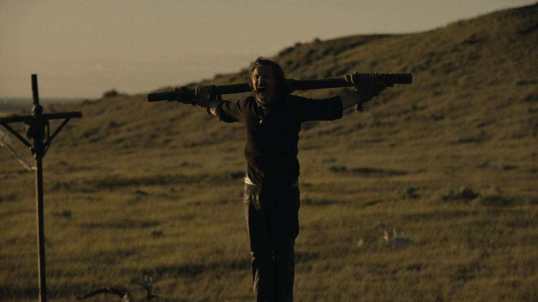
stakeland23

Stake Land 2: The Stakelander premiered on the SyFy network on October 15th.  Normally, I watch and live tweet any and all SyFy premieres but I was actually on vacation when Stake Land 2 premiered.  So, I recorded it!

And now, I’ve watched it.

And…

Well, this is kind of a strange one.  I have to admit that I’m a little bit shocked that this one premiered on SyFy without even getting a limited theatrical release.  (I mean, Hell, even 400 Days played in theaters for a week!)  After all, Stake Land 2 is a direct sequel to Stake Land, which did get a theatrical release back in 2010 along with positive reviews and a strong cult following.

In fact, not only is Stake Land 2 a direct sequel but it also features the return of almost the entire cast and the original screenwriter.  Original director Jim Mickle — who went from Stake Land to Cold In July — does not return but he is on board as an executive producer.  Though the film’s budget was low, it’s still obvious that the production cost a bit more than the typical SyFy mockbuster.  So, I’m a bit curious how Stake Land 2 ended up making its debut on SyFy.

Well, regardless of how it got there, Stake Land 2 premiered as a part of SyFy’s 31 Days Of Halloween.  One of the advantages of Stake Land 2 being a sequel to another fairly well-known film is that it was one of the few SyFy October premieres that did not play out as a rip-off of It Follows.  Instead, it felt like a rip-off of The Walking Dead, except with vampires instead of zombies.

The film picks up where the original Stake Land ended.  Martin (Connor Paolo) and his wife have set up a perfect life in New Eden but it’s all shattered when they’re attacked by a band of vampires that’s led by The Mother (Kristina Hughes).  Seeking revenge, Martin returns to the Badlands of America and searches for his mentor from the previous film, Mister (Nick Damici).  Mister is older and wearier now and he’s haunted by nightmares.  But he and Martin can still kill vampires!

Anyway, the majority of the film is a lengthy road film.  In fact, it’s a bit too lengthy.  This is one of those films that covers for a thin plot by supplying a lot of filler.  There’s a kind of fun scene set in an underground, Mad Max-style fight club and, along the way, Mister and Martin picks up some properly quirky allies.  There’s a few good shots of the desolate landscape and The Mother is genuinely menacing.

But, especially when compared to the first film, Stake Land 2 is ultimately way too predictable and more than a little bland.  Whereas the first Stake Land managed to create its own universe, one that you were actually curious about, Stake Land 2 is just another forgettable sequel.