Here’s one final episode of Thriller for this October’s horrorthon!
In this episode, we learn what happens when you stuff a dead body in a scarecrow. The scarecrow stalks you!
Seriously, scarecrows are so freaky.
Enjoy!
Here’s one final episode of Thriller for this October’s horrorthon!
In this episode, we learn what happens when you stuff a dead body in a scarecrow. The scarecrow stalks you!
Seriously, scarecrows are so freaky.
Enjoy!
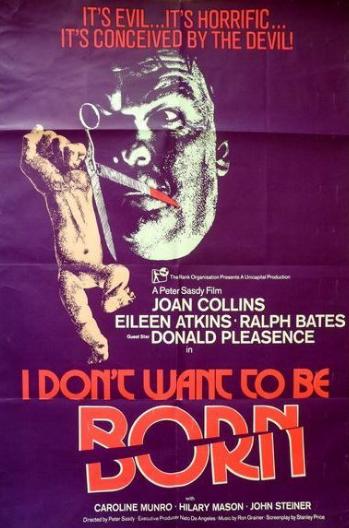
“I don’t want to be born!”
“That’s too bad, kid! YOU’RE COMING OUT!”
Now, admittedly, that dialogue is never heard in the 1975 British horror film, I Don’t Want To Be Born. However, if I had heard that particularly exchange in this film, I would not have been surprised. That’s just the type of movie that I Don’t Want To Be Born is. It’s a thoroughly ludicrous, totally ridiculous movie and what makes it all the more memorable is that it doesn’t seem to realize how silly it all is. This is a batshit crazy movie that tells its story in the most serious way possible. This damn film is almost somber, it’s so serious.
Lucy (played by Joan Collins) is a stripper who performs her act with a perverted dwarf named Hercules (George Claydon). When Hercules tries to force himself on Lucy, he is tossed out of the club by Tommy (who is played by John Steiner, a good actor who somehow always turned up in movies like this one.) After she and Tommy make love, Lucy is confronted by Hercules who curses her, telling her that she will have a baby “as big as I am small and possessed by the devil himself!”
Oh, Hercules, you weirdo.
9 months later, Lucy’s life has somehow completely changed. She’s no longer a dancer. Now, she’s married to a rich Italian named Gino (played by Ralph Bates, speaking in a bizarre accent). When Lucy has her baby, it’s a long and difficult delivery. The baby is huge! Not only is he huge, but he also has a bad temper and unnaturally sharp nails. The first time that Lucy holds him, he attacks her. Whenever the baby is introduced to anyone new, he responds by biting them. When Tommy drops by to take a look at the baby that might be his son, he ends up with a bloody nose!
But that’s not all this baby can do! Anytime he’s left alone in a room, the room ends up getting destroyed. Eventually, he apparently figures out how to climb trees and how efficiently slip a noose around the neck of anyone who walks underneath him. And don’t think that you can escape this baby simply because you’re taller and faster. One unfortunate person is decapitated, even though he’s standing at the time. How did the baby reach his neck? Who knows?
Does this baby need an exorcism? Lucy’s sister-in-law, Sister Albana (Eileen Atkins), certainly believes that it does! As Lucy thinks about whether the baby’s behavior is in any way odd, she glances over at the baby and — OH MY GOD! The baby has Hercules’s face!
And it just keeps going from there. Again, I feel the need to repeat that this film is meant to be taken very seriously. The script may be full of awkward and clichéd dialogue but most of the cast attempts to act the Hell out of it. Speaking of the cast, there’s a lot of familiar horror people in this one. Along with John Steiner, there’s also Caroline Munro and Donald Pleasence. Those three give performances that somehow manage to remain credible, perhaps because they had the experience necessary to understand what type of movie they were in. But the rest of the cast … you feel bad for them because they’re just trying so hard.
It’s a terrible movie but it’s so weird that I have to recommend that everyone see it once. If for nothing else, see it for the scene where Hercules responds to an attempt to exorcise the baby by swaying drunkenly on the stage. It’s weird and it’s hard for mere words to do it justice.
“No wonder this baby didn’t want to be born!”
That line is also nowhere to be found in this movie. It’d be nice if it was, though.
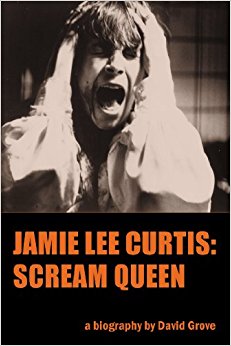
I cannot let this Halloween end without recommending Jamie Lee Curtis: Scream Queen, David Grove’s biography of one of horror cinema’s most iconic stars.
As you can probably guess from the title, the focus of this book is on the start of Jamie Lee Curtis’s career, when she was almost exclusively appearing in slasher films. Beginning with her starring role in Halloween and going all the way through films like Terror Train, Prom Night, Road Games, The Fog, and Halloween 2, the book shows both how Curtis dealt with suddenly being a horror icon and how she eventually left the horror genre behind in an effort to show that she was capable of doing more than just screaming and running. Eventually, as the book details, she reached a point where she could return to horror with Halloween H20 but, for a while, her horror work was truly a double-edged sword. It made her famous but it also kept her from being considered for the type of roles that she truly hoped to play.
That said, this book takes refreshingly positive look at her early film career, providing both serious analysis of and fascinating behind-the-scenes details about all of Curtis’s horror films. Yes, even Prom Night.
In fact, the two chapters devoted to Prom Night were probably my favorite part of the book. Though Curtis herself was not interviewed, several members of the cast and crew were and their recollections of their work on this not-very-good but oddly watchable film provide an interesting portrait of life during a low-budget movie shoot. Of course, everyone focuses on how in awe they were of Jamie but, at the same time, they are also open about their own personal feelings and recollections about the shooting of this movie. Their hopes and dreams, many of them destined to be unfulfilled, come through just as vividly as their memories of watching Jamie Lee Curtis film the famous disco scene. The passages dealing with Casey Stevens, who played Jamie’s Prom Night boyfriend and subsequently died of AIDS, are especially moving. In the end, Jamie Lee Curits; Scream Queen is not just a biography of Jamie Lee Curtis. It’s a tribute to both movies and the people who make them.
If you’re a lover of the horror genre or a student of film history, this is one of those book that you simply must have. It’s got just about everything that you could possibly want.

Do you remember how, a few days ago, I reviewed a silly little movie called Sorority House Massacre II?
Well, it turns out that there’s a sequel and it’s on YouTube! Both films were directed by Jim Wynorski and featured pretty much the same cast, despite the fact that a few of them were playing new characters. It was released under several different titles. Hard To Die is the one that I’m going with for this review. However, the film was also known as Tower of Terror, which makes sense when you consider that the majority of the film takes place in a hi-rise office building. It was also apparently released in some places as Sorority House Massacre III, despite the fact that there’s no sorority house in the movie.
Actually, it’s debatable whether or not Hard To Die is actually a sequel. It’s true that Orville Ketchum (Peter Spellos) does make another appearance. In the first movie, Orville was the creepy neighbor. In Hard To Die, he’s the janitor at the office building. Orville tells the exact same story, with the exact same flashbacks, that he told in Sorority House Massacre II. (Those flashbacks, of course, were lifted from a totally unrelated movie called Slumber Party Massacre. There were apparently a lot of massacres in the 80s and 90s.) The evil spirit of Hockstadder returns as well, though this time he comes flying out of a box that was accidentally delivered to the office building as opposed to a Ouija board. And, of course, there’s an abundance of lingerie, awkward dialogue, and cheap gore effects. (At one point, a bucket of fake blood is literally splashed on a wall.) However, Hard To Die also tells almost exactly the same story of Sorority House Massacre II. There are so few differences that I’m actually more tempted to say that Hard To Die is a remake of Sorority House Massacre II than a sequel. The only problem with that theory is whether or not a second movie can be considered remake when the first movie literally came out the exact same year.
(One of the reasons that I love my work here at the TSL is that it allows me to obsess over minutia like this.)
Anyway, the main difference between Hard To Die and Sorority House Massacre III is that there’s no sorority house in Hard To Die. Instead, Hard To Die takes place in a lingerie shop that just happens to be located on the 7th floor of a skyscraper. The hard-working employees are spending the weekend doing inventory but it’s not going to well. For one thing, the sprinklers accidentally go off so everyone decides to take off their wet clothes, put on skimpy lingerie, and order pizza. Personally, I probably would have waited for the pizza to arrive before getting naked but then again, I’ve never worked retail or dated a pizza deliveryman.
The pizza does eventually arrive but no one gets to eat it because the deliveryperson gets set on fire and ends up falling several floors to her death. That’s a waste of good pizza, which is kind of depressing. Meanwhile, Orville keeps trying to warn everyone about Hockstadder but, instead, he keeps getting beaten up. The end credits of Hard To Die promised that the next film would be called Orville In Orbit. Apparently, it was never made but I do hope that Orville got a vacation after all of this.
Anyway, Hard To Die is an extremely silly movie but it’s just so sincere in its silliness that it feels somewhat churlish to be too critical of it. If I had to choose whether to be in Sorority House Massacre II or Hard To Die, I would probably pick Hard To Die because, at least in that movie, I’d get to shoot a machine gun. Hard To Die is so blatantly and unapologetically over the top that you can’t help but be amused by it all.

Headaches are a bitch!
And if you didn’t already know that, you will know it after watching the 1957 film, The Vampire.
Like many films of this kind, The Vampire starts with death.
Actually, I take that back. Technically, it’s true but it’s also little bit too melodramatic. And, to be honest, The Vampire starts with a 14 year-old boy, who is very much alive, riding his bicycle down the street of Anytown USA. He has a box with him, one that has air holes. On the back of his bike, a cardboard sign reads: “Bobs Pet Zoo! If Its Alive We Got It!” Apparently, the kid is smart enough to run his own zoo but not smart enough to know when to use an apostrophe.
Anyway, the kid comes up to a creepy old house, one that looks somewhat out of place in the otherwise pristine suburban neighborhood. Originally, I thought that maybe Pennywise lived in the house but then I reminded myself that The Vampire was made decades before It. Instead, the house belongs to Dr. Campbell, a scientist who is doing experiments with blood and who needs a never-ending supply of animal test subjects. (Boooooo! Animal testing! Hiss!) Apparently, the kid keeps Dr. Campbell supplied with animals. When the kid enters the house, Dr. Campbell is nowhere to be seen. It’s not until the kid enters the laboratory that he discovers Campbell, dead and slumped over his desk.
As news spreads of Campbell’s death, his friend, Dr. Paul Beecher (John Beal), searches through Campbell’s belongings and he comes across a mysterious bottle of pills, which he promptly takes home with him. Dr. Beecher is kindly doctor, the type that we all wish we could deal with whenever we had to go in for a check up. However, he suffers from terrible migraines. That night, when he’s literally blinded with a headache, he asks his daughter to get him his pills. She retrieves a bottle of pills but guess what? They’re the wrong pills! They’re not headache pills! Instead, they’re Dr. Campbell’s vampirism pills!
The pills cause Beecher to blaxk out. Whenever he comes to, he never has any memory of what he may or may not have done while he was out. However, strange things are happening to his friends and his patients. One of his longtime patients dies of fright when he comes by her house. On her neck, he finds two puncture wounds…
So, it’s not a spoiler for me to tell you that Dr. Beecher has been transformed into a vampire. And I know what you’re thinking. Why doesn’t he just stop taking the pills? The simplest answer is that the pills are addictive. The more complex answer is that he doesn’t want to. The pills have brought out his dark side and, now that it’s free, it’s not planning on going anywhere.
In a strange way, The Vampire reminded me of Nicholas Ray’s Bigger Than Life. In Bigger Than Life, James Mason plays a gentle and good-hearted professor who, after taking steroids, turns into a monster who dreams of creating a master race. Bigger Than Life was unsettling for the exact same reason that The Vampire is unsettling. Both suggest that the pills didn’t turn their user into a monster. Instead, the pills just allowed his true self to come out.
The Vampire was a low-budget film, a B-movie as many would probably call it. The musical score is overly melodramatic and so are some of the actors. But I would say that The Vampire is actually a bit of a subversive masterpiece. This 1957 film suggests that behind the pristine facade of suburbia, there lurked monsters. Even an outwardly successful and respected man like Dr. Beecher can turn into something totally different behind closed doors, this film is saying. That’s a message that it as relevant today as it was when this film was first released. In its own way, The Vampire is a brilliant and important movie.
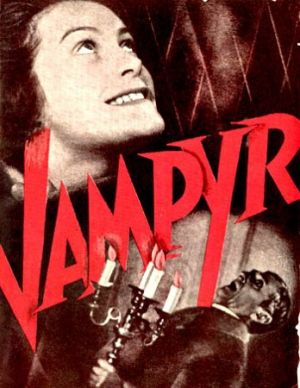
A dream of dark and disturbing things….
Allan Gray (Nicolas de Gunzburg, performing under the name Julian West) might be a student of the occult or he might just be a man having a dream within a dream. He’s handsome with just enough of an aristocratic bearing to be intriguing. His face is strangely blank. Whenever we see him, we wonder if he’s awake or if he’s asleep. We’re reminded of Werner Herzog’s film Heart of Glass, in which the entire cast recited their lines while hypnotized.
Allan’s come to a small village in France. It’s a quaint little place, probably the type that most tourist would consider to be quite beautiful. But from the minute that we see it, the entire landscape seems to be off. The inhabitants of the village seem almost as blank-faced as Allan. When we see the trees sway in the wind, we’re reminded of Victor Sjöström’s The Wind and how the nonstop wind drove Lillian Gish mad.
Allan stays in an inn. He goes to sleep. When he wakes up, an old man stands in his room. The old man gives him a package. The package is not to be opened until the man’s death. Allan goes outside. The village is full of shadows. He watches an old woman and the town’s doctor. Allan meets with one of the old man’s daughters and learns that her sister is deathly ill. She needs a blood transfusion. When Allan reads a book about vampyres, he suspects that both the town and the sisters are being held prisoner. At times, the events feel almost random but the film has such a hypnotic power that we automatically know that nothing happens by mere chance.
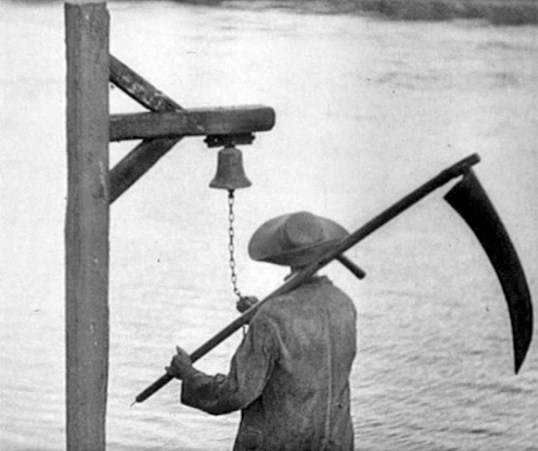
Directed by Carl Theodor Dryer, Vampyr was filmed in 1931 and released in 1932. This was Dreyer’s first sound film but Vampyr almost seems like a silent film. It certainly has more in common with Dreyer’s hallucinogenic silent masterpiece, The Passion of Joan of Arc, than it does with Universal’s version of Dracula. Vampyr feels like a cinematic dream, full of surrealistic images and odd performances. As a collection of images, Vampyr is one of the most intensely atmospheric film that I’ve ever seen. Allan, who may be having a dream within a dream, discovers a coffin and is shocked to discover who is inside. A character is buried alive in flour. Fogs rolls across the river and a figure with a scythe brings to mind Charon, the ferryman who took the dead to the underworld. Shadows dance across the screen. Much like Lucio Fulci’s Beyond trilogy, Vampyr succeeds by creating its own cinematic world, one where reality is solely defined by the images on the screen. The plot of Vampyr might not always make sense in the real world but it’s perfectly logical in the world created by the film.
Vampyr’s a surreal classic, one that reportedly came close to being a lost film. Several of the video releases have been technically inferior, though the flickering picture and inconsistent soundtrack of those releases can actually add to the film’s dreamlike power. It’s been released by the Criterion Collection and that is the ideal version to watch.

Happy Halloween everyone!
Well, as another horrorthon draws to a close, it’s time for another Shattered Lens tradition! Every Halloween, we share one of the greatest and most iconic horror films ever made. For your Halloween enjoyment, here is George Romero’s Night of the Living Dead!
(Be sure to read Arleigh’s equally iconic review!)
ENJOY!
To quote Taking Back Sunday:
“What’s it feel like to be a ghost?”
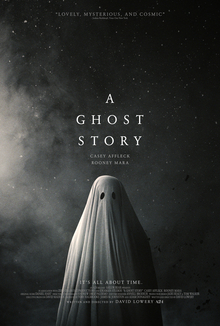
That’s the question that is asked in the hauntingly beautiful film, A Ghost Story.
How to describe the plot of A Ghost Story? It’s not going to be easy because A Ghost Story is a film that defies easy description or categorization. It’s power comes less from the specifics of the story and more from the mood that it creates. A Ghost Story makes you think and it makes you feel and, to a certain extent, you’re just going to have to take my word on that. This is one of those film that, to truly understand, you simply must see.
Casey Affleck plays C and Rooney Mara plays M. They live in a small house, near Dallas. They’re like any couple, really. Sometimes, they appear to be in love. Sometimes, they appear to be on the verge of breaking up and never seeing each other again. Sometimes, they are happy. Sometimes, they are sad. The film starts with an almost random series of scenes, showing their life together.
Suddenly, we see a smashed car sitting in front of the house.
Just as abruptly, we’re in the hallway outside a sterile hospital room. We can see that, inside the room, M is staring down at a body on a slab. The body has been covered with a sheet. M leaves. Slowly, the sheet-covered body sits up. We watch as the sheet-covered ghost walks down the hallways of the hospital. Briefly, it pauses to look at what appears to be a portal to … somewhere else. The ghost does not enter the portal and the portal closes.
We spend the rest of the movie following that sheet-covered ghost as he wanders through our world. No one living sees it and the ghost never says a word. He watches as M mourns over his passing. Time passes. People enter and leave the house. Life goes on but the ghost is stuck forever where he is, powerless to do anything other than occasionally break a dish, play a piano, or open a book. Time passes. The ghost sees the future, the past, and the present. Why is the ghost still there? Does the ghost know? Is the ghost just waiting for someone who it has forgotten?
If I’m making A Ghost Story sound like a sad movie … well, it is. There are moments of humor, largely coming from the fact that the ghost is literally a sheet with some eye holes. For the most part, though, this film is a somber meditation on life, death, and what makes it all worth the trouble. It’s a film that makes you wonder whether you would have entered that portal or if you too would have returned to your old house so that you silently watch the world go on without you.
From the stillness of the morgue to the view of a futuristic cityscape that the ghost can see but probably no longer appreciate, director David Lowery gives some truly beautiful and haunting images while telling this story. (It’s not surprising to learn that the Dallas-based Lowery previously worked on Shane Carruth’s Upstream Color.) A Ghost Story came out earlier this year and really didn’t get the attention that it deserved. It’s a thought-provoking film and definitely one of the best of the year.
For tonight’s televised horror, we have yet another classic episode of the Boris Karloff-hosted anthology series, Thriller!
In the Wig for Miss Devore, Sheila Devore (Patricia Barry) is an actress looking to make a comeback. She’s recently been cast in a film about a real-life witch who was executed centuries ago. Sheila’s so determined to make the part her own that she’s even willing to wear a wig that once belonged to the dead witch.
Needless to say, that proves to be a mistake for her.
However, it’s enjoyable for us!
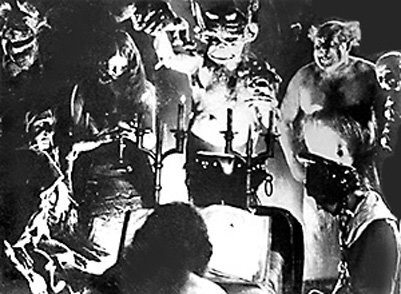
I previously shared Haxan back in October of 2013. A day later, YouTube removed the video and turned my post into a tease.
Well, the video has been uploaded again so I’m sharing Haxan again!
To quote what I wrote the last time that I shared this particular film:
Directed by the Danish director Benjamin Christensen, Haxan is a quasi-documentary that, over the course of four separate sections, documents the history of witchcraft and superstition in Europe. Along with making a potent case that religion and superstition are largely the same thing, Haxan is best known for dramatizing various old folk tales. Though the film was made in 1922, its images of lustful devils and dark magic remain powerful to this day.
Enjoy Haxan!
 Through the Shattered Lens