The Cabinet of Dr. Caligari is a film that I’ve shared four times previously on the Shattered Lens. The first time was in 2011 and then I shared it again in 2014, 2015, 2016, 2017, and 2018! Well, you know what? I’m sharing it again because it’s a classic, it’s Halloween, and everyone should see it! (And let’s face it — it’s entirely possible that some of the people reading this post right now didn’t even know this site existed in any of those previous years. Why should they be deprived of Caligari just because they only now arrived?)
Released in 1920, the German film The Cabinet of Dr. Caligari is one of those films that we’ve all heard about but far too few of us have actually seen. Like most silent films, it requires some patience and a willingess to adapt to the narrative convictions of an earlier time. However, for those of us who love horror cinema, The Cabinet of Dr. Caligari remains required viewing. Not only did it introduce the concept of the twist ending (M. Night Shyamalan owes his career to this film) but it also helped to introduce German expressionism to the cinematic world.
My initial reaction to The Cabinet of Dr. Caligari was that it simply wasn’t that scary. It was certainly interesting to watch and I was happy that I was finally experiencing this film that I had previously only read about. However, the film itself was obviously primitive and it was difficult for my mind (which takes CGI for granted) to adjust to watching a silent film. I didn’t regret watching the film but I’d be lying (much like a first-year film student) if I said that I truly appreciated it after my first viewing.
But you know what? Despite my dismissive initial reaction, the film stayed with me. Whereas most modern films fade from the memory about 30 minutes after the end credits,The Cabinet of Dr. Caligari has stuck with me and the night after I watched it, I even had a nightmare in which Dr. Caligari was trying to break into my apartment. Yes, Dr. Caligari looked a little bit silly staring through my bedroom window but it still caused me to wake up with my heart about to explode out of my chest.
In short, The Cabinet of Dr. Caligari passes the most important test that a horror film can pass. It sticks with you even after it’s over.
For the curious with an open mind to watch with, here is Robert Wiene’s The Cabinet of Dr. Caligari!
I really like this video, mostly because it starts out all light-hearted before then suddenly turning into Event Horizon just to then become light-hearted again before ending a note of senseless tragedy. It’s a bit like life and probably a more realistic look at intergalactic travel than something like Passengers. (Remember that movie?)
To be honest, if I was stuck in the a space shuttle and I didn’t have anyone around, I’d probably end up dancing and singing too. That’s why this video gets to me. I can relate.
This video was directed by the prolific Andrew Donohoe, who has also done videos for twenty-one pilots, Skrillex, and Janelle Monae. The lonely astronaut was played by Kally Khourshid while the doomed gentleman on the space station was played by Damian Lang.
It may not technically be a horror video but it’s still creepy enough for October!
Tonight’s televised horror comes to use from the year 2004 and the nation of Canada! Love you, Canada!
In this episode of Degrassi: The Next Generation, the students at Toronto’s Degrassi Community School are still struggling to come to terms with a recent school shooting that left one student dead and another paralyzed. What better way to help the school deal with their trauma than a play? And what better play to select than an adaptation of …. Dracula?
J.T. (Ryan Cooley) and Libertry (Sarah Barrable-Tishauer) are directing their own script. Starring in the play is Emma Nelson (Miriam McDonald). Before the shooting, Emma was known for being rather strident about her political and environmental activism. After the shooting, Emma has been spiraling out of control. And, as we all know, spiraling out of control on Degrassi inevitably leads to a visit to the ravine where all-around trouble-maker Jay (Mike Lobel) has a van and a collection cheap bracelets.
Meanwhile, in another part of the school, Ashley (Melissa McIntyre) tries to get Craig (Jake Epstein) to join a support group that will help him deal with his recent bipolar diagnosis. Craig is upset to discover that Ellie (Stacey Farber) is in the same group. This episode was the start of the very long and very angsty Craig/Ellie relationship arc. When I first watched Degrassi, I always related to Ellie and I still do to a certain extent but, in retrospect, I think I was probably a lot more like Ashley when I was in high school.
This episode of Degrassi aired, in Canada, on November 30th, 2004. This episode was considered to be so controversial that it actually made national news when it later aired in the United States. (I can actually remember watching some outraged wannabe censor talking about how Degrassi was a corrupting influence.) Part Two of Secret, which we’ll get to tomorrow, was even more controversial.
As for how this fits in with October …. it’s Dracula! And really, when you think about it, Jay’s a bit of a real-life Dracula. That’ll especially become clear in the next episode.
Anyway, here is tonight’s episode. Remember — whatever it takes, you can make it through!
13 years after the release of the first Single White Female and a countless host of imitations, an official sequel was released straight-to-video in 2005. Subtitled “The Psycho,” (because apparently, Jennifer Jason Leigh was totally stable in the first film), Single White Female 2 tells the story of what happens when one roommate becomes obsessed with the other. It all leads to murder and sexual infidelity and sudden hairstyle changes.
Maybe you’re thinking that this sounds exactly like the first Single White Female. And, okay, there are some similarities. But just consider some of the differences!
1. In the first Single White Female, Jennifer Jason Leigh’s character grows obsessed with Bridget Fonda after moving into Fonda’s apartment. In Single White Female 2, Tess (played by Allison Lange) becomes obsessed with Holly (Kristen Miller) after Holly moves into Tess’s apartment. See, this time, the psycho has her name on the lease. HUGE DIFFERENCE!
2. In the first Single White Female, the plot is set in action after Bridget Fonda discovers that Steven Weber cheated on her. In the sequel, the plot is set in motion by Holly’s original roommate, Jan (Brooke Burns), seducing a client who Holly was also sleeping with. Again, that’s a huge difference and it also leads us to wonder if maybe Holly just sucks at choosing roommates.
3. In the first Single White Female, Jennifer Jason Leigh played an unstable bookstore employee. In the sequel, Tess is a nurse who has a history of killing people who she feels would be happier dead. In other words, Tess is a psycho with a mission.
4. In the first Single White Female, Jennifer Jason Leigh’s character hung out in a sleazy S&M club. In the sequel, Tess actually performs on stage.
5. The first Single White Female actually looked like a real movie whereas the sequel has the flat and rather bland look of a film shot for and on video.
6. In the first Single White Female, you could understand why an insecure person would want to steal Bridget Fonda’s identity. In the sequel, Holly’s identity doesn’t seem to be interesting enough to justify trying to steal.
7. In the first Single White Female, Jennifer Jason Leigh gave a performance that inspired both fear and sympathy. In the sequel, Tess is just your typical straight-to-video movie psycho. There’s no indication that she could have ever been anything other than a straight-to-video movie psycho.
8. The first Single White Female was a good film, almost despite itself. The sequel is rather dull.
So, I guess my point here is that, if you want to watch a movie about a roommate stealing someone’s identity and getting a new haircut, the first Single White Female is the one to go with. The sequel doesn’t really add anything worthwhile to the story, nor does it improve on it in any way. Give some credit to Brooke Burns, who plays Holly’s untrustworthy ex-roommate and who, at the very least, seems to understand the type of movie in which she’s appearing. Brooke Burns gets the worst lines but she at least seems to be having fun delivering them. Otherwise, it’s best just to forget about this sequel.
What’s an Insomnia File? You know how some times you just can’t get any sleep and, at about three in the morning, you’ll find yourself watching whatever you can find on cable? This feature is all about those insomnia-inspired discoveries!
If, at 3 in the morning on Wednesday, you were struggling to get to sleep, you could have flipped over to Flix and watched the 1998 film, The Spanish Prisoner.
Joe Ross (Campbell Scott) is an engineer. He’s a quiet, polite, and always considerate man. At one point, he’s told that he’s “too nice” and, watching him, you can’t help but agree. Joe works in an otherwise bland office where the walls are covered with menacing posters that, in an accusatory manner, announce, “SOMEONE TALKED!” Paranoia is in the air but Joe, for whatever reason, seems to be incapable of sensing it.
Joe has just invented something called The Process. It’s deliberately left obscure just what exactly The Process is but we do know that it stands to make Joe’s boss, Mr. Klein (Ben Gazzara), a lot of money. When Mr. Klein invites Joe and the company lawyer, George (Ricky Jay), to an island retreat, Joe assumes that it’s so Mr. Klein can offer him a lucrative cash bonus as a reward for creating the process. Instead, it turns out that Mr. Klein has no interest in giving George any extra reward. Instead, Klein feels that Joe should just be happy to be a part of the company.
On the island, Joe takes a picture of a mysterious man named Jimmy Dell (Steve Martin). Jimmy offers to give Joe a thousand dollars for the camera. Joe, instead, hands over the camera for free. Later, Jimmy tracks down Joe and apologizes for his behavior. He and Joe strike up an unlikely friendship on the island. Upon learning that Joe will soon by flying back to New York, Jimmy gives Joe a package to deliver to his sister. Joe agrees.
It’s not until Joe is on the plane and in the air that he starts to wonder about what’s inside the package. It doesn’t help that his secretary, Susan (Rebecca Pidgeon), won’t stop talking about you never really know anyone and how easy it is to trick an innocent person into becoming a drug mule. Finally, Joe steps into the plane’s lavatory, unwraps the package, and….
And that’s all I can tell you without spoiling the film. The Spanish Prisoner is a film about a dizzying confidence game, one that is full of nonstop twists and turns. No one in the film turns out to be who you thought they were when you first saw them. At times, it can be a bit hard to keep up with the plot but that’s actually a part of the fun. The Spanish Prisoner keeps you guessing and, fortunately, Campbell Scott gives a likable enough performance that you’re willing to explore the maze at the heart of this film with him. Steve Martin is also wonderfully sinister as Jimmy, using his own “nice guy” image to keep us off-balance.
As you might expect from a film written and directed by David Mamet, the dialogue is heavily stylized. The characters all move and speak at their own odd rhythm. Lines that should be innocuous take on a dangerous edge and it becomes impossible not try to read between the lines of even the simplest of exchanges. It creates a rather dream-like atmosphere, one in which you’re never quite sure what’s real and what’s just another part of the game.
The Spanish Prisoner is an intriguing mystery and one that seems like it will definitely reward repeat viewings.
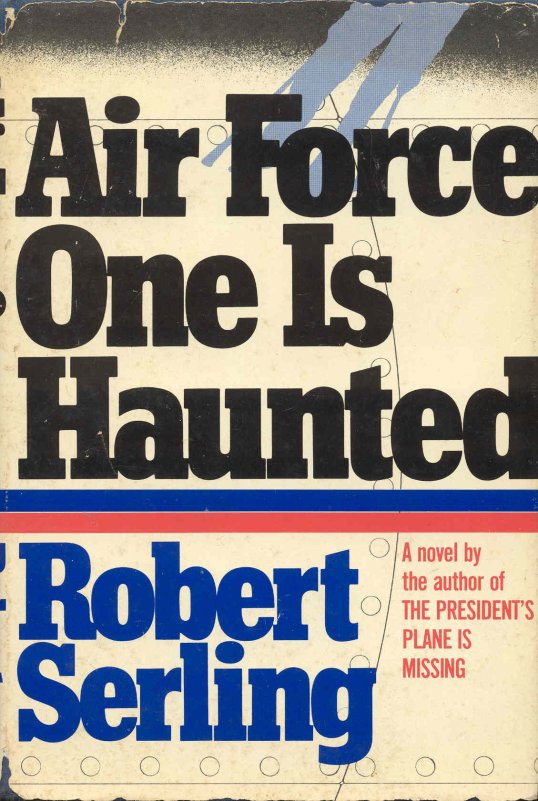
A few weeks ago, I was going through my aunt’s collection of old paperback novels, searching for anything that I could possibly review during October. While I found a good deal of promising books, I have to admit that I almost squealed for joy when I came across Air Force One Is Haunted.
Now, don’t get me wrong. I had never heard of the book before and I knew absolutely nothing about the plot. But I saw that title and I knew I just had to read it. I mean, seriously — Air Force One Is Haunted! That’s like the greatest title ever! I looked at that title and I asked myself, “What’s haunting Air Force One? Angry druids? Zombies? Succubi? Woodrow Wilson?” Either way, it sounded like it had the potential to be terrifying!
Then I got home and I read the book and I discovered that …. well, let’s just say that my imagination got ahead of me.
Air Force Is Haunted was originally published in 1985 and the author was not only a world-renowned aviation expert but he was also the brother of Twilight Zone-creator Rod Serling. So, it’s perhaps not surprising that Air Force One Is Haunted feels like an extended episode of The Twilight Zone. It’s one of those things where a good but conflicted person has the chance to do something that seems like it might be good for him but it will also be bad for the world at large. Fortunately, a ghost shows up and gives him a lot of advice.
The conflicted person, in this case, is President Jeremy Haines. Haines is in his second term and it seems like the entire world is falling apart around him. America’s in the middle of a great depression. Russia and China are teaming up to possibly try to take over the world. President Haines could always launch a first strike, which would wipe out Russia as a world power but which would also kill a lot of innocent civilians. He can’t make up his mind what to do and, as a result, people across the world are starting to view him as being weak. The President has even started to see a psychiatrist but they’re soon too busy having tasteful, mass market paperback-style sex to actually do anything about the President’s issues.
If only there was a mediocre ex-president that Haines could talk to and get some advice from! However, it appears that even Jimmy Carter is refusing to take his calls.
That’s when FDR shows up.
That’s right. It turns out that FDR is haunting Air Force One and, whenever President Haines boards the plane, he ends up getting advice from him. FDR has a lot of stories to tell about governing during an economic depression. He also says “Bully,” a lot, even though that was Teddy’s phrase.
Anyway, I think the book would have been a bit more interesting if FDR had turned out of be some sort of malevolent demon who intentionally gave President Haines bad advice that eventually led to World War III. And, to be honest, I kept expecting that too happen. I kept expecting FDR’s eyes to suddenly burn like hellfire as he said, “Burn it! BURN IT TO THE GROUND!” But that never happened. Instead, this is one of those books where FDR is the greatest dead president ever and, in the end, middle-of-the-road liberalism keeps the world safe for democracy.
As you’re probably guessing, this is kind of a corny book but it is written with a lot of sincerity. One gets the feeling that Serling really did feel that, if only America’s leaders just looked to the ghost of FDR, every problem in the world would be solved. The book is also overwritten in the way that well-meaning, melodramatic novels of the past often were. One character is identified as having a “gnawing ulcer of doubt” deep in the “bowels of his conscience.” (Ewwwwwww!) That’s the type of book that this is. It’s definitely a product of its time but, if you’re a history nerd like me, that’s not necessarily a bad thing.
If anyone is haunting Air Force One, I personally hope that it’s Rutherford B. Hayes. He was the best!
The year is 1820 and Balduin (Paul Wegener) has a problem.
Yes, he might be the most popular student at the University of Prague. And yes, he may be known as the greatest swordsman in the city. And yes, he might get invited to all of the parties and he might have a lot of friends who all look up to him. However, what Balduin does not have is money. While everyone else seems to be living a life of luxury, Balduin lives in a tiny room where his only luxury is the mirror in which he often appreciates his own reflection.
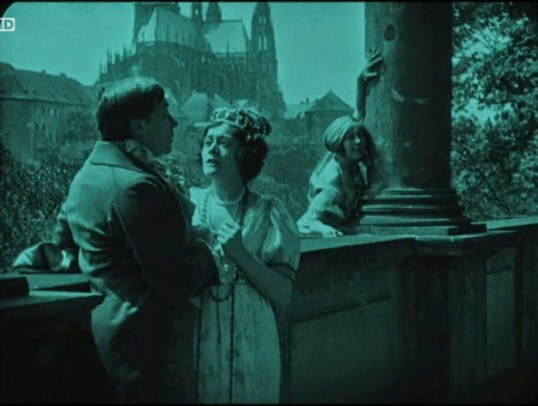
Balduin could really use some money because he’s fallen in love with Countess Margit (Grete Berger) but there’s no way that a member of the noble class could ever marry a destitute man. Instead, it appears that Margit is destined to marry her cousin, the Baron (Fritz Wiedermann).
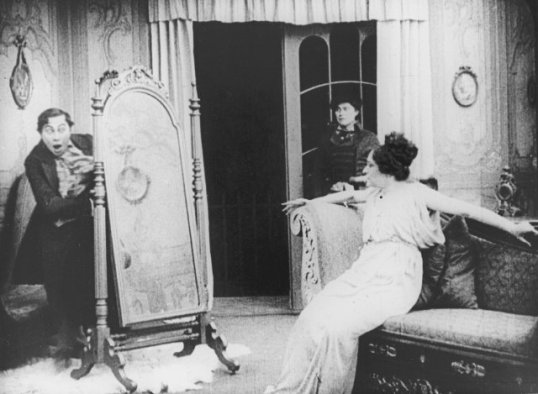
However, an old man named Scapinelli (John Gottowt) claims to have a solution. He promises to give Balduin a fortune in gold if he agrees to let Scapinelli remove just one thing from his room. Convinced that he’s fooled the old man because he has nothing of worth in his room, Balduin agrees to Scapinelli’s conditions. Scapinelli promptly turns to the mirror and, as Balduin watches, Balduin’s reflection steps out of the mirror and then leaves with Scapinelli. Balduin starts to laugh hysterically.
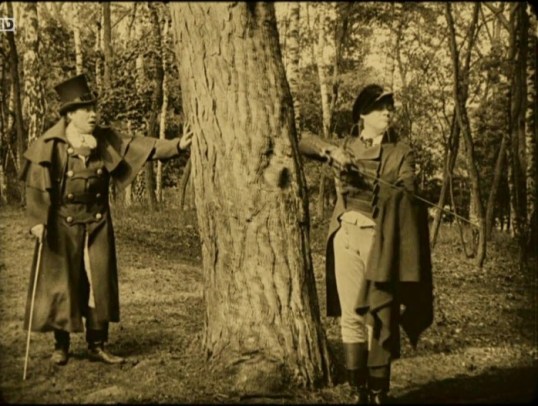
So now, Balduin has no reflection but he does have a lot of money! Balduin sets out to try to win Margit away from the Baron. Making things difficult is that, no matter where Balduin goes, someone always seems to be following him. Sometimes, it’s a mysterious wandering girl (Lyda Salmonova) who always seems to be intent on eavesdropping on every conversation that he has. And then other times, it’s his doppelganger! There’s now two Balduins running around Prague and, whenever the first Balduin finds himself alone with Margit, the second Balduin always seems to pop up and ruin everything.
Obviously something must be done….
This German silent film was first released in 1913 and it’s considered by some to be the first feature-length horror film. (Georges Méliès directed several films featuring ghosts and haunted houses but the majority of those films ran only a handful of minutes.) It’s also considered to be one of the first art films and, since Paul Wegener financed the production and distributed the film himself, also the first independent film. It was also the first film to make use of the type of double exposure tricks that we today take for granted. In 1913, audiences were stunned to see Paul Wegener apparently acting opposite himself. The film was a big hit, with none the less than psychoanalyst Otto Rank praising the film for its psychological depth.
Of course, to watch the film today, audiences have to adjust both their expectations and the way that they take in and process cinematic storytelling. As of this writing, The Student of Prague is 106 years old and it’s definitely a film of its time. The camera largely remains stationary and, from a modern perspective, the film is rather slow-paced. And yet, the film’s story remains rather intriguing. Despite the static camera work, the film manages to create and maintain a properly ominous atmosphere and a scene in which Balduin and Margit attempt to meet in a cemetery is effectively creepy. Paul Wegener’s performance holds up well. Largely eschewing the overly theatrical acting style that we usually tend to associate with silent cinema, Wegener gives a nuanced and effectively subtle performance as both Balduin and his doppelganger. When he’s acting opposite of himself, you don’t think about the fact that you’re witnessing an early camera trick. Instead, Wegener creates two separate but believable versions of the same character. The doppelganger represents all of Balduin’s undesirable impulses and everything that has kept Balduin from achieving happiness. By the end of the film, Balduin can’t live with his doppelganger but he can’t live without him as well.
The Student of Prague is an interesting piece of history and one that every true student of horror should watch and learn from at least once.
Allie Jones (Bridget Fonda) is an always fashionable software designer who is living in New York City and who has just broken up with her cheating lover, Sam (Steven Weber). She has pretty hair, a big apartment, a closet full of nice clothes, and a totally devoted gay best friend.
Hedra Carlson (Jennifer Jason Leigh) is shy and socially awkward and in need of someone who will give her a cute nickname like “Hedy.” She has pretty hair that’s just slightly less pretty than Allie’s, a job at a bookstore, a dead twin sister, a pair of really nice earrings, and a television that only seems to show old black-and-white movies.
Together …. THEY SOLVE CRIMES!
No, actually, they don’t. Instead, Hedy answers an ad that Allie placed about needing a new roommate. Even though Allie was thinking of asking another homeless woman to move in with her, Hedy impresses Allie by fixing her sink. Seriously, how can you turn down a potential roommate who knows how to do simple plumbing? Allie invited Hedy to live with her and, at first, everything is great. Hedy even brings home a dog that Allie quickly falls in love with. However, then Sam shows back up and we quickly discover just how obsessed Hedy has become with her roommate.
Single White Female was originally released way back in 1992 and, even if you’re viewing it for the very first time, you’ll probably feel a sense of deja vu while watching the movie. This is one of those films that has been so endlessly imitated and has been unofficially remade so many times that you probably already know everything that happens in the film, regardless of whether you’ve actually sat through it or not. A few years ago, there was a film called The Roommate that basically was Single White Female, just with a college setting and a bit less of a subversive subtext. As well, I’ve lost count of the number of Lifetime films that have basically ripped off Single White Female‘s plot. Any time that a new friend proves herself to be excessively clingy, chances are that she’s going to get compared to Jennifer Jason Leigh in this film.
And yet, despite all of the imitations, Single White Female still holds up surprisingly well. A lot of that is because Single White Female was directed by Barbert Schroeder. Schroeder started his career as a disciple of the French New Wave and, much like Paul Verhoeven, his American films tend to be genre films with just enough of a subversive subtext to stick in your mind afterwards.
For example, Single White Female is often describes as being a film about “the roommate from Hell” but what always seems to be missed is that, especially during the film’s first half, Allie is often as bad of a roommate as Hedy. For instance, when Allie comes home late after spending two days with Sam, Hedy is pissed off and waiting for her. On the surface, the scene is the first indication that Hedy has become obsessed with Allie. But, at the same time, Hedy actually is making a valid point. After repeatedly telling Hedy that she wants nothing to do with Sam, Allie runs off and spends two days with him without bothering to call home once. Though Hedy may have been a bit too quick to yell, she still had every right to be annoyed.
In fact, Allie really is a bit of self-centered character. She impulsively invited Hedy to live with her and then, just as impulsively, she gets back together with Sam and decides that it’s time for Hedy to move out. Of course, then Hedy tosses a dog out of a window and you pretty much lose whatever sympathy you may have had for her.
Still, you can’t help but feel that, just as Hedy wants to be Allie, there’s a part of Allie that would like to be Hedy. Hedy does all the things that Allie’s scared to do. When Allie is sexually harassed and nearly raped by a client, Hedy’s the one who actually gets revenge. While Allie tries to get over and suppress her anger at Sam, Hedy’s the one who acts on that anger. Just Hedy seems to need Allie’s life to be happy, Allie seems to need Hedy’s anger to survive. In short, there’s a lot more going on underneath the surface of Single White Female than its reputation might lead you to presume.
Not surprisingly, the film is dominated by Jennifer Jason Leigh’s performance. When Hedy first appears, Leigh plays her as just being slightly off. She has some obvious confidence issues but, at the same time, she comes across as being so innocent and naive that you can’t help but want to protect her. You find yourself wondering how she could have possibly survived living in a city like New York. It’s only as the film progresses that you start to discover that Hedy was never particularly naive and everything that she’s done and said has basically been about manipulating the people around her. And yet, even after Hedy has started killing dogs and people, you can’t help but feel a strange empathy (though not necessarily sympathy) for her. There’s an emptiness to Hedy, an emptiness that she attempts to fill by stealing the personalities of the people around her and Leigh does a great job of expressing the pain that would come from not having an identity of your own. Plus, poor Hedy just seemed so happy with Allie said that she liked her earrings! I mean, I just can’t imagine being that insecure but I get the feeling it would really suck.
(Fortunately, I’ve also never really had a truly bad roommate situation. One advantage of having three older sisters is knowing that you’ll always have someone to stay with.)
Despite all of the imitations and rip-offs that have come out over the years, both Single White Female and Jennifer Jason Leigh’s performance hold up remarkably well. I’d recommend watching it before inviting anyone to come live with you. If nothing else, you’ll at least learn what stiletto heels are really for.
(It’s tradition here at the Lens that, every October, we watch the original Little Shop of Horrors. And always, I start things off by telling this story…)
Enter singing.
Little Shop…Little Shop of Horrors…Little Shop…Little Shop of Terrors…
Hi! Good morning and Happy October the 2nd! For today’s plunge into the world of public domain horror films, I’d like to present you with a true classic. From 1960, it’s the original Little Shop of Horrors!
When I was 19 years old, I was in a community theater production of the musical Little Shop of Horrors. Though I think I would have made the perfect Audrey, everybody always snickered whenever I sang so I ended up as a part of “the ensemble.” Being in the ensemble basically meant that I spent a lot of time dancing and showing off lots of cleavage. And you know what? The girl who did play Audrey was screechy, off-key, and annoying and after every show, all the old people in the audience always came back stage and ignored her and went straight over to me. So there.
Anyway, during rehearsals, our director thought it would be so funny if we all watched the original film. Now, I’m sorry to say, much like just about everyone else in the cast, this was my first exposure to the original and I even had to be told that the masochistic dentist patient was being played by Jack Nicholson. However, I’m also very proud to say that — out of that entire cast — I’m the only one who understood that the zero-budget film I was watching was actually better than the big spectacle we were attempting to perform on stage. Certainly, I understood the film better than that screechy little thing that was playing Audrey.
The first Little Shop of Horrors certainly isn’t scary and there’s nobody singing about somewhere that’s green (I always tear up when I hear that song, by the way). However, it is a very, very funny film with the just the right amount of a dark streak to make it perfect Halloween viewing.
So, if you have 72 minutes to kill, check out the original and the best Little Shop of Horrors…
Last night, while overseeing the first day of horrorthon, I still found the time to turn over the Lifetime Movie Network and watch the 2019 thriller, Deadly Excursion!
Why Was I Watching It?
The film premiered way back in January. I watched it on Lifetime but, for some reason, I didn’t get a chance to review it. I may have been busy trying to keep up with all the Oscar news. Who knows? So, when I saw that Deadly Excursion would be re-airing on the Lifetime Movie Network last night, I was like, “Yay! It’s a second chance to do the right thing!”
What Was It About?
Sam (Samire Armstrong) needs a vacation! Not only is she recently separated from her cheating husband (Corin Nemec) but her daughter, Ellie (Alexandria DeBerry), will soon be leaving home. Sam and Ellie head down to Florida where, during their first night in paradise, Sam meets the charming Javier (Callard Harris) and Ellie meets Javier’s brother, Ian (Jonathan Bouvier). Javier invites Sam to spend the day on his boat. Despite barely knowing him, Sam agrees and decides to bring along her daughter.
Well, as you probably already guessed, Javier is not the nice guy that he pretends to be. Anyway, one thing leads to another and soon Sam and Ellie are trapped on an island where they have to figure out how to survive while being stalked by international criminals.
What Worked?
Paradise may be deadly but it’s still very nice to look at. The ocean, the island, the beach, the blue sky, the green trees, this is a film full of pretty views. This is one of those films that will make you want to take a vacation, though hopefully not a deadly one.
Samaire Armstrong and Alexandria DeBerry was well-cast and convincing as mother-and-daughter while Callard Harris and Jonathan Bouvier were both properly menacing. Harris especially did a good job of playing up Javier’s sleazy charm. And, of course, Corin Nemec was his usual likable self.
What Did Not Work?
Obviously, any melodrama is going to require a certain suspension of disbelief but Deadly Excursion occasionally took it a bit too far. Samaire Armstrong did the best that she could with the character but, at the start of the movie, Sam was often just too naive to be believed.
“Oh my God! Just Like Me!” Moments
I related to the relationship between Sam and Ellie. It reminded me of my own relationship with my mom, back when she was newly single and I was a bratty teenager.
The film also reminded me of the trip that my mom, my sisters, and I all took to Hawaii the summer after Erin graduated from high school. It was a fun trip to paradise but it was also kinda disturbing because there was this obviously sleazy beach bum who totally fell in love with my mom and who just would not stop showing up and trying to convince us all to come party with him at some isolated spot that apparently only he knew about. Finally, we were all just like, “Dude, it’s not going to happen!” He looked really depressed at the news but he stopped following us around. If only Sam had been willing to say the same thing to Javier.
Lessons Learned
Don’t get on a boat with a strange man that you barely know. Actually, if you needed a movie to teach you that, you should probably be a little bit concerned. I mean, it’s just common sense, right? But, still, it’s a good lesson. Another good lesson is that, if you ever do find yourself stranded in the middle of nowhere, a good plan is to call Corin Nemec. He’ll do his best to rescue you.





 Through the Shattered Lens