Scene That I Love: The End of Franklin J. Schaffner’s Planet of the Apes


The late director Franklin J. Schaffner was born 105 years ago today.

Though Schaffner won an Oscar for directing Patton, my favorite Schaffner film will always be Planet of the Apes.  In this scene, Charlton Heston discovers where he’s actually been for the entire movie.

Song of the Day: The Hunt by Jerry Goldsmith


The late composer Jerry Goldsmith was born 96 years ago today.  Over the course of his long career, he composed many classic film scores.  He was nominated for 18 Oscars and won for his score for The Omen.

Today’s song of the day comes from Goldsmith’s score for 1968’s Planet of the Apes!  Listen to this and try not visualize Charlton Heston being chased by a bunch of gorillas on horseback.

10 Oscar Snubs From The 1960s


Ah, the 60s. Both the studio system and the production code collapsed as Hollywood struggled to remain relevant during a time of great social upheaval. The Academy alternated between nominating films that took chances and nominating films that cost a lot of money. It led to some odd best picture lineups and some notable snubs!

1960: Psycho Is Not Nominated For Best Picture and Anthony Perkins Is Not Nominated For Best Actor

To be honest, considering that the Academy has never really embraced horror as a genre and spent most of the 60s nominating big budget prestige pictures, it’s a bit surprising that Psycho was actually nominated for four Oscars.  Along with being nominated for its production design and its cinematography, Psycho also won nominations for Alfred Hitchcock and Janet Leigh.  However, Anthony Perkins was not nominated for Best Actor, despite giving one of the most memorable performances of all time.  The film literally would not work without Perkins’s performance and, considering that Perkins pretty much spent the rest of his career in the shadow of Norman Bates, it’s a shame that he didn’t at least get a nomination for his trouble.  Psycho was also not nominated for Best Picture, despite being better remembered and certainly more influential than most of the films that were.

1962: The Man Who Shot Liberty Valance Is Almost Totally Snubbed

The Man Who Shot Liberty Valance was not totally snubbed by the Academy.  It received a nomination for Best Costume Design.  But still, it deserved so much more!  John Ford, James Stewart, John Wayne, Lee Marvin, Vera Miles, and the picture itself were all worthy of nominations.  Admittedly, 1962 was a year full of great American films and there was a lot of competition when it came to the Oscars.  Still, The Man Who Shot Liberty Valance definitely deserved a best picture nomination over the bloated remake of Mutiny on the Bounty.  Today, if the first Mutiny on the Bounty remake is known for anything, it’s for Marlon Brando being difficult on the set.  But The Man Who Shot Liberty Valance is still remembered for telling us to always print the legend.
1964: From Russia With Love Is Totally Snubbed

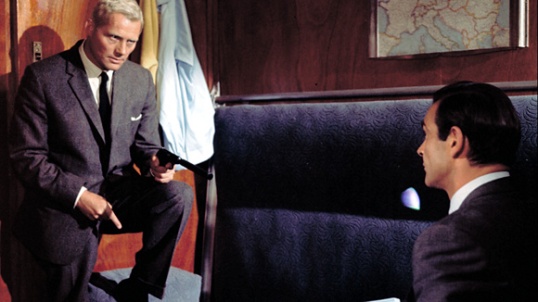
The same year that the Academy honored George Cukor’s creaky adaptation of My Fair Lady, it totally ignored my favorite James Bond film.  From Russia With Love is a Bond film that works wonderfully as both a love story and a thriller.  Sean Connery, Lotte Lenya, Robert Shaw, and Terence Young all deserved some award consideration.  From Russia With Love was released in the UK in 1963.  In a perfect world, it would have also been released concurrently in the U.S., allowing From Russia With Love to be the film that gave the the Academy the chance to recognize the British invasion.  Instead, Tom Jones was named the Best Picture of 1963 and From Russia With Love had to wait until 1964 to premiere in the U.S.  It was snubbed in favor of one of old Hollywood’s last grasps at relevance.

1964: Slim Pickens Is Not Nominated For Best Supporting Actor

Playing three separate roles, Peter Sellers dominates Dr. Strangelove: Or How I Learned To Stop Worrying And Love The Bomb.  But, as good as Sellers is, the film’s most memorable image is definitely Slim Pickens whooping it up as he rides the bomb down to Earth.  George C. Scott and Sterling Hyaden also undoubtedly deserved some award consideration but, in the end, Pickens is the one who brings the film to life even as he helps to bring society to an end.

1967: In Cold Blood Is Not Nominated For Best Picture

In Cold Blood, though not a perfect film, certainly deserved a nomination over Dr. Doolittle.  In Cold Blood is a film that still has the power to disturb and haunt viewers today.  Dr. Doolittle was a box office debacle that was nominated in an attempt to help 20th Century Fox make back some of their money.

1967: Sidney Poitier Is Not Nominated For Best Actor For In The Heat Of The Night

In 1967, Sidney Poitier starred in two of the films that were nominated for Best Picture but somehow, he did not pick up a nomination himself.  His restrained but fiercely intelligent performance in In The Heat Of The Night provided a powerful contrast to Rod Steiger’s more blustery turn.  That Poitier was not nominated for his performance as Virgil Tibbs truly is one of the stranger snubs in Academy history.  (If I had to guess, I’d say that the Actors Branch was split on whether to honor him for In The Heat of the Night or Guess Who’s Coming To Dinner or even for To Sir With Love and, as a result, he ended up getting nominated for none of them.)

1968: 2001: A Space Odyssey and Planet of the Apes Are Not Nominated For Best Picture

Neither one of these classic science fiction films were nominated for Best Picture, despite the fact that both of them are far superior and far more influential than Oliver!, the film that won that year.

1968: The Good, The Bad, and the Ugly Is Totally Ignored

Not even Ennio Morricone’s score received a nomination!

1968: Petulia Is Totally Snubbed

Seriously, I don’t know what was going on with the Academy in 1968 but it seems they went out of their way to ignore the best films of the year.  Richard Lester’s Petulia is usually cited as one of the definitive films of the 60s but it received not a single Oscar nomination.  Not only did the film fail to receive a nomination for Best Picture but Richard Lester, George C. Scott, Julie Christie, Shirley Knight, Richard Chamberlain, and the film’s screenwriters were snubbed as well.

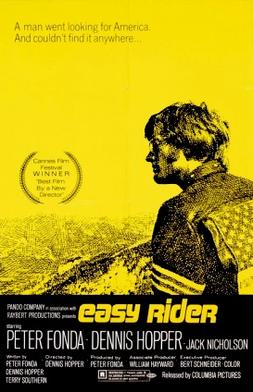
1969: Easy Rider Is Not Nominated For Best Picture

Yes, I know.  Easy Rider is a flawed film and there are certain moments that are just incredibly pretentious.  That said, Easy Rider defined an era and it also presented a portrait of everything that was and is good, bad, and timeless about America.  The film may have been produced, directed, and acted in a drug-razed haze but it’s also an important historical document and it was also a film whose success permanently changed Hollywood.  Certainly, Easy Rider’s legacy is superior to that of Hello, Dolly!

Agree? Disagree? Do you have an Oscar snub that you think is even worse than the 10 listed here? Let us know in the comments!

Up next: It’s the 70s!
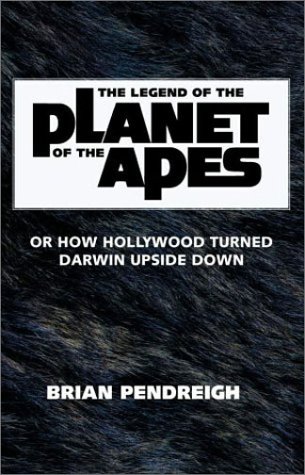
Book Review: The Legend of the Planet of the Apes: Or How Hollywood Turned Darwin Upside Down by Brian Pendreigh


Recently, while going through all the books that I’ve collected over the years, I came across a copy of The Legend of Planet of the Apes: Or How Hollywood Turned Darwin Upside Down.  It’s a book by a Scottish film critic named Brian Pendreigh and it takes a look at the Planet of the Apes film franchise, from the 1968 original all the way to Tim Burton’s now-forgotten remake.  Though I couldn’t find a copyright date in the book, it was obviously written long before the Planet of the Apes franchise was rebooted and sent in an entirely new direction by 2011’s Rise of the Planet of the Apes.

That’s okay, though.  The three recent Planet of the Apes films all had moments of brilliance and Andy Serkis probably deserved an Oscar nomination for his performances in all three of them but they have also tended to overshadow the original Planet of the Apes and its sequels and, as this book points out, the first 5 films were actually pretty good.  (Okay, okay — Battle of the Planet of the Apes isn’t great, even if it is entertaining.  But I defy you not to cry at the end of Escape From The Planet of the ApesBeneath the Planet of the Apes is wonderfully subversive with its abrupt and nihilistic ending.  Conquest of the Battle of the Apes is probably even more relevant today than it was in the 70s.)  While the majority of Pendreigh’s book focuses on the production of the original Planet of the Apes, he writes enough about both its sequels and the short-lived Planet of the Apes television show to make a convincing argument that the original franchise itself deserves to be held in higher regard than it often is.

It’s a good book, though I do wish Pendreigh had been a little bit less obvious in his loathing of Charlton Heston.  Certain writers will never forgive Heston for not being a liberal.  Heston, of course, was hardly the only Republican to be a star during the 50s and the 60s.  John Wayne, Jimmy Stewart, Gary Cooper, James Cagney (from the 50s onward), Robert Mitchum, and many others leaned to the right.  However, John Wayne, Gary Coper, Robert Mitchum, and even Jimmy Stewart were largely associated with westerns and war films, two genres that were already considered to be thematically conservative.  Heston, on the other hand, appeared in left-wing dystopian sci-films like Soylent Green, The Omega Man, and Planet of the Apes.  While other Hollywood conservatives were supporting the blacklist, Heston fought to get Orson Welles hired to direct Touch of Evil.  He appeared in film that were critical of capitalism and blind patriotism and fanatical militarism.  He did everything that a left-wing actor was supposed to do but he did it while voting Republican and a lot of film writers will never forgive him for it.  As a result, people far too often tend to act as if Heston’s films were good despite Heston when, in all actuality, Heston’s macho persona and his willingness to subvert it (or at the very least, his willingness to allow his directors to subvert it) is what made so many of his film memorable and important in the first place.  One reason why the endings of both Planet of the Apes and Beneath the Planet of the Apes continue to resonate after all these years is because they featured Charlton Heston, rendered helpless and driven mad.

Admittedly, when it comes to dismissing Heston, Pendreigh is not as bad as some.  He acknowledges the importance of Heston’s performance to the success of the original Planet of the Apes.  And yet, he can’t resist complaining about Heston’s later political activities or his admittedly pompous view of himself.  Anytime an actor is quoted as saying something good about Heston, Pendreigh is sure to also include a quote from someone saying something negative.  It’s a distraction that takes away from discussing the films.  One gets the feeling that the author was deeply troubled by the fact that praising Planet of the Apes would require him to also offer up some praise for the film’s star.

But …. no matter!  Regardless of however he felt about Charlton Heston, Brian Pendreich clearly appreciated the Planet of the Apes films and that genuine appreciation comes through in this book.  In fascinating and rewarding detail, it explores the controversy of who, among the many people who worked on developing the film, deserves the credit for coming up with the original’s classic final scene.  It examines the circumstances that led to Edward G. Robinson leaving the role of Dr. Zaius.  It takes a look at the career of Pierre Boulle, who wrote the somewhat forgotten novel that led to the films in the first place.  And it provides a fair look at what worked (and occasionally didn’t work) about the film’s sequels.

If you’re a fan of the original and its sequels, this book is a must-have.

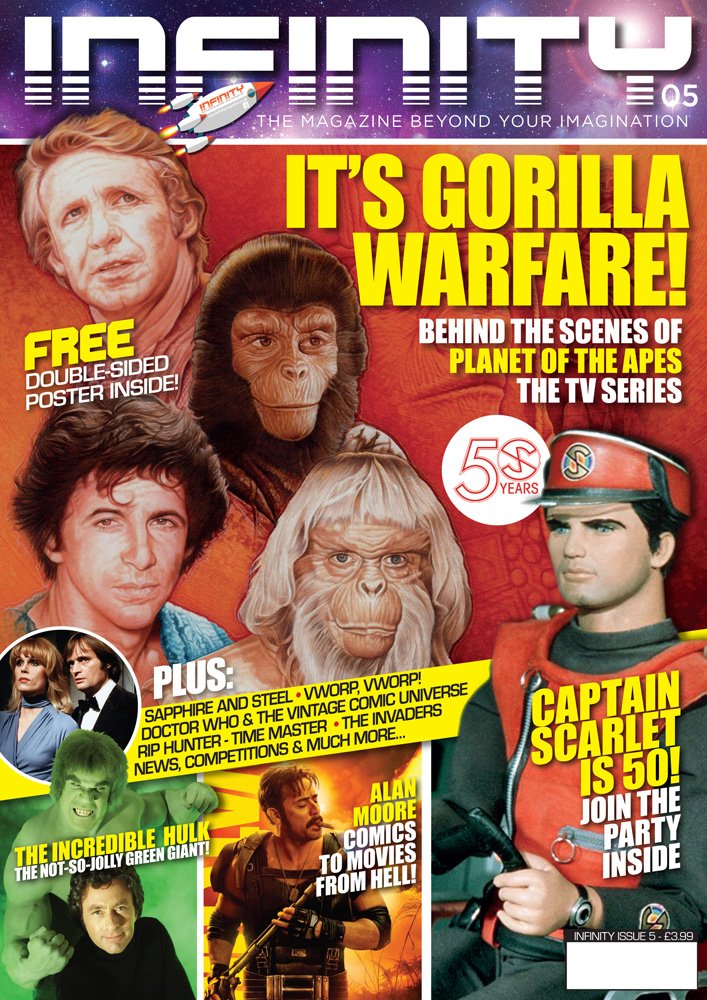
Great Moments In Television History: Planet of the Apes The TV Series


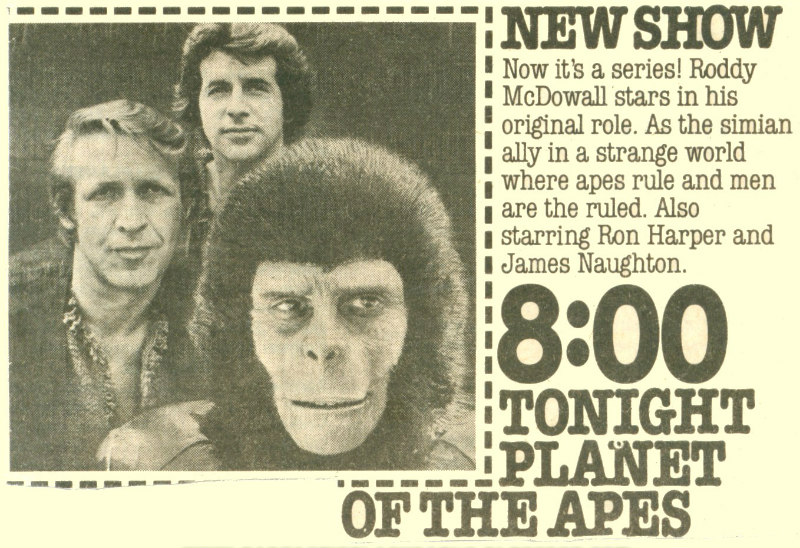
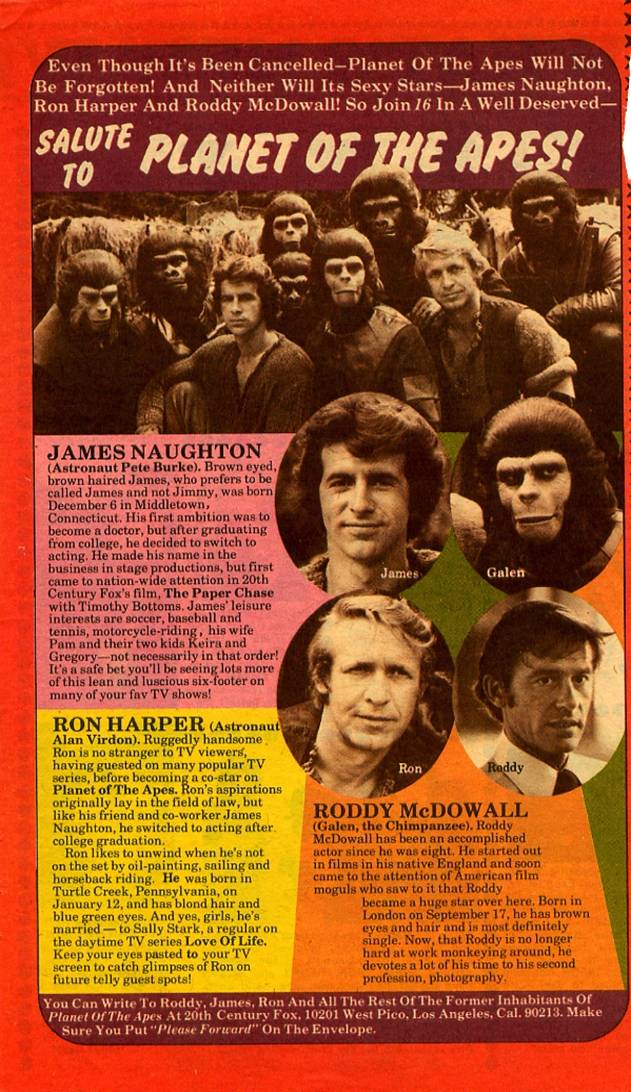
On September 13th, 1974, audiences that tuned into CBS saw the premiere of a new TV show with a familiar premise.

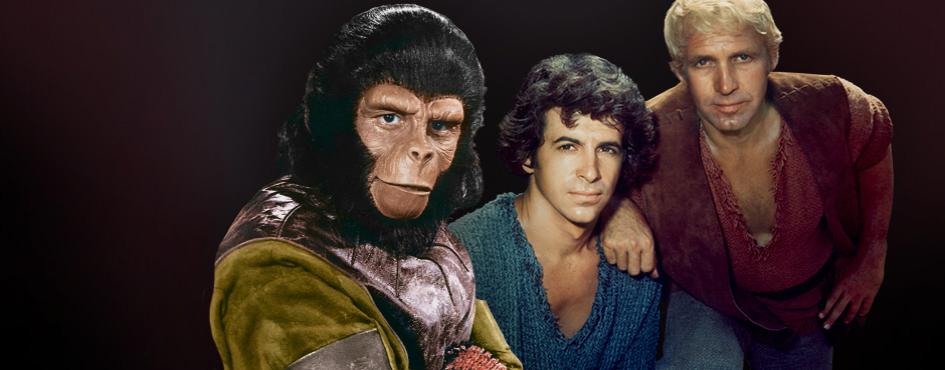
The episode opened with a spaceship crashing on an Earth-like planet.  One of the astronauts was killed.  Two of the astronauts — Alan Virdon (Ron Harper) and Peter Burke (James Naughton) — survived.  Virdon and Burke discovered that the planet was inhabited by humans who, despite it being the year 3085, were living in medieval villages.  The humans were kept in a state of serfdom by the Apes who ruled the planet.  The Apes spoke English and had formed their own society of militaristic gorillas and scientific-minded chimpanzees.  Looking through an old book, Virdon and Burke discovered that they had crash landed on Earth, far in the future!

You know the drill.  Planet of the Apes was based on the famous series of films, with the first pilot episode featuring Virdon and Burke discovering in less than an hour what took Charlton Heston a journey into the forbidden zone to figure out.  Because the humans had “blown it up,” the Earth was now ruled by Apes!

As fugitives from ape justice, Virdon and Burke spent the next fourteen episodes being pursued by the fanatical General Urko (Mark Lenard), who was determined to capture the two astronauts before they revealed that Apes had not always been the planet’s masters.  Traveling with Virdon and Burke was a sympathetic chimpanzee named Galen (Roddy McDowall).  Usually just one step ahead of Urko, Virdon, Burke, and Galen traveled from village to village, seeking a way to fix their spaceship so that they could escape the Planet of the Apes.

Planet of the Apes got off to a strong start with an exciting and concise first episode but the series quickly ran out of gas.  Because Virdon, Burke, and Galen had to flee to a new village at the end of every episode, the show was never able to devote much time to exploring the most intriguing thing about the original Planet of the Apes films, the culture of a world where humans were subservient to apes.  Because Virdon and Burke were largely interchangeable with little in the way of backstory or personality, the show very quickly ran out of a stories to tell.  It didn’t take long for Planet of the Apes to start repeating itself with multiple episodes in which Virdon or Burke got involved in local village drama before Urko showed up and forced them to flee again.

There were some good moments, though.  Probably the highlight of the series was the third episode of the series, The Trap.  In this episode, Virdon, Burke, Galen, and Urko all reach the ruins of San Francisco at the same time.  After an earthquake buries Burke and Urko in a subway tunnel, the two of them are forced to work together to survive.  Burke and Urko make an unexpectedly good team and Urko seems like he’s on the verge of a change of heart when he spots an old poster for the San Francisco zoo, one that features a caged gorilla being gawked at by humans.  Urko’s angry reaction to seeing the poster is well-acted by Mark Lenard and, for a few minutes, his obsession with capturing Virdon and Burke can be understood.  It wouldn’t last but, in that moment, Urko went from being just another villain to being a complex character with his own clearly defined motivations.

The show also benefited from Roddy McDowall, who, by this point, was an expert at acting while wearing chimpanzee makeup.  McDowall brought heart and humor to the role of Galen, even if he was too often treated like a servant by Burke and Virdon.  Whenever the two humans were scared to go out in public, they sent Galen off to gather information.  Galen did a good job but he still deserved better.

Finally, Planet of the Apes had one of the coolest opening title sequences of all time!  Take a look:

Though cancelled after only 14 episodes, Planet of the Apes The Television Series lives on.  Episodes can currently be seen on MeTV.

10 Sci-Fi Films That Should Have Been Nominated For Best Picture


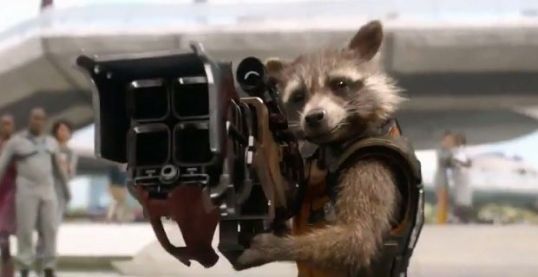
Guardians-of-the-Galaxy-rocket-with-gun

Over the past few years, it’s gotten a little bit more common to see science fiction films nominated for best picture.  While a sci-fi film has yet to win best picture, it is no longer as much of a shock to see a science fiction film nominated.  At least not as much as it is to see a horror film nominated.

That said, it’s still an uphill fight.  Here are 10 science fiction films that I feel could and should have been nominated for best picture:

  1. Metropolis (1927)

Fritz Lang’s expressionistic silent epic remains one of the most influential films of all time.  Metropolis was eligible to be nominated during the first year of the Oscars, a year in which not one but two awards for best picture were handed out.  That Metropolis was nominated for neither Best Production nor Unique and Artistic Picture was a huge missed opportunity.

2. The War of the Worlds (1953)

This film may be over 60 years old but it’s still one of the best alien invasion films ever made.  And yes, I prefer the original to the Spielberg version.

3. The Time Machine (1960)

Morlocks, Eloi, and war … oh my!

4. Planet of the Apes (1968)

“A planet where apes evolved from man?”  No, not quite.  “YOU BLEW IT UP!  GODDAMN YOU TO HELL!”  Yes, that’s better.  Today, Planet of the Apes may seem more than a little bit campy but it’s still an unusually intelligent social satire.  Charlton Heston’s persona has never been better used.

5. 2001: A Space Odyssey (1968)

Can you believe that this classic from Stanley Kubrick was not nominated?  Kubrick got a directing nomination but, when it came to picking the best films of the year, the Academy nominated Oliver! and Rachel, Rachel.

blade%20runner%20final%20cut

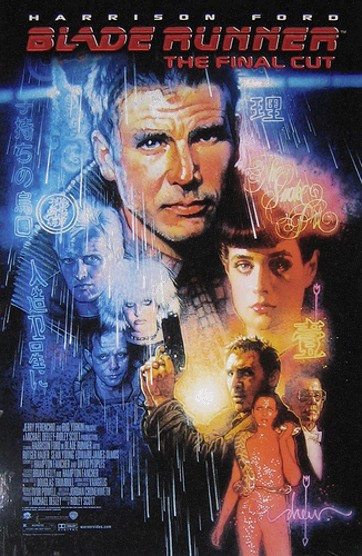
6. Blade Runner (1982)

Blade Runner is today recognized as a classic but it originally received mixed reviews and was ignored by the Academy.  At the very least, Rutger Hauer deserved a nomination.

7. Never Let Me Go (2010)

This underrated clone drama was sadly overlooked.  Andrew Garfield’s performance is heartbreaking.

Film Review Under the Skin

8. Under the Skin (2014)

This enigmatic film was probably too bizarre and unsettling for the Academy but Jonathan Glazer’s direction and Scarlett Johansson’s performance make Under the Skin a classic.

9. Guardians of the Galaxy (2014)

Whenever I rewatch Guardians of the Galaxy, I’m happy to discover that it still holds up as a wonderful piece of entertainment.  It remains my favorite film of 2014.

10. Ex Machina (2015)

Quite simply an amazing film, this is a Metropolis for the 21st Century.


Trash Film Guru Vs. The Summer Blockbusters : “Dawn Of The Planet Of The Apes”


download

This is gonna be one easy review to write because it all boils down to this : you really can believe all the hype, Dawn Of The Planet Of The Apes is flat-out fucking awesome, and you need to go out and see this flick immediately.

My job is done, I’m finished, goodnight.

But I guess I do have at least a little bit more to say —

Screen-Shot-2014-05-08-at-8.56.21-AM-620x400

I wasn’t a big fan of Cloverfield by any means, but I’m turning into a big fan of Matt Reeves. I know it’s heresy to some, but I thought that Let Me In was every bit as good as its Swedish progenitor, and with this latest — and, frankly, best — installment in the venerable Apes franchise,  Reeves has shown himself to be a director who is fully hitting his stride. The bigger and bolder the project, the more he seems to rise to the occasion. I frankly don’t even know how you go about eliciting good performances from actors who are only there for the purpose of having a bunch of hair overlaid onto their faces via computer, but he did it here. Andy Serkis, as ape leader Caesar, and Toby Kebbell, as his primary (and creepily duplicitous) rival, Koba, both turn in Oscar-caliber work on the basis of their facial expressions alone. They’re gonna wow you, folks, no lie.

As for the human actors playing — well, human parts, Jason Clarke is solid as stand-up guy Malcolm, apparent real-life asshole in the extreme Gary Oldman does typically competent (if, to be perfectly fair, unspectacular) work as survivalist head honcho Dreyfus, and Kodi Smit-McPhee is extremely convincing as Malcolm’s teenage son, Alexander (plus, he can be seen reading Charles Burns’ Black Hole, so bonus points for that). About the only weak link comes by way of nominal love interest Keri Russell, whose “concerned as shit” look at all times begins to grate pretty early on. But when you consider the fact that all these people spent pretty much the entire time in front of a blue (or maybe it was green) screen, getting only one subpar performance from the bunch is pretty good. And who knows? Maybe Russell simply can’t help coming off as worried 24/7.

PoA_THUMB

My only other minor quibble here is with the title — when a film called Rise Of The Planet Of The Apes is followed by one called Dawn Of The Planet Of The Apes, you gotta wonder when the buildup is going to stop and we’re finally gonna get down to the shit. Or maybe we’re looking at a 20-part story here and we’ve still got plenty of stage-setting to go, in which case we’ll be treated to Prelude To The Planet Of The Apes and We’re Still Getting To The Planet Of The Apes next.

Hey, I did say it was a minor quibble, did I not?

Dawn-Of-The-Planet-Of-The-Apes3-e1396236946120

Apart from that, this has everything you’d want in a big-budget summer blockbuster, and quite a bit more than you’d honestly expect : there’s pathos, melodrama, palace (if your palace is a tree) intrigue, cheap scares, high-octane thrills, elaborately-staged battle sequences, and a genuine sense of urgency to the proceedings. Events — and tension — gradually build to the point of inevitability, and the film’s third act actually delivers in terms of its promised payoff.  And for those of you who are tired of James Franco’s ever-evolving shtick — whatever it is — rest assured that he doesn’t even pop up in a flashback sequence.

Ya know what? Let’s not even do Dawn Of The Planet Of The Apes the disservice of comparing it to other summer popcorn flicks — this leaves typical blockbuster fare like The Avengers or Star Trek so far back in the dust it’s not even funny. What Reeves has made here is one of the very best films you’ll see all year, even if big-budget sci-fi grandiosity is not your thing. This is eloquent, spectacular, undeniably powerful drama of the highest order. It’s everything and the kitchen sink plus one of those nifty fancy programmable faucets all attached to a fancy-ass 300-pound granite countertop.

Okay, I’m finished with the italics, promise. If you don’t like this, you don’t like movies. My job here really is done.

‘Dawn of the Planet of the Apes’ Prequel Shorts


dawn-of-the-planet-of-the-apes-poster-janee-meadows

(Above is an exclusive poster found on Collider.com)

I am having a hard time remembering the last time I made a post like this that wasn’t a review, so I think you can use this article as a measure of just how excited I am for ‘Dawn of the Planet of the Apes’. I, like a lot of people, was completely surprised by how good ‘Rise of the Planet of the Apes’ was. It rejuvenated a franchise (one I really enjoy) that was most recently tarnished by a really, really bad remake. It was so good that a sequel was not only inevitable, but desired.

Luckily Fox is fulfilling that desire next week with the release of the sequel, which has received universal praise from the few reviews that have already been released. The out-pour of this praise definitely has me more excited than I was beforehand…but it is not the true source of the hype that has me ready to buy a ticket for a Thursday night showing for the first time since ‘The Dark Knight Rises’. No, the source of that hype is a series of short films that act as a bridge between ‘Rise’ and ‘Dawn’, examining (quite artistically, surprisingly) the events that occurred after the outbreak of the Simian Flu at the end of ‘Rise’. These shorts are a collaboration of 20th Century Fox and Motherboard and can be viewed below:

‘Spread of Simian Flu: Before The Dawn of the Apes (Year 1)’ (dir. Isaiah Seret)

‘Struggling to Survive: Before The Dawn of the Apes (Year 5)’ (dir. Daniel Thron)

‘Story of the Gun: Before The Dawn of the Apes (Year 10)’ (dir. “thirtytwo”)

What I love most about these is how they are so unlike most “viral” shorts. These aren’t straight forward stories like you see with the Marvel One-Shots. These are actually artistic, emotional and thought provoking films, to the point in which I saw people commenting on them being pretentious…music to my ears to be honest with you. Each explore themes of their own while also wonderfully adding to the atmosphere and mythos of the new ‘Apes’ series. Furthermore, the very fact that the studio clearly gave the writers and directors of each liberty to not “play it safe” with a piece of marketing revolving around a multi-million dollar franchise just gives me a ton of confidence in the franchise on the whole. It is this, more than the reviews, that has me excited to see ‘Dawn of the Planet of the Apes’ next week, and maybe they will do the same for you.

———————————————————————————————————————-

Along with the prequel shorts, which are directly related to the events of the film, they also released a documentary which can be seen below. It too is incredibly well made, and is a surprisingly poignant true story of apes and human interactions during and after the events of medical testing and human warfare.

‘The Real Planet of the Apes’ 

Trailer: Dawn of the Planet of the Apes (Official)


Dawn of the Planet of the Apes

One of my most-anticipated films this summer of 2014 has released it’s latest trailer and it shows the central conflict which will drive this sequel to 2011’s Rise of the Planet of the Apes.

It’s been many years since the pandemic from the “simian flu” tore through the planet as shown during the end credits of the first film. Now the surviving humans must now contend with the growing population of hyper-intelligent apes led by Caesar from the first film.

While the first film showed the rise of Caesar as a revolutionary leader it looks like this sequel will now put him in the role of war leader as his apes must now gear up for a war with the surviving humans that can’t seem to be avoided.

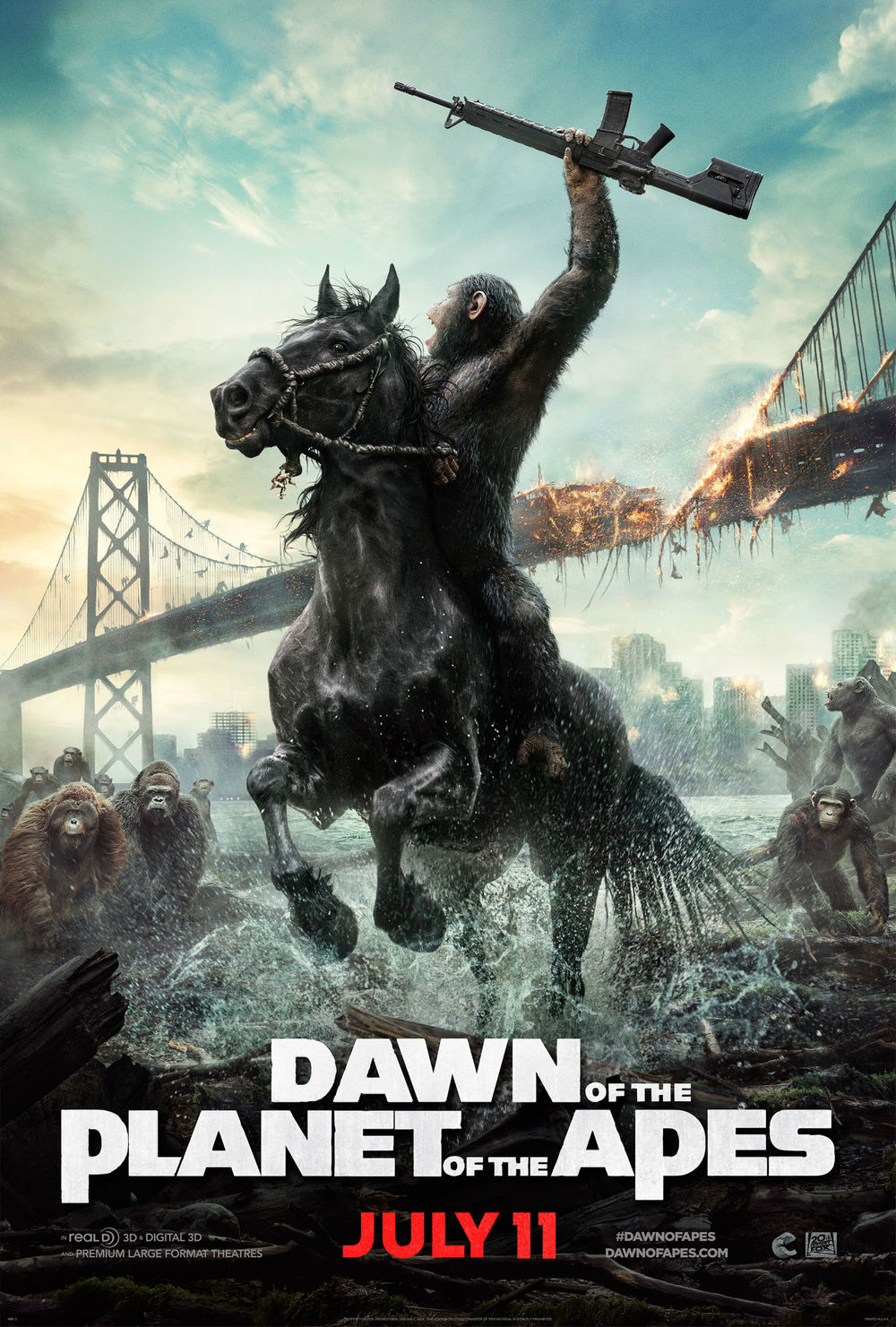
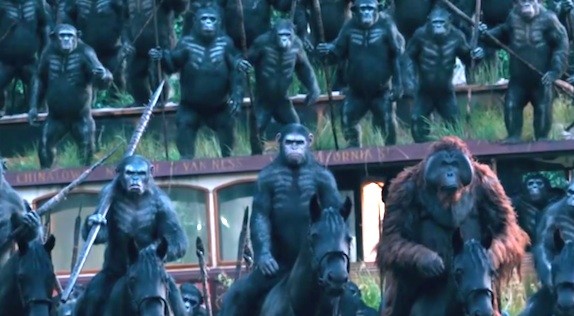
Plus, all I can say is this: Apes on horses with assault rifles.

Dawn of the Planet of the Apes is set for a July 11, 2014 release date.

Trailer: Dawn of the Planet of the Apes


Dawn of the Planet of the Apes

To say that 2011’s Rise of the Planet of the Apes went a long way in washing out the taste out of fans mouth after having seen Tim Burton’s reboot of Planet of the Apes would be an understatement. Rupert Wyatt was able to bring the franchise back to prominence by actually treating the story as a sort of scifi allegory instead of a platform to once again exercise one’s filmmaking quirks.

It was a no-brainer that a sequel will follow up the success of the 2011 film. But with a fast-moving schedule there were several casualties. Rupert Wyatt didn’t think he had enough time to shoot the film the way he wanted to so he was replaced by Matt Reeves. James Franco is also gone from the project. Instead we get several veteran actors like Gary Oldman, Jason Clarke, Keri Russell and Kirk Acevedo joining Andy Serkis.

The film seems to take places a decade or so after the release of the deadly virus at the end of the first film. Humanity has survived both the virus and the wars which followed it, but civilization as we know it now are a thing of the past. With humanity trying to rebuild it must now deal with a rising nation of genetically-enhanced apes led by Andy Serkis’ Caesar. With Gary Oldman on one side seeming to be the leader of humanity’s survivors I don’t see peace as being a goal in this film.

Dawn of the Planet of the Apes is set for a July 11, 2014 release.