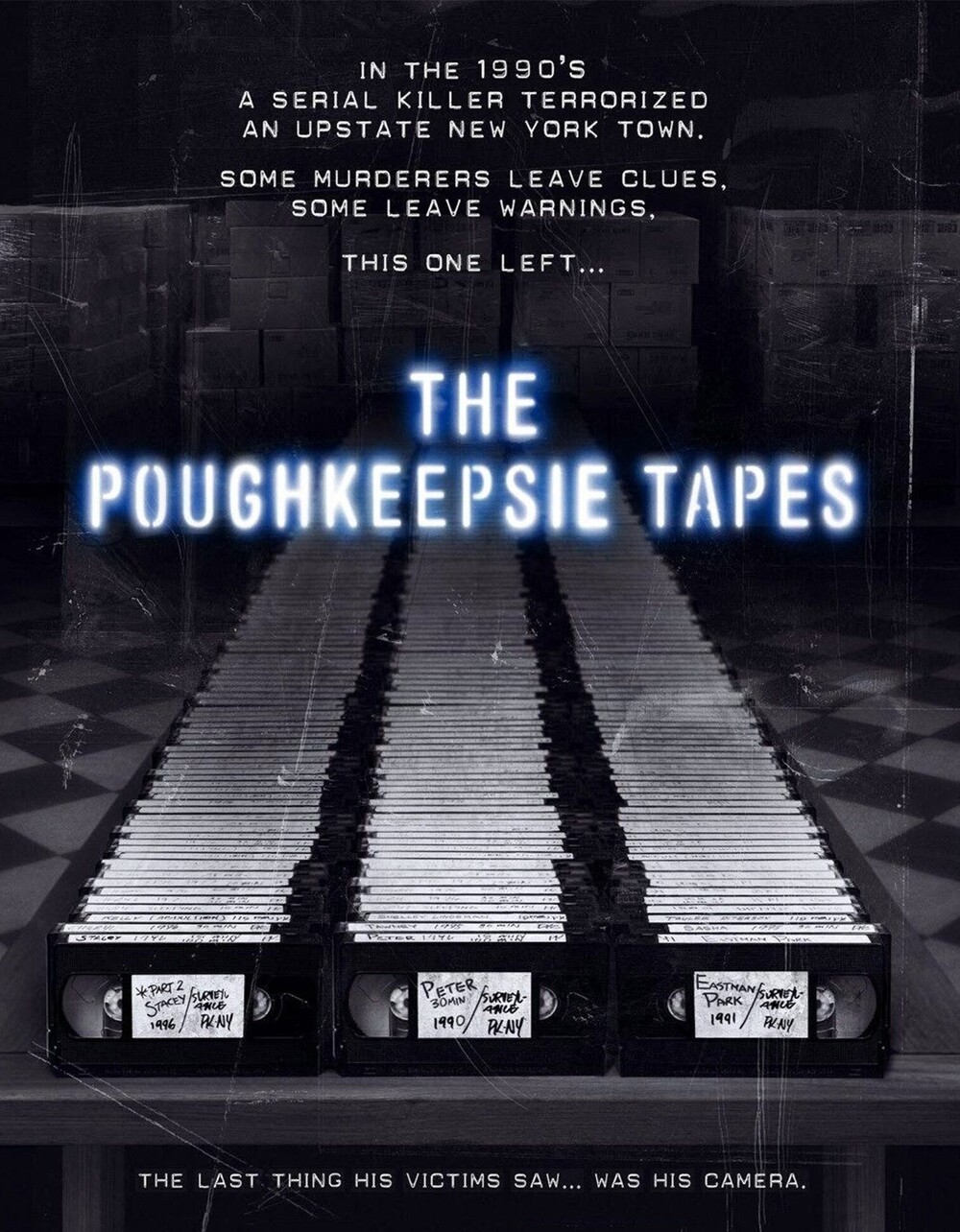
Review: The Poughkeepsie Tapes (dir. by John Erick Dowdle)


“She kept covering her eyes, whispering ‘please take me home, please take me home, please take me home…’ a week later I got her outta there and I brought her home… but she just kept repeating it. At that point I realized… she didn’t mean OUR home.” — Victoria Dempsey

The Poughkeepsie Tapes emerges from the shadows of independent horror like a grainy artifact unearthed from some forgotten police evidence locker, its found-footage aesthetic not merely a gimmick but a deliberate plunge into the abyss of real-world atrocity documentaries. Directed by the Dowdle brothers—John Erick and Drew—this 2007 effort masquerades as a television special pieced together from hundreds of VHS recordings left behind by a serial killer known only as the Waterworks Killer, operating in upstate New York during the late 1990s and early 2000s.

What sets it apart in the crowded found-footage subgenre is its unyielding commitment to procedural authenticity: interviews with beleaguered detectives, forensic psychologists, and shell-shocked family members intercut with the killer’s own unfiltered home movies, creating a mosaic that feels less like scripted cinema and more like a leaked FBI file. The film clocks in at a taut 86 minutes, yet its impact lingers far longer, burrowing into the psyche with the relentless persistence of damp rot. For those weaned on the polished shocks of mainstream slashers, this is horror stripped bare, a methodical dissection of evil that prioritizes psychological dread over jump scares or excessive gore.

From the outset, the mockumentary framework establishes an ironclad verisimilitude, opening with a SWAT raid on a nondescript Poughkeepsie home where authorities uncover not just dozens of bodies meticulously cataloged in black trash bags, but over 800 videotapes chronicling the killer’s decade-long reign of terror. These tapes, purportedly shot on consumer-grade camcorders, capture everything from mundane abductions in broad daylight to the most intimate depravities imaginable, all rendered in that telltale analog fuzz that evokes early 2000s true-crime broadcasts.

Edward Carver—unforgettably embodied by Ben Messmer—remains an enigma, never fully named in the tapes themselves, his face often obscured, voice distorted into a childish lisp that veers from playful taunting to guttural rage, embodying pure, motiveless malignancy without the monologuing backstory that humanizes figures like Hannibal Lecter. Messmer invests the role with a chilling physicality, his lanky frame clad in a grotesque yellow rain slicker becoming an iconic silhouette of suburban nightmare. Yet the film’s true brilliance lies in its restraint; rather than revel in spectacle, it lets the banality of evil seep through, as when Carver methodically dresses a victim in ballerina attire for a mock performance, or forces another into a twisted tea party, the domesticity amplifying the horror. This isn’t about blood sprays or final girls—it’s a taxonomy of sadism, each tape labeled with clinical precision: “Victim 31 – Jennifer,” “Victim 42 – Dance Recital.”

The ensemble of talking heads grounds the proceedings in stark realism, with standouts like Stacy Chbosky as Cheryl Dempsey, the survivor whose tormented recollections form the emotional core of the investigation. Their discussions—ranging from behavioral profiling to Carver’s fetishistic rituals—mirror actual criminology seminars, lending intellectual weight without descending into exposition dumps. These interludes humanize the victims, transforming statistics into shattered lives: a missing jogger here, a single mother there, their absence rippling through communities with quiet devastation. The Dowdles excel at pacing these elements, crosscutting between tape horrors and investigative fallout to build a suffocating tension, where the real terror is Carver’s omnipresence—he films himself stalking malls, taunting police press conferences, even infiltrating a family Thanksgiving. In a genre often criticized for laziness, The Poughkeepsie Tapes weaponizes its format, making viewers complicit voyeurs, questioning why we’re watching at all.

Thematically, the film probes the pornography of violence, echoing the likes of Henry: Portrait of a Serial Killer or the Paradise Lost documentaries, but with a rawer edge that anticipates the analog horror wave of the 2020s. It grapples with voyeurism’s allure, as detectives pore over tapes like addicts, one admitting the footage “gets into your dreams.” Carver’s escalating fetishes—binding victims in spiderwebs of duct tape, staging puppet shows with their limbs—escalate from perverse play to outright desecration, culminating in a sequence involving a captured police officer that tests even hardened viewers. Yet amid the depravity, glimmers of perverse artistry emerge: the meticulous framing of shots, the almost balletic choreography of assaults, suggesting a mind as creative as it is corrupt. This duality fascinates—evil as both banal and sublime—without ever excusing it. The film’s independent ethos shines through its low-budget ingenuity; shot on digital video run through VHS filters, it achieves a patina of age that rivals big-studio recreations. Sound design deserves special mention—the muffled whimpers, the hiss of tape rewind, the sudden shrieks—crafting an auditory assault that lingers in the ears long after the screen fades.

Of course, no film this ambitious escapes imperfection. The grainy visuals, while immersive, occasionally border on opacity, turning key moments murky when clarity might heighten the impact; a few tapes feel repetitious, padding runtime before the finale’s revelations. Acting varies—some interviews veer toward community theater stiffness, and the killer’s voice modulation can grate like a parody of itself. Pacing sags in the midsection amid procedural minutiae, demanding patience from those expecting non-stop carnage. Distribution woes didn’t help; shelved for years post-Tribeca premiere, it finally surfaced on home video in 2017, its cult status now cemented online but still niche. These are quibbles, though, in a landscape of forgettable slashers; they don’t undermine the core achievement.

Ultimately, The Poughkeepsie Tapes endures as a gut-punch reminder of horror’s primal function: to confront the void within humanity. It doesn’t titillate or moralize—it documents, with unflinching gaze, the machinery of monstrosity. Fans of vérité terrors like Lake Mungo or The Bay will find kin here, a film that trades spectacle for seepage, leaving stains no bleach can remove. In an era of sanitized streaming chills, its refusal to look away remains a defiant virtue. Seek it out on a lonely night, but keep the lights on after.

Retro Television Review: Malibu, CA 1.25 “The Yacht”


Welcome to Retro Television Reviews, a feature where we review some of our favorite and least favorite shows of the past!  On Thursdays, I will be reviewing Malibu CA, which aired in Syndication in 1998 and 1999.  The entire show is currently streaming on YouTube!

This week, Jason and Scott do something stupid!

Episode 1.25 “The Yacht”

(Dir by Gary Shimokawa, originally aired on May 16th, 1999)

Because they’re dumbasses, Scott and Jason accidentally destroy their father’s new watch.  At first, they try to do the right thing and buy him a new watch.  But it turns out that watch cost $2,000!

How can they possibly raise $2,000?

Hey, here’s an idea!  Maybe they can just borrow Murray’s yacht and throw a casino night!  (Actually, the yacht belongs to Murray’s father but whatever.)  Surely, that’ll be enough to raise $2,000!

Uhmm …. hey, guys?  Let’s think about this logically.  It’s a casino night.  Now, admittedly, you’ve got the yacht for free because it belongs to Murray’s Dad.  Still, you have to rent (or buy) all of the slot machines, roulette wheels, and poker tables that are necessary for a casino night.  You have to pay the dealers at each table.  You probably have to pay security to keep an eye on all the money that’s floating around.  You have to pay for all the refreshments.  If you have the money to put on a casino night then guess what?  YOU’VE GOT THE MONEY TO REPLACE YOUR DAD’S WATCH!

Good Lord, this show is stupid!

Anyway, Murray shows up at casino night wearing a white captain’s uniform and for once, I agreed with the audiences applause.  Murray looked good!  Brandon Brooks has been this season’s saving grace and he was the best thing about this episode.  Unfortunately, Murray panics when he hears that his father is coming home early.  He tries to steer the yacht back to the docks and instead, he accidentally hits a reef.  The $2,000,000 yacht sinks!

We have spent this entire season hearing about what a monster Murray’s Dad is.  This is the first episode in which he actually appears and he turns out to actually be a pretty cool guy.  Yes, he’s upset that his yacht sank.  And yes, Murray’s in some trouble.  But Murray’s dad says he’s still proud of Murray for taking responsibility.  Awww, what a great guy!

And what a stupid episode!

Actually, speaking of stupid, check out the B-plot.  Stads wants to star in a film about lifeguard training.  Since Traycee’s an actress, she agrees to teach Stads how to perform on camera.  Stads accepts Traycee’s help but doesn’t ever really seem to appreciate it.  As you can probably guess, Traycee ends up with the role and Stads gets even more upset.  At this point, I’m a little bit bored with episodes that center around Stads getting upset about stuff.  Stads is always upset about something.  Even when something good happens to her, Stads gets upset about it.  Stads started out as an interesting character but, halfway through the season, the show’s writers decided to just make her into a permanent killjoy.

Speaking of killing joy, this season is nearly over!  Next week, season one comes to a close.

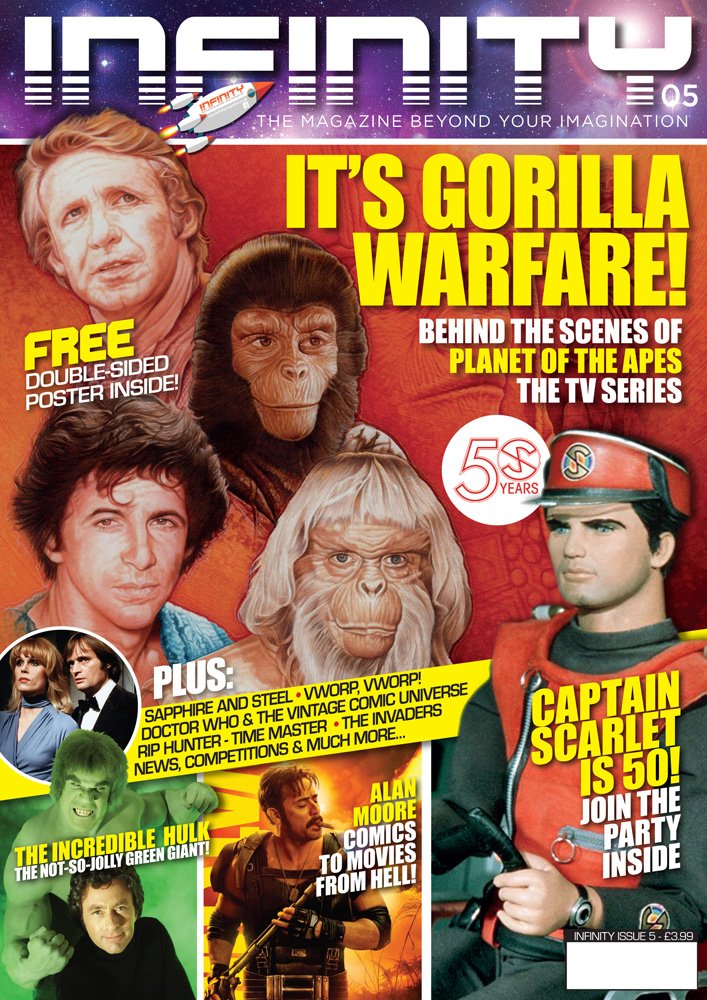
Great Moments In Television History: Planet of the Apes The TV Series


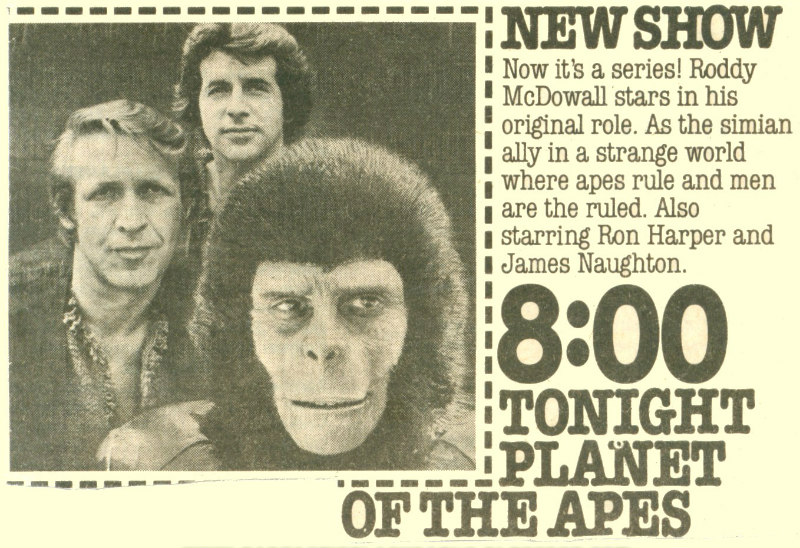
On September 13th, 1974, audiences that tuned into CBS saw the premiere of a new TV show with a familiar premise.

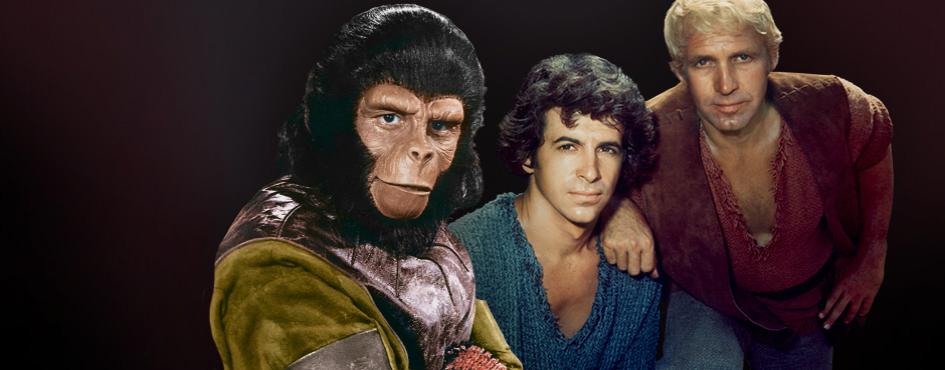
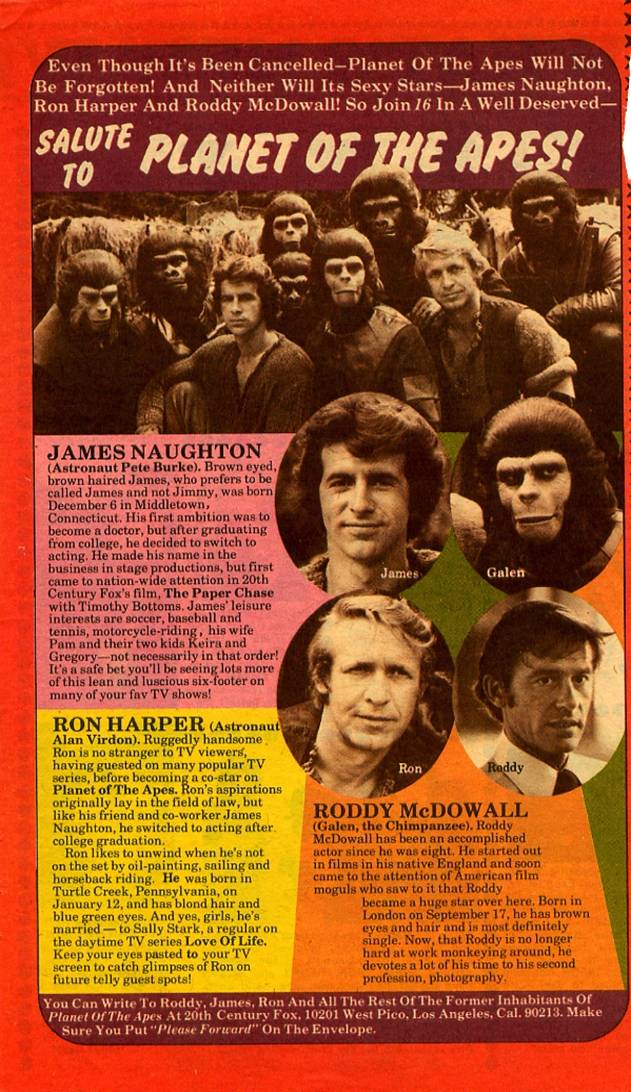
The episode opened with a spaceship crashing on an Earth-like planet.  One of the astronauts was killed.  Two of the astronauts — Alan Virdon (Ron Harper) and Peter Burke (James Naughton) — survived.  Virdon and Burke discovered that the planet was inhabited by humans who, despite it being the year 3085, were living in medieval villages.  The humans were kept in a state of serfdom by the Apes who ruled the planet.  The Apes spoke English and had formed their own society of militaristic gorillas and scientific-minded chimpanzees.  Looking through an old book, Virdon and Burke discovered that they had crash landed on Earth, far in the future!

You know the drill.  Planet of the Apes was based on the famous series of films, with the first pilot episode featuring Virdon and Burke discovering in less than an hour what took Charlton Heston a journey into the forbidden zone to figure out.  Because the humans had “blown it up,” the Earth was now ruled by Apes!

As fugitives from ape justice, Virdon and Burke spent the next fourteen episodes being pursued by the fanatical General Urko (Mark Lenard), who was determined to capture the two astronauts before they revealed that Apes had not always been the planet’s masters.  Traveling with Virdon and Burke was a sympathetic chimpanzee named Galen (Roddy McDowall).  Usually just one step ahead of Urko, Virdon, Burke, and Galen traveled from village to village, seeking a way to fix their spaceship so that they could escape the Planet of the Apes.

Planet of the Apes got off to a strong start with an exciting and concise first episode but the series quickly ran out of gas.  Because Virdon, Burke, and Galen had to flee to a new village at the end of every episode, the show was never able to devote much time to exploring the most intriguing thing about the original Planet of the Apes films, the culture of a world where humans were subservient to apes.  Because Virdon and Burke were largely interchangeable with little in the way of backstory or personality, the show very quickly ran out of a stories to tell.  It didn’t take long for Planet of the Apes to start repeating itself with multiple episodes in which Virdon or Burke got involved in local village drama before Urko showed up and forced them to flee again.

There were some good moments, though.  Probably the highlight of the series was the third episode of the series, The Trap.  In this episode, Virdon, Burke, Galen, and Urko all reach the ruins of San Francisco at the same time.  After an earthquake buries Burke and Urko in a subway tunnel, the two of them are forced to work together to survive.  Burke and Urko make an unexpectedly good team and Urko seems like he’s on the verge of a change of heart when he spots an old poster for the San Francisco zoo, one that features a caged gorilla being gawked at by humans.  Urko’s angry reaction to seeing the poster is well-acted by Mark Lenard and, for a few minutes, his obsession with capturing Virdon and Burke can be understood.  It wouldn’t last but, in that moment, Urko went from being just another villain to being a complex character with his own clearly defined motivations.

The show also benefited from Roddy McDowall, who, by this point, was an expert at acting while wearing chimpanzee makeup.  McDowall brought heart and humor to the role of Galen, even if he was too often treated like a servant by Burke and Virdon.  Whenever the two humans were scared to go out in public, they sent Galen off to gather information.  Galen did a good job but he still deserved better.

Finally, Planet of the Apes had one of the coolest opening title sequences of all time!  Take a look:

Though cancelled after only 14 episodes, Planet of the Apes The Television Series lives on.  Episodes can currently be seen on MeTV.

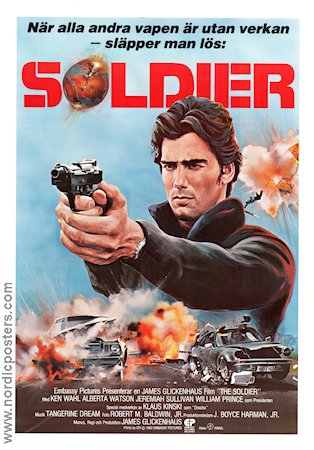
A Movie A Day #331: The Soldier (1982, directed by James Glickenhaus)


The Soldier is really only remembered for one scene.  The Soldier (Ken Wahl) is being chased, on skis, across the Austrian Alps by two KGB agents, who are also on skis.  The Soldier is in Austria to track down a KGB agent named Dracha (Klaus Kinski, who only has a few minutes of screen time and who is rumored to have turned down a role in Raiders of the Lost Ark so he could appear in this movie).  The Russians want the Soldier dead because they’re evil commies.  While being chased, the Soldier goes over a ski slope and, while in the air, executes a perfect 360° turn while firing a machine gun at the men behind him.  It’s pretty fucking cool.

The Soldier, who name is never revealed, works for the CIA.  He leads a team of special agents.  None of them get a name either, though one of them is played by the great Steve James.  When a shipment of Plutonium is hijacked so that it can be used it to contaminate half of the world’s supply of oil, The Soldier is assigned to figure out who is behind it.  Because terrorists are demanding that Israel withdraw from the West Bank, Mossad assigns an agent (Alberta Watson) to help out The Soldier.  She gets a name, Susan Goodman.  She sleeps with The Soldier because, she puts it, the world is about to end anyway.

The Soldier was obviously meant to be an American James Bond but Ken Wahl did not really have the screen charisma necessary to launch a franchise.  He is convincing in the action scenes but when he has to deliver his lines, he is as stiff as a board.  Fortunately, the majority of the movie is made up of action scenes.  From the minute this briskly paced movie starts, people are either getting shot or blown up.  Imagine a James Bond film where, instead of tricking the bad guys into explaining their plan, Bond just shot anyone who looked at him funny.  That’s The Soldier, a film that is mindless but entertaining.

Ken Wahl may have been stiff and Klaus Kinski may have been wasted but there are still some interesting faces in the cast.  Keep an eye out for William Prince as the President, Ron Harper as the director of the CIA, Zeljko Ivanek as a bombmaker, Jeffrey Jones as the assistant U.S. Secretary of Defense, and George Straight performing in a redneck bar.  Best of all, one of the Soldier’s men is played by Steve James, who will be recognized by any Cannon Films aficionado.

Surprisingly, The Solider is not a Cannon film.  It certainly feels like one.