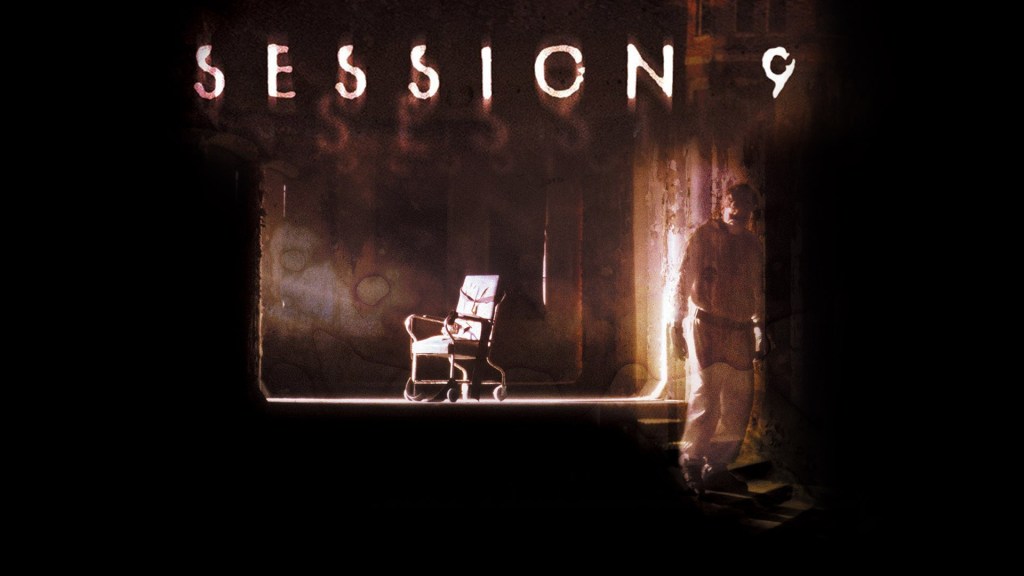
Brad reviews SESSION 9 (2001), starring David Caruso and Peter Mullan!


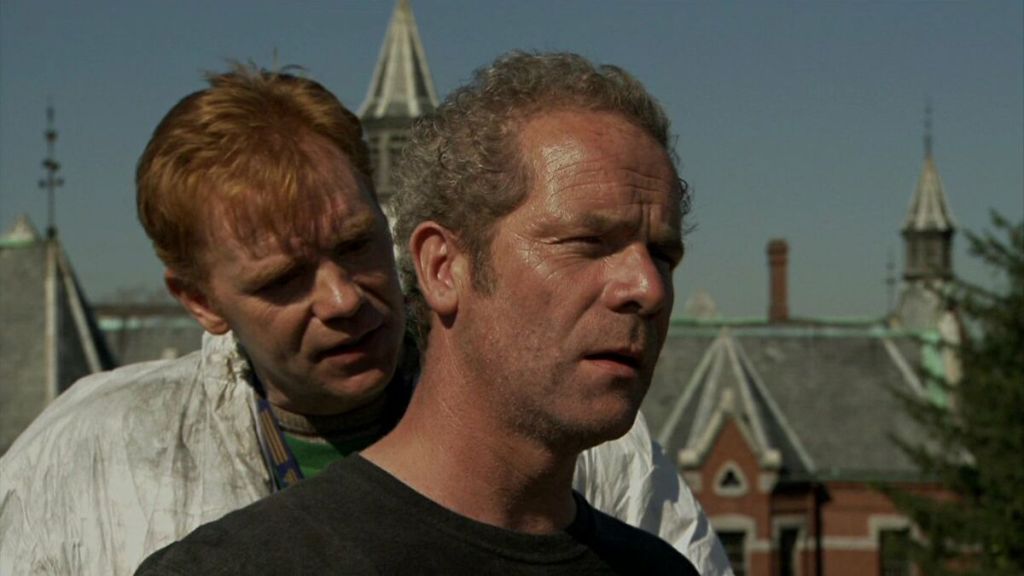
Gordon Fleming (Peter Mullan) the owner of a company that removes asbestos from old buildings, makes a bid for the work at the Danvers State Hospital in Massachusetts. In a desperate need for cash in his personal life, Gordon promises that his crew can complete the job in only one week, even though a job like this should normally take at least three weeks. His crew… Phil (David Caruso) is Gordon’s right hand man who tries to keep everyone else in line. This isn’t very easy these days considering that another member of the team is Hank (Josh Lucas), who’s currently “dating” (not the word Hank uses) Phil’s ex-girlfriend. The crew is rounded out by Mike (co-writer Stephen Gevedon), a law school dropout who seems to be way too smart to be doing this kind of work, and Jeff (Brendan Sexton III), Gordon’s nephew. As you might expect, once they begin the job, strange things start happening as the crew members find various items in the gigantic mental institution that once housed up to 2,400 people. Mike finds a box of tapes of nine therapy sessions detailing the case of Mary Hobbes, a patient with many personalities who may have murdered someone decades before. Meanwhile, Hank finds a stash of coins and other valuable items in one of the walls. A gambling addict, Hank goes back late that night when no one is around to collect his discovery. Things don’t go well and Hank doesn’t show up for work the next day. We’re led to believe that Hank has headed off to Florida for “casino school,” and this is where things start really getting weird as the pressure of the job and the strange events seem to be getting to the entire crew. When Jeff spots a very oddly acting Hank in the building a couple of days later, the sinister events at the Danvers State Hospital begin to completely unravel! 

Director Brad Anderson’s SESSION 9 is a creepy, slow burn that’s best described as a psychological horror film. It’s one of those movies where you can’t trust what you’re seeing on screen because the story is about the disturbed and damaged human mind. In my opinion, this is the most haunting kind of horror film because there are so many examples in the real world of mentally disturbed people committing horrific acts of violence. My wife has spent the last decade of her nursing career in the area of forensic psychology where she takes care of mentally ill individuals who have committed these types of horrible atrocities, often against the very people in their lives who take care of them. This is real world stuff. And the film’s setting, the actual Danvers State Hospital, also known as the Danvers Lunatic Asylum, in Danvers, Massachusetts, which operated from 1878 to 1992, adds a lot to the atmospheric feel of dread in the film. The Neo Gothic architecture of the facility, and the labyrinth of tunnels connecting the various buildings are a perfect setting for the creepy elements of Anderson’s story, and he takes full advantage of the location. The story and the setting set the stage for what feels like true terror, and I have to admit that SESSION 9 has stayed with me after my initial viewing. 

The cast of SESSION 9 is very effective. Though David Caruso receives top billing, the story really revolves around Gordon Fleming, portrayed by Peter Mullan. I primarily recognized Mullan from his interesting role as Jacob Snell in the excellent Netflix series OZARK, but he’s had quite a career as both an actor (TRAINSPOTTING, THE VANISHING) and director (THE MAGDALENE SISTERS). His quiet, internal performance is a solid anchor for the strange things going on around his crew. Caruso’s character is experiencing his own share of problems in his personal life, and the actor’s edgy intensity is a nice counterbalance to Mullan’s stillness. His life seems to be getting a little out of control and that dynamic works well for the moody paranoia of the film. Of the remaining performances, Josh Lucas seems to fair the best. His character isn’t really all that likable, but he does bring some humor to the role, and it’s ultimately the revelation of his character’s fate that begins to bring the story’s horrifying events to light. 

As I mentioned earlier, SESSION 9 is a slow burn of a film. Brad Anderson takes his sweet time setting the story up by introducing us to the dynamic of the main characters and placing them in the spectacular environment of the institution’s decaying buildings. It takes a bit for the doom and gloom to really start kicking in, so it’s possible that impatient or distracted viewers could lose interest as not much seems to be happening. I also wasn’t very surprised when the revelations of the story finally came to light. If you’re paying attention, the end moments of the movie aren’t as big of a “gotcha” as they could have been. But that’s all okay, because the brilliance of SESSION 9 is ultimately the mood it creates and the impending sense of dread we feel for the final discovery of what some of our characters may be capable of. In those aspects, SESSION 9 is a resounding success. 

Retro Television Review: Miami Vice 4.3 “Death and the Lady”


Welcome to Retro Television Reviews, a feature where we review some of our favorite and least favorite shows of the past!  On Mondays, I will be reviewing Miami Vice, which ran on NBC from 1984 to 1989.  The entire show can be purchased on Prime!

This week, the Vice Squad investigates the “other Hollywood” and some notable guest stars pop up.

Episode 4.3 “Death and the Lady”

(Dir by Colin Bucksey, originally aired on October 16th, 1987)

Painter-turned-filmmaker Milton Glantz (Paul Guilfoyle) is very proud to have received an Erotic Film Award for his latest movie, Death and the Lady.  However, when Glantz receives his award, a man named Tulane Knox (Michael David Morrison) shouts that the violent murder that ends the film was real and that Glantz is a killer.

Knox is taken into custody by Gina and Trudy.  Crockett doesn’t believe a word that Knox is saying.  He’s convinced that it’s all just a publicity stunt to get people interested in the film.  Crockett doesn’t have much use for all that art film mumbo jumbo.  He lives on a boat with a crocodile named Elvis, after all.  Actually, it’s been a while since we’ve seen Elvis.  I hope he’s okay.

Still, Crockett investigates.  He and Tubbs discover that the actress from the film — Lori Swann (Kelly Lynch) — is still alive and working in the movies.  However, he also discovers that Lori and Glantz made another film, called Twins.  That film featured Lori and a woman named Amy Ryder, who looked just like her.  A conversation with Amy’s sister (Penelope Ann Miller) reveals that Amy hasn’t been seen for a while.  Plus, Amy has terminal cancer….

Especially when compared to the previous two episodes, this episode felt more like classic Miami Vice, dark, moody, and fatalistic.  It doesn’t take long for both the audience and Crockett to realize that Glantz murdered Amy for his film.  (Amy’s dead eyes appear in Glantz’s film.)  But the problem is that there’s no way for Crockett to prove it.  The District Attorney (Miguel Ferrer, making an early appearance) refuses to bring charges without hard evidence.  When Glantz taunts Crockett with the fact that he committed the perfect murder, Crockett snaps.  He beats up Glantz but he doesn’t kill him.  Crockett hasn’t crossed that line but, watching this episode, you get the feeling that it’s only a matter of time.  But it doesn’t matter how many times Crockett throws a punch, Milton Glantz gets away with murder.

This was the Miami Vice of old, depressing, distressing, and very, very stylish.

(Plus, there’s a kitty in this episode!  He is discovered in a cocaine dealer’s home and he’s given to Gina as a present.  Even Castillo smiles when looks at the kitty.  Awwww!)

An Offer You Can Take or Leave #13: Hoffa (dir by Danny DeVito)


The 1992 film, Hoffa, opens in 1975, with two men sitting in the backseat of a station wagon.  One of the men is the controversial labor leader, Jimmy Hoffa (Jack Nicholson).  The other is his longtime best friend and second-in-command, Bobby Ciaro (Danny DeVito).  The two men are parked outside of a roadside diner.  They’re waiting for someone who is late.  Jimmy complains about being treated with such disrespect and comments that this would have never happened earlier.  Jimmy asks Bobby if he has his gun.  Bobby reveals that he does.  Jimmy asks him if he’s sure that there’s a loaded gun in the diner, as well.  Bobby goes to check.

Jimmy Hoffa, of course, was a real person.  (Al Pacino just received an Oscar nomination for playing him in The Irishman.)  He was a trucker who became a labor leader and who was eventually elected president of the Teamsters Union.  He was a prominent opponent of the Kennedys and that infamous footage of him being interrogated by Bobby Kennedy at a Senate hearing seems to sneak its way into almost every documentary ever made about organized crime in the 50s.  Hoffa was linked to the Mafia and was eventually sent to prison.  He was freed by the Nixon administration, under the condition that he not have anything to do with Teamster business.  When he disappeared in 1975, he was 62 years old and it was rumored that he was planning on trying to take over his old union.  Everyone from the mob to the CIA has been accused of having had Hoffa killed.

Bobby Ciaro, however, was not a real person.  Apparently, he was a composite character who was created by Hoffa’s screenwriter, David Mamet, as a way for the audience to get to know the enigmatic Jimmy Hoffa.  Bobby is presented as being Hoffa’s best friend and, for the most part, we experience Jimmy Hoffa through his eyes.  We get to know Jimmy as Bobby gets to know him but we still never really feel as if we know the film’s version of Jimmy Hoffa.  He yells a lot and he tells Bobby Kennedy (a snarling Kevin Anderson) to go to Hell and he talks a lot about how everything he’s doing is for the working man but we’re never really sure whether he’s being sincere or if he’s just a demagogue who is mostly interested in increasing his own power.  Bobby Ciaro is certainly loyal to him and since Bobby is played by the film’s director, it’s hard not to feel that the film expects us to share Bobby’s admiration.  But, as a character, Hoffa never really seems to earn anyone’s loyalty.  We’re never sure what’s going on inside of Hoffa’s head.  Jack Nicholson is always entertaining to watch and it’s interesting to see him play a real person as opposed to just another version of his own persona but his performance in Hoffa is almost totally on the surface.  With the exception of a few scenes early in the film, there’s doesn’t seem to be anything going on underneath all of the shouting.

The majority of Hoffa is told via flashback.  Scenes of Hoffa and Bobby in the film’s present are mixed with scenes of Hoffa and Bobby first meeting and taking over the Teamsters.  Sometimes, the structure of the film is a bit cumbersome but there are a few scenes — especially during the film’s first thirty minutes — that achieve a certain visual poetry.  There’s a scene where Hoffa helps to change a man’s flat tire while selling him on the union and the combination of falling snow, the dark city street, and Hoffa talking about the working man makes the scene undeniably effective.  The scenes where Hoffa spars with Bobby Kennedy are also effective, with Nicholson projecting an intriguing blue collar arrogance as he belittles the abrasively ivy league Bobby.  Unfortunately, the rest of the movie doesn’t live up to those scenes.  By the time Hoffa becomes a rich and influential man, you realize that the film isn’t really sure what it wants to say about Jimmy Hoffa.  Does it want to condemn Hoffa for getting seduced by power or does it want to excuse Hoffa’s shady dealings as just being what he had to do to protect the men in his union?  The film truly doesn’t seem to know.

Hoffa is definitely not an offer that you shouldn’t refuse but, at the same time, it’s occasionally effective.  A few of the scenes are visually appealing and the cast is full of character actors like John C. Reilly, J.T. Walsh, Frank Whaley, and Nicholas Pryor.  It’s not a disaster like The Gang Who Couldn’t Shoot Straight.  Hoffa is an offer that you can take or leave.

Previous Offers You Can’t (or Can) Refuse:

  1. The Public Enemy
  2. Scarface
  3. The Purple Gang
  4. The Gang That Could’t Shoot Straight
  5. The Happening
  6. King of the Roaring Twenties: The Story of Arnold Rothstein 
  7. The Roaring Twenties
  8. Force of Evil
  9. Rob the Mob
  10. Gambling House
  11. Race Street
  12. Racket Girls

30 Days of Noir #10: Roses are Red (dir by James Tinling)


As the 1947 film, Roses Are Red, begins, Robert A. Thorne (Don Castle) has just been elected to the office of district attorney.

Now, being the horror fan that I am, the thing that I immediately noticed was that the new district attorney had the exact same name as the character played by Gregory Peck in The Omen.  However, Roses Are Red has nothing to do with the son of Satan or the end of the world.  Instead, it’s just a briskly paced tale of swapped identity.

Robert A. Thorne is not just a brilliant lawyer.  He’s also an example of that rare breed, an honest politician.  He ran on a platform of reform and that’s what he’s intending to pursue now that he’s been elected.  As he tells his girlfriend, journalist Martha McCormick (Peggy Knudsen), cleaning up this country isn’t going to be easy but he’s determined to do it.  And the first step is going to be taking down the local mob boss, Jim Locke (Edward Keane).

The wheelchair-bound Jim Locke is a man who prefers to stay in the safety of his penthouse, where he can feed his fish and give orders to his subordinates, all of whom have names like Duke (Charles McGraw), Knuckle (Jeff Chandler), Buster (Paul Guilfoyle), and Ace (Douglas Fowley).  However, his man on the police force, Lt. Rocky Wall (Joe Sawyer), has warned him that this new district attorney might not respond to usual combination of bribes and intimidation.  That’s not good news because there are men who might be willing to testify against Locke in return for a shorter prison sentence.

However, things start to look up when none other than Robert A. Thorne shows up at Locke’s penthouse and says that the honesty bit was all a sham and that he wants to be on Locke’s payroll.  However, Locke soon figures out that he’s not talking to Thorne.  Instead, he’s talking to Don Carney (also played by Don Castle), a career criminal who has recently been released from prison and who just happens to look exactly like Robert Thorne!

Locke and Don come up with a plan that seems foolproof.  What if Knuckle kidnaps Thorne and holds him hostage for a few days?  During that time, Don can study Thorne and learn how to perfectly imitate all of his movements and expressions.  Once the two men are absolutely indistinguishable, Knuckle will murder Thorne and then Don will take his place.

Knuckle manages to kidnap Thorne with absolutely no trouble.  The police, under the prodding of Lt. Wall, announce that Thorne has obviously run off to avoid dealing with the local gangsters.  Don starts the process of studying Thorne but it turns out that the district attorney has a few tricks of his own….

With a running time of only 67 minutes, Roses are Red doesn’t waste any time jumping into its somewhat implausible plot.  Fortunately, the film is so short and quickly paced that most viewers won’t really have time to worry about whether or not the film’s plot actually makes any sense.  This is an entertaining, low-budget film noir, featuring a host of memorable performances and all of the hard-boiled dialogue that you could hope for.  Don Castle does a good job playing both the sleazy Don Carney and the upright Robert A. Thorne.  History nerds like me will immediately notice that, with his mustache and his slicked back hair, Castle bears a distinct resemblance to former Manhattan D.A. and two-time presidential candidate, Thomas E. Dewey.

All in all, Roses are Red is an enjoyable film for fans of old school gangster noir.  Check it out below:


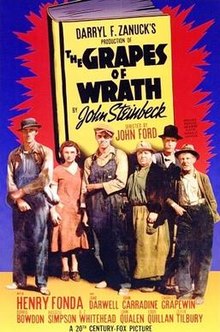
Lisa Reviews An Oscar Nominee: The Grapes of Wrath (dir by John Ford)


(With the Oscars scheduled to be awarded on March 4th, I have decided to review at least one Oscar-nominated film a day.  These films could be nominees or they could be winners.  They could be from this year’s Oscars or they could be a previous year’s nominee!  We’ll see how things play out.  Today, I take a look at the 1940 best picture nominee, The Grapes of Wrath!)

How dark can one mainstream Hollywood film from 1940 possibly be?

Watch The Grapes of Wrath to find out.

Based on the novel by John Steinbeck and directed by John Ford, The Grapes of Wrath tells the story of the Joad family and their efforts to neither get sent to prison nor starve to death during the Great Depression.  When they lose their farm in Oklahoma, they head for California.  Pa Joad (Russell Simpson) has a flyer that says someone is looking for men and women to work as pickers out west.  The 12 members of the Joad Family load all of their possessions into a dilapidated old truck and they hit the road.  It quickly becomes apparent that they’re not the only family basing all of their hopes on the vague promises offered up by that flyer.  No matter how much Pa may claim different, it’s obvious that California is not going to be the promised land and that not all the members of the family are going to survive the trip.

Tom Joad (Henry Fonda) is the oldest of the Joad sons.  He’s just been released from prison and he’s killed in the past.  Having been in prison during the start of the Great Depression, Tom doesn’t realize how bad things truly are until he arrives home and sees someone he grew up with using a tractor to knock down a house.  (It’s just business, of course.  The owners of the house can’t pay their bills so the house gets destroyed.)  The film’s story is largely told through Tom’s eyes and Henry Fonda gives a sympathetic performance, one the gets the audience to empathize with and relate to a character who is a total outsider.

As for the rest of the Joad Family, Ma (Jane Darwell) is the glue who holds them together and who refuses to allow them to surrender to despair.  (And yet even Ma is forced to make some tough choices when the starving children of one work camp ask her to share her family’s meal with them.)  Rosasharan (Dorris Bowdon) is pregnant while Grandpa (Charley Grapewin) is too sickly for the trip but doesn’t have anywhere else to go.  And then there’s Casy (John Carradine), the former preacher turned labor organizer.  Casy is not blood-related but he soon becomes a member of the family.

The Joads have a healthy distrust of the police and other authority figures and that turns out to be a good thing because there aren’t many good cops to be found between Oklahoma and California.  Instead, the police merely serve to protect the rich from the poor.  Whenever the workers talk about forming a union and demanding more than 5 cents per box for their hard work, the police are there to break heads and arrest any troublemakers on trumped up charges.  Whenever a town decides that they don’t want any “Okies” entering the town and “stealing” jobs, the police are there to block the roads.

The Grapes of Wrath provides a portrait of the rough edges of America, the places and the people who were being ignored in 1940 and who are still too often ignored today.  John Ford may not be the first director that comes to mind when you think of “film noir” but that’s exactly what The Grapes of Wrath feels like.  During the night scenes, desperate faces emerge from the darkness while menacing figures lurk in the shadows.  When the sun does rise, the black-and-white images are so harsh that you almost wish the moon would return.  The same western landscape that Ford celebrated in his westerns emerges as a wasteland in The Grapes of Wrath.  The American frontier is full of distrust, anger, greed, and ultimately starvation.  (Reportedly, the film was often shown in the Soviet Union as a portrait of the failure of America and capitalism.  However, it was discovered that Soviet citizens were amazed that, in America, even a family as poor as the Joads could still afford a car.  The Grapes of Wrath was promptly banned after that.)  John Ford is often thought of as being a sentimental director but there’s little beauty or hope to be found in the images of The Grapes of Wrath.  (Just compare the way The Grapes of Wrath treats poverty to the way Ford portrayed it in How Green Was My Valley.)  Instead, the film’s only hint of optimism comes from the unbreakable familial bond that holds the Joads together.

As dark as it may be, the film is nowhere near as pessimistic as the original novel.  The novel ends with a stillborn baby and a stranger starving to death in a barn.  The film doesn’t go quite that far and, in fact, offers up some deus ex machina in the form of a sympathetic government bureaucrat.  (Apparently, authority figures weren’t bad as long as they worked for the federal government.)  That the book is darker than the movie is not surprising.  John Steinbeck was a socialist while John Ford was a Republican with a weakness for FDR.  That said, even though the film does end on a more hopeful note than the novel, you still never quite buy that things are ever going to get better for anyone in the movie.  You want things to get better but, deep down, you know it’s not going to happen.  Tom says that he’s going to fight for a better world and Fonda’s delivers the line with such passion that you want him to succeed even if you know he probably won’t.  Ma Joad says the people will never be defeated and, again, you briefly believe her even if there’s not much evidence to back her up.

Even when viewed today, The Grapes of Wrath is still a powerful film and I can only guess what it must have been like to see the film in 1940, when the Great Depression was still going on and people like the Joads were still making the journey to California.  Not surprisingly, it was nominated for best picture of 1940, though it lost to Alfred Hitchcock’s Rebecca.

Horror On TV: Night Visions 1.1 “The Passenger List” (dir by Yves Simoneau) and “The Bokor” (dir by Keith Gordon)


Do y’all remember an old show called Night Visions?

Night Visions was a horror anthology show that ran for a season in 2001.  It got some good reviews as a summer replacement series but it struggled to find an audience.  After the 9-11 attacks, the show was preempted for three weeks straight and, when it finally did come back, I imagine that viewers weren’t really in the mood for a horror anthology, not when they had real-life horror to deal with on a daily basis.

And so, Night Visions was canceled but apparently, it still has a strong cult following.

Below is the very first episode of Night Visions.  It originally aired on July 12th, 2001 and it tells two stories.  In the Passenger List, a man investigating a plane crash starts to doubt his own sanity.  In the Bokor, a group of medical students make the mistake of cutting into the cadaver of a powerful voodoo priest.  Mayhem follows.

From what I’ve seen on YouTube, it looks like Night Visions was actually pretty good so enjoy this episode!

(And yes, each episode was hosted by Henry Rollins.)


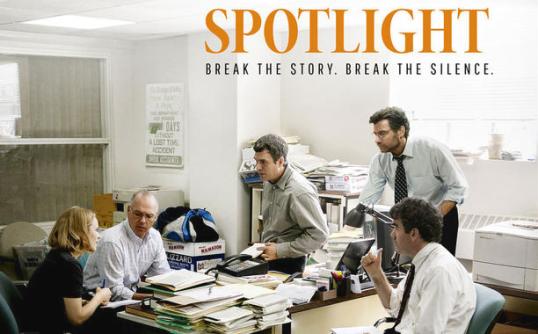
Playing Catch-Up: Spotlight (dir by Tom McCarthy)


Spotlight

Earlier today, I finally got to see Spotlight, the film that is currently the front-runner to win the Oscar for best picture.  Spotlight tells the story of how the Spotlight team, a group of journalists working for the Boston Globe, investigated the shameful history of sexual abuse of children by Catholic priests in the Archdiocese of Boston.  Starting with charges against one priest, the Spotlight team eventually uncovered sexual abuse by at least 70 priests and also revealed that the revered Cardinal Law was involved in covering up the crimes.

Having now seen Spotlight, I can say it’s a good film.  It’s well-made.  It’s well-acted.  The script contains some memorable lines.  I’ve talked to a few friends of mine who have actually worked as journalists and they have all assured me that Spotlight gets the details of their profession correct and that it’s pretty much an authentic look at what it’s like to be a reporter at a major newspaper.  There’s a lot of good things that can be said about Spotlight.

And yet, I’m not particularly enthusiastic about it.  I think my main issue with the film is that it’s just such an old-fashioned and rather conventional film.  It’s a throw back of sorts, an earnest exploration of a real-life outrage.  (Even the fact that the heroes are journalists makes the film feel as if it was made a decade or two in the past.)  On the one hand, you have to respect that director Tom McCarthy had the guts to tell his story in the least flashy way possible.  But, occasionally, his by-the-book approach is not as compelling as you want or need it to be.  Spotlight is a good film but it’s not a particularly challenging film and it’s the films that challenge us that truly stay with us after the final credits conclude.

Yes, it’s a good film but some are declaring that Spotlight is the best film of the year and I’m afraid that I just don’t see it.  There are a lot of 2015 films that will probably still be fondly remembered 5 years from now: Ex Machina, Mad Max: Fury Road, Inside Out, Sicario, and others.  When compared to those films, Spotlight feels more like an admirable made-for-TV movie.  It feels more like something that should sweep the Emmys than the Oscars.

That said, Spotlight does feature some excellent performances.  In fact, the entire cast does such a good job that it’s difficult to really single anyone out.  They come together as a nearly perfect ensemble.  (That said, I’m a bit torn on whether Mark Ruffalo came across as being passionate or merely mannered.)  Michael Keaton, especially, does a good job, embodying everyone’s ideal image of a journalist with integrity.

Spotlight‘s a good film but my favorite Tom McCarthy movie remains Win Win.

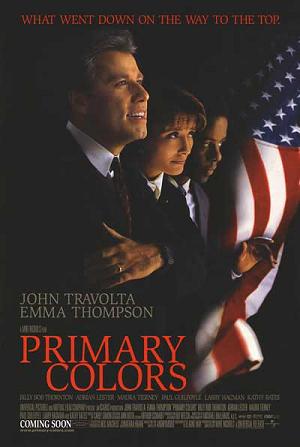
Shattered Politics #63: Primary Colors (dir by Mike Nichols)


Primaryposter

Jack Stanton (John Travolta) is the charismatic governor of an unnamed Southern state.  After spending his entire life in politics, Jack is finally ready to run for President.  Even more ready is his equally ambitious wife, Susan (Emma Thompson).  Jack proves himself to be a strong candidate, a good speaker who understands the voters and who has the ability to project empathy for almost anyone’s situation. He’s managed to recruit a talented and dedicated campaign staff, including the flamboyant Richard Jemmons (Billy Bob Thornton), Daisy Green (Maura Tierney), and journalist Henry Burton (Adrian Lester).  Henry is the son of a civil rights leader and, as soon as they meet, Jack talks about the first time that he ever heard Henry’s father speak.  Within minutes of first meeting him, Henry believes in Jack.

The problem, however, is that there are constant hints that Jack may not be worthy of his admiration.  There’s the fact that he’s a compulsive womanizer who is given to displays of temper and immaturity.  When one of Jack’s old friends reveals that Jack may have impregnated his daughter, Jack and Susan respond with a pragmatic ruthlessness that takes Henry by surprise.

When one of Jack’s mistresses threatens to go public, Henry is partnered up with Libby (Kathy Bates) and sent to dig up dirt on her and her sponsors.  When the former governor of Florida, Freddie Picker (Larry Hagman), emerges as a threat to derail Jack’s quest for the nomination, Henry and Libby are again assigned to research Picker’s background.  Libby is perhaps the film’s most interesting character.  Recovering from a mental breakdown, Libby has no trouble threatening to shoot one political opponent but she’s still vulnerable and idealistic enough that it truly hurts her when Jack and Susan repeatedly fail to live up to her ideals.  As an out lesbian, Libby is perhaps the only character who has no trouble revealing her true self and, because of her honesty, she is the one who suffers the most.

First released in 1998 and based on a novel by Joe Klein, Primary Colors is an entertaining and ultimately rather bittersweet dramedy about the American way of politics.  John Travolta and Emma Thompson may be playing Jack and Susan Stanton but it’s obvious from the start that they’re meant to be Bill and Hillary Clinton.  And while it takes a few minutes to get used to Travolta’s attempt to sound Southern, this is ultimately one of his best performances.  As played by Travolta, Jack Stanton is charming, compassionate, self-centered, and ultimately, incredibly frustrating.  One reason why Primary Colors works is because we, as an audience, come to believe in Jack just as much as Henry does and then we come to be just as disillusioned as Libby.  Emma Thompson’s performance is a little less obviously based on Hillary.  Unlike Travolta, she doesn’t attempt to imitate Hillary’s voice or mannerisms.  But she perfectly captures the steely determination.

Primary Colors captures both the thrill of believing and the inevitability of disillusionment.  It’s definitely a film that I will rewatch in the days leading up to 2016.

Shattered Politics #59: Night Falls on Manhattan (dir by Sidney Lumet)


Night_falls_on_manhattan_poster

Oddly enough, right after I watched City Hall, I watched yet another 1997 film about politics and police corruption in New York.  And while Night Falls on Manhattan is definitely not one of Sidney Lumet’s best films, it’s still definitely an improvement on City Hall.

Night Falls on Manhattan tells the story of what happens when two veteran detectives — Liam Casey (Ian Holm) and Joey Allegreto (James Gandolfini) — attempt to arrest drug dealer Jordan Washington (Shiek Mahmud-Bey).  Liam ends up getting shot multiple times before Jordan, disguised as a police officer, flees the scene.  As the cops search for Jordan, they accidentally shoot and kill one of their own.

In short, Manhattan has gone crazy and only the prompt capture and conviction of Jordan Washington will set things right.

However, the police don’t have to spend too much time searching for Jordan because, the very next day, he turns himself in.  He’s accompanied by a veteran radical lawyer named Sam Vigoda (Richard Dreyfuss).  Vigoda announces that yes, Jordan is a drug dealer and yes, he did shoot Liam Casey.  However, Vigoda claims that Jordan has been paying off the cops and that Liam and Joey weren’t actually trying to arrest him.  Instead, they were specifically looking for an excuse to execute him.

Flamboyant District Attorney Morganstern (Ron Leibman) know that his office has to convict Jordan.  And luckily, he has a secret weapon.  Liam’s son, Sean (Andy Garcia), just happens to be a former cop and an assistant district attorney.  He assigns Sean to handle Jordan’s prosecution.

Sean, it turns out, has political ambitions of his own and, by prosecuting Jordan, he not only gets revenge for the shooting of his father but he also furthers his own career.  (He also gets a girlfriend, in this case an associate of Vigoda’s who is played by Lena Olin.)  When Morganstern has a heart attack, Sean suddenly finds himself being mentioned as a candidate to replace him in the upcoming election.

However, even as Sean appears to be shoo-in to be the next district attorney, he also discovers that neither Liam nor Joey were as innocent as he originally assumed..

Night Falls In Manhattan is an occasionally diverting legal and political thriller.  As a director, Sidney Lumet had an obvious feel for New York culture and, as a result, the film feels authentic even when the plot occasionally veers into melodrama.  As opposed to City Hall, you never doubt the plausibility of Night Falls On Manhattan.  Though Andy Garcia is a bit an odd choice to play an Irish-American (and it’s particularly difficult to imagine him being, in any way, related to Ian Holm), the rest of the film is well-cast.  Fans of The Sopranos will enjoy a chance to see James Gandolfini playing someone who, because he’s on the “right” side o the law, is actually more dangerous than Tony Soprano and Rob Leibman is thoroughly believable as a bullying crusader against crime.

After I watched Night Falls on Manhattan, I did some checking online and I was surprised to discover that the film is apparently not better known than it is.  While it definitely uneven, Night Falls On Manhattan is an interesting look at crime, ethics, and urban politics.

In Memory of Robin Williams #2: Cadillac Man (dir by Roger Donaldson)


Cadillac Man

Cadillac Man is a film that I had never heard of until I came across it while skimming what was available OnDemand last week.  It was a film that I only watched because it starred Robin Williams.  I have to admit that I have mixed feelings about including it in a tribute to Robin Williams because Cadillac Man was definitely one of his lesser films.  However, while Cadillac Man may not be a very good movie, it does feature a very good performance from Robin Williams.

Released in 1990, Cadillac Man tells the story of Joey O’Brien (Robin Williams), who is the type of car salesman who has no problem approaching a widow at a funeral and telling her that now is the time to consider buying a new car.  Joey’s a good salesman but he’s also deep in debt.  He not only owes alimony to his ex-wife (Pamela Reed) but he also supporst two mistresses, a married one (a hilarious Fran Drescher) and a single one (Lori Petty).   He’s also owes money to the local mafia don and, as the film begins, he’s been told that he has to sell 12 cars in two days or else he’ll lose his job.

On top of all that, Joey also has to deal with Larry (Tim Robbins),  an insane jerk with a motorcycle and an assault rifle who takes the entire car dealership hostage because he’s convinced that his wife (Annabella Sciorra) is cheating on him.  Larry spends most of the movie firing his rifle up in the air and screaming at the top of his lungs (and yet, it’s also clear that the audience is supposed to like him).  As the cops surround the car dealership, Joey attempts to keep Larry under control while also trying to get back together with his ex-wife…

After I watched Cadillac Man, I looked up the rest of director Roger Donaldson’s credits.  What I discovered was that Donaldson has directed a lot of movies (including guilty pleasure Cocktail and the upcoming The November Man) but only one of them has been a comedy.  The majority of his films are dramas like Thirteen Days and action films like November Man.  In short, Roger Donaldson is not a comedy director.   And when directors who aren’t experienced with comedy attempt to make a comedy, they almost always resort to having all of the actors shout their lines and run around like characters in a live-action cartoon.  That is certainly the approach that Donaldson took in Cadillac Man and the end result was a film that far too often tried to substitute chaos for genuine comedy.

(As just an example of Donaldson’s lack of comedic touch, Annabella Sciorra went through almost the entire film with a bloody cut on her forehead.  Even if her lines or her character had been funny, I would have never known it because I was spending too much time worrying about what the eventual scar would look like.)

And yet, here’s the thing.  As bad as Cadillac Man turned out to be, Robin Williams was actually pretty good in it.  Joey isn’t exactly a likable character but you root for him because of who is playing him.  What’s interesting is that the role, even though it was definitely comedic, didn’t lend itself to the manic intensity that was the trademark of much of Williams’s comedy.  Instead, the humor comes from the way that, while everyone else in his life is essentially going crazy, Joey O’Brien struggles to maintain his facade of calm and confidence.  Williams portrays Joey as being the ultimate salesman and when Joey has to try to convince Larry to release his hostages, he approaches it almost as if he’s trying to sell Larry a car and it’s impossible not to admire Joey’s determination to close the sale without anyone else getting shot.  As played by Tim Robbins, Larry is thoroughly unhinged.  In fact, it’s probably one of the worst performances of Tim Robbins’ career but it’s obvious that he and Williams enjoyed playing off of each other.  Whenever Robbins’ performance goes over-the-top, Williams’ performance brings things back down to Earth and provides whatever pleasure one can hope to get from a film like this.

And that’s why, despite the fact that Cadillac Man is not a particularly good film, it’s an appropriate tribute to the talent of Robin Williams.  It’s one thing to give a good performance in a good film.  However, it takes true talent to give a great performance in a total misfire.

And that’s exactly what Robin Williams did in Cadillac Man.

Cadillac_Man_31157_Medium