Shattered Politics #59: Night Falls on Manhattan (dir by Sidney Lumet)


Night_falls_on_manhattan_poster

Oddly enough, right after I watched City Hall, I watched yet another 1997 film about politics and police corruption in New York.  And while Night Falls on Manhattan is definitely not one of Sidney Lumet’s best films, it’s still definitely an improvement on City Hall.

Night Falls on Manhattan tells the story of what happens when two veteran detectives — Liam Casey (Ian Holm) and Joey Allegreto (James Gandolfini) — attempt to arrest drug dealer Jordan Washington (Shiek Mahmud-Bey).  Liam ends up getting shot multiple times before Jordan, disguised as a police officer, flees the scene.  As the cops search for Jordan, they accidentally shoot and kill one of their own.

In short, Manhattan has gone crazy and only the prompt capture and conviction of Jordan Washington will set things right.

However, the police don’t have to spend too much time searching for Jordan because, the very next day, he turns himself in.  He’s accompanied by a veteran radical lawyer named Sam Vigoda (Richard Dreyfuss).  Vigoda announces that yes, Jordan is a drug dealer and yes, he did shoot Liam Casey.  However, Vigoda claims that Jordan has been paying off the cops and that Liam and Joey weren’t actually trying to arrest him.  Instead, they were specifically looking for an excuse to execute him.

Flamboyant District Attorney Morganstern (Ron Leibman) know that his office has to convict Jordan.  And luckily, he has a secret weapon.  Liam’s son, Sean (Andy Garcia), just happens to be a former cop and an assistant district attorney.  He assigns Sean to handle Jordan’s prosecution.

Sean, it turns out, has political ambitions of his own and, by prosecuting Jordan, he not only gets revenge for the shooting of his father but he also furthers his own career.  (He also gets a girlfriend, in this case an associate of Vigoda’s who is played by Lena Olin.)  When Morganstern has a heart attack, Sean suddenly finds himself being mentioned as a candidate to replace him in the upcoming election.

However, even as Sean appears to be shoo-in to be the next district attorney, he also discovers that neither Liam nor Joey were as innocent as he originally assumed..

Night Falls In Manhattan is an occasionally diverting legal and political thriller.  As a director, Sidney Lumet had an obvious feel for New York culture and, as a result, the film feels authentic even when the plot occasionally veers into melodrama.  As opposed to City Hall, you never doubt the plausibility of Night Falls On Manhattan.  Though Andy Garcia is a bit an odd choice to play an Irish-American (and it’s particularly difficult to imagine him being, in any way, related to Ian Holm), the rest of the film is well-cast.  Fans of The Sopranos will enjoy a chance to see James Gandolfini playing someone who, because he’s on the “right” side o the law, is actually more dangerous than Tony Soprano and Rob Leibman is thoroughly believable as a bullying crusader against crime.

After I watched Night Falls on Manhattan, I did some checking online and I was surprised to discover that the film is apparently not better known than it is.  While it definitely uneven, Night Falls On Manhattan is an interesting look at crime, ethics, and urban politics.

In Memory of Robin Williams #2: Cadillac Man (dir by Roger Donaldson)


Cadillac Man

Cadillac Man is a film that I had never heard of until I came across it while skimming what was available OnDemand last week.  It was a film that I only watched because it starred Robin Williams.  I have to admit that I have mixed feelings about including it in a tribute to Robin Williams because Cadillac Man was definitely one of his lesser films.  However, while Cadillac Man may not be a very good movie, it does feature a very good performance from Robin Williams.

Released in 1990, Cadillac Man tells the story of Joey O’Brien (Robin Williams), who is the type of car salesman who has no problem approaching a widow at a funeral and telling her that now is the time to consider buying a new car.  Joey’s a good salesman but he’s also deep in debt.  He not only owes alimony to his ex-wife (Pamela Reed) but he also supporst two mistresses, a married one (a hilarious Fran Drescher) and a single one (Lori Petty).   He’s also owes money to the local mafia don and, as the film begins, he’s been told that he has to sell 12 cars in two days or else he’ll lose his job.

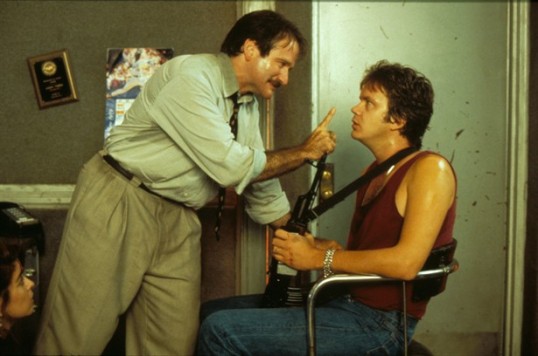
On top of all that, Joey also has to deal with Larry (Tim Robbins),  an insane jerk with a motorcycle and an assault rifle who takes the entire car dealership hostage because he’s convinced that his wife (Annabella Sciorra) is cheating on him.  Larry spends most of the movie firing his rifle up in the air and screaming at the top of his lungs (and yet, it’s also clear that the audience is supposed to like him).  As the cops surround the car dealership, Joey attempts to keep Larry under control while also trying to get back together with his ex-wife…

After I watched Cadillac Man, I looked up the rest of director Roger Donaldson’s credits.  What I discovered was that Donaldson has directed a lot of movies (including guilty pleasure Cocktail and the upcoming The November Man) but only one of them has been a comedy.  The majority of his films are dramas like Thirteen Days and action films like November Man.  In short, Roger Donaldson is not a comedy director.   And when directors who aren’t experienced with comedy attempt to make a comedy, they almost always resort to having all of the actors shout their lines and run around like characters in a live-action cartoon.  That is certainly the approach that Donaldson took in Cadillac Man and the end result was a film that far too often tried to substitute chaos for genuine comedy.

(As just an example of Donaldson’s lack of comedic touch, Annabella Sciorra went through almost the entire film with a bloody cut on her forehead.  Even if her lines or her character had been funny, I would have never known it because I was spending too much time worrying about what the eventual scar would look like.)

And yet, here’s the thing.  As bad as Cadillac Man turned out to be, Robin Williams was actually pretty good in it.  Joey isn’t exactly a likable character but you root for him because of who is playing him.  What’s interesting is that the role, even though it was definitely comedic, didn’t lend itself to the manic intensity that was the trademark of much of Williams’s comedy.  Instead, the humor comes from the way that, while everyone else in his life is essentially going crazy, Joey O’Brien struggles to maintain his facade of calm and confidence.  Williams portrays Joey as being the ultimate salesman and when Joey has to try to convince Larry to release his hostages, he approaches it almost as if he’s trying to sell Larry a car and it’s impossible not to admire Joey’s determination to close the sale without anyone else getting shot.  As played by Tim Robbins, Larry is thoroughly unhinged.  In fact, it’s probably one of the worst performances of Tim Robbins’ career but it’s obvious that he and Williams enjoyed playing off of each other.  Whenever Robbins’ performance goes over-the-top, Williams’ performance brings things back down to Earth and provides whatever pleasure one can hope to get from a film like this.

And that’s why, despite the fact that Cadillac Man is not a particularly good film, it’s an appropriate tribute to the talent of Robin Williams.  It’s one thing to give a good performance in a good film.  However, it takes true talent to give a great performance in a total misfire.

And that’s exactly what Robin Williams did in Cadillac Man.

Cadillac_Man_31157_Medium


Embracing the Melodrama #39: True Colors (dir by Herbert Ross)


True Colors

For the past 9 days, I’ve been posting chronological reviews of 54 of the most (and least) memorable melodramas ever filmed.  I started with a film from 1916 and yesterday, I completed the 80s.  Today, we start in on the 90s with the 1991 political drama True Colors.

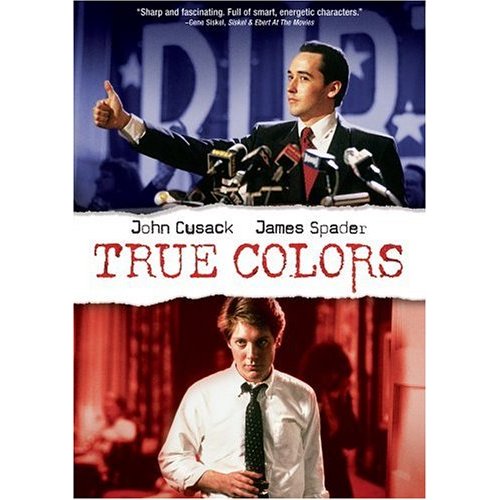
True Colors tells the story of two ambitious law students.  Tim Gerritty (James Spader) is a wealthy idealist who wants to work at the Justice Department so he can uncover and prosecute political corruption.  His roommate and eventual best friend is Peter Burton (John Cusack).  Although Peter initially lies about his background, it’s eventually revealed that he comes from a poor family and the result of growing up in poverty has left Peter with an obsessive desire for revenge on everyone who has ever looked down on him.  And how is Peter planning on getting that revenge?  By marrying the daughter of Sen. James Stiles (Richard Widmark) and eventually running for a seat in the U.S. House.  Despite the fact that Tim happens to be in love with Sen. Stiles’s daughter as well, he still supports his friend Peter and even agrees to be his best man.  However, as Peter gets closer and closer to achieving his goals, Tim starts to reconsider their friendship….

There’s a scene about halfway through True Colors, in which Peter Burton attempts to blackmail Sen. Stiles into supporting his political career.  Stiles agrees but then angrily adds, “God help you when the people find out.  They always do, you know.”  I was naturally waiting for Peter to come up with a properly sarcastic response but instead, Peter simply looks down at the ground, properly chastened.  It’s a jarringly false note and, unfortunately, everything that comes after this scene feels equally false.  The film, which starts out as such a strong portrait of what happens with friendship comes into conflict with ambition, ends up turning into a painfully predictable political diatribe, the type of thing that makes the portrait of politics in The Adjustment Bureau seem subtle and nuanced by comparison.  When Tim decided to betray Peter, it should be a moment full of moral ambiguity.  Instead, we’re expected to ignore their long friendship and just be happy that Tim is willing to do the right thing and protect the integrity of the American political process.

And, who knows?  Maybe that’s the way people viewed politics back in the early 90s.  But for audiences today, it all feels really naive and simplistic.

But, if you can manage to look past the film’s weak’s script, you can enjoy the acting.  John Cusack is wonderfully intense as Peter, making the character compelling even when the screenplay lets him down.  Watching him in True Colors is like watching the performance that he should have given in The Butler.  James Spader is sympathetic as Tim and, like Cusack, his performance almost allows him to overcome a script that doesn’t seem to realize that Tim is essentially a self-righteous jerk.  And finally, there’s Mandy Patikin who has a lot of fun playing the local crime boss who sponsors Peter’s career and who, in one memorable (if out-of-place ) scene beats up a shark that’s jumped up on the desk of his yacht.

Much like High Stakes, True Colors is one of those obscure films that occasionally pops up on cable, usually late at night and usually serving as filler between showings of better-known films.  Keep an eye out for it, if just for the chance to enjoy the performances.