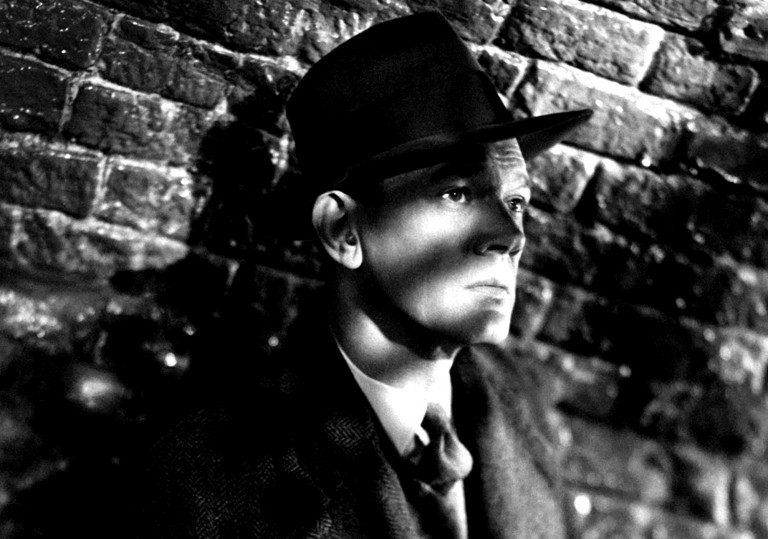
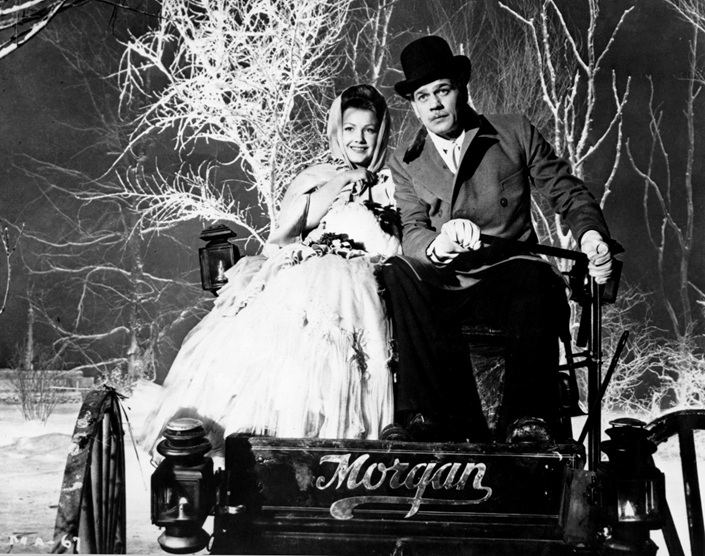
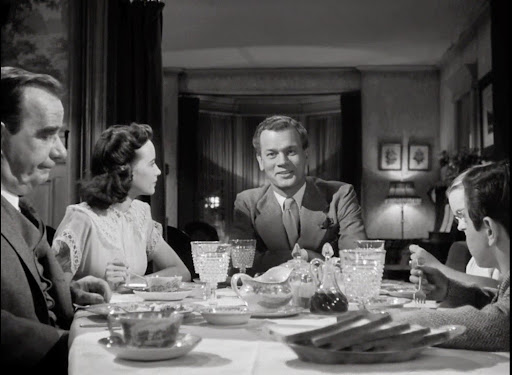
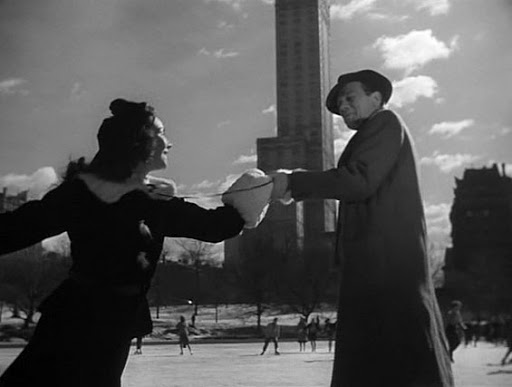
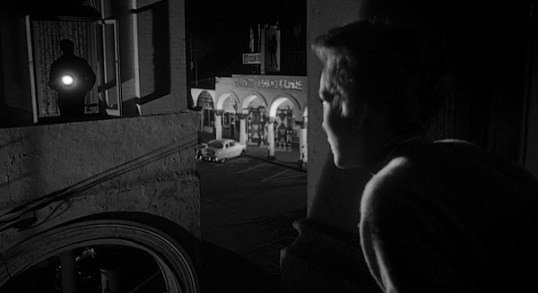
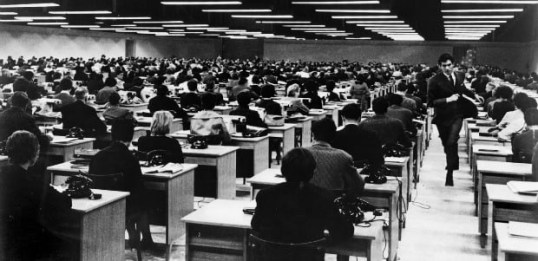
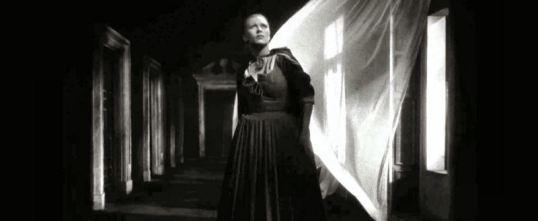
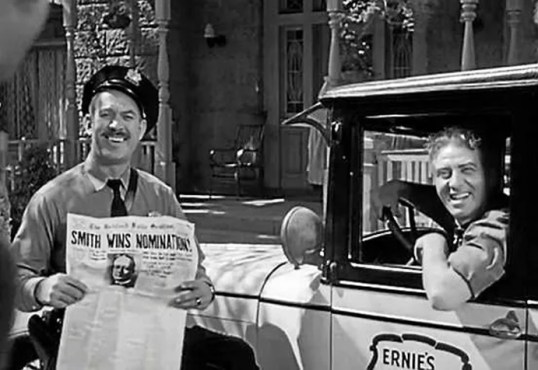
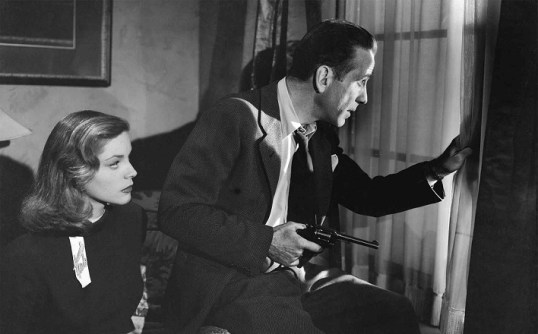
4 Shots From 4 Films is just what it says it is, 4 shots from 4 of our favorite films. As opposed to the reviews and recaps that we usually post, 4 Shots From 4 Films lets the visuals do the talking!
As you can probably guess from my pen name and my profile pic, Joseph Cotten is one of my favorite actors. Cotten may be best known for his association with Orson Welles but he worked with several great directors over the years. Along with playing Jedediah Leland in Welles’s Citizen Kane, he starred in Hitchcock’s Shadow of a Doubt and Carol Reed’s The Third Man. Even while his film career was flourishing, Cotten continued to appear on the Broadway stage and, during the early days of television, he frequently appeared on anthology series, the majority of which were broadcast live.
In honor of Cotten’s birthday, here are four shots from four of his best films.
4 Shots From 4 Films
The Magnificent Ambersons (1942, directed by Orson Welles)
Shadow of a Doubt (1943, directed by Alfred Hitchcock)
Portrait of Jennie (1948, directed by William Dieterle)
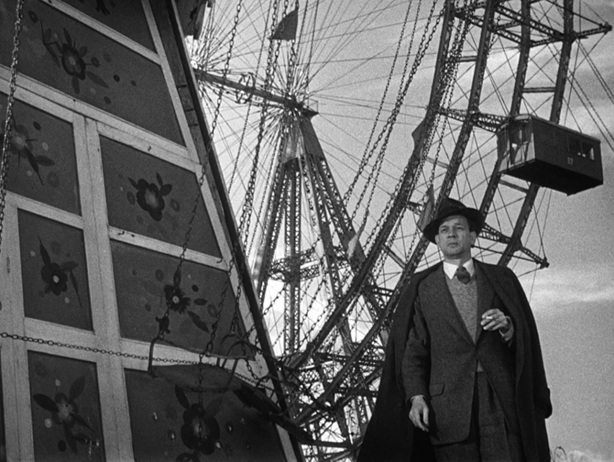
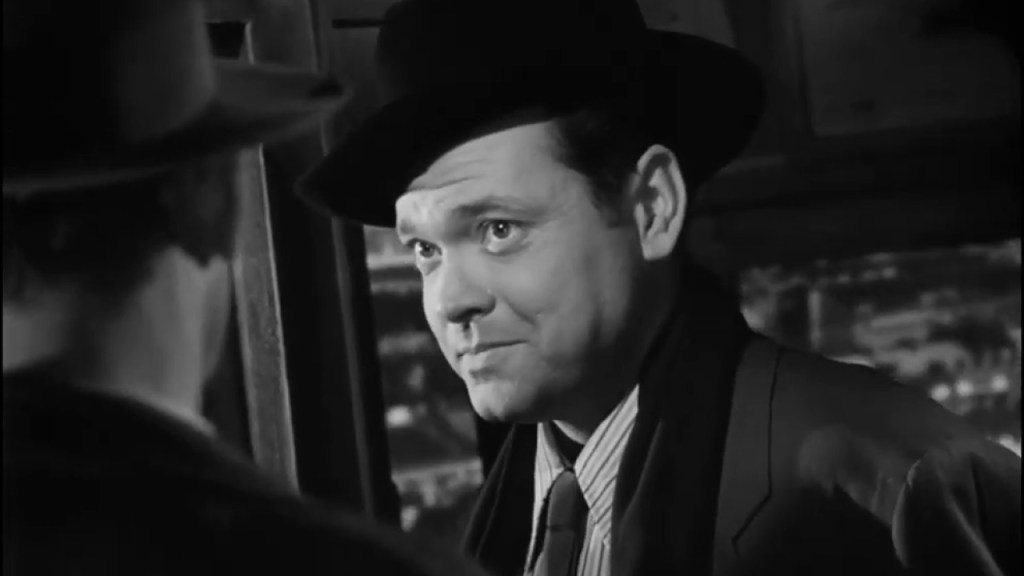
“Holly, I’d like to cut you in, old man. There’s nobody left in Vienna I can really trust, and we’ve always done everything together. When you make up your mind, send me a message – I’ll meet you any place, any time, and when we do meet old man, it’s you I want to see, not the police. Remember that, won’t ya? Don’t be so gloomy.
After all it’s not that awful. You know what the fellow said – in Italy, for thirty years under the Borgias, they had warfare, terror, murder and bloodshed, but they produced Michelangelo, Leonardo da Vinci and the Renaissance. In Switzerland, they had brotherly love, they had five hundred years of democracy and peace – and what did that produce? The cuckoo clock. So long Holly.”
Orson Welles has been a giant of the film industry since he first stepped foot in it with his masterpiece Citizen Kane. He has been lauded as one of the greatest filmmakers and his innovation in the techniques of filmmaking continues to influence past, present and future filmmakers.
Yet, he wasn’t just a great director but a great writer and producer. He was also a great actor both on-screen, and previously, on stage where he honed his craft. He has had some memorable moments in all the films he’s acted in (even his final film which was the cult classic animated film feature Transformers: The Movie, where he was the voice of a planet-devouring transforming robot planetoid).
It is his brief but great monologue past the halfway mark of the classic noir film The Third Man that is my choice for Scenes I Love and another entry in the “Great Film and TV Monologues” series.
Welles plays the amoral Harry Lime who meets up with his childhood friend Holly Martins. As they ride the famous Wiener Riesenrad in Vienna, Welles waxes poetic about the insignificance of people, in general. How, from the the heights of the Riesenrad, people looked like little dots and would one dot or a group of them be missed if they suddenly stopped moving.
Yet, it is when Lime and Martins exit the ride that Welles’ as Harry Lime performs what is considered one of the greatest monologues ever put on film and, most likely, one of the briefest. It is a philosophical observation on the cynics take on the violent nature of man and how it affects society.
The monologue itself wasn’t written by the film’s writer, Graham Greene, but was inserted in the script by Orson Welles himself. The Third Man was one of the greatest films ever produced even without Welles’ contribution as a writer, but we should be all glad that he decided to add this brief monologue which helps explains the character of Harry Lime and the meaning of the “third man”.
Today’s song of the day is the haunting zither theme of The Third Man. Whenever I hear this music, I immediately think of Orson Welles, emerging from the shadows with that charming smile on his face. I also think about poor Holly Martins (Joseph Cotten), being chased through Vienna by that little kid who wouldn’t stop yelling at him. And, of course, there’s that famous final shot….
Though the Academy of Motion Picture Arts and Sciences claim that the Oscars honor the best of the year, we all know that there are always worthy films and performances that end up getting overlooked. Sometimes, it’s because the competition too fierce. Sometimes, it’s because the film itself was too controversial. Often, it’s just a case of a film’s quality not being fully recognized until years after its initial released. This series of reviews takes a look at the films and performances that should have been nominated but were, for whatever reason, overlooked. These are the Unnominated.
I come here to defend Charlton Heston.
1994’s Ed Wood is a great film that has one unfortunate line. Towards the end of the film, director Ed Wood (Johnny Depp) meets his hero, Orson Welles (Vincent D’Onoforio), in a bar. They talk about the difficulties of directing a film. Wood talks about the trouble that he’s having with Plan 9 From Outer Space. Welles says that he can understand what Wood is going through because the studio is forcing him to cast Charlton Heston as a Mexican in his next movie.
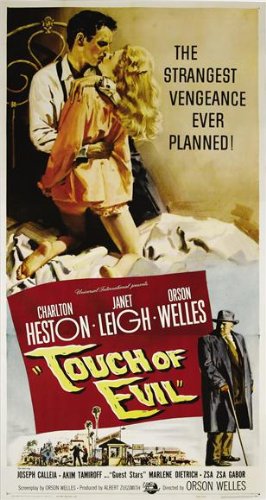
And look, I get it. It is true that Charlton Heston does play a Mexican prosecutor named Mike Vargas in Welles’s 1958 film, Touch of Evil. And it is true that Heston is not the most convincing Mexican to ever appear in a film. And I understand that there are people who enjoy taking cheap shots at Charlton Heston because he did have a tendency to come across as being a bit full of himself and he was a conservative in a industry dominated by Leftists. There are people who actually think Michael Moore doesn’t come across like a self-righteous prick when he confronts Heaton in Bowling for Columbine. I get the joke.
But it’s not true and it’s not fair. When Touch of Evil was first put into production by Universal, Welles was not hired to direct. He was hired to play Hank Quinlan, the formerly honest cop with a habit of planting evidence on those who he believed to be guilty. When Charlton Heston was offered the role of Vargas, he asked who had been hired to direct. When he was told that a director hadn’t been selected, Heston was the one who suggested Welles be given the job. When, as often happened with Welles’s film, the studio decided to take the film out of Welles’s hands, Heston argued for Welles’s vision while Welles was off trying to set up his long-dreamed of film of Don Quixote. Say what you will about Charlton Heston’s career, he fought for Orson Welles, just as he later fought for Sam Peckinpah during the making of Major Dundee. Heston may not have agreed with either Welles or Peckinpah politically but he fought for them when few people were willing to do so.
That Touch of Evil is a brilliant film is pretty much entirely due to Welles’s directorial vision. The story is pure pulp. While investigating the murder of an American businessman in Mexico, Vargas comes to believe that Quinlan is attempting to frame a young Mexican for the crime. While Vargas watches Quinlan, his wife Susie (Janet Leigh) is menaced by the crime lord Joe Grandi (Akim Tamiroff), who has his own issues with both Vargas and Quinlan. The plot may be the stuff of a B-programmer but, as directed by Welles, Touch of Evil plays out like a surreal nightmare, a journey into the heart of darkness that is full of eccentric characters, shadowy images, memorably askew camera angles, and lively dialogue. Welles and cinematographer Russell Metty create a world that feels alien despite being familiar. Just as he did with Gregg Toland in CitizenKane, Welles shapes a film that shows us what’s happening in the shadows that most people try to ignore.
There’s really not a boring character to be found in Touch of Evil and the cast is full of old colleagues and friends of Welles. Marlene Dietrich shows up as Quinlan’s former lover. Mercedes McCambridge plays a leather-clad gang leader. Dennis Weaver is the creepy owner of a remote motel. (Two years before Psycho, Touch of Evil featured Janet Leigh being menaced in a motel. Mort Mills, who played Psycho’s frightening highway patrolman, plays a member of law enforcement here as well.) Zsa Zsa Gabor shows up for a few brief seconds and it makes a strange sort of sense. Why shouldn’t she be here? Everyone else is. Joseph Cotten plays a coroner. Ray Collins plays a local official. In the film’s skewered world, Charlton Heston as Mike Vargas works. His upright performance grounds this film and keeps it from getting buried in its own idiosyncrasies. Big personalites are everywhere and yet the film is stolen by Joseph Calleia, playing Quinlan’s quiet but observant partner. Calleia’s performance is the heart of the film.
TouchofEvil was not nominated for a single Oscar and that’s not surprising. It’s not really the type of film that was noticed by the Academy in the 50s. It was too pulpy and surreal and, with its story of a crooked cop framing someone who might very well be guilty anyway, it was probably too subversive for the Academy of the 1950s. It would take a while for TouchofEvil to be recognized for being the noir masterpiece that it is. In a perfect world, Welles would have been nominated for directing and for his larger-than-life performance as Quinlan. Joseph Calleia would have been nominated for Supporting Actor and perhaps both Janet Leigh and Marlene Dietrtich would have been mentioned for Supporting Actress. That didn’t happen but it would have been nice if it had.
For some reason, certain people seem to feel the need to try to reduce what Orson Welles accomplished with 1941’s CitizenKane.
In 1971, the famous film critic Pauline Kael published an essay called RaisingKane, in which she argued that screenwriter Herman J. Mankiewicz deserved the majority of the credit for CitizenKane. This was Kael’s shot at rival Andrew Sarris and his embrace of the auteur theory. (1971 was the same year that Kael described DirtyHarry as being a “fascist work of art” so I guess even the best film critics can have a bad year.) David Fincher’s father, after reading Kael’s essay, wrote the screenplay for Mank, which not only made the case that Mankiewicz deserved the credit but which portrayed Orson Welles in such a negative fashion that you really did have to wonder if maybe Orson had owed old Jack Fincher money or something. Herman J. Mankiewicz himself always claimed that he deserved the majority of the credit for CitizenKane but then he would, wouldn’t he?
The truth of the matter is that Mankiewicz did write the screenplay for CitizenKane and he did base the character of Charles Foster Kane on William Randolph Hearst and the character of Kane’s second wife on Hearst’s mistress, Marion Davies. There’s some debate over how much of the film’s narrative structure belongs to Mankiewicz and how much of it was a result of Welles rewriting the script. Mankiewicz played his part in the making of CitizenKane but he played that part largely because Orson Welles allowed him to. Like all great directors, Welles surrounded himself with people who could help to bring his vision to life. (That’s something that would think David Fincher, of all people, would understand. Aaron Sorkin may have written The Social Network but the reason why the film touched so many is because it was a David Fincher film.)
Make no mistake about it. CitizenKane is Orson Welles’s vision and Welles is the one who deserves the majority of the credit for the film. The themes of Citizen Kane are ones to which Welles would frequently return and the cast, all of whom bring their characters to vivid life, is made up of largely of the members of Welles’s Mercury Theatre. The tracking camera shots, the dark cinematography, and the satiric moments are all pure Welles. As the Fincher film argues, Mankiewicz may have very well meant to use the film to attack Hearst for his personal hypocrisy and for opposing the political ambitions of Upton Sinclair. If so, let us be thankful that Orson Welles, as a director, was smart enough to realize that such didacticism is often deadly dull.
And there’s nothing dull about Citizen Kane. It’s a great film but it’s also an undeniably fun film, full of unforgettable imagery and scenes that play like their coming to us in a dream. It’s a film that grabs your interest and proves itself to be worthy of every minute that it takes to watch it. I was lucky enough to first see Citizen Kane at a repertory theater and on the big screen and really, that’s the best way to watch it. It’s a big film that’s full of bigger-than-life characters who are ultimately revealed to be full of the same human longings and regrets as all of us. As a young man, the fabulously wealthy Charles Foster Kane thinks that it would be “fun” to run a newspaper. Later, he thinks that he’s found love by marrying the niece of the President. He runs for governor of New York and, watching Welles in these scenes, you can see why FDR tried to recruit him to run for the Senate. Welles has the charisma of a born politician. When Welles first meets Susan Alexander (Dorothy Comingore) it’s easy to laugh. The great man has just been splashed by a taxi. Susan laughs but then winces in pain due to a tooth ache. Later, Kane insists on trying to turn her into an opera star. He runs a negative review written by his friend (Joseph Cotten) and then he promptly fires him. As in all of Welles’s films, it’s all about personal loyalty. Kane may betray his wife and the voters but he’s ultimately just as betrayed by those around him. In the end, you get the feeling that Kane was desperately trying to not be alone and yet, that’s how he ended up.
There are so many stand-out moments in CitizenKane that it’s hard to list them all. The opening — MIGHTY XANADU! — comes to mind. The satirically overdramatic newsreel is another. (CitizenKane can be a very funny film.) Joseph Cotten’s performance continues to charm. Orson Welles’s performance continues to amaze. Who can forget Agnes Moorehead as Kane’s mother or Everett Sloane as Mr. Bernstein, haunted by that one woman he once saw on a street corner? Myself, I’ve always liked the performances of Ray Collins (as the sleazy but strangely reasonable Boss Gettys), Paul Stewart (as the subtly menacing butler), and Ruth Warrick (as Kane’s first wife). Mankiewicz may have put the characters on paper but Welles is the one who selected the amazing cast that brought them to life.
CitizenKane was nominated for nine Oscars and it won one, for the screenplay written by Welles and Mankiewicz. Best Picture went to How Green Was My Valley. When was the last time anyone debated who should be given credit for that movie?
Since today is Orson Welles’s birthday, I wanted to share at least one scene that I love from his films. The famous tracking shot from 1958’s TouchofEvil, which begins in America and ends in Mexico, truly shows Orson Welles at his visionary best.
It’s also Welles at his most clever. Knowing that he wouldn’t be given control over the editing of the footage he shot, Welles included as many long shots as possible to make it more difficult for an editor to chop up or alter his vision.
4 Or More Shots From 4 Or More Films is just what it says it is, 4 shots from 4 of our favorite films. As opposed to the reviews and recaps that we usually post, 4 Shots From 4 Films lets the visuals do the talking!
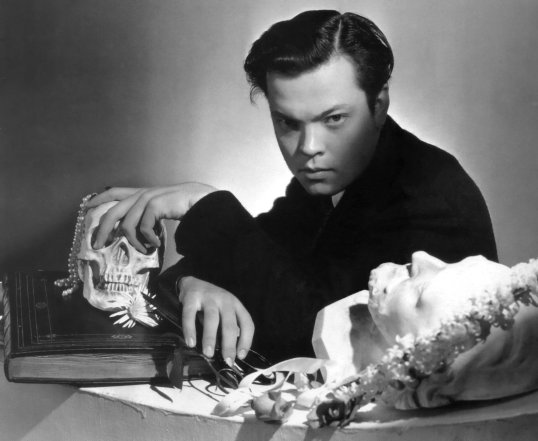
Today we celebrate what would have been the 110th birthday of the great Orson Welles! It’s time for….
4 Shots from 4 Orson Welles Films
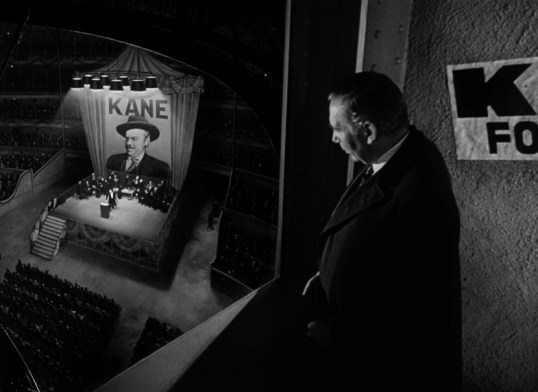
Citizen Kane (1941, directed by Orson Welles, DP: Gregg Toland)
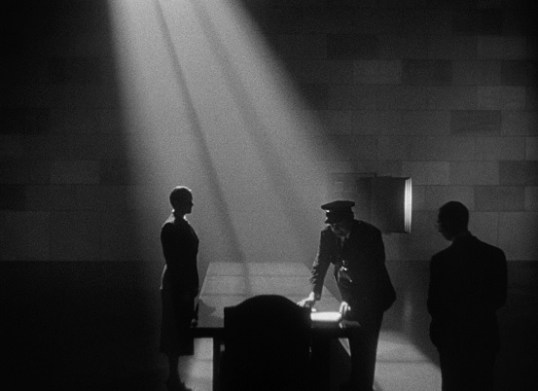
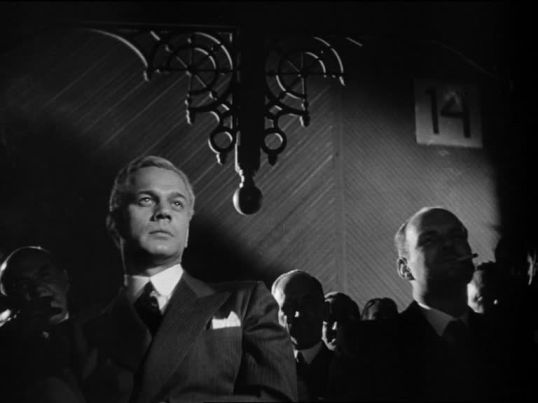
The Stranger (1946, dir by Orson Welles, DP: Russell Metty)
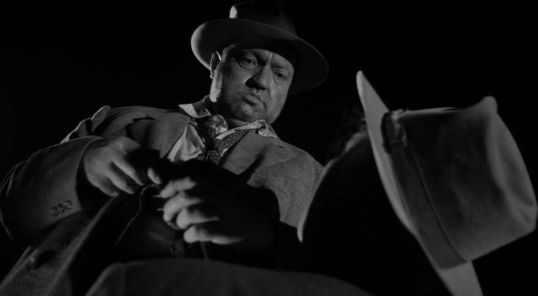
Touch of Evil (1958, dir by Orson Welles. DP: Russell Metty)
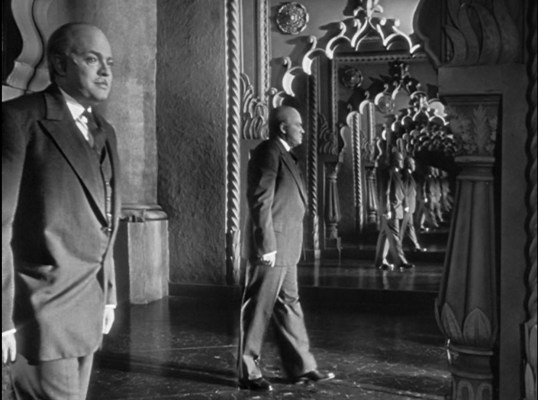
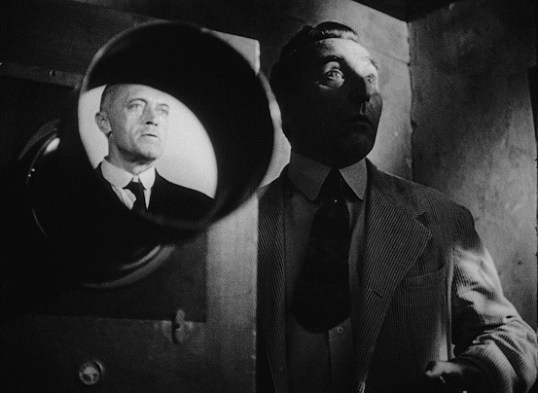
The Trial (1962, dir by Orson Welles, DP: Edmond Richard)
4 Shots From 4 Films is just what it says it is, 4 shots from 4 of our favorite films. As opposed to the reviews and recaps that we usually post, 4 Shots From 4 Films lets the visuals do the talking!
Today, we pay tribute to the year 1946. It’s time for….
4 Shots From 4 1946 Films
Beauty and the Beast (1946, dir by Jean Cocteau, DP: Henri Arinal)
It’s A Wonderful Life (1946, dir by Frank Capra, DP: Joseph Walker and Joseph Biroc)
The Big Sleep (1946, dir by Howard Hawks, DP: Sidney Hickox)
The Stranger (1946, dir by Orson Welles, DP: Russell Metty)
Joseph Cotten passed away 31 years ago today. Cotten appeared in a lot of good films and worked with many important directors but he will always be remembered for bringing to life Jedidiah Leland, the drama critic in Citizen Kane. I liked the character so much that I paid tribute to him with my penname, though I substituted an A for the first I.
Cotten played Jedidiah as both a young man and an old man in Citizen Kane. The first time I saw the movie, I reacted to the young Leland. With each passing year, I think I understand better what the older Leland was talking about when he said that memory is the greatest curse ever inflicted on the human race.
(Even retired and living in what appears to be a nursing home, Jedidiah Leland still spoke like a drama critic.)
4 Or More Shots From 4 Or More Films is just what it says it is, 4 shots from 4 of our favorite films. As opposed to the reviews and recaps that we usually post, 4 Shots From 4 Films lets the visuals do the talking!
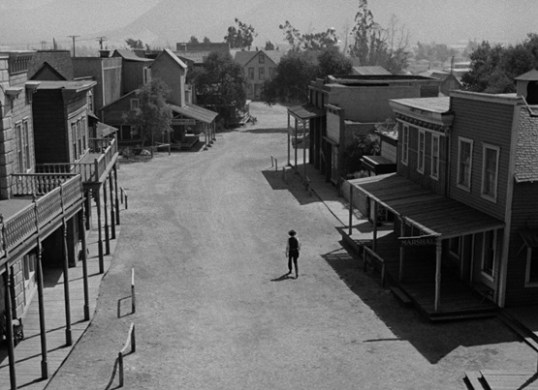
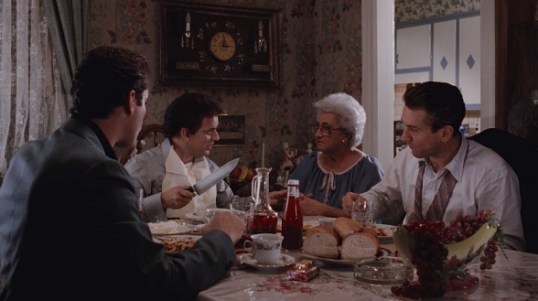
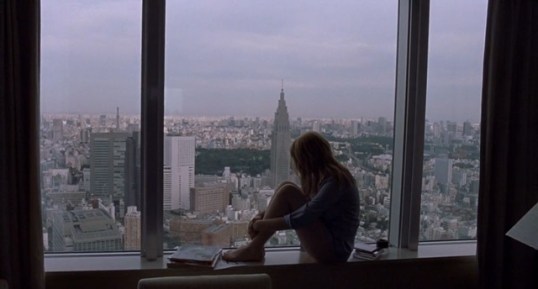
Since today is Oscar nomination day, today’s edition of 4 Shots From 4 Films is dedicated to films that were nominated for Best Picture but which did not win.
4 Shots From 4 Best Picture Nominees
Citizen Kane (1941, dir by Orson Welles, DP: Gregg Toland)
High Noon (1952, dir by Fred Zinnemann, DP: Floyd Crosby)
Goodfellas (1990, dir by Martin Scorsese, DP: Michael Ballhaus)
Lost In Translation (2003, dir by Sofia Coppola, DP: Lance Acord)