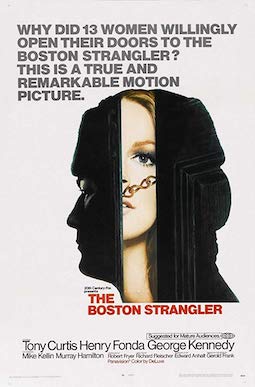
Film Review: The Boston Strangler (dir by Richard Fleischer)


Between June 14, 1962 and January 4, 1964, 13 women between the ages of 19 and 85 were murdered in the Boston area.  It was felt that they had all been killed by the same man, a monster known as The Boston Strangler.  Though the police investigated many suspects, they never made an arrest.  (One should remember that this was before the time of DNA testing or criminal profiling.  The term “serial killer” had not even been coined.  Today, sad to say, we take the existence of serial killers for granted.  In the 60s, it was still an exotic concept.)

In October of 1964, a man named Albert DeSalvo was arrested and charged with being “the Green Man,” a serial rapist who pretended to be a maintenance man in order to gain access to single women’s apartments.  After he was charged with rape, detectives were surprised when DeSalvo confessed to being the Boston Strangler.  When confessing to the murders, DeSalvo got a few minor details wrong but he also consistently included other details that the police hadn’t released to the general public.  Even when put under hypnosis, DeSalvo’s recalled those previously unreleased details.  Because DeSalvo was already going to get a life sentence on the rape charges and because there wasn’t any physical evidence that, in those pre-DNA, could have conclusively linked DeSalvo to the crimes, he was never actually charged with any of the murders.  Still, with his confessions, the cases were considered to be closed.

In 1966, before DeSalvo was even sentenced for the Green Man rapes, Gerold Frank wrote The Boston Strangler, a book about the murders, the investigations, and DeSalvo’s confessions.  It was one of the first true crime books and, in 1968, it was adapted into one of the first true crime films.

Directed by Richard Fleischer (whose filmography somehow includes not only this film but also Dr. Dolittle, Fantastic Voyage, 20,000 Leagues Under the Sea, Conan The Destroyer, and Red Sonja), The Boston Strangler is really two films in one.  The first half deals with the crimes and the police (represented by Henry Fonda, George Kennedy, Murray Hamilton, and James Brolin) investigation.  This half of the film is pulpy and crudely effective, full of scenes of the cops rounding up every sex offender who they can find.  There’s a scene where Henry Fonda talks to a prominent man in a gay bar that’s handled with about as much sensitivity as you could expect from a 1960s studio film.  (On the one hand, the man is portrayed with respect and dignity and he’s even allowed to call out the patron saint of 1960s mainstream liberal piety, Henry Fonda, for being close-minded.  On the other hand, everyone else in the bar is a stereotype and we’re meant to laugh at the idea that anyone could think that Henry Fonda could be gay.)  Director Richard Fleischer makes good use of split screens, creating an effective atmosphere of paranoia.  The scene where a woman tries to keep an obscene caller on the phone long enough for the police to trace his location made my skin crawl and served as a reminder that perverts predate social media.  Another scene where a flamboyant psychic tries to help the police goes on for a bit too long but, at the same time, you’re happy for a little relief from crime scenes and terrified, elderly women discovering that their neighbors have been murdered.

The second half of the film features Tony Curtis as Albert DeSalvo.  Curtis is effective as DeSalvo, playing him as being a self-loathing brute who is incapable of controlling his impulses.  (Before committing one of his crimes, DeSalvo watches the funeral of John Kennedy, his face wracked with pain.  Is the film suggesting that DeSalvo murdered to deal with the stress of life in America or is it suggesting that the hate that killed Kennedy was a symptom of the same sickness that drove DeSalvo?  Or is the film just tossing in a then-recent event to get an easy emotional reaction from the audience?)  As one might expect from a mainstream film made in 1968, The Boston Strangler takes something of a wishy washy approach to the question of whether DeSalvo’s crimes were due to sickness or evil.  Yes, the film says, DeSalvo was bad but it’s still society’s fault for not realizing that he was bad.  It’s the type of approach designed to keep both the law-and-order types and the criminal justice reformers happy but it ultimately feels a bit like a cop out.  Still, the shots of DeSalvo isolated in his padding cell have an undeniable power and Curtis is both pathetic and frightening in the role.  In its more effective moments, the second half of the film works as a profile of a man imprisoned both physically and mentally.

Watching the film today, it’s hard not to consider how different The Boston Strangler is from the serial killer films that would follow it.  DeSalvo is not portrayed as being some sort of charming or interesting Hannibal Lecter or Dexter-type of killer.  Instead, he’s a loser, a barely literate idiot who struggled to articulate even the simplest of thoughts.  The cops aren’t rule-breakers or renegades.  Instead, they’re doing their jobs the best that they can.  Though the film ends with a title card saying that it’s important for society to make more of an effort to spot people like DeSalvo before they kill, The Boston Strangler has a surprising amount of faith in both the police and the law and it assumes that you feel the same way.  It’s a film that takes it for granted the audience respects and trusts authority.  It’s portrayal of the police is quite a contrast to the rebel cops who dominate pop culture today.

After the film came out, DeSalvo recanted his confessions and said that he had never killed anyone.  He was subsequently murdered in prison in 1971, not due to his crimes but instead because he was independently selling drugs for prices cheaper than what had been agreed upon by the prison’s syndicate.  After his death, many books were written proclaiming that DeSalvo was innocent and that the real Boston Strangler was still on the streets.  Others theorized that the actual Strangler was DeSalvo’s cellmate and DeSalvo, knowing he was going to prison for life regardless, confessed in return for money being sent to his family.  That said, in 2013, DNA evidence did appear to conclusively link DeSalvo to the murder of 19 year-old Mary Sullivan.  Of course, that doesn’t mean that DeSalvo necessarily committed the other 12 murders.  In fact, from what we’ve since learned about the pathology of serial killers, it would actually make more sense for the murders to have been committed by multiple killers as opposed to just one man.

Regardless of whether DeSalvo was guilty or not, The Boston Strangler is an uneven but ultimately effective journey into the heart of darkness.
Horror on the Lens: The Failing of Raymond (dir by Boris Sagal)


Raymond (Dean Stockwell) has just escaped from a mental hospital and he has only one thing on his mind.  Raymond wants revenge.  Having looked over the past events of his life, Raymond has figured out that things started to go downhill for him when he failed a test in high school.  He blames his failure on his old teacher, Mary Bloomquist (Jane Wyman).

At the same time that Raymond is escaping, Mary is planning her retirement.  She’s decided that she no longer wants to teach.  The job just doesn’t seem worth it anymore.  But Raymond has other ideas.  Raymond wants her to give him the same test that he failed ten years before.  And this time, Raymond wants her to pass him or else.

The Failing of Raymond is a made-for-TV movie from 1971 and it features a good performance from Jane Wyman and a great one from Dean Stockwell.  The film ultimately hinges on one question.  Did Raymond really fail that test or did Mary fail Raymond?

Enjoy!

Film Review: Jaws 2 (dir by Jeannot Szwarc)


The 1978 film Jaws 2 poses a question that has been asked many times under many different circumstances:

When will people learn?

Seriously, you would think that after everything that happened during the first Jaws, the people of Amity Island would be a little bit smarter when it comes to sharks.  I mean, did Ben Gardner, the Kintner Boy, Quint, and Chrissie Watkins all die in vain?  If I lived on Amity Island, I would be so paranoid about another shark attack that I would probably move to Manitoba.  At the very least, I would demand that the beach be closed if there was even the slightest chance that another great white shark was somewhere out there, eating anyone foolish enough to get back in the water.

It’s just common sense!

But no.  In Jaws 2, when another shark shows up and eats two divers and a water skier before blowing up a motor boat, no one is even willing to consider shutting down the beach.  Even after Chief Brody (Roy Scheider) insists that another shark has shown up, no one is willing to listen to him.  “I know something about sharks!” Brody insists but the town council just shrugs him off.  Maybe they think that Quint and Hooper did all the work the last time and that Brody was just along for the ride.

Of course, Brody does bring some of his problems on himself.  Brody spends a lot of this film sitting in the dark, brooding about sharks.  When he sees a shadow in the ocean, he runs down to the beach and starts shooting at it.  “It’s just blue fish!” someone yells while Brody looks a little confused.  How shocked can we really be when the town council fires Brody?  He was a loose cannon.

Before he gets fired, Brody orders his teenage son, Mike (Mark Gruner) to stay out of the water.  Of course, Mike doesn’t listen.  He goes sailing with his friends and his younger brother, Sean (Marc Gilpin).  That’s a big mistake, of course.  As soon as Mike and company are a good distance away from Amity Island, the shark attacks and leaves them all stranded at sea.  Mike is knocked unconscious.  Sean is trapped on a boat all by himself.  One of the teenage girls, Jackie Peters (Donna Wilkes), totally freaks out while her older sister, Brooke (Gigi Voran), suggests that they all play charades to pass the time.  Everyone dismisses her idea but you know what?  I have it on very good authority that sharks love charades.  I think Brooke was on to something…

Jaws 2 is a strange, strange movie.  It’s really two films in one.  Jaws 2 starts out as an almost by-the-book remake of Jaws.  True, Quint’s dead.  And Richard Dreyfuss had just won an Oscar so there’s no way Hooper was going to come back.  But Brody’s back and he’s once again an island police chief who is afraid of the water and who can’t get anyone to listen to him.  Just as Jaws started out as almost a small town comedy, Jaws 2 has an early scene where Brody has to deal with the quirky citizens of Amity Island. (Unfortunately, Harry and his really bad hat don’t make a return appearance.)  A scene where a dead killer whale washes up on the beach is shot to remind us of the scene in the first in which Hooper and Brody examine a dead shark.

But then, halfway through, Jaws 2 turns into a totally different movie.  Suddenly, the teenagers are trapped out in the middle of the ocean and the shark is circling them and Brody is searching from them and the whole movie just goes insane.  Roy Scheider abandons any attempt at subtlety as he becomes as obsessed with shark as Donald Pleasence was with Michael Myers in Halloween.  The shark turns out to be incredibly sneaky.  He’s never around until you stick your hand in the water and then suddenly — SHARK!

How powerful is this shark?  He’s so powerful that he eats a freaking a helicopter!  Seriously, a coast guard helicopter tries to rescue the kids and ends up getting eaten by the shark!  That scene alone is worth whatever’s led up to it.  (I think Jaws 2 might be the first film to feature a shark eating a helicopter.)  The film only gets crazier from there, with Brody eventually reduced to verbally taunting the shark while clutching onto a power cable.

Now, admittedly, those stranded teenagers aren’t the most developed characters in the world.  There’s a lot of them and it’s sometimes difficult to keep track of who is who.  Fortunately, this is a 70s films and that means that Jaws 2 is all about the hair.  You may not know their names but you’ll never forget their hair:

Check out some of the members of the Jaws 2 hair club:

Jaws, come out to play…

(Okay, Luther wasn’t actually in the movie but just imagine if he had been!)

Anyway, Jaws 2 cannot begin to hold a candle to the original Jaws but it’s still a lot of fun.  Admittedly, there are a few parts, especially during the first hour, that drag in a way that Spielberg, the consummate story teller, would not have allowed.  I could have done without some of the lengthy scenes where Brody tries to convince the city council that there’s another shark in the water, if just because we already know that the shark’s there and we can guess that the beach isn’t going to be closed.  (After all, if the beach was closed, there wouldn’t be a movie…)

But once the teenagers are stranded in the ocean and the shark is eating the helicopter and Brody is calling it a bastard while hanging onto a power cable, there’s no way that you can resist the charms of this sequel.  Jaws 2 isn’t exactly good but it’s just so entertaining!

Jaws 2 frequently shows up on AMC so keep an eye out for it!

And, for the love of God — stay out of the water!

A Movie A Day #325: Damnation Alley (1977, directed by Jack Smight)


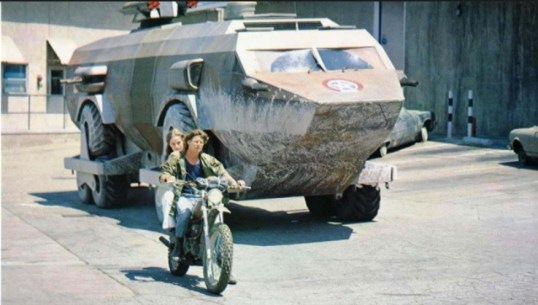
Anyone who has seen Damnation Alley knows that the only thing that matters is the Landmaster.

Damnation Alley has a slight plot.  A nuclear war has knocked the Earth off of its axis.  The skies are green and purple.  The scorpions are huge and the cockroaches eat humans.  Crazed survivors are living like savages, attacking anyone that they come across.  When a radio signal seems to indicate that there might still be civilization in Albany, four military men (George Peppard, Jan-Michael Vincent, Paul Winfield, and Kip Niven) decide to drive across the country to check it out.  To reach Albany, they will have to cross an inhospitable stretch of land called Damnation Alley.  They will be making the journey in two Landmasters, amphibious vehicles that provide RV comfort with the extra advantage of a rocket launcher.  Along the way, they fight scorpions, roaches, and pick up some extra passengers (Dominique Sanda and Jackie Earle Haley).

The radioactive sky looks cool but otherwise, the scorpions and the cockroaches are all obviously fake and no one in the cast makes any effort to do more than recite their lines.  But no one who has watched Damnation Alley cares about any of that.  We just want to drive a Landmaster.

There is nothing that the Landmaster cannot do.  It  can speed across desert sand.  It can tear up city streets.  It can break through walls.  It can turn into a boat.  It can fire missiles.  It also appears to be bigger on the inside than the outside, just like the TARDIS.  Either that or whoever did the set design for Damnation Alley was not detail-oriented.

Despite the awe-inspiring Landmaster, Damnation Alley was neither a critical nor a box office hit.  It was one of two science fiction films released by 20th Century Fox in 1977.  The other one was Star Wars, which was a good movie but didn’t have a Landmaster.

As for the Landmaster itself, it currently resides in California and has appeared in a handful of other movies.  Sadly, it missed out on the opportunity to appear in any of the Smoky and the Bandit movies.  Burt Reynolds driving a Landmaster?  That would have been box office gold.

Right, Burt?

The Movie That Nearly Killed The Godfather: The Brotherhood (1968, directed by Martin Ritt)


Brotherhood_1968Once upon a time, Paramount Pictures released a movie about an Italian-American organized crime family.

It was a self-styled epic that used the Mafia as a metaphor for both business and politics.  The movie mixed scenes of violent death with family and community ceremonies.   The main mafioso was played by a famous actor who was a big box office draw in the 1950s and another character, a war hero who was initially reluctant to get involved in the family business, was played by an up-and-coming young actor.   The majority of the movie took place in New York but there were several scenes that were set in Sicily.

It may sound like The Godfather but actually, it was The Brotherhood, a film that flopped so badly that Paramount executives nearly passed on the chance to make a movie out of Mario Puzo’s bestselling novel.  According to Peter Biskind’s The Godfather Companion, Francis Ford Coppola frequently cited The Brotherhood as being exactly the type of movie that he did not want to make while he was directing The Godfather.

Kirk Douglas, who both produced and starred, plays Frank Ginetta.  Frank, an old-fashioned and honorable mobster, is hiding out in Sicily with his wife, Ida (Irene Pappas).  Frank knows that a rival gangster, Jim Egan (Murray Hamilton), has put a price on his head.  When Frank’s brother, Vinnie (Alex Cord), shows up in Palermo, Frank is overjoyed at first.  But Ida reminds him, “They’re going to send someone.”

Most of the film is taken up with flashback to Frank and Vinnie’s old life in New York.  When Vinnie returns from serving in the army, he marries Emma Bertolo (Susan Strasberg), the daughter of Don Bertolo (Luther Adler who, as a stage actor and director, served as an early mentor to the future Don Corleone, Marlon Brando).  Frank grew up idolizing their Sicilian father and, at first, he is happy when Vinnie announces that he wants to enter the “family business.”  But then Vinnie starts to side with non-Sicilian gangsters like Egan and Sol Levin (Alan Hewitt).

The scenes in Sicily work the best, with Frank unsure as to whether or not Vinnie has arrived to visit or to murder him.  But the scenes in New York are such a mess that it took me a while to realize that they were even supposed to be flashbacks.  It is hard to keep track of how much time has passed from scene to scene and Alex Cord and Kirk Douglas are two of the most unlikely brothers imaginable.

The main problem with The Brotherhood is that it is impossible to watch it without thinking about The Godfather.  The Brotherhood has much in common with The Godfather but it has none of its authenticity and does not come close to matching its epic scale.  Kirk Douglas tries his best and puts a lot of effort into talking with his hands but he is miscast from the moment he first appears.  Robert Evans once said that he chose Coppola to direct The Godfather because he wanted to “smell the pasta.”  The Brotherhood was directed by Martin Ritt and you never smell the pasta.

The Brotherhood is an interesting footnote in the history of The Godfather but ultimately, it’s an offer you can refuse.

1374000145_4

Lisa Reviews An Oscar-Nominated Horror Film: Jaws (dir by Steven Spielberg)


JAWS_Movie_poster

There’s little that is more intimidating than trying to write a review of the 1975 best picture nominee, Jaws.

I mean, seriously, what’s left to be said about this film?  Jaws is one of those movies that everyone has seen and everyone loves.  And, even if someone somehow hasn’t seen the film, chances are that they still know all about it.  They know that it’s a movie about a giant shark that attacks Amity Island, just as the summer season is starting.  They know that the town’s mayor refuses to close the beaches, because he doesn’t want to lose the tourist dollars.  They know that the final half of the film is three men (Roy Scheider, Richard Dreyfuss, and Robert Shaw) floating around in a boat, searching for a shark.  And they certainly know that, whenever you hear John Williams’s iconic theme music, it means that someone is about to get attacked.

Jaws is such a part of our culture that probably not a single day goes by without someone saying a variation on “we’re going to need a bigger boat.”  Did you know that, on twitter, Ben Gardner’s boat has its own account?  And despite getting pretty graphically dismembered about halfway through Jaws, poor little Alex Kintner has an account as well!

What’s amazing about Jaws is that, even though everyone’s seen it and it’s been parodied a few thousand times, Jaws remains incredibly effective.  I still find myself cringing whenever the shark catches Alex Kintner and that geyser of blood explodes out of the ocean.  I still jump whenever the shark suddenly emerges from the water and scares the Hell out of Roy Scheider.  I still laugh at Richard Dreyfuss’s hyperactive performance and I instinctively cover my ears whenever I realize that Robert Shaw is about to drag his nails across that chalk board.

And then there’s that music, of course!  Even after being used, misused, and imitated in countless other films, the Jaws theme still fills me with a sort of existential dread.  The mechanical shark was notoriously fake-looking and was rarely seen onscreen as a result.  The camera and the music stand in for the shark and it works beautifully.

The one unfortunate thing about Jaws is that it’s been so critically acclaimed and so embraced by audiences that I think people tend to forget that it is primarily a horror film.  Mainstream critics tend to look down on horror as a genre so, rather than admit the obvious, they claim that Jaws is more of a thriller than a horror film.  Or they talk about how it’s actually meant to be a political allegory or an environmental allegory or an examination of male bonding.

So, let’s just make this clear.  No matter what the elitist critics or even Steven Spielberg himself may say, Jaws is primarily a horror film, with that relentless killer shark serving as a prototype for such future horror fiends as Michael Myers, Jason Voorhees, Freddy Krueger, and both of the Ghostface and Jigsaw Killers.  (Jaws even opens with a stereotypical slasher movie death, as a nude and stoned swimmer is suddenly attacked by an unseen killer.) If not for Scheider, Shaw, and Dreyfuss floating in the endless ocean, you would never have had films — like the Blair Witch Project — about people being lost and stalked in the wilderness.  And when that shark attacks and graphically rips apart its victims, how different is it from something you might find in a George Romero or Lucio Fulci zombie film?

On the basis of Jaws and Duel, I think it can be argued that, if Steven Spielberg hadn’t become America’s favorite director of crowd-pleasing, Oscar-contending blockbusters, he could have been one of our best horror directors.  Sadly, Spielberg has pretty much abandoned horror and I doubt that Jaws would be as effective if it were made today.  (I suspect that the temptation to resort to a cartoonish CGI shark would be too great.)

But that’s all speculation.

What matters is that Jaws remains one of the greatest films ever made.

And it’s a horror film!


Embracing the Melodrama Part II #68: Mazes and Monsters (dir Steven Hilliard Stern)


M_M_DVDIt’s amazing the things that you find when you randomly search the DVD section of Half-Price Books.  For instance, I found a very cheap DVD of the 1982 made-for-TV film Mazes and Monsters and I simply had to buy it.

Why?

Well, just look at the cover above.  Look at the ominous castle.  Look at the shadowy dragons flying around it.  Look at that Shining-style maze.  Look at the ominous tag line: “Danger lurks between fantasy and reality.”  And especially be sure to look at Tom Hanks gazing serenely over it all.

“Wow,” I thought, “Tom Hanks fights a dragon?  This is something that I’ve got to see!”

Well, there are no dragons in Mazes and Monsters.  There are a few monsters but they’re only briefly seen figments of Tom Hanks’s imagination.  The film is about a group of college students who obsessively play an RPG called Mazes and Monsters.  When one of the students (an annoying genius who wears wacky hats and is played by an actor with the surprisingly poetic name of Chris Makepeace) suggests that they play Mazes and Monsters “for real” in some caverns near the college, it leads to Robbie (Tom Hanks) have a mental breakdown.  Soon, Robbie is convinced that he’s actually a monk.  He breaks up with his girlfriend because he doesn’t want to violate his vow of celibacy.  (Of course, the real fantasy is that a college student obsessed with playing Mazes and Monsters would have a girlfriend in the first place but anyway…)  He keeps seeing imaginary minotaurs lurking in the shadows.  Finally, he runs off to New York on a quest to find “the great Hall.”  It’s up to his friends to find him and hopefully impart an important lesson about the dangerous reality of RPG addiction.

Or something.

Listen, to be honest, if not for Tom Hanks, there would be no reason to watch Mazes and Monsters.  It’s poorly acted.  It’s written and directed with a heavy hand.  There’s some nice shots of downtown New York City but otherwise, it’s visually drab.

But, because Tom Hanks is in it and he’s playing a role that demands that he go totally over-the-top in his performance, Mazes and Monsters is totally worth watching.  If you’ve ever wanted to see Tom Hanks wander around New York City while dressed like a monk, this is the film for you.  If you’ve ever wanted to see Tom Hanks start to tremble while explaining that, as a monk, he’s not allowed to kill minotaurs, this is the movie for you.  Most of all, if you’ve ever wanted to see Tom Hanks shrieking, “THERE’S BLOOD ON MY KNIFE!” while standing in an old school phone booth, this is definitely the movie for you!

Seriously.

Considering that Tom Hanks is currently viewed as being some sort of elder statesman of American film (and, even more importantly, Hanks seems to view himself as being some sort of national treasure), there’s something oddly satisfying about seeing him before he became THE Tom Hanks.  It’s good to be reminded that, at one time, he was just another young actor doing his best in a crappy made-for-TV movie.

Lisa Watches an Oscar Nominee: The Hustler (dir by Robert Rossen)


Hustler_1961_original_release_movie_posterFor my final Oscar-nominated film of the night, I watched the 1961 film The Hustler.

Filmed in harsh black-and-white and featuring characters who live on the fringes of conventional society, The Hustler is one of those films that’s so unremittingly bleak that it would probably be so depressing as to be unwatchable if not for the talented cast.  Paul Newman plays “Fast Eddie” Felson, a pool hustler who is talented but cocky, a guy who has the talent of a winner and the self-centered, self-pitying personality of a loser.  When we first meet Eddie, he and his manager, Charlie (Myron McCormick) have traveled all the way from Oakland to New York, all so Eddie can challenge and hopefully beat the legendary pool player Minnesota Fats (Jackie Gleason).  Eddie does get his chance to challenge Minnesota (or perhaps I should call him Mr. Fats?) and comes close to winning.  However, in the end, Eddie is too arrogant and impulsive and he ends up losing to Mr. Fats.

Defeated and humiliated, Eddie is hiding his meager possessions in a storage locker at the local bus station when he first meets Sarah Packard (Piper Laurie).  Sarah is an alcoholic and an aspiring writer.  She claims to be a part-time student but we never actually see her in class.  She walks with a pronounced limp and she has a habit of declaring the world to be “perverted, twisted, and crippled.”  Soon, she and Eddie are living together, two lost souls who support and destroy each other at the same time.  When Sarah attempts to write a short story about Eddie, Eddie responds by destroying the page and ordering her to never write about him again.  Charlie views Sarah as a destructive influence and decides that he doesn’t want to have anything else to do with Eddie.

However, Eddie soon finds a new manager.  Bert Gordon (a demonic George C. Scott) is a gambler who says that if Eddie sticks with him, Eddie will not only get rich but he’ll defeat Minnesota Fats as well.  At first, Eddie wants nothing to do with Bert but, when his own attempts at hustling lead to him getting his thumbs broken, Eddie has a change of heart.  Under Bert’s guidance, Eddie find success but he does so at the expense of what little decency that he had to begin with…

Eddie is an interesting character, one who most viewers will probably have mixed feelings about.  On the one hand, he’s a jerk.  He’s an arrogant, cocky jerk who thinks that he’s the best and who either uses or allows himself to be used by almost everyone that he meets.  Though he definitely ends up being exploited by Bert, Eddie knew what he was getting into when he made his deal with the devil.  Though he loves Sarah and she loves him, Eddie still treats her poorly.  There are just so many reasons to dislike Eddie Felson.

Except, of course, Eddie Felson is played by Paul Newman.

Seriously, it is possible to dislike a character played by Paul Newman?  As an actor, Newman was so charismatic and projected an innate goodness that came through even when he was playing a character who didn’t always do nice things.  As written, the character of Eddie spends the majority of the movie acting like a louse.  But, as played by Newman, Eddie becomes a wounded anti-hero, the bad boy that every girl dreams of somehow redeeming.

Ultimately, there are many reasons to see The Hustler.  Gleason and Laurie both give good performances.  George C. Scott, meanwhile, is like a force of nature.  Just listen to him as he shouts, “You owe me money!”  Director Robert Rossen finds an odd beauty in some of the sleaziest parts of New York City.  But, in the end, the main reason to see The Hustler is for Paul Newman’s amazing performance in the title role.  It’s a great performance that elevates the entire film.

I have to admit that I don’t know much about pool.  During my first college semester, I lived in a dorm that had a pool table in the front lobby.  There was always a large group of people gathered around that table, playing pool and generally looking like a bunch of hipster douchebags.  Sitting in the lobby meant having to listen to a constant soundtrack of balls clacking against each other, followed by people saying, “Such-and-such in the corner pocket” or whatever the Hell it is people say when they’re playing pool.  (To be honest, though I could hear the voices, I rarely listened to what they were actually saying.)  I don’t know if the people playing pool in the lobby were any good.  But, after seeing The Hustler, I can say that Eddie Felson would have beaten all of them.