Film Review: Mother, May I Sleep With Danger (dir by Melanie Aitkenhead)


mother_may_i_sleep_with_danger_still

Earlier tonight, I turned over to Lifetime and I watched the much hyped remake of Mother, May I Sleep With Danger?  Having watched, what can I say about it?

*sigh*

Seriously, I had such high hopes.  My hopes for this film were almost as high as I was the day I graduated from high school.  That’s pretty freaking high!

And really, can you blame me?  First off, the film was a remake of one of my favorite Lifetime films.  And, while I usually hate remakes, the original Mother, May I Sleep With Danger was so over-the-top and melodramatic that it practically demanded a Deadly Adoption-style remake.  The idea of mixing the original’s stalker plot with lesbian vampires just sounded so promising!  And, on top of that, James Franco was involved!

Up until I saw the movie tonight, I was under the assumption that James Franco would actually be directing the remake.  Well, he didn’t.  Mother, May I Sleep With Danger was directed by Melanie Aitkenhead and, considering that this was her feature debut, she actually did a pretty good job.  The film is full of atmospheric shots and Aitkenhead gets a surprising amount of mileage out of simply showing the movie’s vampires moving across the screen in slow motion.

Instead of direcing, James Franco served as executive producer and is credited with coming up with the film’s “original story.”  (The actual screenplay is credited to Amber Coney, who also plays one of the vampires.)  Franco also plays a theater professor who directs a production of Macbeth.  In his production, Macbeth is played by a woman and you know what?  That’s a great idea!  In fact, there were times that I found myself thinking that, if I had to choose between watching Mother, May I Sleep With Danger? and James Franco’s Macbeth, I would definitely pick Macbeth.

As for the rest of the film — well, it actually has absolutely nothing in common with the original Mother, May I Sleep With Danger.  The original film’s stars — Tori Spelling and Ivan Sergei — both show up in different roles but it would have been a lot more interesting if they had been playing the same roles.  What if Sergei’s psycho stalker actually didn’t drown at the end of the original and ended up teaching a college class on Victorian literature?  And what if his favorite student just happened to be the daughter of his former obsession (played, of course, by Tori Spelling)?  That would have been interesting!  Instead, Sergei is playing just any professor and Spelling is playing just any mother.

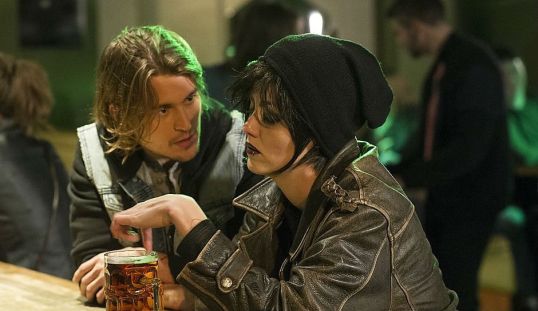
The majority of the film deals with Spelling’s daughter, Leah (Leila George), attempting to work up the courage to tell her mom that 1) she’s a lesbian and 2) she has a new girlfriend, named Pearl (Emily Meade).  What Leah doesn’t know is that Pearl is actually a vampire and is being pressured by her blood-sucking friends to turn Leah into a vampire too.  As well, nerdy and creepy Bob (Nick Eversman) has an unrequited crush on Leah.  When Bob discovers that Leah has a girlfriend, he starts plotting to break them up.

And there’s a lot that I liked about Mother, May I Sleep With Danger.  I liked that the film, unlike a few other Lifetime films that I’ve seen, was unapologetic about being sex positive.  I liked that the film presented an unambigiously positive portrayal of a same-sex couple.  I liked that the vampires were all stylish and enjoyed hanging out in cemeteries.  The film’s best scenes featured the vampires infiltrating frat parties and feeding on the date rapists within.  These were hugely satisfying scenes and I would have been happy if the entire movie had just been scene after scene of vampires attacking Brock Turner.

But despite all that worked about the movie, Mother, May I Sleep With Danger left me feeling disappointed.  After all the hype and the raised expectations and the commercials promising us a masterpiece from “the twisted mind of James Franco,” there was really no way not to be disappointed by the final product.  Unlike last year’s A Deadly Adoption, Mother, May I Sleep With Danger never managed to establish a consistent tone.  It didn’t seem to be sure whether it wanted to be a comedy, a drama, a horror film, or an elaborate send-up of the Lifetime aesthetic.  Whereas A Deadly Adoption was clearly a labor of snarky love, I couldn’t help but feel that Mother, May I Sleep With Danger had probably been made by people who don’t particularly like Lifetime films.  As such, it worked as neither an homage nor a parody.  Instead, it was just another movie about vampires and not a particularly original one at that.

And, hey, I like movies about vampires!  I’ve seen a few hundred of them.  I’ve certainly seen enough to know that Mother, May I Sleep With Danger didn’t bring anything new to the genre.

That said, I still love James Franco!  Seriously, how can’t I?

8e617481e3a3ca90c8d70a0bbb6844fc

What Lisa Watched Last Night #152: Killing Mommy (dir by Curtis Crawford and Anthony Lefrense)


Last night, I gathered together with my three older sisters and I tried to make them watch Killing Mommy on Lifetime!  They all abandoned me after thirty minutes but I stayed for the entire film.

Killing Mommy

Why Was I Watching It?

(Awwwwww!  That is one of the greatest tweets in which I’ve ever been mentioned!  Everyone please be sure to check out Awards Watch!)

What Was It Aboot?

Killing Mommy was the latest in a long line of Canadian-produced Lifetime thrillers.  It tells the story of two twin sisters!  Deb has dark hair, a tattoo, and a bad attitude.  She’s a recovering drug addict and she divides her time between having anonymous sex and going to jail.  Julianne has red hair and is about to graduate from college.  She is always smiling and she’s always spending money!

When Deb and Julianne were younger, their father died when a car mysteriously fell on top of him.  Now, their mom — who runs a charity of some sort — is on the verge of remarrying.  Deb is upset.  Julianne is supportive.  Soon, someone with dark hair is attempting to kill mom.  Is it Deb or is it just Julianne wearing a Deb wig?

What Worked, eh?

Killing Mommy was one of those films that got better the longer it lasted.  During the first hour, I thought it was way too slow and awkwardly acted.  But, during the second hour, the film got enjoyably weird and over-the-top.  It’s as if, during the 2nd half of the movie, the filmmakers suddenly realized that they just had to stop pretending like the movie would ever make any sense.  They decided to embrace the melodrama and good for them!

What Did Not Work, eh?

The second hour of Killing Mommy is a lot of fun but that first hour — oh my God.  See, the main problem with having a great second hour is that you have to get through the first hour to reach it and, if you first hour moves too slowly or features some less than impressive acting, you’re increasing the chances that viewers will never make it to that second hour.  The first hour of Killing Mommy was a real struggle to get through.  If you look at my twitter timeline, you’ll see that I tweeted a hundred times more during the second hour than the first hour.

Some of the acting, especially during that first hour, left a lot to be desired.  I think I may have compared some of the performances to the acting that you typically find in one of those “You got insurance?  With your health problems?!” MetLife insurance commercials.  However, I now think that some of what seemed like bad acting may have instead just been foreshadowing of the film’s 2nd hour twist.

Speaking of twists, there’s a flashback where a man working on a car yells at his daughter so much that she finally gets so annoyed that she lowers the car down on top of him.  (That’s not really a spoiler because what happened is pretty obvious from the minute the car crushing is first mention, especially if you’ve ever seen a Lifetime movie before.)  Anyway, I started giggling during that scene and I’m not sure if I was supposed to.

“OMG!  Just like me!” Moments, for sure

Julianne has red hair and she loves to shop!  How could I not relate to her?

On the other hand, Deb often wears black and has a sarcastic attitude.  How could I not relate to her, as well?

Seriously, other than all the murders, this whole movie had me going, “Oh my God!  Just like me!” over and over again.

Lessons Learned

I love, Canada!


The Fabulous Forties #50: Lady of Burlesque (dir by William A. Wellman)


40s

Way back in April, I started on a series of reviews.  I announced that I would be watching and reviewing all 50 of the public domain films included in Mill Creek’s Fabulous Forties box set.

At the time, I expected that it would take me maybe two weeks.  At the most, two and a half.  After all, I wondered, how long can I take?  Well, needless to say, it took me a little longer than two weeks.  In fact, it took me nearly 3 months.  (In my defense, May turned out to be a very busy month for me and I wasn’t able to review a single Fabulous Forties film.)  However, what’s important is that, after all this time, I am currently writing up the last of my Fabulous Forties reviews!

(And, right now, you’re reading it.)

On the whole, the Fabulous Forties has turned out to be pretty uneven box set.  It contains a few classics, like My Man Godfrey, His Girl Friday, and The Last Chance.  There are several good films, like The Black Book and Trapped.  And then there’s quite a few mediocre and forgettable films, like The Town Went Wild and Jungle Man.  (Dear God, Jungle Man…)  As I started on the final film in the set, I wasn’t sure what I was about to see…

Well, no worries!  The Fabulous Forties ends on a high note!  The 50th film is the wonderfully entertaining 1943 comedy-musical-mystery Lady of Burlesque!

Poster - Lady of Burlesque_03

Lady of Burlesque (which was released in the UK under the title Striptease Lady) takes place in an old and somewhat decrepit New York burlesque house, the type of place where the audience is almost all male, the owners are somewhat sleazy, and the performers are a cross between cynical veterans and naive newcomers who are hoping for their first big break.

As quickly becomes apparent, the theater would fall apart if not for its main attraction, Dixie Daisy (Barbara Stanwyck).  Dixie serves as a mentor for the newcomers and a confidante for the veterans.  She knows how to keep the audience entertained, even when two dancers are loudly screaming at each other offstage.  She knows how to deal with the sleazy owners and how to placate the owners of the Chinese restaurant next door.  Dixie also knows better than to get romantically involved with any of male comics who perform at the theater but that doesn’t stop her from flirting with one of them, Biff Brannigan (Micahel O’Shea, playing his role with an almost poignant earnestness).  As I watched the film, I could tell that Barbara Stanwyck was neither a natural dancer nor singer but it didn’t matter because, whether Dixie was trying to keep peace backstage or performing onstage and singing a song called, “Take It Off The E-String, Play It On The G-String,” Stanwyck totally committed herself to the role.

Plus, her outfits were to die for!

barbara_stanwyck_001_lady_of_burlesque

Seriously, as I watched Lady of Burlesque, I totally wanted to get a job dancing in an old timey burlesque house!  If only I had a time machine…

Of course, it should be understood that the acts in Lady of Burlesque are risqué but, by today’s standards, they’re also rather innocent.   The jokes may be full of double meaning but it’s all hidden in the subtext.  The costumes may be sexy but they also stay on.  (That probably had more to do with the production code than to do with the realities of 1940s burlesque.)

Anyway, Lady of Burlesque is technically a murder mystery but mostly, it’s just an excuse to show the performances happening onstage and a few comedic (and occasionally dramatic) vignettes of what it was like to be backstage in a burlesque house.  Two dancers are murdered but the show must go on.  Even as Dixie solves the murders and tries to keep everyone calm, the show must go on.  In fact, that’s one of the true joys of Lady of Burlesque.  Regardless of what madness might be going on backstage, the show never stops!  In fact, the film often seems undecided about whether or not the backstage murders are bad because of the loss of life or the fact that they threaten to interrupt the performances onstage.  Lady of Burlesque becomes a tribute to the work ethic of entertainers everywhere!

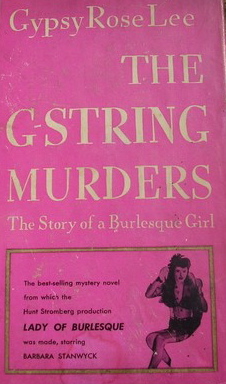
Lady of Burlesque was based on a novel by Gypsy Rose Lee.  The name of that novel was The G-String Murders.  Not surprisingly, that title was changed for the film version.

il_570xN.228180639

Well, that concludes the Fabulous Forties!  In a few weeks, I’ll start in on my next Mill Creek box set, the Nifty Fifties!  Until then, enjoy Lady of Burlesque!

The Fabulous Forties #49: Tulsa (dir by Stuart Heisler)


Tulsa_DVD_Cover

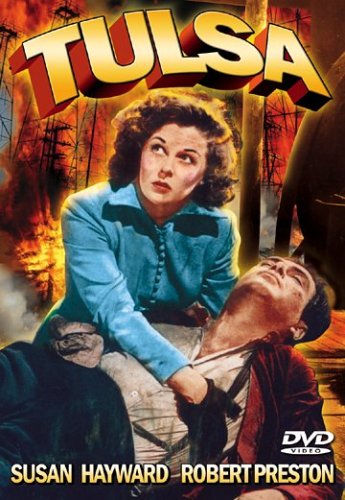
The 49th film in Mill Creek’s Fabulous Forties box set was the 1949 “epic” Tulsa!

I put epic in quotation marks because Tulsa is only 90 minutes long and I personally don’t think you can really have an epic unless you also have epic length.  Giant is an epic, whereas Tulsa is an “epic.”  That said, Tulsa does have a goal worthy of an epic.  Tulsa is about oil and the men and women who sacrifice so much to get that oil out of the ground.  Some of them lose their lives, some of them lose their happiness, and some of them make a lot of money.  I know that makes this film sound a lot like There Will Be Blood but it’s really not.  There Will Be Blood is an epic.  Tulsa is an “epic.”

I have to admit that I was intrigued by this film, just because my family lived in Tulsa for a handful of months, way back when I was 9 years old.  That said, I did groan a little bit when the film opened with a folksy guy named Pinky Jimpson (Chill Wills) standing in front of a white fence and staring straight at the camera.  “Howdy, cousins,” Pinky says, before launching into a monologue about how Oklahoma is the greatest place on Earth.  As a Texan, I was legally required to roll my eyes at Pinky’s claims but, to be honest, Oklahoma’s a pretty nice place.  It’s certainly better than Vermont.

(Take that, Vermont!)

Anyway, once the story gets started, we discover that it’s about Cherokee Lansing (Susan Hayward).  After Cherokee’s rancher father is killed when an oil derrick falls over on him, she decides to get her revenge by entering the oil business herself.  At first, everyone is doubtful that a woman — especially a woman whose only apparent friend is a Native American named Jim Redbird (Pedro Armendariz) — can succeed in a man’s world.  But she proves them wrong by befriending eccentric oilman John Brady (Ed Begley).  After Johnny is killed in a bar fight (because Tulsa is a dangerous place), he leaves all of his land and drilling rights to Cherokee.  He also leaves behind a far more sober-minded son, Brad (Robert Preston), who goes into business with Cherokee.

Soon, Cherokee and Jim Redbird are rich and powerful.  But, as often happens, they are in danger of losing sight of why they wanted to become rich and powerful in the first place.  Jim, in particular, turns out to be a big ol’ sellout.  Brad is disgusted with all of them but then, fortunately, there’s a big oil fire which leads to a lot of stuff blowing up and everyone learning an important lesson…

Or, at the very least, Pinky assures us that they all learned a lesson.  He also talks about how everything in the world now runs on oil.  He mentions that you can get oil from other parts of the world but the best oil comes from Tulsa.

(And again, as a Texan, I am contractually obligated to roll my eyes while noting that people from Oklahoma are some of the nicest folks that you’ll ever meet…)

Anyway, as a film, Tulsa never quite works.  90 minutes isn’t enough time to tell the story that it’s trying to tell and some of the acting is rather inconsistent.  However, the fire at the end is still impressive (Tulsa’s special effects received an Oscar nomination.) and I enjoyed watching Susan Hayward go totally over-the-top in role of Cherokee.  Compared to her subtle and kind of depressing performance in Smash-Up, Hayward actually appears to be having fun in Tulsa and good for her!

Tulsa was the 2nd to last film in the Fabulous Forties box set.  In my next review, I will conclude this series by taking a look at Lady of Burlesque!

The Fabulous Forties #48: Pot O’ Gold (dir by George Marshall)


Pot_o_Gold-_1941-_Poster

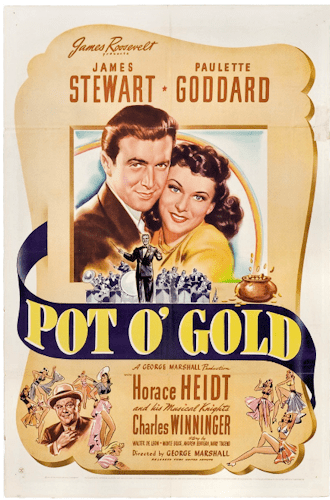
The 48th film in Mill Creek’s Fabulous Forties box set was 1941’s Pot O’ Gold.  At first, I was really excited about watching Pot O’ Gold because it starred James Stewart, one of my favorite of the Golden Age stars.  “Wow,” I thought, “James Stewart never made a bad movie!  This is going to be great!”  However, before watching the film, I looked Pot O’ Gold up on Wikipedia and I discovered that apparently, James Stewart considered Pot O’ Gold to be the worst film that he ever made.

After having watched the film, I think that Jimmy may very well have been correct in his assessment.

Pot O’ Gold is a musical comedy.  Stewart plays Jimmy Haskell, the owner of a music store.  Jimmy loves music but he’s a terrible businessman.  Despite the fact that his store always seems to be full of quirky characters playing musical instruments, it still goes out of business.  Jimmy is forced to go to work for his uncle, C.J. Haskell (Charles Winninger).  C.J. not only owns a health food company but he also produces a radio show.

And, on top of all that, C.J. hates music!

Unfortunately, considering how much C.J. hates music, he lives right next door to the McCorkles, a family of Irish musicians.  The McCorkles are constantly practicing in front of C.J.’s store and, as a result, C.J. is constantly forced to call the cops to make them go away.

When Jimmy first arrives at the store, he befriends the McCorkles.  He even falls in love with Molly McCorkle (Paulette Goddard).  Unfortunately, none of the McCorkles know that he is C.J.’s nephew and C.J. doesn’t know that his nephew secretly continues to love music.  Meanwhile, C.J. is trying to catch the mysterious person who threw a tomato at him.  What he doesn’t realize is that the tomato was thrown by … JIMMY!

And it just keeps going on and on from there.  C.J. conspires to get rid of the McCorkles.  Jimmy tries to bring peace between the two sided without the Molly discovering that he’s related to C.J. and without C.J. realizing that Jimmy threw that tomato.  Jimmy eventually goes on C.J.’s radio show and soon, he’s using the show as a way to give away money to the needy.  Meanwhile, he struggles to forge peace between the McCorkles and C.J. without Molly discovering his true identity and without C.J. finding out he threw that tomato.  Will C.J. ever learn to love music and will it ever occur to anyone that this whole mess could easily be resolved by everyone making an effort not to randomly break out into song every time C.J. happens to be walking down the street?

Pot O’ Gold is an amazingly silly movie and I don’t mean silly in a good way.  This is one of those films where every issue could be resolved if people just showed a little intelligence.  It’s also a movie where everyone breaks into song every few minutes.  The key to a successful musical is that the songs have to feel like the grow organically out of the action.  The songs in Pot O’ Gold feel like they’re just there to be there.

Personally, I think James Stewart is one of those actors who can make any movie worth seeing.  He is his normal, likable self in this film but Pot O’ Gold never seems worthy of his famous persona.

Incidentally, Pot O’ Gold’s credited producer was James Roosevelt, FDR’s wastrel son.  I don’t know how much he had to do with the actual production but I’ve always wanted an excuse to use the word “wastrel” in a review.

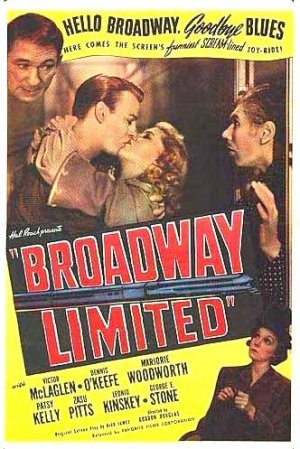
The Fabulous Forties #47: Broadway Limited (dir by Gordon Douglas)


Broadway_Limited_FilmPoster

The 47th film in Mill Creek’s Fabulous Forties box set was a 1941 comedy named Broadway Limited.

Broadway Limited tells the story of several increasingly desperate characters and a baby.  April Tremaine (Marjorie Woodworth) is a film star whose career is in danger of stagnating.  Her frequent director, the eccentric Ivan Ivanski (Leonid Litinsky), comes up with a plan to increase April’s popularity.  He starts a rumor that she has adopted a baby.  The only problem is that April has to be seen with the baby for the rumor to be believable.

Fortunately, April is going to be traveling from Chicago to New York via a train known as the Broadway Limited.  Ivan decides that April needs to be seen with the baby on the train.  April’s assistant, Patsy (Patsy Kelly), is dating the train’s engineer, Mike (Victor McLaglen).  When Patsy tells Mike about the scheme, Mike decides to help out.  He spots a mysterious man with a baby.  Mike asks if he can borrow the baby for a few minutes.  The man agrees and hands over the baby and then Mike gives the baby to April.  Everyone sees April with the baby but the mysterious man has vanished.  What Mike does not initially know but quickly comes to suspect is that the baby might be the Pierson Baby, whose kidnapping has become national news.

(As confusing as it may sound when you read about it, it’s even more confusing when you actually watch it.)

The rest of the film basically follows Patsy, Mike, Ivan, and April as they all try to get the baby to safety without running the risk of being implicated in the kidnapping.  The four of them keep trying to leave the baby in different parts of the train, where she can be discovered by someone, just to inevitably have the baby somehow end up back in their compartment.

But that’s not all!  The high-strung president of the April Tremaine fan club (played by ZaSu Pitts) is also on the train and she keeps getting in everyone’s way.  And then there’s Dr. Harvey North (Dennis O’Keefe).  Harvey was April’s childhood crush and they just happen to be on the same train!  However, Dr. North believes that, since April has a baby, she must also have a lover…

If Broadway Limited sounds like an extremely busy film … well, it is.  The film attempts to do the screwball thing, with increasingly frantic characters running from compartment to compartment and behaving in increasingly ludicrous ways.  How well it works depends on which character is appearing in which scene.  O’Keefe plays his role too seriously, Litinsky is too broad, and Woodward is never believable as a movie star (which, needless to say, is problem when you’re the star of a movie).  However, Patsy Kelly and Victor McLaglen are both hilarious as Patsy and Mike and have a lot of chemistry.  As long as the film concentrates on Patsy and Mike, it’s entertaining.

Plus, the baby’s super cute!

Broadway Limited is hardly a classic but it works well enough.


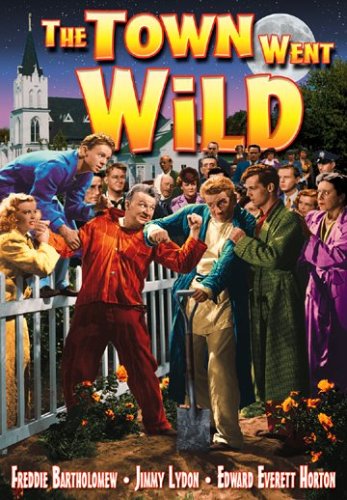
The Fabulous Forties #46: The Town Went Wild (dir by Ralph Murphy)


51BRWYTCMZL

The 46th film in Mill Creek’s Fabulous Forties box set was 1946’s The Town Went Wild!  Nice name, huh?

The name is actually a lot nicer than the movie, which is a bit incoherent.  Basically, David (Freddie Bartholomew) is a nice guy who has lived his entire life in the small town.  His best friend is Bob (Jimmy Lydon) and David is also in love with Bob’s sister, Carol (Jill Browning).  David is an engineer who has just been assigned to go work in Alaska.  Before he leaves, he is determined to marry Carol.

Unfortunately, Bob’s father (Edward Everett Horton) and Carol’s father (Tom Tully) hate each other.  They have been feuding for so long that they’re not even sure what they’re feuding about.  However, Carol and David are determined to get married so they decided to elope.  Getting a ride from their friend Mille (Roberta Smith), they go to the next town over and ask the justice of the peace to marry them,

However, before the justice of the peace can marry them, he needs them to publicly post their wedding plans in the local newspaper.  And before David can post those plans, he needs to get his birth certificate from the local registrar.  When David gets his birth certificate, he discovers something shocking.  There was a mix-up at the hosptial!  His Dad went home with the wrong baby.  David is actually … CAROL’S BROTHER!

So, what can they do?  How can David and Carol still get married despite apparently being related?  And will the fathers be able to set aside their feud long enough to help their children out?  The entire town wants to know!

I have to admit that I’m struggling a bit to come up with anything to say about The Town Went Wild.  The movie is a mess and David and Carol are such boring characters that they even make incest look dull.  Unfortunately, the version I saw of The Town Went Wild suffered from one of those infamously cheap Mill Creek transfers, complete with grainy picture, inconsistent sound, abrupt cuts, and the sneaky suspicion that certain scenes did not make the transfer from film to video.

With all that in mind, it’s hard to fairly judge The Town Went Wild but I can say that at least it provided good roles for Edward Everett Horton and Tom Tully.  If nothing else, these two character actors appeared to enjoy playing loud and frequently stupid rivals.  Otherwise, The Town Went Wild is one of those poverty row films that can safely be forgotten.

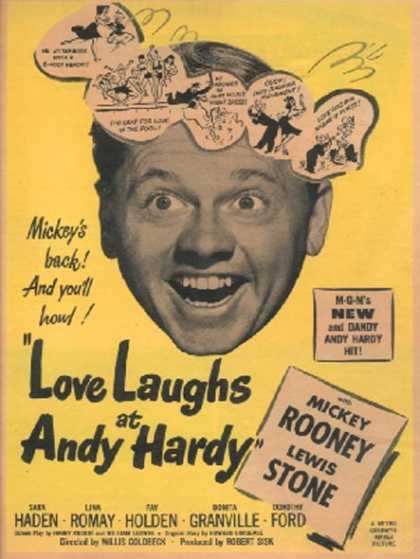
The Fabulous Forties #45: Love Laughs At Andy Hardy (dir by Willis Goldbeck)


LLAAH

I cringed a little when I saw that the 45th film in Mill Creek’s Fabulous Forties box set was 1946’s Love Laughs At Andy Hardy.  

This was because I had never seen an Andy Hardy film before but I did know enough to know that, starting in the 1930s, MGM made a series of films that featured Mickey Rooney in the role of a “nice, young man” named Andy Hardy.  Andy was a well-meaning kid who grew up in Middle America under the watchful eye of his father, Judge Hardy (Lewis Stone).  What little I had heard of the Andy Hardy films led me to suspect that they were very much a product of their time and had not aged particularly well.

Having now watched Love Laughs At Andy Hardy … well, I can confirm that it is a product of its time.  And it is definitely an uneven film, though perhaps I would have felt differently if I had seen any of the other Andy Hardy films.  (Love Laughs was the 15th film about Andy Hardy and it pretty much assumes that the viewer already knows who Andy and all of his friends and family are.)  But I will say this: Mickey Rooney was a really good actor.  In fact, as I watched Love Laughs At Andy Hardy, I was shocked by just how good a performance Rooney gave.  When I think of Mickey Rooney — well, to be honest, it’s rare that I ever do.  But when I do, it’s usually in relation to the exploitation films he made after he was a star.  These were movies like The Manipulator or Silent Night Deadly Night 5, all of which feature an elderly and obviously unwell Mickey acting up a storm.  In contrast to those film, in Love Laughs At Andy Hardy, Mickey gives a totally empathetic and, at times, even subtle performance.   Even by contemporary standards, his performance feels real and, as I watched, I started to understand how there actually could have been 16 separate films about Andy Hardy.  You really do find yourself caring about the little guy,

As for this film, it opens with Andy returning from serving in World War II.  Apparently, he left college to enlist in the army.  Now that he’s back in America, he’s ready to return to college and ask his old girlfriend, Kay (Bonita Granville) to marry him.  However, to Andy’s shock and disappointment, Kay has moved on and has other plans.  Why, it’s almost enough to make Andy want to drop out of school, give up his dreams of becoming an attorney, and try to find work as an engineer in South America!

Fortunately, Judge Hardy is there to talk some sense into his son.

It’s all fairly predictable and, as I said before, definitely uneven.  I get the feeling that a lot of the scenes in Love Laughs At Andy Hardy were meant to serve as call backs to previous films in the series.  Watching this film without a context can lead to a lot of confusion.  But, again, it’s all saved by Mickey Rooney’s performance.  While I can’t really give this film a strong recommendation, I imagine if you’re fan of Rooney’s or the Andy Hardy films, you’ll enjoy it.

Perhaps the best scene in the film comes when Andy is set up on a blind date with a girl named Coffy (Dorothy Ford).  When Andy goes to Coffy’s dorm to pick her up, he can’t understand why all the other girls keep looking at him and laughing.  However, once Coffy shows up, it quickly becomes obvious.  Coffy is 6’2 while Andy is a full foot shorter.

However, when Andy and Coffy arrive at the college dance, they defy all the laughs and the snide remarks.  Instead of surrendering to the expectations of snarky society, they perform a dance to end all dances and I’m going to conclude this review by sharing it below.

Enjoy!