The TSL’s Horror Grindhouse: Day of the Dead: Bloodline (dir by Hèctor Hernández Vicens)


Hey, it’s another zombie film!

Eh, who cares?

At this point, there’s been so many zombie films that I’m a bit burned out on the whole genre.  I can still get enthusiastic for zombie films that attempt to put a new spin on the material and I still love the classic zombie films of the past.  But, for the most part, new zombie films just leave me bored.

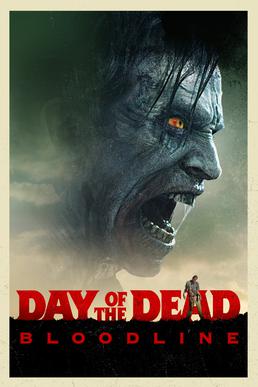
2018’s Day Of The Dead: Bloodline is technically a remake of George Romero’s Day of the Dead but, then again, almost every American zombie film that’s come out over the past twenty or so years has been a remake of something that Romero did earlier.  The whole idea of an isolated military compound where soldiers plot to kill zombies (or rotters, as they’re called here) while scientists try to understand and maybe cure them has been done to death.  Once again, we’ve got a fascist army guy (Jeff Gum) and, once again, we’ve got a dedicated scientist who doesn’t like taking orders from the military.  The scientist is named Zoe (Sophie Skelton).  She was a medical student when the zombie apocalypse began.  Now, five years later, she’s trying to find a way to end it and blah blah blah, wake me when it’s over.

A good deal of the film centers around Max (Jonathon Schaech).  In life, Max was a pervy stalker who was so obsessed with Zoe that he craved her name into his arm.  In death, he’s a rotter who has retained some of his personality and bits of memory.  For instance, he’s still obsessed with Zoe and spends a lot of time saying, “You are mine, you are mine….”  However, Max’s blood potentially holds the cure for the zombie plague.  And, to be honest, that’s kind of an interesting premise.  In life, Max was the worst that humanity had to offer.  In death, he might hold the secret for saving the world.  Even as a rotter, he remains obsessed with Zoe and Zoe has to decide whether or not to destroy the man who tried to rape her or to keep him functional for the good of the world.

But …. eh.  I mean, it’s intriguing but the film doesn’t really do much with it.  It just becomes another zombie movie with a bunch of hardass soldiers and some scientists who don’t understand why the soldiers keep shooting everything.  Who cares?  We’ve already seen all of this in a hundred other movies, not to mention on shows like The Walking Dead.  Neither the script nor the characters in this film are interesting enough to really justify seeing it again.
Horror Scenes I Love: The Dead Rise From The Ground In Poltergeist


This is from 1982’s Poltergeist.

I love Craig T. Nelson’s delivery of the headstones speech.  James Karen is staring at him the whole time like he’s thinking, “Is anyone going to say ‘cut?'”

International Horror Review: The Two Orphan Vampires (dir by Jean Rollin)


Louise (Alexandra Pic) and Henriette (Isabelle Teboul) are two orphaned sisters.  They’re both blind and, as the nuns at the orphanage explains to Dr. Dennary (Bernard Charnacé), innocent to the ways of the world.  When Dr. Dennary adopts them, everyone tells him that he’s made the right choice.  Never have there been two sisters as sweet and beatific as Louise and Henriette.

Of course, what neither the nuns nor Dr. Dennary know is that, when the sun goes down, Louise and Henriette’s vision returns.  They sneak out of Dennary’s home, exploring the nearby cemeteries and meeting other beings who can only move freely during the night.  The sisters tells each other stories of their past and we see memories that seem to suggest that they have been alive for centuries.  But, the sisters also often talk about how they can’t remember their past and it’s suggested that their “memories” are just stories that they’ve created to give themselves a history that they don’t otherwise possess.

At times, you wonder if they’re even sisters.  Perhaps they’re just two vampires who manged to find each other at some point over the past few centuries.  Still, you can never doubt the strength of their bond.  When one of them is weak from a lack of blood, the other allows her to drink from her neck.  When they find themselves being pursued by angry villagers, they refuse to be separated.  Even if it means dying, at least they’ll die together.

Throughout the film, the orphans eagerly await for night to fall so that they can see and sneak out of the house.  But, at the same time, they know that their time is limited.  When the sun rises, they will again lose their sight.  These vampires don’t need to sleep in coffins.  In fact, they don’t need to sleep at all.  But they need the night to see the world around them.

Unfortunately, Dr. Dennary may be kind-hearted but he’s still not happy about the idea of the two orphans sneaking out of his house during the night.  When the sisters go to drastic means to ensure their freedom, they find themselves in even greater danger….

First released in 1997, The Two Orphan Vampires is perhaps my favorite Jean Rollin film.  Rollin, himself, once described it was being one of his best films because it was a film that told a story that went beyond his own personal obsessions.  That may be true but this is definitely a Jean Rollin film.  It’s not just the use of the vampirism or the fact that frequent Rollin co-star Brigitte Lahaie has a cameo.  It’s that the film centers not just on the supernatural but also the way that our memories and our fantasies can provide comfort in an uncertain world, which was a favorite Rollin theme.  Whether their memories are true or not is not important.  What’s important is that the two sisters share them.

In typical Rollin fashion, the movie unfolds at its own deceptively leisurely pace.  The imagery is frequently dream-like, with the orphan vampires discovering an underworld of paranormal creatures.  The film also reflect Rollin’s love of the old serials, with frequent cliffhangers.  By the final third of the movie, you can already guess what’s going to end up happening to the two orphan vampires but I still had tears in my eyes by the time the end credits started to roll up the screen.

For whatever reason, Two Orphan Vampires seems to get a mixed reaction from several Rollin fans, who perhaps are disappointed that it’s considerably less bloody and/or sordid as some of Rollin’s other vampire films.  The film is one of Rollin’s more contemplative films and it has more in common with The Night of the Hunted and The Iron Rose than some of Rollin’s other vampire films.  That said, Two Orphan Vampires is my personal favorite of Rollin’s filmography.  It’s a film that bring me to tears every time that I watch it.


4 Shots From 4 Films: The Conjuring, Mama, We Are What We Are, World War Z


4 Shots From 4 Films is just what it says it is, 4 shots from 4 of our favorite films. As opposed to the reviews and recaps that we usually post, 4 Shots From 4 Films lets the visuals do the talking!

This October, we’re using 4 Shots From 4 Films to look at some of the best years that horror has to offer!

4 Shots From 4 2013 Horror Films

The Conjuring (2013, dir by James Wan)

Mama (2013, dir by Andres Muschietti)

We Are What We Are (2013, dir by Jim Mickle)

World War Z (2013, dir by Marc Foster)

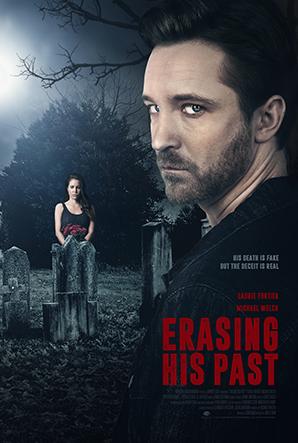
What Lisa Watched Last Night #202: Erasing His Dark Past (dir by Jared Cohn)


Last night, I turned over to the Lifetime Movie Channel and I watched Erasing His Dark Past.

Why Was I Watching It?

So, October isn’t even over yet and Lifetime has already decided that they’re going to start with the Christmas movies!  That’s right — the next two months are just going to be Christmas cheer on my favorite channel!  And listen, I love Christmas.  You know that about me.  I love any holiday that involves me getting presents!  But seriously, it’s too soon for the Christmas movies!

So, instead of watching a Christmas movie last night, I switched over the Lifetime Movie Network and I got caught up with Erasing His Dark Past.

(Don’t worry, everyone!  The holiday spirit will possess me soon and I’ll happily be watching every Christmas movie on Lifetime!)

What Was It About?

David (Michael Welch) has a dark past and he needs to erase it!  What better way to do that than to disappear after a plane crash?

Everyone thinks that David is dead but his wife, Karen (Lauren Fortier), has her doubts.  Those doubts turn out to be justified when she discovers that David had all sorts of weird financial stuff going on.  By vanishing (or dying or whatever he did), he’s basically left Karen broke and in a lot of trouble.  Was David just bad with money or was it all a part of his criminal scheme?

And could it be that David may have had a ….. second family!?

What Worked?

Micheal Welch did a good job as David, I thought.  He came across as being sinister enough to fake his own death and charismatic enough to pull it off.

Fans of the classic film To Kill A Mockingbird will want to keep an eye out for Scout herself, Mary Badham, playing a sympathetic bank employee.

What Did Not Work?

There have been several Lifetime films about husbands faking their own death and running off to their second family.  In fact, it’s become a bit of cliche that you should never trust a husband in a Lifetime film.  Unfortunately, as a result, there was really no shock in discovering that David wasn’t actually dead.  We knew it was going to happen as soon as he first appeared.  To a certain extent, their predictability is one of the things that make Lifetime films enjoyable but still, it was a little bit to easy to see the direction in which Erasing His Dark Past was heading.

“Oh my God!  Just like me!” Moments

This was one of those rare films where there really weren’t any “Oh my God!  Just like me!” moments.  I’ve never been married so I’ve never had to deal with a husband faking his own death and running off with all of my money.  I guess I should consider myself lucky in that regard.

Lessons Learned

If there’s no body, there’s no proof.

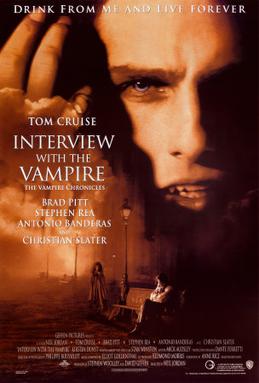
Horror Film Review: Interview With The Vampire (dir by Neil Jordan)


Oh, poor Claudia.

There are a lot of vampires and other cursed beings wandering through the 1994 film adaptation of Interview With A Vampire but Claudia (Kisten Dunst) is the only one for whom I have any sympathy.

Louis (Brad Pitt) may be the main character and the vampire giving the interview but it’s hard to have much sympathy for him.  He’s just such a whiny little bitch.  The Louisiana aristocrat is transformed into a vampire in 1791 and basically spends the next 200 years complaining about it.  You want to have sympathy for him but sometimes, you just have to accept stuff and move on.  It doesn’t help that Brad Pitt, who has always given his best performances when cast as men of action, is somewhat miscast as the effete and self-loathing Louis.

Lestat (Tom Cruise) may be the most charismatic of the vampires but he’s never exactly sympathetic.  He turns Louis into a vampire and then spends years following him across Louisiana and Europe.  Lestat is decadence personified and he never whines and, as a result, he’s far more enjoyable to spend time with than Louis.  Cruise is as perfectly cast as Lestat as Pitt was miscat as Louis.  Lestat is a star and Tom Cruise has always been one of the few true movie stars around.  That said, Lestat is still far too self-indulgent and thoughtlessly self-destructive to really be a sympathetic character.  Instead, he’s like Lord Byron, destroying happy families but at least writing a poem about it afterwards.

Armand (Antonio Banderas) runs the Théâtre des Vampires in Paris and he becomes Louis’s companion for a time.  Louis is charismatic because he’s played by Antonio Banderas but, ultimately, he proves to be a rather ineffectual leader.  Armand puts on a good show but, in the end, that’s all he has to offer.  He’s a bit shallow, despite all of the theatrics.

Santiago (Stephen Rea) isn’t sympathetic at all but at least he really seems to get into being evil.  Good for him!

And then there’s Daniel Malloy (Christian Slater), the journalist who conducts the interview with Louis.  In the film, Malloy starts out as a cynic, the type of writer who theatrically pours himself a glass of whiskey before dramatically turning to his typewriter.  All he needs is a fedora with a press pass tucked into the headband.  It’s difficult to take him seriously.

But then there’s Claudia.  Poor Claudia.  In the book, Claudia was only five years old when she was turned into a vampire.  In the movie, she’s played by 12 year-old Kirsten Dunst and it’s left ambiguous as to how young Claudia actually was when Lestat turned her into a vampire, though it’s still made clear that was too young to be cursed without her consent.  Claudia becomes Lestat and Louis’s companion.  Louis treats her like the daughter that he will never have.  Lestart treats her like an apprentice, teaching her how to kill.  Claudia grows up but is forever trapped in the body of a child.  It’s impossible not to feel sorry for Claudia, who never asked to become a vampire, who indeed was just turned so that Lestat could use her as a pawn to keep control of Louis.  Claudia spends a good deal of the movie in a rage and who can blame her?

Interview With A Vampire is a messy and uneven film.  Brad Pitt is miscast and the whole film is oddly paced, with the New Orleans scenes taking too long and the Paris scenes going by almost too quickly.  At the same time, Tom Cruise brings the proper joie de mort to the role of Lestat and Claudia and her fate will simply break your heart.  Interview With The Vampire is not the best vampire movie that I’ve ever seen but it definitely has its pleasures.

Horror on the Lens: The Failing of Raymond (dir by Boris Sagal)


Raymond (Dean Stockwell) has just escaped from a mental hospital and he has only one thing on his mind.  Raymond wants revenge.  Having looked over the past events of his life, Raymond has figured out that things started to go downhill for him when he failed a test in high school.  He blames his failure on his old teacher, Mary Bloomquist (Jane Wyman).

At the same time that Raymond is escaping, Mary is planning her retirement.  She’s decided that she no longer wants to teach.  The job just doesn’t seem worth it anymore.  But Raymond has other ideas.  Raymond wants her to give him the same test that he failed ten years before.  And this time, Raymond wants her to pass him or else.

The Failing of Raymond is a made-for-TV movie from 1971 and it features a good performance from Jane Wyman and a great one from Dean Stockwell.  The film ultimately hinges on one question.  Did Raymond really fail that test or did Mary fail Raymond?

Enjoy!

The TSL’s Horror Grindhouse: Puppet Master (dir by David Schmoeller)


Since there’s been like 200 Puppet Master films made over the past 30 years — goddamn, 30 years of killer puppets! — I figured that maybe I should finally sit down and actually watch one of them.  I decided to go with the original film that started the entire franchise, 1989’s Puppet Master!

So, basically, this is a movie about little puppets that kill full-sized people.  Obviously, there’s a bit more to the plot but let’s be honest.  No one who watches this movie is going to be watching it for the specifics of the plot.  They’re going to be watching it because they want to see tiny puppets go on a rampage.  I have to say that the puppets themselves are pretty cute.  I mean, they’re murderous and a little bit pervy but they’re still really cute.  I understand that all of the puppets have their own specific names but, while watching the film, I just made up names of my own.

For instance, there’s Hooky, who has a hook for one hand and a knife for the other and looks like he should be the lead singer of an aging Prog Rock band.  And then there’s Drilly, who has a drill on his head.  He can be really dangerous, especially if you’re stupid enough to crawl around on the floor and just stay there, on all fours, while he’s running straight at you.  I mean, if you just stood up, you probably wouldn’t get that badly injured but …. well, what do I know, right?  And then there’s Leechy, who is a female puppet who spits up leeches.  What’s interesting is that she never runs out of leeches but I have to wonder, if you have that many leeches, why not just send them out on their own instead of stuffing them all into some poor little puppet?  I felt bad for Leechy.  She seemed kinda sad.  And then there’s Handy, who has big hands and Facey, who can assume several different facial expressions at once.  They’re all really adorable, to be honest.

Anyway, Puppet Master is about a bunch of psychics who all spend the night in a California hotel that was once home to the “last alchemist,” Andre Toulon (William Hickey).  Toulon had the power to bring inanimate creatures — like puppets! — too life but, when the Nazi spies were closes in on him, Toulon killed himself.  Many years later, a psychic named Neil Gallagher (Jimmie F. Skaggs) discovered Toulon’s hiding place in the hotel but then shot himself as well.  So now, Neil’s former colleagues are all trying to get Toulon’s power for themselves.  Or something.  As I said, following the plot is not always easy.  The main appeal here is watching the cute puppets do really bad things.

That said, who knew that a group of psychics and witches would prove to be so stupid?  I mean, you would think that — when all of you are having constant premonitions of death and destruction — you would be smart enough to take extra precautions or maybe just leave the hotel all together.  For instance, Dana (Irene Miracle) casts a protection spell over someone else but not on herself.  Meanwhile, Frank (Matt Roe) and Clarissa (Kathryn O’Reilly) make the rookie mistake of having sex in a horror film while our nominal hero, Alex (Paul Le Mat, looking like he’s trying to figure out how he went from American Graffiti to this), wanders around in a daze.

And yet, watching the film, I could see why it became so popular.  The puppets are memorable and well-designed and the backstory, with Toulon and all the rest, is actually pretty interesting.  Puppet Master is one of those films that defines “stupid but fun.”  No wonder the puppets came back!

Scenes That I Love: In Heaven, Everything Is Fine From Eraserhead


From David Lynch’s 1977 film, Eraserhead.

Just a reminder that, “In Heaven, everything is fine.”

And Heaven is apparently behind your radiator.

“But Lisa, what is the scene about?”

Well, according to Lynch, the whole movie is “a dream of dark and disturbing things.”  Is that woman really living behind Jack Nance’s radiator and singing that everything is fine, despite the fact that there’s also a mutant baby in the apartment?  She may be.  Or she might just be a figment of someone’s imagination.

Perhaps it’s best not to worry too much about the how’s and the why’s.

Never stop dreaming.

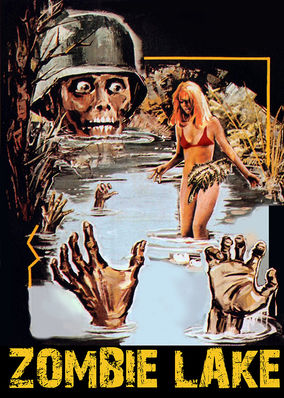
International Horror Film Review: Zombie Lake (dir by “J.A. Lazer”)


Oh, Zombie Lake!

I approach this 1981 Spanish-French film with some trepidation because, while it’s undeniably one of the best known of Eurocine’s low-budget horror films, it was also directed by one of my favorite directors and, by most accounts, it was not an experience that he particularly enjoyed being asked about.  He did not care for this film and (spoiler alert) his name was not J.A. Lazer.

In fact, for several years, it was assumed that this film was actually directed by Jess Franco.  And while it’s true that Franco was originally hired to direct Zombie Lake, he left the project because he said the budget was too low to execute his vision.  Consider that.  A budget too low for Jess Franco!  Franco left the project and went on to direct Oasis of the Zombies.  Apparently, the film’s producers did not understand that Franco had actually left the project because, on the first day of shooting, they were shocked to discover that they didn’t have a director.  In a panic, they called another fiercely independent horror director and asked him to come direct the film.  Jean Rollin agreed.

By his own account, Rollin only had a few days to prepare for shooting and since he had already made a classic zombie film called The Grapes of Death, he didn’t worry too much about trying to do anything too spectacular with Zombie Lake.  He simply filmed whatever scenes were required for the day, played the minor role of doomed police inspector, and, six days later, Zombie Lake had been filmed.

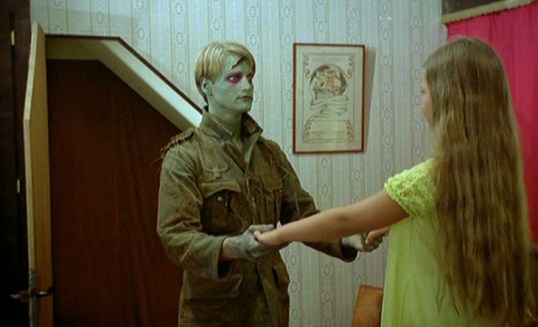
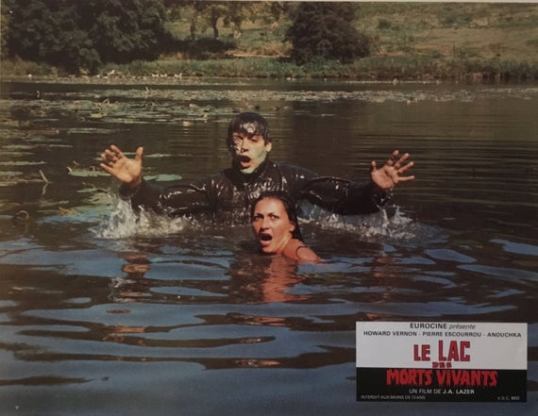
As for the film itself, it takes place in a French village that appears to be exclusively populated by cranky old men and naked young women.  There’s a lake nearby.  Despite seeing (and tossing aside) a big sign with a skull and crossbones on it, one of the naked women decides to go for a swim.  This apparently awakens the green Nazi zombies who lives at the bottom of the lake.  Soon, the zombies are randomly emerging from the lake and killing villagers.  The town’s mayor (Howard Vernon, of all people) is concerned.

It all links back to World War II, when the members of the French Resistance (led by the mayor) gunned down a squad of Nazis and dumped their bodies in the lake.  Somehow, this led to the Nazis coming back as zombies.  One of the Nazis had a daughter with a French woman shortly before he was killed.  Despite the fact that he was killed in 1943 and the movie clearly takes place in 1980, his daughter is only 12 years old.  That’s the type of film that Zombie Lake is.

Watching the film, you can tell why Rollin wasn’t particularly interested in claiming any credit for it.  It’s a messy film, largely because the green zombie makeup keeps washing off whenever the zombies have to emerge from the waters of the lake.  As for the lake itself, the underwater scenes were clearly shot in a swimming pool.  Beyond that, there’s not really any logic as to why the zombies keep emerging from the lake.  Whenever it’s plot convenient, the zombies suddenly emerge and attack anyone who has recently undressed.

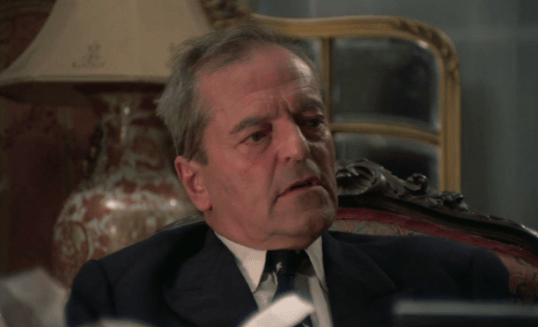
Howard Vernon in Zombie Lake

And yet, there are some good things about Zombie Lake.  (Shut up, there are too!)  For instance, it’s kind of charming how each actor cast as a zombie brings their own interpretation to the role.  Some of them walk slowly with their arms outstretched.  Others move a little bit stiffly with a thousand yard stare.  Some of them just casually stroll around, doing their business.  As well, we’re so used to assuming that any character played by Howard Vernon is going to be decadent and sleazy that it’s kind of fun to see him playing an outright hero here.  Finally, even the frequent nudity is so gratuitous that it actually become rather humorous.  One could easily use Zombie Lake to play a drinking game.  Whenever anyone takes off their top, drink!

Finally, even though this was clearly just a film he did for the money, there are a few instances where Rollin’s signature style manage to peak through.  For instance, when we first see the Mayor’s office, the camera lingers on all of the historical artifacts on the wall.  The fact that one of the zombies has cloudy memories of his former lover and only wants to see his daughter actually works a lot better than you might expect, largely because that seems to be the only storyline that Rollin — with his fascination with memory and history — seems to really care about.

Zombie Lake is a mess and certainly not representative of Rollin’s best (or more personal) films.  But I still kind of like it.