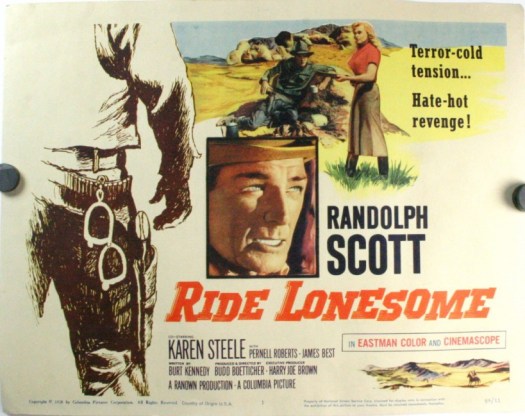
Randolph Scott and director Budd Boetticher teamed again for RIDE LONESOME, their sixth of seven Westerns and fourth with writer Burt Kennedy. Scott’s a hard case bounty hunter bringing in a killer, joined in his trek by an old “acquaintance” with an agenda of his own. Everyone’s playing things close to the vest here, and the stark naked desert of Lone Pine’s Alabama Hills, with its vast emptiness, plays as big a part as the fine acting ensemble.
Ben Brigade (Scott) has captured the murderous Billy John and intends to bring him to justice in Santa Cruz. Coming to a waystation, he finds Sam Boone and his lanky young companion Whit, known outlaws who’ve heard the territorial governor is granting amnesty to whoever brings in Billy. Also at the station is Mrs. Crane, whose husband has been murdered by marauding Mescaleros. Sam’s interested in forming a partnership and taking Billy…
During a torrential rainstorm on a dark, bone-chillingly cold night, a band of men guarding a cache of gold are all murdered by a masked outlaw gang. The marauders then enter the home of the leader, a married man with a family. He is the first to die, and after his wife and young daughter are brutally raped, they too are killed. But the marauders haven’t seen the little boy hiding in the shadows, witnessing his family’s violent demise. The house is burned to the ground, but the boy lives, storing the memory of the men who destroyed his family, until fifteen years pass, and the boy has become a man with an unquenchable thirst for revenge…
This dark, disturbing scene sets the stage for DEATH RIDES A HORSE, a gem of a Spaghetti Western directed with style by Giulio Petroni, made in 1967 but not released stateside until 1969…
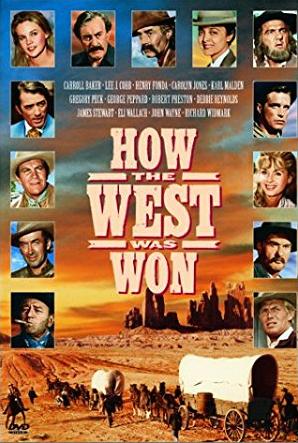
(With the Oscars scheduled to be awarded on March 4th, I have decided to review at least one Oscar-nominated film a day. These films could be nominees or they could be winners. They could be from this year’s Oscars or they could be a previous year’s nominee! We’ll see how things play out. Today, I take a look at the 1963 best picture nominee, How The West Was Won!)
How was the west won?
According to this film, the west was won by the brave men and women who set out in search of a better life. Some of them were mountain men. Some of them worked for the railroads. Some of them rode in wagons. Some of them gambled. Some of them sang songs. Some shot guns. Some died in the Civil War. The thing they all had in common was that they won the west and everyone had a familiar face. How The West Was Won is the history of the west, told through the eyes of a collection of character actors and aging stars from Hollywood’s Golden Age.
In many ways, How The West Was Won was the Avatar of the early 60s. It was a big, long, epic film that was designed to make viewers feel as if they were in the middle of the action. Avatar used 3D while How The West Was Won used Cinerama. Each scene was shot with three synchronized cameras and, when the film was projected onto a curved Cinerama screen, it was meant to create a truly immersive experience. The film is full of tracking shots and, while watching it on TCM last night, I tried to imagine what it must have been like to see it in 1963 and to feel as if I was plunging straight into the world of the old west. The film’s visuals were undoubtedly diminished by being viewed on a flat screen and yet, there were still a few breath-taking shots of the western landscape.
The other thing that How The West Was Won had in common with Avatarwas a predictable storyline and some truly unfortunate dialogue. I can understand why How The West Was Won was awarded two technical Oscars (for editing and sound) but, somehow, it also picked up the award for Best Writing, Screenplay or Story. How The West Was Won is made up of five different parts, each one of which feels like a condensed version of a typical western B-movie. There’s the mountain man helping the settlers get down the river story. There’s the Civil War story. There’s the railroad story and the outlaw story and, of course, the gold rush story. None of it’s particularly original and the film is so poorly paced that some sections of the film feel rushed while others seem to go on forever.
Some of the film’s uneven consistency was undoubtedly due to the fact that it was directed by four different directors. Henry Hathaway handled three sections while John Ford took care of the Civil War, George Marshall deal with the coming of the railroad, and an uncredited Richard Thorpe apparently shot a bunch of minor connecting scenes.
And yet, it’s hard not to like How The West Was Won. Like a lot of the epic Hollywood films of the late 50s and early 60s, it has its own goofy charm. The film is just so eager to please and remind the audience that they’re watching a story that could only be told on the big screen. Every minute of the film feels like a raised middle finger to the threat of television. “You’re not going to see this on your little idiot box!” the film seems to shout at every moment. “Think you’re going to get Cinerama on NBC!? THINK AGAIN!”
Then there’s the huge cast. As opposed to Avatar, the cast of How The West Was Won is actually fun to watch. Admittedly, a lot of them are either miscast or appear to simply be taking advantage of a quick payday but still, it’s interesting to see just how many iconic actors wander through this film.
For instance, the film starts and, within minutes, you’re like, “Hey! That’s Jimmy Stewart playing a mountain man who is only supposed to be in his 20s!”
There’s Debbie Reynolds as a showgirl who inherits a gold claim!
Is that Gregory Peck as a cynical gambler? And there’s Henry Fonda as a world-weary buffalo hunter! And Richard Widmark as a tyrannical railroad employee and Lee J. Cobb as a town marshal and Eli Wallach as an outlaw!
See that stern-faced settler over there? It’s Karl Malden!
What’s that? The Civil War’s broken out? Don’t worry, General John Wayne is here to save the day. And there’s George Peppard fighting for the Union and Russ Tamblyn fighting for the Confederacy! And there’s Agnes Moorehead and Thelma Ritter and Robert Preston and … wait a minute? Is that Spencer Tracy providing narration?
When Eli Wallach’s gang shows up, keep an eye out for a 36 year-old Harry Dean Stanton. And, earlier, when Walter Brennan’s family of river pirates menaces Karl Malden, be sure to look for an evil-looking pirate who, for about twenty seconds, stares straight at the camera. When you see him, be sure to say, “Hey, it’s Lee Van Cleef!”
How The West Was Won is a big, long, thoroughly silly movie but, if you’re a fan of classic film stars, it’s worth watching. It was a huge box office success and picked up 8 Oscar nominations. It lost best picture to Tom Jones.
(By the way, in my ideal fantasy world, From Russia With Love secured a 1963 U.S. release, as opposed to having to wait until 1964, and became the first spy thriller to win the Oscar for Best Picture.)
(I am currently in the process of cleaning out my DVR! I recorded the 1952 best picture nominee, High Noon, off of Retroplex on January 28th. This review is scheduled to posted at 12 noon, central time. Clever, no?)
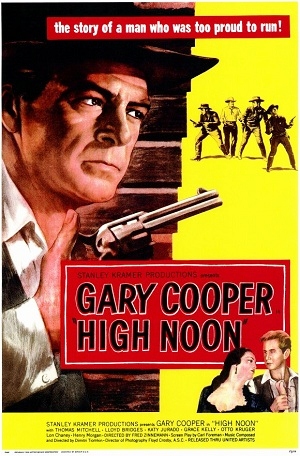
High Noon is a testament to the power of simplicity.
It’s a famous film, one that continues to be influential and which is still studied today. It’s known for being one of the greatest westerns ever made but it’s also a powerful political allegory. Even people who haven’t seen the film know that High Noon is the moment of the day when someone shows their true character. Just as everyone knows the plot of Star Wars, regardless of whether they’ve actually watched the film, everyone knows that High Noon is about a town marshal who, after the entire town deserts him, is forced to face down a gang of gunmen on his own.
And yet, it really is a surprisingly simple movie. It’s the quintessential western, filmed in black-and-white and taking place in the type of frontier town that you would expect to find hiding on the back lot of an old movie studio. Though wonderfully brought to life by a talented cast, the majority of the characters are familiar western archetypes.
There’s the aging town marshal, a simple man of integrity. Gary Cooper won an Oscar for playing the role of Will Kane. When we first see Will, he’s getting married in a frontier courtroom. All of the town leaders have come to his wedding and all of them wish him luck in the future. Will is retiring and everyone agrees that the town would never have survived and prospered if not for Will Kane. After all, Will is the one who captured the notorious outlaw, Frank Miller. When the news comes that Miller has been pardoned and will be arriving back in town on the noon train, everyone tells Will that he should just leave town and go on his honeymoon. However, the new marshal will not be arriving for another day and Will is not willing to abandon the town. However, the town is more than willing to abandon him.
Will’s new wife is Amy Fowler (Grace Kelly). Amy is a Quaker and a pacifist. Amy begs Kane to leave town but Kane says that he’s never run from a fight. Amy tells him that she’ll be leaving on that noon train, with or without him. Helen Ramirez (Katy Jurado) is the former girlfriend of both Kane and Miller. She is one of the few people in town to call out everyone else’s cowardice but she is still planning to leave before Miller arrives. As she explains it to Amy, she would never abandon Kane if he were her man but he’s not her man anymore.
The townspeople, who first appear to be so friendly and honest, soon prove themselves to be cowards. None of them are willing to stand behind Will. The Mayor (Thomas Mitchell) publicly castigates Will for staying in town and putting everyone else in danger. Deputy Harvey Pell (Lloyd Bridges) says that he’ll only help Will if Will recommends him as his replacement. The town minister (Morgan Farley) is more concerned with why Will was married by the justice of the peace, instead of in the church. The town judge (Otto Kruger) leaves early, saying he can be a judge in some other town. One of the few people to show Will any sympathy is the former marshal (Lon Chaney, Jr.) but, unfortunately, he is too old and crippled by arthritis to provide any help.
Though it all, Frank’s gang sits at the train station and waits for Frank to arrive. One gang member is played be Lee Van Cleef. He looks really mean!
With a brisk running time of 84 minutes, High Noon unfolds in real time. Throughout the film, as Kane grows increasingly desperate in his attempt to find anyone brave enough to stand with him, we see clocks in the background of nearly every scene. We hear the ticking. We know that both noon and Frank Miller are getting closer and closer. We know that, soon, Will will have no other option but to stand on the street by himself and defend a town that doesn’t deserve him.
It’s simple but it’s undeniably powerful.
It’s been said that High Noon was meant to be a metaphor for the blacklist. Frank Miller and his gang were the fascists that, having been defeated in World War II, were now coming back to power. Will Kane was a stand-in for all the men and women of integrity who found themselves blacklisted. The townspeople represented the studio execs who refused to challenge the blacklist. That’s the theory and it’s probably true. But, honestly, the political metaphor of High Noon works because it can be applied to any situation. Will Kane is anyone who has ever had to face down the forces of totalitarianism. He is anyone who has ever had the courage to take a lonely stand while everyone else cowered in the corner.
It’s a powerful metaphor and it’s also a genuinely entertaining movie. The gunfight is thrilling. The romance between Will and Amy feels real. Even the town feels like an actual place, one that has its own history and culture. It’s a simple film but it’s a great film.
Like a lot of great films, High Noon was nominated for best picture. And, like a lot of great films, it lost. In High Noon‘s case, it lost to a film that is almost its exact opposite, The Greatest Show on Earth. However, Gary Cooper did win an Oscar for his unforgettable performance as Will Kane.
I think we tend to take classic films for granted. Don’t do that with High Noon. See it the next chance you get.
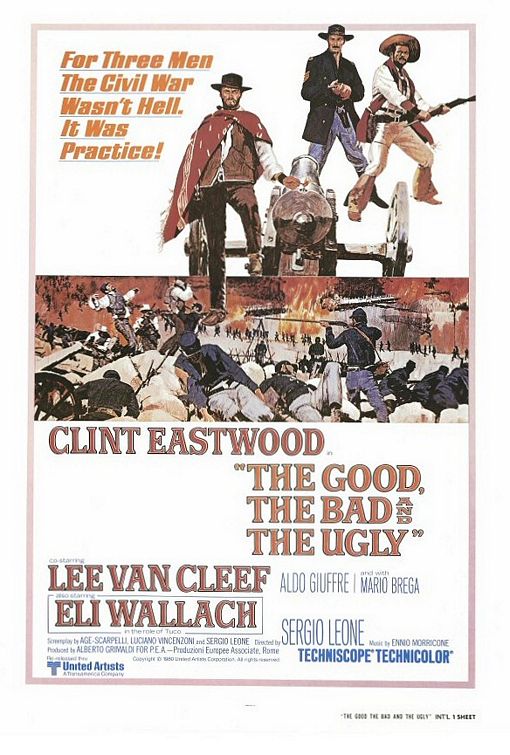
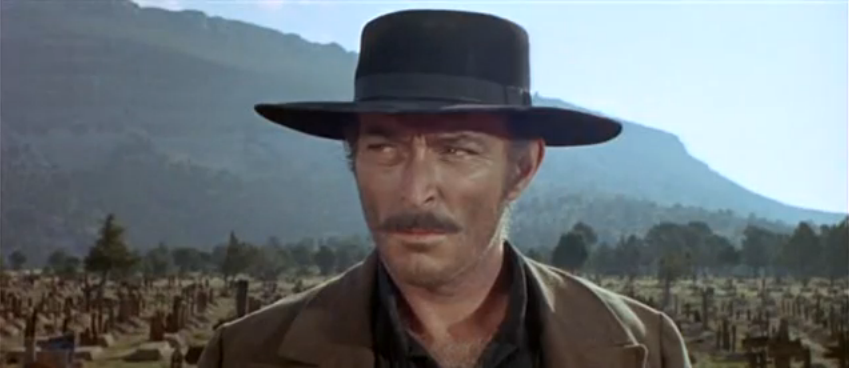
THE GOOD, THE BAD, AND THE UGLY is the GONE WITH THE WIND of Spaghetti Westerns, Sergio Leone’s masterpiece, and definitely in my Top 5 Favorite Films. After turning the genre upside down with A FISTFUL OF DOLLARS and inside out with FOR A FEW DOLLARS MORE, Leone’s final entry in his triptych of films starring Clint Eastwood as The Man With No Name is an ambitious epic about greed, revenge, and the futility of war, told with a warped sense of humor and plenty of action. Besides Eastwood and FEW DOLLARS co-star Lee Van Cleef, Eli Wallach joins the cast in a performance that should have won the Oscar.
We’re first introduced to Angel Eyes (Van Cleef), who’s one mean mutha. Sent to find information on the location of stolen Confederate gold, he kills his informant, then kills the man who hired him, and begins his search for “Bill Carson”. Meanwhile…
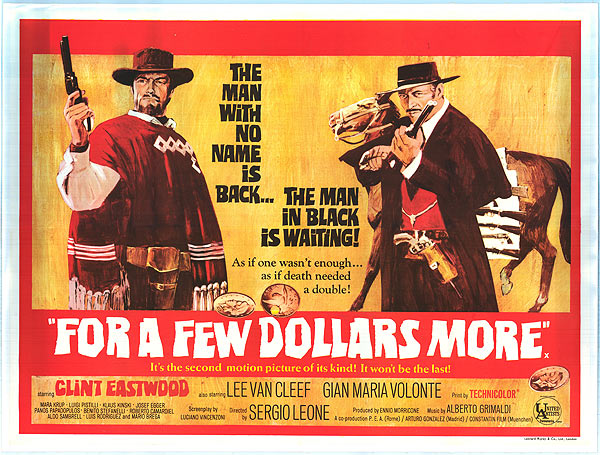
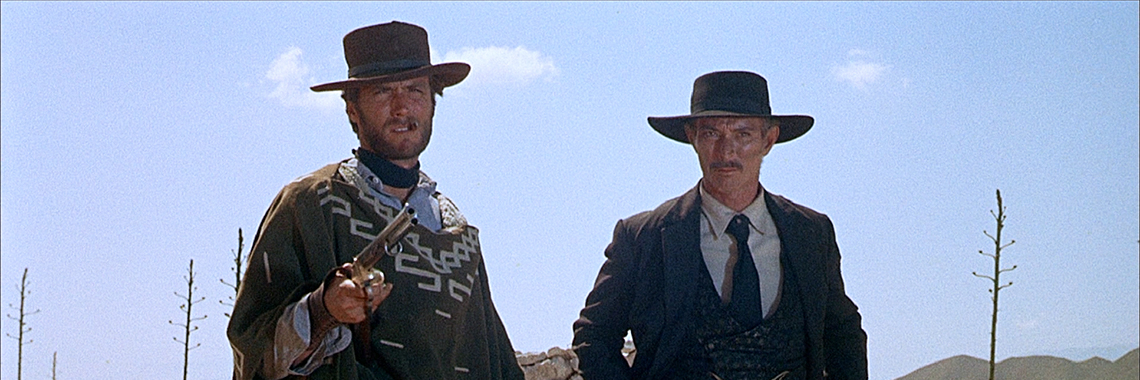
After the huge international success of his A FISTFUL OF DOLLARS , Sergio Leone was red hot. Another Spaghetti Western was hastily written by Leone and Luciano Vincenzoni (and an uncredited assist from Sergio Donati), but FOR A FEW DOLLARS MORE is pure Leone, from the visual style to the bits of humor interspersed between the violence. Clint Eastwood returned as The Man With No Name, paired this time with veteran Western heavy Lee Van Cleef as the beady-eyed Colonel Mortimer.
Eastwood’s character (briefly referred to as ‘Manco”) is a fast-drawing bounty hunter. He’s interested in the $10,000 reward for escaped killer/outlaw Indio. Mortimer is also interested in Indio, but has another motive: a young Indio raped his sister, resulting in her suicide during the act. The two meet up in El Paso, where Indio plans to rob the bank’s estimated one million dollars, kept in a secret cabinet. Manco and Mortimer engage in pissing contest…
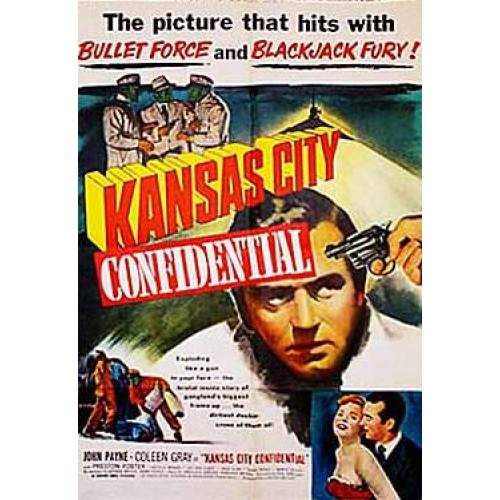
My friend Rob suggested I review KANSAS CITY CONFIDENTIAL awhile back, and I’m sorry I waited so long. This is a film noir lover’s delight, packed with tension, violence, double-crosses, and a head-turning performance by John Payne in the lead. Made on an economical budget like the same year’s THE NARROW MARGIN , director Phil Karlson and George Diskant create a shadowy, claustrophobic atmosphere brimming with danger at every turn.
I knew Payne mainly from his 40’s musicals and his idealistic lawyer opposite Maureen O’Hara in MIRACLE ON 34TH STREET, but he’s a revelation here as Joe Rolfe, a florist truck driver who’s set up as a patsy by a gang of armored car robbers. He can dish out (and take) beatings with the best them, and delivers the tough-talking dialog with aplomb. KANSAS CITY CONFIDENTIAL helped Payne shed his lightweight image, and he went on to do other dark crime films and rugged…
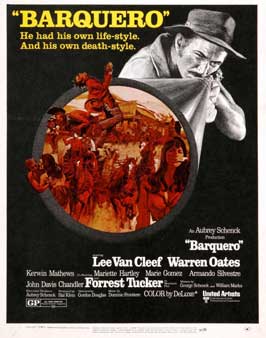
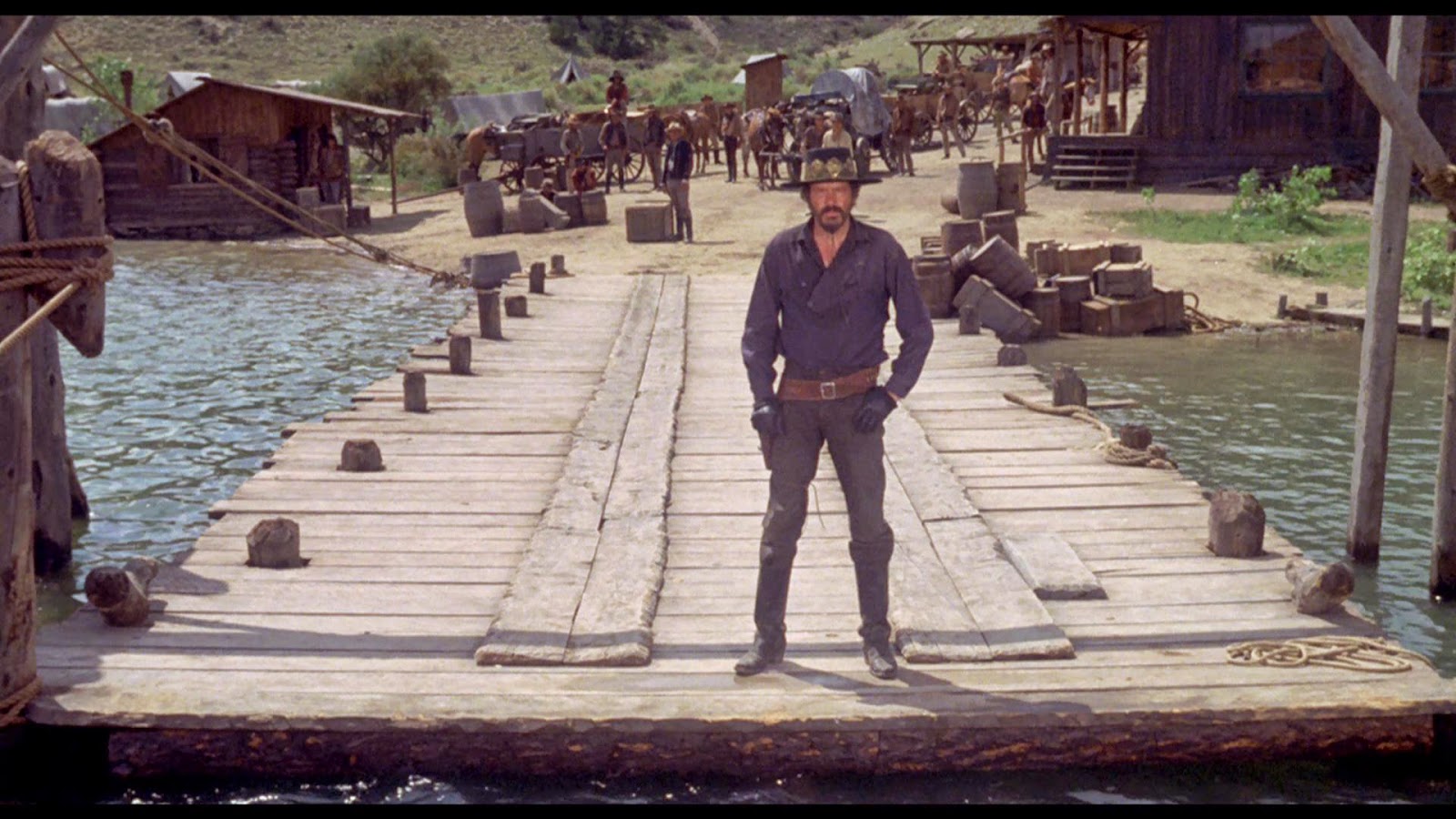
Travis (Lee Van Cleef) is a former gunslinger who now makes his living taking settlers across a river on his small barge. When we first meet him, he is telling a child to shut up and stop bothering him while he is guiding the barge. He depends on the settlers on the other side of the river for his livelihood and they depend on him for transportation but he doesn’t like them and they don’t like him. Travis only cares about two people, his Mexican lover, Nola (Maria Gomez) and an eccentric hunter named Mountain Phil (Forrest Tucker).
After stealing a shipment of silver, outlaw Jake Remy (Warren Oates) and his army of mercenaries need to cross the river to escape into Mexico. To prevent anyone from following, they plan to destroy the barge afterward. However, Travis and Phil find out that Remy is on the way and take the barge to the other side of the river. When Jake and his gang arrive, a tense stand-off ensues, with the outlaws on one side of the river and Travis and the settlers trapped on the other.
Though Barquero was directed by the veteran American director Gordon Douglas (Douglas’s best known film is the 1950s giant ant film, Them!), it was heavily influenced by contemporary Spaghetti Westerns and Sam Peckinpah’s The Wild Bunch. This can be seen in both its graphic violence and in the casting of Lee Van Cleef and Warren Oates in the leading roles.
Travis was a perfect role for Van Cleef, a talented actor who was ignored by Hollywood until he found fame playing ruthless villains in European westerns. Surly and unsmiling, Travis may seem like an unlikely hero but, like many of the best Spaghetti westerns, there are no traditional good guys in Barquero. Travis is more interested in saving his boat than protecting the settlers. He is a hero of circumstance.
As Jake, Warren Oates is a great villain. In his very first scene, he and a prostitute watch as his gang massacre the citizens of a small town. When the prostitute asks if she can come with them, Jake calmly replies, “I don’t think so” and shoots her dead. Stuck on his side of the river, Jake smokes the local weed and starts to have violent hallucinations. Soon, he is shooting bullets into the river.
Also doing good work are Forest Tucker as Mountain Phil and Kerwin Mathews. Mathews, who is best remembered for starring in The 7th Voyage of Sinbad, plays the Marquette, a disgraced French nobleman who has started a second life as Jake Remy’s right-hand man.
Barquero starts with a bang but it struggles to keep up the momentum over its entire running time. The opening shoot out is exciting but things slow down almost too much during the stand-off at the river. It is an interesting but flawed western that deserves to be better known than it is and worth watching to see Lee Van Cleef and Warren Oates at their best.
“When the legend become fact, print the legend.” — Maxwell Scott (Carleton Young) in The Man Who Shot Liberty Valance (1962)
Though I understand and respect their importance in the history of both American and Italian cinema, I have never really been a huge fan of westerns. Maybe its all the testosterone (“A man’s got to do what a man’s got to do…”) or maybe it’s all the dust but westerns have just never really been my thing.
However, I will always make an exception for The Man Who Shot Liberty Valance, which is not just a great western but a great film period.
But you already knew that. It’s a little bit intimidating to review a film that everyone already knows is great. I even opened this review with the exact same quote that everyone uses to open their reviews of The Man Who Shot Liberty Valance. To a certain extent, I feel like I should have found a quote that everyone hasn’t already heard a thousand times but then again, it’s a great quote from a great film and sometimes, there’s nothing wrong with agreeing with the critical consensus.
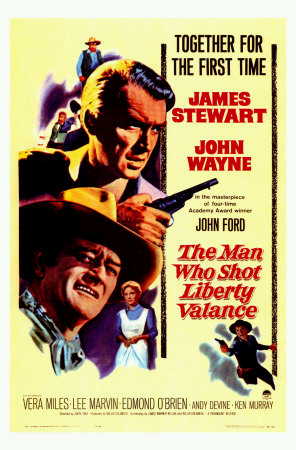
The Man Who Shot Liberty Valance opens with a train stopping in the small western town of Shinbone. The residents of the town — including newspaper editor Maxwell Scott (Carleton Young) — are shocked when Sen. Rance Stoddard (James Stewart) and his wife Hallie (Vera Miles) get off the train. Sen. Stoddard is considered to be a front-runner to become the next Vice President of the United States. Scott is even more shocked to discover why the Stoddards are in town. They’ve come to Shinbone to attend the funeral of an obscure rancher named Tom Doniphon (played, in flashback, by John Wayne).
Sitting in the funeral home with Doniphon’s coffin (and having reprimanded the local mortician for attempting to steal Tom’s boots), Rance tells Scott why he’s come to pay respect to Tom Doniphon. We see, in flashback, how Rance first came to Shinbone 25 years ago, an idealistic lawyer who — unlike most of the men in the west — refused to carry a gun. We see how Rance was robbed and assaulted by local outlaw Liberty Valance (a wonderfully intimidating and bullying Lee Marvin), we discover how Rance first met Hallie while working as a dishwasher and how he eventually taught her how to read, and we also see how he first met Tom Doniphon, the only man in town strong enough to intimidate Liberty Valance.
At first, Rance and Doniphon had an uneasy friendship, epitomized by the condescending way Doniphon would call Rance “pilgrim.” Doniphon was in love with Hallie and, when he attempted to teach Rance how to defend himself, he was largely did so for Hallie. Rance, meanwhile, was determined to bring law and society to the west.
And, eventually, Rance did just that. When Shinbone elected two delegates to the statehood convention in the territory’s capitol, Rance attempted to nominate Doniphon for the position but Doniphon refused it and nominated Rance instead, explaining that Rance understood “the law.” When Liberty Valance attempted to claim the other delegate spot, Rance and Doniphon worked together to make sure that it instead went to newspaper editor Dutton Peabody (Edmond O’Brien). And when Liberty Valance attempted to gun Rance down in the street, Rance shot him.
Or did he?
That’s the question that’s at the heart of The Man Who Shot Liberty Valance. However, as a film, The Man Who Shot Liberty Valance is far less interested in gunfights than it is in politics. Perhaps the most important scene in the film is not when Rance and Liberty meet out on that dark street. Instead, it’s the scene at the statehood convention where the reformers (represented by Rance) and the cattlemen (represented by John Carradine) battle over who will be the territory’s delegate to Washington. Between John Carradine orating, the horses riding in and out of the hall, Edmond O’Brien drinking, James Stewart looking humble, and John Wayne glowering in the background, this is one of the best political scenes ever put on film.
When Rance first arrives in the west, there is no political system in place. With the exception of the ineffectual town marshal (Andy Devine), there is no law. The peace is kept by men like Tom Doniphon and, oddly enough, by Liberty Valance as well. (Whether he realizes it or not, Shinbone’s fear of Liberty has caused the town to form into a community.) What little official law there is doesn’t matter because the majority of the Shinbone’s citizens can’t read.
When Rance arrives, he brings both education and the law. He makes Shinbone into a town that no longer needs Liberty Valance but, at the same time, it no longer need Tom Doniphon either. Hence, it’s Rance Stoddard who goes from dishwasher to U.S. Senator while Tom Doniphon dies forgotten. Rance represents progress and unfortunately, progress often means losing the good along with the bad things of the past.
(It’s no coincidence that when Rance and Hallie return to Shinbone, the first person that they see is the former town marshal, who no longer wears a star and who, we’re told, hasn’t for years. Time has passed by.)
It’s a bittersweet and beautiful film, one that features four great performances from Stewart, Wayne, Marvin, and Vera Miles. Personally, I like to think that maybe Sen. Stoddard had a daughter who married a man named Smith and maybe they had a son named Jefferson who later made his way to the Senate as well.
For today’s horror on the lens, we present a film from the legendary Roger Corman. First released in 1956, It Conquered The World tells the tragic story of what happens when it … well, conquers the world. It, by the way, is one of the most iconic of the 1950 sci-fi monsters. It is kind of a crab-like thing but … well, just watch the film. It’s kind of hard to describe.
The film also features future spaghetti western star Lee Van Cleef as the human scientist who foolishly helps It conquer the world. Van Cleef’s wife is played by one of the greatest B-movie actresses of all time, Beverly Garland. Hoping to thwart It is Peter Graves who spends the majority of the film riding around on a bicycle. Also keep an eye out for Dick Miller and Jonathan Haze, who both play soldiers here and who would later co-star in tomorrow’s horror on the lens.



 Through the Shattered Lens