I review COOGAN’S BLUFF (1968) – starring Clint Eastwood!


Here at The Shattered Lens, we’re looking forward to celebrating the birthday of Clint Eastwood on May 31st. In anticipation, I decided to revisit COOGAN’S BLUFF (1968). 

Clint Eastwood is Coogan, a tough as nails deputy sheriff from Arizona, who’s ordered by his boss, Sheriff McCrea (Tom Tully) to go to New York City and bring back the escaped killer James Ringerman (Don Stroud). When he gets to New York, he’s informed by Lieutenant McElroy (Lee J. Cobb) that Ringerman has overdosed on LSD while in the state’s custody, he’s now in the Bellevue Hospital, and he will not be released to Coogan until the state Supreme Court says so. Stuck in the Big Apple with nothing to do but flirt with probation officer Julie Roth (Susan Clark), Coogan decides to take matters into his own hands and get Ringerman out of the hospital early. He bluffs the attendants at the hospital into turning Ringerman over to him so he can catch the first plane back to Arizona. It seems like a good plan until he’s ambushed by Ringerman’s girlfriend Linny (Tisha Sterling) and his friend Pushie (David Doyle), he gets conked on the head, and he loses both his gun and his prisoner. Now, in trouble with Lieutenant McElroy and Sheriff McCrea, Coogan is ordered back home to Arizona. Determined to get Ringerman at any cost, Coogan stays in the city and leaves a trail of broken hearts and bruised bodies on his way to capturing his man! 

Made in 1968 after Eastwood’s string of excellent spaghetti westerns with Sergio Leone, COOGAN’S BLUFF may be set in contemporary times, but Coogan still seems to be a product of the old west. A big part of the fun is watching him interact with the people of New York City, where everyone is trying to take advantage of him, whether it be the cab driver, the hotel clerk, or the hooker down the hall. When he finally gets to the police station, he sees a building that’s completely overrun with criminals and crazies. He soon finds that Lieutenant McElroy follows the law down to the letter, while he treats the law as more of a set of suggestions on his way to getting the bad guys. This leads to endless frustration and almost gets Coogan arrested multiple times throughout the film as he doesn’t want to deal with all the red tape. One thing that doesn’t change whether Coogan is in Arizona or New York is his success with the ladies. They all swoon and he more than willingly obliges. The only problem for his prospect of true love is the fact that getting his guy always comes first, and he’ll use that sex appeal to get whatever information he needs. One of the main action scenes in this film, the bar fight, is set up ironically when the woman he’s “using” turns the tables and instead sets him up to be pummeled. 

COOGAN’S BLUFF is Eastwood’s first film with director Don Siegel, with whom he’d make DIRTY HARRY a few years later. You can definitely see the genesis of Harry Callahan in Walt Coogan, a man who does whatever it takes to stop criminals, is quick with a whip, and usually pisses off his superiors along the way. In some ways, you could say that Walt Coogan set the mold for the hero of cop films for the next couple of decades! It also has that sense of humor that would be a mark of Eastwood’s cop films. This one includes a funny thread that runs throughout where every person he meets assumes he’s from Texas because he wears a cowboy hat, and he always corrects them that he’s from Arizona. I get this as I always make sure people know that I’m from Arkansas! 

Overall, I really enjoy COOGAN’S BLUFF due mainly to Clint Eastwood’s excellent performance in the lead role. It was a great start to his “post Leone” career and would influence action movie heroes from that point forward. 
Film Review: Exodus (dir by Otto Preminger)


First released in 1960 and based on a novel by Leon Uris, Otto Preminger’s Exodous is two films in one.

The first half of the film takes place in Cyprus in the days immediately following World War II.  A young war widow named Kitty (Eva Marie Saint) is sightseeing when she learns of the Karaolos Internment Camp, where the British are interning thousands of Jewish refugees who demand to be allowed to go to the land that will eventually become the State of Israel.  Kitty visits with General Sutherland (Ralph Richardson), who oversees the camp and who is rumored to secretly be Jewish because of his relatively benevolent attitude towards the internees.  Disgusted by the anti-Semitism displayed by many of the British officers (one of whom is played by Kennedy in-law Peter Lawford), Kitty volunteers at the camp and learns about the Holocaust from those who survived it.  She also meets Ari Ben Caanan (Paul Newman), a former officer in the British army.  Ari manages to get control of a cargo ship, one that is renamed Exodus.  Six hundred refugees stage a hunger strike, vowing that they will willingly starve to death rather than be returned to Europe.

The second part of Exodus takes place in what will become the modern State of Israel.  It follows Ari, Kitty, and several of the passengers of the Exodus as they adjust to life and continue to fight for a land of their own, despite the opposition of the British and much of the rest of the world.  Karen (Jill Haworth) is a young woman who searches for her father, a brilliant man who has been driven into a nearly catatonic state by the horrors of the Holocaust.  Dov Landau (Sal Mineo) is an explosives expert who survived Auschwitz as a Sonderkommando and who was repeatedly raped by the guards at the camp.  Dov joins the Irgun, a paramilitary organization that the British consider to be terrorists.  Leading the Irgun is Ari’s uncle, Akiva (David Opatoshu), and Dov soon finds himself being targeted by both the British and the Arabs who, despite the moderating efforts of men like Taha (John Derek, who would later direct Ghosts Can’t Do It), want to violently force the Jews out of the land.

Legend has it that, after a private screening on Exodus, comedian Mort Sahl turned to director Otto Preminger and said, “Otto, let my people go.”  And it’s true that Exodus is a very long film.  Preminger, who started out making film noirs like Laura, spent the latter part of his career making “important” epics and, like many Golden Age directors struggling to compete with television and the 60s counterculture, he tended to make long, star-studded films that dealt with current events and which pushed the envelope just enough to be controversial without actually being radical.  However, I would argue that the three-hour running time of Exodus is justified.  To understand why Ari, Dov, Karen, and the other passengers of the Exodus would rather risk their lives by staying in what will become the State of Israel, one has to understand both what they went through to get there and also the anti-Semitism that they faced even in post-World War II Europe.  If Exodus were made today, it would be a mini-series.  Since it was made in 1960, it was instead a 3-hour film with an intermission.

Exodus holds up relatively well, with the sprawling action anchored by the presence of a cast of familiar faces.  Paul Newman and Eva Marie Saint bring a good deal of movie star glamour to scenes that would have otherwise just been dry exposition.  The film’s heart truly belongs to Jill Haworth and Sal Mineo, both of whom bring two life characters who have very differing views of the world.  Karen remains an optimist, one who is convinced that people can live together.  Dov, fueled by his own guilt and anger, has no room for negotiations and compromises.  Mineo received his second and last Oscar nomination for his performance in Exodus, though he lost to Peter Ustinov’s showy turn in Spartacus.  Exodus itself was clearly made with a hope for Oscar glory.  While Exodus did pick up a handful of nominations, it was left out of the five movie Best Picture slate.  The Academy only had room for one historical epic and they went for John Wayne’s The Alamo.  The eventual winner was The Apartment, the best of the nominated films.  (Indeed, even if Exodus had taken the Alamo’s spot, The Apartment would still be the best of the nominees.)  The Oscars aside, Exodus remains a good example of the type of epic filmmaking that once defined the Hollywood studios.

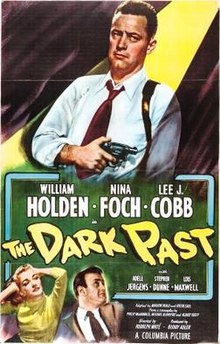
30 More Days of Noir #6: The Dark Past (dir by Rudolph Mate)


Now, this is an interesting little film noir!

This 1948 film stars William Holden, Lee J. Cobb, Nina Foch and Lois Maxwell.  William Holden is Al Walker, an escaped convict and a ruthless murderer.  Nina Foch is Betty, Walker’s devoted girlfriend and partner in crime.  Lee J. Cobb is Dr. Andrew Collins.  Lois Maxwell, years before she would be cast as Miss Moneypenny in the first Bond films, plays Ruth Collins, Andrew’s wife.  When Walker, Betty, and the gang break into the Collins home, they hold he doctor and his family hostage.

That may sound like a similar set-up to Desperate Hours and hundreds of other low-budget crime movies.  And, indeed, it is.  What sets The Dark Past apart from those other films is that Dr. Collins is a psychiatrist and his response is not to try to defeat or trick Walker but instead to understand him.  Even after Walker kills a friend of the family’s, Collins remains convinced that he can get to the heart of Walker’s anger and help the criminal start the process of reform.

When the nervous and violent Walker threatens the family, Collins calmly offers to teach him how to play chess.  When it looks like Collins might have a chance to escape, he instead stays in the house and continues to talk to Walker.  Eventually, he finds out about a recurring dream that Walker has been having, one that involves Walker standing in the rain under an umbrella that has a hole in it.  Collins links the dream to Walker’s traumatic childhood and he shows Walker why he feels the need to be violent and destructive.  But will it make a difference when the cops show up?

The Dark Past is an interesting relic.  Watching it today, it can seem a bit strange to see just how unquestioning the film is of the benefits of analysis and dream interpretation.  Nowadays, of course, we know that dream symbolism is often just random and that it’s impossible for a psychiatrist to “cure” a patient after only talking to them for an hour or two.  However, The Dark Past was made at a time when psychiatry was viewed as being the new science, the thing that that no one dared to question.  This was the time of The Snake Pit and Spellbound.  The Dark Past suggests that all any criminal needs is just a night spent talking to someone who had studied Jung and Freud.  Today, the film seems a bit naive but it’s still an interesting time capsule.

William Holden is great as Al Walker.  That, in itself, isn’t a surprise because William Holden was almost always great.  Still, Holden does an outstanding job of making Walker and his neurosis feel real and, like the best on-screen criminals, he brings a charge of real danger to his performance.  Lee J. Cobb has the less showy role but he also does great work with it.  It takes a truly great actor to make the act of listening compelling but Cobb manages to do it.

The Dark Past may not be as well-known as some film noirs but it’s an interesting and occasionally even compelling film.  Keep an eye out, eh?

30 Days of Noir #29: Johnny O’Clock (dir by Robert Rossen)


The 1947 film, Johnny O’Clock, invites us to take a behind-the-scenes look at the sleazy and sordid world of casino management.  If that doesn’t intrigue you, just consider that the man character is named Johnny O’Clock.

Seriously, that’s a really kickass name.  I have to admit that, if my last name was O’Clock, I would be tempted to name my child Four Twenty.  But, that said, Johnny is a pretty good name too.  On the one hand, he’s got an all-American name like Johnny but he’s also got a last name — O’Clock — that promises mystery and danger.  Johnny O’Clock is also played by Dick Powell, who was always good at playing tough guys who had a heart of gold.  (Along with appearing in several noir films, Dick Powell was also the first actor to ever play the famed detective, Philip Marlowe.)

Johnny O’Clock is a partner in a casino with Guido Marchettis (Thomas Gomez).  Johnny and Guido are longtime business partners who find the future of their casino threatened when a hat-check girl named Harriet Hobson (Nina Foch) dies under mysterious circumstances.  Even though the crime scene was clearly set up to make it appear as if Harriet committed suicide, it doesn’t take Inspector Koch (Lee J. Cobb) long to figure out that Harriet was actually murdered.

Who killed Harriet?

Was it her boyfriend, Chuck Blayden (Jim Bannon)?  Chuck is a corrupt cop who has been trying to convince Guido to force Johnny out of the casino and instead hire Chuck instead.

Or is the murderer Guido’s wife, Nellie (Ellen Drew)?  Nellie used to be Johnny’s girlfriend and, as soon becomes obvious, she still has feelings for him.  When she attempted to give Johnny a romantic present, Johnny’s response was to give it to Harriet so that Harriet could return it.  Did Johnny’s rejection of Nellie push her over the edge and did she take her anger out on Harriet?

Or maybe the murderer was Guido.  Guido, after all, is a rather shady sort.  Maybe Harriet discovered something that she shouldn’t have.

Then again, you could also say the same thing about Johnny O’Clock….

Inspector Koch isn’t the only person determined to get to the truth!  Harriet’s sister, Nancy (Evelyn Keyes), also shows up and starts to investigate on her own.  Soon, she and Johnny are falling in love but Johnny knows that the situation is too dangerous for either him or Nancy to stick around the casino.  He starts to make plans to flee with her to South America but he’s got just a few things to do before they can leave….

Johnny O’Clock was the first film to be directed by Robert Rossen, who is often credited as being one of the most important filmmaers in development of American film noir.  A year after Johnny O’Clock was released, Rossen’s All The King’s Men would win best picture.  Rossen’s career was derailed when he was accused of being a communist and blacklisted in the 50s.  Like Elia Kazan, Rossen initially took the fifth but he later relented and “named names” to the House UnAmerican Activities Committee.  Though Rossen would later direct the Oscar-nominated The Hustler in 1962, it can be argued that Rossen’s career never recovered from either being blacklisted or from naming names.

Clocking in at 93 minutes, Johnny O’Clock is probably about 20 minutes too long and the murder mystery is never really as intriguing as you might hope it would be.  On the positive side, the casino is stylish and the cast is full of noir talent.  Dick Powell is a likable, if occasionally bull-headed, protagonist and Lee J. Cobb is well-cast as Inspector Koch.  (The film has some fun contrasting the glitz of the casino with the shabbiness of Koch.)  Burnett Guffey’s black-and-white cinematography gives the film a properly noirish look and, while the pace may be slow, the occasional bursts of action are well-handled.  The scene where Johnny is nearly the victim of a drive-by shooting is particularly exciting.  Johnny O’Clock is a flawed noir but the cast is good enough to hold the interest of fans of the genre.

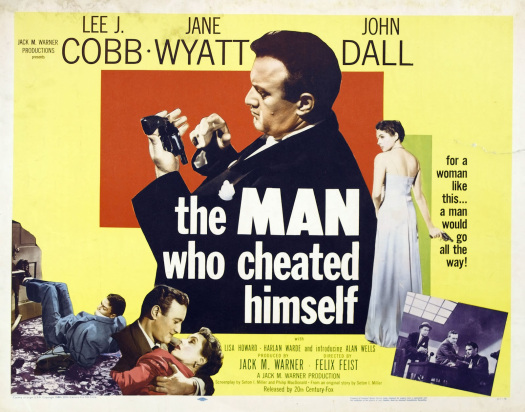
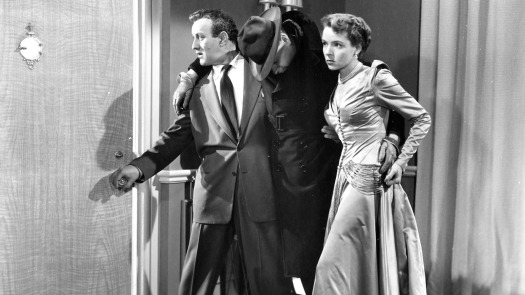
Midnight Snack: THE MAN WHO CHEATED HIMSELF (2Oth Century-Fox 1950)


gary loggins's avatarcracked rear viewer

THE MAN WHO CHEATED HIMSELF made it’s TCM debut last Saturday night on Noir Alley, hosted by “The Czar of Noir” Eddie Muller. This is a ‘B’ film I’d never heard of before, and since you all know how much I love discovering new/old ‘B’ movies, I stayed up past the midnight hour to give it a watch (which I usually do on Saturday nights anyway, being a Noir Alley fan!).

The film doesn’t waste any time, quickly introducing the main characters and getting right into the story. Thinking her husband is planning to murder her, rich San Francisco socialite Lois Frazer guns him down in cold blood directly in front of her lover, Homicide Lt. Ed Cullen. Ed dumps the body at the airport to make it look like a robbery/murder, tossing the murder weapon off the Golden Gate Bridge. Then he takes the lead in the investigation, along…

View original post 320 more words

Music Video of the Day: Brando by Scott Walker + Sunn O))) (2014, dir by Gisele Vienne)


Today would have been Marlon Brando’s 94th birthday so it seems appropriate that today’s music video should be for a song that was, at least partially, inspired by Marlon Brando’s career!

In 2014 interview, Scott Walker explained the idea behind this song, saying that he found that there were several movies that features scenes of Marlon Brando being physically assaulted.  Along with detailing some of the assaults that Brando suffered on screen, the song serves as a tribute to sadomasochism in general.

In the third verse, there are several references to Brando’s films.  First there’s mention of Brando getting beat up by John Saxon in The Appaloosa.  “I took it from dad” is probably a reference to One-Eyed Jacks, the only film that Brando ever directed.  Fat Johnny Friendly was the racketeer played by Lee J. Cobb in On The Waterfront while the three vigilantes are a reference to Brando’s role in The Chase.  “I took it for The Wild One” is obviously a reference to the film of the same name.  As “Lizbeth,” that’s presumably a reference to Elizabeth Taylor, who beat Brando with a riding crop in Reflections in a Golden Eye.

Enjoy!

Lisa Reviews An Oscar Nominee: How The West Was Won (dir by Henry Hathaway, George Marshall, John Ford, and Richard Thorpe)


(With the Oscars scheduled to be awarded on March 4th, I have decided to review at least one Oscar-nominated film a day.  These films could be nominees or they could be winners.  They could be from this year’s Oscars or they could be a previous year’s nominee!  We’ll see how things play out.  Today, I take a look at the 1963 best picture nominee, How The West Was Won!)

How was the west won?

According to this film, the west was won by the brave men and women who set out in search of a better life.  Some of them were mountain men.  Some of them worked for the railroads.  Some of them rode in wagons.  Some of them gambled.  Some of them sang songs.  Some shot guns.  Some died in the Civil War.  The thing they all had in common was that they won the west and everyone had a familiar face.  How The West Was Won is the history of the west, told through the eyes of a collection of character actors and aging stars from Hollywood’s Golden Age.

In many ways, How The West Was Won was the Avatar of the early 60s.  It was a big, long, epic film that was designed to make viewers feel as if they were in the middle of the action.  Avatar used 3D while How The West Was Won used Cinerama.  Each scene was shot with three synchronized cameras and, when the film was projected onto a curved Cinerama screen, it was meant to create a truly immersive experience.  The film is full of tracking shots and, while watching it on TCM last night, I tried to imagine what it must have been like to see it in 1963 and to feel as if I was plunging straight into the world of the old west.  The film’s visuals were undoubtedly diminished by being viewed on a flat screen and yet, there were still a few breath-taking shots of the western landscape.

The other thing that How The West Was Won had in common with Avatar was a predictable storyline and some truly unfortunate dialogue.  I can understand why How The West Was Won was awarded two technical Oscars (for editing and sound) but, somehow, it also picked up the award for Best Writing, Screenplay or Story.  How The West Was Won is made up of five different parts, each one of which feels like a condensed version of a typical western B-movie.  There’s the mountain man helping the settlers get down the river story.  There’s the Civil War story.  There’s the railroad story and the outlaw story and, of course, the gold rush story.  None of it’s particularly original and the film is so poorly paced that some sections of the film feel rushed while others seem to go on forever.

Some of the film’s uneven consistency was undoubtedly due to the fact that it was directed by four different directors.  Henry Hathaway handled three sections while John Ford took care of the Civil War, George Marshall deal with the coming of the railroad, and an uncredited Richard Thorpe apparently shot a bunch of minor connecting scenes.

And yet, it’s hard not to like How The West Was Won.  Like a lot of the epic Hollywood films of the late 50s and early 60s, it has its own goofy charm.  The film is just so eager to please and remind the audience that they’re watching a story that could only be told on the big screen.  Every minute of the film feels like a raised middle finger to the threat of television.  “You’re not going to see this on your little idiot box!” the film seems to shout at every moment.  “Think you’re going to get Cinerama on NBC!?  THINK AGAIN!”

Then there’s the huge cast.  As opposed to Avatar, the cast of How The West Was Won is actually fun to watch.   Admittedly, a lot of them are either miscast or appear to simply be taking advantage of a quick payday but still, it’s interesting to see just how many iconic actors wander through this film.

For instance, the film starts and, within minutes, you’re like, “Hey!  That’s Jimmy Stewart playing a mountain man who is only supposed to be in his 20s!”

There’s Debbie Reynolds as a showgirl who inherits a gold claim!

Is that Gregory Peck as a cynical gambler?  And there’s Henry Fonda as a world-weary buffalo hunter!  And Richard Widmark as a tyrannical railroad employee and Lee J. Cobb as a town marshal and Eli Wallach as an outlaw!

See that stern-faced settler over there?  It’s Karl Malden!

What’s that?  The Civil War’s broken out?  Don’t worry, General John Wayne is here to save the day.  And there’s George Peppard fighting for the Union and Russ Tamblyn fighting for the Confederacy!  And there’s Agnes Moorehead and Thelma Ritter and Robert Preston and … wait a minute?  Is that Spencer Tracy providing narration?

When Eli Wallach’s gang shows up, keep an eye out for a 36 year-old Harry Dean Stanton.  And, earlier, when Walter Brennan’s family of river pirates menaces Karl Malden, be sure to look for an evil-looking pirate who, for about twenty seconds, stares straight at the camera.  When you see him, be sure to say, “Hey, it’s Lee Van Cleef!”

How The West Was Won is a big, long, thoroughly silly movie but, if you’re a fan of classic film stars, it’s worth watching.  It was a huge box office success and picked up 8 Oscar nominations.  It lost best picture to Tom Jones.

(By the way, in my ideal fantasy world, From Russia With Love secured a 1963 U.S. release, as opposed to having to wait until 1964, and became the first spy thriller to win the Oscar for Best Picture.)

Cleaning Out the DVR #17: Film Noir Festival 3


gary loggins's avatarcracked rear viewer

To take my mind off the sciatic nerve pain I was suffering last week, I immersed myself on the dark world of film noir. The following quartet of films represent some of the genre’s best, filled with murder, femme fatales, psychopaths, and sleazy living. Good times!!

I’ll begin chronologically with BOOMERANG (20th Century-Fox 1947), director Elia Kazan’s true-life tale of a drifter (an excellent Arthur Kennedy ) falsely accused of murdering a priest in cold blood, and the doubting DA (Dana Andrews ) who fights an uphill battle against political corruption to exonerate him. Filmed on location in Stamford, CT and using many local residents as extras and bit parts, the literate script by Richard Murphy (CRY OF THE CITY, PANIC IN THE STREETS, COMPULSION) takes a realistic look behind the scenes at an American mid-sized city, shedding light into it’s darker corners.

Andrews is solid as the honest…

View original post 1,048 more words

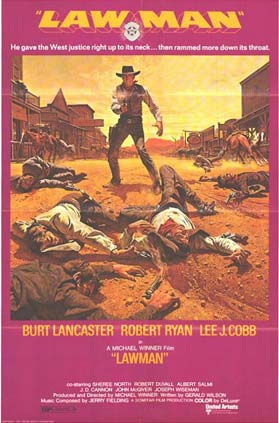
A Movie A Day #238: Lawman (1971, directed by Michael Winner)


In the 1880s, Jared Maddox (Burt Lancaster) is the marshal of the town of Bannock.  After a night of drinking and carousing leads to the accidental shooting of an old man, warrants are issued for the arrest of six ranch hands.  Maddox is determined to execute the arrest warrants but the problem is that the six men live in Sabbath, another town.  They all work for a wealthy rancher (Lee J. Cobb) and the marshal of Sabbath, Cotton Ryan (Robert Ryan), does not see the point in causing trouble when all of the men are likely to be acquitted anyway.  Maddox doesn’t care.  The law is the law and he does not intend to leave Sabbath until he has the six men.
Lawman starts out like a standard western, with a stranger riding into town, but then it quickly turns the western traditions on their head by portraying Marshal Maddox as being a rigid fanatic and the wealthy rancher as a morally conflicted man who does not want to resort to violence and who continually tries and fails to convince Maddox to leave.  In the tradition of Sergio Leone and Sam Peckinpah, there are no real heroes to be found in Lawman and, even when Maddox starts to reconsider his strict adherence to the law and refusal to compromise, it is too late to prevent the movie from ending in a bloody massacre.  Since Lawman was made in 1971, I initially assumed it was meant to be an allegory about the Vietnam War but then I saw that it was directed by Michael Winner, a director who specialized in tricking audiences into believing that his violent movie were deeper than they actually were.

Even if Lawman never reaches the heights of a revisionist western classic like Pat Garrett and Billy the Kid, it is still pretty good, with old pros Lancaster, Ryan, Cobb, and Albert Salmi all giving excellent performances.  The cast is full of familiar faces, with everyone from Robert Duvall to Richard Jordan to Ralph Waite to Joseph Wiseman to John Beck showing up in small roles.  In America, Winner is best remembered for his frequent collaborations with Charles Bronson.  Chuck is not in Lawman, though it seems like he should have been and Lee J. Cobb’s rancher is named Vincent Bronson.  Winner would not make his first film with Charles Bronson until a year later, when he directed him in Chato’s Land.

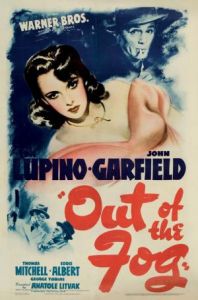
A Movie A Day #155: Out of the Fog (1941, directed by Anatole Litvak)


When two aging fishermen (Thomas Mitchell and John Qualen) attempt to buy a new boat, they run into a problem with local mobster, Harold Goff (John Garfield).  As Goff explains, if they do not pay him $5.00 a week, something bad could happen to their boat.  When one of the fisherman’s daughter (Ida Lupino) falls in love with Goff, she makes the mistake of letting him know that her father is planning on giving her $190 so that she can take a trip to Cuba.  When Goff demands the money for himself, the fishermen attempt to go to the police, just to be told that there is nothing that the authorities can do.  Goff tricked them into signing an “insurance” contract that allows him to demand whatever he wants.  The two fishermen are forced to consider taking drastic measures on their own.  Out of the Fog is an effective, early film noir, distinguished mostly be John Garfield’s sinister performance as Harold Goff.

Out of the Fog is also memorable as an example of how Hollywood dealt with adapting work with political content during the production code era.  Out of the Fog was based on The Gentle People, a play by Irwin Shaw.  In the play, which was staged by The Group Theater in 1939, Harold Goff was obviously meant to be a symbol of both European fascism and American capitalism.  In the play, the two fisherman had Jewish names and were meant to symbolize those being persecuted by the Third Reich and its allies.  In the transition for stage to film, Jonah Goodman became Jonah Goodwin and he was played by the very talented but definitely not Jewish Thomas Mitchell.   The play ended with Harold triumphant and apparently unstoppable.  Under the production code, all criminals had to be punished, which meant the ending had to be changed.  Out of the Fog is an effective 1940s crime thriller but, without any political subtext, it lacks the play’s bight.

One final note: while Out of the Fog had a good cast, with up and comer John Garfield squaring against old vets Thomas Mitchell and John Qualen, the original Broadway play’s cast was also distinguished.  Along with contemporary film stars Sylvia Sidney and Franchot Tone, the play’s cast was a who’s who of actors and directors who would go on to be prominent in the 1950 and 60s: Lee J. Cobb, Sam Jaffe, Karl Malden, Martin Ritt, and Elia Kazan all had roles.