
Here’s the trailer for William Friedkin’s final film, an adaptation of The Caine Mutiny Court Martial Trailer. The film will be premiering on Showtime in October and I look forward to seeing Kiefer Sutherland in the role of Lt. Commander Queeg.
Here’s the trailer for William Friedkin’s final film, an adaptation of The Caine Mutiny Court Martial Trailer. The film will be premiering on Showtime in October and I look forward to seeing Kiefer Sutherland in the role of Lt. Commander Queeg.
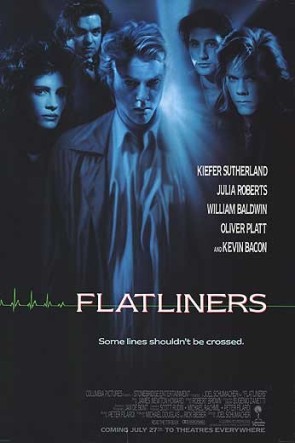
“Our sins have come back in a physical form … and they’re pissed!”
That one line pretty much sums up the original 1990 version of Flatliners. It’s a good line in that it’s one that you remember and it’s a line that you can use in almost any situation.
Have you gotten a phone call from an unknown caller? “Our sins have come back in physical form … and they’re pissed!”
Have you and your boyfriend recently been driving across Texas and suddenly noticed that a car has been following you all the way from Lake Dallas to the border of Oklahoma. “Our sins have come back in physical form … and they’re pissed!”
Have you ever had a stranger fail to hold a door open for you? There’s only one possible reason for that rudeness. “Our sins have come back in physical form .. and they’re pissed!”
And don’t even get me started on people who leave negative comments under my reviews. We all know what’s going on with that! “Our sins have come back in physical form … and they’re pissed!”
It’s a line that is both oddly memorable and also deeply stupid. The same description can be applied to Flatliners. It’s a film about a group of medical students (played by Julia Roberts, William Baldwin, Oliver Platt, and Kevin Bacon) who help Kiefer Sutherland investigate whether or not there’s actually an afterlife. Sutherland believes that there is but he needs an atheist to be a part of the group, that’s where Kevin Bacon comes in. And he needs a potential love interest and a Baldwin brother to be a member of the group as well, that’s why Julia Roberts and William Baldwin are there. And, of course, someone has to provide comedic relief whenever things start to get too dark. Say hello to Oliver Platt! Anyway, Sutherland’s plan is to die for a minute or two and then have his fellow medical students bring him back to life. It sounds like kind of a dumb idea but everyone agrees to it.
Anyway, it turns out that the afterlife looks a lot like an overproduced student film, full of weird camera angles, tinted lighting and disembodied voices. When Sutherland dies, he sees a boy that he used to bully. Julia Roberts sees her father, who committed suicide when she was younger. Kevin Bacon sees a little girl that he used to bully. (There are a lot of bullies in this movie.) William Baldwin, a sex addict who is chronically unfaithful to his fiancée, sees hundreds of women, all saying, “But you said you loved me.” Oliver Platt never actually gets to die and therefore, he sees nothing. He does make a joke about how his vision would probably involve an angry babysitter. I laughed.
What happens next? “Our sins have come back in physical form … and they’re pissed!”
Flatliners has an intriguing premise but oh my God, is it ever a silly film. It’s not really a spoiler to tell you that all of these returned sins want the characters to either atone for their mistakes or make peace with their past. For Kevin Bacon, this means tracking down the girl that he used to bully and allowing her to bully him. For Julia Roberts, it means getting an apology from her Dad and understanding that he was addicted to heroin. For William Baldwin, it means making peace with never being as well-known as either Alec or Steven. As for Kiefer … well, things are a bit more complicated for Kiefer Sutherland.
Flatliners starts out as a horror film but then it turns into a squishy movie about letting go of bitterness and learning how to forgive oneself. It’s kind of annoying that the film couldn’t just stick to being scary because the first half of the film does have some effectively tense moments. However, it all gets lost as the film’s plot sinks into sentimental, New Age-y quicksand.
Flatliners was directed by Joel Schumacher, who generally does well with shallow films that 1) don’t really mean anything and 2) don’t involve super heroes. And really, the only film that I can think of that’s more shallow than the original Flatliners is the remake. (But we’ll talk about that later…) Schumacher’s direction here is not particularly bad — everyone looks good and the film is never boring. It’s a very, very pretty film and one that doesn’t add up to much.
I would suggest watching it with your sins, especially after they take physical form. Maybe they’ll be a little less pissed off afterward.
What’s an Insomnia File? You know how some times you just can’t get any sleep and, at about three in the morning, you’ll find yourself watching whatever you can find on cable? This feature is all about those insomnia-inspired discoveries!
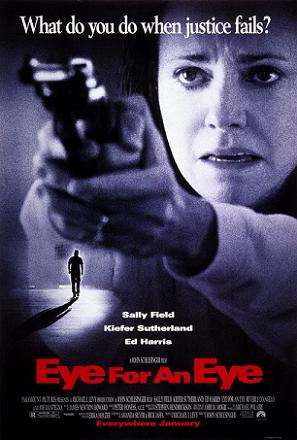
If you were awake at midnight and trying to get some sleep, you could have turned over to ThillerMax and watched the 1996 revenge thriller, Eye For An Eye. However, the film wouldn’t have helped you get to sleep. Eye For An Eye is not a film that you sleep through.
Eye For An Eye opens with Karen McCann (Sally Field) comforting her youngest daughter, Megan (Alexandra Kyle). Megan is terrified of a moth that has flown into her bedroom. “Kill it, mommy, kill it!” Megan shouts. Instead, Karen gently takes the moth in her hand and allows it to escape through an open window. In those first few minutes, the film tells us everything that it feels to be important about Karen. She’s a mother. She lives in a big house in the suburbs. And she wouldn’t kill a moth…
But — the name of the title is Eye For An Eye and that would seem to promise killing so we know that something terrible is going to happen to change Karen’s outlook on life.
And it does! The next afternoon, Karen is stuck in traffic and calls her oldest daughter, 17 year-old Julie (Olivia Burnette). In an extremely harrowing sequence that is pure nightmare fuel, Karen helplessly listens as Julie is raped and murdered.
A white trash deliveryman named Robert Doob is arrested for the crime and we immediately know that he’s guilty. First off, his name is Robert Doob and that’s a serial killer name if I’ve ever heard one. Secondly, he smirks at Karen and her husband (Ed Harris) and, in a particularly cruel moment that was especially upsetting to this former stutterer, he imitates Julie’s stammer. Third, Robert has tattoos and Satanic facial hair. And finally, Robert Doob is played by Keifer Sutherland. And usually, I find Keifer and his growl of a voice to be kinda sexy in a dangerous sorta way but in Eye For An Eye, he was so icky that he just made my skin crawl.
Robert Doob is obviously guilty but an evil liberal judge throws the case out on a technicality. After Karen gets over the shock of seeing justice perverted, she decides to take the law into her own hands. After meeting a professional vigilante (Philip Baker Hall, looking slightly amused no matter how grim he tries to act), Karen decides to learn how to use a gun so that she can get her revenge…
There’s not a single subtle moment in Eye For An Eye but that’s actually the main reason I enjoyed the film. Everything — from the performances to the script to the direction to the music to … well, everything — is completely and totally over-the-top. The symbolism is so heavy-handed and the film is so heavily stacked in favor of vigilante justice that the whole thing becomes oddly fascinating. It may not be a great film but it’s always watchable. It may not be subtle and it may even be borderline irresponsible in its portrayal of the American justice system but who cares? By the end of the movie, I was over whatever real world concerns I may have had about the film’s premise and I was totally cheering Karen on in her quest for vengeance. I imagine I’m not alone in that. Eye For An Eye is the type of film that elitist movie snobs tend to dismiss, even while secretly knowing that it’s actually kinda awesome.
Previous Insomnia Files:
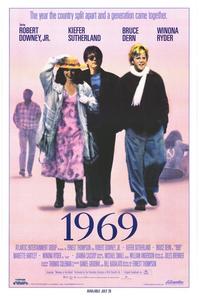 In 1988, the same year that he was forcing Michael J. Fox to snort cocaine in Bright Lights, Big City, Kiefer Sutherland played a far different role in the film 1969.
As you might guess from the film’s title, 1969 takes place in 1969. Scott (Kiefer Sutherland) and Ralph (Robert Downey, Jr.) have just graduated from high school and are facing a future that involves either going to college or going to Vietnam. Scott’s older brother, Alden (Christopher Wynne), has already enlisted in the army and has made their father, Cliff (Bruce Dern), proud in a way that Scott knows he will never be able to match.
So, Scott and Ralph make plans to go to college together and basically stay there until the war ends. But, needless to say, things don’t work out as perfectly as Scott assumed that they would. Scott and Ralph spend the summer on a road trip, during which time they meet the usual collection of hippies and fascists who always populate films like this. They also discover that they have less in common than they thought. Scott is an idealist who is convinced that he can change the world. Ralph is far more fatalistic, a cynic who hides his pain behind a constant stream of sarcasm.
When Ralph is kicked out of school (and loses his draft deferment as a result), Alden is killed in Vietnam and Scott sees his father in a potentially compromising position with Ralph’s mother (Joanne Cassidy) (on the night of the moon landing no less!), the disillusioned Scott feels that he has to take action. With the help of Ralph and Ralph’s sister, Beth (Winona Ryder), Scott breaks into the local draft office and tries to destroy all the records.
Now, if you guessed that the police arrive and that Scott and Beth eventually find themselves in a van, driving for the Canadian border, then you’ve probably seen countless other films that were set in the same year as 1969…
1969 is a rather predictable film but, at the same time, it’s likable in much the same way that a rerun of Everybody Loves Raymond is likable. It’s not something you really need to watch but, if you do watch it, you won’t necessarily be filled with regret. I imagine that one reason why 1969 tends to show up on networks like Antenna and This TV so much is precisely because it is such a thoroughly inoffensive little movie.
The film also features some above average performances. It’s not surprising that Robert Downey, Jr. and Winona Ryder both give good performances because, to a large extent, their characters mirror their own public personas. But, considering that he’s best known for playing Jack Bauer in 24, it’s still somewhat surprising to see a much younger Kiefer Sutherland playing such an essentially gentle character and being totally convincing in the role. (He already had that sexy growl of a voice, however.) And finally, the film’s best performance comes from Bruce Dern. Eternally befuddled and confused by the changes around him, Cliff is ultimately the film’s most sympathetic character, even if he wasn’t originally meant to be.
And needless to say, considering that the film is called 1969, it’s got a great soundtrack!
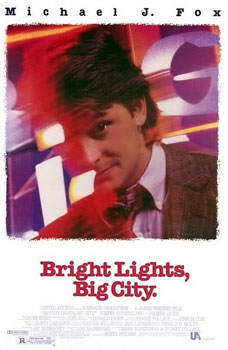 The 1988 film Bright Lights, Big City is one of the many films from the late 80s in which Kiefer Sutherland plays a demonic character. In this case, his character is so demonic that his name is — seriously, check this shit out — Tad Allagash. Nobody named Tad Allagash has ever been a good guy!
Tad is the best friend of Jamie Conway (Michael J. Fox), an aspiring writer who has moved to New York City from some middle-America farm state and who now has a job as a fact checker at the New Yorker. Jamie is still struggling to deal with both the death of his mother (played in flashbacks by Dianne Wiest) and the collapse of his marriage to Amanda (Phoebe Cates). Tad helps out his depressed little friend by taking him out to the clubs and supplying him with so much cocaine that Jamie literally spends the entire film on the verge of having a geyser of blood shoot out from his powder-coated nostrils.
And the thing is, Tad knows that he’s not a good influence on Jamie’s life but he doesn’t care. Whenever Jamie starts to get a little bit too wrapped up in his self-pity, Tad is there to make a tasteless joke. Whenever Jamie tries to argue that he and Amanda aren’t really broken up, Tad is there to remind him that Amanda wants nothing to do with him. Whenever Jamie starts to think that doing all of this cocaine is potentially ruining his life, Tad is there to cheerfully cut another line. Tad makes no apologies for being Tad Allagash. He’s too busy having a good time and it’s obvious that Sutherland’s having an even better time playing Tad. As a result, Tad Allagash becomes the perfect antihero, the bad guy that you like despite yourself.
Unfortunately, Bright Lights, Big City isn’t about Tad Allagash. You’re happy whenever Kiefer shows up but he doesn’t show up enough to actually save the film. No, Bright Lights, Big City is the story of Jamie Conway and that’s why the film is a bit of a pain to sit through. Despite having a great Irish name, Jamie Conway is one of the whiniest characters that I have ever seen in a film. From the minute he first appears on screen and starts complaining about the failure of his marriage, you want someone to just tell him to shut up. When he tells an alcoholic editor (Jason Robards) that his latest short story was autobiographical, you nod and think, “So, that’s why it hasn’t been published.”
Of course, since Jamie is the main character, everyone in the film feels sorry for him but he really is just insufferable. There’s a lengthy scene where Jamie delivers a drunken monologue to a sympathetic coworker, Megan (played by Swoosie Kurtz). And while Jamie goes on and on about how he first met Amanda and how their marriage fell apart (and how it was all her fault), poor Megan has to sit there and try to look sympathetic. Personally, I would have kicked Jamie out of my apartment after the first minute of that whiny diatribe. Megan has the patience of a saint.
There is some curiosity value to watching Michael J. Fox snort cocaine. (I wonder if contemporary audiences shouted, “McFly!” as they watched Fox sniffing up the devil’s dandruff.) But otherwise, Bright Lights, Big City is a relic of 80s cinema that can be safely forgotten.
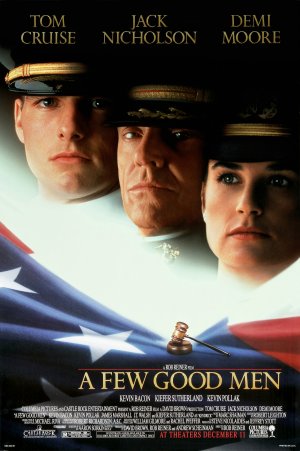
So, late Saturday night, I turned over to TCM’s 31 Days Of Oscar and I was watching the 1992 best picture nominee, A Few Good Men, and I noticed that not only was there only one woman in the entire film but she was also portrayed as being humorless and overwhelmed. While all of the male characters were allowed to speak in quippy one liners and all had at least one memorable personality trait, Lt. Commander Joanne Galloway (Demi Moore) didn’t get to do much beyond frown and struggle to keep up.
“Hmmmm…” I wondered, “why is it that the only woman in the film is portrayed as basically being a humorless scold?” Then I remembered that A Few Good Men was written by Aaron Sorkin and it all made sense. As I’ve discussed on this site before, Aaron Sorkin has no idea how to write woman and that’s certainly evident in A Few Good Men. Joanne (who goes by the masculine Jo) is the one character who doesn’t get to say anything funny or wise. Instead, she mostly serves to repeat platitudes and to be ridiculed (both subtly and not-so subtly) by her male colleagues. You can tell that Sorkin was so busy patting himself on the back for making Jo into a professional that he never actually got around to actually giving her any personality. As a result, there’s really not much for her to do, other than occasionally scowling and giving Tom Cruise a “that’s not funny” look.
(“C’mon,” Tom says at one point, “that one was pretty good.” You tell her, Aaron Tom.)
A Few Good Men, of course, is the film where Tom Cruise yells, “I want the truth!” and then Jack Nicholson yells back, “You can’t handle the truth!” At that point in the film, I was totally on Nicholson’s side and I was kinda hoping that the scene would conclude with Cruise staring down at the floor, struggling to find the perfect come back. However, this is an Aaron Sorkin script which means that the big bad military guy is never going to have a legitimate point and that the film’s hero is always going to have the perfect comeback. Fortunately, the scene took place in a courtroom so there was a wise judge present and he was able to let us know that, even if he seemed to be making the better point, Nicholson was still in the wrong.
As for the rest of the film, it’s a courtroom drama. At Guantanamo Bay, a marine (Michael DeLorenzo) has died as the result of a hazing. Two other marines (Wolfgang Bodison and James Marshall) have been accused of the murder. Daniel Kafee (Tom Cruise), Joanne Galloyway (Demi Moore), and Sam Weinberg (Kevin Pollack) have been assigned to defend them. Jack Ross (Kevin Bacon) is prosecuting them. Kafee thinks that the hazing was ordered by Col. Nathan Jessup (Jack Nicholson) and Lt. Kendrick (Kiefer Sutherland).
We know that Kendrick’s a bad guy because he speaks in a Southern accent and is religious, which is pretty much the mark of the devil in an Aaron Sorkin script. We know that Jessup is evil because he’s played by Jack Nicholson. For that matter, we also know that Kafee is cocky, arrogant, and has father issues. Why? Because he’s played by Tom Cruise, of course. And, while we’re at it, we know that Sam is going to be full of common sense wisdom because he’s played by Kevin Pollack…
What I’m saying here is that there’s absolutely nothing surprising about A Few Good Men. It may pretend to be about big issues of national security but, ultimately, it’s a very slick and somewhat hollow Hollywood production. This, after all, is a Rob Reiner film and that, above all else, means that it’s going to be a very conventional and very calculated crowd pleaser.
Which isn’t to say that A Few Good Men wasn’t enjoyable. I love courtroom dramas and, with the exception of Demi Moore, all of the actors do a good job. (And, in Demi’s defense, it’s not as if she had much to work with. It’s not her fault that Sorkin hates women.) A Few Good Men is entertaining without being particularly memorable.
On May 5th, Jack Bauer’s back! How many people will he kill this time?
Was it just me or did the Super Bowl commercials kinda sorta suck this year? I mean, I expect the game to always be long and boring but I can usually count on seeing at least a few memorable commercials. Howevever, with a few notable exceptions (mostly involving puppies and horses), this year’s crop of commercials were just boring. You could tell that advertisers were going so out of their way to keep things positive that they forgot that commercials also need to be interesting.
However, there was one commercial that seemed to excite everyone on twitter and that was a brief 49-second commercial for the return of 24. Judging from this commercial, Jack Bauer is back and he’s as violent as ever. And, apparently, he has some issues with the British.

Every year, there’s a handful of film scenes that come to define the entire year for us. At their best, these scenes can leave such an impression that they become a part of our shared history. For some people (though not me), 2009 will always be the year of Avatar. Meanwhile, for me (but not others), 2010 will always be the year I realized it was okay to admit how much I love to dance. Listed below are 20 of the many film moments that I will remember whenever I look back on this current year.
20) Carey Mulligan and Andrew Garfield discover what really happened to all of their childhood artwork in Never Let Me Go.
Permeated with an atmosphere of nonstop melancholy, Never Let Me Go never quite found the audience is deserved but I think it’s one of the best films of 2010 and the scene mentioned above is one of the reasons why.

19) Scott Pilgrim says, “Oh cool, coins!” in Scott Pilgrim Vs. The World.
And Lisa Marie suddenly realizes that she has fallen in love with a movie.
18) Keifer Sutherland says, “Tap that ass” in Twelve.
Truth be told, I don’t even remember what was happening on-screen. I just remember Keifer, as the film’s narrator, saying “Tap that ass” in that sexy, nicotine-fueld growl of his and thinking to myself, “Well, okay…”
17) Jake Gyllenhaal chases down a bus full of dying old people in Love and Other Drugs.
Yes, the old people desperately need to get up to Canada so they can get their prescriptions filled but unfortunately for them, Anne Hathaway happens to be on the bus as well and Jake — apparently realizing that he’ll never get to see her breasts again if they break up — chases the bus down in his Porsche so he can reconcile with her. And, of course, the old people are just so adorably excited at the idea of a 15-minute delay while these two deeply damaged characters stand outside and talk about their relationship. I mean, fuck it — who cares about getting these people their medicine when there’s a disposable pop tune playing in the background and Jake wants to talk to his ex-girlfriend? In so many ways, this scene represents everything I hate about mainstream filmmaking.
16) Joseph Gordon-Levitt flies through the corridors of a dream hotel in Inception.
Inception was a film full of amazing images but my personal favorite was perhaps the simplest — Joseph Gordon-Levitt (looking rather adorable in his dark suit) floating down those Argentoesque hallways while trying to figure out how to wake everyone up.
15) Jacki Weaver delivers the line of the year in Animal Kingdom.
“And you’ve done some bad things, sweetie.”
14) John Hawkes “talks” his way out of a traffic stop in Winter’s Bone.
While Winter’s Bone should rightfully make Jennifer Lawrence a star, John Hawkes also contributed some of the film’s best moments.
13) Patrick Fabian slips a recipe into his sermon in The Last Exorcism.
Cast as a modern-day Marjoe Gortner in this underappreciated film, Fabian gives one of the best performances of the year, if not the best.
12) Chloe Grace Moretz saves Kick-Ass from the mafia in Kick-Ass.
As far as women kicking ass was concerned, 2010 was a good year. Sure, the majority of cinematic female portraits were — as always — sexist to the extreme but there were a few rays of hope. Angelina Jolie in Salt, Noomi Rapace in The Girl With The Dragon Tattoo films, Mila Jovovich in Resident Evil — all were among the women who got to do something more than just look pretty while the boys saved the day. Seeing as how I’m honoring Rapace further down the list, I’m going to allow Chloe Grace Moretz (in the role of Hit Girl) to serve as a stand-in here for every single woman who was allowed to kick a little ass in 2010.
11) Christian Bale and Mark Wahlberg walks down the streets of Lowell at the beginning of The Fighter.
Seriously, this entire sequence — set to Heavy’s How You Like Me Now? (or “The Sock Monkey Song” as I call it) — could be a short film in itself. Call it: “Men and why we love them.”

10) Colin Firth fearfully waits to give a speech at the start of The King’s Speech.
One look at Firth’s terrified eyes and I was in tears. From that minute on, this unexpected gem of a film had me.
9) Jennifer Lawrence fishes for her dad’s hand in Winter’s Bone.
Southern gothic at its best!
8) James Franco is rescued by a purifying storm in 127 Hours.
Helpless and hopeless, Franco is suddenly freed by a sudden storm. Both Franco and director Danny Boyle handle this scene with such skill that the audience finds itself just as saddened as Franco when it all turns out to be a hallucination.
7) Katie Jarvis dances in an abandoned apartment and finds a momentary glimmer of hope in Fish Tank.
Between this movie and Black Swan, 2010 was the year that reminded me of just how much I love to dance and why. 2010 is the year that I realized it was okay for me to love to dance again.

6) Andy gives away his toys at the end of Toy Story 3.
And Lisa Marie cries and cries.
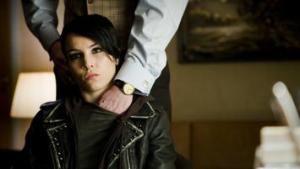
5) Lisbeth Salander (played by Noomi Rapace) gives her abusive guardian a tattoo in The Girl With The Dragon Tattoo.
For any and every girl who has ever been used, abused, hurt, spoken down to, insulted, manipulated, or betrayed by someone who claimed to only be looking after her best interests, this scene was truly cathartic. When I say that Noomi Rapace’s Lisbeth will be iconic, it’s largely because of scenes like this. In that one scene, Lisbeth is established as a woman who will never be victimized and it gives hope any for those of us who don’t have dragon tattoos.
4) Footage from Theirry’s completed “documentary” is revealed in Exit Through The Gift Shop.
And the audience is suddenly forced to question just how much of anything they’ve seen is the truth.
3) The spinning top wobbles at the end of Inception.
Or does it?
2) Kathryn Bigelow becomes the first woman to win the Oscar for best director while her ex-husband glowers in silence.
I wasn’t a huge fan of The Hurt Locker but I still squealed with delight as Kathryn Bigelow accepted the award that should have gone to Sofia Coppola back in 2004. Not only did Bigelow make history but she did it by beating her soulless jerk of an ex-husband, James Cameron. And then she gave one of the best acceptance speeches in Oscar history, all the while looking about 20 years younger than she actually is. In short, Kathryn Bigelow showed every Oscar winner — past, present, and future — exactly how it’s done.

1) The final fifteen minutes of Black Swan
In 15 minutes, Darren Aronofsky reminded me of how much I love ballet and audiences of why we love movies in the first place.

I’ve seen a lot of reviews for the just-released Twelve that have referred to this movie as just being an extended episode of Gossip Girl, largely because the movie deals with spoiled, rich teenagers and it stars Chace Crawford. I’m going to venture a guess that the majority of these reviewers have never actually seen an episode of Gossip Girl, which is actually entertaining and self-aware in a way that the ploddingly obvious Twelve could never hope to match.
Crawford plays White Mike. He’s a recent high school drop out who now makes his living selling drugs — mostly marijuana — to his former classmates. However, his classmates — not to mention his cousin, Charlie — are more interested in sampling a new designer drug known as twelve. We’re told that twelve feels like a combination of cocaine and ecstasy. As this movie struggled to reach its apocalyptic conclusion, I found myself thinking, “That doesn’t sound too bad. I wonder if I can get some twelve after the movie…”
Anyway, Twelve charts out four days in the life of Crawford and his former classmates. It starts with Crawford ignoring a pathetic phone call from his junkie cousin and it ends with a shooting rampage at a party that leaves the majority — but not all — of the cast dead. It’s supposed to be an anti-drug film but, like far too many anti-drug films, it can’t disguise the fact that the characters are a lot more fun to watch when they’re on drugs than when they aren’t. (For instance, we’re told early on that White Mike doesn’t do drugs, smoke, or drink and just look how miserable he is.) Director Joel Schumacher gives us a lot of really pretty images but there’s nothing below the surface and as a result, the film’s massacre doesn’t so much feel tragic as it just feels like a poorly planned fashion spread in Elle.
(As opposed to Nick McDonnell’s original novel, the film Twelve is mainstream enough to only allow unlikable characters to die at the end.)
The cast is almost achingly pretty but, at the same time, largely forgettable, with two major exceptions. Poor Rory Culkin (who I worry about because he always seems so sad every time he shows up in a movie) brings a lot of pathos to his role as the geeky kid who happens to have the perfect party house, permissive parents, and a psychotic older brother. Emily Meade is memorable playing a character who, in many ways, is a female version of Culkin’s. Playing a bipolar girl who discovers a love for twelve, Meade actually manages to overcome the generic plot (the type that demands that she go from being an honor’s student to selling her body to Curtis “50 Cent” Jackson in little over 24 hours) and makes her character compelling. Plus, she has a fun scene where her teddy bears encourage her to kill people.

Still, the movie ultimately belongs to Keifer Sutherland who never appears on-screen but who gets more dialogue than anyone else in the entire film. Sutherland plays the narrator. That’s right, as simplistic as the movie is, Schumacher apparently felt that the movie needed a narrator to tell us what we’ve just seen onscreen. For instance, we see Crawford selling drugs. Suddenly, Sutherland’s voice informs us, “White Mike is a drug dealer.” “Oh,” we say in the audience, “so that’s why he’s exchanging marijuana for money…”
Even though the narrator is essentially just quoting large chunks of prose from McDonnell’s novel, the use here is technically a mistake. I say “technically” because it cannot be denied that Sutherland has probably got the sexiest narrator voice around. Regardless of whether the movie needed it, I needed it. If nothing else, I will always remember seeing Twleve as the time I heard Keifer Sutherland say, in his purring growl of a voice, “I want to tap that ass,” and I thought, “Well, okay…”

 Through the Shattered Lens