The Sea Spoilers (1936, directed by Frank R. Strayer)


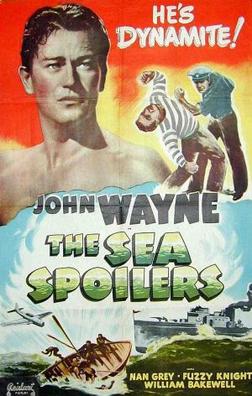
Bob Randall (John Wayne) is a coast guard boatswain, headquartered in Alaska where he and the members of his crew battle evil seal poachers like oily Phil Morgan (Russell Hicks).  When Randall returns to port after his latest patrol, he has to deal with two disappointments.  First off, he is passed over for a promotion to commanding officer, even though everyone knows that he deserves it.  Instead, the promotion goes Lt. Commander Mays (William Blakewell), the son of a commander (George Irving).  Mays doesn’t even want the job.  He’s scared of the water and he’d rather fly airplane as a part of the Coast Guard’s aviation force.  Bob is disappointed but he’s a professional and he’s going to support Mays.  Secondly, Bob’s girlfriend (Nan Grey) witnesses a murder and is kidnapped by Phil Morgan.  Bob and his sidekick (dependable western mainstay Fuzzy Knight) go undercover as fisherman to try to find her.

The Sea Spoilers was the first of six B-movies that John Wayne did for Universal.  Wayne, who had been stuck in the B’s for a while, was trying to prove that he was more than just a singing cowboy so, in this one, he plays a tough and ready sailor.  Wayne is convincing in the role, even if the movie is really just a western set in what was then modern day Alaska.  Though only 30, Wayne shows the no-nonsense professionalism that would become his trademark once he became one of the world’s biggest movie stars.  Unlike some of Wayne’s early films, it’s possible to see the icon that John Wayne would eventually become while watching him here.  The Sea Spoilers is only 66 minutes long but fans of the Duke should enjoy it.

Finally, The Sea Spoilers was written by George Waggner.  Waggner would later go on to direct the original Wolf Man.

Maker Of Men (1931, directed by Edward Sedgwick)


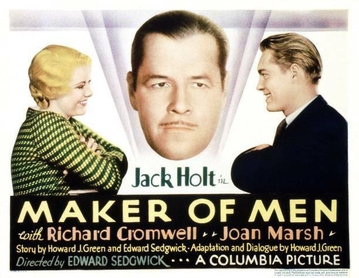
Bob Dudley (Richard Cromwell) is the wimpy son of Coach Dudley (Jack Holt), who is in charge of the local college’s football team.  Bob joins the team out of a sense of family obligation but he turns out to be a cowardly player who would rather fumble the ball than take a hard hit.  Coach Dudley is disgusted with his son.  Bob’s girlfriend (Joan Marsh) dumps him.  Bob drops out of school and disappears for two years and no one seems to care. Then, on the day of a big game, Bob reappears playing for another college.  Despite Coach Dudley’s team being led by All-American Dusty Rhoades (John Wayne!), Bob leads the rival team to victory.  He’s won Coach Dudley’s respect.  Coach Dudley is probably going to get fired.

This was one of the weirdest sports films that I’ve ever seen.  Usually, you would expect Coach Dudley to bring out the best in his son or to understand that his son is just not meant to be a football player.  Instead, Bob is forced to drop out of college!  Bob returns just so he can defeat his father.  The slight Richard Cromwell is not a convincing football player.  On the other hand, John Wayne is a convincing football player but his role is tiny.  The movie is a little over an hour long and 20 minutes of that running time is taking up with grainy footage of an actual football game.

The best thing about the film?  It reminds us that everyone, even John Wayne, had to start somewhere.

Happy Birthday in heaven to the great Paul Fix! A “4 Shots From 4 Films” special edition…


If you love movies, then there’s no doubt you’ve seen the work of the great movie and TV character actor Paul Fix. With over 340 acting credits to his name, including 26 with John Wayne, Fix co-starred in some of the best movies and TV shows ever made. Born on March 13th, 1901, Fix passed away on October 14th, 1983, leaving behind a tremendous legacy of superior performances. I just wanted to take a moment to remember this amazing actor who’s provided me with so much great entertainment over the years!! 

THE RIFLEMAN T.V. Series (1958-1963)

TO KILL A MOCKINGBIRD (1962)

STAR TREK: WHERE NO MAN HAS GONE BEFORE (1966)

EL DORADO (1967)

Born To The West (1937, directed by Charles Barton)


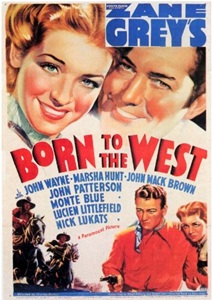
John Wayne plays Dare Rudd, a friendly rogue who aspires to be the best poker player west of the Mississippi.  When he and his sidekick, Dinkey Hooley (Syd Saylor), ride into Montana, they meet up with Dare’s cousin, Tom Filmore (Johnny Mack Brown, billed as John here).  Filmore needs some help on his cattle drive and Dare sure does like Tom’s girl, Judy (Marsha Hunt).  Dare replaces Lynn Hardy (John Patterson) as head of the cattle drive and Lynn teams up with rustler Bart Hammond (Monte Blue) to try to get revenge.  While Dinkey tries to sell lightning rods, Dare moves the herd and even finds time to play poker with notorious gambler Buck Brady (James Craig).

This is another one of the B-westerns that John Wayne made before John Ford made him a stars by casting him in Stagecoach.  This one is interesting because Wayne is not playing his usual stolid do-gooder or even an expert marksman.  Instead, Dare is impulsive and reckless and he’s ultimately not as smart a card player as he thinks he is.  It’s rare to see John Wayne need help from anyone but that’s what he gets from Johnny Mack Brown, who shows up in time to reveal that Dare is getting cheated in his poker game.  For fans of the genre, this short oater is worth watching for the chance to see two western icons acting opposite each other.  Johnny Mack Brown and John Wayne would both go on to appear in a countless number of westerns.  Wayne became a superstar, appearing in big budget studio films.  Brown remained a mainstay on the B-circuit.  They’re amusing to watch in this film as they bounce dialogue off of each other and continually try to steal scenes from one another.  Brown is playing the type of no-nonsense, hard-working westerner who would later become John Wayne’s trademark character.

Based on a novel by Zane Grey, Born to the West is a fast-paced western featuring two of the best to ever ride a horse.

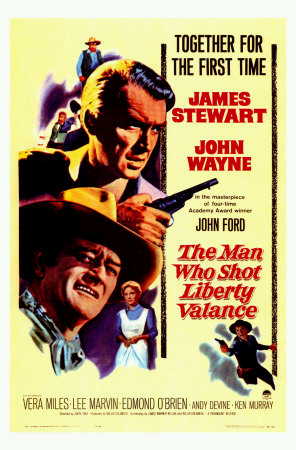
Song of the Day: The Man Who Shot Liberty Valance, performed by Gene Pitney


Since I already shared a scene from my favorite John Ford film, it seems only right that today’s song of the day should pay some respect to Mr. Ford as well.  Here is the theme song from 1962’s The Man Who Shot Liberty Valance, performed by Gene Pitney.

When Liberty Valance rode to town
The womenfolk would hide, they’d hide
When Liberty Valance walked around
The men would step aside

‘Cause the point of a gun was the only law
That Liberty understood
When it came to shooting straight and fast
He was mighty good

From out of the East a stranger came
A law book in his hand, a man
The kind of a man the West would need
To tame a troubled land

‘Cause the point of a gun was the only law
That Liberty understood
When it came to shooting straight and fast
He was mighty good

Many a man would face his gun
And many a man would fall
The man who shot Liberty Valance
He shot Liberty Valance
He was the bravest of them all

The love of a girl can make a man stay on
When he should go, stay on
Just trying to build a peaceful life
Where love is free to grow

But the point of a gun was the only law
That Liberty understood
When the final showdown came at last
A law book was no good

Alone and afraid, she prayed that he’d
Return that fateful night, oh that night
When nothing she said could keep her man
From going out to fight

From the moment a girl gets to be full grown
The very first thing she learns
When two men go out to face each other
Only one returns

Everyone heard two shots ring out
One shot made Liberty fall
The man who shot Liberty Valence
He shot Liberty Valance
He was the bravest of them all

The man who shot Liberty Valance
He shot Liberty Valance
He was the bravest of them all

Songwriters: Burt F. Bacharach / Hal David

Scenes That I Love: Who Was Really “The Man Who Shot Liberty Valance?”


John Ford was born 131 years ago today and it seems appropriate that today’s scene of the day should come from his final great film (even if it wasn’t the last film that Ford directed).

In 1962’s The Man Who Shot Liberty Valance, frontier lawyer Ransom Stoddard (James Stewart) comes to political prominence due to his notoriety for being the man who, in self-defense, gunned down notorious outlaw Liberty Valance (Lee Marvin).  Stoddard, an intellectual who opposes violence, is not happy about this.  When Stoddard considers refusing to be a delegate to the upcoming statehood convention, he is reprimanded by Tom Doniphon (John Wayne).  Stoddard and Doniphon are friends but they’re also romantic rivals, both being in love with Hallie (Vera Miles).  In this scene, Doniphon reveals the truth about who shot Liberty Valance.

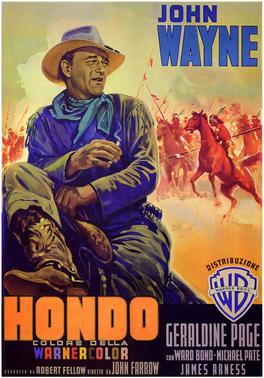
HONDO – John Wayne takes on Apaches!


John Wayne is just one of those actors I love. He’s made so many great movies. My personal favorites are RIO BRAVO, TRUE GRIT, BIG JAKE, THE SONS OF KATIE ELDER, THE MAN WHO SHOT LIBERTY VALANCE, THE SEARCHERS, THE QUIET MAN, RED RIVER, THE SHEPHERD OF THE HILLS and STAGECOACH. But hell, there are so many great ones not listed above. He just knew how to play tough, honorable, flawed men in his uniquely John Wayne way. When I hit play on a John Wayne film, I know I’m in for a good time. 

The 1953 John Wayne movie HONDO starts with a man and his dog walking through a dusty, rocky landscape on their way towards a pond and a rough looking farmhouse. He’s greeted by a woman and her young son. The man, Hondo Lane (Oscar winner John Wayne), is a scout for the U.S. Cavalry who’s just escaped from Apaches but lost his horse in the process. The woman, Angie Lowe (Oscar winner Geraldine Page), allows Hondo to stay at her ranch to rest and get something to eat. She tells him that her husband is away in the hills chasing wildcats for the day, and he asks her if he can buy a horse to get back to his cavalry post. Hondo ends up having to stay a few days at the ranch in order to break a wild, rambunctious horse before it can be ridden. While there, Hondo learns that Angie doesn’t really know where her husband is, as he left months ago and has never returned. Hondo and Angie share some nice conversation and even a kiss. Before he leaves, he tells her that she’s not safe at her remote ranch. It seems that the U.S. government has broken their treaty with the Apaches and no one is safe in the area. Angie refuses to leave her farm as the Apaches have always treated her well, using her spring for water. Hondo heads back to his post and is barely out of sight when the Apaches show up. Will they scalp Angie and her son, Johnny? Will Angie’s husband ever show back up? Will Hondo come back to the ranch and kiss her again in the moonlight? Will Hondo teach Johnny how to swim by throwing him into the pond? Will Hondo have to save a regiment of pony soldiers and settlers from marauding Apaches? It’s my guess that you probably know the answers to these questions, and that’s part of the fun of watching John Wayne movies. 

It should come as no surprise that I enjoyed HONDO. John Wayne plays a variation of his normal tough, honorable, honest character, and I like that character. Geraldine Page was nominated for her first Oscar for her performance as Angie Lowe. It was the first of eight nominations she would receive in her career. She’s an interesting actress. She’s not conventional at all in this role yet she absolutely nails it. I haven’t watched much of her work so I need to check some more of her stuff out. Ward Bond shows up as fellow cavalry scout Buffalo Baker. It’s always fun to see Wayne and Bond work together. They go together like peas and carrots. Leo Gordon is effectively slimy as the deserter Ed Lowe, and James Arness shows up as cocky young man who’s humbled and then redeems himself through battle. It’s a fine cast that helps in the fun factor. 

It’s not a perfect film, especially by the social standards of 2024, but it’s a fun and entertaining western. I liked it. 

Remembering Actor Earl Holliman (1928 – 2024) – 3 things I’ll remember him for!


I saw that actor Earl Holliman passed away on November 25th, 2024 at 96 years of age. For someone who loves movies as much as I do, Mr. Holliman has been a pleasant part of my life over the years, and it makes me sad that he’s gone.

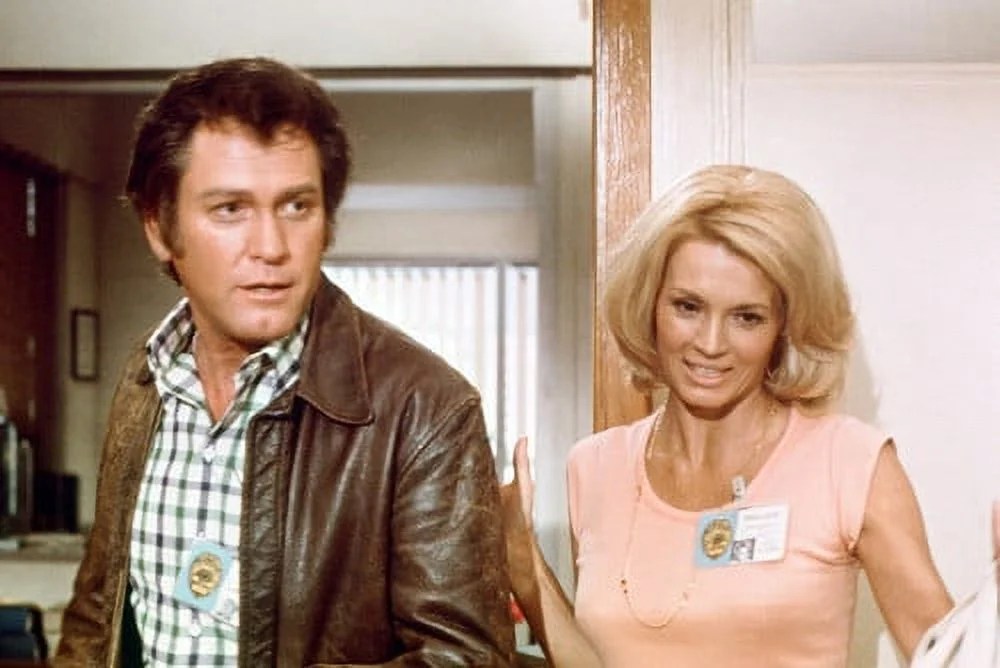
I first really noticed Earl Holliman as one of the sons of Katie Elder along with John Wayne and Dean Martin. I like John Wayne movies so I’ve watched it quite a few times over the years. There’s just something about Holliman that appeals to me, and his fate in the film still makes me sad. Later, in 2006, I acted in the Southwest Arkansas Arts Council production of THE RAINMAKER in Hope, Arkansas. The 1956 movie version stars Burt Lancaster, Katherine Hepburn, Lloyd Bridges and Earl Holliman. I played the Lloyd Bridges part, so I watched the movie several times to help me get into my character. Holliman was just so good in the movie. He won a Golden Globe for his performance in the film, and it just made me notice him that much more. Finally, as part of the THIS WEEK IN CHARLES BRONSON podcast, I had the opportunity to interview actor Jordan Rhodes who had worked with Charles Bronson in MR. MAJESTYK and THE INDIAN RUNNER. As part of the interview, Jordan told us some of the things that made him proud over the years during his time in Hollywood. He told us about the time that his mom was visiting him in Los Angeles, and how proud he was to be able to introduce her to Earl Holliman who was working on POLICE WOMAN with Angie Dickinson at the time. His story was complimentary of Mr. Holliman and just another really nice thing to hear. 

Thanks, Earl Holliman, for adding joy to my life over the years through your performances on TV and in the movies. Much love and respect for a job well done, sir. Rest in peace. 

Ride Him, Cowboy (1932, directed by Fred Allen)


The year is 1898 and the frontier is still a tough and harsh place where even horses can face the long arm of justice.  Because a horse named Duke is viewed as being wild and uncontrollable, a judge is on the verge of sentencing him to death.  Fortunately, John Drury (John Wayne) happens to be passing through town and he agrees to take the horse for himself.  Duke is so grateful for being rescued that he not only allows Drury to ride him but he also looks out for Drury when Drury announces that he is going to go after a mysterious outlaw known as the Hawk.

Underneath his mask, the Hawk is actually Henry Simms (Frank Hagney), who everyone thinks is a trustworthy member of the community.  When Simms and Drury go searching for the Hawk, Simms ties Drury to a tree and then frames Drury for murder.  Fortunately, both Duke and Ruth Gaunt (Ruth Hall) are determined to clear Drury’s name and help him stop the Hawk’s reign of terror.

This was one of John Wayne’s early films, from the pre-Stagecoach days when he was getting small roles in A-list films but was spending most of his time appearing in in the type of B-westerns that were typically shown as the bottom part of a double bill.  Though it is obvious that Wayne was still getting used to being in front of the camera when he made Ride Him, Cowboy, Wayne shows hints of the charisma that eventually led to John Ford casting him as the Ringo Kid in Stagecoach.  The true star of the film is Duke, the horse that is smart enough to unsaddle another horse, untie the bound Drury, and keep the bad guy from escaping.  Without Duke, John Drury would have spent the rest of his life tied to that tree and the Hawk would never have been stopped.  Duke did such a good job that he was rewarded with a film career and he would go on to co-star with John Wayne in five more films.

The Lucky Texan (1934, directed by Robert N. Bradbury)


After graduating from college, Jerry (John Wayne) travels down to the ranch owned by his uncle, Grandy (George “Gabby” Hayes).  Jerry wants to look after the cattle but it turns out that Grandy doesn’t have any more cattle.  They’ve all been stolen by rustlers.  What Grandy does have is a dog, some horses, and a granddaughter named Betty (Barbara Sheldon) who Jerry is eager to marry even though the two of them are related.  Things start to look up when Grandy and Jerry discover gold in a nearby creek.  When a crooked assayer named Mr. Harris (Lloyd Whitlock) and a rustler named Joe Cole (Yakima Canutt) find out about the creek, they scheme to steal both it and the ranch from Grandy.  It’s up to Jerry to save the ranch and to expose the bad guys, even after they attempt to frame him for murder.  Fortunately, both Jerry and Grandy have a few tricks up their sleeves.

This was one of the many B-westerns that John Wayne did for the poverty row studios in the years before Stagecoach made him a star.  (Though the film is a western with its ranches and its search for gold, the climax features Gabby Hayes driving a car so it’s hard to say for sure when it’s supposed to be taking place.)  Though he seems too old to be playing a recent college graduate (John Wayne was 27 when he starred in The Lucky Texan but he looked closer to 40), Wayne gives a relaxed and likable performance as Jerry.  Watching him in this film, it’s possible to see hints of the screen presence that led to John Ford casting him as the Ringo Kid in Stagecoach.  As always, Yakima Canutt is on hand to do some impressive stuntwork during the film’s many chase scenes and Gabby Hayes provides the comic relief.  Like most of the poverty row productions, the film can seem more than a little creaky by today’s standards but fans of John Wayne will not be disappointed with either his performance or the film’s action.