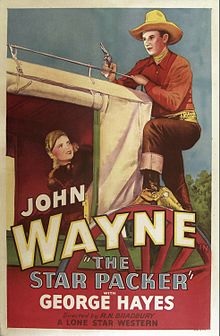
The Star Packer (1934, directed by Robert N. Bradbury)


A mysterious outlaw known as the Shadow is terrorizing turn-of-the-century Arkansas.  He and his gang have killed the last few sheriffs of Little Rock.  No one is sure who the Shadow is or how he communicates with his gang but somehow, he is always one step ahead of the law.  However, the Shadow didn’t count on federal agent John Travers (John Wayne) riding into town and declaring himself to be the new sheriff.  Working with his Native sidekick, Yak (Yakima Canutt), Travers sets out to expose the Shadow and take him down.  Along the way, he falls for Anita (Verna Hillie), the niece of rancher Matt Matlock (Gabby Hayes).  Luckily, Anita knows her way around a gun too.

This is one of the 50 B-westerns that John Wayne made before Stagecoach made him a star.  The Star Packer is more interesting than some of Wayne’s other poverty row productions because The Shadow is a more interesting and much more clever villain than the usual greedy but dumb outlaws that Wayne went up against in these movies.  The Shadow actually has a clearly thought-out plan and, for once, Wayne can’t defeat the bad guys on his own.  In The Star Packer, it takes a community to stand up to evil.  As always with Robert Bradbury’s westerns, the fights and the stunts are impressive.  Fans of Wayne’s B-period will probably especially be interested to see the legendary stuntman, Yakima Canutt, play a good guy for once.  He and Wayne both do a good job in this 52 minute programmer.

Neath The Arizona Skies (1934, directed by Harry L. Fraser)


Chris Morrell (John Wayne) is an honest cowboy who keeps an eye on Nina (Shirley Jean Rickert), a little girl whose Indian mother died when Nina was just a baby.  When oil is discovered on land that belonged to Nina’s mother, Nina is offered $50,000 for the land.  Because Nina is only eight years old, her legal guardian will be responsible for taking care of the money.  Chris and Nina set out to find Nina’s father so that he can sign the guardianship papers and make Chris into Nina’s legal guardian.

When outlaw Sam Black (Yakima Canutt) decides that he would rather be Nina’s legal guardian, Chris sends Nina to a ranch owned by his old friend, Bud Moore, while he defeats Sam and his men.  At the ranch, it turns out that Bud Moore has died and the new ranch owner is another outlaw named Vic (Jack Rockwell) and Vic wants Nina’s oil claim for himself.  What Vic doesn’t know is that Nina’s father is one of his ranch hands.

For a 52 minute programmer, there’s a lot going on in ‘Neath The Arizona Skies.  There’s actually too much going on and, with that short of a run time, it feels as if more than a few important plot points were glossed over, like how Chris came to look after Nina in the first place.  John Wayne is stiff but likable as Chris while Yakima Canutt does his usual double duty as both an outlaw and a stuntman.  There are a few good action scenes, especially when Chris runs off Sam’s gang for the first time.  Sheila Terry plays Wayne’s love interest, who has to be first convinced that Chris isn’t actually an outlaw.  As Nina, Shirley Jean Rickert is energetic but you’ll quickly get tired of her yelling, “Daddy Chris!” whenever anything happens.  This isn’t one of the best of the 50 poverty row films that Wayne appeared in before Stagecoach made him a star but, even in this film, there are still hints of the screen presence that would later become Wayne’s trademark.

Paradise Canyon (1935, directed by Carl Pierson)


Someone is passing counterfeit bills on the Mexican border and the government thinks that it might be Doc Carter (Earle Hodgins), the manger of a traveling medicine show.  Working undercover, Treasury agent John Wyatt (John Wayne) joins Doc Carter’s medicine show as a trick shooter.  John discovers that Doc Carter is a quack and the miracle cure that he sells is 90% alcohol but that Doc Carter isn’t a counterfeiter.  Instead, Doc Carter is being framed by his former partner, Curly Joe (Yakima Canutt).  When John tries to tell the Mexican authorities about Curly Joe is doing, he discovers that Curly Joe has framed him as well!

This was the last of the B-programmers that John Wayne made for Monogram Pictures and it was the only one of Wayne’s films to be directed by Carl Pierson.  As he did in almost all of his early B-pictures, John Wayne gives a tough but likable performance.  He’s the most cheerful undercover agent that I’ve ever seen.  The action scenes are rudimentary and Pierson was obviously not as creative a director as some of the other filmmakers that Wayne worked with early in his career.  Carl Pierson was no Robert Bradbury.  But the medicine show angle does bring a different angle to the story, with Wayne getting to show off his trick shooting skills and Earle Hodgins providing comedic relief with his miracle cure.  Of course, John has a romance with pretty Linda (Marion Burns), who is Doc Carter’s daughter and who is also known as Princess Natasha.

Though it may not be one of the best of the 50 movies that John Wayne made before getting his star-making role in Stagecoach, Paradise Canyon will still be appreciated by fans of both the Duke and the simple but entertaining B-westerns of the past.

Sagebrush Trail (1933, directed by Armand Schaefer)


Accused and convicted of a murder that he didn’t commit, John Brant (John Wayne) breaks out of prison in Maryland and, following the advice of Horace Greeley, he goes west.  After making a narrow escape from the authorities, he meets and befriends Joseph Conlan (Lane Chandler).  Conlan brings Brant into his gang, where Brant starts out as a cook but is soon being assigned to help rob stores and stagecoaches.  Despite his time in prison, Brant is no criminal and he secretly thwarts every robbery that the gang tries to pull off.  When the gang starts to suspect that Brant might be an undercover cop, Conlan is the only one willing to stand up for him and help him.  Conlan is also responsible for the murder that Brant was accused of committing.

John Wayne as a hardened escaped convict?  Maybe the older John Wayne could have pulled that off but, in 1933, Wayne was still too cheerful and easy going to be believable as someone who had spent the last few months doing hard time.  Fortunately, even early in his career, Wayne was convincing when riding a horse or shooting a gun and that’s probably all that the audience for these short programmers demanded.  There’s also an exciting scene where Wayne is forced to swim across a pond while his pursuers shoot at him.  As the criminal with a conscience, Lane Chandler steals the film.

Fans of westerns will want to keep an eye out for legendary stuntman Yakima Canutt, playing yet another outlaw gang leader.  Yakima Canutt started out his career risking his life as a rodeo rider and then went on to risk his life ever more as Hollywood’s most daring stunt performer.  When he got too old to continue doing stunt work, he became a second unit director, for John Ford and others.  He staged Ben-Hur‘s famous chariot race and was credited with making sure that not a single horse was hurt and not a single human was seriously injured during filming.  Yakima Canutt lived to be 90 years old, outliving most of the actors from whom he doubled as a stuntman.

The Dawn Rider (1935, directed by Robert N. Bradbury)


Cowboy John Mason (John Wayne) rides into a frontier town.  He is planning on working with his father, rancher Dad Mason (Joseph De Grasse).  Unfortunately, John arrives just in time to witness his father being killed by a gang of thieves.  John is wounded while chasing the thieves but, once he recovers, he’s determined to get vengeance against the man who killed his father.  That man is Rudd Gordon (Dennis Gordon), who is also the brother of Alice Gordon (Marion Burns), the woman who nursed John back to health and who is also engages to marry John’s best friend, Ben McLure (Reed Howes).

There is a little deliberate humor to be found in The Dawn Rider.  Every time someone is shot, the undertaker (Nelson McDowell) steps out of his office and measures the body while the town doctor celebrates having some business coming his way.  Otherwise, this is one of the most serious films that John Wayne made in the years before Stagecoach made him a star.  John Mason is determined to get revenge, even if his obsession means hurting his best friend’s fiancé.  (Though John Mason is less fanatical, it is easy to imagine him growing up to be The Searchers‘s Ethan Edwards.)  Ben has to decide whether to support his friend or the woman that he loves.  (Complicating matters is that John is in love with Alice, too.)  John Wayne and Reed Howes are a good team and Dennis Gordon is a convincing villain.  There’s a good action scene involving John protecting a gold shipment from the gang and the final shootout is handled well.  This 55-minute programmer undoubtedly taught many young viewers about frontier justice, even if they didn’t pick up on the film’s ambiguity.  The Dawn Rider is one of the more mature of John Wayne’s early films and offers hints of the actor that John Wayne would eventually become.

Winds of the Wasteland (1936, directed by Mack V. Wright)


When the invention of the telegraph puts the Pony Express out of business, two veteran riders — John Blair (John Wayne) and Larry Adams (Lane Chandler) — decide to start their own stagecoach line.  The richest man in Buchanan City, “Honest” Cal Drake (Douglas Cosgrove), sells them the line to nearby Crescent City.  Though initially grateful, Blair and Larry soon discover that Crescent City is now a ghost town that serves as home to exactly two inhabitants.  Rather than give up, Blair and Larry set up their stagecoach and they suddenly get lucky as settlers start to find themselves in Crescent City.  Blair is even able to convince the local telegraph company to run the wire though Crescent City, which leads to an influx of even more people.  Now, Blair just needs to land the contract delivering mail for the area.  To do that, he’ll have to win a stagecoach race against Drake, who turns out to not be very honest at all.

Winds of the Wastelands is one of John Wayne’s better pre-Stagecoach programmers.  While it has the western action that most people would expect from a B-western, it also has a lot more comedy than some of Wayne’s other poverty row productions.  For instance, a skunk tries to turn the stagecoach into his home and, of course, shows up at a key moment during the big race.  When one of bad guys tries to convince Blair to take his donkey to Crescent City in the stagecoach, Blair asks if there are any other “jackasses” who want a ride while casting a look at Drake’s men.  The movie takes a more serious turn when Drake goes to extreme methods to try to stop Blair and, as a result, Larry is wounded in a gunfight.  Doc Forsythe (Sam Flint), the founder of Crescent City, has to rediscover his confidence to perform the operation that can save Larry’s life.  Fortunately, the doctor’s daughter (Phyllis Fraser) is there to both help him out and to fall in love with John Blair.

This 55-minute programmer featured John Wayne playing the type of character for which he best known, the level-headed westerner who wasn’t going to let anyone push him around but who still fought fair.  Watching this movie, it’s easy to see why, just three years later, John Ford used him in Stagecoach.

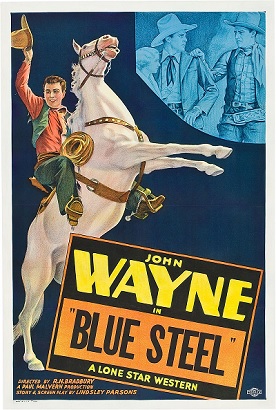
Blue Steel (1934, directed by Robert N. Bradbury)


On a stormy night, frontier Sheriff Jake Withers (George “Gabby” Hayes) and undercover U.S. Marshal Carruthers (John Wayne) both check into the same inn.  They are both searching for the infamous Polka Dot Bandit (Yakima Canutt), who has been burglarizing homes and businesses all over California.  They both figure that, on a rainy night like this, there’s no way that the Bandit is going to be out.  It turns out they are both wrong.  The Bandit breaks into the inn and robs the safe but also leaves behind one of his spurs.  The sheriff comes across Carruthers investigating the safe and mistakenly believes that Carruthers is the bandit.

Later, when Sheriff Winters goes out to Carruthers’s cabin, he’s planning on arresting Carruthers.  Before he can do so, they both hear gun shots.  Outside, another group of bandits is chasing Betty (Eleanor Hunt) and her father.  The Sherriff and Carruthers manage to save Betty but her father is killed.  The grieving Betty is taken in by a local rancher named Malgrove (Edward Peil, Jr.) but it turns out that Malgrove is the head of the Polka Dot Gang and he is planning on killing Betty in order to keep a shipment of supplies from coming to the town!  Carruthers and the sheriff have to work together to thwart Malgrove’s plan and bring the Polka Dot Bandit to justice.

This 54-minute programmer was one of the many B-westerns that John Wayne made for Monogram Pictures in the days before John Ford made him a star by casting him in Stagecoach.  Though Wayne was still learning how to act on camera, the screen presence that would make him a star can be seen in Blue Steel and he and Hayes make a good team.  The story is simple enough but there’s enough horse riding and fistfights to keep most B-western fans entertained.  It’s still hard not to imagine how much different the movie would have been if the sheriff had arrested Carruthers at the scene of the crime instead of letting him ride out to his cabin.  It’s a good thing these old programmers never had to make too much sense.

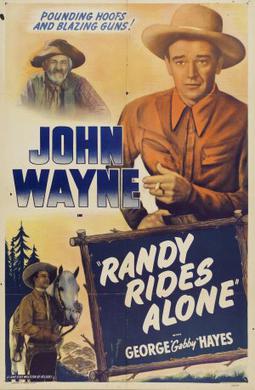
Randy Rides Alone (1934, directed by Harry L. Fraser)


Randy (John Wayne) rides his horse into a frontier town.  He is planning to pay a visit to his old friend, saloon owner Ed Rogers.  But when Randy enters the saloon, he discovers that everyone, including Ed, has been shot dead and a hand-written note has been left by the perpetrator, warning the sheriff not to come after him.

The sheriff and a posse of citizens arrive at the saloon and refuse to believe Randy when he says that he didn’t commit the crime.  Matt the Mute (George Hayes, before he became known as Gabby) hands the sheriff a note in which he suggests arresting Randy and hanging him for the crime.  Matt’s note is written in the same handwriting as the note that was left at the saloon but no one notices because Matt has a reputation for being a fine, upstanding citizen.

With the help of Ed’s niece, Sally (Alberta Vaughn), Randy escapes from the posse and makes his way to a cave, which he discovers is the hideout for a gang of thieves led by Matt the Mute, who isn’t even a mute!  When the gang kidnaps Sally, Randy has to rescue her and clear his name.

A 56-minute programmer, Randy Rides Alone is one of the many B-westerns that John Wayne made before Stagecoach made him a star.  In the 30s, every poverty row studio was churning out short westerns that would play as double features and which would entertain audiences looking for an escape from the present day.  Randy Rides Alone is one of the better examples of the genre, due to John Wayne’s authoritative presence and a better-than-average plot.  The opening, with a smiling John Wayne entering the saloon just to discover that all of his friends have been murdered, establishes the stakes early on and the movie is as much about revenge as it is about Randy clearing his name.  George Hayes, who became best known for playing comedic relief sidekicks, is an effective villain.  The film’s target audience was probably bored with Sally and Randy falling in love but they also probably enjoyed Randy climbing a mountain to rescue her.  The movie ends with Sally announcing that Randy won’t be riding alone much longer.  Randy may have settled down but John Wayne had 150 more films ahead of him.

10 Oscar Snubs From The 1960s


Ah, the 60s. Both the studio system and the production code collapsed as Hollywood struggled to remain relevant during a time of great social upheaval. The Academy alternated between nominating films that took chances and nominating films that cost a lot of money. It led to some odd best picture lineups and some notable snubs!

1960: Psycho Is Not Nominated For Best Picture and Anthony Perkins Is Not Nominated For Best Actor

To be honest, considering that the Academy has never really embraced horror as a genre and spent most of the 60s nominating big budget prestige pictures, it’s a bit surprising that Psycho was actually nominated for four Oscars.  Along with being nominated for its production design and its cinematography, Psycho also won nominations for Alfred Hitchcock and Janet Leigh.  However, Anthony Perkins was not nominated for Best Actor, despite giving one of the most memorable performances of all time.  The film literally would not work without Perkins’s performance and, considering that Perkins pretty much spent the rest of his career in the shadow of Norman Bates, it’s a shame that he didn’t at least get a nomination for his trouble.  Psycho was also not nominated for Best Picture, despite being better remembered and certainly more influential than most of the films that were.

1962: The Man Who Shot Liberty Valance Is Almost Totally Snubbed

The Man Who Shot Liberty Valance was not totally snubbed by the Academy.  It received a nomination for Best Costume Design.  But still, it deserved so much more!  John Ford, James Stewart, John Wayne, Lee Marvin, Vera Miles, and the picture itself were all worthy of nominations.  Admittedly, 1962 was a year full of great American films and there was a lot of competition when it came to the Oscars.  Still, The Man Who Shot Liberty Valance definitely deserved a best picture nomination over the bloated remake of Mutiny on the Bounty.  Today, if the first Mutiny on the Bounty remake is known for anything, it’s for Marlon Brando being difficult on the set.  But The Man Who Shot Liberty Valance is still remembered for telling us to always print the legend.

1964: From Russia With Love Is Totally Snubbed

The same year that the Academy honored George Cukor’s creaky adaptation of My Fair Lady, it totally ignored my favorite James Bond film.  From Russia With Love is a Bond film that works wonderfully as both a love story and a thriller.  Sean Connery, Lotte Lenya, Robert Shaw, and Terence Young all deserved some award consideration.  From Russia With Love was released in the UK in 1963.  In a perfect world, it would have also been released concurrently in the U.S., allowing From Russia With Love to be the film that gave the the Academy the chance to recognize the British invasion.  Instead, Tom Jones was named the Best Picture of 1963 and From Russia With Love had to wait until 1964 to premiere in the U.S.  It was snubbed in favor of one of old Hollywood’s last grasps at relevance.

1964: Slim Pickens Is Not Nominated For Best Supporting Actor

Playing three separate roles, Peter Sellers dominates Dr. Strangelove: Or How I Learned To Stop Worrying And Love The Bomb.  But, as good as Sellers is, the film’s most memorable image is definitely Slim Pickens whooping it up as he rides the bomb down to Earth.  George C. Scott and Sterling Hyaden also undoubtedly deserved some award consideration but, in the end, Pickens is the one who brings the film to life even as he helps to bring society to an end.

1967: In Cold Blood Is Not Nominated For Best Picture

In Cold Blood, though not a perfect film, certainly deserved a nomination over Dr. Doolittle.  In Cold Blood is a film that still has the power to disturb and haunt viewers today.  Dr. Doolittle was a box office debacle that was nominated in an attempt to help 20th Century Fox make back some of their money.

1967: Sidney Poitier Is Not Nominated For Best Actor For In The Heat Of The Night

In 1967, Sidney Poitier starred in two of the films that were nominated for Best Picture but somehow, he did not pick up a nomination himself.  His restrained but fiercely intelligent performance in In The Heat Of The Night provided a powerful contrast to Rod Steiger’s more blustery turn.  That Poitier was not nominated for his performance as Virgil Tibbs truly is one of the stranger snubs in Academy history.  (If I had to guess, I’d say that the Actors Branch was split on whether to honor him for In The Heat of the Night or Guess Who’s Coming To Dinner or even for To Sir With Love and, as a result, he ended up getting nominated for none of them.)

1968: 2001: A Space Odyssey and Planet of the Apes Are Not Nominated For Best Picture

Neither one of these classic science fiction films were nominated for Best Picture, despite the fact that both of them are far superior and far more influential than Oliver!, the film that won that year.

1968: The Good, The Bad, and the Ugly Is Totally Ignored

Not even Ennio Morricone’s score received a nomination!

1968: Petulia Is Totally Snubbed

Seriously, I don’t know what was going on with the Academy in 1968 but it seems they went out of their way to ignore the best films of the year.  Richard Lester’s Petulia is usually cited as one of the definitive films of the 60s but it received not a single Oscar nomination.  Not only did the film fail to receive a nomination for Best Picture but Richard Lester, George C. Scott, Julie Christie, Shirley Knight, Richard Chamberlain, and the film’s screenwriters were snubbed as well.

1969: Easy Rider Is Not Nominated For Best Picture

Yes, I know.  Easy Rider is a flawed film and there are certain moments that are just incredibly pretentious.  That said, Easy Rider defined an era and it also presented a portrait of everything that was and is good, bad, and timeless about America.  The film may have been produced, directed, and acted in a drug-razed haze but it’s also an important historical document and it was also a film whose success permanently changed Hollywood.  Certainly, Easy Rider’s legacy is superior to that of Hello, Dolly!

Agree? Disagree? Do you have an Oscar snub that you think is even worse than the 10 listed here? Let us know in the comments!

Up next: It’s the 70s!

“Do ya feel lucky, Pilgrim?” What Dirty Harry Could Have Been


Paul Newman as San Francisco Police Detective Harry “Dirty Harry” Callahan?

Today, it sounds unthinkable that the outspokenly liberal Newman could ever have been a contender for the role of Harry Callahan, a police detective who is quick with a quip but even quicker on the trigger.  As everyone knows, Clint Eastwood played Harry and, as a result, he finally became as big of a star in the United States as he already was in Europe.  Today, it’s impossible to imagine anyone other than Clint Eastwood torturing the Scorpio Killer for information and then announcing himself to be “all torn up about his rights.”  Just try to imagine Paul Newman snarling as reflexively as Clint Eastwood did upon hearing that the whiny guy in the liberal office taught constitutional law at Berkeley.  Try to imagine Paul Newman calling someone “a punk” or bragging about the power of his gun.  It can’t be done.

And yet, as hard as it is to believe, Clint Eastwood was not the first choice for Harry Callahan.  In fact, Eastwood apparently wasn’t even on Warner Bros.’s list of contenders when they initially bought the rights for the script that would eventually become Dirty Harry.

Written by Harry Julian Fink and Rita M. Fink, that script was originally called Dead Right and it took place in New York.  In the original script, Harry Callahan was world-weary, veteran New York cop, in his 50s and just a few months away from retirement.  In the original script, Harry pursued a serial killer named Travis.  When Warner Bros. bought the script in 1969, they viewed it as being a potential vehicle for Frank Sinatra with Irvin Kershner directing.  (Kershner is probably best remembered for later directing The Empire Strikes Back.)  As was his habit, Sinatra immediately demanded rewriters.  John Milius wrote three drafts, each one expanding on the idea of Callahan as a rebel against the system.  Terrence Malick (yes, that Terrence Malick) was also brought it and came up with a storyline in which the serial killer would specifically be targeting mobsters and other people who had escaped justice.  Somewhere, amongst all the rewrites, the action moved from New York to Seattle.

After all that effort, why didn’t Frank Sinatra play Harry Callahan?  Reportedly, he broke his hand and, as a result, he was told that he wouldn’t be able to hold a microphone or a gun or anything else while it was healing.  Since you really can’t have Harry Callahan without a gun, Sinatra left the project and Irvin Kershner went with him.

While trying (unsuccessfully) to recruit Sidney Pollack as their new director, Warner Bros. searched for a new leading man.  Reportedly, the script ended up on John Wayne’s desk.  Wayne later said that he turned down the role because he felt the violence was gratuitous.  Other sources indicate that John Wayne actually was interested in the role but that the studio didn’t consider him to be contemporary enough.  (After the success of Dirty Harry, Wayne would play a similar cop character in McQ and would provide a hint of what Dirty Harry starring John Wayne would have been like.)  Burt Lancaster turned down the role because he didn’t like the script’s politics.  Lee Marvin and Robert Mitchum both turned down the role because they refused to play cops.  George C. Scott reportedly refused the role because of the violence.  Marlon Brando was considered but, probably wisely, was never approached.

Having been turned down by all of the older tough guys, Warner Bros. went with the younger tough guys.  Steve McQueen turned down the role because he had already played a cop in Bullitt and he felt the critics would accuse him of repeating himself.  (He was probably right.)  Paul Newman refused the role on political grounds but, as he often tended to do whenever he turned down a role, he also recommended another actor for the part.  That actor was Clint Eastwood who was an old friend of Newman’s and who, obviously, had no problems with the film’s politics.

(Let’s take a moment to give some respect to Paul Newman, who was reportedly one of the nicest guys in Hollywood.)

Once Eastwood was on board, his requested that his friend and frequent collaborator, director Don Siegel, be hired to direct the film.  The script was again rewritten, moving the action to San Francisco and making Harry into a far less talkative character.  The serial killer known as Travis became the serial killer known as Scorpio.  The idea of the killer targeting criminals was abandoned at Siegel’s insistence, though Eastwood liked the idea enough to use it for Dirty Harry’s first sequel, Magnum Force.

Audie Murphy

Originally, James Caan was approached for the role of Scorpio but Caan turned it down (which, of course, left him free to play Sonny in The Godfather).  Perhaps most intriguingly, Audie Murphy was offered the role.  Murphy was one of the most decorated combat soldiers of World War II.  He had gone from the Army to appearing in movies.  By the time Dirty Harry went into production, Murphy was largely appearing in B-westerns and was as known for his temper as his films.  (He was acquitted of attempted murder shortly before filming began on Dirty Harry.  Murphy said that his anger issues were largely due to the trauma of World War II and he was one of the first prominent people to openly speak about what has since become known as PTSD.)  Murphy undoubtedly would have been an intimidating Scorpio but he died in a plane crash before he could accept or refuse the role.

Instead, the role went to Andrew Robinson, who an unknown at the time.  He was also, in real life, a pacifist who had difficulty not flinching whenever he had to fire a rifle in the film.  That said, Robinson gave a brilliantly unhinged performance as Scorpio and reportedly had to get an unlisted telephone number because of all the angry and threatening phone calls that he received after the movie was released.

Now, I have to admit that I personally find the idea of Frank Sinatra/James Caan or, for that matter, a John Wayne/Audie Murphy police procedural to be kind of intriguing.  And goodness know, I would certainly like a chance to see Marlon Brando doing the “do you feel lucky, punk?” speech.  In the end, though, I think things turned out for the best.