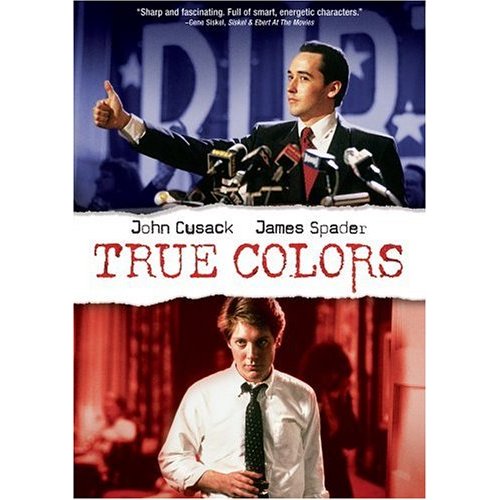
Embracing the Melodrama #39: True Colors (dir by Herbert Ross)


True Colors

For the past 9 days, I’ve been posting chronological reviews of 54 of the most (and least) memorable melodramas ever filmed.  I started with a film from 1916 and yesterday, I completed the 80s.  Today, we start in on the 90s with the 1991 political drama True Colors.

True Colors tells the story of two ambitious law students.  Tim Gerritty (James Spader) is a wealthy idealist who wants to work at the Justice Department so he can uncover and prosecute political corruption.  His roommate and eventual best friend is Peter Burton (John Cusack).  Although Peter initially lies about his background, it’s eventually revealed that he comes from a poor family and the result of growing up in poverty has left Peter with an obsessive desire for revenge on everyone who has ever looked down on him.  And how is Peter planning on getting that revenge?  By marrying the daughter of Sen. James Stiles (Richard Widmark) and eventually running for a seat in the U.S. House.  Despite the fact that Tim happens to be in love with Sen. Stiles’s daughter as well, he still supports his friend Peter and even agrees to be his best man.  However, as Peter gets closer and closer to achieving his goals, Tim starts to reconsider their friendship….

There’s a scene about halfway through True Colors, in which Peter Burton attempts to blackmail Sen. Stiles into supporting his political career.  Stiles agrees but then angrily adds, “God help you when the people find out.  They always do, you know.”  I was naturally waiting for Peter to come up with a properly sarcastic response but instead, Peter simply looks down at the ground, properly chastened.  It’s a jarringly false note and, unfortunately, everything that comes after this scene feels equally false.  The film, which starts out as such a strong portrait of what happens with friendship comes into conflict with ambition, ends up turning into a painfully predictable political diatribe, the type of thing that makes the portrait of politics in The Adjustment Bureau seem subtle and nuanced by comparison.  When Tim decided to betray Peter, it should be a moment full of moral ambiguity.  Instead, we’re expected to ignore their long friendship and just be happy that Tim is willing to do the right thing and protect the integrity of the American political process.

And, who knows?  Maybe that’s the way people viewed politics back in the early 90s.  But for audiences today, it all feels really naive and simplistic.

But, if you can manage to look past the film’s weak’s script, you can enjoy the acting.  John Cusack is wonderfully intense as Peter, making the character compelling even when the screenplay lets him down.  Watching him in True Colors is like watching the performance that he should have given in The Butler.  James Spader is sympathetic as Tim and, like Cusack, his performance almost allows him to overcome a script that doesn’t seem to realize that Tim is essentially a self-righteous jerk.  And finally, there’s Mandy Patikin who has a lot of fun playing the local crime boss who sponsors Peter’s career and who, in one memorable (if out-of-place ) scene beats up a shark that’s jumped up on the desk of his yacht.

Much like High Stakes, True Colors is one of those obscure films that occasionally pops up on cable, usually late at night and usually serving as filler between showings of better-known films.  Keep an eye out for it, if just for the chance to enjoy the performances.

Guilty Pleasure No. 18: Class (dir by Lewis John Carlino)


Tonight, I’ve got insomnia.

Since I realized I wasn’t going to get any sleep, I decided I might as well watch a random movie via Encore On Demand.  That movie turned out to be Class, a dramedy from 1983.  (I love dramedies, especially when I’ve got insomnia.)  I just finished watching it about 30 minutes ago and what can I say?  If there’s any film that deserves to be known as a guilty pleasure, it’s Class.

Class tells the story of two prep school roommates.  Skip (Rob Lowe) is rich  and spoiled.  Jonathan (Andrew McCarthy) is poor but brilliant.  As the result of getting a perfect score on his SAT, Jonathan has already received a scholarship to Harvard.  Their friendship gets off on a rocky start.  Skip locks Jonathan outside while Jonathan is wearing black lingerie.  Jonathan responds with a fake suicide.  (Boys are so weird.)  Not surprisingly, Jonathan and Skip become best friends and even share their darkest secrets.  Skip admits to killing a man.  Jonathan confesses to cheating on his SAT.  One of the two friends is lying.  Try to guess which one.

When Skip also discovers that Jonathan is a virgin, Skip makes it his mission to help his friend get laid.  Skip pays for Jonathan to spend a weekend in Chicago.  While there, Jonathan meets an older woman named Ellen (Jacqueline Bisset).  Soon, Jonathan and Ellen are having a torrid affair.

Once Christmas break arrives, Skip takes Jonathan home with him.  Jonathan meets Skip’s parents.  Guess who turns out to be Skip’s mom.

Meanwhile, an officious investigator (Stuart Margolin) has shown up on campus.  What is he investigating?  SAT fraud, of course.

Class is a weirdly disjointed movie.  On the one hand, it attempts to tell a rather melancholic coming-of-age tale, in which a naive young man learns about love from a beautiful but sad older woman.  (This part of the film perhaps would have been more effective if there had been a single spark of chemistry between Andrew McCarthy and Jacqueline Bisset.)  On the other hand, it also wants to be a heartfelt comedy about two best friends who come from opposite worlds.  And then, on the third hand (that’s right — this movie has three hands!), it wants to be a raunchy teen comedy, complete with a stuffy headmaster, misogynistic dialogue, gratuitous nudity, and a lengthy scene where all of the students attempt to get rid of all of their weed and pills because they’ve been incorrectly told that there’s a narc on campus.  That’s three different movies being crammed into a 90-minute film.  Not surprisingly, the end result is an uneven mishmash of different themes and styles.

And yet, as uneven as the film may be,  I still enjoyed it.  As I watched, I knew that I should have been far more critical and nitpicky about the film’s many flaws but the movie itself is just so damn likable that I found myself enjoying it despite myself.  Ultimately — like many guilty pleasures — Class is a film that is best appreciated as a portrait of the time it was made.  Everything from the questionable fashion choices of the characters to the film’s not-so-subtle celebration of wealth and narcissism, serves to remind the viewer that Class was made in the 80s.

Finally, Class should be seen just for its cast.  It’s undeniably odd to see an impossibly young and goofy-looking John Cusack making his film debut here as a rather snotty student named Roscoe.  While Andrew McCarthy doesn’t have much chemistry with Jacqueline Bisset, he still gives a good performance and is simply adorable with his messy hair and glasses.  And finally, who can resist young Rob Lowe, who was just as handsome in Class as he would be 30 years later in Parks and Recreation?

Class did not cure my insomnia.

But I’m still glad I watched it.

Previous Guilty Pleasures:

  1. Half-Baked
  2. Save The Last Dance
  3. Every Rose Has Its Thorns
  4. The Jeremy Kyle Show
  5. Invasion USA
  6. The Golden Child
  7. Final Destination 2
  8. Paparazzi
  9. The Principal
  10. The Substitute
  11. Terror In The Family
  12. Pandorum
  13. Lambada
  14. Fear
  15. Cocktail
  16. Keep Off The Grass
  17. Girls, Girls, Girls

Film Review: Lee Daniels’ The Butler (dir by Lee Daniels)


Dare I admit it?

When I saw Lee Daniels’ The Butler, I was not impressed.

Yes, the audience applauded as the end credits rolled.  And yes, I know that almost all of the mainstream critics have given it a good review.  I know that Sasha Stone has been hyping it as a surefire Oscar contender.  I know that, up until 12 Years A Slave introduced us all to an actress named Lupita Nyong’o, Oprah Winfrey was considered to be the front-runner for the Best Supporting Actress Oscar.

But it doesn’t matter.  The Butler did little for me.

I also realize that the film ended with a title card that announced that what I had just watched was dedicated to the American civil rights movement.  In many ways, that title card felt like emotional blackmail, implying that if you criticized The Butler than that meant you were also criticizing the brave, real life men and women who risked their lives to fight for equal rights.

However, when you put emotions and good intentions to the side, the fact of the matter is that Lee Daniels’ The Butler is not that good of a movie.  One need only compare The Butler to some of the other films that were released this year that dealt with the African-American experience — films like 12 Years A Slave and Fruitvale Station — to see just how safe and uninspiring The Butler truly is.

The Butler tells the story of Cecil Gaines (Forrest Whitaker), the son sharecroppers (played by David Banner and Mariah Carey) in the deep south.  After Cecil’s father is murdered by plantation owner Thomas Westfall (Alex Pettyfer), Cecil is raised and educated by the wealthy Annabeth Westdall (Vanessa Redgrave).  Eventually, the teenaged Cecil leaves the plantation and ends up working in a hotel where he’s educated in how to be a master servant by the elderly Maynard (Clarence Williams III, who brings a quiet dignity to his role).  Cecil eventually gets promoted to a hotel in Washington, D.C.  It’s there that he meets and marries Gloria (Oprah Winfrey).

In 1957, Cecil is hired to work at the White House.  Along with befriending two others butlers (played by Cuba Gooding, Jr. and Lenny Kravitz), Cecil also gets the chance to observe history play out first hand.  Starting with Dwight Eisenhower (played by Robin Williams) and ending with Ronald Reagan (Alan Rickman, giving a performance that is incredibly bad), Cecil watches as President after President deals with the civil rights movement.  Some presidents, like John F. Kennedy (James Marsden) are portrayed as being heroes while others, like Richard Nixon (John Cusack), are portrayed as being villains but all of them have the watchful eye of Cecil Gaines in common.

Meanwhile, at home, Gloria has a brief affair with Howard (played by Terrence Howard and really, you have to wonder what Cecil was thinking leaving his wife alone with anyone played by Terrence Howard) and Cecil’s oldest son, Louis (David Oyelowo), gets involved with the civil rights movement and grow increasingly estranged from his father.

The Butler actually starts out pretty well.  There’s a lengthy sequence where Louis and a group of students are trained on how to conduct a sit-in that’s extremely compelling to watch.  However, then John Cusack shows up wearing a big fake nose and the entire film starts to fall apart.

From a cinematic point of view, the film fails because it ultimately seems to be more dedicated to trotting out a parade of celebrity cameos to actually telling a compelling story.  As is his usual style, Lee Daniels directs with a heavy hand and, as a result, the film is full of emotionally-charged scenes that fail to resonate for longer than a handful of minutes.

My main issue with The Butler is that the film literally contains no surprises.  Nothing out of the ordinary happens and, at no point, is the audience actually challenged to consider the way they view history or race relations.  Whereas films like Fruitvale Station and 12 Years A Slave truly challenge our assumptions, The Butler encourages us to pat ourselves on the back for being so enlightened.  Every single frame of The Butler is specifically designed to fool us into thinking that we’re watching an important and challenging movie.

Because of a silly copyright lawsuit, the official title of The Butler is Lee Daniels’ The Butler.  However, that title is very appropriate because The Butler is definitely a Lee Daniels film.  Even if you didn’t know it beforehand, it would be easy to guess that the  same man who directed Precious and The Paperboy also directed The Butler.  As a director, Daniels specializes in making simplistic points in the most bombastic way possible.  The results are films, like The Butler, that are more concerned with manipulating an audience than challenging an audience.  When audiences applaud at the end of The Butler, they aren’t so much applauding the film as much as they are applauding themselves for having seen it.

6 More Films From 2012: 4:44: Last Day On Earth, First Position, Flight, The Paperboy, Red Tails, and The Trouble With Bliss


Continuing my desperate attempt to review all of the 2012 films that I’ve seen but haven’t gotten around to reviewing yet, here’s six more reviews.

1) 4:44: Last Day On Earth (dir. by Abel Ferrara)

Whether it’s because of the Mayan calendar or the fact the Obama got reelected, people seem to be obsessed with the end of the world right now and it’s been the subject of several recent films.  4:44: Last Day On Earth is one of the more low-key entries in this genre.

Willem DaFoe plays a New York-based actor who deals with the impending end of the world by meditating in his loft, having sex with his much younger girlfriend, and having awkward conversations on Skype with his daughter.  As opposed to the characters in several other end of the world films, DaFoe doesn’t use the situation as an excuse to go on a quest for true love.  Unlike 2012, there’s no talk of escaping the apocalypse.  Instead, the world is ending and DaFoe has no choice but to accept it.  From a cinematic point of view, DaFoe’s passivity can be frustrating (4:44 is a film that’s willing to be boring to make its point) but, at the same time, it does force a viewer like me to wonder how she would handle the end of the world in a way that a film like Seeking A Friend For The End Of The World does not.

One interesting thing that distinguishes 4:44 from other end-of-the-world films is that, in 4:44, the world ends specifically because of the actions of mankind.  Whereas films like Melancholia and Seeking A Friend For The End Of The World presented a random apocalypse, 4:44 presents the apocalypse as the fitting punishment for the sins of humanity.  While I could have done without the scenes of DaFoe listening to Al Gore droning on and on about global warming (because, seriously, Gore always sounds like the creepy community college professor who you know is having an affair with one of his students), this still adds an interesting element to the film.

4:44 requires a bit of tolerance and a lot of patience but it’s still a film that’s worthy of being seen.

2) First Position (dir. by Bess Kargman)

First Position is a documentary about ballet so, of course, you know that I loved it.  The film follows six young dancers as they prepare for the Youth American Grand Prix in New York City and it brought back a lot of memories (both good and bad) for me.  First Position captures both the beauty and the pain of both dance and life.

3) Flight (dir. by Robert Zemeckis)

In Flight, Denzel Washington plays a cocky and talented pilot who is also an alcoholic and a drug addict.  In a truly harrowing sequence, the plane that Washington is piloting goes into a nosedive over Atlanta.  After Washington manages to crash-land the plane with only a few fatalities, he finds himself hailed as both a hero and also under investigation.  Working with a union rep (Bruce Greenwood) and a slick attorney (Don Cheadle), Washington tries to cover up his mistakes while, at the same time, romancing a recovering heroin addict (Kelly Reilly).

Flight has a brilliant opening and a strong ending.  Unfortunately, the middle of the film tends to drag.  Flight also suffers from the fact that cinematic addicts are always more fun to watch when they’re under the influence as opposed to when they’re getting sober.  On the plus side, the film itself is well-acted and the cast is always fun to watch even when the rest of the film is getting bogged down.  Washington is brilliant in the lead role and John Goodman has a great cameo as the world’s most helpful drug dealer.

4) The Paperboy (dir by Lee Daniels)

In 1960s Florida, Hillary Van Wetter (an amazingly sleazy John Cusack) is on death row for the murder of a small town sheriff.  His girlfriend, the flamboyant Charlotte Bess (Nicole Kidman), convinces reporter Ward Jansen (Matthew McConaughey) to return to his hometown and investigate the case against Van Wetter.  With the help of his younger brother (Zac Efron) and an arrogant colleague (David Oyelowo), Ward works to get Van Wetter off of death row but it becomes obvious that all of the film’s characters are hiding secrets of their own.

The Paperboy has a few isolated moments where it achieves a certain pulp poetry but, for the most part, Lee Daniels’ follow-up to his Academy Award-winning Precious is a total and complete mess.  Unfortunately, it’s not even all that interesting of a mess.  Nicole Kidman’s vampish performance and her white trash femme fatale outfits are definitely the film’s highlight.  As for Zac Efron, he’s not much of an actor but he’s pipin’, boilin’ hot.  It’s just  too bad the character that he’s playing isn’t that interesting.

In the end, The Paperboy showcases everything that didn’t work about Precious and nothing that did.

5) Red Tails (dir. by Anthony Hemingway)

Red Tails was one of the first “major” releases of 2012 and it’s also one of the most forgettable.  The film, which was executive produced and reportedly co-directed by George Lucas, is based on the story of the Tuskegee Airmen, a group of African-Americans who served in the U.S. Air Force during World War II and who had to not only fight Nazis abroad but racial discrimination at home.  There’s undoubtedly an inspiring story to be told here but Red Tails is such a predictable and corny film that it feels as if Lucas and Hemingway essentially wasted the real life story of the Tuskegee Airmen on a painfully generic movie.

6) The Trouble With Bliss (dir. by Michael Knowles)

Morris Bliss (played by Michael C. Hall) is the type of guy who always seems to show up in quirky independent films.  He has no job, he has no money, and he lives in a tiny apartment with his father (Peter Fonda).  Since there’s nothing more attractive than a middle-aged guy with no future, he finds himself being pursued by an 18 year-old (Brie Larson), who also happens to be the daughter of a former high school classmate, and his married neighbor (played by Lucy Liu).

I have a weakness for quirky indie films but the nonstop quirkiness of The Trouble of With Bliss feels less like narrative imagination and more like total desperation.  Michael C. Hall’s a likable actor but he essentially turns Morris Bliss into Dexter Morgan and, as a result, I kept expected for the trouble with Bliss to turn out to be that he had about a few dozen bodies hidden away in a closet somewhere.

Now that would have been a quirky film!

A Quickie With Lisa Marie: The Raven (dir. by James McTeigue)


The Raven, a largely disappointing thriller that just opened this weekend, takes place in 1849 in Baltimore, Maryland.  A mysterious killer is terrorizing the city and, as Inspector Fields (Luke Evans) quickly deduces, he’s patterning his murders after the works of an alcoholic and disreputable writer named Edgar Allan Poe (played here, in the style of Robert Downey, Jr., by John Cusack).  Fields recruits Poe to help catch the killer but the killer has other plans.  He kidnaps Edgar’s fiancée  Emily(Alice Eve*) and then challenges Edgar to a game.  The killer will continue to commit random murders and, with each murder, he’ll include a clue to finding Emily.  However, Edgar also has to write a story inspired by the killer’s crimes.  Desperate to save Emily, Edgar agrees…

I wouldn’t necessarily say that I had high hopes for The Raven but, on the basis of the trailer, I was hoping that it would at least be an entertaining and self-aware genre piece.  Unfortunately, The Raven isn’t even that.  Instead, it’s a slowly paced, predictable film that’s not even awful enough to be fun.  John Cusack has a few enjoyably over-the-top moments as Edgar Allan Poe and Brendan Gleeson is always fun when he’s being all blustery but the rest of the cast barely seems to be awake.  (In particular, poor Luke Evans struggles to look like he’s interested in anything that’s happening on-screen.)  Director James McTeigue comes up with a lot of striking images but the film is so oddly edited that the scenes never seem to flow together and the end result is a film that feels oddly static and listless.

*Alice Eve has heterochromia, just like me!  Yay for both of us!

Trailer: The Raven


When we went to see Haywire earlier tonight, one of the trailers that played before the movie started was for an upcoming horror/mystery film called The Raven.  I have to admit that I have mixed feelings about the trailer.  The idea of Edgar Allan Poe as a detective is one that is either going to be campy fun or else it’s just going to be an annoying gimmick.  To be honest, the trailer leads me to suspect the latter because it definitely has a wannabe Sherlock Holmes feel to it.  That said, I do have some hope for this film if just because it looks like John Cusack is having a lot of fun with this role.  Cusack is one of those “serious” actors who can be very watchable when he’s finally allowed to just cut loose and go totally over the top.

Quickie Review: 2012 (dir. by Roland Emmerich)


[guilty pleasure]

When one sees the name Roland Emmerich attached as the director to a film on any given year one almost has to audibly groan. He’s not on the level of Uwe Boll in terms of awful films, but he does give Michael Bay a run for the title of worst blockbuster filmmaker. It’s quite a shame to see Emmerich’s films one after the other get worse and worse. This was a filmmaker who showed some talent in the scifi-action genre with such cult classics as Universal Soldier and Stargate. He would reach his apex with the popcorn-friendly and thoroughly enjoyable Will Smith alien-invasion flick, Independence Day. Since reaching those lofty heights each successive film has been more groan-inducing and worse than the previous one. For a brief moment in 2009 this would change as he finally succeeded in destroying the world that he had only hinted at with previous films such as ID4, Godzilla and The Day After Tomorrow. The film 2012 was released in late-2009 and, while it was universally lambasted by critics and a large portion of the public, I thought it was his most fun film since ID4.

2012 literally has the world greet it’s apocalypse according to the Mayan Calendar in the year 2012. The first forty or so minutes has Emmerich explaining the details of how the world will end in 2012 either through the film’s lead scientist (played by Chiwetel Ejiofor) or through a conspiracy-theorist played with manic glee by Woody Harrelson. The bulk of this film is almost like disaster porn for film lovers who are into disaster flicks. We have earthquakes which sends the whole California coast sliding into the Pacific. Supervolcanoes erupting in what is the Yellowstone National Forest right up to mega-tsunamis that dwarf the highest mountain ranges.

The cast might be called an all-star one, but I rather think it’s more a B-list with such names as John Cusack playing a goofy everyman who must save his ex-wife and two young children right up to Danny Glover playing the lame duck of lame duck presidents (I guess Morgan Freeman was unavailable or already done with disaster films after doing Deep Impact). The performance by this cast ranged from alright to laughable, but even with the latter the sense of fun never wavered. This was a flick about the world ending and Emmerich delivered everything promised.

It’s the scenes of world devastation which made this film so enjoyable for me and has become one of my latest guilty pleasures. No matter how bad the dialogue got or how wooden some of the acting came off the sense of wonder from Emmerich destroying the world on the big-screen and on my TV made this film fun to watch. Maybe those who hated it or thought it was trash were aiming to high. I will admit that the film is trash, but in a good way that past enjoyable disaster flicks of the 70’s were fun. It took the premise serious enough, but the filmmakers involved didn’t skimp on over-the-top destruction. I mean this film’s premise means we get to see in high-definition billions of people die as the planet decides to suddenly switch things around to get a better feng shui vibe to the planet.

Scenes such as the mega-tsunamis topping over the Himalayan mountain range was awesome. But even that scene couldn’t top the super-quake which destroys Los Angeles around Cusack’s character who tries to outdrive the quake and the resulting chasms which appear to chase his limo with is family inside. Seeing Los Angeles and the bedrock it’s on upheave and slide into the Pacific was one of the best disaster porn sequences I’ve ever seen and I don’t see anything topping it in the near future.

2012 as a Roland Emmerich production already has a black mark on it because of his reputation as a filmmaker, but for once he actually made a film that was able to surpass all the glaring flaws from it’s one-note, stereotypical characters to it’s wooden dialogue. He did this by making a film with disaster scenes of such epic spectacle that one had no choice but to just sit back and enjoy the ride. It’s a bad film, but it sure was a fun ride. This is why I decided on a fan-made trailer which best exemplifies this film and not the one made by the studio.

I eagerly await the sequel I fully expect from Hollywood: 2013: Disaster Strikes Back.

Quickie Review: Hot Tub Time Machine (dir. by Steve Pink)


I was a child of the 80’s. I can’t escape that particular information about my past, but unlike some of those of my generation I wholeheartedly embrace the 80’s both the good and the bad and the oh-so-awful. This is why after watching Hot Tub Time Machine (directed by Steve Pink…quite an 80’s name if there ever was one) I have a much deeper appreciation for the things I went through growing up as a teen during the mid-80’s. Rap was just starting to get real popular. Hairstyles, fashion and pop culture was dictated by the emerging juggernaut that was MTV (when they actually played music videos). This raunchy (and it is pretty raunchy) comedy starring John Cusack, Rob Corddry, Craig Robinson and Clark Duke definitely spoke to my inner 80’s teen self.

The film’s premise could’ve been taken straight out of any 80’s direct-to-video knock-off of Back to the Future meets Porky’s. I mean the title itself pretty much explains the premise of the film. A literal hot tub acts as a time machine which whisks the four actors mentioned above to 1986 where they get to re-live a specific night they all spent together in 1986 (well, except Duke’s character who wasn’t born yet). Talk about space-time continuum and butterfly effect gets bandied about, but in the end the whole film was just trying to insert as much 80’s pop culture references as possible within 90 and plus minutes.

The film definitely got the 80’s vibe by liberally putting in boobs and naked chicks. 80’s icons Chevy Chase, Crispin Glover and William Zabka make appearances and John Hughes moments get replicated. I mean shot literally like it was Sixteen Candles all over again. The performances by everyone involved was great and it seemed like everyone were enjoying themselves. Craig Robinson as Nick had me laughing out loud every time he said something.

One thing good I can say about Hot Tub Time Machine that encompasses everything good about it is that it played like the anti-Judd Apatow comedy. While Apatow laughers I enjoy they’ve gotten to the point that everyone tries to make their comedies sound like his. Plus, any comedy that can have Sixteen Candles and Red Dawn references in the same 30-minute span has to be awesome….Oh yeah, it also used Mötley Crüe’s “Home Sweet Home” power ballad over and over.