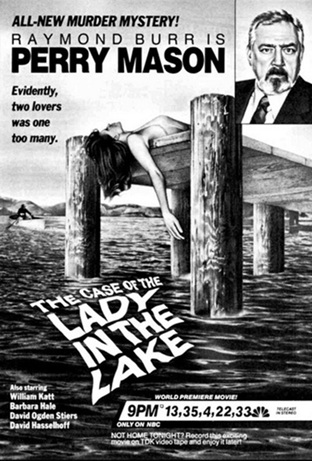
Fifteen years ago, the sister of Sara Wingate (Doran Clark) was murdered at a lake near the family home. Traumatized, Sara had a nervous breakdown. It was only when she married Billy Travis (David Hasselhoff), a former tennis player, that Sara started to get over her fear of the lake. When Sara disappears while walking along the lake, Billy is arrested and charged with murdering her. Because Perry’s is an old friend of Sara’s uncle (John Ireland), he takes the case. If you’re going to get arrested for murder, you better hope one of your relatives knows Perry Mason.
This movie wasn’t bad. It had a twist at the end, which I saw coming but which was still unique for the Perry Mason movies. The actual guilty party is pretty obvious but the mystery wasn’t as important as usual in this one. The supporting cast was pretty good, though David Hasselhoff seemed to be too calm for someone accused of murder. As Perry, Raymond Burr uses his cane again and leans against something whenever he has to stand up. Della jokes that Perry won’t be skiing anymore. Most of the action falls to Paul Drake, Jr. (William Katt), who gets beaten up even more than usual but who also gets to be the big hero in the end.
This was the last Perry Mason film for both William Katt and David Ogder Stiers, who played the district attorney. I’m going to miss both of them. William Katt’s hair was huge in this one and I was really looking forward to seeing how much bigger it could get.
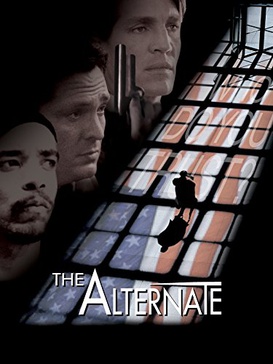
Why is 2000’s The Alternate one of the greatest action films ever made?
Consider this: President John Fallbrook (John Beck) is scheduled to give a speech at a World Hunger Symposium, where he will be announcing legislation that will make it illegal for people not to have food. (I’m not sure how that would work but whatever. It’s a movie.) Eric Roberts is The Alternate, a former intelligence agent who has just been recruited to serve as a member of a team that is being used by Agent William (Ice-T) to test the President’s security. (Ronn Moss, of Hard Ticket to Hawaiiand Bold and the Beautiful fame, plays the fake President.) The Leader (Bryan Genesse) tells the Alternate that the CIA actually wants to abduct the President for real in order to help boost the President’s reelection campaign. The Alternate agrees to help but then it turns out that the Leader is actually just in it for the money and he’s planning on holding the President hostage until he gets paid. While Agent Briggs (Michael Madsen) watches from the outside, The Alternate makes his way through a nearly deserted hotel and attempts to defeat the bad guys.
It’s Die Hard …. with Eric Roberts!
The plot is so convoluted that it borders on self-parody but director Sam Firstenberg keeps the action moving quickly and, to its credit, this is a film that fully understands how to embrace the melodrama. When the Leader tries to take out The Alternate, he doesn’t just pursue him with a gun. Instead, he picks up a flame thrower! When The Alternate gets into a gunfight at the hotel’s pool, he doesn’t just duck behind pillars and fire his gun. Instead, he grabs a banner and swings back and forth over the water, all the while shooting his gun. When the President says that he doesn’t like heights, it isn’t just a case of him getting nervous about being on the roof of the hotel. Instead, he’s so paralyzed that he literally has to be picked up and carried from one location to the next. When The Leader calls the police and gives them his list of demands, he doesn’t just make the usual threats. Instead, he speaks in what sounds like a French accent and claims to be a infamous (and possibly fictional) terrorist. When it’s time to kidnap the President, the kidnappers don’t just use guns. Instead, they also use blow-darts to paralyze the Secret Service agents. Everything about the film is gloriously and wonderfully over the top.
(I’ve always felt that, when it comes to low-budget action films, the best ones are the ones that are willing to just be as ridiculous as possible. Bring out the flame thrower. Fly the Money Plane. Cast Joe Don Baker as your lead. Just jump off that cliff and see what happens.)
The Alternate is definitely a film that deserves to be better-known. (It was also released under the title The Replacement.) In the realm of Die Hard rip-offs, it’s in a class by itself, a totally enjoyable thrill ride that manages to get more and more excessive with each passing minute. Bryan Genesse, who also wrote the script, gets to show off some stylish martial arts moves. John Beck is the wimpiest President ever. Michael Madsen never takes off his dark glasses. And, best of all, Eric Roberts gets to be the star!
The Alternate? Why, it’s just one of the best action movies ever!
Previous Eric Roberts Films That We Have Reviewed:
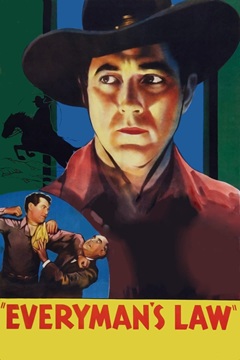
Corrupt Sheriff Chris Bradley (Homer Murphy) sends letters to three outlaws, asking them to come to his town and to work for him. Sheriff Bradley wants to use them to kick some homesteaders off their land. What Sheriff Bradly didn’t count on was one of the outlaws being an undercover Texas Ranger! Johnny Mack Brown plays Johnny, a.k.a. The Dog Town Kid.
The Kid takes a liking to homesteader Marian Henley (Beth Marion) and her infant son. When the Kid and the other two outlaws don’t move out the homesteaders to the sheriff’s liking, Bradley hires fearsome outlaw Lobo Joe (Roger Gray).
This is a pretty typical Poverty Row western. After you see enough of these, you realize that every plot is going to be about a corrupt sheriff and a businessman teaming up to try to steal the land away from the settlers. What makes these film work (or not) is the quality of the stars and Johnny Mack Brown was one of the best, someone who seemed authentic when he was riding a horse or shooting a gun but who was also a good enough actor to bring some life to the familiar plots. As usual, with this film, Johnny Mack Brown is better than his material.
Everyman’sLaw is best-known for the scenes of Brown and the other two outlaws having to babysit Marian’s baby. The “comedic” scene where the baby puts the barrel of Johnny’s six-shooter in his mouth probably had the audience rolling in 1936 but today, it would undoubtedly get the film banned.
Welcome to Retro Television Reviews, a feature where we review some of our favorite and least favorite shows of the past! On Tuesdays, I will be reviewing the original Fantasy Island, which ran on ABC from 1977 to 1984. Unfortunately, the show has been removed from most streaming sites. Fortunately, I’ve got nearly every episode on my DVR.
And now, it’s time for …. wait? What? *sigh* Okay.
Episode 6.10 “Operation Breakout/Candy Kisses”
(Dir by George W. Brooks, originally aired on January 15th, 1983)
My fantasy would be to be able to review this episode.
Ever since Fantasy Island was yanked down on all the streaming sites, I’ve been watching the show off of my DVR. A few years ago, I recorded nearly every episode off of one of the retro stations. (Sadly, the station also appears to no longer be broadcasting the show.) Unfortunately, nearly is not all and this is one of the episodes that I did not record. So, obviously, I can’t review it.
I can talk a little bit about it because I did watch this episode a few years ago. When I read the plot description on the imdb — Wheelchair-bound Kentucky racehorse breeder Rowena Haversham wants one last chance to win a race; and self-professed failure Danny Clements of Boston wants to turn his life around by breaking an American agent out of a tough foreign prison. — a bit of it came back to me. I remembered that Rowena (Ann Turkel) was given what she thought was a magic riding crop but that, at the end of the episode, Roarke revealed that the only magic was Rowena’s belief in herself. I think Rowena was transformed into a younger version of herself and she befriended a young rider played by Jill Whelan and ended up falling in love with Whelan’s father, who played by John Beck and not Gavin MacLeod. And I remember that Ben Murphy played the guy who entered the prison to save the American spy but it turned out that the prison was run totally by women and the spy was having the time of his life. I remember bits and pieces but it’s been a few years and I still wouldn’t feel comfortable even trying to tell you whether or not the episode worked.
So, consider this to be a placeholder. If I ever find Fantasy Island streaming somewhere or if someone is kind enough to reupload the show to YouTube, I’ll come back and review this episode.
Until then, my fantasy is for an official home video release of the entire series as opposed to just the first few seasons. Seriously, this is a fun show and one that still has a lot of fans. Yanking it off of Tubi to make room for the Fox reboot that only lasted for two seasons really doesn’t make a bit of sense.
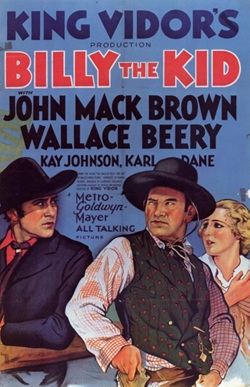
In a frontier town, land baron William P. Donavon (James A. Marcus) finds his control challenged by the arrival of a English cattleman named John W. Tunston (Wyndham Standing). Donavon orders his henchmen to gun down Tunston on the same day that Tunston was to marry the lovely Claire (Kay Johnson). Tunston’s employee, an earnest young man named Billy The Kid (Johnny Mack Brown), sets out to avenge Tunston’s murder. When Billy starts killing Donavon’s henchmen, it falls to Deputy Sheriff Pat Garrett (Wallace Beery) to arrest him. When Billy escape from jail and rides off to be with Claire, Garrett pursues him. Garrett is a friend of Billy’s and he knows that Billy’s killings were justified. But he’s also a man of the law. Will he be able to arrest or, if he has to be, even kill Billy? Or will Garrett let his friend escape?
There were two silent biopics made about Billy the Kid but neither of them are around anymore. This sound movie, directed by King Vidor, appears to the earliest surviving Billy the Kid film. It’s a loose retelling of Billy’s life and his friendship with Pat Garrett and it doesn’t bother with sticking close to the established facts but that’s to be expected. It’s an early sound film and, seen today, the action and some of the acting feels creaky. Wallace Beery was miscast as Pat Garrett but I did like Johnny Mack Brown’s performance as the callow Billy. The movie goes out of its way to justify Billy’s murders and it helps that Billy is played by the fresh-faced Brown. King Vidor shows a good eye for western landscapes, a skill that would come in handy when he directed Duel In The Sun seventeen years later.
There are better westerns but, for fans of the genre, this film is important as the earliest surviving film about one of the most iconic outlaws not named Jesse James. It’s interesting to see Brown, usually cast as the clean-cut hero, playing a killer here. The film’s ending is pure fantasy but I bet audiences loved it.
Welcome to Retro Television Reviews, a new feature where we review some of our favorite and least favorite shows of the past! On Fridays, I will be reviewing Half Nelson, which ran on NBC from March to May of 1985. Almost all nine of the show’s episodes can be found on YouTube!
Last week, I took a look at the sixth episode of Half Nelson, which was called Nose Job and which featured Rocky (Joe Pesci) dealing with an obsessed plastic surgeon who was stalking a former girlfriend. That episode featured not only two villains (it turned out that the plastic surgeon wasn’t the only homicidal stalker in Hollywood) but is also ended with Victoria Jackson’s Annie O’Hara starting a romantic relationship with Gary Grubbs’s Detective Hamill.
Nose Job was followed by an episode called Chariots For Hire. It apparently aired on April 26th, 1985 and that’s really all I can tell you about the episode. Chariots For Hire is the only episode of Half Nelson that has not been uploaded to YouTube. I can’t even find a plot summary for it on the imdb. Chariots For Hire is apparently the lost episode of Half Nelson.
Fortunately, the eighth episode of Half Nelson is on YouTube. So, let’s pick up the adventures of Rocky Nelson in Malibu Colony!
Episode 1.8 “Malibu Colony”
(Dir by James Sheldon, originally aired on May 3rd, 1985)
Rocky, Annie, Beau (Dick Butkus), and Kurt (Bubba Smith) have been assigned to guard what Rocky claims is “one of the most valuable art collections in the world.” Fortunately, this job means that they get to spend a few days hanging out in a fabulous beach house in Malibu! Standing out on the deck of the beach house, Annie looks out at the ocean and says that she can hardly believe that China is on the other side of it.
“I wonder how the egg rolls stay fresh crossing over from that far,” Kurt says.
Before anyone can ponder that question for too long, a half-naked woman runs screaming down the beach while being pursued by two thugs in suits. Rocky saves the woman from the thugs and sends her into the beach house so that she can borrow some clothes from Annie. Once dressed, the woman explains that she’s Nancy Norton (Shari Shattuck) and that she was fleeing from a nearby yacht club. She claims that the owner of the club has some naked pictures of her and she needs to get them back. Rocky, deciding that the art can protect itself, helps Nancy sneak back into the club so that she can retrieve her photographs. However, when she sees the club’s president, Crane (John Beck), she suddenly holds up a gun and shoots at him. Rocky is able to push Crane out of the way of the bullets and then he chases after Nancy.
Fortunately, both Rocky and Nancy make it out of the club without anyone realizing that they’re together. Despite the fact that she nearly made him an accessory to murder, Rocky still wants to help Nancy. Nancy explains that there are no pictures and she wasn’t trying to kill Crane. (“I just wanted to scare him.”) Nancy’s father lost a lot of money while playing poker with Crane and now Crane is threatening to kill him if he doesn’t pay. But Nancy is convinced that the poker game was rigged. The reason she was in club earlier was to take a look at Crane’s cards.
(For some reason, she thought it would be smart to do that while wearing a bikini, the top of which was somehow lost while she was fleeing Crane’s guards. That explains that partial nudity, which I am sure was definitely viewed as being important to the plot and not just as an attempt to boost the show’s ratings.)
Having saved Crane’s life, Rocky is able to get Annie, Kurt, and Beau jobs at the club. Annie models clothes. Kurt and Beau work as waiters. Rocky’s boss, Chester (Fred Williamson), shows up at the club with Dean Martin and is shocked to see all of his employees working there. Dean demands that Chester give them all raises so that they can quit their second jobs.
Eventually, Rocky finds his proof that Crane is a criminal and, with Chester’s help, he takes Crane down. After being stuck in the office for the past few episodes, Chester actually gets to do something in this episode. It’s always nice to see Fred Williamson in action and making it even better is that he smokes a big cigar while he’s taking down the bad guys. Finally, after eight episodes, Half Nelson reminded everyone of why Fred Williamson was so cool to begin with.
This episode definitely earns some points for allowing the entire supporting cast — from Fred Williamson to Victoria Jackson to Dean Martin — to play a role in solving the case of the week. One of Half Nelson‘s biggest flaws was that the appealingly quirky supporting characters often felt underused and Malibu Colony finally gives them a chance to show what they could have done as an ensemble. The mix of Pesci’s wise guy nerve, Jackson’s spaciness, Williamson’s effortless coolness, and Butkus and Smith’s comedic relief is actually pretty entertaining. Unfortunately, as good as the heroes are, Crane is pretty boring villain and the case of the week isn’t particularly interesting. In particular, Nancy’s actions never really make that much sense.
Oh well. This was a flawed episode but it still offered up a hint of what Half Nelson could have been. Next week, I will be reviewing this show’s final episode. Until then, L.A. — you belong to me!
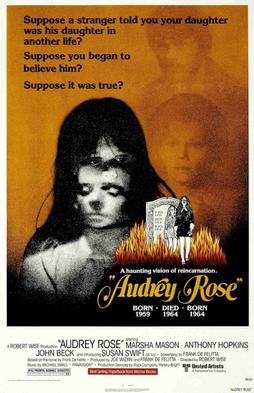
The 1977 film, Audrey Rose, tells the story of an annoying little girl named Ivy (Susan Swift), who is the daughter of annoying Janice (Marsha Mason) and annoying Bill (John Beck). Everything seems to be perfectly normal in an annoying way until, one day, they notice that they’re being followed around by an annoying man named Elliott (Anthony Hopkins). Elliott explains that Ivy is the reincarnation of his daughter, Audrey Rose, who was herself kind of annoying. Whenever Elliott says, “Audrey Rose,” Ivy going into a trance and starts screaming, which gets a bit annoying after a while. Elliott explains this is because Audrey died in a fiery car crash and was apparently reincarnated too soon after her death. Therefore, anytime Elliott shows us, Ivy relives the crash and tries to burn herself. Annoying!
To me, it seems like there’s a simple solution to all of this. Elliott could just go away or, at the very least, stop saying, “Audrey Rose” every ten seconds. Anyway, at one point, Ivy starts screaming so Elliott rushes into the apartment and makes her stop. However, Elliott is accused of attempting to abduct Ivy, arrested, and put on trial.
Elliott’s defense is that he couldn’t abduct his own daughter so therefore, if Ivy is the reincarnation of Audrey Rose, then he’s innocent. Somehow, this leads to the trial becoming about proving reincarnation. Hindu holy men are called to the stand. Elliott smirks and tells his lawyer to call Janice to the stand because he’s figured out that Janice believes him. Meanwhile, Ivy finds herself drawn towards every fire that she sees…
Audrey Rose was directed by a legitimately great director, Robert Wise. Unfortunately, Wise takes the material way too seriously. Just when you think the film is going to be an over the top possessed child flick, it suddenly turns into a turgid and serious debate about reincarnation. The movie is so busy trying to be realistic that it forgets to be fun.
There’s also a lot of yelling in Audrey Rose. In between Ivy screaming and Elliott continually calling his dead daughter’s name and Bill arguing with Janice and random characters screaming whenever Ivy gets to close to a fire, it’s easy to get a headache while watching this film.
Mason and Beck are pretty lousy in the roles of Janice and Bill. Hopkins brings an occasionally neurotic edge to the role of Elliott. You never quite trust him, even though the movie wants you to. The best performances in the film come from the performers in the minor roles, character actors like Norman Lloyd, Robert Walden, and John Hillerman. None of them are required to pretend like they’re taking their dialogue seriously and, as such, they’re a lot more fun to watch.
All in all, Audrey Rose is a fairly silly movie. For some reason (probably the presence of Hopkins), it does seem to show up on TCM fairly regularly but I wouldn’t recommend watching. If you want to see a good Robert Wise horror movie, check out The Haunting.
In the 1880s, Jared Maddox (Burt Lancaster) is the marshal of the town of Bannock. After a night of drinking and carousing leads to the accidental shooting of an old man, warrants are issued for the arrest of six ranch hands. Maddox is determined to execute the arrest warrants but the problem is that the six men live in Sabbath, another town. They all work for a wealthy rancher (Lee J. Cobb) and the marshal of Sabbath, Cotton Ryan (Robert Ryan), does not see the point in causing trouble when all of the men are likely to be acquitted anyway. Maddox doesn’t care. The law is the law and he does not intend to leave Sabbath until he has the six men.
Lawman starts out like a standard western, with a stranger riding into town, but then it quickly turns the western traditions on their head by portraying Marshal Maddox as being a rigid fanatic and the wealthy rancher as a morally conflicted man who does not want to resort to violence and who continually tries and fails to convince Maddox to leave. In the tradition of Sergio Leone and Sam Peckinpah, there are no real heroes to be found in Lawman and, even when Maddox starts to reconsider his strict adherence to the law and refusal to compromise, it is too late to prevent the movie from ending in a bloody massacre. Since Lawman was made in 1971, I initially assumed it was meant to be an allegory about the Vietnam War but then I saw that it was directed by Michael Winner, a director who specialized in tricking audiences into believing that his violent movie were deeper than they actually were.
Even if Lawman never reaches the heights of a revisionist western classic like Pat Garrett and Billy the Kid, it is still pretty good, with old pros Lancaster, Ryan, Cobb, and Albert Salmi all giving excellent performances. The cast is full of familiar faces, with everyone from Robert Duvall to Richard Jordan to Ralph Waite to Joseph Wiseman to John Beck showing up in small roles. In America, Winner is best remembered for his frequent collaborations with Charles Bronson. Chuck is not in Lawman, though it seems like he should have been and Lee J. Cobb’s rancher is named Vincent Bronson. Winner would not make his first film with Charles Bronson until a year later, when he directed him in Chato’s Land.
Scott Bruin (Jeff Lester) is a high fashion photographer who is haunted by nightmares in which he strangles a naked woman in the swimming pool. His nymphomaniac girlfriend, Lena (Shannon Tweed!), is surprisingly understanding when she wakes up to discover Scott strangling her but Scott is worried that he might be losing his mind. His psychiatrist (David Soul) is not much help. When Scott has a violent vision in the middle of photo shoot, he freaks out. “Hey, are you on drugs?” one of the models asks.
Then Scott meets Kimberly (Adrienne Sachs) and she looks exactly like the woman from his dreams. When she invites him to back to her house, the house looks exactly like the house from his nightmares. Is Scott going crazy or is he seeing the future? And how is Kimberly’s ex, a cold businessman named Ken Strom (Marc Singer), involved?
Does anyone remember this movie? In the 90s, this used to be on HBO and Cinemax all of the time. It’s a typical sex-fueled, nudity-filled direct-to-video thriller but Nico Mastorakis, a Greek director who has obviously learned a lot from Brian DePalma, gives the movie an enjoyably slick sheen. Neither Jeff Lester nor Adrienne Sachs gives a good performance and the plot feels like it was made up on the spot but fans of Shannon Tweed in her Skinemax heyday might enjoy it.
In the Cold of the Night also features Tippi Hedren, playing Kimberly’s mother. She only appears in one scene and freaks out when she sees some birds. The scene ends with Adrienne Sachs looking directly at the camera and saying, “Mother simply hates birds!”
First released in 1977, The Other Side of Midnight is one of those film that literally seems to have everything a viewer could want: sex, love, betrayal, sex, war, melodrama, intrigue, sex, expensive clothes, private island, see-through nightgowns, sex, hurricanes, murder, a surprise twist ending that involves a convent, and sex. Did I mention that this film has sex in it, because it so does.
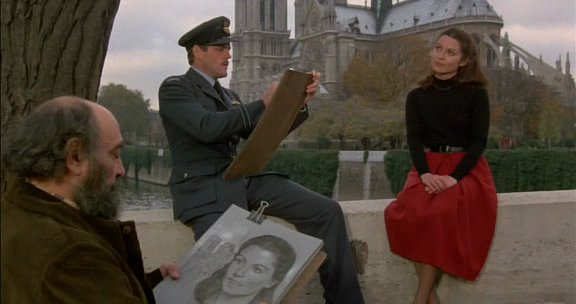
The film opens in Paris during the years leading up to World War II. Beautiful Noelle (Marie-France Pisier) meets Larry Douglas (John Beck), a handsome American who is serving with the Canadian Air Force. Noelle agrees to go out on a date with Larry and they get to have the of the movie’s many falling-in-love montages. Fortunately, they’re in Paris which has a lot of great scenery in front of which they can pose. Unfortunately, Larry is ordered back to the United States. He promises Noelle that he’ll return but he never does. What Larry doesn’t realize is that Noelle’s pregnant — or at least she is until a harrowing scene where she climbs into a bathtub with a wire hanger.
Montage!
This is followed by another montage. Call this the “Out-of-Love-And-Growing-Bitter” montage. Noelle survives the German occupation by seducing and using every powerful man that she meets. Along the way, she becomes one of the most glamorous and famous film stars in all of Europe. Finally, she becomes the mistress of the wealthy and somewhat shady Constantin Demaris (Raf Vallone, doing his best Anthony Quinn impersonation).
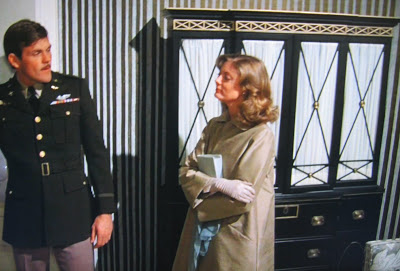
Meanwhile, Larry is back in America and, after going through another falling-in-love montage, has ended up married to innocent Catherine Alexander (Susan Sarandon). What Larry doesn’t realize is that Noelle has hired a detective to keep track of him. After the war, Larry gets a job as a commercial airline pilot but Noelle secretly arranges for him to lose that job. Unemployed and desperate, Larry accepts a job to work as the private pilot for Demaris and his mistress.
Montage!
Though it takes him a while to recognize her, Larry eventually does realize that his new boss is his former lover, Noelle. As Larry starts to truly fall in love with Noelle all over again, Noelle starts to pressure him to do something about his new wife. As is the case with several Hollywood melodramas, it all ends in a courtroom. The courtroom scenes may not be exactly exciting but they do feature my favorite image from the entire film: at one point, we see that literally every single character who has appeared in the movie up to this point is sitting in that courtroom, all lined up like a bunch of disparate figures in an Edward Hopper painting.
The Other Side of Midnight is one of those big films where a lot of stuff happens but very little of it really seems to add up to anything. It has a nearly 3 hour running time but it’s story could have just as easily been told in 90 minutes. Instead, director Charles Jarrott pads out the running time with endless falling-in-love and falling-out-of-love montages. This is the type of film that never says anything once that it can say an extra three times.
Montage!
Susan Sarandon and Marie-France Pisier both give good performances. Susan Sarandon is likable, even if her character is unbelievably naive while Marie-France Pisier gives a performance worthy of any good film noir but neither one of them has much chemistry with John Beck. Fortunately, some of the supporting players — like Raf Vallone and Christian Marquand — take full advantage of every chance that they get to chew every piece of scenery that’s available. Clu Gulager, the father of horror director John Gulager, pops up as well, playing perhaps the only good male in the entire film.
In the end, The Other Side of Midnight (and what the Hell does that title mean anyway?) is a rather silly movie about a bunch of shallow characters wearing beautiful clothes and wandering through wonderfully baroque locations. Fortunately, I love elaborately decorated locations and glamorous outfits so I enjoyed The Other Side of Midnight despite myself.
Montage!
One final thing about The Other Side of Midnight: 20th Century Fox was so sure that The Other Side of Midnight would be a huge success that they used it to blackmail theater owners into agreeing to show an obscure science fiction film called Star Wars. Theaters would only be allowed to show The Other Side of Midnight if they also agreed to show Star Wars during the week before Midnight opened.
The end result, of course, is that The Other Side of Midnight was a bomb at the box office and Star Wars is still making money.
Below is a behind-the-scenes documentary on the making of The Other Side of Midnight.

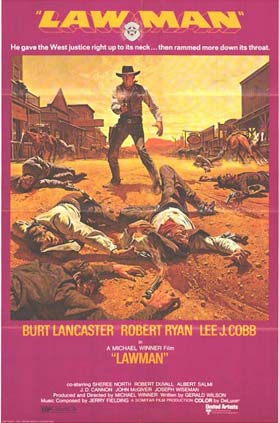 In the 1880s, Jared Maddox (Burt Lancaster) is the marshal of the town of Bannock. After a night of drinking and carousing leads to the accidental shooting of an old man, warrants are issued for the arrest of six ranch hands. Maddox is determined to execute the arrest warrants but the problem is that the six men live in Sabbath, another town. They all work for a wealthy rancher (Lee J. Cobb) and the marshal of Sabbath, Cotton Ryan (Robert Ryan), does not see the point in causing trouble when all of the men are likely to be acquitted anyway. Maddox doesn’t care. The law is the law and he does not intend to leave Sabbath until he has the six men.
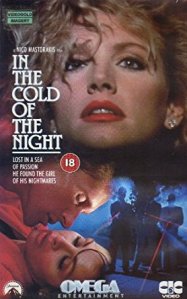 Scott Bruin (Jeff Lester) is a high fashion photographer who is haunted by nightmares in which he strangles a naked woman in the swimming pool. His nymphomaniac girlfriend, Lena (Shannon Tweed!), is surprisingly understanding when she wakes up to discover Scott strangling her but Scott is worried that he might be losing his mind. His psychiatrist (David Soul) is not much help. When Scott has a violent vision in the middle of photo shoot, he freaks out. “Hey, are you on drugs?” one of the models asks.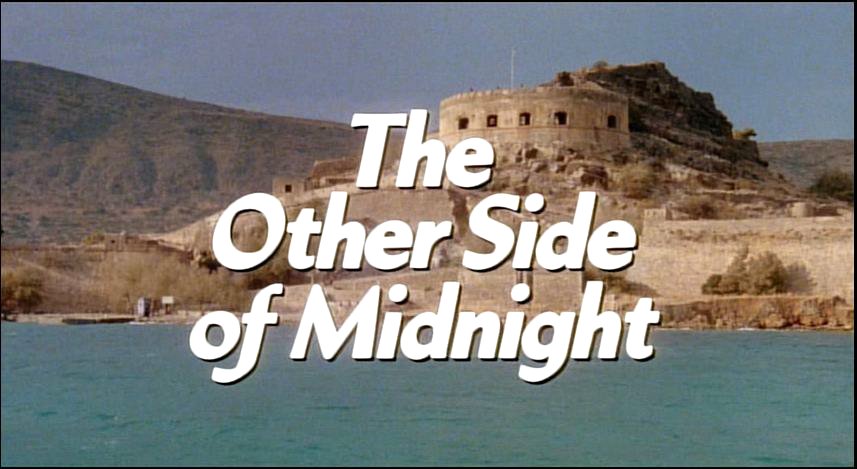

 Through the Shattered Lens