Small town boxer Charlie Davis (Ray Mancini) travels to Reno with his best friend and manager, Tiny O’Toole (Michael Chiklis). Charlie wants to become a professional and he has the support of Tiny and Gina (Jennifer Beals), a saintly hitchhiker that they pick up on the way to Nevada. Charlie managers to impress a legendary trainer (Rod Steiger) but, as Charlie moves up the ranks, he comes under the influence of a corrupt promoter (Joe Mantegna). Seduced by a bad girl (Tahnee Welch) and allowing his success to go to his head, Charlie alienates Tiny just when he needs him the most. A chance to become the champion is coming up and the promoter expects Charlie to throw the fight.
There’s not a boxing cliche that goes unused in this movie. Simple-minded by talented boxer? Check. Loyal best friend? Check. Overwrought narration? Double check because merely calling this film’s narration overwrought doesn’t begin to do it justice. Saintly good girl? Check. Dangerous bad girl? Check. Gruff trainer? Check. Corrupt promoter? Another double check. It’s not that the cliches are necessarily unwelcome. Most boxing movies follow the same basic plot. Instead, the problem here is that the film neither has the direction or the performances to make the cliches compelling.
You would think that casting Ray Mancini as a boxer would give this film some authenticity but Mancini looks as uncomfortable in the ring as he does when he’s having to actually act. As bad as Mancini is, his performance is nowhere near as desultory as Michael Chiklis’s. Chiklis not only plays Tiny but he also narrates the movie and watching and listening to him, you would be hard pressed to believe that he would someday star in The Shield. Meanwhile, Rod Steiger and Jennifer Beals are wasted in underwritten roles.
If there is one thing that redeems the film, it’s Joe Mantegna as the crooked promoter. Using his Fat Tony voice, Mantegna at least seems to have a sense of humor about the film.
I always appreciate a good boxing movie but this ain’t it.
Based on a one-act play by David Mamet, 2005’s Edmond tells the story of Edmond Burke (William H. Macy).
Edmond shares his name (if not the actual spelling) with the philosopher Edmund Burke. Edmund Burke was a strong believer that society had to put value in good manners to survive and that religious and moral institutions played an important role in promoting the idea of people treating each other with respect and decency. Edmund Burke knew what he believes and his writings continue to influence thinks to this day. Edmond Burke, on the other hand, doesn’t know what he believes. He doesn’t know who he wants to be. All he knows is that he doesn’t feel like he’s accomplished anything with his life. “I don’t feel like a man,” he says at one point to a racist bar patron (played by Joe Mantegna) who replies that Edmond needs to get laid.
On a whim, Edmond steps into the shop of a fortune teller (Frances Bay), who flips a few Tarot cards and then tells Edmond that “You’re not where you’re supposed to be.” Edmond takes her words to heart. He starts the night by telling his wife (played by Mamet’s wife, Rebecca Pidgeon) that he’s leaving their apartment and he won’t be coming back. He goes to the bar, where he discusses his marriage with Mantegna. He goes to a strip club where he’s kicked out after he refuses to pay $100 for a drink. He goes to a peep show where he’s frustrated by the glass between him and the stripper and the stripper’s constant demand that he expose himself. He gets beaten in an alley by three men who were running a three-card monte scam. Edmond’s problem is that he left home without much cash and each encounter leads to him having less and less money. If he can’t pay, no one wants to help him, regardless of how much Edmond argues for a little kindness. He pawns his wedding ring for $120 but apparently, he just turns around and uses that money to buy a knife. An alley-way fight with a pimp leads to Edmond committing his first murder. A one-night stand with a waitress (a heart-breaking Julia Stiles) leads to a second murder after a conversation about whether or not the waitress is actually an actress leads to a sudden burst of violence. Edmond ends up eventually in prison, getting raped by his cellmate (Bookem Woodbine) and being told, “It happens.” Unable to accept that his actions have, in one night, led him from being a businessman to a prisoner, Edmond says, “I’m ready to go home now.” By the end of the film, Edmond realizes that perhaps he is now where he was meant to be.
It’s a disturbing film, all the more so because Edmond is played by the likable William H. Macy and watching Macy go from being a somewhat frustrated but mild-mannered businessman to becoming a blood-drenched, racial slur-shouting murderer is not a pleasant experience. Both the play and the film have generated a lot of controversy due to just how far Edmond goes. I don’t see either production as being an endorsement of Edmond or his actions. Instead, I see Edmond as a portrait of someone who, after a lifetime of being willfully blind to the world around him, ends up embracing all of the ugliness that he suddenly discovers around him. He’s driven mad by discovering, over the course of one night, that the world that is not as kind and well-mannered as he assumed that it was and it all hits him so suddenly that he can’t handle it. He discovers that he’s not special and that the world is largely indifferent to his feelings. He gets overwhelmed and, until he gets his hands on that knife, he feels powerless and emasculated. (The knife is an obvious phallic symbol.) It’s not until the film’s final scene that Edmond truly understands what he’s done and who he has become.
Edmond is not always an easy film to watch. The second murder scene is truly nightmarish, all the more so because the camera remains on Edmond as he’s drenched in blood. This is one of William H. Macy’s best performances and also one of his most disturbing characters. That said, it’s a play and a film that continues to be relevant today. There’s undoubtedly a lot of Edmonds out there.
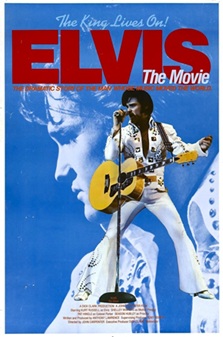
Made for television, it was the first of many biopics to be made about the King of Rock and Roll. Seeing as how it went into production just a year after Elvis’s death and that its script was vetted and approved by Priscilla Presley herself, it’s not surprising that Elvis doesn’t really delve into the darker aspects of his life. Elvis shoots a television, gets frustrated with his bad movies, and wonders who he can trust but we don’t see him get fat nor do we see him popping pills. The movie ends with Elvis making his comeback in 1969, allowing a happy ending for the title character.
The film was directed by John Carpenter. It was his first film to be released after the monster success of Halloween, though Carpenter actually started work on Elvis before Halloween was released. Though the film’s television origins means there aren’t many examples of Carpenter’s signature style in Elvis, Carpenter does a good job recreating Elvis’s performances and, most importantly, he comes up with a film that holds your interest for three hours.
Finally, the role of Elvis is played by Kurt Russell, who was at the time still struggling to prove himself as being something more than just a Disney star. Russell, who made his film debut kicking Elvis in the shins, throws himself into playing the role and captures the look, the swagger, and the voice of Elvis without ever descending into caricature. His singing voice is dubbed for the performances but Russell is still convincing as the King. It takes skill to wear that white jumpsuit without looking like you’re wearing a bad Halloween costume. While this film showed that Russell was capable of more than just Disney films, it even more importantly launched his friendship with John Carpenter. Escape From New York, The Thing, and Big Trouble In Little China all began with Elvis.
The movie doesn’t really tell us anything that we didn’t already know about Elvis but its entertaining and it has a big, colorful cast that include Pat Hingle as Tom Parker, Shelley Winters as Elvis’s mother, and Bing Russell (Kurt’s father) as Elvis’s father. Priscilla is played by the beautiful Season Hubley, who married Kurt Russell shortly after filming. (They divorced in 1983.) Joe Mantegna, Ed Begley Jr., Ellen Travolta, and Dennis Christopher all appear in small roles and do their part to bring Elvis’s world to life. Elvis is a fitting tribute to the King of Rock and Roll, one that gave Elvis a happy ending and started a great collaboration between a director and his star.
The Clericuzio saga continues and it’s sillier than ever!
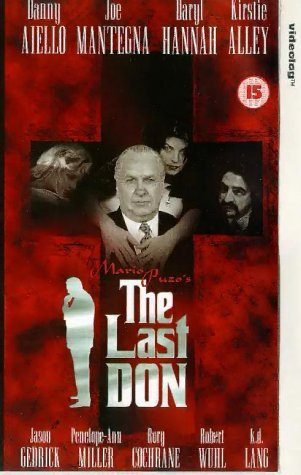
The Clericuzios were the Mob family who were first introduced in a Mario Puzo novel called The Last Don. In 1997, CBS turned The Last Don in a three-part miniseries. The ratings were good enough that, in 1999, the network gave the world a two-episode sequel, The Last Don II. The Last Don II was created without the input of Mario Puzo (who died shortly before the miniseries aired) but director Graeme Clifford returned, as did a few members of the cast.
For example, Danny Aiello briefly returns as the honorable but aging Don Domenico Clericuzio, talking about life in the old country and demanding to know why some of his children have yet to marry. Under his leadership, the Clericuzios are almost totally legit and they’ve even become powerful in Hollywood. Claudia De Lena (Michelle Burke) is in charge of the family’s film studio and has recently become engaged to a film star named Dirk Von Schelburg (Andrew Jackson, trying to do an Arnie impersonation but coming across more like Jean-Claude Van Damme). Still, despite the fact that the Clericuzios are (slowly) abandoning organized crime, they haven’t completely cut their ties. They still have enemies. And when Don Clericuzio dies after dancing at his final birthday party, those enemies are set to strike.
Who can run the Clericuzio family? Only one of the Don’s son was actively involved in the underworld aspect of the organization and he’s promptly (and, to be honest, hilariously) crushed when someone drops a shipping crate on him. Another Clericuzio son is gunned down at his legitimate business, proving that someone is trying to take out the entire family, regardless of whether they’re a part of the family business or not. Georgio Clericuzio (David Marciano) goes to Paris and tires to convince Claudia’s brother, Cross (Jason Gedrick), to return from exile to take things over. Cross refuses because he’s happily married to the most famous actress in the world, the improbably named Athena Aquataine (Mo Kelso, replacing Daryl Hannah in the role). However, Athena is subsequently blown up by a bomb that was meant for Cross and that’s all it takes to bring Cross back to America.
Now that Cross is in charge, he sets about to discover who, among the other Families, is targeting the Clericuzios. Helping him out with this is Billy D’Angelo (James Wilder), who we are told is the the most important of the Clericuzios capos, despite the fact that he was neither seen nor mentioned in the previous Last Don. It seems pretty obvious from the start that Billy is not to be trusted. Everyone who has ever seen The Godfather will automatically look at Billy and say, “There’s your rat.” But Cross is a remarkably naïve crime lord. He’s apparently the only guy in the Mafia who has never seen a Mafia movie.
Of course, there’s more going on than just Cross trying to figure out who is targeting the Clericuzio family. His unstable aunt, Rose Marie (Kirstie Alley), wants revenge for the murder of her son Dante but, fortunately, she’s distracted by an affair with the family’s priest (Jason Isaacs, of all people). Disgraced former studio exec Bobby Bantz (Robert Wuhl) is plotting against Claudia. And finally, Cross is falling in love with his stepdaughter’s nanny (Patsy Kensit) despite the fact that it’s kind of obvious that the nanny is actually an undercover FBI agent. Remember what I said about Cross being impossibly naïve?
The Last Don was a fairly silly miniseries. The Last Don 2 is even sillier but, for that every reason, it’s also a bit more entertaining. If the first Last Don was held together by the rivalry between Cross and Dante, the sequel is held together by a nonstop flow of melodrama, overheated dialogue, and thoroughly unsubtle acting. It’s as if the director looked at every over-the-top scene and said, “It’s okay but can we turn things up just a little bit more?” As such, tt’s not enough for Danny Aiello to merely make a cameo before his character dies. Instead, he has to deliver cryptic words of wisdom about family and and honor and he has to do one final, Zorbaesque dance of joy before his heart gives out. Meanwhile, Kirstie Alley really throws herself into playing the insane Rose Marie and whether she’s seducing a priest or hoarsely yelling that she doesn’t know how to ice skate, her performance is always more than strange enough to be watchable. Jason Isaacs, meanwhile, furrows his brow desperately as he tries to resist temptation. Patsy Kensit is the world’s worst FBI agent while Kim Coates shows up as one of her colleagues. Conrad Dunn returns as Lia, the Sicilian assassin with the world’s silliest mustache. Even the presence of Robert Wuhl is less of a problem in the sequel. With everyone chewing up every piece of scenery that they can get their hands on, it somehow makes sense that Robert Wuhl would show up and start yelling, “DON’T LAUGH AT ME!” Somehow, it even seems appropriate that Joe Mantegna receives a “special appearance” credit, even though his character pretty much only appears in the archival footage used during the opening credits. The Last Don II is just that type of miniseries.
Jason Gedrick and James Wilder are both good actors and they both do what they can with the roles of Cross and Billy. Unfortunately, both of them were seriously miscast in The Last Don 2. Neither one of them is the least bit Italian and Wilder was a bit too young to be convincing as the most feared capo in the family. Compared to the classic gangster films that inspired them, both The Last Don and its sequel feels more like gangster cosplay than an actual portrait of life as a member of the Cosa Nostra. Like the first Last Don, The Last Don II suffers from a lack of authenticity but it’s just ludicrous enough to be fun.
First broadcast over three nights in 1997, The Last Don tells the story of a powerful and respected Mafia family. They control politicians across the country and they own casinos in Vegas and their power even extends all the way to Hollywood. Despite having many enemies, the family has thrived due to the leadership of a wise but ruthless Don. This Don remembers the old ways and imparts lessons about honor to the members of his own family. Never let anyone know what you’re thinking. Never side against the family. If someone like you were to make enemies, they would become the Don’s enemies and then they would fear you …. you know, stuff like that.
However, times are changing and America is changing with it. The underworld is no longer run by men of honor. On top that, the Don is aging and in ill-health. Who will succeed him? One possible successor is respected by all but he’s stayed out of the dirtier aspects of the family’s business and, in fact, he seems to have no desire to be a feared man. Another possible successor is ruthless and has a terrible temper. He sometimes speaks out of turn, because the Don has a sentimental weakness for his children. This possible successor’s anger is feared but perhaps fear is the future of the organized crime in America. The old ways are changing but one thing remains the same. The Don believes in America and he believes in family and….
Wait.
Okay, is it just me or does this all sound just a little bit familiar?
If it does, that’s probably because The Last Don is based on a novel by The Godfather‘s Mario Puzo. Though the family may be called The Clerichuzios and the action may have been moved fro the 40s and the 50s to the 60s, 70s, and 80, the story is still the same basic one that was told in The Godfather. Don Clerichuzio (Danny Aiello) is an honorable man whose time is coming to an end. His grandnephew, Cross (Jason Gedrick), is the possible successor who isn’t crazy. His grandson, Dante (Rory Cochrane), is the possible successor who is violent and doesn’t know how to negotiate. Don Clerichuzio’s dream is for the family to become completely legitimate but good luck with that when the film business and the political world are just as corrupt as the Mafia. I supposed one could argue that The Last Don is narrated by Don Clerichuzio while The Godfather has no narration at all but, seriously, once you have to add a voice-over to explain what’s going on, you have pretty much already last the war.
And yes, I did mention the film business. When Francis Ford Coppola first read The Godfather, he famously hated the Hollywood sections of the book and, with the exception of Tom Hagen’s visit to Jack Woltz (and Woltz’s subsequent discovery of a horse’s head in his bed the next morning), Coppola refused to include them in the movie. The second half of The Last Don, however, goes full Hollywood and, more or less, proves Coppola’s point. Cross’s sister, Claudia (Michelle Burke, who also co-starred with Cochrane in Dazed and Confused), gets a job as an agent and one of her clients is the world’s most famous actress, the ludicrously named Athena Aquataine (Daryl Hannah). When Athena has trouble with her crazy ex-husband (Chris Meloni, bringing a spark of genuine danger to the production), Cross helps her out, falls in love, and gets involved in the production of her next film. This brings him into conflict with a studio exec named Bobby Bantz (Robert Wuhl). Unfortunately, all of the Hollywood stuff is pretty dull. One gets the feeling that Puzo was perhaps settling some old scores with the character of Bobby but Robert Wuhl is one of those goofy actors who belongs nowhere near a Mafia drama. And don’t even get me started on country singer k.d. lang, who is bizarrely cast as a film director.
(Add to that, how can anyone take a character named Athena Aquataine seriously? I never miss an Athena Aquataine movie!))
The Hollywood stuff distracts from the Mafia stuff, which is unfortunate because the Mafia stuff is at least occasionally interesting and it’s certainly better-acted than the Hollywood scenes. Joe Mantegna plays Pippi, who is Cross’s father and who, years earlier, killed Dante’s father. (Mantegna’s always good but it’s a struggle to take any character named Pippi seriously.) Kirstie Alley plays Rose Marie, who is Dante’s mentally unstable mother and the Don’s only daughter. Aiello, Mantegna, and Alley all give good performances, as do Burt Young and Seymour Cassel in the roles of family associates. As for the “younger generation” of Clerichuzios, Gedrick is a bit dull but then again, Cross isn’t a very interesting character. The slightly-built Cochrane is miscast as Dante but ultimately, that miscasting kind of works in that it reminds us that, due to his father being the scion of a rival family, Dante is destined to always be viewed as being an outsider.
As I said earlier, The Last Don was originally broadcast over three nights. I watched the whole thing — all five hours of it — in one sitting and, yes, it was a bit of an endurance test. It’s not just that it’s long but also that it keeps getting bogged down in all of the Hollywood stuff. You don’t watch a film like this because you want to spend five hours watching Robert Wuhl mug for the camera. You watch a film like this for the Mafia action and, for a film called The Last Don, there really wasn’t enough Mafia action. It has its moments but it never feels as authentic as The Godfather, Casino, Goodfellas, The Irishman, The Sopranos or any of the other classic films and shows about the Mafia.. The Last Don needed to be extremely Italian but instead, it was only slightly Italian. Robert Evans famously said that Coppola was selected to direct The Godfather because Coppola would make audiences “smell the pasta.” There’s very little pasta in The Last Don.
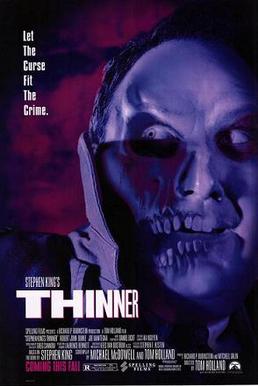
Billy Halleck (Robert John Burke, in a fat suit) is a morbidly obese attorney who might be destined to die of a heart attack but who definitely will not be serving jail time despite running over an old gypsy woman. After a corrupt judge and crooked cop, both of whom are friends of Billy’s, conspire to get Halleck acquitted, all three of them are cursed by the woman’s husband (Michael Constnatine). The judge turns into a lizard while the cop is covered in sores. Halleck, however, finally starts to lose weight! At first, he’s happy. He’s finally getting thin and all he had to do was run over an old woman! But then, he realizes that he’s never going to stop getting thinner and he’s going to just waste away.
Thinner is based on a novel by Richard Bachman, who was actually Stephen King. Like most of the Bachman books, Thinner is nastier than most of the King books. Billy is a terrible character and he deserves exactly what’s coming to him. The book is not usually listed as being one of King’s better efforts and the movie doesn’t get much love either. I’ve always liked Thinner, though. It’s like a really good episode of Tales From The Crypt, with Billy paying the price for his sins. Billy actually gets several chances to redeem himself but, because he’s such a terrible character, he keeps messing them up. Instead of begging for forgiveness, Billy hires a gangster (Joe Mantegna) to try to take out the gypsies. Even when the dead woman’s husband gives Billy a chance to escape his fate with some shred of dignity, Billy would rather go after his perceived enemies. Many bad things happen to Billy but he brings them all on himself. Even when it becomes obvious that he’s under a curse, he still thinks he can plea bargain his way out of it. He’s a lawyer, through and through.
Thinner is frequently cartoonish and broad but that works for the story that it’s telling. Robert John Burke’s performance may not have many shadings to it but again, it’s right for the story that’s being told. My favorite performance in the film was Joe Mantegna’s turn as the gangster and fans of Late Night Cinemax will feel a rush of nostalgia when Kari Wuhrer makes an appearance as the beautiful daughter of the woman that Billy ran over. Thinner is a middle-tier King adaptation, neither as bad nor as good as some others. I dug it.
Dempsey Cain (Christopher Reeve) is a former test pilot turned homicide detective who ends up getting shot because of the incompetence of another cop, a patrolman named Nick Cain (Edward Kerr). Nick also happens to be Dempsey’s younger brother. While Dempsey’s in the hospital, Nick has an affair with Dempsey’s wife, Gail (Kim Cattrall). When a now-paralyzed Dempsey returns home, he deals with his depression by drinking and contemplating suicide. He tells Gail and Nick that he no longer wants to live but that his life insurance policy doesn’t cover suicide. He comes up with a plan for his wife and brother to stage a break-in and murder him. Because Gail and Nick are secretly lovers and want Dempsey out of the way, they agree. However, it turns out that Dempsey isn’t as naive as they assumed and he still has a few tricks of his own. It looks like the perfect murder but Detective Alan Reinhardt (Joe Mantegna) is determined to solve the case.
Produced for HBO, Above Suspicion is a clever and twisty film noir that, unfortunately, never escapes the shadow of Reeve’s real-life tragedy. Just a week after the film first aired on HBO, Christopher Reeve was suffered the spinal chord injury that left him confined to a wheelchair for the rest of his life. Knowing that Reeve would spend the final nine years of his life paralyzed from the neck down can make it difficult to watch Above Suspicion, which is unfortunate because this film features what might be Reeve’s best performance.
As an actor, Christopher Reeve was always typecast as Superman and he definitely missed out on some roles as a mistake. Above Suspicion makes clever use of Reeve’s good guy image but casting him as someone who everyone thinks is a hero but who actually has a very dark side to his personality. Everyone in the film thinks of Dempsey as being Superman but he instead reveals himself to be Lex Luthor. It was definitely a chance of pace role for Reeve and he really seems to enjoy playing a scheming villain for once. Watching the film today, it is obvious that he had enough talent that, if not for his injury, he probably would have eventually made an Alan Alda-style comeback that would have seen him settling into the role of being a much-in-demand character actor.
Interestingly, the clever script was written by William H. Macy, shortly before he found fame as Jerry Lundegaard in Fargo. The film is a clever homage to films like Double Indemnity and The Postman Always Ring Twice and Christopher Reeve and Joe Mantegna are both fun to watch as they play their cat-and-mouse game. Despite the real-life tragedy that it unintentionally invokes, Above Suspicion is a clever and twisty thriller featuring a cast of talented actors at their best.
As a part of my continuing effort to get caught up with reviewing all of the movies that I’ve seen this year, here’s two courtroom dramas that I recently caught on This TV.
Suspect
Released in 1987
Directed by Peter Yates
Starring Cher, Dennis Quaid, Liam Neeson, John Mahoney, Joe Mantegna, Philip Bosco, Fred Melamed, Bernie McInerney, Bill Cobbs, Richard Gant, Jim Walton, Michael Beach, Ralph Cosham, Djanet Sears
Suspect is a hilariously dumb movie. How dumb is it? Let me count the ways.
First off, Cher plays a highly successful if rather stressed public defender. And don’t get me wrong. It’s not that Cher is a bad actress or anything. She’s actually pretty good when she’s playing Cher. But, in this movie, she’s playing someone who managed to graduate from law school and pass the DC bar.
Secondly, Cher is assigned to defend a homeless man when he’s accused of murdering a clerk who works for the Justice Department. The homeless man is deaf and mute, which isn’t funny. What is funny is when he gets a shave and a shower and he’s magically revealed to be a rather handsome and fresh-faced Liam Neeson. Liam doesn’t give a bad performance in the role. In fact, he probably gives the best performance in the film. But still, it’s hard to escape the fact that he’s Liam Neeson and he basically looks like he just arrived for a weekend at Cannes.
Third, during the trial, one of the jurors (Dennis Quaid) decides to investigate the case on his own. Cher even helps him do it, which is the type of thing that would get a real-life attorney disbarred. However, I guess Cher thinks that it’s worth the risk. I guess that’s the power of Dennis Quaid’s smile.
Fourth, the prosecuting attorney is played by Joe Mantegna and he gives such a good performance that you find yourself hoping that he wins the case.
Fifth, while it’s true that real-life attorneys are rarely as slick or well-dressed as they are portrayed in the movies, one would think that Cher would at least take off her leather jacket before cross-examining a witness.
Sixth, it’s not a spoiler to tell you that the homeless man is innocent. We know he’s innocent from the minute that we see he’s Liam Neeson. Liam only kills who people deserve it. The real murderer is revealed at the end of the film and it turns out to be the last person you would suspect, mostly because we haven’t been given any reason to suspect him. The ending is less of a twist and more an extended middle finger to any viewer actually trying to solve the damn mystery.
I usually enjoy a good courtroom drama but bad courtroom dramas put me to sleep. Guess which one Suspect was.
12 Angry Men
Released 1997
Directed by William Friedkin
Starring Courtney B. Vance, Ossie Davis, George C. Scott, Armin Mueller-Stahl, Dorian Harewood, James Gandolfini, Tony Danza, Jack Lemmon, Hume Cronyn, Mykelti Williamson, Edward James Olmos, William Petersen, Mary McDonnell, Tyrees Allen, Douglas Spain
The 12 Angry Men are back!
Well, no, not actually. This is a remake of the classic 1957 film and it was produced for Showtime. It’s updated in that not all of the jurors are white and bigoted Juror #10 (Mykelti Williamson) is now a member of the Nation of Islam. Otherwise, it’s the same script, with Juror #8 (Jack Lemmon) trying to convince the other jurors not to send a young man to Death Row while Juror #3 (George C. Scott) deals with his family issues.
I really wanted to like this production, as it had a strong cast and a strong director and it was a remake of one of my favorite films. Unfortunately, the remake just didn’t work for me. As good an actor as Jack Lemmon was, he just didn’t project the same moral authority as Henry Fonda did the original. If Fonda seemed to be the voice of truth and integrity, Lemmon just came across like an old man who had too much time on his hands. Without Fonda’s moral certitude, 12 Angry Men simply becomes a story about how 12 men acquitted a boy of murder because they assumed that a woman would be too vain to wear her glasses to court. The brilliance of the original is that it keeps you from dwelling on the fact that the accused was probably guilty. The remake, however, feels like almost an argument for abandoning the jury system.
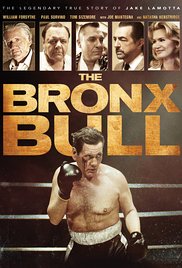
New York in the 1930s. Jake LaMotta (Morean Aria) is a tough street kid who is pushed into fighting by his abusive father (Paul Sorvino) and who is taught how to box by a sympathetic priest (Ray Wise). When Jake finally escapes from his Hellish home life, it is so he can pursue a career as a professional boxer. Ironically, the same violent nature that nearly destroyed him as a youth will now be the key to his future success.
In the late 60s, a middle-aged Jake LaMotta (William Forsythe) testifies before a government panel that is investigating that influence of the Mafia in professional boxing. LaMotta testifies that, during his professional career, he did take a dive in one of his most famous matches. LaMotta goes on to pursue an entertainment career which, despite starring in Cauliflower Ears with Jane Russell, never amounts too much. He drinks too much, fights too much, and gets into arguments with a ghost (Robert Davi). He also gets married several times, to women played by everyone from Penelope Ann Miller to Alicia Witt. The movie ends with Jake happily walking down a snowy street and a title card announcing that Jake is now 95 years old and married to his seventh wife. (The real Jake LaMotta died on September, 9 months after the release of The Bronx Bull.)
The Bronx Bull is a largely pointless movie about the later life of the antisocial boxer who was previously immortalized in Martin Scorsese’s Raging Bull. In fact, The Bronx Bull was originally announced and went into production as Raging Bull II. Then the producers of the original Raging Bull found out, filed a lawsuit, and the film became The Bronx Bull. Because of the lawsuit, The Bronx Bull could cover every aspect of Jake’s life, except for what was already covered in Raging Bull. In fact, Scorsese’s film (which undoubtedly had a huge impact on LaMotta’s later life) is not even mentioned in The Bronx Bull.
William Forsythe does what he can with the role but, for the most part, Jake just seems to be a lout with anger issues. With a cast that includes everyone from Tom Sizemore to Cloris Leachman to Bruce Davison, the movie is full of familiar faces but none of them get too much of a chance to make an impression. Joe Mantegna comes the closest, playing Jake’s best friend. The Bronx Bull was not only shot on the cheap but it looks even cheaper, with studio backlots unconvincingly filling in for 1930s Bronx. The film’s director, Martin Guigui, occasionally tries to throw in a Scorsesesque camera movement and there are a few black-and-white flashbacks but, for the most part, this is the mockbuster version of Raging Bull.
What’s an Insomnia File? You know how some times you just can’t get any sleep and, at about three in the morning, you’ll find yourself watching whatever you can find on cable? This feature is all about those insomnia-inspired discoveries!
If you were awake at midnight and trying to get some sleep, you could have turned over to ThillerMax and watched the 1996 revenge thriller, Eye For An Eye. However, the film wouldn’t have helped you get to sleep. Eye For An Eye is not a film that you sleep through.
Eye For An Eye opens with Karen McCann (Sally Field) comforting her youngest daughter, Megan (Alexandra Kyle). Megan is terrified of a moth that has flown into her bedroom. “Kill it, mommy, kill it!” Megan shouts. Instead, Karen gently takes the moth in her hand and allows it to escape through an open window. In those first few minutes, the film tells us everything that it feels to be important about Karen. She’s a mother. She lives in a big house in the suburbs. And she wouldn’t kill a moth…
But — the name of the title is Eye For An Eye and that would seem to promise killing so we know that something terrible is going to happen to change Karen’s outlook on life.
And it does! The next afternoon, Karen is stuck in traffic and calls her oldest daughter, 17 year-old Julie (Olivia Burnette). In an extremely harrowing sequence that is pure nightmare fuel, Karen helplessly listens as Julie is raped and murdered.
A white trash deliveryman named Robert Doob is arrested for the crime and we immediately know that he’s guilty. First off, his name is Robert Doob and that’s a serial killer name if I’ve ever heard one. Secondly, he smirks at Karen and her husband (Ed Harris) and, in a particularly cruel moment that was especially upsetting to this former stutterer, he imitates Julie’s stammer. Third, Robert has tattoos and Satanic facial hair. And finally, Robert Doob is played by Keifer Sutherland. And usually, I find Keifer and his growl of a voice to be kinda sexy in a dangerous sorta way but in Eye For An Eye, he was so icky that he just made my skin crawl.
Robert Doob is obviously guilty but an evil liberal judge throws the case out on a technicality. After Karen gets over the shock of seeing justice perverted, she decides to take the law into her own hands. After meeting a professional vigilante (Philip Baker Hall, looking slightly amused no matter how grim he tries to act), Karen decides to learn how to use a gun so that she can get her revenge…
There’s not a single subtle moment in Eye For An Eye but that’s actually the main reason I enjoyed the film. Everything — from the performances to the script to the direction to the music to … well, everything — is completely and totally over-the-top. The symbolism is so heavy-handed and the film is so heavily stacked in favor of vigilante justice that the whole thing becomes oddly fascinating. It may not be a great film but it’s always watchable. It may not be subtle and it may even be borderline irresponsible in its portrayal of the American justice system but who cares? By the end of the movie, I was over whatever real world concerns I may have had about the film’s premise and I was totally cheering Karen on in her quest for vengeance. I imagine I’m not alone in that. Eye For An Eye is the type of film that elitist movie snobs tend to dismiss, even while secretly knowing that it’s actually kinda awesome.
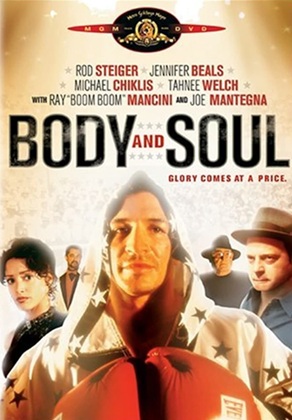 Small town boxer Charlie Davis (Ray Mancini) travels to Reno with his best friend and manager, Tiny O’Toole (Michael Chiklis). Charlie wants to become a professional and he has the support of Tiny and Gina (Jennifer Beals), a saintly hitchhiker that they pick up on the way to Nevada. Charlie managers to impress a legendary trainer (Rod Steiger) but, as Charlie moves up the ranks, he comes under the influence of a corrupt promoter (Joe Mantegna). Seduced by a bad girl (Tahnee Welch) and allowing his success to go to his head, Charlie alienates Tiny just when he needs him the most. A chance to become the champion is coming up and the promoter expects Charlie to throw the fight.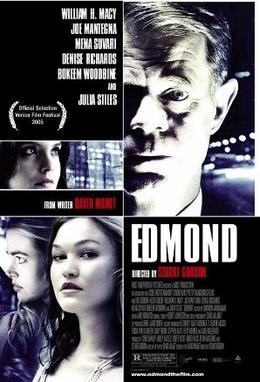



 New York in the 1930s. Jake LaMotta (Morean Aria) is a tough street kid who is pushed into fighting by his abusive father (Paul Sorvino) and who is taught how to box by a sympathetic priest (Ray Wise). When Jake finally escapes from his Hellish home life, it is so he can pursue a career as a professional boxer. Ironically, the same violent nature that nearly destroyed him as a youth will now be the key to his future success.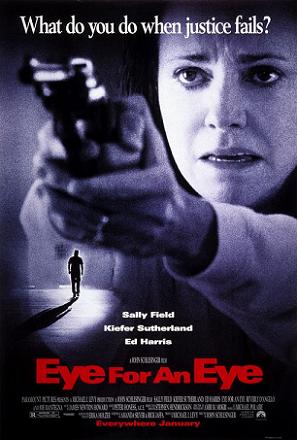
 Through the Shattered Lens