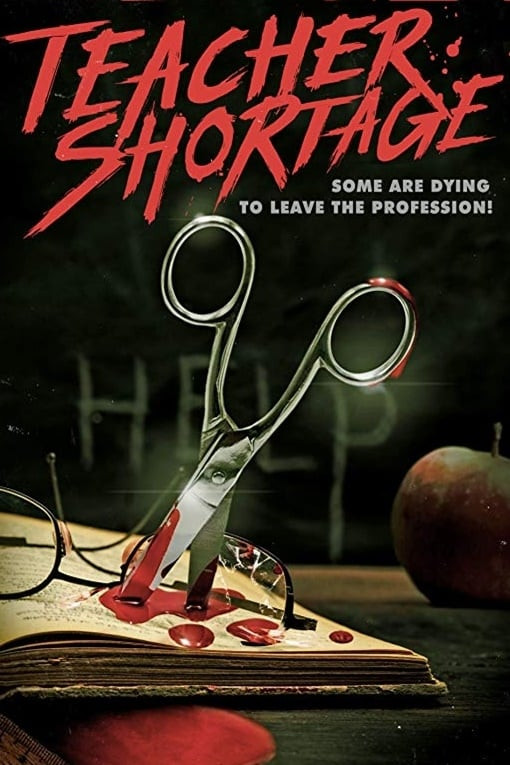
2020’s Teacher’s Shortage starts off with a genuinely disturbing suicide scene.
In a high school classroom, the teacher hands out the yearbooks. Everyone, including the teacher, has a good laugh when they see that one of their classmates has been labeled an “ugly skank,” in her class photo. The only person who doesn’t laugh is the victim of the prank. She runs from the classroom, hides in a bathroom stall, and eventually smashes a mirror and slits her wrists.
It’s disturbing because this is something that actually does happen. This is especially true in the age of social media, when it’s so important to fit in and say the right thing and have a certain number of people following you and liking whatever it is that you’re offering up. With the rise of AI and the increase of people stupid enough to fall for AI, this is something that is only going to get worse. In our efforts to create a better and more connected world, we’ve actually created a world where there’s even more incentive to be a bully.
The rest of the film never quite duplicates the power of its opening. It’s a slasher film in which the killer is tracking down and murdering teachers from the high school. The film was directed by Troy Escamilla, who also did Party Night.Party Night was a not-bad homage to the slasher films of the 80s. The main thing that made Party Night work was Escamilla’s obvious love for the genre and it should be noted that the kills in Teacher Shortage are effectively done. I could have done without the red-tint that the film uses whenever the killer attacks but I can understand what Escamilla was going for. In those scenes, his love for the genre comes through.
Unfortunately, the non-kill scenes are extremely slow. I have no doubt that the film is accurate in its portrayal of burned-out veteran teachers and overly earnest rookies but, whenever there’s any scene featuring more than three or four lines of dialogue, the viewer will probably find themselves checking the clock. This is one of those films that felt far longer than its 86 minutes, largely because the editing (with the exception of the kill scenes) was so poorly realized that every scene just seemed to drag on for an eternity.
The other problem with the film is that I wasn’t particularly shocked by the identity of the killer. In the best giallo tradition, Escamilla attempts to generate some suspense about who is actually underneath the killer’s mask but it’s not hard to figure out. By process of elimination, it’s easy to note who is accounted for and who isn’t during each kill. There was really only one suspect. I guessed the killer after about 15 minutes of watching and I was hoping that I was wrong. I was hoping there would be some sort of out-of-nowhere, totally bonkers twist that wouldn’t make any sense but which would at least add some life to the movie. Unfortunately, there was not.
For horror fans, there’s a lot of blood and there’s also Brinke Stevens. That said, there’s not a lot of suspense. This is ultimately a pretty forgettable slasher film.
Mad bomber Rollo Dillon (Fred Ward) has been hired by terrorists to bomb a major American institution. Captain Ed Hocken (George Kennedy) and Detective Nordberg (O.J. Simpson) know that there’s only one man who can handle this job and his name is Frank Drebin (Leslie Nielsen). Frank, however, has retired from Police Squad and promised his wife, Jane (Priscilla Presley), that he is through with police work.
At heart, Frank remains a cop. He even dreams of shoot-outs. When he tries to do police work without Jane noticing, it backfires on him. Even though Frank lies and claims that he’s just having an affair, Jane leaves him. Frank, with nothing better to do, goes into prison undercover to gain Rollo’s confidence. After Rollo and Frank escape, Frank discovers that Rollo and his girlfriend (Anna Nicole Smith) is planning on bombing the Academy Awards!
The Naked Gun 33 1/3 is the weakest of the original Police Squad films, which is to say that it’s still pretty funny, even if some of the jokes no longer feel as fresh as they did in the previous films. It opens with a brilliant send-up of the shoot-out from The Untouchables and it ends with a perfect parody of the Academy Awards. (Pia Zadora singing This Could Be The Start Of Something Big is funny because it’s exactly the sort of thing that used to happen at the Oscars.) It’s in the middle section that the film drags, though there are still things that made me laugh, like a flashback to Frank, Ed, and Nordberg in the 70s. David Zucker did not return to direct this installment and his absence is definitely felt.
Leslie Nielsen is as funny as ever and he’s well-matched with George Kennedy and Priscila Presley. (OJ Simpson’s presence is as awkward as ever.) Fred Ward plays his villainous role straight, a smart move. But then you’ve got Anna Nicole Smith, who was such a terrible actress that her presence in the film doesn’t even work as a joke. Whenever Smith shows up, the film grinds to a halt. It’s the worst type of stunt casting.
This was Leslie Nielsen final performance as Frank Drebin. Even in a lesser film, he was still a comedic treasure.
Let’s take a moment to appreciate Frank Drebin (Leslie Nielsen), a true American hero.
Even though Frank is just a Los Angeles cop, he still goes to the Middle East and disrupts a conference of America’s greatest enemies. He beats up Fidel Castro. He knocks out Gadafi and Yasser Arafat. He cleans Gorbachev’s head. (“I knew it!” he says as the birthmark disappears.) He takes out Idi Amin and he sends the Ayatollah Khomeini through a window. Thirty-seven years ago, this scene opened The Naked Gun and, after all that time, it is still funny because Leslie Nielsen plays it all with a straight face, delivering his silly lines without flinching. It’s also interesting that none of the leaders taken down by Frank Drebin are around anymore. Khomeini died just a few months after this film came out. Gorbachev was the last to go, in 2022, by which time he was no longer an enemy. Consider it the Frank Drebin Effect. He’s making the world safe for democracy.
When Drebin returns to Los Angeles, he’s informed by Captain Ed Hocken (George Kennedy) that Police Squad has been put in charge of security for a visit from Queen Elizabeth (Jeanette Charles) and that Officer Nordberg (O.J. Simpson) is in the hospital and suspected of being a dirty cop. The Mayor (Nancy Marchand) doesn’t want Los Angeles to be embarrassed by a police scandal before the Queen arrives so Drebin has 24 hours to exonerate Nordberg. Drebin’s attempt to clear Nordberg’s name leads him to a shipping magnate (Ricardo Montalban) who has come up with a diabolical scheme to assassinate the Queen at a baseball game. It also leads to love between Drebin and Jane Spencer (Priscilla Presley).
Though Liam Neeson did a fine job in the recent reboot, there really is only one Frank Drebin and his name is Leslie Nielsen. The original Naked Gun is nearly 40 years old and, even if some of the jokes are dated, it’s still laugh out loud funny. Most of the credit has to go to Leslie Nielsen and ability to deliver even the most bizarre bits of dialogue with natural authority, gravitas and a straight face. Whether he’s mumbling his way through the National Anthem, paying an informer for information, or hamming it up as an umpire, Nielsen is never less than hilarious. By the end of the movie, it’s impossible to look at Nielsen without laughing. Kennedy, Presely, and Montalban also generate their share of laughs. John Houseman has a great cameo as an unflappable driving instructor. (“Now, extend your middle finger.”) As for OJ Simpson, he doesn’t seem to be in on the joke like the rest of the cast but he does frequently get injured and re-injured throughout the movie and there’s definitely some pleasure to be found in that.
(When Simpson died, director David Zucker said, “His acting was a lot like his murdering: He got away with it, but no one believed him.” That sounds about right.)
Liam Neeson made for a fine Frank Drebin, Jr. I hope he has many more adventures. But the greatest Frank Drebin will always be Leslie Nielsen and the original Naked Gun will always be one of my favorite comedies. Sometimes, it’s good just to laugh.
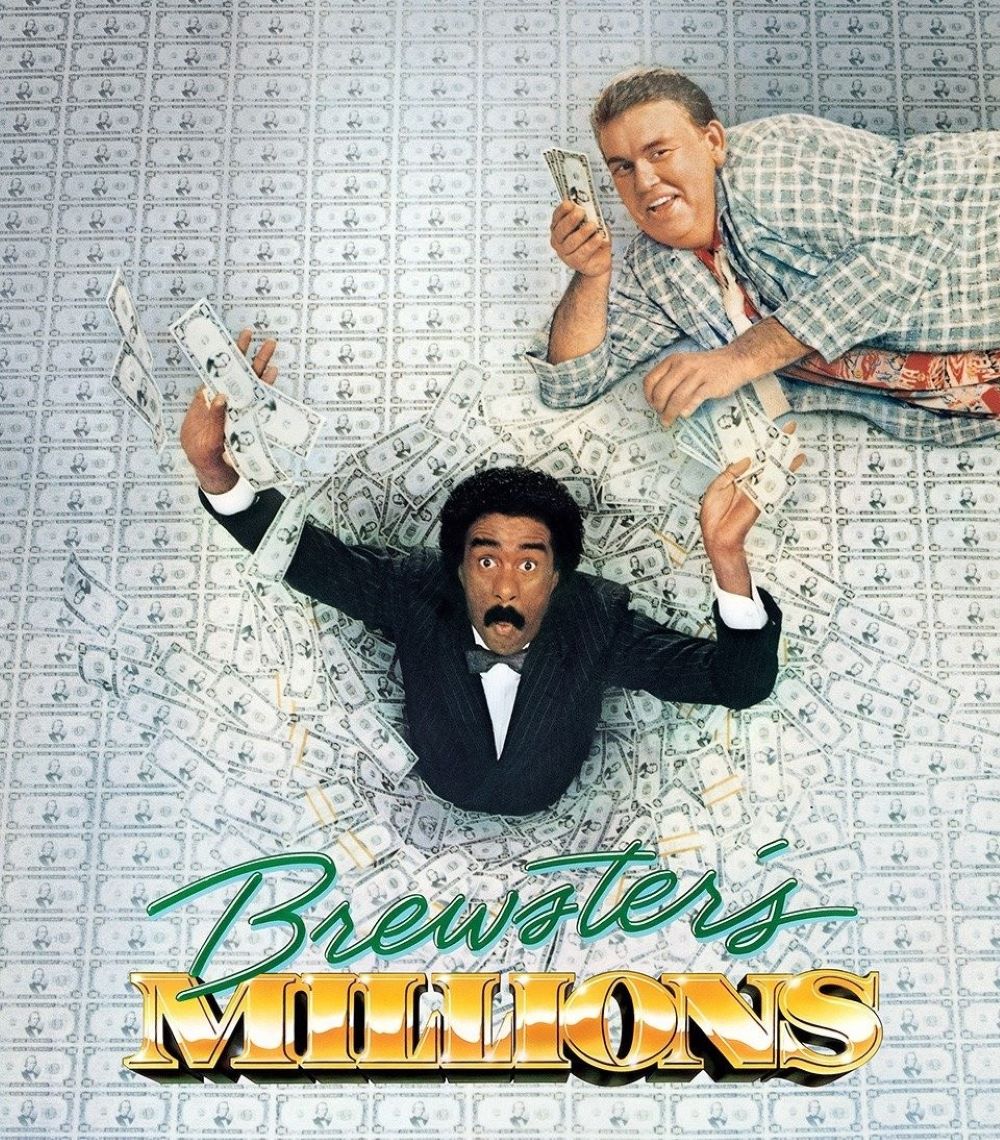
Walter Hill’s Brewster’s Millions (1985) isn’t a perfect movie by any stretch, but it’s the kind of film that sneaks up on you. It may not be sharp enough to qualify as great satire or consistent enough to hit every comedic note, but it has an undeniable charm that pulls you in regardless. It’s loud, uneven, and often ridiculous, yet few comedies from the 1980s are as weirdly entertaining when they’re firing on all cylinders. For many movie fans, it’s that quintessential “guilty pleasure”—a film you know has problems, but that somehow feels impossible to turn off once it starts. And in many ways, that’s exactly where Brewster’s Millions finds its lasting appeal.
The setup alone is too fun to resist. Richard Pryor stars as Montgomery Brewster, a minor league baseball pitcher who unexpectedly inherits the opportunity of a lifetime—to claim a $300 million fortune from a distant relative. The catch? Before he can get it, he has to spend $30 million in 30 days under a bizarre set of conditions that make financial ruin easier said than done. He can’t give the money away, can’t destroy it, can’t buy assets or investments that retain value, and can’t tell anyone why he’s doing it. Fail, and he gets nothing. Succeed, and he becomes one of the richest men alive. It’s the sort of gleefully absurd premise that could only have come from Hollywood in the 1980s, and it’s immediately clear that the film wants audiences to sit back, grab some popcorn, and watch Pryor tear through cash in increasingly funny and desperate ways.
Richard Pryor is, without doubt, the heart and soul of the movie. He imbues Montgomery Brewster with equal parts manic energy and human frustration, giving the character a real emotional arc beneath all the comic spectacle. Pryor’s talent for blending humor with exasperation makes Brewster’s predicament believable, even when it’s insane. Watching him scramble to lose money while the world keeps rewarding him is strangely satisfying. Pryor understood how to play ordinary men caught in extraordinary circumstances, and that quality grounds the film when it could have easily spiraled into total silliness. In scenes where he loses his patience with accountants, schemes wild spending sprees, or watches his good intentions backfire, Pryor’s comic timing keeps the chaos enjoyable.
John Candy adds another layer of charm as Brewster’s best friend and teammate, Spike Nolan. Candy brings warmth, loyalty, and that unmistakable good-heartedness that made him one of the decade’s most beloved comedic actors. The chemistry between Pryor and Candy keeps the film buoyant even through its weaker stretches. Their friendship defines the film’s tone—it’s loose, goofy, and full of bro-ish camaraderie. Without Candy’s infectious energy, the movie’s more hollow comedic beats might have hit the floor with a thud. Together, they create a dynamic that feels real, even inside a premise that’s totally absurd.
As a director, Walter Hill feels like an odd fit for this kind of broad comedy, but that’s part of what makes Brewster’s Millions interesting. Hill, better known for tough, kinetic action films like The Warriors and 48 Hrs., approaches this farce with a surprising amount of structure and visual precision. The film looks slicker and sharper than most comedies of its kind, which gives the excess on-screen an unintentionally epic flair. Hill’s direction keeps the story moving, and though he’s not naturally a comedic filmmaker, his grounded style adds a peculiar edge to all the craziness. It’s chaos with discipline—an aesthetic that somehow works in the movie’s favor.
Still, Brewster’s Millions can’t quite escape its shortcomings. The pacing is uneven, especially in the middle, where the film loses some steam as Brewster cycles through increasingly repetitive spending gimmicks. The story flirts with satire but rarely commits, brushing up against deeper commentary on wealth, politics, and capitalism before retreating to the comfort of broad comedy. The “Vote None of the Above” subplot, where Brewster’s money-wasting political campaign taps into voter cynicism, is one of the smartest parts of the film—but it’s introduced and resolved too quickly to leave a mark. And while the movie is full of lively energy, not every gag lands; a few supporting performances veer into caricature, and some jokes feel very much of their time.
Yet these flaws are partly what make Brewster’s Millions such a delightful guilty pleasure. It’s the cinematic equivalent of junk food—high on calories, low on nutritional value, but deeply enjoyable all the same. Pryor’s constant exasperation, the sheer absurdity of trying to “waste” money legally, and the exaggerated set pieces (like the overblown parties or his failed attempts to lose at gambling) make for irresistible entertainment. Even when the humor dips into predictable territory, the concept keeps pulling you back in. There’s a giddy satisfaction in watching Brewster try—and fail—to lose money, especially because the universe just won’t let him.
The romance subplot with Lonette McKee’s character, Angela Drake, adds just enough heart to balance the absurdity. McKee gives a grounded, intelligent performance that prevents the love story from feeling tacked on, even if it never fully takes center stage. Her presence keeps Brewster tethered to some kind of reality, and the moral through-line—learning that not everything valuable can be bought—lands gently rather than preachily. It’s not profound, but it fits the breezy tone perfectly.
As a comedy of excess, Brewster’s Millions is very much a product of its time. The slick suits, the gaudy parties, the blind faith in wealth, and the Reagan-era optimism about money’s moral neutrality all ooze from every frame. That time-capsule quality is part of its modern appeal. Watching it today, you can’t help but smile at how on-the-nose it feels—a movie from the “greed is good” decade that accidentally ends up mocking the very mindset it sprang from. It’s self-aware only in flashes, but those flashes are enough to make you recognize the movie’s satirical edge hiding beneath its loud surface.
In the end, that’s what makes Brewster’s Millions endure as a lovable guilty pleasure. It has flaws you can’t ignore—uneven pacing, scattershot tone, underdeveloped ideas—but none of them outweigh its charm. Pryor’s comic genius makes even the weakest joke land better than it should. Candy’s warmth keeps the film light. And Hill’s straightforward direction infuses the lunacy with just enough realism to make it believable. The result is a movie that’s too silly to take seriously but too fun to dismiss. You watch it, laugh at its audacity, shake your head at the logic gaps, and yet somehow come away smiling.
Brewster’s Millions may not be a comedy classic, but it’s easy to see why people keep revisiting it. It’s comfort food cinema—lighthearted, clumsy, and endlessly watchable. And like all the best guilty pleasures, it doesn’t need to be perfect to make you happy. Sometimes, seeing Richard Pryor outsmart the meaning of money for two hours is more than enough.
Harrison Ford stars as Rusty Sabich, a smart and ambitious prosecutor who is accused of murdering his former mistress, Carolyn Polhemus (Greta Scacchi).
A lot of people were taken by surprise when PresumedInnocent first came out in 1990. After a career of always being the hero and the type of person who took his fate into his own hands, PresumedInnocent featured a passive Harrison Ford whose fate was in the hands of his lawyer, Sandy Stern (Raul Julia) and in the prosecutors who are trying to send him to prison. For most of the movie, the audience doesn’t know if Rusty is innocent and a lot of what Rusty does makes him seem to be guilty. Just the fact that Harrison Ford was playing someone who would cheat on his wife (played by Bonnie Bedelia, who everyone had last seen sticking up for Bruce Willis in DieHard) was considered to be shocking at the time. It says a lot about Ford’s appeal as an actor that he remains sympathetic even though he’s playing a character who does a lot of bad things. He remains compelling, even though Rusty is forced to spend a good deal of the movie as a passive spectator. To anyone who underrates Harrison Ford an actor, this is the film to show them.
PresumedInnocent is a murder mystery but it’s also a sad-eyed look at a corrupt judicial system. Rusty is accused of murder largely due to the whims of fate. If Raymond Horgan (Brian Dennehy), Rusty’s former patron, had been reelected as district attorney, Rusty would never have been charged. When the trial moves to the courtroom, the Judge (Paul Winfield) himself is revealed to have been compromised by his own relationship with Carolyn, something that Sandy is willing to use to the defense’s advantage. John Spencer plays a detective who is willing to hide evidence to protect Rusty. Joe Grifasi plays a former detective who is motivated less by the evidence in the case and more by a personal grudge against Rusty. The idea of getting justice for Carolyn is pushed to the side by everyone’s personal drama. The ending challenges all of our preconceived notions about Rusty and the meaning of guilt and innocence.
Intelligently directed by Alan J. Pakula and featuring an excellent cast, PresumedInnocent is a top-notch legal thriller and also one of Harrison Ford’s best films.
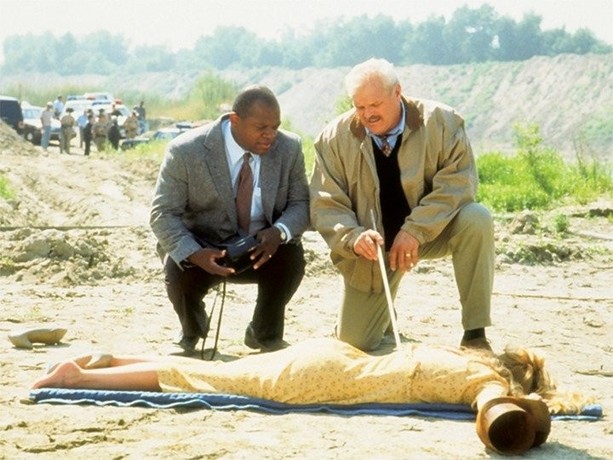
Brian Dennehy directed, co-wrote and starred in this made-for-TV movie about Chicago homicide detective Jack Reed. This is the third TV movie based on Reed’s exploits, following 1992’s DEADLY MATRIMONY, and 1993’s BADGE OF HONOR. In A SEARCH FOR JUSTICE, Jack Reed (Brian Dennehy) investigates the murder of pregnant stripper Lorelei Bradley (Marjorie Monaghan), who also happens to love children, even running a daycare center in the trailer park she lives in. Reed’s investigation quickly identifies the politically connected businessman and strip club owner, Win Carter (Miguel Ferrer), as the prime suspect. As if trying to solve the murder isn’t tough enough, Reed must also deal with corrupt superiors within his own department and train his new boss Charles Silvera (Charles S. Dutton), the latest in a long line of men to be promoted over him. No matter what obstacles Reed encounters, he remains determined to bring the killer to justice!
JACK REED: A SEARCH FOR JUSTICE, is my first “Jack Reed” film, and I enjoyed it. The character of Jack Reed is based on real life Cook County, Illinois Sheriff John “Jack” Reed, with each of the different movies loosely based on cases that Reed investigated throughout his career. As you might imagine, Brian Dennehy is excellent in the lead role as the tough, principled cop who will stop at nothing to catch criminals. The Chicago backdrop adds a nice wrinkle to the proceedings with its strong reputation for corruption, something that plays strongly into this installment and makes Reed’s job that much harder. I also really like Charles S. Dutton’s character, Lieutenant Charles Silvera. Initially promoted due to the color of his skin, and as a way to stick it to Reed, Silvera turns out to be an incorruptible lawman who develops a great working relationship with Reed. I’ve always been a fan of Dutton as an actor, mainly because of his ability to project decency and integrity on screen, and I’m looking forward to seeing them work together in future installments. Miguel Ferrer is also a good villain. He doesn’t go over the top here, rather he plays the part as low key, politically connected, amoral, and ultimately, very dangerous. It’s a good choice.
The fact that JACK REED: A SEARCH FOR JUSTICE is based on real life cases helps bring a little more realism than you might get in most TV movie cop movies of the time. As an example, our cops are more concerned about putting together solid evidence and getting a conviction over anything else. There is some action, but after watching this installment, I realize that these movies are just as likely to end with lawyers cutting a deal than with a big shootout. On the flip side, there are elements of the story that don’t seem realistic at all, such as Reed’s wife Arlene (Susan Ruttan) doing her own undercover work at one point, and our victim’s unlikely dual life as a stripper and daycare operator. What can I say, it’s not a perfect movie, but if you enjoy 90’s TV cop dramas like I do, you should enjoy this film and this series. The cast is good, and the characters are men of integrity trying to bring justice to a corrupt world. That’s a recipe for enjoyment as far as I’m concerned, and I’m looking forward to watching the rest of the film series!
61* is about two baseball player and two friends who couldn’t seem to be more different.
Roger Maris (Barry Pepper) is an introverted family man who doesn’t like it when reporters show up at his house in search of a story or a quote. He’s a good ball player, one of the best, but he doesn’t want to be a celebrity. Mickey Mantle (Thomas Jane) is a larger-than-life personality, a beloved figure on the field and in the dugout. Mickey loves being famous and the fans love him. Both Maris and Mantle are members of the New York Yankees. Because Mantle is struggling with his drinking, he becomes Maris’s roommate when they’re on the road. In 1961, the two friends both go after Babe Ruth’s record of 60 home runs in a season. The press presents their season as a battle, a race to see who will be the first to hit the sixty-first home run of the season. Mantle and Maris, though, are just swinging the bat and making plays.
I really enjoyed 61*, which is a baseball film made by and for people who love baseball. I liked the contrast between the quiet Maris and the charismatic Mantle. Even though Maris is a hard worker and a good ballplayer, Mantle is the fan favorite and the one that people actually want to break the record. I appreciated that Maris and Mantle remained friends even when the press tried to turn them into rivals. That’s what teamwork is all about. Barry Pepper and Thomas Jane were great as Maris and Mantle and the movie showed how each man dealt with the stress of possibly breaking Babe Ruth’s record.
(Why is there an asterisk in the title? Babe Ruth set his record in a season that only had 154 games. The 1961 baseball season was 8 games longer. The asterisk was added as a reminder that Maris and Mantle had 8 more games than Ruth did to try to break the record. Baseball fans understand how important accurate statistics are to a player’s career and a team’s season.)
61* celebrates the way baseball used to be, a game played by athletes who had to depend on skill and teamwork instead of performance enhancing drugs. The movie opens with Maris’s family watching as Mark McGuire closes in on breaking the record. McGuire would only briefly hold the record. He would lose it, for 48 minutes, to Sammy Sosa and then, three years after winning it back, he would lose it a second time to Barry Bonds. Of course, Roger Maris won the record without using steroids so, as far as I’m concerned, it still belongs to him.
If you’re a baseball fan, 61* is a film that you have to see.
Nominated for Best Picture of 1987, Moonstruck is a film about love, romance, New York City, and being Italian.
Loretta Castorini (Cher) is a widow and a bookkeeper who lives with her parents, Cosmo (Vincent Gardenia) and Rose (Olympia Dukakis) in Brooklyn. When her boyfriend, Johnny (Danny Aiello), asks Loretta to marry him, Loretta says yes even though she knows that, while she likes him, she’s not really in love with him. After he proposes, Johnny reveals that he has to go to Sicily to see his “dying” mother. He asks Loretta to pay a visit to his estranged brother, Ronny (Nicolas Cage), and invite him to the wedding. Loretta, a strong believer in family and the importance of following tradition, agrees.
Loretta finds Ronny working in the bakery that he owns. Ronny is not thrilled to learn that his brother has gotten engaged. Ronny reveals that he has a wooden hand. He lost his real hand when he accidentally placed it in a bread slicer while having a conversation with Johnny. After he lost his hand, Ronny’s then-fiancée left him. Ronny has never forgiven Johnny for the loss of his hand. “I lost my hand! I lost my bride!” Ronny yells to the heavens. Loretta, however, immediately understands that Johnny actually hurt his hand to get his fiancée to break up with him. A conversation at Ronny’s apartment leads to the two of them impulsively sleeping with each other. The next day, Ronny promises to never bother Loretta again if she agrees to go the opera with him.
What the guilt-stricken Loretta doesn’t know is that her father is having an affair himself and it turns out that Cosmo and Mona (Rose Gilette) enjoy the opera as well. Meanwhile, Rose finds herself tempted by a lecherous college professor named Perry (John Mahoney).
There’s a lot of stereotypes to be found in Moonstruck. Of course, passionate Ronny loves the opera. Of course, the simple but well-intentioned Johnny abandons his fiancée so that he can rush to Sicily to be with his “dying” mother who, it turns out, isn’t dying at all. Of course, Loretta slaps Ronny and tells him to snap out of it. (I should note that I’m a fourth Italian myself so I could definitely relate to some of this film. I’ve never liked opera, though.) Fortunately, the film’s cast is so perfectly chosen and John Patrick Shanley’s script so adroitly maintains the balance between the broad comedy and the small dramatic moments that it doesn’t matter that all of the characters are a bit stereotypical. The film comes to a wonderful life. It’s impossible not love these characters, flaws and all. Cher and Olympia Dukakis deserved the Oscars that they both won for this film. Vincent Gardenia deserved the nomination that he received. Nicolas Cage, Danny Aiello, and John Mahoney were not nominated but they should have been. In particular, John Mahoney is heart-breaking in his small role, playing the type of lecherous character that most films would have just portrayed as being a cardboard buffoon. As for Nicolas Cage, Moonstruck is a film that features both his trademark eccentricity and his ability to show the real and vulnerable human being underneath all of the bluster. Moonstruck is a film about the search for love and the glory of finding it. It’s a wonderfully romantic film, even if almost all of that love seems to involve infidelity. As directed by Norman Jewison, Moonstruck not only celebrates falling in love but also celebrates being lucky enough to do so in New York City. It’s a love letter not just to its characters but to the city as well.
Moonstruck was nominated for Best Picture but it lost to a far more epic production, The Last Emperor.
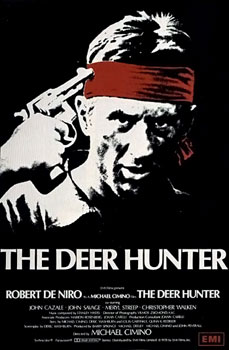
The Deer Hunter, which won the 1978 Oscar for Best Picture Of The Year, opens in a Pennsylvania steel mill.
Mike (Robert De Niro), Steve (John Savage), Nick (Chistopher Walken), Stan (John Cazale), and Axel (Chuck Aspegren, a real-life steel worker who was cast in this film after De Niro met him while doing research for his role) leave work and head straight to the local bar, where they are greeted by the bartender, John (George Dzundza). It’s obvious that these men have been friends for their entire lives. They’re like family. Everyone gives Stan a hard time but deep down, they love him. Axel is the prankster who keeps everyone in a good mood. Nick is the sensitive one who settles disputes. Steve is perhaps the most innocent, henpecked by his mother (Shirley Stoler) and engaged to marry the pregnant Angela (Rutanya Alda), even though Steve knows that he’s not actually the father. And Mike is their leader, a charismatic if sometimes overbearing father figure who lives his life by his own code of honor. The men are held together by their traditions. They hunt nearly every weekend. Mike says that it’s important to only use one shot to kill a deer. Nick, at one point, confesses that he doesn’t really understand why that’s important to Mike.
Steve and Angela get married at a raucous ceremony that is attended by the entire population of their small town. The community is proud that Nick, Steve, and Mike will all soon be shipping out to Vietnam. Nick asks his girlfriend, Linda (Meryl Streep), to marry him when he “gets back.” At the reception, Mike gets into a fight with a recently returned soldier who refuses to speak about his experiences overseas. Mike ends up running naked down a street while Nick chases him.
The Deer Hunter is a three-hour film, with the entirety of the first hour taken up with introducing us to the men and the tight-knit community that produced them. At times, that first hour can seem almost plotless. As much time is spent with those who aren’t going to Vietnam as with those who are. But, as the film progresses, we start to understand why the film’s director, Michael Cimino, spent so much time immersing the viewer in that community of steel workers. To understand who Nick, Mike, and Steve are going to become, it’s important to know where they came from. Only by spending time with that community can we understand what it’s like to lose the security of knowing where you belong.
If the first hour of the film plays out in an almost cinema verité manner, the next two hours feel like an increasingly surreal nightmare. (Indeed, there was a part of me that suspected that everything that happened after the wedding was just Michael’s drunken dream as he lay passed out in the middle of the street.) The film abruptly cuts from the beautiful mountains of Pennsylvania to the violent horror of Vietnam. A Viet Cong soldier blows up a group of hiding women and children. Michael appears out of nowhere to set the man on fire with a flame thrower. An army helicopter lands and, in a coincidence that strains credibility, Nick and Steve just happen to get out. Somehow, the three friends randomly meet each other again in Vietnam. Unfortunately, they are soon captured by the VC.
They are held prisoner in submerged bamboo cages. Occasionally, they are released and forced to play Russian Roulette. Mike once again becomes the leader, telling Steve and Nick to stay strong. Eventually, the three men do manage to escape but Steve loses his leg in the process and a traumatized Nick disappears in Saigon. Only Mike returns home.
The community seems to have changed in Mike’s absence. The once boisterous town is now quiet and cold. The banner reading “Welcome Home, Mike” almost seems to be mocking the fact that Mike no longer feels at home in his old world. Stan, Axel, and John try to pretend like nothing has changed. Mike falls in love with Linda while continuing to feel guilty for having abandoned Nick in Saigon. Steve, meanwhile, struggles to come to terms with being in a wheelchair and Nick is still playing Russian Roulette in seedy nightclubs. Crowds love to watch the blank-faced Nick risk his life.
Eventually, Mike realizes that Nick is still alive. Somehow, Mike ends up back in Saigon, just as the government is falling. Oddly, we don’t learn how Mike was able to return to Saigon. He’s just suddenly there. It’s the type of dream logic that dominates The Deer Hunter but somehow, it works. Mike searches for Nick but will he be able to save his friend?
The Deer Hunter was one of the first major films to take place in Vietnam. Among the pictures that The Deer Hunter defeated for Bet Picture was Coming Home, which was also about Vietnam but which took a far more conventional approach to its story than The Deer Hunter. Indeed, while Coming Home is rather predictable in its anti-war posture, The DeerHunter largely ignores the politics of Vietnam. Mike, Nick, and Steve are all traumatized by what they see in Vietnam. Mike is destroyed emotionally, Steve is destroyed physically, and Nick is destroyed mentally. At the same time, the VC are portrayed as being so cruel and sadistic that it’s hard not to feel that the film is suggesting that, even if we did ultimately lose the war, the Americans were on the correct side and trying to do the right thing. (Many critics of The Deer Hunter have pointed out that there are no records of American POWs being forced to play Russian Roulette. That’s true. There are however records of American POWs being forced to undergo savage torture that was just as potentially life-threatening. Regardless of what one thinks of America’s involvement in Vietnam, there’s no need to idealize the VC.) Released just a few years after the Fall of Saigon, The Deer Hunter was a controversial film and winner. (Of course, in retrospect, the film is actually quite brilliant in the way it appeals to both anti-war and pro-war viewers without actually taking a firm position itself.)
In the end, though, The Deer Hunter isn’t really about the reality of the war or the politics behind it. Instead, it’s a film about discovering that the world is far more complicated that you originally believed it to be. De Niro is a bit too old to be playing such a naive character but still, he does a good job of portraying Mike’s newfound sense of alienation from his former home. In Vietnam, everything he believed in was challenged and he returns home unsure of where he stands. While John, Axel, and Stan can continue to hunt as if nothing happened, Mike finds that he can no longer buy into his own philosophical BS about the importance of only using one shot. Everything that he once believed no longer seems important.
It’s a good film and a worthy winner, even if it does sometimes feel more like a happy accident than an actual cohesive work of art. The plot is often implausible but then again, the film takes place in a world gone mad so even the plot holes feel appropriate to the story being told. Christopher Walken won an Oscar for his haunting performance as Nick and John Savage should have been nominated alongside of him. This was Meryl Streep’s first major role and she gives a surprisingly naturalistic performance. During filming, Streep was living with John Cazale and she largely did the film to be near him. Cazale was dying of lung cancer and he is noticeably frail in this film. (I cringed whenever Mike hit Stan because Cazale was obviously not well in those scenes.) Cazale, one of the great character actors of the 70s, died shortly after filming wrapped. Cazale only appeared in five films and all of them were nominated for Best Picture. Three of them — The first two Godfathers and The Deer Hunter — won.
The Deer Hunter is a long, exhausting, overwhelming, and ultimately very moving film. Whatever flaws it may have, it earns its emotional finale. Though one can argue that some of the best films of 1978 were not even nominated (Days of Heaven comes to mind, as do more populist-minded films like Superman and Animal House), The Deer Hunter deserved its Oscar.
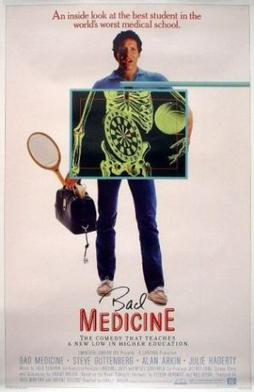
Jeff Marx (Steve Guttenberg) is a smart but lazy pre-med student whose grades are so bad that he can’t get accepted to any of the good medical schools. His father (Bill Macy), who is also a doctor and who wants Jeff to one day take over the family practice, arranges for Jeff to attend medical school in a fictional Central American country. The head of the school, Dr. Ramon Madera (Alan Arkin), is also the country’s dictator. Dr. Madera is happy to make money off of desperate Americans but he still enforces strict rules of behavior at the school. He also makes it clear that none of the medical students are to treat the poor villagers who live near the school.
When Jeff arrives at his new school, he discovers that his classmates are, like him, all screw-ups. They’re also played by a cast of actors who, like Guttenberg, epitomize the 80s ensemble comedy craze. Curtis Armstrong, of Revenge of the Nerds and Risky Business, plays Jeff’s best friend. Fast Times At Ridgemont High‘s Robert Romanus is the Italian medical student who is loved by all the ladies. Airplane!‘s Julie Haggerty is the idealistic medical student who wants to take care of the local villagers. Even Gilbert Gottfried is in this movie! He plays Dr. Madera’s main assistant and hatchet man.
Bad Medicine was released in between the first and the second Police Academy films and it basically tells the same sort of story that made those two films unlikely hits. Guttenberg and his fellow students start out as a screw-ups but, by the end of the movie, they’ve proven themselves as doctors. Perhaps because it was based on a novel that was written by an actual doctor, Bad Medicine is a little more sincere than Police Academy. In Police Academy, the scenes of the recruits doing police work were the biggest jokes of all and, even after he helped to save the city, you still never bought the idea that Steve Guttenberg would have stuck around after graduation so that he could wear a uniform and walk a beat everyday. Though Bad Medicine is full of the usual Police Academy-style hijinks, it doesn’t treat the work that the doctors are doing as a joke. Though regrettable stereotypes abound (this is a film that features Gilbert Gottfriend playing a character named Tony Sandoval, after all), Bad Medicine treats the villagers with respect. Guttenberg gives a relaxed and likable performance, without making Jeff into as much of a wiseass of Police Academy‘s Cary Mahoney. Julie Haggerty brings her usual spacey charm to her role. Not surprisingly, it’s Alan Arkin who steals the film, though you do have to wonder how Dr. Madera has time to run both a country and a medical school while also falling in love with Julie Haggerty. Give the man some credit for knowing how to multitask.
It ends, much like Police Academy, with the med students giving a chance to prove themselves in a crisis situation. Unlike Police Academy,Bad Medicine was not a hit at the box office, though it did make a small profit. As a result, there was never a Bad Medicine 2, which is unfortunate because we could always use more good doctors.
 2020’s Teacher’s Shortage starts off with a genuinely disturbing suicide scene.


 Through the Shattered Lens