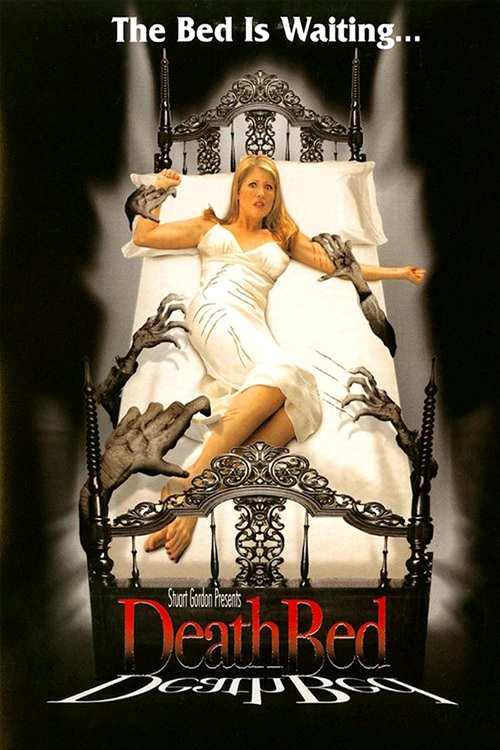
In 2002’s DeathBed, Karen (Tanya Dempsey) and Jerry (Brave Matthews) move into a new apartment. Karen is an illustrator of children’s books. Jerry is a professional photographer who occasionally does “nudie stuff.” Their new landlord and building superintendent is Art (Joe Estevez).
At first, the new apartment seems ideal. But then, strange things start happening. Karen starts to have visions of a woman being strangled in the apartment. She struggles to finish her latest illustration project and instead finds that strange and disturbing pictures have been drawn while she was apparently asleep. Jerry gets weird at work, telling models to pose as if they’ve been tied down to a mattress. Jerry and Karen’s sex life gets a bit more adventurous but even that leaves Karen worried. She feels as if she’s losing control.
Could the apartment be haunted?
Or could it have something to do with the creepy bed that Karen and Art previously found in a hidden room and which Karen decided to make the centerpiece of the new apartment?
Karen starts to do research. At first, she can’t find any evidence that a murder was ever committed in the apartment but then she discovers that the name of the street was changed in the 40s and that her new apartment actually has a very long and rather macabre history. Meanwhile, Jerry worries about her sanity. Deadlines are blown. Murders are committed. And the viewer is left asking one question….
Would you rent an apartment from Joe Estevez?
Actually, I’m being way too snarky with that question. DeathBed is surprisingly effective horror film and Joe Estevez gives a likable performance as Art. Personally, I still think Karen was way too quick to explore a previously hidden room with him but, otherwise, Art comes across as being a genuinely nice guy.
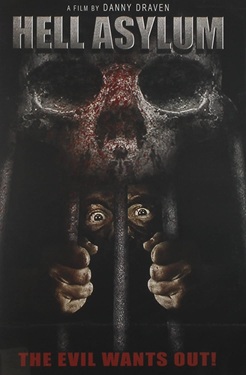
DeathBed is actually one of the better films that I’ve seen from Full Moon Pictures. While I wasn’t a huge fan of Danny Draven’s direction of Hell Asylum, he does an excellent job with DeathBed, creating and maintaining an atmosphere of ominous doom and gradual decay. What makes the film so effective is that Karen and Jerry don’t fall apart immediately. Instead, it’s a gradual process. The viewer can see it happening but Karen and Jerry can’t. Brave Matthews and especially Tanya Dempsey are well-cast as the troubled couple. Dempsey gives an especially strong performance, playing a woman who has used her art to create the ideal life that she’s never had.
DeathBed has an interesting story and a few creative twists, even if the film’s actual ending what come as a huge surprise to experienced horror fans. I appreciated that Karen’s visions of the previous murder appeared to carry hints of the infamous Black Dahlia case. It served to remind the viewer that real life can sometimes be just as terrifying and mysterious as the movies.
Would I rent an apartment from Joe Estevez?
Well, probably not. Not after seeing what happened with Karen and Jerry. But I don’t blame Karen and Jerry for wanting the apartment. It’s a nice apartment. It’s just that there are times that hidden rooms should definitely remain hidden.
Would you watch a reality show produced by Joe Estevez?
Of course not! Reality TV …. hey, that’s the form of entertainment that is destroying our culture and leaving viewers unable to think for themselves! Reality TV is a pox on our house. Thanks to reality TV, the Kardashians are more famous than they have any right to be. Jennifer Welch has become a political pundit despite having all the charm of a sour lemon. People now feel like they have to live every moment as if there’s a million people watching and as a result, it’s become difficult to connect in any meaningful way…..
Eh. Actually, I like reality TV more than I should and I probably would watch a reality show produced by Joe Estevez.
I mean, why not? The best reality shows are always kind of sleazy and there are few actors who are as talented at playing sleazy characters as Joe Estevez. If Martin Sheen often seems as if he’s auditioning to be the Pope, his brother Joe comes across as if he’s auditioning to be the tabloid reporter who writes a slanderous story about the Pope. The fact that Joe Estevez looks like a drunk version of his brother only serves to make him all the more effective as someone who you wouldn’t necessarily want to be associated with. (Unless, of course, he could make you a lot of money….)
In Hell Asylum, Joe Estevez plays Stan, a network television executive. The movie opens with a show being pitched to him. The pitch, like many of the scenes in Hell Asylum, goes on way too long. Basically, a group of models have been recruited to spend the night in a supposedly haunted asylum while being filmed. The pitch is nothing special but Stan needs a hit.
Of course, it turns out that the asylum really is haunted. It takes a while but eventually, the models and the television crew end up being stalked by a bunch of mysterious hooded figures. (Brinke Stevens is credited as being the “Head Spectre.”) The murders are filmed with a blue tint, which is creepy at first but eventually just hurts your eyes. There’s some gore, but it’s mostly just some red gloop and rope meant to stand-in for spilled intestines. It’s not particularly scary but at least it’s only 72 minutes.
Of course, Joe Estevez thinks that he has his hands on America’s hottest new reality show. At first, I thought the movie was being a bit too cynical but then I thought about all of the real-life deaths that I’ve seen posted to twitter and YouTube and I realized that I was probably being naive. We actually did have a reality show in which each episode ended with someone pretending to “die.” Murder in Small Town X was set up like Survivor, except that no one was voted off the island. Instead, they were voted to meet the killer. Even though no one actually died, I would have to think it would be more infinitely more traumatic to know that a bunch of people voted for you to be pretend-killed instead of pretend-exiled. That said, Murder In Small Town X was actually a lot of fun!
An foul-tempered man named Yuri (Jorge Riverso) gets his hands on the skeleton of a werewolf that was discovered out in the middle of the Arizona desert. Anyone who gets scratched by the werewolf’s skeleton is destined to transform into a werewolf themselves.
That’s not much of a plot. This is the first time that I’ve come across the idea that touching a werewolf’s skeleton will also turn you into a werewolf. It doesn’t make much sense but it does lead to a lot of scenes of Yuri creeping around and hitting people with pieces of the werewolf skeleton. He’s working with an archeologist (Richard Lynch) who wants to capture a werewolf and then make money by displaying it in a freak show. Unfortunately, almost everyone who gets touched by the werewolf skeleton dies shortly afterwards.
Other than Richard Lynch and Jorge Rivero, the only “name” actor in this movie is Joe Estevez, Martin Sheen’s look-alike brother. Joe Estevez has the role that I guess would go to Daniel Baldwin if the movie were made today. He stands around and yells. Overall the acting is so poor that it’s often laugh-out-loud funny. Adriana Stastny mutters, “This is absolutely fascinating,” in the dullest voice possible when she’s first told about how the skeleton can turn someone into a werewolf. As for the werewolf, it’s appearance changes from scene-to-scene, making it next to impossible to actually follow the plot.
There’s a reason why this movie is best-known for being used in an episode of Mystery Science Theater 3000. Without Mike and the bots, it’s almost unbearably dull. There’s nothing absolutely fascinating about it.
I have to admit that, when I see Joe Estevez’s name in the credits, I’m usually not expecting to see him cast as a saintly man whose faith holds his family together and gives people a reason to keep on living.
That’s nothing against Joe Estevez. Estevez is the youngest brother of actor Martin Sheen and there’s definitely a family resemblance between the two. That said, while Martin is best-known for playing priests and absurdly left-wing presidents, Joe Estevez has often been cast as villains. If Joe Estevez plays a cop, you can bet he’ll turn out to be dirty. If he plays a politician, he’ll turn out to be corrupt. If he’s a CEO, you can bet his company is going to be pouring sludge into the reservoir. Some actors just get typecast as villains and that seems to be the case with Joe Estevez.
That makes My Brother’s Crossing a definite change-of-pace. Estevez appears as Bobby Clark, a former fireman who rides a motorcycle and who tells all of his bickering relatives, including brother JT (Daniel Roebuck), that they need to turn their lives over to God. Bobby is married to Pam (Eliza Roberts) and they’re both beloved members amongst their community.
One night, both Bobby and Pam are killed when they collide with a car. The driver of the car is CJ Martin (James Black), a pastor. As a stunned CJ sits in an ambulance, he’s approached by a biker (Duane Whitaker) who introduces himself as Pastor Mike Price. Pastor Mike says a prayer over CJ. As he walks away, he’s approached by two EMTs who say, “Pastor, we want to serve your God.” Mike looks up to Heaven and gives praise to Bobby for bringing people to God, even in death.
Yep, this is one of those movies. It’s a low-budget, not particularly well-made, painfully slow faith-based movie. CJ is forgiven by Bobby’s daughter and indeed, the entire Clark family eventually comes to forgive him. He’s even invited to eat dinner with surviving members of the family. At first, JT is driven by his need for revenge but, ultimately, he not only insists that CJ not be charged with vehicular manslaughter but he also pays CJ’s fine for reckless driving. “Praise Jesus,” CJ says. Oh, the mixed feelings! I’m all about forgiveness but everything about the accident suggests that the vehicular manslaughter charge was totally justified. Forgiving someone doesn’t mean that there shouldn’t be consequences for their actions.
To be honest, though, I almost feel guilty about giving this film a negative review, just because it’s based on a true story and it’s told so earnestly (if also amateurishly). My father died a few months after he was involved in a car accident. This woman and her lawyers attempted to sue his estate after he passed and, for months, I was consumed by hatred for her and the people representing her in court. Eventually, I realized that I had to let go of that hate and I had to forgive her, if just so I could move on. That doesn’t mean that I’m obligated to like her, though. I did give that some thought while I watched this movie and that’s probably the compliment that I can give My Brothers’s Crossing.
1979’s Apocalypse Now reimagines the Vietnam War as pop art.
Jim Morrison sings The End in the background as slow-motion helicopters pass in front of a lush jungle. The jungle erupts into flame while in a dingy hotel room, Captain Benjamin Willard (Martin Sheen) gets drunks, practices his karate moves, and smashes a mirror before collapsing to the floor in tears. The next morning, the hung-over and bandaged Willard ends up at a U.S. military base where he has a nice lunch with Lt. General Corman (G.D. Spradlin) and Col. Lucas (Harrison Ford) and a nearly silent man wearing an undone tie. Willard is asked if it’s true that he assassinated an enemy colonel. Willard replies that he did not and that the operation was classified, proving that he can both lie and follow military protocol. Willard is told that a Col. Walter Kurtz (Marlon Brando) has gone rogue and his mission is to go into Cambodia and terminate his command with “extreme” prejudice. It’s a famous scene that features G.D. Spradlin delivering a brilliant monologue about good and evil and yet it’s often missed that Willard is getting his orders from Roger Corman and George Lucas.
(Roger Corman was the mentor of director Francis Ford Coppola while the pre-Star Wars George Lucas was Coppola’s business partner. Indeed, Apocalypse Now was originally somewhat improbably planned to be a George Lucas film.)
Up the river, Willard heads on a patrol boat that is populated with characters who could have come out of an old World War II service drama. Chief (Albert Hall) is tough and no-nonsense. Lance (Sam Bottoms) is the goofy comic relief who likes to surf. Clean (Laurence Fishburne) is the kid who is obviously doomed from the minute we first see him. Chef (Fredric Forrest) is the overage, tightly-wound soldier who just wants to find mangoes in the jungle and who worries that, if he dies in a bad place, his soul won’t be able to find Heaven. The Rolling Stones are heard on the boat’s radio. Soldiers on the other patrol boats moon the boat and toss incendiary devices on the roof. It’s like a frat prank war in the middle of a war.
Colonel Bill Kilgore (Robert Duvall) is a badass calvary officer whose helicopter raids are legendary amongst the enemy and a dedicated surfer who tries to turn every night into the equivalent of an AIP Beach Party film. He’s a brilliant warrior who speaks with Malibu accent (“Charlie don’t surf!”) and who doesn’t flinch when a bomb goes off near him. “I love the smell a napalm in the morning,” he says and, for a few moments, you really wish the film would just abandon Willard so we could spend more time with Kilgore. “Some day this war is going to end,” he says with a reassuring nod, showing a non-neurotic attitude that is the opposite of Kurtz’s. Willard says that he could tell Kilgore was going to get through the war without even a scratch and it’s true. Kilgore doesn’t try to rationalize or understand things. He just accepts the reality and adjusts. He’s a true surfer.
The film grows progressively more surreal the closer the boat heads up the river and gets closer to Cambodia. A USO show turns violent as soldiers go crazy at the sight of the Playboy Bunnies, dressed in denim outfits and cowboy hats and twirling cap guns like the love interest in a John Wayne western. A visit to a bridge that is built every day and blown up every night is a neon-lit, beautiful nightmare. Who’s the commanding officer? No one knows and no one cares.
The closer Willard gets to Kurtz, the stranger the world gets. Fog covers the jungles. A tiger leaps out of nowhere. Dennis Hopper shows up as a photojournalist who rambles as if Billy from Easy Rider headed over to Vietnam instead of going to Mardi Gras. Scott Glenn stands silently in front of a temple, surrounded by dead bodies that feel as if they could have been brought over from an Italian cannibal film. Kurtz, when he shows up, is an overweight, bald behemoth who talks in riddles and who hardly seem to be the fearsome warrior that he’s been described as being. “The horror, the horror,” he says at one point in one of the few moments that links Apocalypse Now to its inspiration, Joseph Conrad’s Heart of Darkness.
Directed by near-communist Francis Ford Coppola and written by the unapologetically right-wing John Milius, Apocalypse Now is actually less about the reality of Vietnam and more about how the images of the war shaped pop culture the world over. It’s a reminder that Vietnam was known for being the first television war and that counterculture was not just made up of dropouts but also of writers, actors, and directors. Kurtz may say that Willard’s been sent by grocery store clerks but actually, he’s been sent by the B-movie producers who first employed and mentored the directors and the actors who would eventually become the mainstays of the New Hollywood. The film subverts many classic war film cliches but, at the same time, it stays true to others. Clean dying while listening to a tape recording of his mother telling him not to get shot and to come home safe is the type of manipulative, heart-tugging moment that could have appeared in any number of World War II-era films. And while Coppola has always said the film was meant to be anti-war, Col. Kilgore remains the most compelling character. Most viewers would probably happily ride along with Kilgore while he flies over Vietnam and plays Wagner. The striking images of Vietnam — the jungle, the explosions, the helicopters flying through the air — stay in the mind far more than the piles of dead bodies that appear in the background.
It’s a big, messy, and ultimately overwhelming film and, while watching it, it’s hard not to get the feeling that Coppola wasn’t totally sure what he was really trying to say. It’s a glorious mess, full of stunning visuals, haunting music, and perhaps the best performance of Robert Duvall’s legendary career. The film is too touched with genius to not be watchable but how one reacts overall to the film will probably depend on which version you see.
The original version, which was released in 1979 and was nominated for Best Picture, is relentless with its emphasis on getting up the river and finding Kurtz. Willard obsesses on Kurtz and really doesn’t have much to do with the other people on the boat. It gives the story some much-needed narrative momentum but it also makes Kurtz into such a legendary badass that it’s hard not to be disappointed when Willard actually meets him. You’re left to wonder how, if Kurtz has been living in the jungle and fighting a brutal and never-ending guerilla war against the communists, he’s managed to gain so much weight. Brando, who reportedly showed up on set unprepared and spent days improvising dialogue, gives a bizarre performance and it’s hard to view the Kurtz we meet as being the Kurtz we’ve heard about. As strong as the film is, it’s hard not to be let down by who Kurtz ultimately turns out to be.
In 2001 and 2019, Coppola released two more versions of the film, Redux and The Final Cut. These versions re-inserted a good deal of footage that was edited out of the original cut. Most of that footage deals with Willard dealing with the crew on the boat and it’s easy to see why it was cut. The scenes of Willard bonding with the crew feel out of character for both Willard and the rest of the crew. A scene where Willard arranges for Clean, Lance, and Chef to spend time with the Playboy bunnies seems to go on forever and features some truly unfortunate acting. Worst of all, Redux totally ruins Kilgore’s “I love the smell of napalm in the morning” monologue by having Willard suddenly steal his surf board. Again, it’s out of character for Willard and it actually feels a bit disrespectful to Duvall’s performance to suddenly turn Kilgore into a buffoon.
But then there are moments that do work. I actually like the lengthy French Plantation scene. By the time Willard, Lance, and Chef stumble into the plantation, the journey upriver has gotten so surreal that it makes a strange sort of sense that they would run into a large French family arguing politics while a clown tries to keep everyone distracted. The new versions of the film are undeniably disjointed but they also shift the focus off of finding Kurtz and place it more on Willard discovering how weird things are getting in Vietnam. As such, it’s less of a disappointment when Kurtz actually shows up. Much as with the French Plantation scene, the journey has become so weird that Kurtz being overweight and pretentious feels somehow appropriate.
What all the versions of the film have in common is that they’re all essentially a neon-lit dream of pop cultural horror. Is Apocalypse Now a horror film? Critic Kim Newman argued that it owed a lot to the genre. Certainly, that’s the case when Willard reaches the temple and finds himself surrounded by corpses and and detached heads. Even before that, though, there are elements of horror. The enemy is always unseen in the jungle and, when they attack, they do so quickly and without mercy. In a scene that could almost have come from a Herzog film, the boat is attacked with toy arrows until suddenly, out of nowhere, someone throws a very real spear. Until he’s revealed, Kurtz is a ghostly figure and Willard is the witch hunter, sent to root him out of his lair and set his followers on fire. If the post-60s American horror genre was shaped by the images coming out of Vietnam then Apocalypse Now definitely deserves to be considered, at the very least, horror-adjacent.
Apocalypse Now was controversial when it was released. (It’s troubled production had been the talk of Hollywood for years before Coppola finally finished his film.) It was nominated for Best Picture but lost to the far more conventional Kramer vs Kramer. Robert Duvall was the film’s sole acting nominee but he lost the award to Melvyn Douglas’s turn in Being There. Douglas was very good in Being There and I imagine giving him the Oscar was also seen as a way of honoring his entire career. That said, Duvall’s performance was amazing. In his relatively brief screen time, Duvall somehow managed to take over and ground one of the most unruly films ever made. The Oscar definitely should have gone to him.
As for the film itself, all three versions, flaws and all, are classics. It’s a film that proves that genius can be found in even the messiest of productions.
What’s an Insomnia File? You know how some times you just can’t get any sleep and, at about three in the morning, you’ll find yourself watching whatever you can find on cable or streaming? This feature is all about those insomnia-inspired discoveries!
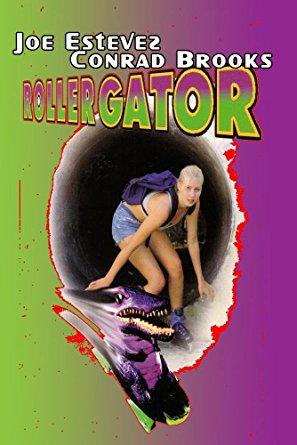
Last night, if you were having trouble getting to sleep, you could have logged onto Tubi and watched the 1996 film, Rollergator! Of course, you would have had to watch the Rifftraxx version but, trust me, that would have been for the best. There are some films that demand a certain amount of snarkiness in order to be survived and that’s certainly the case with Rollergator.
P.J. (Sandra Shuker) is a teenage girl who has just moved to Los Angeles. There’s not much to do so P.J. spends her time either hanging out at a local carnival or relaxing on the beach. It’s while she’s on the beach that she hears a voice calling out to her from a nearby cave. Of course, she enters the cave to see who is calling for her because, when you’re otherwise alone and only wearing a bikini, it would only make sense to wander into a strange and dangerous location just because a totally unfamiliar voice asks you to.
Anyway, the voice belongs to a purple alligator who is kind of obnoxious. The alligator can talk. He says that he’s just escaped from the carnival and now Chico Dennis (Joe Estevez) has sent out a mysterious ninja (Lisa Kaake) to bring him back. The alligator just wants to be reunited with his former owner, The Swamp Farmer (played by Conrad Brooks, who was a member of the Ed Wood stock company back in the 50s and the 60s). After giving the alligator a hard time about always being rude and sarcastic, PJ tosses him in her backpack and takes him to …. THE CARNIVAL! The alligator has a great time at the carnival until he and PJ run into Chico and the alligator realizes that they’re at the same carnival from which he previously escaped! How many carnivals are in Los Angeles?
Anyway, the majority of the movie is PJ rollerblading around Los Angeles with a talking alligator puppet in her backpack. The Dark Ninja pursues them on a skateboard but fortunately, a karate instructor (Bobbie Blackford) and a runaway named Slingshot (Jenette Lynne Hawkins) decide to help out PJ and the alligator. Occasionally, the alligator puppet raps but he’s not very good at it. Still, everyone loves the talking alligator. Oddly, no one ever questions the fact that the alligator can talk. Then again, no one manages to deliver their lines with the least bit of emotion, suggesting that everyone in Los Angeles is fairly blasé when it comes to talking alligators and skateboarding ninjas.
Rollergator is perhaps the only movie ever made about a rapping alligator and, watching it, it was kind of easy to see why there haven’t been any other movies featuring rapping alligators. This is one of those films that features an alligator puppet for the kids and a lead actress who spends the entire movie in either a bikini or a sports bra for the adult males watching the movie with the kids but what about the women — the underpaid babysitters and the extremely helpful aunts and the exhausted mothers — who would have, if the film had been successful, been forced to watch Rollergator over the years? The only thing we get is Joe Estevez, bulging his eyes and looking like Martin Sheen on meth. It doesn’t seem quite fair!
Anyway, did I mention that you could watch this if you were having trouble getting to sleep? Well, you definitely can but be warned, you may have Rollergator-inspired dreams as a result. Those are the risks you take.
I should have known what I was getting into as soon as my sister told me, “You’ll like this, it’s a baseball movie!”
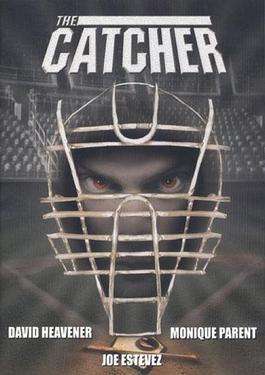
The Catcher is a movie about a little boy who goes crazy when his baseball-obsessed Dad makes fun of his swing. The boy beats his father to death with a baseball bat. Years later, catcher David Walker (David Heavener) is told that his contract with the Devils baseball team will not be renewed. Someone dressed as a catcher starts to murder players, coaches, and one commentator, using baseball equipment as his weapon. I could have gone my entire life without seeing the scene where one player is sodomized with a baseball bat. But even if that’s your thing, The Catcher is slow and the acting’s terrible. I had a hard time buying the idea of a killer catcher. Outfielders move a lot quicker. Why does my sister recommend these films to me and why do I watch them?
One thing that I did appreciate about this movie is that, for once, it was only men being killed by the masked maniac. I get so tired of horror movies that were obviously made by men who never got over being turned down for a date in high school. The Catcher was a change of pace as far as that’s concerned but otherwise, I wish I had not watched this film.
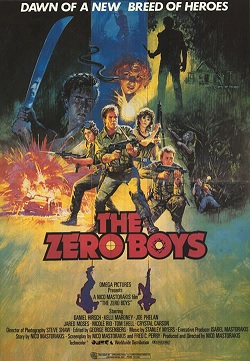
When a paintball team known as the Zero Boys wins the big tournament, they decide to celebrate by spending the weekend in the woods with their girlfriends. Accompanying the group is Jamie (Kelli Maroney), who was put up as a side bet by her boyfriend, who just happens to be the wannabe Nazi dork who lost the tournament. The wilderness fun and games take a disturbing turn when the group comes across a deserted cabin and decide to camp there for the night. The cabin belongs to family of hillbilly survivalists (one of whom is played by Martin Sheen’s brother, Joe Estevez) and they don’t intend to let anyone leave alive. Soon, the Zero Boys are forced to put their paintball knowledge to the test in a real battle for survival.
The Zero Boys is one of those films that always used to come on television when I was growing up and I would always watch it because I thought it was going to be a standard, Friday the 13th-style slasher film. When I was a kid, I would always end up getting annoyed with the film’s deliberate pace and its weird mix of the action and slasher genres. I would usually watch for about an hour and then I would change the channel and try to find something better. I thought The Zero Boys was just that, a big zero.
Now that I’m older, I realize that I was wrong and I better appreciate The Zero Boys and the way that it pokes fun at both the action and the slasher genres. The Zero Boys opens with a really intense battle scene, between the Zero Boys and Casey, who is wearing a swastika armband. It plays out like a standard Cannon action film, up until the moment that the Zero Boys catch up to Casey and shoot him in the head with a paintball. Our “heroes” are not mercenaries or former vets looking to rescue their brothers-in-arms from a POW camp. There’s not a single Chuck Norris among them. Instead, they’re just a bunch of dorky teens who are good at paintball and think that they have survival skills. (One of them looks at a picture of Rambo and says, “Sly, eat your heart out.”) The movie goes on to further upend the audience’s expectations by introducing Jamie, a heroine who is anything but the typical, virginal final girl. When it becomes obvious that the group is being stalked by a group of killers, the Zero Boys and their girlfriends actually fight back and it’s a definite change of pace from other slasher films of the era, When it comes to horror films, The Zero Boys has more in common with The Hills Have Eyes than with Friday the 13th.
The Zero Boys is an action/horror hybrid that is willing to poke fun at itself. It’s also one of the many superior genre pictures that Kelli Maroney made in the 80s. Between this film, Chopping Mall, and Night of the Comet, Kelli Maroney was the crush of every 80s and 90s kid who spent too much time searching HBO and Cinemax for R-rated horror films. She was cute but tough and, even if no one else in the movie realized it, she could definitely take care of herself. Whether fighting malfunctioning robots, zombie scientists, or killer hillbillies, there was no one better to have on your side.
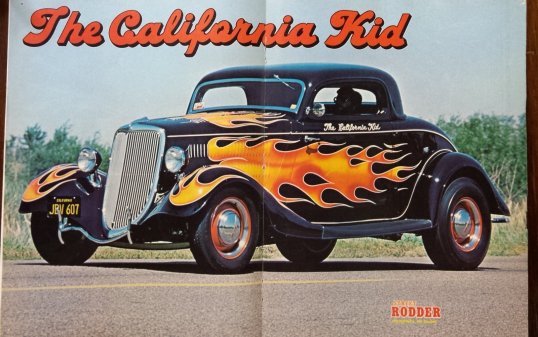
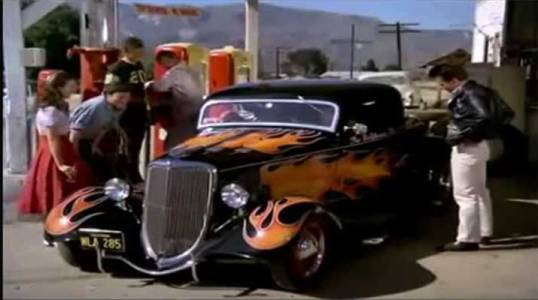
In 1973, a customized 1934 Ford three-window coup appeared on the cover of the November issue of Custom Rod. The car had been created by legendary customizer Pete Chapouris and it was called The California Kid. The cover caught the attention of television producer Howie Horowitz, who thought that maybe the car could become a star.
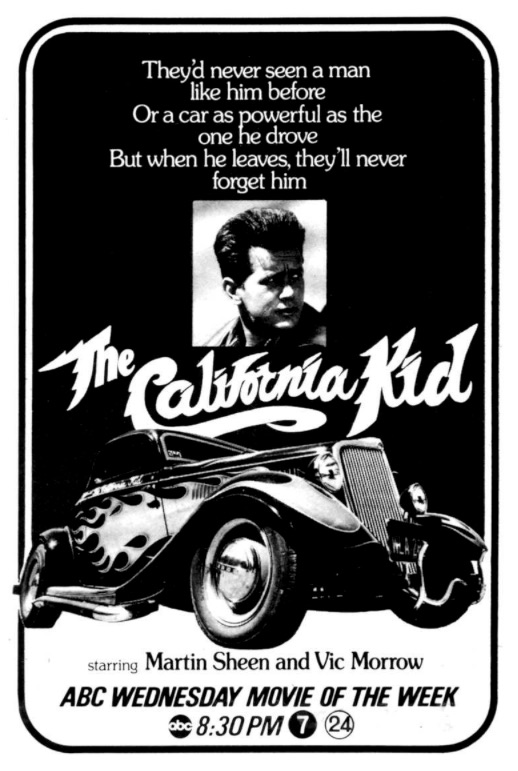
A year later, the car starred in it’s own made-for-TV movie. Naturally, that movie was called The California Kid.
The California Kid takes place in 1958 in the small town of Clarksberg. Clarksberg is known for being a town that does not tolerate speeders. Sheriff Roy Childress (Vic Morrow) lost his wife and daughter to a speeder and, ever since, he’s become a fanatic about making sure that people respect the speed limits. He’ll give a ticket to anyone who he sees going too fast. He’ll even impound your car. And if you don’t learn your lesson or if you try to outrun him, he’ll get behind your car, give it a push, and send both you and your vehicle plunging over the side of a mountain.
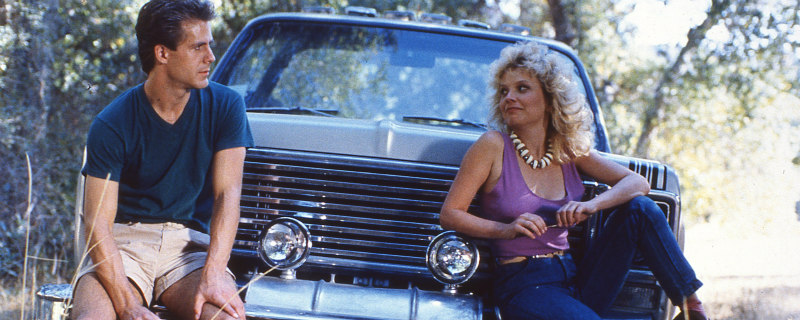
That’s what happens to Don McCord (Joe Estevez), a Marine who was just trying to get back to back to his base on time. After Don and his car go over the side of a cliff, the official ruling is that it was an accident. However, Don’s brother, Michael (Martin Sheen, real-life brother of Joe Estevez), doesn’t buy that. Determined to prove that his brother was murdered, Micheal rolls into town, behind the wheel of the California Kid.
The California Kid is a typical 70s car chase movie. There’s not much going on other than the sheriff chasing the Michael and the California Kid. Martin Sheen coasts through the movie, doing the James Dean impersonation that he perfected in the previous year’s Badlands and Vic Morrow plays his thousandth sadistic authority figure. The supporting cast is full of familiar names who don’t get to do much. Michelle Phillips plays the waitress who falls in love with Martin Sheen. (It’s always a waitress.) Stuart Margolin is Morrow’s deputy and keep an eye out for Nick Nolte, playing a mechanic. Interestingly, The California Kid was written by Richard Compton who, a year later, would direct Notle in his first starring role in the 1975 car chase film, Return to Macon County. Of course, the real star of the movie is the car and the California Kid earns its star billing. The movie might not be anything special but there’s no way you can watch it and not want to drive that car.
This is a made-for-TV movie so you won’t hear any profanity and the characters are all as simple can be. However, there are enough shots of cars going over cliffs to keep chase enthusiasts entertained.
The streets are being flooded with lousy, synthetic heroin. Could the source be somewhere inside of Trabuco Federal Prison? That is what Nick Slater (Ben Maccabee) has been assigned to find out. Nick is a tough cop but now he is going undercover, pretending to be a tough but incarcerated bank robber. Nick discovers that Trabuco is like no other prison out there. For one thing, Wings Hauser is the warden. Warden Pitt is a smirking Aryan who forces his prisoners to box for his amusement and who enforces discipline with a CIA-style torture chamber. (Because the Warden is a boxing fanatic who likes to reward his best fighters, he also regularly brings prostitutes into the prison, which allows the film to reach its quota of B-movie nudity.) Even worse, Warden Pitt and the head of the Aryan Brotherhood, Jigsaw (Paulo Tocha) are working together. Only Nick can end Warden Pitt’s reign of terror but he will have to survive prison first. Fortunately, Ben knows how to throw a punch and deliver kick and he is going to have to do a lot of both if he is going to make it out alive.
Broken Bars is a dumb but entertaining movie, with plenty of action and Wings Hauser villainy. Ben Maccabee’s a credible 90s style action hero. He may not be as good an actor as Dolph Lundgren or as fast as Jean-Claude Van Damme but, by the end of Broken Bars, there is no doubt that he could easily knock out Steven Seagal. It’s no surprise that the best thing about the movie is Wings Hauser. As anyone who ever watched late night Cinemax in the 90s knows, Wings Hauser was usually the best thing about any movie that he appeared in. As a character, Warden Pitt is demented even by the standards of Wings Hauser and Hauser obviously had a ball screaming his lines. B-movie stalwart Joe Estevez also shows up, playing a good guy for once.
Joe Estevez and Wings Hauser in the same movie? Who cares if it’s any good? Hauser and Estevez together is just another way of saying, “Must see.”

 I have to admit that, when I see Joe Estevez’s name in the credits, I’m usually not expecting to see him cast as a saintly man whose faith holds his family together and gives people a reason to keep on living.



 The streets are being flooded with lousy, synthetic heroin. Could the source be somewhere inside of Trabuco Federal Prison? That is what Nick Slater (Ben Maccabee) has been assigned to find out. Nick is a tough cop but now he is going undercover, pretending to be a tough but incarcerated bank robber. Nick discovers that Trabuco is like no other prison out there. For one thing, Wings Hauser is the warden. Warden Pitt is a smirking Aryan who forces his prisoners to box for his amusement and who enforces discipline with a CIA-style torture chamber. (Because the Warden is a boxing fanatic who likes to reward his best fighters, he also regularly brings prostitutes into the prison, which allows the film to reach its quota of B-movie nudity.) Even worse, Warden Pitt and the head of the Aryan Brotherhood, Jigsaw (Paulo Tocha) are working together. Only Nick can end Warden Pitt’s reign of terror but he will have to survive prison first. Fortunately, Ben knows how to throw a punch and deliver kick and he is going to have to do a lot of both if he is going to make it out alive.
 Through the Shattered Lens