A couple weeks ago site music writer necromoonyeti wrote up quite an article about what just makes a piece of music a “horror music”.
Using some of what necromoonyeti wrote about I decided to look at some horror and non-horror films with music that evokes that sense of terror and horror that sometimes come from music that we wouldn’t associate with such emotions. It’s a much more difficult task than one would think. Yet, while I didn’t find one of those non-traditional pieces of horror music I did come across one that I should’ve used in this segment a long time ago.
The latest “Song of the Day” is a piece of disturbing music titled “Polymorphia” by Polish composer Krzysztof Penderecki.
This musical composition has been used in two classic horror films (some would say some of the best in their genre) to help build the sense of horror and dread for the audience. The two films in question would be William Friedkin’s The Exorcist and Stanley Kubrick’s The Shining. I know that in the former it more than added to that film’s creeping dread from the moment the song came on. It made one feel like Hell itself was about to break through the screen. It’s that sense that one’s skin was sensing something evil was afoot.
I found a particular youtube video that used this song and the chosen imagery to great effect. I dare anyone to watch the video, listen to the music in a dark room and in the middle of the night while alone.
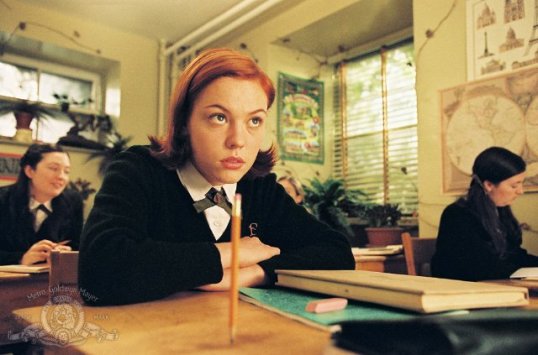
Last night, I turned over to Chiller and watched the brilliant 2006 horror film, The Woods.
Why Was I Watching It?
I ended up watching The Woods almost at random. I didn’t want to go out last night because it’s Texas-OU weekend and that meant that the streets of Dallas would probably be full of drunk people from Tulsa. Even more importantly, I couldn’t go out because I’m recovering from a sprained ankle.
Normally, under those circumstances, I would have watched and live tweeted an original SyFy film. However, last night, SyFy was showing Fright Night which I had little interest in sitting through. So, instead, I turned over to Chiller and decided to give The Woods a try.
And that is how I randomly discovered one of the best horror films that I’ve recently seen.
What Was It About?
The year is 1965. Angry teenager Heather (Agnes Bruckner) starts a fire in a forest. Frustrated by their daughter’s rebellious nature, her parents enroll her at Falburn Academy, a boarding school that sits in the middle of the woods. Because she is the only redhead at the school, Heather is an immediate outsider who finds herself being taunted by the blonde Samantha (Rachel Nichols) and called “Firecrotch” by her other classmates.
However, Heather has more problems that just a bunch of anti-redhead bigots. She has nightmares where voices seem to call to her from the woods. Her friends Marcy and Ann both disappear from their beds, leaving behind a pile of dead leaves. Meanwhile, the school’s mysterious headmistress (Patricia Clarkson) insists that nothing strange is happening…
What Worked?
I wasn’t expecting much from The Woods. After all, it was a film that was released straight-to-DVD in 2006 and Chiller doesn’t exactly have a reputation for showing the best films. But, oh my God, y’all — The Woods turned out to be such a good film! The Woods is an atmospheric and surprisingly well-acted film that’s full of haunting imagery and memorable details. Much like Dario Argento’s Suspiria (which has a similar plot to this film), The Woods is a triumph of both style and substance.
While the entire film is well-acted, special mention should be made of Patricia Clarkson, who gives a performance that is both menacing and humorous. Genre fans will be happy to see Bruce Campbell in the role of Bruckner’s well-meaning father.
Finally, I have to admit that, as a member of the 2% of the population who have been blessed with red hair, I have a special appreciation for this film. Behind all of the scares, The Woods provides a compelling portrait of the discrimination that those of us with red hair struggle with every single day. From the minute Heather enters Falburn Academy, she is the subject of constant prejudice because of the color of her hair. As someone who has had to endure countless comments about redheads not having souls, I both related to and appreciated the film’s sensitivity to those of us in the 2%.
What Did Not Work?
Over on the film’s imdb page, there’s some debate as to whether or not the term “Firecrotch” was in use back in 1965. Personally, I think that’s nitpicking. The fact of the matter is that anti-redhead prejudice has always been with us. If people in the 60s didn’t attack us by calling us “Firecrotch,” they undoubtedly called us something equally bad. As far as I’m concerned, the entire film worked perfectly.
“Oh my God! Just like me!” Moments
Almost the entire film was an “Oh my God! Just like me!” moment, largely because the main character was a redhead and had to deal with constant anti-redhead prejudice. (“Oh my God! Just like me!”)
At one point, Samantha taunts Heather by asking, “Is your pubic hair red?” which is the exact same question that I got asked several times throughout high school, though in my case, I was usually asked by a guy with a smirk on his face. (“You’ll never know,” I would reply.) Heather then finds herself being repeatedly called “Firecrotch” by people who are jealous of her red hair and again, oh my god! Just like me!
Finally, as I mentioned above, I sprained my ankle last Wednesday and, as such, I’ve spent the last few days recovering. Amazingly enough, about halfway through the film, Heather twists her ankle. She spends the rest of the movie either on crutches or painfully limping. Oh my God! Just like me!
(As a quick aside, can I just say how much I HATE crutches!? Oh my God, they’re the worst…)
Lessons Learned
I am tempted to say that the main lesson to be learned from The Woods is that it’s not easy being a redhead. However, I knew that before I watched the film. I also knew that you should stay out of the woods, which is the main reason why you’ll never catch me camping.
So, the most important lesson that I learned is that everyone should see The Woods.
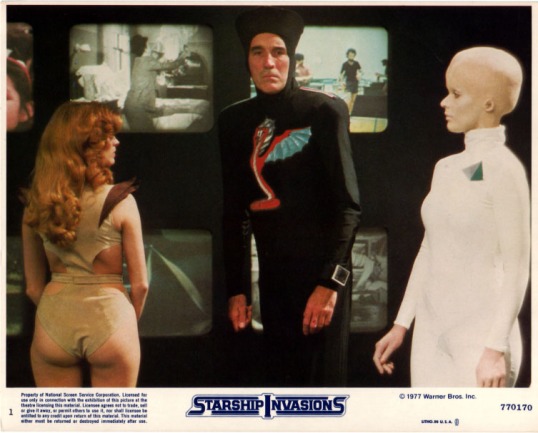
Today’s horror movie on the Shattered Lens is a 1977 Canadian film called Starship Invasions. While at first glance, Starship Invasions may appear to be more of a science fiction film than a horror film, things do get pretty horrific once Christopher Lee starts shooting his suicide ray.
Here’s what you need to know about Starship Invasions:
1) Judging from the look of the film, it must have cost hundreds of dollars to make.
2) All of the aliens communicate through telepathy so, while you get to hear Christopher Lee’s voice, you never actually see his lips move. I presume this was done because the filmmakers wanted to save money by shooting the majority of the film without sound.
3) In the UK, the film was released under the title Project Genocide, which just doesn’t have the same oddly generic charm as Starship Invasions.
4) Christopher Lee reportedly considers this to be one of his worst films.
5) However, the film is kind of fun in a bad, 1970s sort of way.
Add to that, how can you have a horror month without featuring at least one Christopher Lee film?
Down here in Dallas, channel 47 is the local Me-TV affiliate. Me-TV specializes in showing old TV shows from the 50s, 60s, and 70s. The network sells itself as a nostalgic refuge for people who are several decades older than me, a place where they can go to escape from Seth McFarlane producing sitcoms and Maury Povich conducting DNA tests.
But you know what?
I like Me-TV and I’m glad that it exists. It probably has something to do with me being a history nerd at heart. I love the chance to see what the world was once like. Add to that, some very good shows were produced in the 50s and 60s. Just because a lot of us weren’t there to experience them firsthand doesn’t mean that we can’t appreciate them in rerun syndication.
Case in point: Thriller.
Thriller aired for two seasons in the early 60s. It was an anthology series, in the tradition of The Twilight Zone. Whereas The Twilight Zone was hosted by Rod Serling, Thriller was hosted by horror icon Boris Karloff, who always introduced the macabre material with a bemused gleam in his eyes.
Parasite Mansion was the 30th episode of Thriller and it originally aired on April 25th, 1961. In this episode, Marcia (Pippa Scott) crashes her car outside of a dilapidated Southern mansion. When she awakens, she finds herself in the position of being the unwilling guest of the eccentric family that lives inside the mansion. I like this episode, largely because I can never resist Southern gothic atmosphere.
Incidentally, the family’s matriarch is played Jeannette Nolan and, if she sounds familiar, that’s probably because she was one of the many actresses to voice Mrs. Bates in Psycho.
Today’s horror movie on the Shattered Lens is 2004’s Suburban Sasquatch.
Suburban Sasquatch (and, it must be admitted, that is a great freaking title) tells the story of a sasquatch who invades the suburbs. Well, we assume he’s a sasquatch. To be honest, the creature actually looks like some guy wandering around in a bear suit but no matter. Once the so-called sasquatch reaches the suburbs, he goes on a killing spree and … well, that’s pretty much it.
Okay, so obviously, Suburban Sasquatch isn’t a very good movie. In fact, it’s probably one of the worst movies ever made. The monster looks ridiculous, the acting is terrible, and the special effects … well, it’s debatable whether or not there are any special effects. However, Suburban Sasquatch is one of those movies — much like Manos, the Hands of Fate — that is watchable precisely because it is so unbelievably bad.
Also, Joel McHale once said that Suburban Sasquatch was his favorite movie of all time.
Of all the monsters who have appeared in horror cinema, Count Dracula is perhaps the most iconic. Reportedly, Dracula first appeared on film in 1920, in a silent Russian film that is now considered to be lost. In 1921, he would appear in a Hungarian film called Dracula’s Death and in 1922, he would be renamed Count Orlok for the German masterpiece Nosferatu. Indeed, by the time Bela Lugosi gave his famous performance in Tod Browning’s Dracula, the count had been appearing in films for at least 11 years. In nearly 100 years of filmmaking, a countless number of actors have brought Dracula to life.
We could spend hours debating who was the best Dracula and certainly, there are some worthy contenders. Bela Lugosi brought a continental sophistication to the role, while John Carradine was properly intimidating and theatrical. Udo Kier, Gary Oldman, Thomas Kretschmann, Leslie Neilsen, Zandor Vorkov, and Frank Langella have all played the prince of darkness, to varying degrees of success.
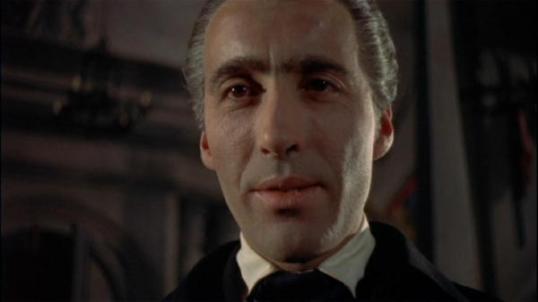
Yet for me, as worthy as any of those actors may be, there is only one true Dracula and he was played by Christopher Lee.
Lee famously played Dracula in seven movies for Hammer Films and, though he has often complained about the quality of these films (especially the later ones, which tended to mix Dracula with hippies), they were largely responsible for making Christopher Lee into the iconic figure that he remains today. It’s also largely due to Lee’s performance that horror fans like me continue to discover and appreciate the films of Hammer today.
As played by Christopher Lee, Dracula was pure evil. Lee’s Dracula had no use for self-pity and one can only imagine what his reaction would have been if he had ever run into the self-torturing vampires of Twilight. Lee’s Dracula had no use for doubt or regret. Instead, he was a determined animal who was driven by a singular lust for blood.
And yet, at the same time, Lee brought an intelligence to the role that was often lacking in previous performances. Lee’s Dracula may have been an animal but he was a cunning animal. Whereas it’s easy for me to imagine escaping from the clutches of Bela Lugosi, I know that if Lee’s Dracula wanted me then he would have me. There’s no escape from Lee’s Dracula. He’s too quick, determined, and intelligent.
His animal nature made Lee’s Dracula frightening but it was his cunning and determination that made him dangerous and, ultimately, even sexy. (While I’ve read that audiences in 1931 swooned over Bela Lugosi, whatever sex appeal he may have had is lost on modern viewers like me.) It has often been argued that Bram Stoker meant for Dracula to be a symbol of all the desires that were repressed by Victorian society. That’s certainly true when it comes to Christopher Lee’s carnal and viscous portrayal of the character.
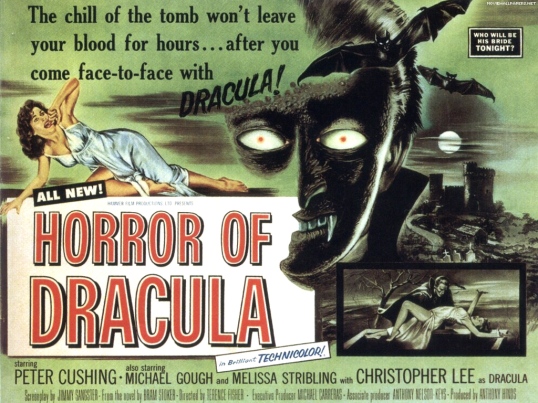
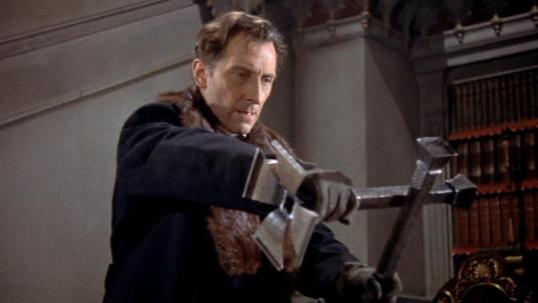
Of the seven Dracula films that Christopher Lee made for Hammer Films, the first remains the best. Released in 1958 and known as Dracula in the UK and the Horror of Dracula in the US, it revitalized the horror genre and helped to make stars of both Christopher Lee and Peter Cushing. Especially when compared to some of the sequels that Hammer subsequently produced, it remains one of the best Dracula films ever made.
The film is a very loose adaptation of Stoker’s original novel. Jonathan Harker comes to Dracula’s castle in Romania. Though posing as a librarian, Harker has actually come to the castle to drive a stake through the heart of both Dracula and his vampire bride. However, no sooner has Harker staked the bride than he’s overpowered and bitten by Dracula. Significantly, all of this occurs within the first 10 minutes of the film. As opposed to certain other Dracula films, Horror of Dracula gets straight to the point. And why shouldn’t it? After all, anyone watching the film already knows that Dracula’s a vampire so why waste time trying to convince us otherwise? We don’t watch Dracula for the familiar story as much as we watch to discover how different filmmakers will choose to tell that story.
When Harker’s colleague, Prof. Van Helsing (played with the perfect amount of intensity by Peter Cushing) shows up at the castle, he discovers that Harker is now a vampire and that Dracula is nowhere to be found.
Dracula, needless to say, is out for revenge. He stalks Harker’s fiancee Lucy, as well as Lucy’s brother Arthur Holmwood (Michael Gough) and his wife Mina (Melissa Stribling). Much as in Stoker’s original novel, Lucy is eventually turned into a vampire and it’s up to Van Helsing and Arthur to stop both her and her new master.
(Of course, in Stoker’s original novel, Harker is not turned into a vampire and instead marries Mina while the aristocratic Arthur is one of Lucy’s three suitors. However, I have to say that I always thought the literary Harker was a bit on the dull side and that Arthur was always my favorite character so I’m happy that he gets to be the hero here.)
If I had to pick one film to epitomize everything that I love about the Hammer brand of horror, it would be Horror of Dracula. As directed by Terrence Fisher, the film moves at an exciting, non-stop pace while the traditionally lush cinematography is almost bombastically colorful. Cushing and Lee, who were the best of friends off screen, make for formidable opponents, with Cushing embodying good just as effective as Lee embodied evil. Though it’s been over 50 years since Horror of Dracula was originally released, the film remains effective and, not coincidentally, a lot of fun.
Quite simply put, this is a film that, for so many reasons, remains a true pleasure to watch.
One final note — I often find myself lamenting that I was born several decades too late and I realize just how true that is whenever I watch a film like Horror of Dracula. Seriously, I would have loved to have been a Hammer girl, showing off my cleavage and getting hypnotized by Christopher Lee.
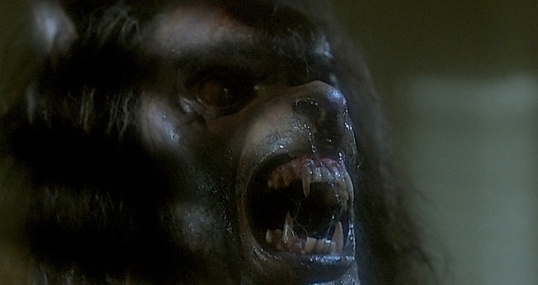
I always thought that Joe Dante’s 1981 horror film, The Howling, has been overlooked just a little bit due to it’s release being the same year as John Landis’ own horror film, An American Werewolf In London. Both were werewolf films and both were good in their own right.
Dante’s film has been called silly by some critics, but it was the more serious of the two with Landis’ own film mixing in more black humor in the narrative than Dante’s which took on a more traditional approach to the werewolf horror. Even the transformation scene from both films took on opposite sides in terms of mood and tone. Where Landis’ film treated the scene with both a mixture of horror and camp (due to the music playing in the background) in The Howling the scene went for full-on horror.
This has been one of my favorite horror scenes and it’s all due to the work of the very person who made John Carpenter’s The Thingsuch a memorable piece of horror filmmaking: Rob Bottin.
This man should be handed every award for every effects work he has ever done and will continue to do. It’s a shame that he hasn’t done anything of note since 2002’s Serving Sara, but until Hollywood decides that if they want great practical effects paired with advancing CG ones and hire Bottin once again we can always fall back on his past work such as the one’s he did for The Howling.
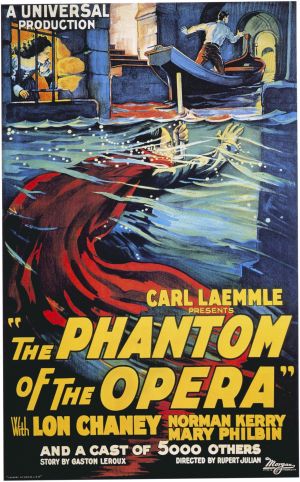
Today’s horror movie on the Shattered Lens is both a classic of silent era and one of the most influential horror films ever made.
First released in 1925, The Phantom of the Opera is today best known for both Lon Chaney’s theatrical but empathetic performance as the Phantom and the iconic scene where Mary Philbin unmasks him. However, the film is also a perfect example of early screen spectacle. The Phantom of the Opera was released during that period of time, between Birth of the Nation and the introduction of sound, when audiences expected films to provide a visual feast and Phantom of the Opera certainly accomplishes that. Indeed, after watching this film and reading Gaston Leroux’s original novel, it’s obvious that the musical was inspired more by the opulence of this film than by the book.
This film is also historically significant in that it was one of the first films to be massively reworked as the result of a poor test screening. The film’s ending was originally faithful to the end of the novel. However, audiences demanded something a little more dramatic and that’s what they got.
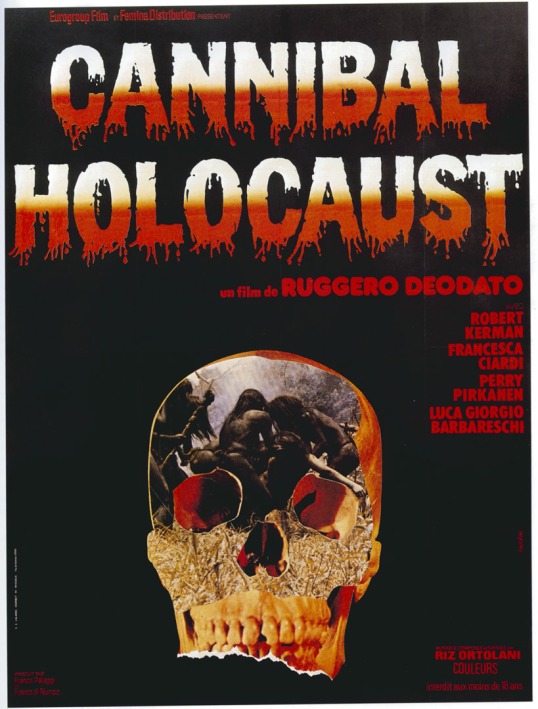
The month of October here at Through the Shattered Lens wouldn’t be complete if I didn’t introduce one of the very films which this site was made for: Cannibal Holocaust.
This 1980 film by Italian exploitation filmmaker Ruggero Deodato remains of the best examples of grindhouse filmmaking. It continues to be many people’s teop ten grindhouse and exploitation films list. Cannibal Holocaust could be considered as the best of the cannibal subgenre films which first began with Umberto Lenzi’s 1972 The Man from the Deep River.
Cannibal Holocaust also remains one of the best found footage films which has regained a sort of come back the last couple years with such popular found footage horror films like the Paranormal Activity series right up to 2012’s The Bay from Barry Levinson. It’s no surprise that Deodato’s film has survived the test of time as new legions of horror fans discover his films and older fans return to watch it again.
The film itself has continued to gain notoriety as newer fans discover the film. Upon it’s release the film was censored or outright banned from many countries who thought it was an actual snuff film (an allegation that even got Deodato and the film’s producers arrested in Italy on charges of murder) or because of atual animal cruelty performed by the film crew on live animals during the shoot. While the notion of Cannibal Holocaust was an actual snuff film remains a sort of urban legend amongst the new and young horror fans discovering it for the first time it really was the allegations of animal cruelty that continues to haunt the film to this day as it remains banned it several countries.
While the film was finally removed from the UK’s “video nasties” list it still hasn’t been released fully uncut and unedited in that country unlike the rest of the world. Though with the global reach of the internet such censorship and banned lists have become irrelevant and thus has given Cannibal Holocaust a much wider reach than it has ever had.
Cannibal Holocaust may be over thirty years old now, but it remains one of the finest example of grindhouse and exploitation filmmaking. It will continue to live on for future generations of horror fans and gorehounds to discover.
 A couple weeks ago site music writer necromoonyeti wrote up quite an article about what just makes a piece of music a “horror music”.