I love films, all films, in general but if there’s one particular film genre that really floats my boat then it would be in the horror category. This summer will see the release of a title that I’ve been anticipating since I heard about it at last year’s San Diego Comic-Con. The film I speak of is the remake of the 1973 tv horror film of the same name: Don’t Be Afraid of the Dark.
While Troy Nixey takes the director’s chair for this film he’s working on a story written by Guillermo Del Toro who’s been known to dabble in the horror genre (Cronos, The Devil’s Backbone). Del Toro promised a horror film that would bring back horror the way it’s meant to be and that’s with genuine scares and not horror predicated on torture and extreme use of gore. Don’t Be Afraid of the Dark will be a throwback to the atmospheric, almost gothic horror, that reached it’s peak during the late 70’s before the slasher boom hit.
The film has been delayed several times as Miramax Films was sold by Disney and the restructuring of the studio after it’s owners finalized it’s purchase put the film on the backburner. It now has an official August 26, 2011 release and it looks like the film got an R-rating from the MPAA for “pervasive scariness”. While Del Toro, Nixey and the rest of the film crew were hoping for a PG-13 rating the one given by the MPAA who seemed to really enjoy said “pervasive scariness” recommended it go out as an R-rated horror (one with little to no gore).
So, we have an upcoming horror film by an upcoming filmmaker handpicked by Del Toro. A film written by Del Toro himself and one which just got an R-rating which made Del Toro as happy as a clam. Plus, it’s a horror film that relies on genuine scares and not gore. My answer to that is August 26, 2011 cannot come sooner.
There’s a certain number of books when I was much younger that I thought would’ve made for some great horror films. They were the early works by Clive Barker. Short stories collected into several volumes aptly dubbed his Books of Blood. While several short stories from these volumes were adapted to film in the intervening years most were not worth the time to watch them. So, lo and behold that when I finally saw the latest short story adapted from these collections I was genuinely surprised at how well-made and entertaining it turned out to be. The Midnight Meat Train by Japanese filmmaker Kitamura Ryuhei was a fine piece of horror filmmaking that dripped in atmosphere and a growing sense of existential dread right up to it’s very surprising end.
The Midnight Meat Train is quite a simple story when one really breaks it down to it’s component parts. It’s a crime thriller wrapped in the bloody layers of an extreme horror film. There’s a certain noirish quality to it’s storytelling as we see the film’s protagonist in Leon (Bradley Cooper). He’s a photographer struggling to find the inspiration for his next set of photographs and decides to wander the train stations at midnight to find that inspiration. It’s during one visit at night that he begins to suspect that he might’ve come across one of the latest missing persons who might’ve become a victim of the so-called “Subway Butcher”. The film shows his growing obsession in finding out if the urban legend of this so-called serial killer is actually true.
His mental state only deteriorates as the reality about the “Subway Butcher” (Vinnie Jones in one of his best roles to date) catches up to the truth on one midnight ride on the subway train. His witnessing of the killer at work brings him into a hidden world the rest of the city seems unaware or incapable of acknowledging despite the hundreds of people who go missing year in and year out for almost a hundred years. His girlfriend Maya (Leslie Bibb) and best friend Jurgis (Roger Bart) soon become drawn into Leon’s nightmarish situation and must confront the very boogeyman who has begun to haunt Leon’s waking life.
The film is Kitamura Ryuhei’s first Hollywood film and it doesn’t diminish the talent for some creative visuals he earned while directing horror and genre films in his native Japan. He makes great use of the nighttime setting and the stark environs of the subway trains at midnight to give The Midnight Meat Train an almost black and white look punctuated by vivid splashes of visceral red during the many inventive killings by Vinnie Jones’ mute Mahogany character. Kitamura showed that he was able to squeeze as much as was possible from a script that was average at best. Especially considering that the script had to adapt one of Barker’s shorter tales.
The performances by the ensemble group led by Bradley Cooper ranged from good to excellent with the aforementioned Vinnie Jones leading the pack. Even Bradley Cooper as the tormented protagonist Leon handled the role well. I’ve never warmed to Cooper as an actor as he always came across as a smirking douchebag in almost every role he played prior to this one. He quickly shed some of that reputation for me with his performance in this film and continues to do so with every one since this film. The smirk is still there but he has managed to drop the douchebag aspect of it. I also must point out a nice turn by veteran genre actor Tony Curran as the train conductor who exuded a sense of the otherworldly and a character who held the answers to the questions brought up by the film.
Since this is a horror film one must mention it’s horrofic aspects and this film fills it’s quota of horror. The scenes where Jones’ Mahogany dispatches the unwary last riders of the train at midnight were shot extremely well and with some visual flairs Kitamura has gained a reputation for. There’s nothing cartoony about these kills unlike other slasher films of it’s type. The kills are done in a brutal fashion as meat tenderizers smash into skulls and backs. Then there are the dressing of the kills which gives meaning to the film’s title. The only part of this film which seemed so out of place, but was necessary in the film’s overall narrative was the make-up effects in the end of the dead-end tunnel where Leon finally sees the truth of why Mahogany has been killing passengers on the subway train. It’s here that the film’s budget shows. At least Kitamura was smart enough to film these scenes in very low light to hide some of the zippers and laces on the costuming.
Overall, The Midnight Meat Train was one horror film in 2008 that deserved to have been seen by more people. It’s a shame that the handling of this film’s distribution by Lionsgate bordered on the criminal as it failed to be screened by many theaters which led to it’s failure in the box-office. This was a horror film that delivered on the goods without pandering to the torture porn crowd who had begun to dominate the scene due to the popularity of the Saw franchise. Kitamura’s first work in America showed that he brings a fresh new voice to Western horror. The film also ends up becoming the best of all the Books of Blood short story adaptations and shows that Barker’s earlier grand guignol writing phase could be adapted well to the bigscreen.
Here’s to hoping that the failure of this film in the box-office (Again, I say fuck you Lionsgate) doesn’t keep other up-and-coming horror filmmakers from tapping into Barker’s volumes of short stories for their projects. There’s horror gold to be found there and Kitamura’s The Midnight Meat Train was one gleaming example of it.
The latest AMV I’ve chosen for the regular “AMV of the Day” comes from one of the anime hit series from 2010. It combines the horror and ecchi (softcore) themes and images from that series with one of Rob Zombie’s most popular songs to date in “Dragula”. The video is plainly and simply titled, “Instinct”.
Highschool of the Dead (Gakuen Mokushiroku in Japan) was one of the major anime hits of 2010. It was the anime adaptation of the wildly popular manga series of the same name. It was a series which successfully combined the horror aspects that a zombie apocalypse brings to any story and the softcore elements that ecchi brought to the table. Simply put it was a series that was about sex, violence and horror. So, it wasn’t too much of a surprise that someone decided what better song to merge scenes from this series than Rob Zombie’s very own “Dragula”.
The editing work on this video was actually excellent. The creator, StarSapphire26, didn’t just edit and splice together scenes to match the tone and tempo of the song, but added some visual touches which made it stand out from most AMVs. This is one reason why this video stood out for me beyond just being one of the better and rare good AMVs which uses Highschool of the Dead as the foundation.
Anime: Highschool of the Dead (Gakuen Mokushiroku)
There’s literally been hundreds of film adaptations of Mary Shelley’s novel Frankenstein, or the Modern Prometheus. Everyone from James Whale to Terrence Fisher to Paul Morrissey to Kenneth Branagh to Marcus Nispel has taken a shot at interpreting the legend and the monster’s been played by everyone from Boris Karloff to Christopher Lee to Robert De Niro to Srdjan Zelenovic (who was pretty freaking hot and yummy for a creature stitched together out of random corpses in Flesh for Frankenstein).
However, the very first cinematic version of Frankenstein came out in 1910. Produced by Thomas Edison’s film company, this 10-minute, silent film starred an actor named Charles Ogle as the monster. Frankenstein, himself, was played by Augustus Phillips while his fiancée was played by Mary Fuller. The film was directed by a fellow known as J. Searle Dawley. Dawley reportedly directed over a hundred silent films and most of them are lost to history.
For about 6 decades, it was assumed that Dawley’s Frankenstein was lost as well. However, in the mid-70s, it turned out that one remaining print of the film still existed and was apparently sitting up in someone’s attic in Wisconsin. It also turned out that the film was still in viewable condition.
And now, thanks to a combination of YouTube and the fact that every movie made before 1922 is now in the public domain, I’ve had the opportunity to see this movie for free and even better, here’s your chance to see it for free. Understand that when I say better, I’m speaking from the point of view of someone who is fascinated by history in general and cinematic history in specific. In many ways, this film epitomizes everything that makes it difficult for modern audiences to appreciate the excitement once generated by silent film. The acting is overly theatrical and watching the film makes you appreciate the eventual development of the dolly shot and the zoom lens even more. Add to that, the music that was selected to accompany this video is way too obvious and heavy-handed. I would suggest, before watching, that you mute the video and put your own preferred music on instead.
Still, the film does have a lot of historic interest. I don’t think you can truly judge and appreciate the films of today unless you know something about the films of the past. Watching a movie like the 1910 Frankenstein not only makes you realize how far films have come as an art form but also how much of the medium’s inherent earnestness has been lost with each advance in technology.
Anyway, with all that said, here is the 1910 version of Frankenstein…
I wasn’t expecting much from Insidious, the new horror film that’s recieved a surprising amount of critical acclaim over the past month. After all, the film is the product of a collaboration between the makers of Saw and Parnormal Activity, two of the most overrated horror films ever. Add to that, the movie is rated PG-13 and the lesson I took away from seeing The Roommate earlier this year was that PG-13 dooms horror. Insidious might be the proverbial exception that proves the rule.
As with all good horror films, Insidious starts with a deceptively simple premise. Patrick Wilson and Rose Byrne play a married couple whose marriage is thrown into choas when their oldest son slips into what appears to be a coma. After three months of being in the hosptial, their son is moved back into their house where he spends his days lying in bed, hooked up to ominous medical equipment.
(Speaking for myself, there is no more disturbing sound than the sound of heart monitor, because for every beep, there’s that moment of deafening silence between beeps. The film’s director James Wan knows this too because he makes brilliant use of sound in this film.)
While Wilson deals with things by finding excuses to stay late at work, Byrne is soon seeing shadowy figures running through the house and hearing voices coming from empty rooms. Even as Wilson continues to insist that its just her imagination (that’s something all men seem to have in common — they never ask for direction and they always refuse to accept that the house is haunted), Byrne becomes more and more convinced that its not. Eventually, with a help of an eccentric psychic (well-played by Lin Shaye), Wilson and Byrne are forced to confront the evil forces that have taken control of their lives.
Let’s get the most important thing out of the way first.
Insidious is one scary movie. It’s scarier than any movie rated PG-13 has any right to be. It scared me when I was sitting in the theater watching it and, even more importantly, it’s still scary a day later.
Let me set the scene for you. As I sit here writing this, it is nearly 3 in the morning. I live in a two-story house that is full of random cold spot and which, for some reason, never seems to be totally lit even with all the lights on. My friends are with their families for Easter. My sister Erin is currently in Arlington, visiting with our other sister, Melissa. I’m in this house alone with only my overactive imagination keeping me company. Oh, did I mention that, because of some foundation issues, this house tends to randomly creak?
About two hours ago, I had just taken a shower and I was sitting, wrapped in a towel and a blow dryer, on the edge of my bed. I have this antique floor mirror that sits a few feet in front of my bed and I was about to start drying my hair when it suddenly occured to me — what if I looked at the mirror and I suddenly saw a dark shadow — like the ones in Insidious — sitting on the bed directly behind me?
And yes, I knew that was a silly thought just like I know, despite what the Insidious might tell us, there’s no such thing as ghosts and demons. I knew that if I rasied my head, I would not see anything but isolated, vulnerable little me reflected in the mirror.
But, God help me, I could not bring myself to look. Because, even though I knew that there was 99.9% chance that nothing would be sitting behind me, I knew that there was 0.1.% chance that something would be. I sat there, almost paralyzed with my heart pounding so hard I could almost hear it. I realized I was starting to breathe faster, knowing that if there was something there, it was there with me at that exact moment, siting behind me, waiting to strike…
Finally, realizing that I was on the verge of giving myself a very real panic attack over a very unreal possibility, I forced myself to look up at the reflection in the mirror.
A dark shadow was sitting directly behind me.
And I screamed and jumped off that bed so quickly that I’m amazed I actually managed to stay on my feet. I swung around, cluthing that blow dryer like a weapon, prepared to do whatever…
Nobody was sitting on the bed.
Slowly, I creeped across the room. Cautiously, I stuck a foot underneath my bed to feel if anything was hiding underneath it. I opened the closests and pushed my clothes to the side to confirm that nobody was hiding behind them.
Finally, after I somehow found the courage to sit back down on the bed, I realized that there had indeed been a shadow behind me and that shadow, because of the angle of the lights in my room, had been mine.
That’s the type of film Insidious is. It’s the type of film that uses the simple things that scare us — the unexplainable noises, the things that you sometimes think you see out of the corner of your eye — to creates a truly macabre experience that sicks with you. At its best, its a truly creepy film that works its way into your imagination through a perfect combination of atmosphere and paranoia. One reason why the haunted house genre has remained such a dependable horror set up is because it perfectly reflects one of our most basic fears — the fear of having no control, of knowing that there is no place to hide, that the forces of chaos and evil can even get to us in the sanctuary of our own homes. Especially during its first half, Insidious exploits this fear perfectly. James Wan’s camera prowls through the otherwise unremarkable suburban home like a creature possessed and you find yourself spotting shadowy figures and sudden movements in every frame that flickers before your eyes. Wan makes remarkably good use of sound here. I realize that sound of silence may be an oxymoron but if silence can make a sound, then director Wan manages to capture it in Insidious.
A lot of critics and filmgoers have been rather critical of the film’s second half and it is true that the second half if remarkably different from the first. If the first half finds Wan concentrating on atmopshere then the second half concentrates on shock and, as a result, it feels a lot more conventional. During the 2nd half of them, we learn just what exactly is happening and why and unfortunately, no possible solution could hope to compete with the sense of dread that the first part of the movie generated. That doesn’t mean that the second half of the movie isn’t well-executed. It is. It’s just not as surprising as the first half.
(However, there is one scene in that 2nd half — a red-skinned demon cheerfully sharpening his finger nails — that is just so bizarre and disturbing that it borders on genius.)
Now, I will admit (POSSIBLE SPOILER COMING UP DEPENDING ON HOW ANAL YOU ARE) that I was not a huge fan of the film’s ending. It’s not that the ending didn’t work or that it wasn’t well-exectued. It’s just that it’s the same type of ending that we’ve come to expect from all horror films, the type of thing that used to be considered a twist but now is just a cliche.
Still, ending aside, Insidious is an effective, little horror film. While it is true that the film rather liberally borrows from a lot of previous horror films (most blatantly from Poltergiest, Mario Bava’s Shock, an Australian film called Patrick, and an excellent Canadian shocker called The Changeling), Wan still takes all of those familiar elements and molds them into a genuinely scary experience.
My weekend was full of sleep, coughing and just vegetating in front of my bedroom tv as I tried to get better from my bout of the cold and flu. For some reason or another AMC channel decided to hold a mini-marathon of David Fincher’s classic neo-noir thriller, Seven, and I must say that I probably saw all three straight showings before sleep finally took over. It surely made for some very unusual, drug-induced dreams.
I’ve always seen Seven as Fincher at his most exploitative best. If there was ever a modern grindhouse exploitation film of the past twenty years I would have to consider Seven as one of them. From start to finish the film just felt grimy and made one feel dirty just for having seen it. Take away all the gloss and veneer afforded Fincher due to modern film technology and techniques this film was grindhouse to its core. No better scene exemplifies and solidifies Seven as a grindhouse exploitation film than it’s shocking, nihilistic ending which bucked traditional Hollywood happy ending (or at least and ambiguous one).
It’s been made famous due to the powerful performances from the three leads who dominate the scene. It is almost played off like a stage play with some gorgeous camera work from cinematographer Darius Khondji switching from Morgan Freeman to Kevin Spacey to Brad Pitt with mathematical precision as the scene unfolds through very strong dialogue by screenwriter Andrew Kevin Walker.
The performances shown by Spacey is both chilling and otherworldly as the sociopathic John Doe urging Pitt’s Det. Mills to become wrath and punish him for his sin of envy. Looking helpless and desperate is Freeman’s Det. Somerset trying to talk some sense and decency to the rapidly unraveling Mills who has just learned that what is inside the box he’s been screaming for is his wife’s head.
The fact that the unfolded and ended the way it did honors the grindhouse sensibilities of past exploitation films where the good guys never always win and even when they do it’s at a very heavy cost to the victor. This climactic ending to Seven is so nihilistic that when the film was first shown in 1995 many walked out grumbling at such a dark and heavy ending. Where was the Hollywood happy ending everyone was so used to. There was no cavalry charging last second to save the day. No deus ex machina intervening to show that Mill’s wife was still alive. No, Fincher and crew knew they had something special in their hands and went full tilt to see it through.
It’s no wonder I still consider Seven to be David Fincher’s best film to date.
Ever since it was announced in around Fall of 2010 that an anime series was going to be made based on the first two seasons of the popular CW drama series, Supernatural, I knew I had to get the DVD and/or Blu-Ray release of this series.
Like most Japanese anime series they rarely got shown in the US unless it was part of a video set. It’s rare to find newly shown episodes in Japan shown in the US at the same time. Lately, a new practice of streaming new episodes on-line through official anime streaming sites has given American anime fans the same access to new episodes as their Japanese counterparts. A fine example of this recent practice was the simultaneous airing of each new episode for the horror-ecchi series, Highschool of the Dead. Unfortunately, this wasn’t the case for the Supernatural anime series.
So, it was a relief to read the news release earlier this week about the anime series being released in the US through DVD and Blu-Ray sets of Supernatural the Animation season 1.
The DVD and Blu-Ray Season 1 sets will be released by Warner Home Video on July 26, 2011.
If there was ever a series that belongs to be redone in anime fashion it was, and is, Eric Kripke’s Supernatural. As I joked with people about this news once it was confirmed, the Supernatural slashfic community will now have to deal with an equally rabid yaoi community which has already sprouted since Supernatural the Animation premiered on Japanese TV earlier this year.
One thing that should please both subbed and dubbed warring camps is that the DVD and Blu-Ray release should have both original Japanese voice cast (which includes the very Japanese voice actors who dub the Dean and Sam Winchester characters in the live-action showing of the series in Japan) and the stars of the series itself, Jensen Ackles and Jared Padelecki dubbing the anime series in English (though it would seem Padelecki will be voicing all 22-episodes while Ackles only select episodes).
People I know who have seen the series while it aired in Japan have spoken nothing but positive things about the first season. So, far the announcement hasn’t been followed up with the items being put up for pre-orders on Amazon.com or any of the online video retailers. I’m sure that will change once more details about the DVD and Blu-Ray release come down in the coming weeks.
There’s several very good films that I need to review over the next few days but, at the moment, I really need to write about Basement Jack, a low-budget 2009 slasher film that I watched on Chiller. Why do I need to write about Basement Jack? Well, I’m already hesitant to go to sleep because I know I’m going to have nightmares about this film. So, consider this to be my attempt at a quickie exorcism. Indulge me because I need to get this film out of my system.
Why Was I Watching This:
I love horror movies and, even though they always seem to end up giving me nightmares, these old school slasher films are like catnip to me. I can’t resist watching them, if just to see if they can keep the inherently predictable conventions of genre interesting.
What’s The Movie About:
Basement Jack (Eric Peter Kaiser) is a serial killer because when you’ve got a name like Basement Jack, it’s not like you’re going to become an accountant. Anyway, Jack’s thing is that he goes from town-to-town, selects a family to kill, and then secretly moves into their basement until there’s a thunder-storm. Once it starts raining, Jack proceeds to brutally kill the family.
Karen (Michelle Marrow) is only person to have ever survived being attacked by Jack. Now, Jack is obsessed with Karen and follows her from town to town. So, Karen decides to turn the tables and she starts following Jack. Except, of course, Jack was already following her so it would seem like for her to follow him, all she would really have to do would be turn around. But anyway, I guess the important thing is that Karen-and-Jack have one of those hunter/hunted connections.
Jack and Karen both end up in a new small town where Jack sets off on another murder spree while Karen hunts for him. She does this by teaming up with a seriously incompetent cop named Chris (Sam Skoryna). Unfortunately, all of Chris’s fellow officers are 1) convinced that Karen is the murderer and 2) kinda stupid. Will Karen be able to convince the cops that Jack is real? Will Jack continually manage to stand back up after taking more damage than anyone should, realistically, be able to take? And most importantly, will Lisa be able to sleep tonight?
What Worked?
Oh my God, this film should not have disturbed me as much as it did. Seriously, I’ve seen thousands of horror movies that all had better production values, better gore effects, and better acting. And yet, Basement Jack really made me paranoid. I think that’s because director Shelton does manage to create a legitimate feeling of dread that saturates every ludicrous frame of this movie. There is remarkably little humor in this film and, as opposed to a lot of slasher films, all of the victims here just come across as normal, likable people (as opposed to being slasher movie stereotypes).
Kaiser is a genuinely scary killer and Morrow makes for a sympathetic protagonist. She brings a lot of conviction to her role. Exploitation vet Lynn Lowry (remember her from the original Crazies and I Drink Your Blood?) plays Basement Jack’s domineering mother and wow, she is scary.
Now, I’m going to admit there’s one image in this film that I know is going to give me nightmares tonight. It’s of a policewoman who, after being gutted by Jack, is seen lying on the floor, trying to stuff her intestines back into her body and oh my God, I wish I hadn’t seen that because it really got to me. I’ve read several other reviews that have all criticized the CGI gore effects as looking fake. Maybe they do, I’m not really an expert on anatomy. All I know is that image of those intestines sprouting out across a twitching body; that image is trapped in my head. It’s something that I truly wish I hadn’t seen but I still have to list it as something that worked because film horror is supposed to leave the viewer uncomfortable.
What Didn’t Work:
Oh, trust me, a lot didn’t work. Like most slasher films, this one was riddled with a combination of plot holes and characters just acting as stupid as can be.
As our male lead, Sam Skoryna displayed all the charisma of a spilled intestine and, to be honest, most of the other actors gave performances that were fairly atrocious. For some reason, one of the film’s detectives is played by musician Billy Morrison and his English accent is just so jarringly out-of-place in the film’s middle American setting. (What makes the situation especially odd is that no one in the film ever comments on his accent. Trust me — I live in middle America. Hell, I’ll be really pretentious — I mean like Sasha Stone pretentious — and say that I am Middle America. No, actually, forget I said that. That sounds really stupid. Anyway, my point is that if you’re the only Englishman in town, people are going to remind you of that every chance they get.)
An attempt was made to give Basement Jack some backstory and to explain why he does what he does. And by that, I mean that this is one of those movies where the action comes to a sudden halt every few minutes juts so we can be told that a man,who hides in people’s basements and only kills when it’s raining, is mentally ill. Gee, filmmakers, thanks for clearing that up.
And finally (SPOILER!), I am so sick of seeing slasher movies that end with a close-up of the killer’s signature killing tool just so we can suddenly see the killer’s hand come out of nowhere and grab the weapon. I mean, is anyone ever surprised by this anymore? I guess, at one time, this seemed like a twist ending but today, it just comes across as being lazy. (END OF SPOILER!)
“Oh my God! Just like me!” Moments:
Just like our heroine Karen, I usually try to flirt my way out of traffic tickets as well.
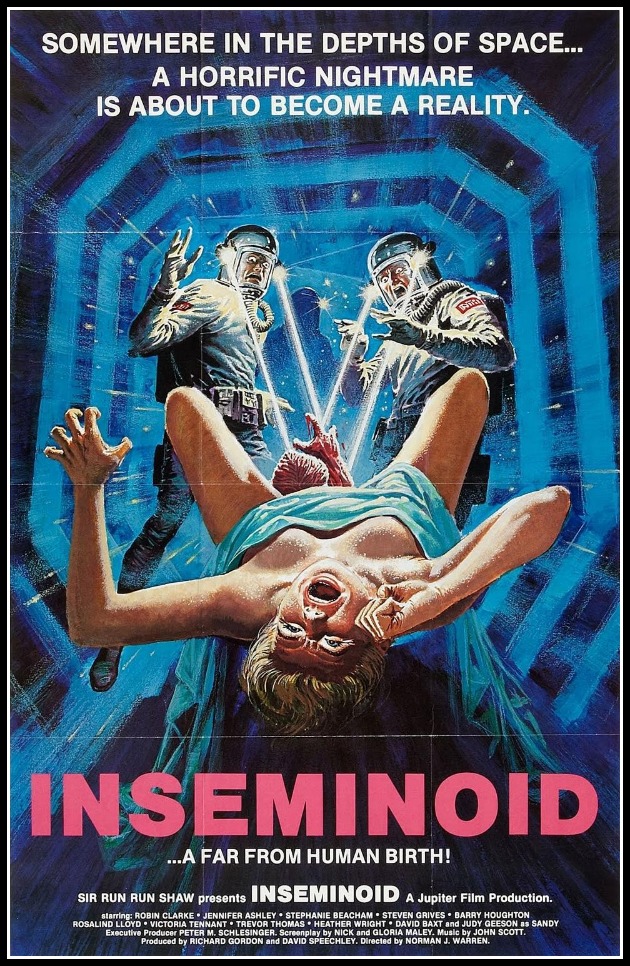
The latest daily grindhouse comes straight out of the UK from the early 80’s. It’s a sci-fi horror flick which came about as part of the exploitation wave of Alien rip-offs and imitation of the past several years since Ridley Scott’s scifi-horror masterpiece stormed through Hollywood. While it’s director, Norman J. Warren and it’s producers do not think it’s grindhouse or an exploitation film of any stripe I beg to differ.
Inseminoid (renamed for a U.S. release as Horror Planet) screams grindhouse right from that title alone. It’s a film about a group of scientists landing on an unknown and desolate planet in search of evidence that an alien civilization existed once upon a time on the planet. The whole thing was either filmed inside a studio-built spacecraft set or in a cavern complex near the studio in the UK. It’s once one of the scientists (as always with grindhouse horror it happened to be a female scientists) has become impregnated by a remnant of the planet’s long-dead civilization that the horror truly begins.
It’s that very scene of rape and alien impregnation which got this film labeled as a “video nasty” in the UK which made it’s release on video near-impossible to make without editing out that pivotal scene early in the film. That scene also got the flick compared to another grindhouse scifi-horror released the same year by low-budget auteur Roger Corman called Galaxy of Terror. Outside of both films using a rape scene by alien means the two films really had nothing in common plot-wise so I think the filmmakers of Inseminoid and Galaxy of Terror just happened to think of a similar idea at the same time.
This film is not great or even good, but like all true grindhouse the people involved in the film took their roles and task seriously to try and make the best film their budget allowed them to. It’s not a horrible film and when seen now it’s actually quite a fun little scifi-horror flick that showed a glimpse into an era of cheap, exploitation films that would last well into the late 80’s.
There’s a film called Black Death that came out sometime around 2010 that seems to have fallen below the radar of most everyone. It’s a British historical horror film from upcoming genre filmmaker Christopher Smith. The film stars Sean Bean in the role of a knight during the Black Death era of Europe.
From what I’ve seen of the trailer and read about the film it seems to be a horror film that looks at the Black Death era of history with a slightly supernatural bent to it. Even the trailer gives gives the film a certain Wicker Man vibe to it. Holy warriors of the Christian faith coming into a village untouched by the Black Death. A village whose inhabitants might be dabbling with powers from a much older and earthy religion to keep the village safe. It definitely sounds like this film might have been influenced by that classic horror film starring Edward Woodward.
I like the look of the film as seen through the trailer. It almost looks black and white with splashes of vibrant colors here and there. Black Death hasn’t been announced as having a North American theatrical release date so this film looks like it will be a blu-ray release for me to finally see it.


 Through the Shattered Lens