Review: The Walking Dead (EP04) – “Vatos”


[Some Spoilers Within]

We’re now into the first episode of the second half of this initial season. The Walking Dead has been a definitive hit for cable network AMC who has been hyping up the show every week for months. The pilot episode has been hailed as one of the best premiere shows and it helped that showrunner Frank Darabont wrote and directed it. Then we had the follow-up episode which have been hit-or-miss for some people with the second one being a miss for some who began to question whether Robert Kirkman’s comic book series will have the legs to last several seasons and beyond. The third episode allayed some of those fears, but still some people were still doubting whether the show can truly balance the intense drama and character interaction with the zombie mayhem and gore.

Now we’re on the fourth episode and when people heard that creator Robert Kirkman would be writing the episode more doubts started to creep in. I say this because as critically-acclaimed and popular the comic book series is there’s a vocal segment of the fans who think the book succeeds despite Kirkman’s writing which tend to be heavy on the exposition. They see him not knowing the concept of “less is more”. As a long-time fan I can see what these fans mean, but I also think he’s quite good in creating the scenarios his characters must navigate through.

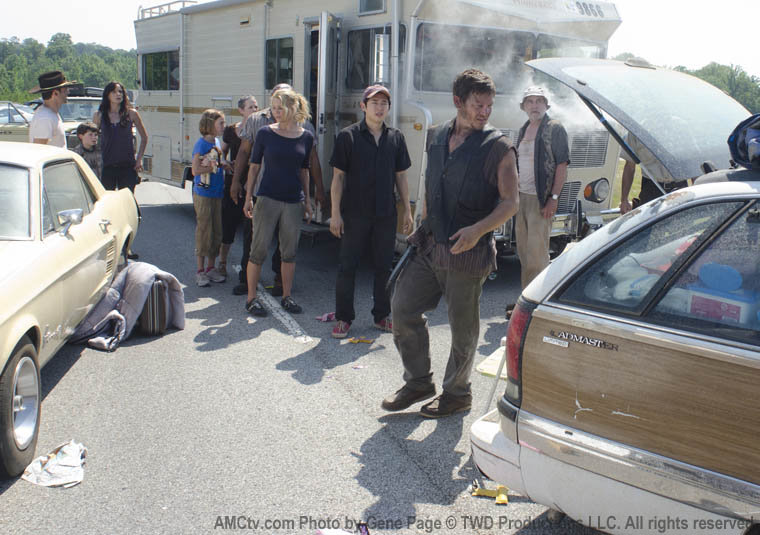
With this fourth episode titled “Vatos” we get Robert Kirkman writing not as a comic book writer but as someone who knows its a new medium and must write accordingly. In what I consider the best episode since the Darabont written and directed pilot, Robert Kirkman has shown just why millions of fans have flocked to read the comic book and why millions more have fallen in love with it’s tv adaptation.

The episode begins with a beautifully shot prologue of Amy and Andrea sitting in a boat fishing in the quarry lake and reminiscing about their father. It’s a nice tender moment which takes on a sad note as they finally voice every survivor’s fear. Are their parents alive? Maybe where they lived wasn’t hit hard. It’s survivor’s guilt to the nth degree as we and these characters know that the odds of any of the camp’s loved ones in far off places being alive are miniscule to none.

We also see a disturbing portent of what may yet come to pass as Jim, the mechanic from the past episode, seem to be losing his edge. It falls to Dale to notice Jim’s erratic behavior and then down to Shane to take care of things before Jim finally goes over the deep end and hurts not just himself but everyone else. I liked how Jim’s little revelation about what happened to his family arrived quite naturally and the effect it had on Lori and the others. Lori, Carol and Andrea may still have a semblance of a family, but Jim is the prime example of someone who has lost everything and may not have anything left to live for.

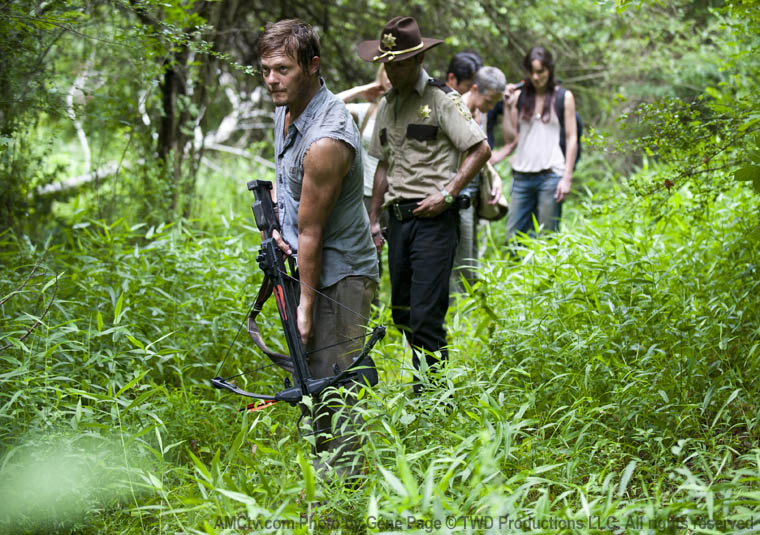
Now, we ended the third episode with Rick and his little band of Merle rescuers finding their quarry missing and not just from the roof but the hand he was cuffed with. We see the aftermath of Merle’s improbable, but quite the badass, escape from the roof. While we don’t see Michael Rooker as Merle in this episode his presence looms over everything and everyone. It’s during Rick and the groups attempt to find not just where Merle went but also the bag of guns Rick dropped in the pilot episode that we finally meet the episode’s title characters.

At first, it seemed like another attempt by Kirkman and the writers to drop stereotypical characters into an already crowded plate. Latino gangbangers becoming an immediate threat to Rick and his group. They even had a smooth-talking and intelligent leader that some may see as the show’s attempt on the typical drug lord. The confrontation between the two groups don’t come off so smoothly the first, second and third time, but it takes the intervention of the kindly grandma-type to ease the tensions. Tensions which reveals that people shouldn’t judge a book by it’s covers.

I definitely think this is like Kirkman’s shot across the bow of his detractors who think he cannot write beyond wordy exposition. The dialogue in this episode was some of the strongest and I’d say just slightly above of the pilot’s. There were more characters involved with two paralleling storylines to manage. Kirkman has shown with this episode that he actually knows the concept of “less is more” and that his true calling may not be writing comic books but writing teleplays for tv. I wouldn’t mind if all the episodes of The Walking Dead were written by just Darabont and Kirkman. I truly believe that this episode won’t be last time we see a Kirkman-written episode and that’s a good thing to look forward to.

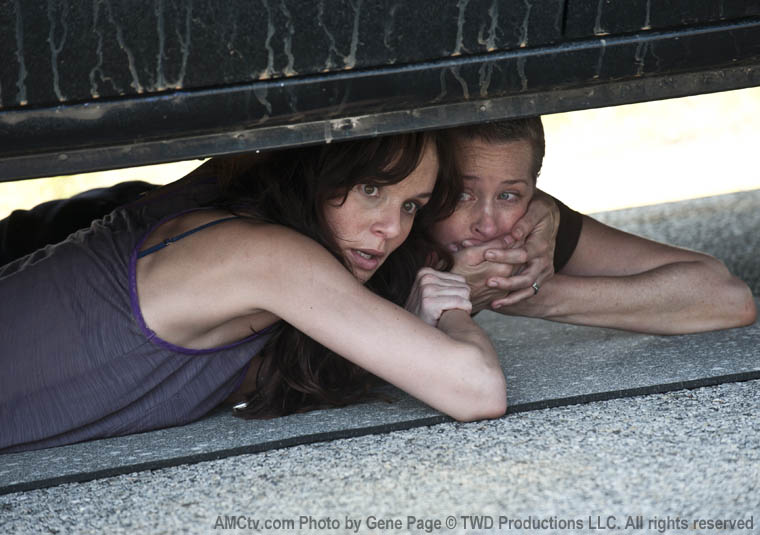
In the end, “Vatos” more than lives up to the high standard the pilot episode set. It was an episode which was able to combine not just the dramatic interaction between character and groups (and not just conflicts, but the quieter moments) but also the very zombie mayhem and carnage fans of the genre expect the show to have. The episode which begins so calm and serene ends on a horrifying and sad way. This episode has finally illustrated what the comic book was all about. A story and journey of survivors living day by day trying to retain a semblance of their old lives only to have the ever-present threat of the zombie apocalypse shatter such misguided attempts.

Extras

* KNB EFX founder Greg Nicotera makes an appearance as a zombie in the second-half of the episode.

* Merle Dixon never appearing on-screen but still ends up being the badass of the episode.

* Guillermo’s (leader of the Vatos) hounds from hell.

* “Admit it, we only came back to Atlanta for the hat” (Glenn seeming to be the one person in every episode with the witty quip and remark to lighten things a bit)

* Breakin’ Bad veteran-director Johan Renck’s masterful handling of the episode’s climactic scene in the camp.

* The show loses a regular character and one of the cardboard ones.


Review: The Walking Dead (EP03) – “Tell It to the Frogs”


[Some Spoilers Within]

Ok, the second episode of The Walking Dead was seen by some as being too much like every past zombie films and stories that’s ever been told. It was too much about the typical zombie siege of a group of survivors inside a building with little to no way out of the predicament. Now add in the elements of infighting within the group not to mention a dangerous wild card of a character and some viewers were turned off by it. The fact that the episode was one of the goriest episodes of any show ever put on non-premium cable never got much press.

One character introduced in episode 2 which really polarized viewers was the one played by veteran genre actor Michael Rooker. The character was one Merle Dixon and he instantly appeared in the show as an uncouth, loud, abrasive redneck racist that for some the only thing missing was the song “Dixie” playing in the background. I must admit that the character of Merle Dixon was written and introduced rather awkwardly, but to say that the zombie apocalypse wouldn’t include such blatant racists individuals have way too an optimistic view of humanity.

It is how we start the third episode, titled “Tell It to the Frogs”, that has redeemed the character of Merle Dixon to some skeptics. I wouldn’t say redeemed as in they accepted the racist but that he might still have a part to play in this 6-episode first season of the show. In the second episode Merle was left behind by Rick and the group handcuffed on the roof of the very building which was now overrun by “walkers”. Fortunately for Merle, T-Dog (who had happened to drop the cuff keys down the drain in his attempt to free Merle) had chained and padlocked the door to the roof to keep Merle from becoming the next sun-burned meal for the walkers. Unfortunately for Merle the chain and padlock had some slack to it that the door could be opened with enough of a gap for a walker to stick its head through.

Merle opens the third episode talking to himself as he reminisces about punching some Army officer in the past. Right from the get-go we see Merle might have lost his mind somewhat. But as soon as his trip down racist memory lane ends he finally snaps back to reality and realizes he’s cuffed to the roof, no key to the cuffs and the zombies as working their damndest to push the chained roof door wide enough to get through. Before the scene moves to the intro credits me last see Merle trying to use his belt to pull the steel hacksaw to him while praying and condemning Jesus in equal amounts.

That was some fine acting from Michael Rooker and was one of the highlights of the episode. While it still doesn’t answer the question of how such a racist was even with the group in the building, it does confirm that Merle might not be all there mentally. The appearance of his brother Daryl halfway through the episode and showing the younger Dixon to be as racist but not as unhinged reminds me of the two characters from Of Mice and Men except these two are of the racist variety. George being the younger Dixon and the Lennie role taken on by Merle. It’ll be interesting how these two new characters to the series will unfold as the first season rushes towards its conclusion. The scene in the end with Daryl finding the aftermath of Merle’s attempts to escape his cuffs was another fine moment in an episode that was more about character interaction and drama than about violence and gore (thought there’s some of that in the episode).

While the episode begins and ends with the fate of Merle Dixon the bulk of the episode was the reunion of the Grimes family and how Rick’s miraculous arrival has changed the camp’s group dynamics with Shane Walsh (Jon Bernthal in a performance which turned his character of Shane from hated “black hat” of the show to one that was a complex character who may or may not still be a simple “black hat”) and his wife Lori.

The scene where Rick slowly makes himself seen by the camp was very touching and showed hints of the love triangle the show will be exploring between Rick, Lori and Shane. The fact that Shane’s the first to see Rick and his expression turns from curiosity about who this new survivor was to one of shocked disbelief that the man he had spoken of as being dead has come back to his life. A life he seemed to be remaking with Lori as his partner and him a surrogate father to Rick’s son Carl. The reaction by Lori to suddenly seeing her husband back in her life healthy and alive ran the spectrum of surprise, shock and guilt.

Even the complex reactions from Shane and Lori didn’t diminish the heartwarming reunion between father and son as Rick literally fell to his knees in tears to hug his son Carl. That scene definitely was a tearjerker for many and Lincoln’s performance was very believable. One could almost see the burden and tension drain away from Lincoln’s Rick. The goal he had set for himself since episode 1 was now complete and nothing else mattered at that moment.

The show did have some moments which showed Darabont and the writers still feeling their way around Kirkman’s source material. One of it being the introduction of an abusive husband for one of the book’s regular faces in Carol. In the book the husband was only  mentioned as not having survived the trip to Atlanta but no mention of him ever being abusive. Like the introduction of Merle in the previous episode, the appearance of Ed as the caveman husband was done too haphazardly. Almost like someone out of stereotype casting call, Ed bullied his way around the women in the camp until Shane had to step in and put on an epic beating that added some depth to the character of Shane but also made one wonder if the addition of Ed was just as a way to give Shane an outlet for the anger and frustration he was feeling from the return of Rick and the subsequent frosty attitude by Lori towards him.

In the end, “Tell It to the Frogs” was a much stronger return for the show after a second episode that some thought was being too stereotypical of a zombie story. I enjoyed the second episode but understand why some reacted to negatively to it after such a powerful initial pilot episode. The crew of Darabont, Kirkman and the other writers definitely have a balance to do between dramatic storytelling and zombie mayhem as the show continues through this first season and into the next. While some of the characters, both new and old, do seem too one-dimensional and more like plot devices for the main characters the show is only in its third episode and to judge the whole thing on such a small sampling is not fair to the show and the people behind it. I think the show has hit a nice balance of drama and mayhem. Time will tell if the show will live or die by balancing the two or finally landing on one side or the other.

PS: Oh yeah, anyone who happens to be fans of Bambi and her mom will have a hard time watching this episode.

Review: The Walking Dead (EP02) – “Guts”


[Some Spoilers Within]

The second episode of The Walking Dead just aired and while it didn’t have the emotional impact the Frank Darabont-directed pilot episode had it still more than held its own. It was an episode that more than lived up to it’s title and for zombie fans and gorehounds this episode should assuage any thoughts that the series will be heavy on emotional themes and scenes while lacking on any sort of zombie mayhem and bloody good horror (shout out to the Bloody Good Horror Crew). With an apt title of “Guts” the follow-up episode of this series looks to move the story forward now that we’ve gotten some of the basics of this new zombie apocalyptic world and its rules out of the way in the pilot episode.

When last we left our intrepid hero, Rick Grimes, he had gotten himself into quite a pickle. Mode of transportation was now chow for the zombies he had cantered into and he was now stuck inside a tank with no idea of how to get himself out of the situation until he hears a voice over the tank’s radio. One would think that we’d see the start of the second episode starting up from this very last moment in the pilot, but instead we get a quieter, but more disturbing sequence to begin the show. It involves Rick’s wife Lori out in the woods near their make-shift camp outside Atlanta. The scene is set-up to almost be a jump scare scene and for some I’m sure the pay-off in the end probably made them jump, but instead we get another glimpse into Lori Grimes’ current situation and expands on what she has been doing since leaving their Kentucky town with her son Carl and Shane Walsh, Rick’s partner. This opening scenes really paints Lori in a bad light and I’m not sure it needed to be handled so heavily. I’ll reserve a bit of judgement on this development on Lori and Shane as characters. The pilot episode seem to have hinted to something like this maybe happening already before the zombie apocalypse dropped in their laps which would definitely diverge this series from the original comic book source. Only time will tell if the planned triangle-drama will pay off in the long-run or ruin a major character’s growth with audiences in this show’s future.

This brief interlude leads up to where we last left Rick and his mysterious friend on the other end of the tank’s radio. From the moment this scene starts the show puts the episode on high gear and never lets up. The pilot episode was all about quiet desolation and isolation for our main character. This second offering is all about adrenalin and desperation as Rick goes from one dangerous situation into another. We also get to meet his benefactor who had been helping him by way of radio. In a role that should make Steven Yeun a fan favorite at comic book and fan conventions starting now, we meet a fan favorite of the comic book.

The character of Glenn has always been one of the constants in the comic book series. He has been with Rick since the very beginning and while his character doesn’t have the emotional and/or dramatic gravitas as the others he does prove himself to be voice of reason when everyone around him seem to be on the verge of losing their minds from the constant barrage of danger not just from the zombies but from other people as well. It was good to see Glenn portrayed early on as the snarky character the original source material had him before he become just a tad domesticated as the series went along. The fact that he was the one who seem to know how to truly survive in this new world while those around him seem to be making mistakes after mistakes should make fans of his character very happy.

We meet the rest of Glenn’s group which includes original character from the comic book in Andrea with four new additions created just for the series. All these new characters almost have “red-shirt yeoman” tattoed to their foreheads with the exception of Michael Rooker’s blatant racist redneck role of Merle Dixon. Rooker takes this over-the-top character and drives it into the ground. I thought the character could’ve used just a tad bit of subtlely in how he was written, but Rooker definitely looked liked he was having fun with the character. In any other actor’s hand the character of Merle Dixon would’ve looked just foolish, but the Rook’s manic intensity in playing the role made me hope the situation the group left him in wouldn’t be the last we see of Merle. Rook needs to get some more screen time to either play his character’s racist personlaity to the very end or at least time to round him out a bit before he finally gets his just desserts.

Laurie Holden as Andrea seemed like she was still searching for her character’s main focus. We find out that her younger sister is back at the camp with Lori and Shane and that she’s very knowledgeable with firearms. Her Andrea also seem to be slightly prone to panicking (though with zombies having destroyed one’s world panicking seems like a natural thing to do). I hope Daradont and his writers (Robert Kirkman being one of them) don’t mess with Andrea too much, but just expand on the type of person she is and how it will grow in time to be the Andrea everyone who are fans of the comics see as one kick-ass lady.

Now, the aforementioned episode title and what it means. It literally means guts. One could see the word used metaphorically to describe Glenn’s character finding his inner courage to follow Rick into one crazy and dangerous plan to save everyone in the group. Or one could see it in the way everyone who saw the episode saw it. Rick, Glenn and their group hacking a zombie to pieces to use it’s guts to camouflage themselves. This sequence is in line with how the comic book handled it but was moved up in the story’s timeline. This slight adjustment tells me that Darabont and crew look to be mixing and matching some of the original source’s narrative to create something more dramatic on the tv screen. Either way the sequence was the best one in the episode. It had the gross out factor zombie and gorehounds love. It also had tension and white-knuckle terror as we wonder if their trick will fool the zombies and when nature throws a curvebal their way while their in the middle of a horde I could almost sense millions of viewers shouting at Glenn and Rick to drop their shit and run (for people in the same situation they may literally drop their shit before running).

While the second episode didn’t have the quieter and emotional moments as the pilot episode it did have the adrenalin boost some horror fans were missing from the first one. Some have called this episode a let-down from the pilot because it played off as your typical zombie siege story. From group members bickering to rehashing scenes from other zombie films to solve their problem. I can’t say I disagree with them, but I didn’t see it as being a bad thing. I understand some critics and non-zombie fans want something new and fresh to be done in the zombie genre. Again I wholeheartedly agree, but one also cannot forget that this is a zombie horror series and zombies will still be on the forefront of what makes the show tick. A zombie story with no guts and in-group bickering is not a zombie story. How they handled it in this episode show that the writers know how to take the usual zombie story tropes and do it well.

Now, if the series is just all about gore or interpersonal drama then it will lose people. The writers definitely have their work cut out for them about balancing what horror fans want and what fans of dramatic storytelling want. So far, they’ve done a good job, but with four more episodes left in this freshman season the question now is will they be able to pull it off and end the season on a high note. Official word that AMC has announced the series has been renewed for a second 13-episode season should make fans of the show happy and make the writers get somne of the burden off their shoulders. They now have some leeway in terms of time to go at their pace. I  do think even episode that skew more towards the dramatic need at least a couple exploding headshots and one gore scene just to keep the horror fans sated til the next gore-heavy episode.

Extras

This episode also had some memorable lines to remember and repeat…

Glenn: “He’s also an organ donor.” (right before Rick takes a fireaxe into one of the truely dead “walkers”)

T-Dog: “Yeah, dead puppies and kittens.” (after Rick tells a visibly sick Glenn to think of puppies and kittens to take his mind off the gore)

Rick: “We need more guts.” (realizing that he and Glenn need more zombie guts and viscera after already wearing almost a full body suit of it. Still best line of the episode.)

Review: The Walking Dead (EP01) – “Days Gone Bye”


[Some Spoilers Within]

It took just a little over 7 years from the time the first issue of Robert Kirkman’s zombie apocalypse comic book series was first published to the airing of its tv adaptation’s first episode. Who could’ve thought that a tv show (even one appearing on a channel with very mature and edgy shows like Mad Men and Breaking Bad) about a zombie apocalypse would ever make it on the small-screen. When I say make it I mean with all the violence and gore intact in addition to some very smart and emotional storytelling.

Now here we are just a little after Halloween, 2010 and the premiere of Frank Darabont’s The Walking Dead has finally completed airing it’s pilot episode to all of North America (Europe will get it’s own premiere a few days later). The series is the brainchild of Darabont and producer Gale Anne Hurd with Robert Kirkman on-board as executive producer and the source of all that is “The Walking Dead”. To say that the pilot episode was a wonderful piece of filmmaking and storytelling would be an understatement.

The pilot episode begins with a prologue showing a lone sheriff’s deputy with gas can in hand walking amongst the empty and abandoned vehicles parked every which way around a long gas station. We see the detritus of this makeshift camp’s former inhabitants. Every this deputy look he sees torn down tents and ripped blankets and sleeping bags. The camera even does a gradual sweep and pan on abandoned children’s toys and dolls. Before we even start to ask what happened to the people of the camp we finally see the first dead bodies as they molder inside some of the vehicles with flies flitting on and off the rotting corpses.

A sign proclaiming to anyone that the station has “NO GAS” dashes whatever hopes the deputy has of finding any. Before leaving to search the cars themselves a noise behind stops him. He looks down to find where the footsteps he heard might be and sees a pair of small, rabbit-ear slippered feet walking slowly before the figure bends down to pick up a ragged teddy bear off of the ground. One could see on this deputy’s face a sense of relief that he’s not alone and has found another survivor. But his relief doesn’t last as the small figure of the girl turns around to show the ravaged and bloody wound on her face plus the glossed over eyes of the dead. We finally see our first zombie and it happens to be a little blond-haired girl. How he deals with this zombified little girl definitely sets the tone for what coudl be one of the best shows on tv this season and, perhaps, beyond. It’s not the norm to see a little girl (even if she is one of the walking dead) get shot in the head with blood spurting and the back of the head exploding on tv. Darabont’s The Walking Dead will not be pulling any punches and dares the audience to stay and hold on for the ride to come.

The episode flashes back after this great opening to show the sheriff’s deputy in a more mundane time. He’s Rick Grimes (played by British actor Andrew Lincoln) and we learn through a back and forth with his partner Shane Walsh (Jon Bernthal) that he’s an introspective man who seems to love his wife and son, but like most marriages when one parent is a cop the  dangerous nature of his job has strained his relationship with his wife. This quite interlude gives way to a shoot-out with some criminals at the end of a car chase and crash where Rick gets seriously wounded and landing him in the hospital. Rick seems aware of whats going, but in fact he’s been under a coma for a month or more and when he finally wakes its not to the mundane world he left behind when he was under but one irrevocably changed for the horrific.

Darabont’s cinematic touches could be seen in the sequence in the hospital where Rick explores the empty and darkened hallways and corridors looking for anyone. This entire sequence tells me that Darabont knows how to milk a scene for tension and horror. His camera doesn’t linger on any particular bloody mess but just enough to convey the realization dawning on Rick’s mind that he just stepped into a nightmare. The decision not to use any sort of music to score this section of the episode just added to tension and built up dread. The part where he finally goes into the lightless exit stairwell has to be one of the scariest sequence on tv or film this year, bar none.

The rest of the episode sees Rick learning more and more of this new world he has woken up in. It’s not a nightmare though it definitely counts for one albeit a real one. His fortuitous run-in with survivors in the father and son duo of Morgan Jones (excellently played by another British actor, Lennie James) and Duane Jones becomes the audiences way of learning the basic rules of this new world. The recently dead are not staying dead but returning to some sort of life with little intelligence but with a voracious need to feed to people (and later we find out even animals).

While the word zombies was never uttered audiences know what they are whether they’re called “walkers”, “lurkers” or “roamers”. They could only be killed by destroying the brain (either by bullet or smashing the skull with whatever’s handy). They’re also quite slow and easily avoided when spread out in small singles or two’s but deadly when in a herd-like group and all riled up and hungry. Rick takes all of this in as stoically as possible (something the character in the comic book does as well), but in the end all he wants is to find his wife and son. Which the episode doesn’t answer, but his journey to where they might be leads to one of the best cliffhangers for a pilot episode. A cliffhanger that should hook even the least fan of zombies. All I can say is poor Seabiscuit.

The performances by all the actors we get to see in the pilot episode ranges from excellent (Lennie James) to very good (Andrew Lincoln) to the jury is still out (Sarah Wayne Callies and Jon Bernthal). This episode really hinges on Lincoln’s work as Rick Grimes and he pulls it off despite what some were calling as a very bad Southern accent. I did’t notice and I’ve been around people who spoke with Southern accents and dialects that I think I could tell when one was bad or not. I think fellow blog writer Lisa Marie being from the South would have a better perspective on how good or bad Lincoln’s Southern accent was in this first episode.

It’s Lennie James as Morgan Jones who shined in this pilot episode. He did outshine Lincoln in their scenes together and he added several layers of characterization to a secondary character in the comic book series who only appeared in the first couple issues before disappearing for most of the comic’s current run until recently. It’s his work as Morgan Jones which gives me some hope that Darabont and his writers will deviate from Kirkman’s comic book timeline and bring the character back sooner rather than later. It would benefit the series in the long run (and from the ratings numbers the pilot episode received I’m guessing this show will have legs).

But what would a tv series about zombies be if I didn’t talk about the zombie make-up and gore-effects. When news first filtered in that AMC was where Kirkman’s on-going zombie opus was landing for a live-action adaptation there were some trepidation from the book’s fans and just zombie fans, in general. How can a comic book that was nihilistic to its core and very violent (and gory when it required it to be) be able to truthfully translate to tv when it wasn’t being filmed for one of the two premium cable channels like HBO or Showtime. AMC was the home of very mature series like Mad Men and Breaking Bad. While both shows explored very mature and dark themes it’s only in some episodes of the latter title that very violent scenes were shown. In something like The Walking Dead the show is about violence and how it’s now the primary rule of the land. It’s a kill or be killed world and it’s not even the zombies who would be the most violent encounters Rick and his group would run across.

It’s safe to say that AMC has been true to their word that they would have a hands-off approach to how Darabont and compant will deal with the violence and gore of the series. They seem to understand that this is a zombie story and zombie stories have inherent in their genetic make-up violence and gore. The pilot episode showcases both in plain view with some of the best zombie make-up effects work from Greg Nicotero and Howard Berger of KNB EFX fame. I’ve seen hundreds of zombie films and I will say that the make-up work this pilot episode is some of the best ever done. The so-called zombie bike girl still impresses me everytime I see it on my tv screen. As for the gore well all I can say is poor Seabiscuit.

I would say that the pilot episode of The Walking Dead was a success in more ways than one. It was a success in that for the first time in American tv history we had a genuine zombie show on tv and the kind fans have been wanting to see for years. It was also a success in that fans of Kirkman’s book who were still leery about how well it would translate to live-action should worry no more. Darabont and his writers were true to Kirkman’s vision while still able to deviate here and there from the comics to help strengthen the dialogue and the story as a whole. Critics of Kirkman’s writing style should be loving just how well the series writers have worked out some of the heavy exposition from the comics to create what really is a leaner, but better story.

Here’s to hoping that AMC sees the numbers and general positive reaction from critics and audiences alike and do the right thing by greenlighting a second season with more episodes. The six for this first season is definitely enough to whet the appetites of old and new fans but we want more. The dead have come to to tv and I don’t see them going away anytime soon.

Review: The Walking Dead Volume 12 (by Robert Kirkman)


[Some Spoilers Within]

Tonight marks the premiere of Robert Kirkman’s widely-acclaimed and fan favorite zombie comic book series aptly titled The Walking Dead. The series has preeminent filmmaker Frank Darabont (Shawshank Redemption, The Mist) and genre-veteran producer Gale Anne Hurd producing the adaptation for AMC. So, it’s with the 12th volume in the collected series that I welcome the tv series.

“Life Among Them” sees Rick and his group of survivors (now less three of its original members and picking up a new one along the way in the previous volume) finally finding a semblance of a safe haven after the travails they endured at the hands of “The Hunters”. It has been a long and deadly journey for Rick and his people. The fact that the promise of a working government they had been moving towards was actually a lie from one of the new members wasn’t too much of a surprise to loyal readers of the comic. This is a group which has had its hopes dashed bloodily over and over that any good news they see as too good to be true.

This goes for the sudden arrival of a scout party from a walled-off community which promises the group safe haven with no questions asked. Rick, who has gone through such promises from a previous safe community, sees this offer with some suspicion and this brings forth another aspect of Rick’s personality which has changed from issue 1 to this volume. He has become paranoid and mistrustful of those not in his group and offers of safety and a respite from the grueling travels of the road he sees with suspicions eyes. But they accept this invitation and find out that this safe haven couldn’t be any different from Woodbury.

What they see inside the fortified walls could pass off as a slice of their former lives. A suburban-like community where people safely walk the streets at night and their kids play ball in the yards and streets without hints of danger. Leading this community is a former Congressman who had taken the stole of leadership and keep the haven running smoothly. All he asks of Rick and his people is that they contribute in some way to help continue the community’s expansion in some way. Rick returns to what he did before the fall of civilization and patrols the streets as the town’s constable. Michonne thinks it is now safe for her to put away her sword. Even Andrea has caught the eyes of more than one of the town’s many single men. Even Abraham has pitched in to become part of the work detail whose job is to go out and find building supplies to help strengthen and expand the walls.

All seems to be working as it should with everyone safe. The first sign that not all is what it seems is the mention of a name. A person who helped organized the building of the walls, but who seems to have become “HE WHO MUST NOT BE NAMED” to everyone Rick and his group meets inside the haven. The town’s leader also seems to hold secrets of his own. Rick senses the dark undercurrents permeating the town’s vibe and in a sequence right at the end of the volume we see just how damaged Rick has become since we first meet him in issue 1.

While the volume doesn’t go heavy on the zombie action it does a great job in setting up what could be another major story-arc coming in the subsequent volumes. Will Rick and his people learn the secrets the town has been keeping from them? Will Rick become what he despises the most in trying to keep his son and his group safe from the dangers of the outside and what he perceives as dangers inside as well? This volume is almost the calm before another shitstorm about to hit the group and this time will the butcher’s bill be as large as the one which was tallied in the end of the 8th volume.

Song of the Day: Halloween Theme (by John Carpenter)


The penultimate choice for this week’s horror-themed “Song of the Day” feature brings one of the best theme songs ever composed and put on film. I am talking about the Main Title theme for John Carpenter’s classic horror film (also one of the best grindhouse films ever made) and one which launched a whole new horror subgenre with Halloween. This theme would become synonymous with the “slasher film” that when the many copies and imitators of the film came out in droves a year later they would try to replicate this keyboard synthesizer-based theme and fail miserably.

It’s actually a pretty simple theme. Carpenter composed the theme as a piano melody played in a 5/4 meter that even the most novice piano player could play with ease. This theme could be heard throughout the film whenever Michael Myers appears and/or in the vicinity. Some have even started calling it the Michael Myers theme and they wouldn’t be far off. It’s become the film’s leitmotif that Carpenter ends up relying on it to set the mood and tension in the film. Other kids of songs could be heard throughout the film but outside of the Blue Oyster Cult’s “Don’t Fear the Reaper” the rest of the score is forgettable until this theme kicks in.

This theme will be the final of the instrumental themes for the week. With one more day left in this special week-long horror-themed week for “Song of the Day” the last one will definitely usher in another awesome Halloween and help kick off the premiere of what will probably be the best thing to ever grace the tv screen past, present and future.

Song of the Day: Tubular Bells (by Mike Oldfield)


I remember being very young and getting the chills and scares whenever I heard the opening notes to the fifth entry to the week-long horror-themed “Song of the Day” feature for the site. Even now into my third decade I still get a bit of the willies whenever this song comes on TV, cable or I happen to click on the video on YouTube. The song I’m speaking of is the opening theme to William Friendkin’s horror masterpiece, The Exorcist.

The theme was composed by English musician Mike Oldfield in 1973. “Tubular Bells” is actually an epic piece of progressive rock music which is actually split into two parts. It’s the first part which was chosen and slightly reworked by Oldfield himself to become the opening theme to The Exorcist. This particular theme has become one of the most iconic film themes in cinema history. I’m not just talking about in the horror genre but in all of film.

A person who has never seen Friedkin’s masterpiece about a young girl possessed by the Devil and the ritual which happens soon after will know the theme once they hear it. The theme is literally played on the same name musical intruments. While the original has a more baroque sound with some synth manipulation added to the overall tone, the one used for the film definitely has a more progressive/synth rock to its tempo and tone.

In the end, this chosen theme for the day will be continue to scare and terrify old and new audiences of The Exorcist. Just looking at the video above with just the fog-shrouded Georgetown brownstone in the foreground and Father Merrin just standing there looking up at the home then having the theme playing would make even the most God-less person want to start praying for their eternal soul.

Song of the Day: East Hastings (by Godspeed You! Black Emperor)


We’re now halfway through the week-long horror-themed “Song of the Day” feature and the first three days has been all Italian composers. Two of them were known for working in the grindhouse film scene while the other has been more well-renowned for having worked in spaghetti westerns and more mainstream, albeit very artful, film projects. The fourth selection in this fourth day of the series is the epic song “East Hastings” by the Montreal-based eclectic band Godspeed You! Black Emperor.

“East Hastings” was chosen because of not just its apocalyptic sound and tone, but also how it was used in an excellent way to highlight the desolation in Danny Boyle’s “zombie-faux” film, 28 Days Later.

The song begins after a brief prologue and shows Cilliam Murphy’s character walk the deserted and silent streets of London after waking up from a coma. His lost and dazed travel through the empty streets and by-ways of England’s capital was quite haunting and the song by GY!BE just added to the tension building up on the screen. If there ever was a song that typified the British viewpoint about how the world ends it would be “East Hastings”.

Anime You Should Be Watching: Higurashi no Naku Koro ni


Believe it or not, originally I was brought on to be the anime guy. Granted, I haven’t always been the most active of people, but that’s my natural laziness taking over. But with the season being what it is, and me having drank enough, allow me to enlighten everyone about one of the finer horror anime out there, Higurashi no Naku Koro ni.

Previously Arleigh had posted up another yandere classic, School Days. The Higurashi visual novel predates said visual novel by three years. The big difference is that while School Days was a fairly well funded project (with many, many bugs in it!) and Higurashi was basically a doujinshi project.

Let me explain doujinshi for a very little bit. A lot of people make the mistake that doujinshi instantly equals porn comics. Now, if you attend Comiket, which is the single largest doujinshi convention in Japan, you could be excused for thinking that it’s all about comics, and more importantly, comics that solely deal in erotic content. However, doujinshi basically just means “self published”. Again, not a literal translation. You want literal? Fine. The literal translation is “same person periodical publication”. Basically this can be taken to mean a project taken on by someone without the financial backing of the mainstream media. This could mean either comics, games, or even anime. Yes, the more common genre are the comics, but there is a fairly decent market for self published games. Higurashi falls under the blanket of the self published games.

But if you can get past the rough character designs,  (keep in mind that the true meat of the game comes from the story, not the graphics) then you’re in for a very good story with many a twist and turn along the way.

One thing I must say, based on the experiences I’ve had with people is that you should probably watch the anime first. Perhaps I’ve just been subjected to extremely rabid fans, but too many of them have an irrational hatred of the anime. I’ll accept that there is a chance the complaints are valid, because I have not personally played the visual novel (you play them, not read them. Trust me on this) but having seen all of the anime, even if the transition is not perfect, it’s still a fun watch that will keep you guessing right up until the answer arcs are shown.

Each arc starts out in a very light hearted manner, but make no mistake, this is a horror series at its core.  The fact that such cute girls are at the center of it all makes it seem all the more horrific, especially with the actions that are taken throughout the various arcs.  While it’s very difficult for anime to effectively show gore without getting to the ridiculous buckets of blood level, Higurashi manages to be very effective in its depictions of it, and some scenes are actually a bit shocking to see.

The thing is, you have to watch both seasons of the show, Higurashi no Naku Koro ni, and Higurashi no Naku Koro ni Kai, to get the true ending and find out the reason for all the happenings in the town of Hinamizawa during June of 1983, but it is well worth the time spent, and shows that anime can successfully pull off the horror genre.

Anime You Should Be Watching

Song of the Day: Humanity Part II (by Ennio Morricone)


Day Three of the week-long horror-themed “Song of the Day” feature brings us one of the greatest pieces of film music ever composed. I’m talking about the score for John Carpenter’s remake of The Thing from Another World. The remake retains only the first two words of the original’s title, and that alone speaks volumes.

At first listen, one might mistake this music as being composed by John Carpenter himself—an accomplished film composer in his own right, known for scoring most of his own films. Its similarity to his iconic Halloween theme and even his earlier work on Assault on Precinct 13 makes the connection understandable. But one would be wrong to assume Carpenter had a hand in writing it. For the first time, Carpenter allowed someone else to compose the score, and for the task he selected none other than the Italian maestro Ennio Morricone.

By the time he collaborated with Carpenter on this sci-fi horror masterpiece, Morricone was already firmly established as one of the great masters of film composition. Audiences knew him best for his legendary work on Sergio Leone’s “spaghetti westerns” as well as numerous classics of Italian cinema. While Morricone’s full score for The Thing deserves a complete discussion of its own, I’ll focus on the one track that most powerfully captures the themes of horror, isolation, dread, and paranoia that make Carpenter’s film such a landmark: “Humanity (Part II).”

The piece opens with a heartbeat-like sequence that pulses steadily through most of its length. Strings layer on top of this rhythm, creating a mournful, dirge-like quality, while the bass thump lurks ominously just beneath the surface, as though danger is present but unseen. For much of its runtime, the music exudes a stark sense of emptiness, forcing the listener into the same suffocating isolation as the characters onscreen, stranded in the vast Arctic wasteland. The repetition and looping structure almost feel like a trap, with no release or resolution, mirroring the crew’s paranoia as suspicion and fear close in tighter than the snowstorms outside. Each cycle draws the listener deeper into a psychological cage, heightening the dread with its unrelenting stillness.

It isn’t until the final two minutes that the track breaks from its oppressive restraint. Here, Morricone channels Carpenter’s trademark minimalism with unsettling synthesizer tones, jagged and piercing against the steady backdrop. The music shifts from mournful to dissonant, almost alien, capturing the horrifying essence of the creature in its most grotesque form. This sharp intrusion is not just an auditory shock but a symbolic transformation—the moment when the lurking horror finally emerges from shadow into focus, confirming that the paranoia has been justified all along. It is this careful build, held back until the very end, that demonstrates Morricone’s mastery at fusing Carpenter’s sensibilities with his own, delivering a piece that is both restrained and devastatingly effective.

There’s a reason so many film aficionados cite Carpenter’s The Thing as one of their all-time favorites. Its reputation owes much to Carpenter’s skill as a filmmaker and editor, but Morricone’s score plays an equally crucial role in shaping the film’s atmosphere. “Humanity (Part II)” stands as one of the finest pieces of horror film music ever written.