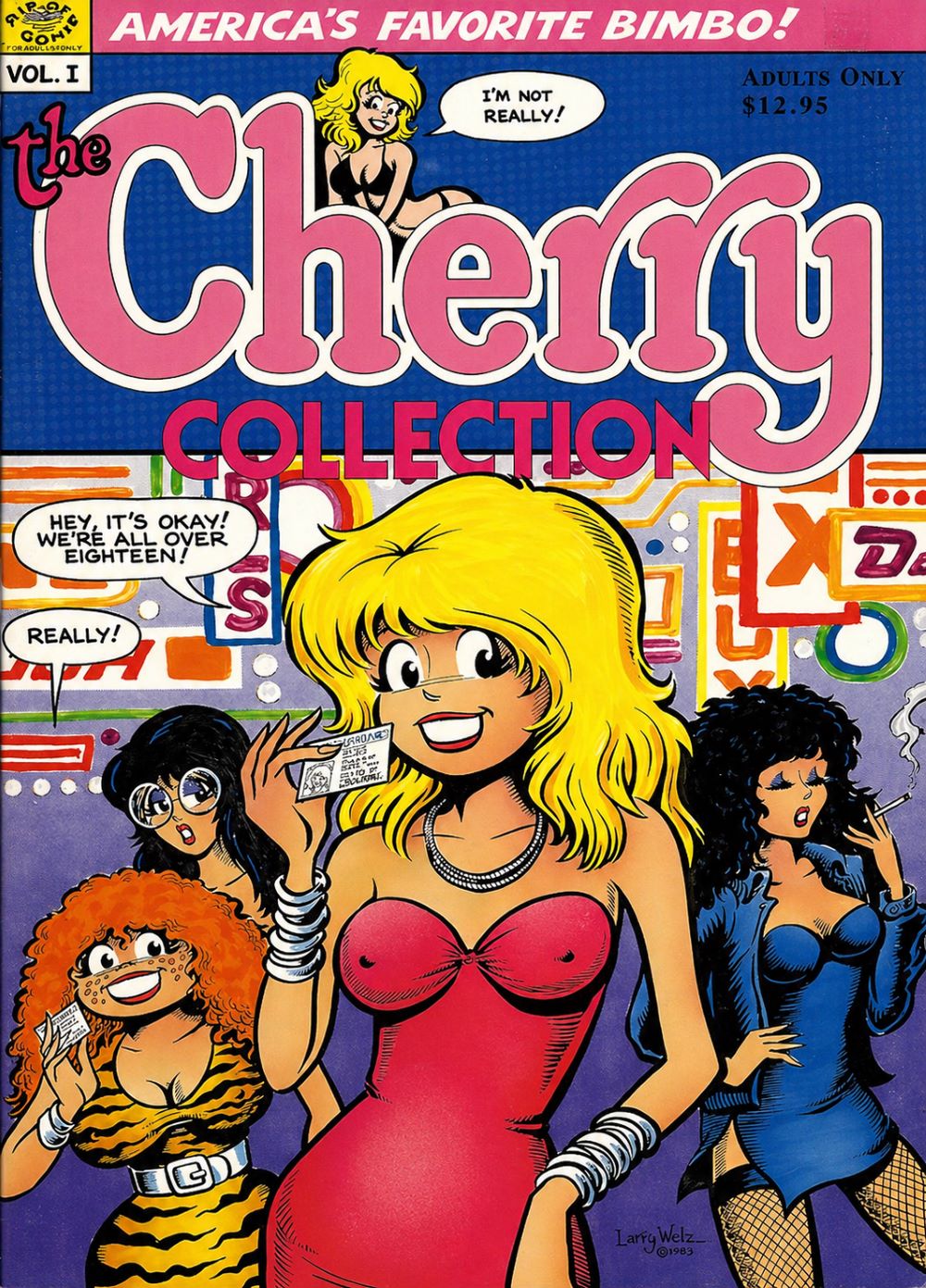
Guilty Pleasure No. 113: Cherry (by Larry Welz)


In the sprawling, often grimy landscape of underground comics, few characters have managed to carve out as distinct—or as controversial—a niche as Cherry, the perpetually eighteen-year-old protagonist born from the mind of cartoonist Larry Welz. Originally debuting in 1971 under the moniker Cherry Poptart, the character became a fixture of counter-culture erotica, eventually settling into a self-titled series that would span decades. Welz’s work was instrumental in helping to usher in the vibrant, anarchic underground comics movement in San Francisco during the tumultuous social and political landscape of the 1960s and 1970s. Engaging with Cherry today is an exercise in complex appreciation; it is the definition of a “guilty pleasure,” a work that exists at the intersection of satirical wit, overt hedonism, and a stylistic homage to the quintessential American comic book aesthetic.

At the core of the series’ appeal is the striking contrast between its visual presentation and its mature, often raunchy subject matter. Welz famously adopted an art style that directly mirrored the work of Dan DeCarlo, the legendary artist who defined the iconic look of the Archie comics. By utilizing the clean, “happy teenager” lines of mid-century Americana—often associated with the wholesome, classic adventures of Riverdale—and infusing them with unrestrained, sex-positive, and frequently explicit content, Welz created a powerful visual dichotomy. This deliberate juxtaposition of a quintessential teen comic aesthetic with an adults-only narrative creates a jarring, transgressive experience that makes the work particularly effective as a guilty pleasure. There is an undeniable, subversive thrill in seeing character designs that evoke the innocent charm of Betty or Veronica placed in scenarios that would have sent the strict mid-century Comics Code Authority into a tailspin.

The character of Cherry herself is a fascinating, if problematic, focal point. Defined by her insatiable curiosity, liberal attitude, and complete lack of inhibitions, she is less of a traditional narrative character and more of an agent of chaos who wanders through various high-school-adjacent tropes. Because she remains eighteen, the series avoids the weight of traditional character growth, opting instead for an episodic format where the pleasure is derived entirely from the immediate situation—be it a pop-culture parody, a bizarre social commentary, or a sexual escapade. While the series is categorized as erotica, to dismiss it solely as such is to overlook the sharp satirical edge that occasionally pokes through the panels. Fans of the underground and transgressive culture scene often point out that Cherry frequently served as a vehicle for Welz to comment on the broader socio-political zeitgeist of the era. By utilizing the “anything goes” freedom of the underground press, the series tackled issues and social norms that mainstream comics dared not touch, masking biting critiques within its provocative and irreverent framing.

This thematic depth, however, exists in tension with the repetitive nature of the stories. As a guilty pleasure, the series relies on a specific cadence: the setup of a conventional trope, the predictable introduction of sexual absurdity, and the punchline. For the dedicated reader, this repetition is comforting and familiar, but it is also the source of the series’ main weakness. There are moments where the narrative feels like it is running on fumes, and the reliance on sexual shock value can feel stagnant compared to more modern or structurally daring indie comics. Furthermore, admitting to enjoying Cherry in a contemporary landscape is complicated by how the series has—or hasn’t—aged. Much of the humor and the treatment of gender dynamics feel firmly rooted in the specific, often male-gaze-dominated world of mid-century underground comix.

Consequently, it is a work that requires a reader to compartmentalize; one can admire the historical significance of Welz’s contribution to erotic art and the audacity of his stylistic parody while simultaneously acknowledging that the execution of certain themes feels archaic. This is why Cherry remains a quintessential guilty pleasure. It does not aim for the lofty aspirations of a graphic novel masterpiece, nor does it try to serve as a beacon of progressive morality. Instead, it succeeds as a piece of “low-brow” entertainment that is proud of its own transgression. The inclusion of guest work, such as a rare script by Neil Gaiman in Cherry Deluxe, highlights that the series was often respected within its own subculture as a legitimate, if edgy, playground for creative expression.

Looking back, the series acts as a testament to the “anything goes” ethos of the underground press era. While there are certainly other adult-oriented comics that might offer more robust character arcs or sophisticated storytelling, few manage to balance the specific blend of nostalgia, irreverence, and raw, unapologetic hedonism that defines the Cherry universe. It is a series that invites the reader to lean into the discomfort and find humor in the sheer absurdity of the scenarios. For those who enjoy exploring the fringes of comic history, Cherry remains a vital, if occasionally flawed, artifact. It represents a time when comics were a battlefield for free speech and a canvas for uninhibited adult fantasy. As a guilty pleasure, it holds up because it never pretends to be anything other than what it is: a fun, slightly reckless, and undeniably bold experiment in the possibilities of the medium.

Previous Guilty Pleasures

  1. Half-Baked
  2. Save The Last Dance
  3. Every Rose Has Its Thorns
  4. The Jeremy Kyle Show
  5. Invasion USA
  6. The Golden Child
  7. Final Destination 2
  8. Paparazzi
  9. The Principal
  10. The Substitute
  11. Terror In The Family
  12. Pandorum
  13. Lambada
  14. Fear
  15. Cocktail
  16. Keep Off The Grass
  17. Girls, Girls, Girls
  18. Class
  19. Tart
  20. King Kong vs. Godzilla
  21. Hawk the Slayer
  22. Battle Beyond the Stars
  23. Meridian
  24. Walk of Shame
  25. From Justin To Kelly
  26. Project Greenlight
  27. Sex Decoy: Love Stings
  28. Swimfan
  29. On the Line
  30. Wolfen
  31. Hail Caesar!
  32. It’s So Cold In The D
  33. In the Mix
  34. Healed By Grace
  35. Valley of the Dolls
  36. The Legend of Billie Jean
  37. Death Wish
  38. Shipping Wars
  39. Ghost Whisperer
  40. Parking Wars
  41. The Dead Are After Me
  42. Harper’s Island
  43. The Resurrection of Gavin Stone
  44. Paranormal State
  45. Utopia
  46. Bar Rescue
  47. The Powers of Matthew Star
  48. Spiker
  49. Heavenly Bodies
  50. Maid in Manhattan
  51. Rage and Honor
  52. Saved By The Bell 3. 21 “No Hope With Dope”
  53. Happy Gilmore
  54. Solarbabies
  55. The Dawn of Correction
  56. Once You Understand
  57. The Voyeurs 
  58. Robot Jox
  59. Teen Wolf
  60. The Running Man
  61. Double Dragon
  62. Backtrack
  63. Julie and Jack
  64. Karate Warrior
  65. Invaders From Mars
  66. Cloverfield
  67. Aerobicide 
  68. Blood Harvest
  69. Shocking Dark
  70. Face The Truth
  71. Submerged
  72. The Canyons
  73. Days of Thunder
  74. Van Helsing
  75. The Night Comes for Us
  76. Code of Silence
  77. Captain Ron
  78. Armageddon
  79. Kate’s Secret
  80. Point Break
  81. The Replacements
  82. The Shadow
  83. Meteor
  84. Last Action Hero
  85. Attack of the Killer Tomatoes
  86. The Horror at 37,000 Feet
  87. The ‘Burbs
  88. Lifeforce
  89. Highschool of the Dead
  90. Ice Station Zebra
  91. No One Lives
  92. Brewster’s Millions
  93. Porky’s
  94. Revenge of the Nerds
  95. The Delta Force
  96. The Hidden
  97. Roller Boogie
  98. Raw Deal
  99. Death Merchant Series
  100. Ski Patrol
  101. The Executioner Series
  102. The Destroyer Series
  103. Private Teacher
  104. The Parker Series
  105. Ramba
  106. The Troubles of Janice
  107. Ironwood
  108. Interspecies Reviewers
  109. SST — Death Flight
  110. Undercover Brother
  111. Out for Justice
  112. Food Wars!

Anime You Should Be Watching: Chōjin Densetsu Urotsukidōji


Hentai: slang for the Japanese term “hentai seiyoku” which literally means sexual perversion. A word used by Western fans of anime to signify anime/manga as being of the pornographic variety.

In 1990, during my junior year of high school, I was introduced to a form of animation unlike anything I had known before—the darkly imaginative and transgressive world of hentai. While explicit Japanese media had existed long before, the particular title that marked my first encounter with the genre was Chōjin Densetsu Urotsukidōji. The work did not simply define hentai; it transformed how adult animation would be viewed by audiences in both Japan and the West.

Prior to its release, erotic or explicit manga had long circulated quietly within Japan, often categorized separately from mainstream entertainment. Yet when mangaka Maeda Toshio’s Chōjin Densetsu Urotsukidōji was adapted into animation by director Takayama Hideki in the late 1980s, something shifted. The result was a film that combined the grotesque, the apocalyptic, and the erotic into a single overwhelming experience. Takayama’s adaptation was not content to merely illustrate Maeda’s ideas—it amplified them into a fever dream of violence and desire that pushed the medium into territory rarely explored in animation.

This era in Japanese media was also defined by strict obscenity laws. Direct depictions of genitalia or explicit intercourse were prohibited, both in live-action and animation. To circumvent these limitations, artists employed mosaics or invented visual metaphors. Takayama approached the problem with disturbing creativity: he replaced human anatomy with monstrous, tentacle-like appendages. These served a dual purpose—they satisfied censors while reinforcing the story’s occult and otherworldly atmosphere. Inadvertently, this gave rise to one of the most infamous tropes in hentai culture: “tentacle rape.” What began as a method of evading censorship evolved into a symbol of perversion, horror, and fascination.

Though Maeda initially regarded Takayama’s interpretation as excessively cruel and sadistic, he expressed admiration for the director’s ability to explore the darker undercurrents of his story. In time, Maeda’s own works would adopt similar motifs, blending eroticism with the supernatural. His later projects—including Yōjū Kyōshitsu GakuenAdobenchā Kiddo, and the enduring Injuu Gakuen La Blue Girl—refined the sensibilities born from Urotsukidōji, mixing violence, humor, and demonic imagery. These works often shifted in tone but never strayed far from the genre’s defining combination of horror and sexual excess.

Chōjin Densetsu Urotsukidōji can best be described as a collision of disparate influences: the mythic nihilism of H. P. Lovecraft, the explicit confrontational style of Larry Flynt, and the occult transgression of Aleister Crowley, all underscored by the philosophical cruelty associated with the Marquis de Sade. The film’s narrative combines apocalypse with pornography, constructing a universe where gods, demons, and humans become locked in violent and erotic cycles of destruction and rebirth. It is both a nightmare and a spectacle, a work that examines desire as an extension of cosmic chaos.

Watching the OVA as a seventeen-year-old was an experience of shock and bewilderment. Nothing in my understanding of animation prepared me for it. The optimism and adventure of series like RobotechStarblazers, and Voltron stood in stark contrast to the nihilistic intensity of Urotsukidōji. If such a term had been common at the time, “culture shock” would have described it perfectly. Yet beyond my initial disorientation, I recognized something compelling beneath the shock value—a strange vision that treated eroticism not as mere indulgence but as a reflection of human fear and fascination.

Takayama’s film succeeded because it used obscenity as both spectacle and metaphor. The sexualized violence was horrifying, but it also emphasized the collapse of moral order within its world. The boundaries between sensuality and monstrosity blurred, suggesting that both sprang from the same primal source. In this way, Urotsukidōji transformed its limitations into aesthetic strength. Censorship forced invention, and invention created symbolism: the tentacle became an image of corruption, domination, and inhuman desire.

When Urotsukidōji began circulating in the West through VHS imports in the early 1990s, it acquired immediate notoriety. For many international viewers, the notion that animation could contain such extreme imagery was almost unthinkable. Western audiences, accustomed to animation as a medium for children or adolescent adventure, suddenly encountered a work that combined cinematic brutality with mythology and eroticism. Owning or viewing it became an act of curiosity and defiance. Accessing such media often meant seeking imported tapes or attending small conventions—a process that only heightened its sense of exclusivity and taboo.

Not everyone perceived Urotsukidōji as art. Its reputation became divisive; for some, it represented the most exploitative and grotesque tendencies of Japanese culture, while to others, it was a bold exercise in creative freedom. Regardless of one’s stance, its influence was undeniable. The film inspired countless imitators, establishing a visual and thematic template for subsequent hentai and “erotic horror” animation. Even as later works diversified into comedy, fantasy, and romance, the long shadow of Urotsukidōji remained.

There is also a deeper irony in its legacy. The same adaptation Maeda once criticized expanded the reach and visibility of his creation beyond what any manga publication could have achieved. The collaboration between artist and director—however fraught—produced a convergence of imagination that shaped both the erotic and horror dimensions of modern anime. In a broader sense, it demonstrated that the animated form could explore the same depths of transgression, myth, and existential dread that live-action cinema often reserved for its most daring auteurs.

Seen through this lens, Urotsukidōji becomes more than a piece of pornographic shock cinema. It emerges as a cultural artifact—one that reflects how desire, repression, and fantasy intersect within specific historical and artistic contexts. The work exposes how censorship and creativity can collide to produce unexpected invention, and how audiences, whether through fascination or outrage, help define a genre’s legacy.

For those of my generation, encountering Urotsukidōji was a defining moment that reshaped perception. It suggested that animation could express not only beauty and adventure but also the darker instincts of the human psyche. What began as disbelief evolved into a kind of reluctant respect for its ambition. Beneath the grotesque imagery lay a thematic depth that continues to invite examination—questions about power, violation, and the thin line separating horror from desire.

Today, both Maeda Toshio’s manga and Takayama Hideki’s adaptation occupy a controversial yet essential place in the history of Japanese media. They are remembered not only for their sensational content but for their cultural and aesthetic audacity. The story of Chōjin Densetsu Urotsukidōji endures because it refuses simplification—it is at once abhorrent and visionary, obscene yet strangely philosophical.

From the most ardent anime historian to the casual viewer, its reputation persists. Whether reviled or revered, Urotsukidōji remains the ultimate symbol of hentai’s origins and its infamous reach. It stands as both a warning and a testament: that art, when unfettered by convention and driven by instinct, can explore places society dares not name.