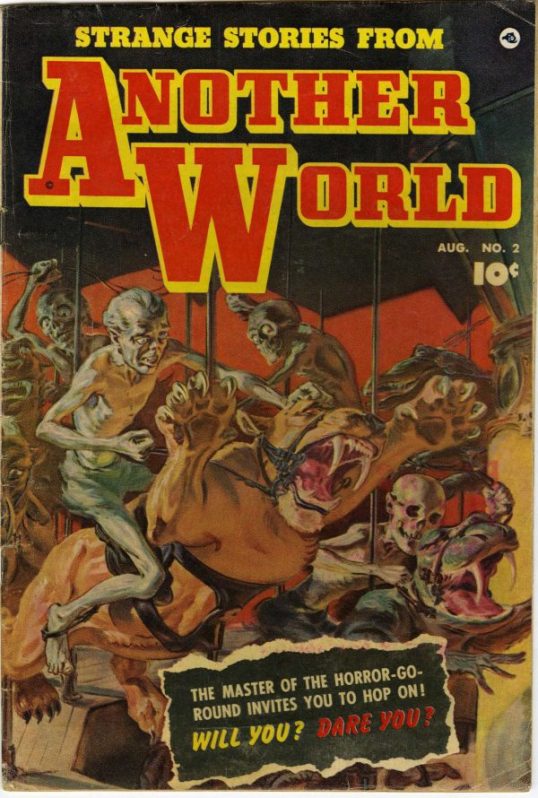
by Norman Saunders
by Norman Saunders
Are you in the Halloween spirit yet?
No?
Well, maybe this short music video from The Pretty Reckless will help you get into it!
Enjoy!

The first Skyline was better than I was expecting.
I never saw the second.
As for the third, it’s scheduled to be released on December 18th and here’s the trailer:
To help to continue to promote the holiday spirit, here’s an AMV of the Day.
Anime: shingeki no kyojin, bakemonogatari, high school of the dead, mirai nikki, another, dance in the vampire bund, deadman wonderland, kara no kyoukai, psycho pass, hellsing ultimate, shiki, tasogare otome x amnesia, tokyo ghoul, ghost hunt, umineko no naku koro, Shinsekai Yori
Song: Madness by Ruelle
Creator: miyumiyu TV
(As always, please consider subscribing to this creator’s YouTube channel!)
Past AMVs of the Day

On tonight’s episode of One Step Beyond, a man suspects that his best friend is having an affair with his fiancee. What better way to take care of the problem than by leaving his friend to die on the side of a mountain?
It seems like the perfect crime and the man might get away with it …. but only if he can do something about the ghost who seems to be stalking him in the days leading up to his wedding!
As always, this is supposedly based on a true story.
This episode originally aired on March 1st, 1960.
Enjoy!
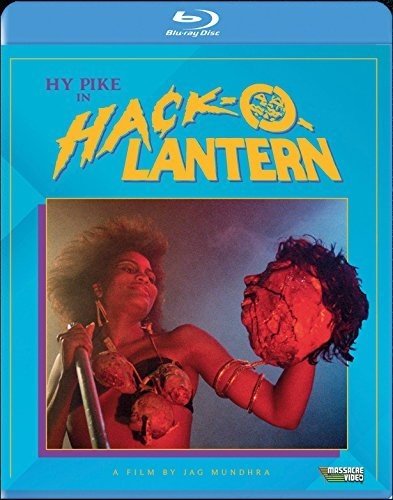
Note that actor Hy Pyke’s name is misspelled on the cover of this Blu-ray.
Sometimes, you just see a film that simply cannot be reviewed in any conventional use of the term and that’s definitely the case with the 1988 slasher/Satanist/rock musical Hack-O-Lantern.
On Friday, I watched Hack-O-Lantern on Shudder. It was broadcast as a part of Joe Bob Brigg’s Last Drive-In Halloween special. I watched the film in a bizarre sort of daze, trying to figure out just what the Hell was actually going on. It’s a film that apparently has a plot but good luck figuring out what exactly that plot is. I do know that that the film is supposed to be taking place on Halloween night but, in the world of Hack-O-Lantern, Halloween is apparently a time when people get together and dance in a gym or something. Seriously, it’s a weird movie.
As far as I can tell, the film is about Tommy (Gregory Scott Cummings), who I guess is like the local trouble maker or something. He spends all of his time listening to heavy metal music and having these elaborate fantasies in which the members of a band rip off his head. Or, at least, I assume they were meant to be fantasies. Tommy’s brother, meanwhile, is a local cop and his mother is crazy and overprotective …. I think. As I said, the film’s plot was not always easy to follow and it actually took me a while to figure out that the earnest and innocent-looking cop was also Tommy’s brother. To be honest, I’m not really sure that words alone can express just how incoherent the plot of Hack-O-Lantern is. I could tell you that the film appears to have been edited with a chainsaw but even that would not begin to capture just how difficult it is to understand why one scene follows another in this film.
Anyway, Tommy’s Grandpa (Hy Pyke) might seem like he’s a fun-loving old man but actually, he’s in charge of the local Satanic cult. He wants to bring Tommy into the cult but apparently, Tommy might be ambivalent or Tommy might just not know that the cult exists. It’s really hard to figure out what exactly is going on inside of Tommy’s head, beyond the fact that it involves a heavy metal band beheading him. Grandpa’s plot to turn Tommy into a Satanist somehow leads to several murders at the Halloween dance. The murderer wears a devil’s mask and kills people in a variety of bloody ways. If you like cheap but effective gore effects, you’ll get something out of this film. The scene with shovel is especially nasty.
It’s a bit of a strange Halloween dance, to be honest. For one thing, there’s a stripper who shows up for no particular reason and who appears to be like 70 years old. There’s also a stand-up comedian who pops up out of literally nowhere and does this long routine that has nothing to do with Satanism, Halloween, or people getting killed with shovels. Why is the comedian there? Why does the film spend so much time on him? Where does he disappear to after he tells his bizarrely long joke? These are the type of questions that you’re forced to ponder while trying to figure out what the Hell’s going on in Hack-O-Lantern.
The thing is that, as easy as it is to criticize a film like Hack-O-Lantern, there really is no other film like it. Sure, there are other slasher films. There are other films about Satanists. There are even other films that feature a random stand-up comedian and a lot of gratuitous nudity. But there are few films that mix all of those elements together quite as incoherently as Hack-O-Lantern. As such, Hack-O-Lantern is an oddly fascinating film. You watch the film and you wonder, “How the Hell did this happen?” And for that reason, it’s worth tracking down and watching.
Do I recommend Hack-O-Lantern?
Hell yeah, I do.
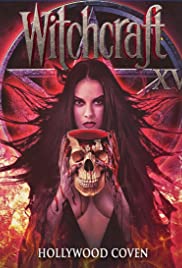 The Witchcraft series comes to an end (?), with this the 16th installment in the bizarrely long-lived franchise.
This one is weird, though. All of the actors from the previous three installments return. (The final three films were, more or less, shot simultaneously.) They’re still playing people named Will Spanner, Lucy Lutz, Rose, Sharon, Samuel, and Garner. But they’re no longer witches and warlocks. Instead, they are all actors and production associates who are working on the latest Crystal Force movie. Crystal Force is a long running series of low budget, softcore films about a warlock. So, basically, this is a film about the making of a Witchcraft movie but, in this universe, Witchcraft is known as Crystal Force. Got it? It turns out that the director of this latest Crystal Force film is a Satanist and he needs to complete one of those overly complicated rituals that are so popular in the Witchcraft films (and apparently the Crystal Force films as well).
Once you get beyond the film-within-a-film aspect, it’s a pretty standard Witchcraft plot but the plot really isn’t important. Instead, Witchcraft 16 is more of a meta commentary on both the Witchcraft franchise and low budget movie making in general. When the cast gets together, they talk about the indignities of low-budget horror filmmaking and the fact that no one’s career has been made by appearing in a Crystal Force movie. (When they say that, you can’t help but wonder what has happened to all the other actors who have played Will Spanner over the years. Hopefully, they didn’t suffer the same fate as some of the actors in Crystal Force.) This film is really an elaborate in-joke for people who have a nostalgic attachment to the other films in the series. Witchcraft 16 is not a film that’s meant to be taken seriously. It’s also not terrible, which is maybe the best thing that you can say about a Witchcraft film. It looks and sounds cheap but Berna Roberts does what she can with the role of Lutz and the meta joke works a lot better than I think anyone would expect it to. It’s actually a clever way to to acknowledge that the Witchcraft movies are never going to be critically acclaimed but that they did have a good run and there are certain people who will have fond memories of checking them out from Blockbuster.
Will Spanner gets zapped out of existence during Witchcraft 16 so I guess the franchise has finally come to an end. Of course, who knows? There are still warlocks and witches out there so it could be that the world is going to need Will Spanner again someday. He already came back from the dead once so who knows what the future might hold.
In this seriously creepy scene from the 1972 film Sisters, a reporter (Jennifer Salt) is hypnotized and made to believe that she was once a conjoined twin, attached to a psychotic model (played by Margot Kidder). The scene was directed by Brian De Palma.
Enjoy!
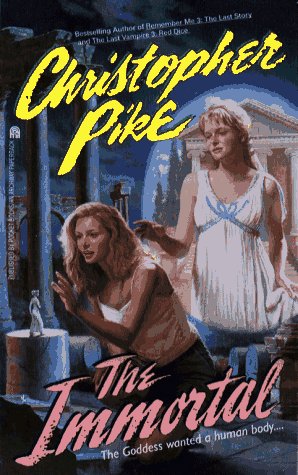
This 1993 novel tells the story of two friends on a Greek vacation.
Now, when I say “friends,” what I mean is that we’re told that they’re friends and they spend a lot of time hanging out with each other and the entire book is pretty much about the developments in their relationship. However, for two lifelong friends, they really don’t seem to like each other that much. I mean, when I was in high school, I had friends who I secretly disliked but I never went to Greece with them.
Our friends are named Helen and Josie. Josie has a rich father, who is a screenwriter and who is accompanying the girls to Greece. Helen has a less rich father because this is a Christopher Pike book and someone always has to come from a poor but honest family. Both Helen and Josie are recovering from near-death experiences. Helen attempted to commit suicide. Josie had a heart problem of some sort. You would think that, having come close to dying, Helen and Josie would be all about celebrating life but actually, they’re still fighting over Ralph. Ralph used to date Helen and then he dated Josie and then he left town.
One thing that I quickly discovered while reading this book is that it’s not always easy to remember what happened to Helen and what happened to Josie. Even while I was reading it, I kept mixing up who had which tragic backstory. I probably should have kept better notes but, honestly, when you’re reading a 200-page YA novel from the early 90s, your first thought is not going to be, “I better go grab my notebook because these 200 pages might be too complicated for me to keep track of.”
Anyway, Josie hooks up with Tom, who is British and sensitive and who refuses to have sex on a nude beach without a condom. Helen kind of hooks up with Pascal, who doesn’t speak English. Josie steals an ancient artifact. Helen serves Josie a hamburger that’s full of ground-up glass. There’s a big storm that overturns a boat and …. wait a minute, what? Ground up glass in a hamburger!? AGCK!
Anyway, it’s all because Helen and Josie were apparently possessed by two angry Greek goddesses during their last visit to Greece. Apparently, these angry Greek spirits have been trying to kill each other for centuries or something like that. I couldn’t really follow it and, to be honest, I think Christopher Pike just made it up as he was going along.
That said, I kind of enjoyed the book, just because of how silly it all was. I mean, Helen and Josie seriously are the worst friends ever. The book may not make sense but between all of the strange dreams, the deadly hamburgers, and all the passive aggressive insults, it was never boring. If nothing else, it made me think about the vacation that I took the summer after I graduated from high school. My sisters and I traveled all over Europe and we saw all sorts of ancient ruins and we managed to do it without stealing any artifacts or trying to kill each other. I’m proud of what we accomplished!

In this short film from 1958, a terrible little kid named Larry is given detention because he’s a terrible little kid. He’s supposed to clean the chalkboard but instead he draws a cartoon character, which promptly comes to life and probably traumatizes Larry for life. Larry does learn a little something about behaving at school but at what cost? Seriously, Larry may have had bad manners but you know who I blame? The parents. That’s who the stick figure should be tormenting.
Now, believe it or not, there is a reason why I’m posting this in October. This short film — like many educational films from the 50s — was directed by Herk Harvey. Harvey spent the majority of his long career making industrial and educational films. However, horror fans will always know him as the man who directed 1962’s Carnival of Souls! I’ll be sharing Carnival Of Souls next week but for now, enjoy Manners in School!
And remember …. good manners are good for everyone! And if you don’t believe me, a stick figure is going to lecture you and give you nightmares.
 Through the Shattered Lens