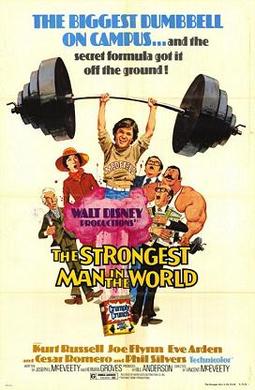
I Watched The Strongest Man In The World (1975, Dir. by Vincent McEveety)


Dexter Riley (Kurt Russell) is back, again!  He still hasn’t graduated from Medfield College and Medfield is still on the verge of going broke.  Dean Higgins (Joe Flynn) discovers that the reason Medfield can never get out of the red is because the science class and students like Dexter are spending so much money on their experiments.  The Dean fires the science professor and threatens to expel Dexter!  But when Dexter’s latest experiment develops a type of milk that gives the drinker super strength, the Dean might have to change his mind.

A cereal company wants to buy the supermilk, which would get Medfield out of the hole.  But a rival cereal company just wants to steal the formula for the milk so they hire disgraced businessman and gangster A.J. Arno (Cesar Romero) to once again try to thwart the best laid plans of Medfield College.  Meanwhile, Dexter competes in a contest to prove that the supermilk has truly made him into the strongest man in the world.

The plot of the last Dexter Riley movie somehow manages to be even dumber than the first two and it was high time for Dexter to graduate and get on with his life but The Strongest Man In The World did make me laugh a few times.  Because this entry in the series involved super strength instead of invisibility or merging with a computer, it allowed for more physical comedy and it felt less dates than the other two movies.  The action is pretty much nonstop, as Dexter gets into one scrape after another and the cast is likable even if they all were getting a little old to still be playing college students.  Like the other Dexter Riley films, The Strongest Man In The World is too innocent and good-natured not to enjoy on some level.

I guess Dexter finally graduated after this movie.  Both he and Kurt Russell went on to better things.

Retro Television Reviews: Welcome Back, Kotter 2.16 “Kotter and Son”


Welcome to Retro Television Reviews, a feature where we review some of our favorite and least favorite shows of the past!  On Saturdays, I will be reviewing Welcome Back Kotter, which ran on ABC  from 1975 to 1979.  The entire show is currently streaming on Tubi!

This week, Gabe’s father comes to visit!

Episode 2.16 “Kotter and Son”

(Dir by Bob LaHendro, originally aired on January 20th, 1977)

January 20th, 1977.  While many Americans was celebrating the inauguration of Jimmy Carter and others were laying the groundwork for the election of 1980, teenagers all across America were tuning into ABC so that they could see what Barbarino was going to do this week.

The first image they saw on that Inauguration Day was Gabe and Julie sitting in the apartment and reading the newspaper.

“Know who this guys looks like?” Gabe asks, pointing to a picture in the paper.

“One of your relatives?” Julie replies, as if she’s already dreading what’s to come.

“My cousin, Sidney Kotter!” Gabe announces.

Cousin Sid was so stupid that he once locked his keys in the car.  He called the auto club (the auto club again!) and they said they would be there in an hour.  Sid replied, “Well, you can’t come here in an hour because it’s raining outside and my car’s a convertible and I left the top down.”

At school, Gabe teaches about World War II but he’s obviously distracted, not even acknowledging a joke told by Epstein.  After the bell rings and the rest of the class leaves, Gabe tells the main four Sweathogs that he’s having problems at home.  Everyone assumes that Julie has left him again but Gabe eventually confesses that he’s nervous because his father is coming for a visit from Florida.  Barbarino says that Gabe has nothing to be nervous about.

“Vinny,” Gabe says, “Imagine your father is coming 14,000 miles to see his son!  Imagine that!”

Barbarino tries to imagine.  “Is he coming on a bus or a train?”

Gabe then compares his father the iceberg that hit the Titanic, which leads to the Sweathogs singing a song about an iceberg wearing a sports shirt.

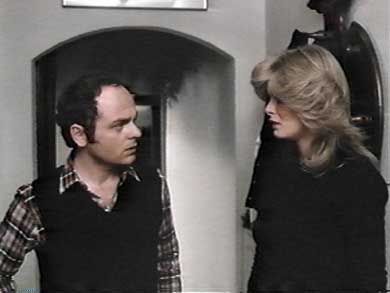
The next morning, at the apartment, Julie struggles to convince Gabe to get out of bed and get ready for his father’s visit.  While Gabe and Julie try to figure out why his father would come all the way to New York from Florida, the man himself, Charlie Kotter (Harold Gould), knocks on the front door.  Charlie enters the apartment and tells Julie that she’s beautiful and then orders Gabe to “wash your teeth.”  Charlie declares that the cab that picked him up at the airport was Gabe’s apartment and says that he’s glad that he’ll be staying with Gabe’s brother, Melvin.  “Remember your brother, Melvin?” Charlie asks before then asking if Gabe has found a real job yet.

You may have guessed that Charlie and Gabe have a strained relationship and they do.  Charlie thinks that Gabe is wasting his life, teaching remedial classes at his old high school in New York.  Gabe thinks that he’s doing a good thing by teaching the Sweathogs.  Charlie says that he wants Gabe to come back to Florida with him and join him in selling coconut-themed souvenirs.  “Kotter and Son!” Charlie announces.  Charlie then says that he’s going to school with Gabe so that he can finally see what Gabe does for a living.  Gabe is not happy about this but finds himself powerless to stop his elderly father from following him out of the apartment.

Cut to the school, where Charlie has made friends with Mr. Woodman.  As Mr. Woodman looks at the coconut paperweight that Charlie has given him, Charlie says, “I just want to see what my son does for a living.”  Woodman asks Charlie to let him know if he ever figures it out.

In class, Gabe tries to teach but is nervous with Charlie constantly interrupting him.  Finally, Charlie agrees to remain quiet so that he can observe and Gabe teaches about the Great Depression while pretending to be Walter Winchell doing a radio report.  Gabe pretends to be a stockbroker who has lost everything.  He pretends to be a bitter worker.  He pretends to be Herbert Hoover.  Charlie is skeptical of Gabe’s techniques but then Gabe proves that the Sweathogs now know and understand far more about the Great Depression than they did at the start of the class.  Even Barbarino had debatably picked up some knowledge!

(“What did the Stock Market crash do to the price of products?” Gabe asks Barbarino.  “What products?” Barbarino replies.)

Charlie asks Gabe to step out in the hallway and tells Gabe that he knows Gabe isn’t going to move down to Florida.

Gabe says, “Pop, I’m 30 years old.  Just tell me your proud of me!”

“You should hear how much I talk about in Florida,” Charlies replies, “People down there are sick of hearing about you!  Now, go teach your Sweathogs.”

Realizing that he’s not going to get anything better than that, Gabe returns to his classroom.  As Gabe closes the door, Charlie says, “I’m proud of you, my son.”

Gabe opens the door and says, “I heard you.”

Awwwwwwww!

Back at the apartment, Charlie asks Julie if she ever heard about what happened to his brother, Saul Kotter.  Julie is a bit more tolerant of Charlie telling jokes than she is when Gabe does it.  Anyway, Saul was hit by a truck while crossing the street.  A policeman put his jacket under Saul’s head and asked him if he was comfortable.  Saul replied, “I make a good living.”  As Charlie finishes his joke, Gabe steps in the apartment and asks, “Julie, have I ever told you about my Uncle Saul?”

This episode definitely worked, mostly because Harold Gould and Gabe Kaplan were totally believable as father and son.  There were not a lot of Sweathog shenanigans this episode but the scenes between Gabe and his father were well-acted and ultimately rather sweet.

Next week: Gabe takes a second job to pay for dental work!  Julie thinks that he’s having an affair with someone who actually likes his jokes.

Retro Television Reviews: The Love Boat 1.15 & 1.16 “The Eyes of Love / Masquerade / Hollywood Royalty / The Caper: Parts 1 & 2”


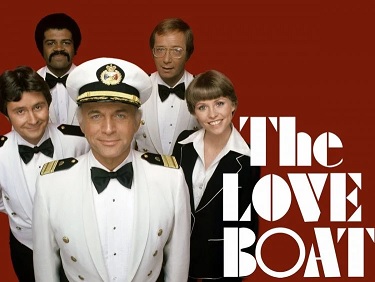
Welcome to Retro Television Reviews, a feature where we review some of our favorite and least favorite shows of the past!  On Wednesdays, I will be reviewing the original Love Boat, which aired on ABC from 1977 to 1986!  The series can be streamed on Paramount Plus!

This week’s episode of The Love Boat is one of historical value so let’s climb aboard and get to it!

Episodes 1.15 & 1.16 “The Eyes of Love / Masquerade / Hollywood Royalty / The Caper: Parts 1 & 2”

(Dir by Allen Baron, originally aired on January 21st, 1978)

This is an important episode for two reasons.

First off, this episode marked the first time that the opening credits featured video of the guest stars along with their names.  This was the only time that this was done during the first season, though it would become a regular feature of the show from the second season forward.

Secondly, excluding the three pilot films that aired before the series was ordered, this was the first super-sized two hour episode of The Love Boat.  This episode is split into two parts when it airs in syndication, which is why it’s listed as being the 15th and the 16th episode of The Love Boat

Oddly enough, despite all of that, it’s pretty much a standard episode.  Usually, whenever a TV shows airs an extra-long episode, it’s because some important event is occurring.  Usually, either someone’s getting married or someone’s leaving the show or maybe an actor died and the show needs an extra hour to pay tribute to them.  In this case, though, it’s just a typical cruise of the love boat, complete with three separate stories and a lot of time spent looking at the ocean.

For instance, Roz Rogers (Michele Lee) and Bill Teague (Fernado Lamas) are a famous and glamorous Hollywood couple who book a voyage and who are followed all the way to the dock by the paparazzi.  As quickly becomes clear, Bill and Roz’s relationship is not as perfect as the world believes.  Still, Bill is convinced that their relationship can be fixed by Roz co-starring in an old-fashioned adventure film that he wrote.  Along with having written the script, Bill hopes to direct, produce, and star in it.  Roz is a bit skeptical but fear not, everything works out in the end and she finally convinces Bill that she loves him for him and not because he’s a star.

Roz boards the boat with not just Bill’s script but also a large and valuable diamond.  A group of jewelry thieves follow her onto the boat, hoping to steal the diamond for themselves.  Vernon (Howard Gould) is the arrogant leader of the group.  Taffy (Karen Valentine) distracts Gopher, Doc, and the Captain by flirting with them.  Elwood (Larry Storch) is the group’s technician.  And Ox (John Schuck) is the muscle who tends to take things literally.  When the first attempt to steal the jewel fails, Vernon disguises himself as Captain Stubing and Gavin MacLeod gets a chance to do something more than just look slightly annoyed by the crew.  To be honest, I actually enjoyed the jewelry theft subplot far more than I was expecting.  Gould, Valentine, Storch, and Schuck all seemed to be having fun playing off of each other.  Plus, the whole story ended with a nice little twist that James Cameron would later use in Titanic.

(No, the Love Boat does not sink.)

While this is going on, a blind girl named Jenny (Stephanie Zimbalist) is stunned to discover that one of her former classmates, Steve (Desi Arnaz, Jr.), is also on the boat.  Jenny and Steve fall in love but Steve has recently gotten back his sight and Jenny worries that he won’t want to spend the rest of his life with someone who can’t see.  Fortunately, it turns out that Jenny’s wrong.

Finally, Alan (Dan Rowan) is horrified to discover that not only are both his wife (Juliet Mills) and his mistress (Adrienne Barbeau) on the cruise together but that they’ve become friends.  Alan was an adulterous jerk so it was pretty difficult to really care about this story.  

Again, it was pretty much a typical episode of The Love Boat, despite the extra length and the inclusion of a masquerade ball during the episode’s 2nd hour.  That said, the thieves were funnier than they had any right to be and the Jenny/Steve storyline was sweet.  The ocean scenery was lovely.  That’s really all I ask from The Love Boat.  This episode delivered.

Holiday Sweets: Fred Astaire in THE MAN IN THE SANTA CLAUS SUIT (NBC-TV 1979)


gary loggins's avatarcracked rear viewer

Eighty year old Fred Astaire takes on nine different roles in THE MAN WITH THE SANTA CLAUS SUIT, his next to last film. Fred is as charming and debonair as ever, and his presence is what carries the saccharine script, with three varied tales of romance, comedy, and drama interwoven and played by a cast of Familiar TV and Movie Faces, kind of like a “very special Christmas episode” of THE LOVE BOAT.

Gary Burghoff (M*A*S*H’s Radar) is a nerdy math teacher in love with his neighbor, a beautiful (are there any other kind?) fashion model (Tara Buckman, THE CANNONBALL RUN). The model secretly digs him too, but the nerd’s too shy to express his feelings, until a chance encounter with a jeweler (Fred) leads him to rent a Santa suit and propose before she makes the mistake of marrying a rich, handsome playboy (again, are there any other kind?)…

View original post 449 more words

Insomnia File #28: The Arrangement (dir by Elia Kazan)


What’s an Insomnia File? You know how some times you just can’t get any sleep and, at about three in the morning, you’ll find yourself watching whatever you can find on cable? This feature is all about those insomnia-inspired discoveries!

If, on Saturday you were having trouble sleeping at three in the morning, you could have turned on TCM and watched the 1969 film, The Arrangement.

The Arrangement is one of those films where a rich guy gets hit by a sudden case of ennui and, as a result, spends the entire movie acting like a jackass.  However, as often happens in films like this, The Arrangement makes sure that we understand that it’s not the guy’s fault.  Instead, it’s his wife’s fault for not being as much fun as his mistress.

In this case, the guy is an ad executive who goes by the name of Eddie Anderson (Kirk Douglas).  His original name was Evangelos Arness but he changed his name when he was younger because he apparently didn’t want anyone to know that he came from a Greek family.  When we first meet Eddie, he’s attempting to commit suicide by driving his car into an 18 wheeler.  If he had died, the movie could have ended quickly.  However, since Eddie survived, the audience is now required to spend two hours watching Eddie as he tries to figure out what it all means.

Eddie’s father (Richard Boone) is dying.  His long-suffering wife (Deborah Kerr) just doesn’t understand that Eddie needs more than a big house and a nice pool to feel like a man.  Eddie’s mistress is Gwen (Faye Dunaway), whose new baby may or may not be Eddie’s.  Who could blame Eddie, the film demands to know, for being disillusioned with his comfortable life?

The Arrangement was one of the last films to be directed by Elia Kazan, who was a big deal in the 40s and the 50s and whose goal with The Arrangement was apparently to prove that he should still have been a big deal in the 60s and 70s.  Kazan’s way of doing this is to fill The Arrangement with all types of tricks that were designed to make young filmgoers say, “Man, that Eliza Kazan may be old but he’s one of us!”

Freeze frames?  Kazan’s got them!  Flashback after flashback?  Kazan spreads them all throughout the movie, even when they don’t really have anything to show us.  Scenes where the action is sped up for no identifiable reason?  Just watch Kirk Douglas trot down that hallway!  Rack focus shots?  Zoom shots?  A scene where the young Kirk Douglas argues with the old Kirk Douglas?  Casual nudity that’s still filmed in such a way that it feels oddly reticent, as if the filmmaker was just including it to try to establish his rebel credentials?  The Arrangement has it all!

It also has a lot of close-ups of Kirk Douglas.  In far too many scenes, he’s just sitting around with this blank look on his face and it doesn’t quite work because, as an actor, Douglas has never exactly come across as the type to get trapped in an existential crisis.  We’re supposed to view Kirk as being depressed and conflicted but, in all of his films, Kirk has always come across as someone who hasn’t known a day of insecurity in his entire life.

There are also a few scenes of Kirk just laughing and laughing.  For some reason, movies in the late 60s and early 70s always seemed to feature at least a handful of closeups of people laughing uncontrollably.  I’m not sure why.  (If you want to see the most extreme example of this, check out Getting Straight.)  These scenes are always kind of annoying because there’s only so much time you can spend watching someone laugh at the absurdity of it all before you want them to just close their damn mouth.  Especially when the person in question is a middle-aged man.  I mean, shouldn’t have Kirk figured out that the world is absurd before his 50th birthday?

Anyway, The Arrangement is a pretentious mess.  Of course, most films from the 60s are pretentious.  The problem with The Arrangement is that it’s also boring.  If you’re going to be pretentious, at least have some fun with it, like The Graduate did.  The Arrangement goes on forever and it’s never quite as profound as it seems to think that it is.  I once read a short story that a former friend of mine wrote.  She explained that writing the story had caused her to realize that, the longer you know someone, the more likely your initial impression of that person is going to change.  “You had to write an entire short story to figure that out?” I replied.  (That’s one reason why she’s a former friend.)  But that’s kind of how The Arrangement is.  For all the drama and the technique and the pretension, it has nothing to teach us that we shouldn’t already know.

Previous Insomnia Files:

  1. Story of Mankind
  2. Stag
  3. Love Is A Gun
  4. Nina Takes A Lover
  5. Black Ice
  6. Frogs For Snakes
  7. Fair Game
  8. From The Hip
  9. Born Killers
  10. Eye For An Eye
  11. Summer Catch
  12. Beyond the Law
  13. Spring Broke
  14. Promise
  15. George Wallace
  16. Kill The Messenger
  17. The Suburbans
  18. Only The Strong
  19. Great Expectations
  20. Casual Sex?
  21. Truth
  22. Insomina
  23. Death Do Us Part
  24. A Star is Born
  25. The Winning Season
  26. Rabbit Run
  27. Remember My Name

Lisa Reviews an Oscar Winner: The Sting (dir by George Roy Hill)


Earlier tonight, as a part of their 31 Days of Oscar, TCM aired The Sting, the film that the Academy selected as being the best of 1973.  I just finished watching it and what can I say?  Based on what I’ve seen of the competition (and there were a lot of great films released in 1973), I would not necessarily have picked The Sting for best picture.  However, the movie is still fantastic fun.

The Sting reunited the director (George Roy Hill) and the stars (Robert Redford and Paul Newman) of Butch Cassidy and the Sundance Kid and told yet another story of likable criminals living in the past.  However, whereas Butch Cassidy largely satirized the conventions of the traditional Hollywood western, The Sting is feels like a loving homage to the films of 1930s, a combination of a gritty, low-budget gangster film and a big budget musical extravaganza.  The musical comparison may sound strange at first, especially considering that nobody in The Sting randomly breaks out into song.  However, the musical score (which is famously dominated by Scott Joplin’s The Entertainer) is ultimately as much of a character as the roles played by Redford, Newman, and Robert Shaw.  And, for that matter, the film’s “let-pull-off-a-con” plot feels like an illegal version of “let’s-put-on-a-show.”

The film takes place in the 1936 of the cultural imagination, a world dominated by flashy criminals and snappy dialogue.  When con artists Johnny Hooker (Robert Redford) and Luther Coleman (Robert Earl Jones) inadvertently steal money from a gangster named Lonnegan (Robert Shaw), Lonnegan has Luther murdered.  Fleeing for his life, Hooker goes to Chicago where he teams up with Luther’s former partner, veteran con man Henry Gondorff (Paul Newman).  Gondorff used to be one of the great con artists but he is now living in self-imposed obscurity, spending most of his time drinking and trying to avoid the FBI.  Hooker wants to get revenge on Lonnegan by pulling an elaborate con on him.  When Gondorff asks Hooker why, Hooker explains that he can either con Lonnegan or he can kill him and he doesn’t know enough about killing.

The rest of the film deals with Hooker and Gondorff’s plan to con Lonnegan out of a half million dollars.  It’s all very elaborate and complicated and a bit confusing if you don’t pay close enough attention and if you’re ADHD like me.  But it’s also a lot of fun and terrifically entertaining and that’s the important thing.  The Sting is one of those films that shows just how much you can accomplish through the smart use of movie star charisma.  Redford and Newman have such great chemistry and are so much fun to watch that it really doesn’t matter whether or not you always understand what they’re actually doing.

It also helps that, in the great 70s tradition, they’re taking down stuffy establishment types.  Lonnegan may be a gangster but he’s also a highly respected and very wealthy gangster.  When Newman interrupts a poker game, Lonnegan glares at him and tells him that he’ll have to put on a tie before he’s allowed to play.  Lonnegan may operate outside the law but, in many ways, he is the establishment and who doesn’t enjoy seeing the establishment taken down a notch?

As entertaining as The Sting may be and as influential as it undoubtedly is (Steven Soderbergh’s Ocean films may be a lot more pretentious — which makes sense considering that Soderbergh is one of the most pretentious directors in film history — but they all owe a clear debt to The Sting), it still feels like an unlikely best picture winner.  Consider, for instance, that The Sting not only defeated American Graffiti and The Exorcist but Ingmar Bergman’s Cries and Whispers as well.  On top of that, when you consider some of the films that were released in 1973 and not nominated — Mean Streets, Badlands, The Candy Snatchers, Day of the Jackal, Don’t Look Now, Jesus Christ Superstar, and The Long Goodbye — it’s debatable whether The Sting should have been nominated at all.  That’s not a criticism of The Sting as much as it’s an acknowledgement that 1973 was a very good year in film.

So, maybe The Sting didn’t deserve its Oscar.  But it’s still a wonderfully entertaining film.  And just try to get that music out of your head!