Guilty Pleasure No. 90: Ice Station Zebra (dir. by John Sturges)


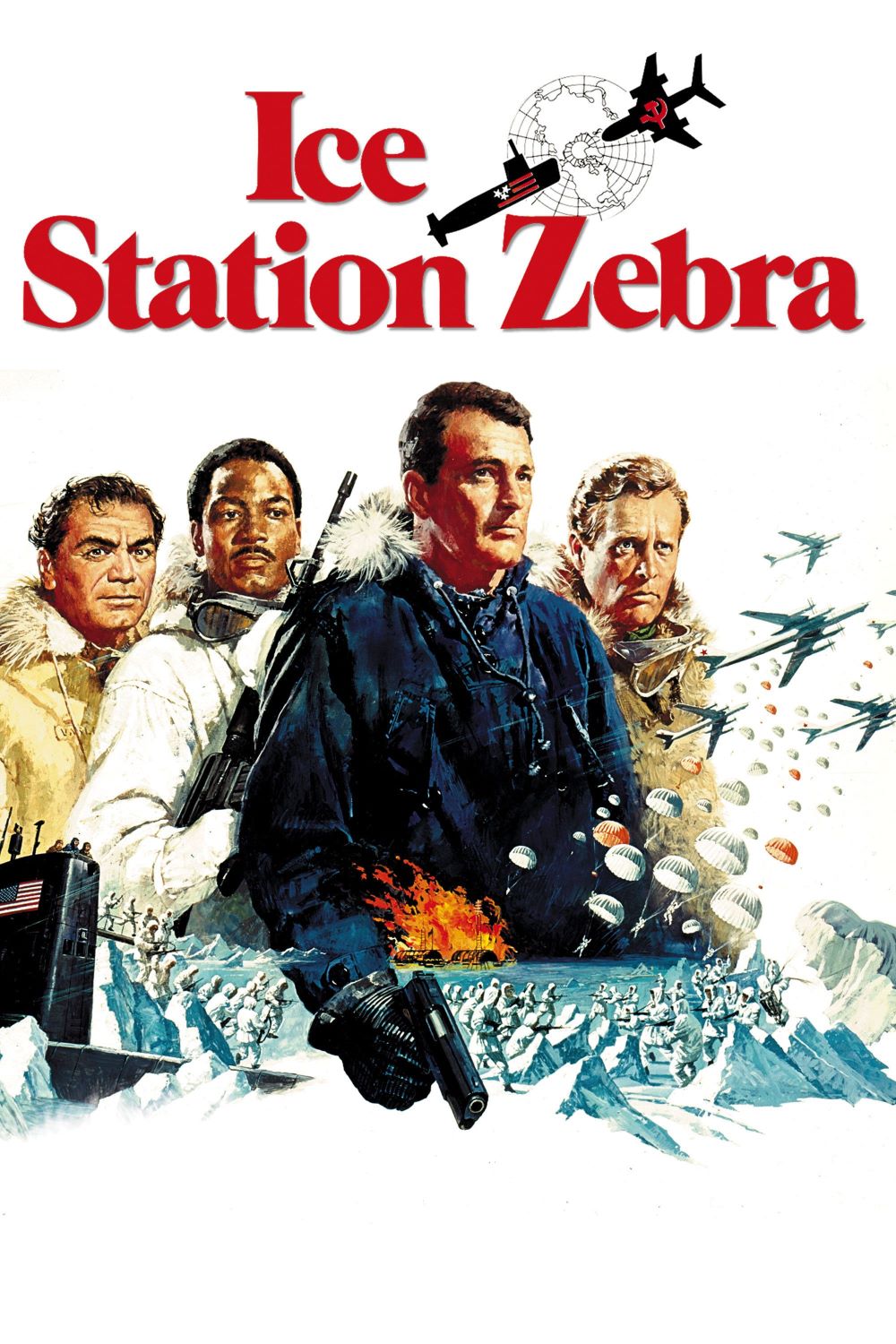
Ice Station Zebra, directed by John Sturges in 1968, slides into guilty pleasure territory like a submarine slipping under polar ice—full of big Cold War ambitions, shadowy spy games, and submarine peril that tease something epic, but so loaded with pacing hiccups, studio shortcuts, and earnest overreach that it ends up a lopsided, lovably messy ride. Sturges had already cemented his rep with crowd-roaring hits like The Magnificent Seven, where a ragtag posse of gunslingers delivered razor-sharp tension and quotable showdowns, or The Great Escape, a WWII breakout yarn crackling with clever schemes, sweaty escapes, and Steve McQueen’s motorcycle glory. Those films moved like a well-oiled engine, every scene stacking stakes and character beats into unforgettable momentum. By contrast, Ice Station Zebra feels like Sturges chasing that same high-wire ensemble vibe—a U.S. nuclear sub, the USS Tigerfish, barreling toward a trashed Arctic outpost—but bloating into a 148-minute sprawl that swaps tight plotting for endless red-lit corridor glares and withheld mission secrets. It’s not in the same league as his earlier triumphs, lacking their propulsive drive and lived-in grit, yet that very shortfall turns it into quirky comfort viewing for fans who dig flawed ’60s spectacle.

The setup hooks you quick: Commander James Ferraday, Rock Hudson’s square-jawed everyman at the helm, gets tapped for a hush-hush run to Ice Station Zebra after a satellite supposedly carrying spy photos crashes nearby. No full briefing for him, just orders to play it cool while three mystery passengers board—Mr. Jones, a buttoned-up British agent with evasive smirks; Boris Vaslov, Ernest Borgnine’s barrel-chested Russian turncoat oozing fake bonhomie; and Captain Anders, Jim Brown’s steely Marine barking orders over a squad of jarheads. As the Tigerfish dives under thickening ice floes, the sub’s innards come alive with flickering sonar pings, steam-hissing valves, and crewmen hunched over gauges in perpetual sweat. It’s claustrophobic gold at first, the hull creaking like it’s got a bad case of frostbite, echoing the trapped dread Sturges nailed in his POW camp classic but without the same spark of rebellion. Then sabotage strikes—a flooded missile bay, a wild plunge toward crush depth—and fingers start pointing. Who tampered with the ballast? Jones with his locked trunk of gadgets? Vaslov’s too-friendly vodka toasts? The Marines itching for a fight? The scene builds real sweat, divers suiting up in the nick of time, but Sturges lets the fallout drag, turning interrogation into a tea party of suspicions rather than the cutthroat blame game his best films thrived on.

These early stumbles set the tone for a film that’s promising yet perpetually off-kilter, far from the seamless revenge rhythm of The Magnificent Seven‘s dusty trails. Production fingerprints show everywhere: rumors swirl of Navy brass forcing script tweaks to glorify their boats, last-minute casting shifts from bigger names to Hudson, and a roadshow rollout with overture, intermission, and 70mm pomp that screams overambition. The Arctic plunge delivers tense highlights—the sub ramming upward through ice chunks like a whale breaching, sparks flying from shorted panels, crew barking damage reports—but lulls follow with tech jargon dumps and characters circling motives without committing to conflict. Hudson anchors it all with unflappable poise, barking commands like a TV dad in a crisis, but he lacks McQueen’s sly charisma or Yul Brynner’s brooding fire. Borgnine hams it up as Vaslov, his accent flipping from gravelly growl to vaudeville schtick during mess-hall ribbing, while McGoohan brings the sharpest edge as Jones, his dry barbs hinting at deeper layers. Brown’s Anders gets muscle but little nuance, leading a Marine crew that feels like stock tough guys waiting for their cue.

Pushing topside, the flaws bloom into full charm. The ice cap arrival unfolds in sweeping widescreen vistas—endless white expanses, howling gales whipping snow devils—but close-quarters betray the soundstage: actors plodding through “blizzards” in lightweight jackets, no puffing breath in the deep freeze, sets that wobble if you squint. It’s the kind of earnest cheesiness that sinks modern blockbusters but endears this relic, especially when the station siege erupts. Soviets drop from the sky in parachutes like deadly snowflakes, scouring the charred ruins for a buried film capsule packed with NATO missile coords. Americans fan out in white camo, trading potshots amid smoke grenades and collapsing tunnels, loyalties cracking as Vaslov’s true colors flash. Ferraday’s cool bluff seals a three-way stalemate, denying everyone the prize in a nod to mutually assured secrets. Michel Legrand’s score surges here, horns blaring over the chaos like a war drum, giving Sturges’ action chops a late workout. Yet even this payoff sprawls, talky standoffs eating screen time where his peak films would’ve sprinted to the finish.

What seals Ice Station Zebra‘s guilty pleasure status is embracing its dated quirks as features, not bugs—hammy all-male bravado, Cold War jitters turned quaint, plot gaps you could park a destroyer in. Sturges conjures submerged panic and frosty fireworks that nod to his glory days, the sub’s practical effects holding up better than some CGI today, but without the narrative steel of The Great Escape‘s tunnel triumphs or The Magnificent Seven‘s mythic standoffs, it coasts on atmosphere over precision. Clocking 148 minutes, it tests patience with filler like extended sail sequences and coy reveals, yet rewards surrender: grin at Borgnine’s bear hugs masking menace, chuckle at the Navy polish glossing gritty potential, savor the sheer balls of staging Arctic Armageddon on a backlot. Howard Hughes reportedly looped it endlessly in his casino screening rooms, and you get why—it’s hypnotic in its wonkiness, a time capsule of late-’60s Hollywood flexing before New Wave grit crashed the party.

Pop this on a stormy night with cocoa and zero expectations, and Ice Station Zebra shines as cozy flawed fun. Sturges’ touch keeps the chills coming amid the clunkers, delivering submarine squeezes, betrayals under the aurora, and a finale with enough brinkmanship bang to forgive the bloat. It’s no peer to his earlier masterpieces, more a quirky footnote, but that’s the hook: imperfect promise wrapped in icy spectacle, begging a rewatch to spot every goofy grace note. For ’60s thriller buffs, submarine nuts, or anyone needing a break from slick reboots, it’s a frosty, flawed feast worth the dive.

Previous Guilty Pleasures

  1. Half-Baked
  2. Save The Last Dance
  3. Every Rose Has Its Thorns
  4. The Jeremy Kyle Show
  5. Invasion USA
  6. The Golden Child
  7. Final Destination 2
  8. Paparazzi
  9. The Principal
  10. The Substitute
  11. Terror In The Family
  12. Pandorum
  13. Lambada
  14. Fear
  15. Cocktail
  16. Keep Off The Grass
  17. Girls, Girls, Girls
  18. Class
  19. Tart
  20. King Kong vs. Godzilla
  21. Hawk the Slayer
  22. Battle Beyond the Stars
  23. Meridian
  24. Walk of Shame
  25. From Justin To Kelly
  26. Project Greenlight
  27. Sex Decoy: Love Stings
  28. Swimfan
  29. On the Line
  30. Wolfen
  31. Hail Caesar!
  32. It’s So Cold In The D
  33. In the Mix
  34. Healed By Grace
  35. Valley of the Dolls
  36. The Legend of Billie Jean
  37. Death Wish
  38. Shipping Wars
  39. Ghost Whisperer
  40. Parking Wars
  41. The Dead Are After Me
  42. Harper’s Island
  43. The Resurrection of Gavin Stone
  44. Paranormal State
  45. Utopia
  46. Bar Rescue
  47. The Powers of Matthew Star
  48. Spiker
  49. Heavenly Bodies
  50. Maid in Manhattan
  51. Rage and Honor
  52. Saved By The Bell 3. 21 “No Hope With Dope”
  53. Happy Gilmore
  54. Solarbabies
  55. The Dawn of Correction
  56. Once You Understand
  57. The Voyeurs 
  58. Robot Jox
  59. Teen Wolf
  60. The Running Man
  61. Double Dragon
  62. Backtrack
  63. Julie and Jack
  64. Karate Warrior
  65. Invaders From Mars
  66. Cloverfield
  67. Aerobicide 
  68. Blood Harvest
  69. Shocking Dark
  70. Face The Truth
  71. Submerged
  72. The Canyons
  73. Days of Thunder
  74. Van Helsing
  75. The Night Comes for Us
  76. Code of Silence
  77. Captain Ron
  78. Armageddon
  79. Kate’s Secret
  80. Point Break
  81. The Replacements
  82. The Shadow
  83. Meteor
  84. Last Action Hero
  85. Attack of the Killer Tomatoes
  86. The Horror at 37,000 Feet
  87. The ‘Burbs
  88. Lifeforce
  89. Highschool of the Dead

October True Crime: In Cold Blood (dir by Richard Brooks)


In 1959, the Clutter Family was murdered in Holcomb, Kansas.

Herbert Clutter was a farmer and was considered to be prosperous by the standards of small-town Holcomb.  Neither he nor his wife nor his teenage son and daughter were known to have any enemies.  The brutality of their deaths took not just the town but the entire state by surprise.  People like the Clutters were not supposed to be brutally murdered.  They certainly weren’t supposed to be brutally murdered in a tight-knit community like Holcomb or in a state like Kansas.

The Clutters

The author Truman Capote traveled to Holcomb with his friend Harper Lee, looking to write a story about how the heartland was dealing with such a brutal crime.  Six weeks after the murders, while Capote and Lee were still conducting their interviews, two small-time criminals named Dick Hickock and Perry Smith were arrested for the crime.  Capote’s proposed article about Holcomb instead became the basis for his best-known book, In Cold Blood.  Capote followed the case from the initial investigation to the eventual execution of both Hickok and Smith.  He examined the backgrounds of the two criminals, especially Perry Smith’s.  (Indeed, there were some who felt that Capote saw something of himself in the mentally-fragile Smith.)  In Cold Blood was Capote’s most successful book and it also launched the entire “true crime” genre.  It also may have been Capote’s downfall as Capote reportedly spent the rest of his life haunted by the feeling that he would never top the book and that he had potentially exploited Perry Smith while writing it.  In Cold Blood may be critical of the death penalty but, if Smith and Hickok hadn’t gone to the gallows, Capote would never have had an ending for the book.

(The writing of In Cold Blood and Capote’s subsequent struggles are dramatized in the excellent Capote.)

When it was published in 1965, In Cold Blood shot up the best seller lists.  A film version was an inevitability.  Otto Preminger —  who had already made films out of Anatomy of a Murder, Exodus, Advice and Consent, and The Cardinal — was eager to turn the book into a film and one can imagine him churning out some epic version with his usual all-star cast.  (Sal Mineo as Perry Smith?  Peter Lawford as Dick Hickok?  With Preminger, anything was possible.)  However, Capote sold the rights to Richard Brooks, an independent-minded director who was also an old friend.  Brooks decided to duplicate Capote’s “non-fiction novel” approach by actually shooting his film in Holcomb and having several residents of the town play themselves.  He also rejected Columbia’s suggestion that Smith and Hickok should be played by Paul Newman and Steve McQueen.  Instead, he cast former child actor Robert Blake as Perry Smith and an up-and-coming character actor named Scott Wilson as Dick Hickok.  The only “star” who appeared in the film was television actor John Forsythe, who played the Kansas detective who was placed in charge of the investigation.

The story plays out in deliberately harsh black-and-white.  (Legendary cinematographer Conrad Hall made his debut with this film.)  The opening contrasts scenes of Smith and Hickok, both recently released from prison, meeting up in Kansas with scenes of the Clutter family innocently going about their day.  Perry Smith is neurotic and quick to anger, a wannabe tough guy who wears a leather jacket and whose greasy hair makes him look less like a cunning criminal and more like an understudy in a regional production of West Side Story.  Dick Hickok is friendly and slick, a compulsive shoplifter who claims that his smile can get him out of anything.  In jail, Hickok heard a story that suggested that Mr. Clutter kept a lot of money hidden away in a safe on his farm.  Hickok’s plan is to tie up and rob a family of strangers, with the assumption being that, by the time the Clutters get loose and call the police, he and Smith will already be far out of town.  Neither he nor Smith seem like natural-born murderers.  Smith seems to be too sensitive.  Hickok seems like the epitome of someone who brags but doesn’t follow through.  And yet, the morning after the robbery, four of the Clutters are discovered murdered in their own home.

The film delves quite a bit into Perry Smith’s background.  Throughout the film, he has flashbacks to his abusive father and his promiscuous mother.  When Alvin Dewey (played by John Forsythe) investigates Smith’s family, the recurring theme is that Perry never really had much of a chance to become anything more than a criminal.  We learn less about Dick Hickok’s background, beyond the fact that he was a popular high school jock who turned mean after a car accident.  And yet, despite the fact that the film is clearly more interested in Perry Smith than Dick Hickok, it’s Scott Wilson who dominates the film.  It’s not that Robert Blake gives a bad performance.  It’s just that Perry is such a neurotic mess and Blake gives a performance that is so method-y that occasionally, you’re reminded that you’re just watching a movie.  Scott Wilson, on the other hand, gives a very natural performance as Dick Hickok.  There’s nothing particularly showy about his performance and that makes Hickok all the more disturbing as a criminal and a potential murderer.  If you’ve spent any time in the country, you’ve met someone like Dick Hickok.  He’s the friendly guy who always knows that right thing to say but there’s something just a little bit off about him.  He’s likable without being trustworthy.

A few years ago, when I saw that In Cold Blood was going to be airing on TCM, I told my aunt that I was going to watch the film.  She replied that I shouldn’t.  She saw the film when it was originally released and she described it as being incredibly disturbing.  Despite her warning, I watched the film and I have to admit that she was right.  Even though it’s nearly 60 years old and not particularly explicit when compared to the true crime films of today, In Cold Blood is still a disturbing viewing experience.  Towards the end of the film, we finally see the murders in flashback and the image of Smith and Hickok emerging from the darkness of the farmhouse will haunt you.  There’s not a lot of blood.  The camera often cuts away whenever the actual murders occur (we hear more gunshots than we see) but the Clutters themselves are sympathetic and innocent victims and their deaths definitely hurt.  Indeed, considering that the film falls on the more liberal side of the question of root causes, In Cold Blood deserves a lot of credit for not shying away from the brutality of the crimes.  After spending 90 minutes emphasizing Perry Smith’s terrible childhood, it was important to remind the audiences of what he and Dick Hickok actually did.

The murder scene is so nightmarish that it actually makes it a bit difficult to buy into the film’s anti-death penalty argument.  The film may end with Smith remorseful and a reporter (Paul Stewart) talking about how revenge is never the answer but the film’s liberal talking points feel hollow after witnessing the murder of four innocent people.  (Ironically, it turned out there was no safe so those four people died so Smith and Hickok could steal about forty dollars.)  A few years ago, I probably would have been very moved by the film’s anti-death penalty message.  While I’m still opposed to the death penalty because I think there’s too much of a risk of a wrongly convicted person being executed, I’m long past having much personal sympathy for the Perry Smiths of the world.

Overall, In Cold Blood remains a powerful and disturbing movie. It was a film that was nominated for several Oscars, though it missed out on Best Picture due to 20th Century Fox’s huge campaign for Dr. Dolittle.  Neither Blake nor Wilson were nominated, which is evidence that they were perhaps too convincing as Smith and Hickok for the Academy’s taste.  While Robert Blake would go on to have the more storied career, Scott Wilson was a dependable character actor up until his death in 2018.  A whole new generation of fans knew him not as Dick Hickok but instead as The Walking Dead‘s beloved Herschel Greene.

One final note: Both the book and the film present the murders as being an aberration, something that neither Smith nor Hickok originally planned.  In 2013, new evidence was released that revealed the Smith and Hickok were the number one suspects in the murder of Christine and Cliff Walker and their two children, a crime that occurred in Florida shortly after they fled Kansas.  The two of them were questioned at the time and given a polygraph test, which they both passed.  The bodies of Smith and Hickok were exhumed for DNA testing,  The tests came back inconclusive.

Late Night Retro Television Review: Highway to Heaven 1.21 “The Brightest Star”


Welcome to Late Night Retro Television Reviews, a feature where we review some of our favorite and least favorite shows of the past!  On Thursdays, I will be reviewing Highway to Heaven, which aired on NBC from 1984 to 1989.  The entire show is currently streaming on Freevee and several other services!

Jonathan and Mark are once again in Hollywood, bringing yet another family together.

Episode 1.21 “The Brightest Star”

(Dir by Victor French, originally aired on March 6th, 1985)

Despite the fact that Mark was hoping to finally have a vacation from work, the Boss has other ideas.  Jonathan and Mark end up picking up a hitchhiking little girl who claims that she’s escaped from an abusive orphanage.  It doesn’t take long for Jonathan and Mark to figure out that she’s lying.  She’s actually Laurie Parks (Carrie Wells), one of the most in-demand child actresses working in Hollywood.

Hired to do some carpentry at the Parks home, Jonathan and Mark soon start offering advice to the family and indeed, this family needs a lot of help.  The family is totally dependent on Laurie’s salary and Laurie deals with the pressure of being the main provider by acting like a monstrous brat.  Her alcoholic father (Gerald S. O’Loughlin) wants to return to his previous life of driving a cab.  Her mother (Trish Van Devere) spends all of her time watching out for Carrie’s career.  The daughter (Laura Jacoby) of the family’s loyal maid (Mary Armstrong) is the selfless angel that Laurie is not and, with Jonathan’s help, she begins her own acting career.  Unfortunately, her success comes at Laurie’s expense.

As I watched this episode, I was struck by how familiar it felt.  Eventually, I realized that it was reminding me of an earlier episode from season 1, in which a father was the one who neglected his family until his son was cast opposite of him in a movie that was he was shooting.  Both of these episodes present Hollywood as being a shallow place, where family is often put second and people are corrupted by the pressures of stardom.  Both episodes were critical of Hollywood but ultimately ended with the classic Hollywood story of a new star being discovered from out of nowhere.  One gets the feeling that Michael Landon, as the show’s guiding force, was dealing with his own issues of trying balance his career with his family.  Highway to Heaven both loves and criticizes the entertainment industry with equal abandon.

As for the episode itself, it wasn’t particularly memorable and it struggled to balance moments of sentimental drama with moments of comedy.  One could understand the father’s unhappiness with his situation without necessarily thinking that the solution would be for him to move out of the house and start driving a cab again.  In the end, Laurie was such a monster that it was difficult to care about what happened to her one way or the other.

Next week, Jonathan and Mark go up against another heartless corporation!

Playing Catch-Up: Crisscross, The Dust Factory, Gambit, In The Arms of a Killer, Overboard, Shy People


So, this year I am making a sincere effort to review every film that I see.  I know I say that every year but this time, I really mean it.

So, in an effort to catch up, here are four quick reviews of some of the movies that I watched over the past few weeks!

  • Crisscross
  • Released: 1992
  • Directed by Chris Menges
  • Starring David Arnott, Goldie Hawn, Arliss Howard, Keith Carradine, James Gammon, Steve Buscemi

An annoying kid named Chris Cross (David Arnott) tells us the story of his life.

In the year 1969, Chris and his mother, Tracy (Goldie Hawn), are living in Key West.  While the rest of the country is excitedly watching the first moon landing, Chris and Tracy are just trying to figure out how to survive day-to-day.  Tracy tries to keep her son from learning that she’s working as a stripper but, not surprisingly, he eventually finds out.  Chris comes across some drugs that are being smuggled into Florida and, wanting to help his mother, he decides to steal them and sell them himself.  Complicating matters is the fact that the members of the drug ring (one of whom is played by Steve Buscemi) don’t want the competition.  As well, Tracy is now dating Joe (Arliss Howard), who just happens to be an undercover cop.  And, finally, making things even more difficult is the fact that Chris just isn’t that smart.

There are actually a lot of good things to be said about Crisscross.  The film was directed by the renowned cinematographer, Chris Menges, so it looks great.  Both Arliss Howard and Goldie Hawn give sympathetic performances and Keith Carradine has a great cameo as Chris’s spaced out dad.  (Traumatized by his experiences in Vietnam, Chris’s Dad left his family and joined a commune.)  But, as a character, Chris is almost too stupid to be believed and his overwrought narration doesn’t do the story any good.  Directed and written with perhaps a less heavy hand, Crisscross could have been a really good movie but, as it is, it’s merely an interesting misfire.

  • The Dust Factory 
  • Released: 2004
  • Directed by Eric Small
  • Starring Armin Mueller-Stahl, Hayden Panettiere, Ryan Kelly, Kim Myers, George de la Pena, Michael Angarano, Peter Horton

Ryan (Ryan Kelly) is a teen who stopped speaking after his father died.  One day, Ryan falls off a bridge and promptly drowns.  However, he’s not quite dead yet!  Instead, he’s in The Dust Factory, which is apparently where you go when you’re on the verge of death.  It’s a very nice place to hang out while deciding whether you want to leap into the world of the dead or return to the land of the living.  Giving Ryan a tour of the Dust Factory is his grandfather (Armin Mueller-Stahl).  Suggesting that maybe Ryan should just stay in the Dust Factory forever is a girl named Melanie (Hayden Panettiere).  Showing up randomly and acting like a jerk is a character known as The Ringmaster (George De La Pena).  Will Ryan choose death or will he return with a new zest for living life?  And, even more importantly, will the fact that Ryan’s an unlikely hockey fan somehow play into the film’s climax?

The Dust Factory is the type of unabashedly sentimental and theologically confused film that just drives me crazy.  This is one of those films that so indulges every possible cliché that I was shocked to discover that it wasn’t based on some obscure YA tome.  I’m sure there’s some people who cry while watching this film but ultimately, it’s about as deep as Facebook meme.

  • Gambit
  • Released: 2012
  • Directed by Michael Hoffman
  • Starring Colin Firth, Cameron Diaz, Alan Rickman, Tom Courtenay, Stanley Tucci, Cloris Leachman, Togo Igawa

Harry Deane (Colin Firth) is beleaguered art collector who, for the sake of petty revenge (which, as we all know, is the best type of revenge), tries to trick the snobbish Lord Shabandar (Alan Rickman) into spending a lot of money on a fake Monet.  To do this, he will have to team up with both an eccentric art forger (Tom Courtenay) and a Texas rodeo star named PJ Puznowksi (Cameron Diaz).  The plan is to claim that PJ inherited the fake Monet from her grandfather who received the painting from Hermann Goering at the end of the World War II and…

Well, listen, let’s stop talking about the plot.  This is one of those elaborate heist films where everyone has a silly name and an elaborate back story.  It’s also one of those films where everything is overly complicated but not particularly clever.  The script was written by the Coen Brothers and, if they had directed it, they would have at least brought some visual flair to the proceedings.  Instead, the film was directed by Michael Hoffman and, for the most part, it falls flat.  The film is watchable because of the cast but ultimately, it’s not surprising that Gambit never received a theatrical release in the States.

On a personal note, I saw Gambit while Jeff & I were in London last month.  So, I’ll always have good memories of watching the movie.  So I guess the best way to watch Gambit is when you’re on vacation.

  • In The Arms of a Killer
  • Released: 1992
  • Directed by Robert L. Collins
  • Starring Jaclyn Smith, John Spencer, Nina Foch, Gerald S. O’Loughlin, Sandahl Bergman, Linda Dona, Kristoffer Tabori, Michael Nouri

This is the story of two homicide detectives.  Detective Vincent Cusack (John Spencer) is tough and cynical and world-weary.  Detective Maria Quinn (Jaclyn Smith) is dedicated and still naive about how messy a murder investigation can be when it involves a bunch of Manhattan socialites.  A reputed drug dealer is found dead during a party.  Apparently, someone intentionally gave him an overdose of heroin.  Detective Cusack thinks that the culprit was Dr. Brian Venible (Michael Nouri).  Detective Quinn thinks that there has to be some other solution.  Complicating things is that Quinn and Venible are … you guessed it … lovers!  Is Quinn truly allowing herself to be held in the arms of a killer or is the murderer someone else?

This sound like it should have been a fun movie but instead, it’s all a bit dull.  Nouri and Smith have next to no chemistry so you never really care whether the doctor is the killer or not.  John Spencer was one of those actors who was pretty much born to play world-weary detectives but, other than his performance, this is pretty forgettable movie.

  • Overboard
  • Released: 1987
  • Directed by Garry Marshall
  • Starring Goldie Hawn, Kurt Russell, Edward Herrmann, Katherine Helmond, Roddy McDowall, Michael G. Hagerty, Brian Price, Jared Rushton, Hector Elizondo

When a spoiled heiress named Joanne Slayton (Goldie Hawn) falls off of her luxury yacht, no one seems to care.  Even when her husband, Grant (Edward Herrmann), discovers that Joanne was rescued by a garbage boat and that she now has amnesia, he denies knowing who she is.  Instead, he takes off with the boat and proceeds to have a good time.  The servants (led by Roddy McDowall) who Joanne spent years terrorizing are happy to be away from her.  In fact, the only person who does care about Joanne is Dean Proffitt (Kurt Russell).  When Dean sees a news report about a woman suffering from amnesia, he heads over to the hospital and declares that Joanne is his wife, Annie.

Convinced that she is Annie, Joanne returns with Dean to his messy house and his four, unruly sons.  At first, Dean says that his plan is merely to have Joanne work off some money that she owes him.  (Before getting amnesia, Joanne refused to pay Dean for some work he did on her boat.)  But soon, Joanne bonds with Dean’s children and she and Dean start to fall in love.  However, as both Grant and Dean are about to learn, neither parties nor deception can go on forever…

This is one of those films that’s pretty much saved by movie star charisma.  The plot itself is extremely problematic and just about everything that Kurt Russell does in this movie would land him in prison in real life.  However, Russell and Goldie Hawn are such a likable couple that the film come close to overcoming its rather creepy premise.  Both Russell and Hawn radiate so much charm in this movie that they can make even the stalest of jokes tolerable and it’s always enjoyable to watch Roddy McDowall get snarky.  File this one under “Kurt Russell Can Get Away With Almost Anything.”

A remake of Overboard, with the genders swapped, is set to be released in early May.

  • Shy People
  • Released: 1987
  • Directed by Andrei Konchalovsky
  • Starring Jill Clayburgh, Barbara Hershey, Martha Plimpton, Merritt Butrick, John Philbin, Don Swayze, Pruitt Taylor Vince, Mare Winningham

Diana Sullivan (Jill Clayburgh) is a writer for Cosmopolitan and she’s got a problem!  It turns out that her teenager daughter, Grace (Martha Plimpton), is skipping school and snorting cocaine!  OH MY GOD!  (And, to think, I thought I was a rebel just because I used to skip Algebra so I could go down to Target and shoplift eyeliner!)  Diana knows that she has to do something but what!?

Diana’s solution is to get Grace out of New York.  It turns out that Diana has got some distant relatives living in Louisiana bayou.  After Cosmo commissions her to write a story about them, Diana grabs Grace and the head down south!

(Because if there’s anything that the readers of Cosmo are going to be interested in, it’s white trash bayou dwellers…)

The only problem is that Ruth (Barbara Hershey) doesn’t want to be interviewed and she’s not particularly happy when Diana and Grace show up.  Ruth and her four sons live in the bayous.  Three of the sons do whatever Ruth tells them to do.  The fourth son is often disobedient so he’s been locked up in a barn.  Diana, of course, cannot understand why her relatives aren’t impressed whenever she mentions that she writes for Cosmo.  Meanwhile, Grace introduces her cousins to cocaine, which causes them to go crazy.  “She’s got some strange white powder!” one of them declares.

So, this is a weird film.  On the one hand, you have an immensely talented actress like Jill Clayburgh giving one of the worst performances in cinematic history.  (In Clayburgh’s defense, Diana is such a poorly written character that I doubt any actress could have made her in any way believable.)  On the other hand, you have Barbara Hershey giving one of the best.  As played by Hershey, Ruth is a character who viewers will both fear and admire.  Ruth has both the inner strength to survive in the bayou and the type of unsentimental personality that lets you know that you don’t want to cross her.  I think we’re supposed to feel that both Diana and Ruth have much to learn from each other but Diana is such an annoying character that you spend most of the movie wishing she would just go away and leave Ruth alone.  In the thankless role of Grace, Martha Plimpton brings more depth to the role than was probably present in the script and Don Swayze has a few memorable moments as one of Ruth’s sons.  Shy People is full of flaws and never really works as a drama but I’d still recommend watching it for Hershey and Plimpton.
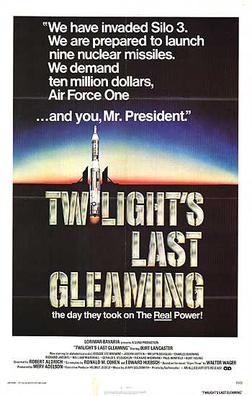
A Movie A Day #235: Twilight’s Last Gleaming (1977, directed by Robert Aldrich)


In Montana, four men have infiltrated and taken over a top-secret ICBM complex.  Three of the men, Hoxey (William Smith), Garvas (Burt Young), and Powell (Paul Winfield) are considered to be common criminals but their leader is something much different.  Until he was court-martialed and sentenced to a military prison, Lawrence Dell (Burt Lancaster) was a respected Air Force general.  He even designed the complex that he has now taken over.  Dell calls the White House and makes his demands known: he wants ten million dollars and for the President (Charles Durning) to go on television and read the contents of top secret dossier, one that reveals the real reason behind the war in Vietnam.  Dell also demands that the President surrender himself so that he can be used as a human shield while Dell and his men make their escape.

Until Dell made his demands known, the President did not even know of the dossier’s existence.  His cabinet (made up of distinguished and venerable character actors like Joseph Cotten and Melvyn Douglas) did and some of them are willing to sacrifice the President to keep that information from getting out.

Robert Aldrich specialized in insightful genre films and Twilight’s Last Gleaming is a typical example: aggressive, violent, sometimes crass, and unexpectedly intelligent.  At two hours and 30 minutes, Twilight’s Last Gleaming is overlong and Aldrich’s frequent use of split screens is sometimes distracting but Twilight’s Last Gleaming is still a thought-provoking film.  The large cast does a good job, with Lancaster and Durning as clear stand-outs.  I also liked Richard Widmark as a general with his own agenda and, of course, any movie that features Joseph Cotten is good in my book!  Best of all, Twilight’s Last Gleaming‘s theory about the reason why America stayed in Vietnam is entirely credible.

The Vietnam angle may be one of the reasons why Twilight’s Last Gleaming was one of the biggest flops of Aldrich’s career.  In 1977, audiences had a choice of thrilling to Star Wars, falling in love with Annie Hall, or watching a two and a half hour history lesson about Vietnam.  Not surprisingly, a nation that yearned for escape did just that and Twilight’s Last Gleaming flopped in America but found success in Europe.  Box office success or not, Twilight’s Last Gleaming is an intelligent political thriller that is ripe for rediscovery.

A Movie A Day #23: The Valachi Papers (1972, directed by Terrence Young)


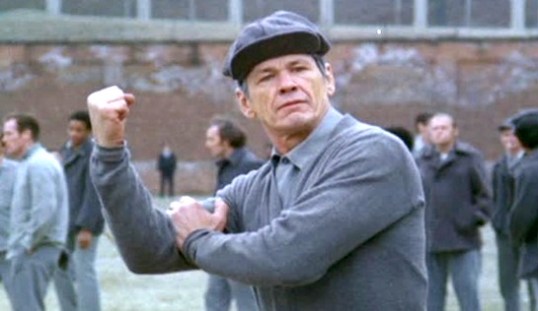
The best thing about The Valachi Papers is this:

valachi-0

That is Charles Bronson, playing real-life mob informant Joe Valachi and making a gesture that expresses the way many people feel about the world right now.  Valachi, in both the film and real life, was a bit player in the Cosa Nostra, a driver and an occasional hitman who was lucky enough to marry the daughter (played by Bronson’s real-life wife, Jill Ireland) of one of the bosses.  In prison for smuggling heroin, Valachi runs into one of those bosses, Vito Genovese (Lino Ventura).  Genovese, convinced that Valachi has broken the code of omerta, gives Valachi the kiss of death.  Valachi kisses him right back and then becomes a rat.

Valachi’s 1963 testimony to the U.S. Senate was the public’s first glimpse into life in the Mafia.  Many of the cliches that have since appeared in every mob movie or television show were the result of Valachi’s testimony and Peter Maas’s subsequent book, The Valachi Papers.  (In the “Test Dream” episode of The Sopranos, Tony can be seen holding a copy of The Valachi Papers.)

Over the years, doubts have been raised about both the validity of Valachi’s testimony and his claim that he only turned rat because Genovese put a contract on his life.  The film version of The Valachi Papers takes Valachi’s claims at face value, telling Valachi’s story in a series of flashbacks.

The Valachi Papers is often compared to another mob movie that came out in 1972, The Godfather, though there’s really not much of a comparison to be made.  Whereas The Godfather was a family saga, The Valachi Papers is much more concerned with the day-to-day operations of the Mafia.  It never comes close to matching The Godfather‘s epic feel and the cheap production values don’t help.  (Keep an eye out for the twin towers of the World Trade Center, anachronistically towering over depression-era New York City.)

Storywise, The Valachi Papers actually has more in common with Goodfellas than with The Godfather.  Like Henry Hill, Joe Valachi is not a major player.  He’s just a working man whose employer happens to be the Mafia.  Stylistically, of course, The Valachi Papers has nothing in common with Goodfellas.  If not for the violence and some the language, it would be easy to mistake The Valachi Papers for an old made-for-TV movie.

The best thing about The Valachi Papers is Charles Bronson as Joe Valachi.  When The Valachi Papers was made, Bronson was a huge draw in Europe but was still largely unknown in the United States.  It was not until Death Wish came out, two years later, that Bronson became a star.  He does a good job as Joe Valachi.  In a way, it’s the perfect role for Bronson, who was a genuine tough guy who, like Valachi, spent decades working in the trenches before eventually becoming a household name.

I don’t think Charles Bronson ever would have turned informant, though.

Not our Chuck.

the_valachi_papers_still

Embracing the Melodrama Part II #77: Quicksilver (dir by Thomas Michael Donnelly)


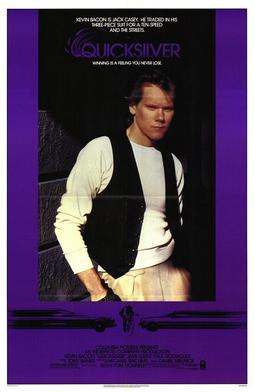
QuicksilverWho doesn’t love Kevin Bacon?

Seriously, I have yet to meet anyone who doesn’t have a positive reaction to seeing Kevin Bacon on screen.  He may not be a star in the way that Bradley Cooper or Bollywood sensation Shah Rukh Kahn are stars but still, he is one of those actors that everyone just seems to instinctively like.

I think, to a large extent, that is because, despite the fact that he’s been around and acting forever, Kevin Bacon himself still comes across as being a normal, blue-collar sorta guy.  Whenever you see him being interviewed, you get the feeling that Kevin Bacon basically shows up, does his job to the best of his ability, and, as opposed to many other actors, he doesn’t take himself or his movies too seriously.  He’s justifiably proud of the good films that he’s appeared in and he’s never had any problem admitting that he’s been in a lot of bad films as well.

In fact, it was Kevin Bacon’s openness about his bad films that led to me discovering 1986’s Quicksilver.  This is the film that, in a 2008 interview, Kevin Bacon referred to as being “the absolute lowest point of my career.”  (Consider, for a minute, that this is being said by the same Kevin Bacon who had an arrow shoved through his throat in the original Friday the 13th and that will give you some clue of how much disdain Kevin seems to have for Quicksilver.)

Naturally, having read that, I knew that I simply had to see Quicksilver.  I’ll admit right now that I was hoping to discover that it was some sort of loss and unappreciated classic.  I wanted this to be the review where I defended the unacknowledged brilliance of Quicksilver.  I wanted to say, “Don’t be so hard on yourself, Kevin!  Give Quicksilver another chance!”

But no.

Quicksilver doesn’t quite suck but it definitely comes close.

At the same time, it is interesting as a classic example of what happens when a filmmaker tries to assign some sort of deeper meaning to or find inherent nobility in an activity or job that really isn’t that interesting.  Often times, this will happen with sports movies.  A director or producer will make the mistake of thinking that just because he’s obsessed with beach volleyball that means that there’s a huge audience out there just waiting for someone to make the ultimate beach volleyball film.  Or, you’ll get a film like 1999’s Just The Ticket, where Andy Garcia is described as being the “world’s greatest ticket scalper” and the audience is supposed to be impressed.

In the case of Quicksilver, it’s all about being a bicycle messenger.  I’m assuming that, one day, director Thomas Michael Donnelly was stuck in traffic and he happened to see a bike messenger rushing down the street, whizzing past all of the stalled commuters.  And Donnelly probably thought, “I wish I was that guy right now!”  Every day after that, whenever Donnelly was stuck in traffic, he thought back to that bike messenger and slowly he grew obsessed.  All of his friends and his family got sick of listening to him talk about how much he envied the freedom of that bike messenger.  Finally, a little light bulb turned on over Donnelly’s head and he said, “I’ve got to make a movie out of this!”

And then the bulb burned out but nobody noticed.

Quicksilver-photo_625px_8col

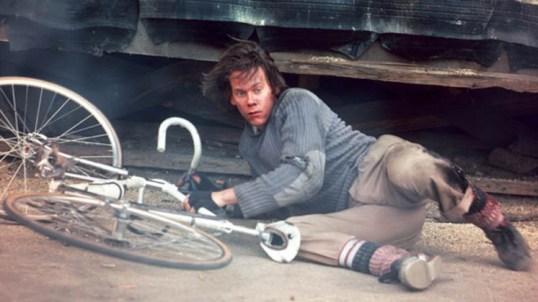
Kevin Bacon plays Jack Casey.  When we first meet Jack, he’s a successful stock broker and he’s got a really bad, porn-appropriate mustache.  One day, he’s sitting in the back of a cab and he goads his driver into getting into a race with a bike messenger.  The messenger beats the cab.  Jack is amazed!

And then, perhaps the very same day (the film is so poorly edited that it’s hard to tell), Jack not only loses all of his money but all of his parents’ money as well.  Since poor men couldn’t afford facial hair in the 1980s, he shaves off his mustache.  Desperately needing work, Jack applies to be a  — you guessed it! — bicycle messenger.

The rest of the film is basically Jack delivering messages and talking about how he’s free now to live the life that he’s always wanted to live.  And the thing is, you like Jack because he’s being played by Kevin Bacon.  I mean, Kevin Bacon is so inherently likable that audiences even liked him when he was trying to kill Professor X and Magneto in X-Men: First Class.  But, at the same time, you listen to Jack go on and on about how much better his life is now and you just want to say, “Who are you kidding?”

Needless to say, Jack has a group of quirky coworkers.  Of course, by quirky, I mean that they are all quirky in a very predictable Hollywood sort of way.  For instance, there’s the crusty old veteran and the goofy fat guy and the hard-working Mexican guy who wants to start his own business in America and the cocky black guy who is mostly notable for being played by Laurence Fisburne.  One thing they all have in common is that they all love and damn near worship Jack, who has quite the common touch despite having formerly been a super rich stock broker with a bad mustache.

Anyway, Terri (Jami Gertz) also wants to become a bicycle messenger but she’s being used to deliver drugs by Gypsy (Rudy Ramos).  She and Jack fall in love and, along with helping out his quirky coworkers and finding a way to make back his fortune, Jack also has to deal with Gypsy.  It’s all very dramatic (though the drug dealer subplot feels as if it was awkwardly inserted into the film at the last moment) but mostly, the plot is just an excuse for scenes like the one below:

Quicksilver is … well, it’s not particularly good.  It has a few good bike weaving in and out of traffic scenes but it’s definitely no Premium Rush.  But it is kinda fun, in a “Oh my God, look at the 1980s” sorta way.  And, for what it’s worth, it’s a film that proves that Kevin Bacon can be likable in almost anything.