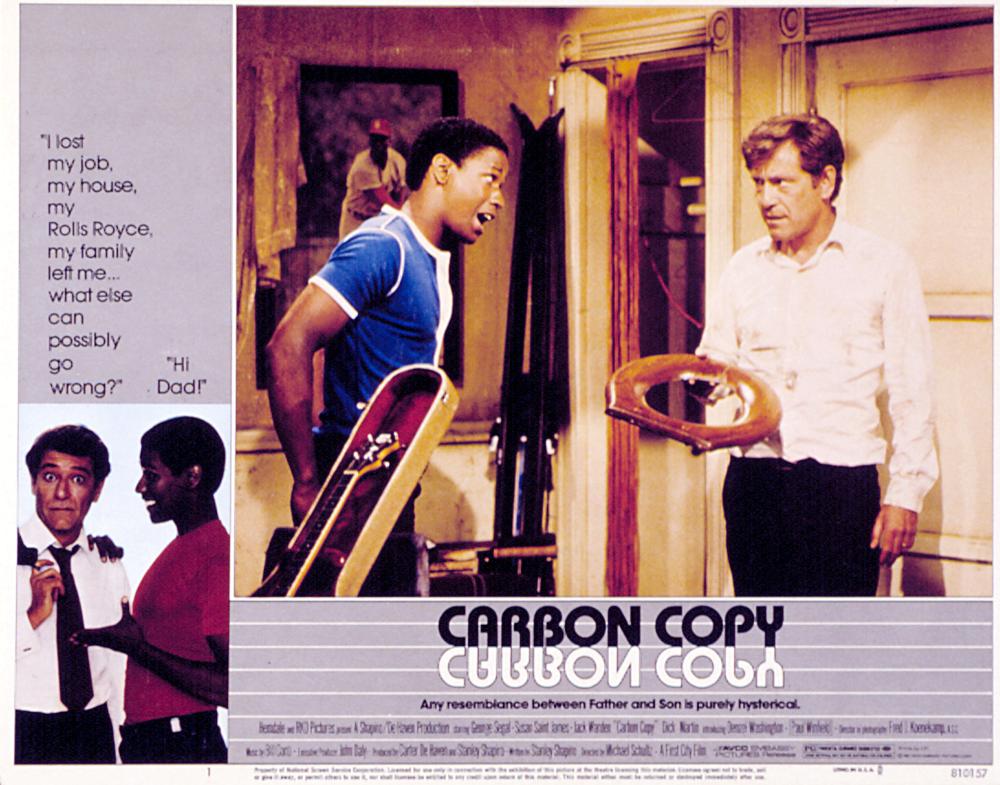
#MondayMuggers presents CARBON COPY (1981) starring George Segal and Denzel Washington!


Every Monday night at 9:00 Central Time, my wife Sierra and I host a “Live Movie Tweet” event on X using the hashtag #MondayMuggers. We rotate movie picks each week, and our tastes are quite different. Tonight, Monday March 3rd, we’re watching CARBON COPY starring George Segal, Susan Saint James, Jack Warden, Dick Martin, Paul Winfield, and “introducing” Denzel Washington.

CARBON COPY is the story about a rich, white corporate executive (George Segal) who finds out that he has an illegitimate black son (Denzel Washington). This creates a variety of issues for him at home, at work, and in his social circles.

Although CARBON COPY was chosen by Sierra, I’m looking forward to watching it for the first time for several reasons:

  1. This is the theatrical film debut of one of the all-time great actors in Denzel Washington. Everyone has to start somewhere, and it will be interesting to see Denzel at the very beginning.
  2. George Segal starred in a movie with Rod Steiger called NO WAY TO TREAT A LADY (1968). My dad used to always tell me about this movie. I bought it on DVD and added it to my collection simply because my dad loved it. I even took it to their house one year for our annual Christmas celebration so we could watch it together. That doesn’t have anything to do with CARBON COPY, but it’s always given me a reason to appreciate Segal.
  3. George Segal reportedly turned down the lead role in the film ARTHUR (1981) in order to make CARBON COPY. I enjoyed ARTHUR when I watched it growing up. It will be interesting to see how the two films compare.
  4. Director Michael Shultz also directed movies like COOLEY HIGH (1975), CAR WASH (1976), GREASED LIGHTNING (1977), WHICH WAY IS UP (1977), and BUSTIN’ LOOSE (1981) leading up to CARBON COPY. It will be interesting to see how he handles the material.

So, join us tonight for #MondayMuggers and watch CARBON COPY! It’s on Amazon Prime.

Cinemax Friday: The Babysitter (1995, directed by Guy Ferland)


Teenager Jennifer (Alicia Silverstone, shortly before she starred in Clueless) is hired to babysit Jimmy (Ryan Slater), the son of Denise (Lee Garlington) and Harry Tucker (J.T. Walsh) while the Tuckers attend a party over at the the home of Bill and Bernice Holstein (played by George Segal and Lois Chiles).  Harry spends the night drinking and fantasizing about Jennifer while Denise spends the night fantasizing about Bill.  Who does Bernice fantasize about?  The movie doesn’t say.

The adults aren’t the only ones fantasizing.  Bill’s son, Mark (Nicky Katt), is also obsessed with Jennifer and, while his parents are holding their party, he hangs out with his friend Jack (Jeremy London), who also happens to be Jennifer’s bitter ex-boyfriend.  Jack and Mark both start to discuss their own fantasies about Jennifer and they make plans to head over to the Tucker House and surprise Jennifer.  (Mark has even more in mind.)  Meanwhile, even little Jimmy is having fantasies of his own.

Today, it can be easy to forget just what a big deal Alicia Silverstone was in the early to mid-90s.  Even before she landed her star-making turn in Clueless, Silverstone achieved fame as the star of three videos from Aerosmith, all of which featured her playing roles that personified male fantasies.  Her role in The Babysitter fits right in with those Aerosmith videos as the entire film is devoted to men fantasizing about her.  Not much is revealed about who The Babysitter is and her name isn’t even revealed until the end of the movie.  Instead, the movie is about how every male in town, except for George Segal, is obsessed with her.  (What makes George Segal so special?)  Fortunately, Silverstone had the right mix of innocence and sultry beauty to be believable as everyone’s object of lust.  She does a good job playing both the normal teenage girl who just wants to make some extra money babysitting and also the exaggerated caricature who appears in everyone’s fantasies.  (Some of the fantasy scenes are ridiculous but most fantasies are.)

Especially after the release of Clueless, The Babysitter was advertised as being a softcore thriller and it used to show up frequently on late night Cinemax, playing alongside films like Body Chemistry.  Actually, it’s a satire of the suburbs that follows all of the men as they have too much to drink and make fools of themselves.  Thematically, it has more in common with movies like American Beauty, The Ice Storm, and The Virgin Suicides than it does to anything that’s ever been made by Shannon Tweed.  While many viewers were undoubtedly disappointed that Silverstone remained clothed for the majority of the film (and that even the scene where she took a bath was carefully shot to suggest more than it showed), The Babysitter was not a bad movie and it provided the great J.T. Walsh with a rare leading role.  The Babysitter is a better-than-expected mix of Nabokov and Cheever.


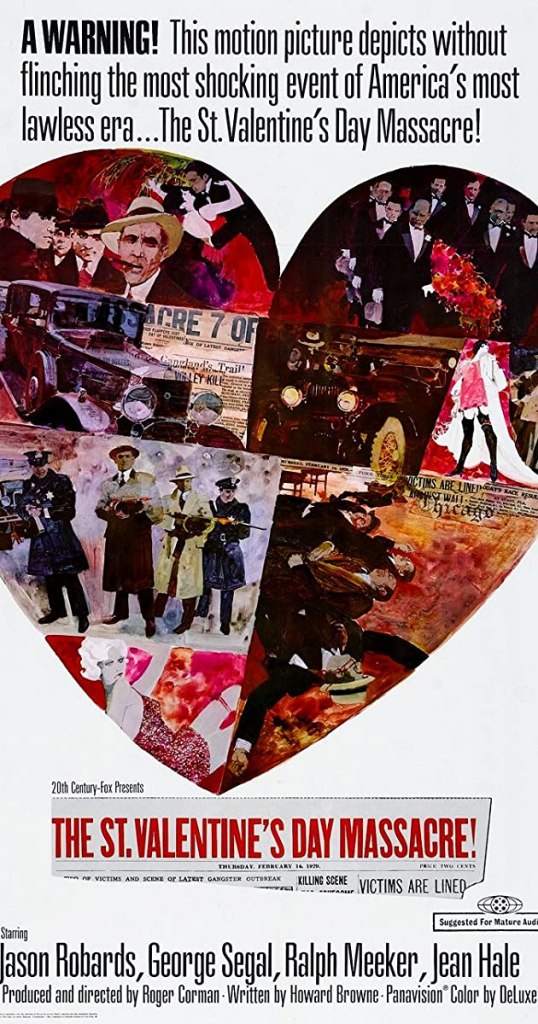
An Offer You Can’t Refuse #18: The St. Valentine’s Day Massacre (dir by Roger Corman)


On February 14th, 1929, seven men were murdered in a garage in Chicago, Illinois.  Five of the seven men were known to be associates of gangster George “Bugs” Moran.  The other two men were considered to be innocent bystanders, a mechanic and a dry cleaner who just happened to enjoy hanging out with gangsters.  Though no one was ever convicted of the crime, it was well-known that the murders were carried out on the orders of Al Capone.

In many ways, the St. Valentine’s Day Massacre was a turning point in America’s relationship with organized crime.  Before the massacre, Capone had become a bit of a folk hero.  He knew how to talk to the press and he was viewed as merely breaking a law (in this case, prohibition) that most people opposed in the first place.  However, after the murders, public opinion soured on Capone.

Some of it was the brutality of the crime.  It’s been said that over five hundred bullets were fired in that garage, all to kill seven defenseless men who were lined up against a wall.  Grisly pictures of the victims were released to the press.  Perhaps if the seven men had been carrying weapons and had been involved in a shootout with their murderers, the public’s reaction would have been different.  But this was a cold-blooded execution.

Personally, I think the fact that the killers disguised themselves as cops also played a role in the public’s outrage.  It was a very calculated move on the part of the killers and it highlighted just how much planning went into the St. Valentine’s Day Massacre.  As well, it undoubtedly made people paranoid.  If a bunch of killer could dress up like cops, who knew who else they could dress up as?

Finally, I think that Capone’s biggest mistake was carrying out the crime on Valentine’s Day.  You don’t murder people on a holiday.  Anyone should know that.  If Capone had waited until February 20th, he probably could have gotten away with it.

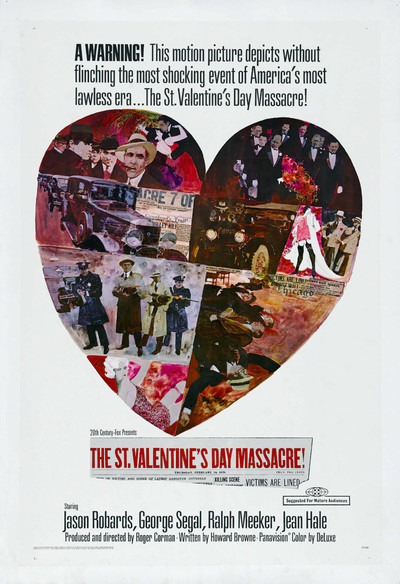
The 1967 film, The St. Valentine’s Day Massacre, details the rivalry between Capone and Moran, starting with them fighting for control over the Chicago rackets and ending with the title event.  Moran is played by Ralph Meeker while Jason Robards plays Capone.

Now I know what you’re probably thinking.  Perennial WASP Jason Robards as Al Capone?  That may sound like odd casting and, let’s just be honest here, it is.  However, it actually kind of works.  Robards may not be convincingly Italian but he is convincingly ruthless.  Add to that, one of the major subplots of the St. Valentine’s Day Massacre is that, even as the head of the Chicago Outfit, Capone still feels like an outsider in the world of organized crime because, while he is Italian, he isn’t Sicilian.  Capone feels as if Lucky Luciano and all of the major New York crime bosses look down on him and one reason why he’s so ruthless about taking over Chicago is that wants to show Luciano that he can be just as effective a crime lord as any Sicilian.  Capone feeling out of place in the Mafia is reflected by Robards initially seeming to be out of place in a gangster film.  By the end of the movie, of course, Capone has proven himself and so has Jason Robards.

Robards isn’t the only familiar face to be found in The St. Valentine’s Day Massacre.  Though this film was released by 20th Century Fox, it was directed by Roger Corman and Corman fills the production with members of his stock company.  Dick Miller, Jonathan Haze, and Jack Nicholson all have small roles as gunmen.  Bruce Dern plays the unlucky mechanic who enjoys hanging out with gangsters.  Buck Taylor, Leo Gordon, and Joe Turkel all have small roles.  John Agar plays Dion O’Bannon and is gunned down in his flower store.  Though not members of the Corman stock company, George Segal and David Canary plays brothers who work for Moran.  There’s a lot of characters wandering through this film but Corman makes sure that everyone gets a chance to make an impression.

It’s a good gangster film.  Though he was working with a larger budget than usual, Corman still brought his exploitation film aesthetic to the material and the end result is a violent, melodramatic gangster film that looks really impressive.  The film’s recreation of 1920s Chicago is a visual delight and looking at the well-dressed and stylish gangsters walking and driving down the vibrant city streets, you can understand why organized crime would have such a draw for some people.

The St. Valentine’s Day Massacre is a classic gangster film and a classic Corman film.  It’s an offer you can’t refuse.

Previous Offers You Can’t (or Can) Refuse:

  1. The Public Enemy
  2. Scarface
  3. The Purple Gang
  4. The Gang That Could’t Shoot Straight
  5. The Happening
  6. King of the Roaring Twenties: The Story of Arnold Rothstein 
  7. The Roaring Twenties
  8. Force of Evil
  9. Rob the Mob
  10. Gambling House
  11. Race Street
  12. Racket Girls
  13. Hoffa
  14. Contraband
  15. Bugsy Malone
  16. Love Me or Leave Me
  17. Murder, Inc.


18 Days of Paranoia #10: The Quiller Memorandum (dir by Michael Anderson)


The 1966 film, The Quiller Memorandum, is a diabolically clever little spy thriller.

The film opens with a British secret agent getting gunned down while trying to make a call from a phone booth in Berlin.  While we never learn the exact name of the agency that the man was working for, we do discover that they don’t take kindly to their agents getting gunned down in phone booths.  They send in another agent, an American named Quiller (George Segal), to take his place.

In Berlin, Quiller’s boss is a man named Pol (Alec Guinness).  Pol explains that the man in the phone booth was actually the second of his agents to be assassinated in Berlin.  All of the agents were looking for information about a Neo-Nazi group called Phoenix.  Pol tells Quiller that it is vitally important they discover just where, in Berlin, Phoenix is headquartered.  Quiller is given a few items that were found on the dead man in the phone booth: a bowling alley ticket, a swimming pool ticket, and a newspaper article about a school where it was discovered that one of the teachers had Nazi sympathies.

Though The Quiller Memorandum was undoubtedly produced with the hopes of capitalizing on the popularity of the Bond films, Quiller is no James Bond.  We know that as soon as we see him.  It’s not just that Quiller’s an American while Bond was British.  It’s also that James Bond was played by the cool and calculating Sean Connery while Quiller is played by George Segal.  Whereas Connery’s Bond never loses his confidence, Segal’s Quiller comes across as being, at first, a bit cocky and, as a result, we worry about him.  Whereas Connery’s Bond rarely gave his actions a second thought, Segal brings a slightly neurotic edge to Quiller.  You take one look at Connery’s Bond and you know that he’s going to survive no matter what.  Quiller, however, you never get that feeling.  When he’s in danger, you worry about him because it’s easy to imagine him turning up like the man in the phone booth.

And, indeed, it doesn’t take long for Quiller to get captured by the members of Phoenix.  A man bumps him with a suitcase, injecting a drug into his system that makes Quiller become drowsy.  When Quiller awakens, he’s being interrogated by an erudite man named Oktober (Max von Sydow).  Oktober’s an aristocrat.  He speaks in a very calm tone, rarely showing any hint of anger.  The only thing that betrays his evil nature are his eyes, which are cold and soulless.

Even though Quiller survives the interrogation, it’s tempting to give up on him.  After all, Quiller got captured so easily and Oktober seems so clever that you kind of find yourself wondering if maybe the agency made a mistake when they gave this mission to Quiller.  That’s where The Quiller Memorandum surprises you, though.  Quiller turns out to be a lot more clever and resourceful than anyone gave him credit for being and, for that matter, the film itself turn out to have a few more twists and turns in store for the viewer.

It’s a clever and enjoyable spy film, featuring wonderful performances from Segal, Guinness, von Sydow, and Senta Berger as the teacher who may be in love with Quiller or who may have an agenda of her own.  The film may be a spy thriller but Michael Anderson directs it as if its a film noir, full of shadowy streets and morally ambiguous characters.  The script, by Harold Pinter, encourages us to trust no one and Anderson’s direction reminds us that we made the right decision.  On the dark streets of Cold War Berlin, no one is who they seem.

The Quiller Memorandum is a must-see for fans of 60 spy films.  Watch it with someone who you think you can trust.

Other Entries In The 18 Days Of Paranoia:

  1. The Flight That Disappeared
  2. The Humanity Bureau
  3. The Private Files of J. Edgar Hoover
  4. The Falcon and the Snowman
  5. New World Order
  6. Scandal Sheet
  7. Cuban Rebel Girls
  8. The French Connection II
  9. Blunt: The Fourth Man 

Lisa Reviews An Oscar Nominee: Who’s Afraid of Virginia Woolf? (dir by Mike Nichols)


I’ve starred in a production of Edward Albee’s play, Who’s Afraid of Virginia Woolf?

That’s right.  I’ve played Martha, the heavy-drinking and dissatisfied wife of a burned-out English professor named George.  Yes, I’ve played the same role for which Uta Hagen won a Tony and Elizabeth Taylor won an Oscar.  Among the other actresses that have played Martha on stage: Colleen Dewhurst, Meg Tilly, Diana Rigg, and Kathleen Turner.  And, of course, me.

Now, I should admit that I was only 16 when I played Martha so I was perhaps a bit too young for the role.  Fortunately, my friend Erik — who played George — was only a year and a half older so he was just as miscast as I was.  (It was, at one point, suggested that I should try to put some gray in my hair but I pointed out that, as a redhead, I would never have to worry about that.)  On Broadway and film, Who’s Afraid of Virginia Woolf? runs for over two hours.  The production in which I starred only had a running time of 13 minutes.  Also, the version in which I starred did not feature the characters for Honey and Nick.  I mean, who needed them when you could just watch Erik and me yell at each other for ten minutes straight.

And that’s pretty much what we did.  When we told our drama teacher that we would be doing a scene from Who’s Afraid of Virginia Woolf? for our “Dramatic Duet,” I’m pretty sure that I saw her roll her eyes.  I imagine that’s because she knew that both of us had a tendency towards the dramatic and that the main we picked the play was so we could compete to see who could be the first to go hoarse from yelling.  She was right, of course.  There was no nuance to our performance, largely because neither one of us really understood what the play was about.  We just thought it was funny that some of our classmates covered their ears while we were loudly insulting and taunting each other.  (For the record, I went hoarse before Erik did and I spent the next two days receiving compliments about my new sexy voice.)

Now that I’ve grown up a little, I think I have a better understanding of what Who’s Afraid of Virginia Woolf? is actually about.  At the very least, I now understand that the story is about more than just two burn-outs yelling at each other while a younger couple awkwardly watches.  I now understand that the game that George and Martha play over the course of the night is not a game of hate but instead a game of a very dysfunctional but also rather deep love.  If anything, I now have more sympathy for George and Martha and far less for the play’s judgmental younger couple, Nick and Honey.

Of course, it helps that I’ve seen the 1966 film version of Who’s Afraid of Virginia Woolf?  Directed (in his directorial debut) by Mike Nichols, Who’s Afraid of Virginia Woolf? features Elizabeth Taylor and Richard Burton as George and Martha and George Segal and Sandy Dennis and Nick and Honey.  All four of them were Oscar-nominated for their roles, making Who’s Afraid of Virginia Woolf? one of the few films to see its entire cast nominated.  Elizabeth Taylor and Sandy Dennis both won in in their categories but it really is Richard Burton (who lost to Paul Scofield) who dominates the film.

Burton was a performer who could be shameless in his overacting.  (Just watch his performance in The Exorcist II if you need proof.)  And really, one would expect that the role of George would appeal to all of his worst instincts.  Instead, Burton gives a surprisingly subtle performance.  He growls when you expect him to yell and he delivers the majority of his lines not with fury but instead with a resigned and rather sardonic self-loathing.  He’s actually less showy than Elizabeth Taylor, who gives an overall good performance but still sometimes comes across like she’s trying too hard to convince the audience that she’s a 50 year-old drunk and not one of the world’s most glamorous film stars.  Throughout the film, Burton seems to be digging down deep and exposing his true self to the audience and, watching the action unfold, you can’t take your eyes off of him.  Everyone in the cast does a good job with their roles but Burton is the one who keeps the film moving.  Just as George is ultimately revealed to be stronger than he originally appears, Burton also reveals himself to be a far more compelling actor than you might think if you just knew him from his lesser roles (and performances).

Admittedly, Who’s Afraid of Virginia Woolf? is not my favorite of the many films that have been nominated for best picture over the last 90 years.  Even when the characters are inhabited by skilled performers, a little bit of George and Martha goes a long way.  That said, this is a historically important film.  The film’s language may seem tame today but it was considered to be shockingly profane in 1966.  The fact that the National Legion of Decency declined to condemn the film despite the language was considered to be a major step forward in the maturation of American cinema.  In fact, it can be argued that the MPAA rating system started as a way to tell audiences that a film like Who’s Afraid Of Virginia Woolf? was not morally objectionable but that it was still meant for adults.

Who’s Afraid of Virginia Woolf? received thirteen Academy Awards nominations.  It was nominated in every category for which it was eligible.  It won 5 awards but ultimately lost Best Picture to rather more sedate theatrical adaptation, A Man For All Seasons.


Film Review: To Die For (dir by Gus Van Sant)


The 1995 satire, To Die For, is a very clever film about some seriously stupid people.

Of course, you could debate whether or not Suzanne Stone-Maretto (Nicole Kidman) is actually dumb or not.  Suzanne may not know much about anything that isn’t on TV but she does have a natural understanding for what makes a good story.  She knows exactly the type of story that the public wants to hear and she does a good job of faking all of the right emotions.  As she proves throughout the course of the film, she’s also very good at convincing people to do stuff.  Whether it’s convincing the local television station to put her on the air as a weather person or convincing two teenagers to murder her husband, Suzanne always seems to get what she wants.

Of course, what Suzanne really wants is to be a celebrity.  She wants to be a star.  As she explains it, that’s the greatest thing about America.  Anyone can become a star if they just try hard enough and find the right angle.  If the film were made today, Suzanne would be a social media junkie.  Since the movie was made in 1995, she has to settle for talk shows and murder.

So maybe Suzanne isn’t that dumb but her husband, Larry (Matt Dillon) …. well, if we’re going to be honest, Larry’s more naive than dumb.  He’s the favored son of a big Italian family and it’s obviously never occurred to him that a woman would possibly want something more than just a husband and a lot of children.  He thinks it’s cute that Suzanne’s on TV but he’s also fully convinced that she’s going to eventually settle down and focus on starting a family.  It never occurs to him that his wife would be willing to sacrifice him on her way to stardom.

Of course, if you really want to talk about dumb, just check out the teenagers who Suzanne recruits to kill her husband.  They’ve been appearing in a documentary that Suzanne’s been shooting.  The documentary’s title is “Teens Speak Out,” which is something of an ironic title since none of the teens that Suzanne interviews really has anything to say.  Lydia (Allison Folland) is just happy that the “glamorous” Suzanne is pretending to care about her.  Russell (Casey Affleck) is the type of grinning perv who drops a pen just so he can try to get a peek up Suzanne’s skirt while he’s on the floor retrieving it.  And then there’s Jimmy (Joaquin Phoenix), with his flat voice and his blank stare.  Jimmy is briefly Suzanne’s lover before he ends up in prison for murdering her husband.  It doesn’t take much to convince Jimmy to commit murder, either.  Apparently, all you have to do is dance to Lynard Skynard while it’s raining outside.  Media interviews with Lydia, Jimmy, Suzanne, and Larry’s sister (Ileana Douglas) are sprinkled throughout the film and Jimmy continues to insist that he will always love Suzanne.

As for Suzanne, she’s got stardom to worry about….

Though the subject matter is a bit familiar and the film, made before the age of Twitter and Instagram, is a bit dated, To Die For‘s satire still carries a powerful bite.  One need only watch A&E or the Crime and Investigation network to see that Suzanne was absolutely correct when she decided that killing her husband would make her a star.  If To Die For were made today, you could easily imagine Suzanne leveraging her infamy into an appearance on Dancing With The Stars and maybe Celebrity Big Brother.  At the very least. she could get her own house hunting show on HGTV.  Delivering her often sociopathic dialogue with a perky smile and a positive attitude, Nicole Kidman is absolutely chilling as Suzanne.  Meanwhile, Joaquin Phoenix’s blank stare will continue to haunt you long after the film ends.

And speaking of endings, To Die For has a great one.  You’ll never hear Season of the Witch the same way again!

The TSL’s Horror Grindhouse: The Terminal Man (dir by Mike Hodges)


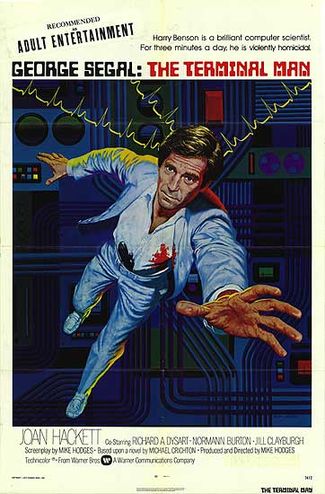
Check out the poster for 1974’s The Terminal Man.

Look at it carefully.  Examine it.  Try to ignore the fact that it’s weird that George Segal was once a film star.  Yes, on the poster, Segal has been drawn to have a somewhat strange look on his face.  Ignore that.  Instead, concentrate on the words in the top left corner of the poster.

“ADULT ENTERTAINMENT!” it reads.

That’s actually quite an accurate description.  The Terminal Man is definitely a film for adults.  No, it’s not pornographic or anything like that.  Instead, it’s a movie about “grown up” concerns.  It’s a mature film.  In some ways, that’s a good thing.  In some ways, that’s a bad thing.

Taking place in the near future (and based on a novel by Michael Crichton), The Terminal Man tells the story of Harry Benson (played, of course, by George Segal).  Harry is an extremely intelligent computer programmer and he’s losing his mind.  It might be because he was in a serious car accident.  It may have even started before that.  Harry has black outs and when he wakes up, he discovers that he’s done violent things.  Even when he’s not blacked out, Harry worries that computers are going to rise up against humans and take over the world.

However, a group of scientists think that they have a way to “fix” Harry.  It’ll require a lot of brain surgery, of course.  (And, this being a film from 1973, the film goes into excruciating details as it explains what’s going to be done to Harry.)  The plan is to implant an electrode in Harry’s brain.  Whenever Harry starts to have a seizure, the electrode will shock him out of it.  The theory is that, much like Alex in A Clockwork Orange 0r Gerard Malanga in Vinyl, Harry will be rendered incapable of violence.

Of course, some people are more enthusiastic about this plan than others.  Harry’s psychiatrist (Joan Hackett) fears that implanting an electrode in Harry’s brain will just make him even more paranoid about the rise of the computers.  Other scientists worry about the ethics of using technology to modify someone’s behavior.  Whatever happens, will it be worth the price of Harry’s free will?

But, regardless of the risks, Harry goes through with the operation.

Does it work?  Well, if it worked, it would be a pretty boring movie so, of course, it doesn’t work.  (Allowing Harry’s operation to work would have been like allowing King Kong to enjoy his trip to New York.)  Harry’s brain becomes addicted to the electrical shocks and, as he starts to have more and more seizures, Harry becomes even more dangerous than he was before…

The Terminal Man is a thought-provoking but rather somber film.  On the one hand, it’s a rather slow movie.  The movie does eventually get exciting after Harry comes out of surgery but it literally takes forever to get there.  The movie seems to be really determined to convince the audience that the story it’s telling is scientifically plausible.  On the other hand, The Terminal Man does deal with very real and very important issues.  Considering how threatened society is by people who cannot be controlled, issues of behavior modification and free thought will always be relevant.

Though the film may be slow, I actually really liked The Terminal Man.  Judging from some of the other reviews that I’ve read, I may be alone in that.  It appears to be a seriously underrated film.  As directed by Mike Hodges, the film is visually stunning, emphasizing the sterility of the white-walled hospital, the gray blandness of the doctors, and the colorful vibrancy of life outside of science.  Though he initially seems miscast, George Segal gives a good and menacing performance as Harry.

The Terminal Man requires some patience but it’s worth it.

A Movie A Day #167: Stick (1985, directed by Burt Reynolds)


Stick (Burt Reynolds) is a veteran car thief who has just gotten out of prison.  No sooner has Stick arrived home in Florida then he accompanies his friend, Rainy (Jose Perez), on a drug deal that goes bad.  When Rainy is killed, Stick goes into hiding.  He manages to get a stable job, working as a chauffeur for an eccentric millionaire (George Segal).  He gets a new girlfriend (Candice Bergen) and starts to bond with his teenage daughter (Tricia Leigh Fisher).  Stick wants to go straight but, before he can, he knows that he has to confront the men who murdered Rainy.
Stick starts out strong.  The first half of the film finds Burt, who was often as underrated as a director as he was as an actor, in pure Sharky’s Machine mode, mixing the steamy Florida atmosphere with quirky character comedy and hardboiled action.  Adapting his own novel, Elmore Leonard wrote the screenplay and Stick seems like a classic Leonard hero, a criminal with his own moral code.  

But then Stick falls apart during the second half and it becomes obvious why both Reynolds and Leonard often cited this film as being one of the biggest disappointments of their careers.  Universal Studios disliked Burt’s first cut of the film and brought in a second screenwriter, who beefed up the action scenes and added the subplot with Stick’s teenage daughter.  Reynolds reshot the second half of the movie, no longer playing Stick as a tough criminal but instead as another variation on the Bandit.  The end result is a very disjointed movie, with Burt looking bored.

It does not help that the movie’s main villain is played by Charles Durning, who wears an orange fright wig and several Hawaiian shirts.  Durning was an actor who gave many great performances but never was he as miscast as when he played a drug dealer in Stick.

Roger Corman’s Bloody Valentine: THE ST. VALENTINE’S DAY MASSACRE (20th Century-Fox 1967)


gary loggins's avatarcracked rear viewer

Low budget auteur Roger Corman had visited the gangster genre twice before, with 1958’s MACHINE GUN KELLY (featuring Charles Bronson in the title role) and I, MOBSTER (starring noir vet Steve Cochran ). Nine years later,  Corman produced and directed THE ST. VALENTINE’S DAY MASSACRE, with major studio backing, star power, and a million dollar budget. It’s still a Roger Corman film though, which means it’s a helluva lot of fun!

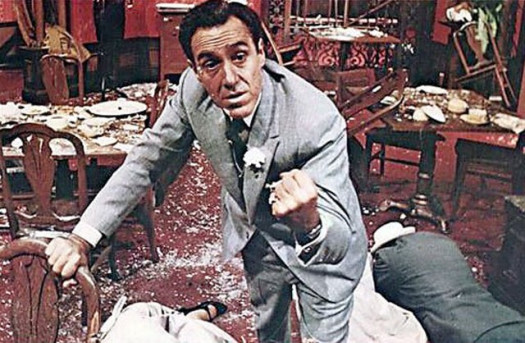
We’re in 1929 Chicago (as narrator Paul Frees tells us), a time of lawlessness, bootlegging, and mob killings on a daily basis. Two rival factions are battling to control the Windy City: the Southside gang led by ‘Scarface’ Al Capone (Jason Robards) and his Northside enemy ‘Bugs’ Moran ( Ralph Meeker ). Moran sends his top hood Peter Gusenberg (George Segal) to muscle in on Capone’s rackets, but when Big Al’s mentor Patsy is gunned down by Moran’s assassins, the crime boss goes…

View original post 495 more words

Lisa Reviews An Oscar Nominee: The Longest Day (dir by Ken Annakin, Andrew Marton, Bernhard Wicki, Gerd Oswald, and Darryl F. Zanuck)


As my sister has already pointed out, today is the 73rd anniversary of D-Day.  With that in mind, and as a part of my ongoing mission to see and review every single film ever nominated for best picture, I decided to watch the 1962 film, The Longest Day!

The Longest Day is a pain-staking and meticulous recreation of invasion of Normandy, much of it filmed on location.  It was reportedly something of a dream project for the head of the 20th Century Fox, Darryl F. Zanuck.  Zanuck set out to make both the ultimate tribute to the Allied forces and the greatest war movie ever.  Based on a best seller, The Longest Day has five credited screenwriters and three credited directors.  (Ken Annakin was credited with “British and French exteriors,” Andrew Marton did “American exteriors,” and the German scenes were credited to Bernhard Wicki.  Oddly, Gerd Oswald was not credited for his work on the parachuting scenes, even though those were some of the strongest scenes in the film.)  Even though he was not credited as either a screenwriter or a director, it is generally agreed that the film ultimately reflected the vision of Darryl F. Zanuck.  Zanuck not only rewrote the script but he also directed a few scenes as well.  The film had a budget of 7.75 million dollars, which was a huge amount in 1962.  (Until Steven Spielberg’s Schindler’s List, The Longest Day was the most expensive black-and-white film ever made.)  Not only did the film tell an epic story, but it also had an epic length.  Clocking in at 3 hours, The Longest Day was also one of the longest movies to ever be nominated for best picture.

The Longest Day also had an epic cast.  Zanuck assembled an all-star cast for his recreation of D-Day.  If you’re like me and you love watching old movies on TCM, you’ll see a lot of familiar faces go rushing by during the course of The Longest Day.  American generals were played by actors like Robert Mitchum, Robert Ryan, Henry Fonda, and John Wayne.  Peter Lawford, then the brother-in-law of the President of the United States, had a memorable role as the Scottish Lord Lovat, who marched through D-Day to the sounds of bagpipes.  When the Allied troops storm the beach, everyone from Roddy McDowall to Sal Mineo to Robert Wagner to singer Paul Anka can be seen dodging bullets.  Sean Connery pops up, speaking in his Scottish accent and providing comic relief.  When a group of paratroopers parachute into an occupied village, comedian Red Buttons ends up hanging from the steeple of a church.  When Richard Beymer (who is currently playing Ben Horne on Twin Peaks) gets separated from his squad, he stumbles across Richard Burton.  Among those representing the French are Arletty and Christian Marquand.  (Ironically, after World War II, Arletty was convicted of collaborating with the Germans and spent 18 months under house arrest.  Her crime was having a romantic relationship with a German soldier.  It is said that, in response to the charges, Arletty said, “My heart is French but my ass is international.”)  Meanwhile, among the Germans, one can find three future Bond villains: Gert Frobe, Curt Jurgens, and Walter Gotell.

It’s a big film and, to be honest, it’s too big.  It’s hard to keep track of everyone and, even though the battle scenes are probably about an intense as one could get away with in 1962 (though it’s nowhere near as effective as the famous opening of Saving Private Ryan, I still felt bad when Jeffrey Hunter and Eddie Albert were gunned down), their effectiveness is compromised by the film’s all-star approach.  Often times, the action threatens to come to a halt so that everyone can get their close-up.  Unfortunately, most of those famous faces don’t really get much of a chance to make an impression.  Even as the battle rages, you keep getting distracted by questions like, “Was that guy famous or was he just an extra?”

Among the big stars, most of them play to their personas.  John Wayne, for instance, may have been cast as General Benjamin Vandervoort but there’s never any doubt that he’s playing John Wayne.  When he tells his troops to “send them to Hell,” it’s not Vandervoort giving orders.  It’s John Wayne representing America.  Henry Fonda may be identified as being General Theodore Roosevelt II but, ultimately, you react to him because he’s Henry Fonda, a symbol of middle-American decency.  Neither Wayne nor Fonda gives a bad performance but you never forget that you’re watching Fonda and Wayne.

Throughout this huge film, there are bits and pieces that work so well that you wish the film had just concentrated on them as opposed to trying to tell every single story that occurred during D-Day.  I liked Robert Mitchum as a tough but caring general who, in the midst of battle, gives a speech that inspires his troops to keep fighting.  The scenes of Peter Lawford marching with a bagpiper at his side were nicely surreal.  Finally, there’s Richard Beymer, wandering around the French countryside and going through the entire day without firing his gun once.  Beymer gets the best line of the film when he says, “I wonder if we won.”  It’s such a modest line but it’s probably the most powerful line in the film.  I wish The Longest Day had more scenes like that.

The Longest Day was nominated for best picture of 1962 but it lost to an even longer film, Lawrence of Arabia.