Lisa Reviews An Oscar Nominee: The Human Comedy (dir by Clarence Brown)


The-human-comedy-1943Thanks to TCM’s 31 Days of Oscar, I now have several movies on my DVR that I need to watch over the upcoming month.  Don’t get me wrong — I’m not complaining.  I’m always happy to have any reason to discover (or perhaps even rediscover) a movie.  And, being an Oscar junkie, I especially enjoy the opportunity to watch the movies that were nominated in the past and compare them to the movies that have been nominated more recently.

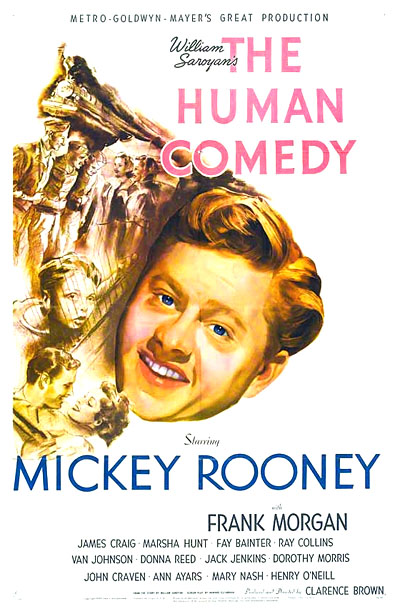
For instance, tonight, I watched The Human Comedy, a film from 1943.  Along with being a considerable box office success, The Human Comedy won on Oscar (for Best Story) and was nominated for four others: picture, director (Clarence Brown), actor (Mickey Rooney), and black-and-white cinematography.  The Human Comedy was quite a success in 1943 but I imagine that, if it were released today, it would probably be dismissed as being too sentimental.  Watching The Human Comedy today is something of a strange experience because it is a film without a hint of cynicism.  It deals with serious issues but it does so in such a positive and optimistic manner that, for those of us who are used to films like The Big Short and Spotlight, a bit of an attitude adjustment is necessary before watching.

And yet that doesn’t mean that The Human Comedy is a bad film.  In fact, I quite enjoyed it.  The Human Comedy is a time capsule, a chance to look into the past.  It also features a great central performance, one that was quite rightfully nominated for an Oscar.  As I watched Mickey Rooney in this film, I started to feel guilty for some of the comments I made when I reviewed Mickey in The Manipulator last October.
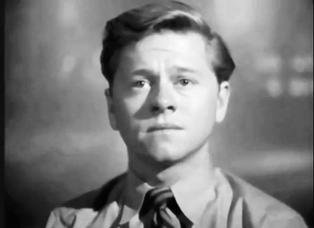
2Mickey Rooney in The Human Comedy

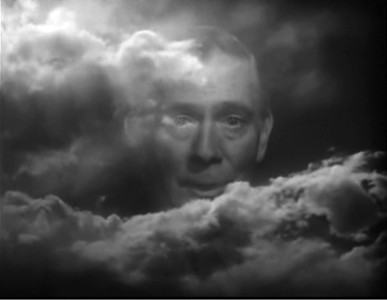
The Human Comedy opens with an overhead shot of the small town of Ithaca, California.  The face of Mr. McCauley (Ray Collins, who you’ll recognize immediately as Boss Jim Gettys from Citizen Kane) suddenly appears in the clouds.  Mr. McCauley explains that he’s dead and he’s been dead for quite some time.  But he loves Ithaca so much that his spirit still hangs around the town and keeps an eye on his family.  Somehow, the use of dead Mr. McCauley as the film’s narrator comes across as being both creepy and silly.
Matthew-clouds-400-387x300

But no sooner has Mr. McCauley stopped extolling the virtues of small town life than we see his youngest song, 7 year-old Ulysseus (Jack Jenkins), standing beside a railroad track and watching a train as it rumbles by.  Sitting on the cars are a combination of soldiers and hobos.  Ulysseus waves at some of the soldiers but none of them wave back.  Finally, one man waves back at Ulysseus and calls out, “Going home, I’m going home!”  It’s a beautifully shot scene, one that verges on the surreal.

That opening pretty much epitomizes the experience of watching The Human Comedy.  For every overly sentimental moment, there will be an effective one that will take you by surprise.  The end result may be uneven but it’s still undeniably effective.

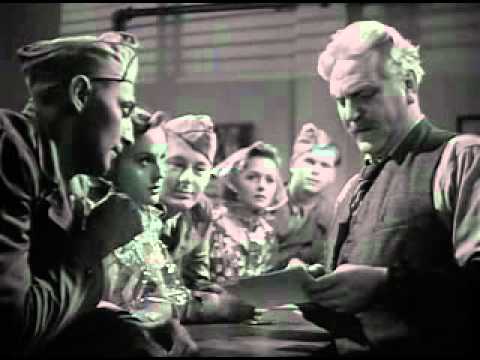
The majority of the film deals with Homer McCauley (Mickey Rooney).  Homer may still be in high school but, with his older brother, Marcus (Van Johnson), serving overseas and his father dead, Homer is also the man of the house.  Homer not only serves as a role model for Ulysseus but he’s also protector for his sister, Bess (Donna Reed).   (At one point in the film, she gets hit on by three soldiers on leave.  One of them is played by none other than Robert Mitchum.)  In order to bring in extra money for the household, Homer gets a job delivering telegrams.
hqdefault

In between scenes of Homer in Ithaca, we get oddly dream-like scenes of Marcus and his army buddies hanging out.  Marcus spends all of his time talking about how much he loves Ithaca and how he can’t wait for the war to be over so he can return home.  One of his fellow soldiers says, “I almost feel like Ithaca is my hometown, too.”  Marcus promises him that they’ll all visit Ithaca.  As soon as the war is over…

With World War II raging, Homer’s job largely consists of delivering death notices (and the occasional singing telegram, as well).  Telegraph operator Willie Grogan (Frank Morgan) deals with the burden of having to transcribe bad news by drinking.  Homer, meanwhile, tries to do his job with compassion and dignity but one day, he has to deliver a telegram to his own house…

The Human Comedy is an episodic film, full of vignettes of life in Ithaca and Homer growing up.  There’s quite a few subplots (along with a lot of speeches about how America is the best country in the world) but, for the most part, the film works best when it concentrates on Homer and Mickey Rooney’s surprisingly subdued lead performance.  By today’s standards, it may seem a bit predictable and overly sentimental but it’s also so achingly sincere that you can’t help but appreciate it.

The Human Comedy was nominated for best picture but it lost to a somewhat more cynical film about life during World War II, Casablanca.


Here’s the Latest Trailer For Demolition!


Much like Miles Ahead, Demolition is another film that was briefly pegged as a certain 2015 Oscar nominee until its release date was moved back to 2016.  Jean-Marc Vallee’s follow-up to the wonderful Wild, Demolition features Jake Gyllenhaal as a recent widower who struggles to deal with his grief.

I have to admit that I’ve seen the first trailer for Demolition about a hundred times now (it plays before every film at the Alamo Drafthouse) and I’m kind of sick of listening to Gyllenhaal talk about that damn vending machine.  That said, I’ll watch Jake Gyllenhaal in just about anything.  If I could force myself to sit through Southpaw, I’m sure I’ll be able to handle Demolition when it opens in April.

Here’s the latest trailer for Demolition!  Unfortunately, it opens with that same endless vending machine monologue but it does go on to reveal that one of my favorite actresses, Naomi Watts, is in the film as well.  So, that’s a good thing.

Hallmark Review: All Things Valentine (2016, dir. Gary Harvey)


IMG_2814

Sorry I’ve been gone for a few days, but it’s been pretty horrible here. No worries though because I come bearing All Things Valentine. All Things Valentine is a film that on the surface appears to be just a reworked version of Love On The Air, but is actually pretty messed up. For those of you who don’t recall, Love On The Air was the movie where two idiots on the radio fall in love with each other over #NotAllMen and #YesAllWomen statements they make on the radio. Not my favorite, but at least it didn’t do what this film does.

The film opens up with that super generic title card that at least looks better than the ones for Unleashing Mr. Darcy and Dater’s Handbook. Then we are introduced to Avery Parker played by Sarah Rafferty. I guess that makes two Hallmark movies where the actresses are from the USA show Suits since Dater’s Handbook had Meghan Markle in it.

IMG_2835

Poor Avery was really happy as she was walking around in red, carrying a gift, and balloons, but then saw her boyfriend kissing another girl. Instead of confronting him or anything, she just goes home to pout. Then we get a shot of a dog she owns. Can’t say I’ve seen a dog with a nose like that.

IMG_2845

And yes Hallmark, I am excited about your upcoming cannibal Valentine’s Day movie. If somebody doesn’t get eaten then I am going to be very disappointed by your deceptive title. Now we find out that Avery works for The Portland Banner as a Dear Abby type called “The Coach”. Her column is called “Consult The Coach”. Here’s the letter that just came in:

IMG_2850

Now we meet the person who wrote the letter named McKenna played by Kimberly Sustad. Sadly, Superman from The Nine Lives Of Christmas isn’t here to save her.

IMG_2860

Here’s the response she receives from The Coach:

IMG_2861

So her letter said that she kept bringing up Valentine’s Day, but that it didn’t seem important to him. The Coach’s advice is that “his insensitivity suggests the kind of man he is. Not someone you should trust with your heart.” Based on the letters I don’t think there is trust in this relationship at all. Wouldn’t the right advice be to stop being cryptic and actually just tell him? Being cryptic then being sad because the other person didn’t figure it out is your problem, not there’s. She actually will do this later and the film will rub it in her face.

Now Avery goes to work and her boss suddenly springs on her this idea for a series of Valentine’s Day related columns. Avery tells her how she isn’t the right person for this, that she doesn’t like Valentine’s Day, etc. Didn’t think of this just a little while ago when she dispensed advice about Valentine’s Day to McKenna, but now this comes out. I know she couched it with “I’m not a big fan of Valentine’s Day”, but come on! How many of us have read Internet comments that started with I’m not racist or homophobic, but then launch into something blatantly racist or homophobic? Her boss tells her not to worry because it wouldn’t really be you writing the columns, but you’d be pretending to be someone who likes this holiday. Oh, that’s nice! Her boss is telling her to be a liar. Let’s go to dinner now!

IMG_2943

That’s right! McKenna is going to dump her boyfriend Brendan Bates played by Sam Page. I love this conversation because McKenna ceases to think for herself and basically quotes verbatim the turd The Coach sent her calling it advice. He reminds her that the very reason they are out at dinner right now is because he knows he won’t be able to be there on Valentine’s Day, but she doesn’t listen. He is just kicked to the curb.

So let’s see what we have so far. We have a woman who has the maturity of a 12 year-old. A boss who tells her to lie to people in an advice column. We have a woman who probably would think poison would be in her Valentine’s Day candies if an anonymous person online told her that. Wait, sorry, that was Ann Landers and Dear Abby that did that convincing people poison and razor blades might be in their child’s candy. The Coach would never give bad advice even though the scene that follows her giving said advice has her saying she shouldn’t write that stuff because she is biased. Then we have a guy who knew that he would have to work on Valentine’s Day so he made sure to take her out when he could. Fine, but watch what the movie does to this person whose relationship was ruined and what they do to the person who ruined it. That’s why this film is messed up.

Next we meet Brendan’s best friend and McKenna’s best friend who she works with at a bakery. They exist in this story to be a charming subplot on the surface, but really are there to just rub it into McKenna’s face even more. Yes, she will have a conversation with her blonde friend here to try and set us up for the ending. Still not going to work for Hallmark though. If this movie could have ended with none of the main characters together, then it could have worked, but it’s Hallmark so that can’t happen. Yeah, I think you can see what’s coming, can’t you?

Now we find out that Brendan is a vet. And wouldn’t you know it? Avery comes in with her dog that is now sick. Oh, but just before, Brendan fires off an angry letter to The Coach as Bench The Coach. Then the lovers meet, and they start dating.

IMG_3118

I’ve teased it enough. This movie is going to reward this woman for destroying this other’s woman’s life by giving her this guy and delivering an even better guy to her blonde friend leaving McKenna twisting in the wind. No joke. Oh, the writer J.B. White tries to put in a scene here and there so we are properly couched for this ending, but nope. This would be like if Chilly Scenes Of Winter (1979) stuck with it’s original ending and rewarded John Heard for all his stalking by having him end up with the girl. That’s what happens here.

I probably should stop now, but can you believe this situation is made even worse. Yeah, McKenna actually has a conversation with Brendan where she says that the Bench The Coach letters to The Coach have caused her to reconsider what she did. He not only brushes her off, but apparently has a date with The Coach on Valentine’s Day. The very day he said earlier he couldn’t do anything on.

IMG_3373

So in case we thought this might actually be a decent guy and were rooting for him, the movie gives us a reason to hate him. Yep!

The rest of the story plays out with Brendan and Avery getting closer and closer together while Brendan’s friend builds and builds up his courage to finally tell the blonde he is head over heels in love with her.

Near the end of the movie McKenna and Avery actually do have a conversation with each other about the whole situation. McKenna told Avery that Brendan was the guy who was sending her Coach persona those letters as Bench The Coach. They have a conversation that really tries to justify the ending by having McKenna reach out in a heart to heart with Avery.

IMG_3699

The movie so wants this to work, but it doesn’t. J.B. White has written some of the better Hallmark movies I’ve seen such as Lead With Your Heart. He obviously wanted to avoid the childish and contrived plots that usually riddle these Hallmark films and shoot for the stars with this one. The movie ends with blonde and Brendan’s friend getting together right in front of McKenna, Brendan and Avery getting together, and this being the last shot of McKenna that we get.

IMG_3765

Looks happy, doesn’t she? This simply wasn’t a plot that the Hallmark template could handle. The movie needed to end with only the blonde and Brendan’s friend getting together. The two worst people in the story end up happy together and the person who was lied to by both of those people is left alone with no one. Neither Avery nor Brendan learn lessons about hiding behind anonymity because doing so gets them together and heals Avery’s wounds associated with Valentine’s Day. This just wasn’t the right script for Hallmark. I actually kind of encourage you to watch it because White was certainly trying here for something adult and mature, but you’ll find that it doesn’t quite work because of the Hallmark romance movie framework that he just couldn’t break so strongly.

Here’s The Trailer for Miles Ahead!


With Miles Ahead, Don Cheadle both directs and stars as jazz legend Miles Davis.  Originally expected to be released at the end of last year, Miles Ahead is also a film that many of us were expecting to be a definite Oscar contender.  However, the film’s release was delayed, the Oscar nominations led to #OscarsSoWhite trending on twitter for the second year in a row, and Miles Ahead will finally be released in April of this year.

And here’s the trailer!  With a few notable exceptions — like Grand Budapest Hotel — it’s rare that anything too good is ever released in March or April.  But I remain cautiously optimistic, if just because of the pairing of Don Cheadle and Ewan McGregor.

Lisa Reviews An Oscar Nominee: Five Star Final (dir by Mervyn LeRoy)


Five_Star_Final_1931_poster

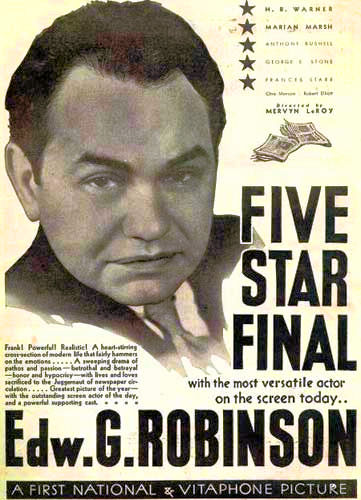
In 1911, a pregnant secretary named Nancy Voorhees (Frances Starr) shot and killed her boss and lover.  It was quite a scandal at the time but, twenty years later, it has largely been forgotten.  Nancy has married a successful businessman named Michael Townsend (H.B. Warner) and is a respected member of society.  Her daughter, Jenny (Marian Marsh), has no idea about Nancy’s past and believes Michael to be her father.  Jenny is now engaged to marry the handsome and rich Phillip Weeks (Anthony Bushnell).

Everything seems to be perfect but you know what they say about perfection.

Bernard Hincliffe (Oscar Apfel) is the publisher of a struggling tabloid newspaper.  He is frustrated by city editor Joseph Randall (Edward G. Robinson) and Randall’s refusal to do whatever it takes to boost circulation.  “Why, he won’t even print pictures of women in their underwear!” one of Hincliffe’s assistants exclaims.  Finally, Hincliffe orders Randall to publish a series of articles that will take a retrospective look at both the scandal and what has happened to those involved in the years since.  At first, the cynical Randall refuses but eventually, he gives in.

He assigns two reporters to crack the story.  One of them, Kitty Carmody (Ona Munson) is first introduced showing off her legs and bragging about how there’s no way that she won’t be hired to work at the newspaper.  (By the way, if anyone ever remakes Five Star Final and needs someone to play Kitty, I am ready and available.)  The other is the incredibly creepy T. Vernon Isopod (Boris Karloff).  Isopod was a divinity student until he was arrested on a “morals charge.”  Now, he pretends to be a minister as a way to fool people into revealing their deepest secrets to him.  Kitty and Isopod dig into the life of Nancy and Michael.  The stories appear on the front page.  Suicide and melodrama follow and Randall is forced to finally take a stand.

Released in 1931, Five Star Final was nominated for best picture but lost to Grand Hotel.  Seen today, Five Star Final is undeniably stagey (it was based on a play) but it’s still a compulsively watchable melodrama, featuring good performances and a lot of memorably snappy 30s dialogue. Five Star Final is one of several films about journalism to have been nominated for best picture.  Most of these films — like All The Presidents Men, The Front Page, and this year’s front-runner, Spotlight — have featured journalists as heroic seekers of the truth.  Five Star Final, on the other hand, plays more like a pre-Code version of Network set at a newspaper.  It’s a deeply angry film and, when Randall finally tells off Hincliffe, it feels like the 30s equivalent of Peter Finch shouting that he’s mad as hell and not going to take it anymore.

Finally, the best part of the film, for me, was Boris Karloff as the sleazy Isopod.  Karloff made Five Star Final right before he played the creature in Frankenstein and it’s interesting to see him play a totally different type of monster here.  If I had to choose which character is scarier, I’m going with T. Vernon Isopod.

Prepare To Cringe Your Way Through The Red Band Trailer For Green Room!


OH MY GOD!

So, here’s the thing: there is an intense moment towards the end of the just released red band trailer for Green Room that is literally bone snapping.  I saw it, I heard it, and I literally threw my hands over my eyes and went, “Agck!”

Green Room is about a punk band who finds themselves fighting for their lives against Patrick Stewart and a bunch of Neo-Nazis.  The red band trailer (which you can watch below) is seriously intense!  Now I have to admit that I’ve reached a point of exhaustion when it comes to film violence but I’m still going to see Green Room because it was directed by Jeremy Saulnier, who previously directed the brilliant (and unapologetically violent) Blue Ruin.  Saulnier’s involvement promises that, at the very least, Green Room will be a hundred times better than Kevin Smith’s Red State.

Anyway, here’s the trailer!


You Are The Shooter! Here’s The Trailer for Pandemic!


Here’s the trailer for the upcoming action film, Pandemic.  It’s a zombie apocalypse film that is entirely shot in the first person.  Judging from the trailer … well, it looks kinda awkward.  Since you’re viewing the film through the eyes of a soldier, I imagine that a good deal of the film will be made up of people telling the solider (and by extension, you) to do things.  I don’t know about you but I would have a problem with that.  I don’t like being told what to do, I’m not good at following orders, and I think I would resent a film that would suggest otherwise.

Then again, I really loved Unfriended and that was also shot in the first person.  So, I will try to keep an open eye.  (Not to mention an open mind!)

(Assuming, of course, that I actually see Pandemic…)

Lisa Reviews an Oscar Winner: The Sting (dir by George Roy Hill)


Earlier tonight, as a part of their 31 Days of Oscar, TCM aired The Sting, the film that the Academy selected as being the best of 1973.  I just finished watching it and what can I say?  Based on what I’ve seen of the competition (and there were a lot of great films released in 1973), I would not necessarily have picked The Sting for best picture.  However, the movie is still fantastic fun.

The Sting reunited the director (George Roy Hill) and the stars (Robert Redford and Paul Newman) of Butch Cassidy and the Sundance Kid and told yet another story of likable criminals living in the past.  However, whereas Butch Cassidy largely satirized the conventions of the traditional Hollywood western, The Sting is feels like a loving homage to the films of 1930s, a combination of a gritty, low-budget gangster film and a big budget musical extravaganza.  The musical comparison may sound strange at first, especially considering that nobody in The Sting randomly breaks out into song.  However, the musical score (which is famously dominated by Scott Joplin’s The Entertainer) is ultimately as much of a character as the roles played by Redford, Newman, and Robert Shaw.  And, for that matter, the film’s “let-pull-off-a-con” plot feels like an illegal version of “let’s-put-on-a-show.”

The film takes place in the 1936 of the cultural imagination, a world dominated by flashy criminals and snappy dialogue.  When con artists Johnny Hooker (Robert Redford) and Luther Coleman (Robert Earl Jones) inadvertently steal money from a gangster named Lonnegan (Robert Shaw), Lonnegan has Luther murdered.  Fleeing for his life, Hooker goes to Chicago where he teams up with Luther’s former partner, veteran con man Henry Gondorff (Paul Newman).  Gondorff used to be one of the great con artists but he is now living in self-imposed obscurity, spending most of his time drinking and trying to avoid the FBI.  Hooker wants to get revenge on Lonnegan by pulling an elaborate con on him.  When Gondorff asks Hooker why, Hooker explains that he can either con Lonnegan or he can kill him and he doesn’t know enough about killing.

The rest of the film deals with Hooker and Gondorff’s plan to con Lonnegan out of a half million dollars.  It’s all very elaborate and complicated and a bit confusing if you don’t pay close enough attention and if you’re ADHD like me.  But it’s also a lot of fun and terrifically entertaining and that’s the important thing.  The Sting is one of those films that shows just how much you can accomplish through the smart use of movie star charisma.  Redford and Newman have such great chemistry and are so much fun to watch that it really doesn’t matter whether or not you always understand what they’re actually doing.

It also helps that, in the great 70s tradition, they’re taking down stuffy establishment types.  Lonnegan may be a gangster but he’s also a highly respected and very wealthy gangster.  When Newman interrupts a poker game, Lonnegan glares at him and tells him that he’ll have to put on a tie before he’s allowed to play.  Lonnegan may operate outside the law but, in many ways, he is the establishment and who doesn’t enjoy seeing the establishment taken down a notch?

As entertaining as The Sting may be and as influential as it undoubtedly is (Steven Soderbergh’s Ocean films may be a lot more pretentious — which makes sense considering that Soderbergh is one of the most pretentious directors in film history — but they all owe a clear debt to The Sting), it still feels like an unlikely best picture winner.  Consider, for instance, that The Sting not only defeated American Graffiti and The Exorcist but Ingmar Bergman’s Cries and Whispers as well.  On top of that, when you consider some of the films that were released in 1973 and not nominated — Mean Streets, Badlands, The Candy Snatchers, Day of the Jackal, Don’t Look Now, Jesus Christ Superstar, and The Long Goodbye — it’s debatable whether The Sting should have been nominated at all.  That’s not a criticism of The Sting as much as it’s an acknowledgement that 1973 was a very good year in film.

So, maybe The Sting didn’t deserve its Oscar.  But it’s still a wonderfully entertaining film.  And just try to get that music out of your head!

The Medium is the Message: Andy Griffith in A FACE IN THE CROWD (Warner Brothers 1957)


gary loggins's avatarcracked rear viewer

face1

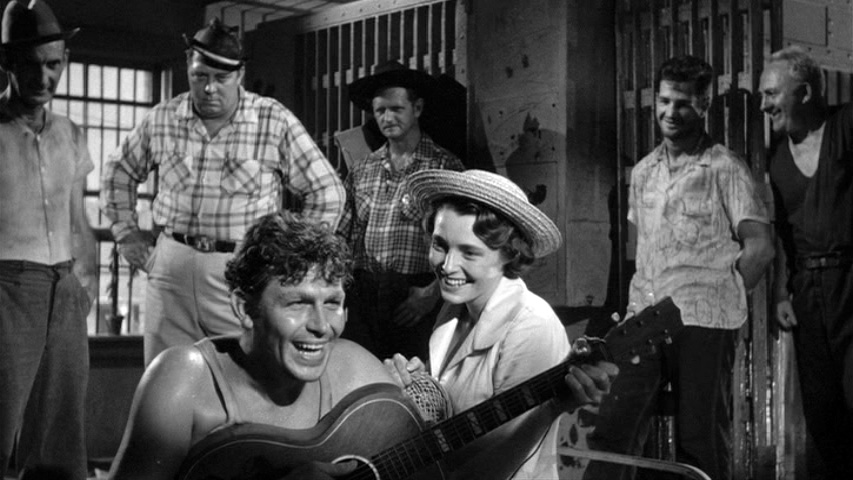
If you only know Andy Griffith from his genial TV Southerners in THE ANDY GRIFFITH SHOW and MATLOCK, brace yourself for A FACE IN THE CROWD. Griffith’s folksy monologues had landed him a starring role in the hit Broadway comedy NO TIME FOR SERGEANTS. The vicious, wild-eyed Lonesome Rhodes was thousands of miles away from anything he had done before, and the actor, guided by the sure hand of director Elia Kazan, gives us a searing performance in this satire of the power of the media, and the menace of the demagogue.

face2

When we first meet Larry Rhodes, he’s in the drunk tank in rural Pickett, Arkansas, a small town not unlike Mayberry. Local radio host Marcia Jeffries is doing a remote broadcast there, hoping to catch some ratings. The no-account drifter is hostile at first, but when the sheriff promises him an early release, you can practically see the wheels spinning…

View original post 684 more words