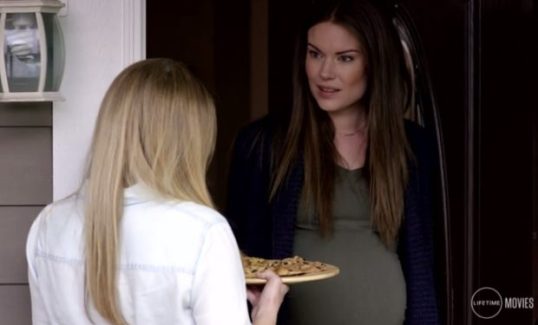
Last night, I watched a new Lifetime film, Drink Slay Love!
Why Was I Watching It?
Because it was on Lifetime, of course!
Plus, it was a Canadian film about vampires. I love Canada and I love vampires! Ever since that episode of Degrassi where Emma got a “social disease” while playing Mina in a school production of Dracula, Canada and vampires have mixed well.
(Now, I should admit, that, while watching Drink Slay Love, I was also watching a film called The Dead Don’t Die on YouTube. I’m a big believer in multitasking.)
What Was It About?
Pearl (Cierra Ramirez) has a life that most of us can only have erotically-themed nightmares about. She’s a sixteen year-old vampire princess. She’s headstrong. She’s a little bit bratty. She’s convinced that nothing can hurt her. Even after she’s the victim of an attempted staking, she still insists on going out in the middle of the night by herself. On the plus side, Pearl doesn’t attack animals. She only attacks humans, especially Brad, the poor guy who works at a 24 hour ice cream parlor and who never remembers Pearl’s nightly visits, in which she always gets a scoop of mint ice cream and a pint of blood.
However, everything changes when it’s discovered that Pearl is immune to sunlight! She is a rare vampire who can actually walk around in the daylight. This leads to her parents getting the brilliant idea of sending Pearl to high school. There’s a big feast coming up and apparently, teenage blood is in high demand. However, once Pearl arrives at the school, she starts to make friends, almost despite herself. She starts to do the type of things that teenagers in Lifetime movies always do. How can she set her new friends up to be the main course?
Of course, some of her new friends have secrets of their own. You know how that goes…
What Worked?
This was a nice change of pace for Lifetime. After endless movies about obsessive stalkers and stolen babies and bad celebrity lookalikes, it was nice to see something different on Lifetime. I’m going to guess that Drink Slay Love was made with October in mind and really, this is a good movie for people who want celebrate Halloween without getting traumatized. It’s not particularly scary but it’s got vampires and it’s enjoyably silly.
Cierra Ramirez did a good job as Pearl. Pearl is a very sardonic vampire, which is the best type of vampire to be. Ramirez delivered her sarcastic dialogue with just the right amount of bite. (Heh heh, see what I did there?)
If the director’s name seems familiar, that’s because Vanessa Parise has directed several Lifetime movies. She does a good job with Drink Slay Love, keeping the story moving at a good pace and getting good performances from the entire cast.
What Did Not Work?
To be honest, I liked the whole film. Even the occasionally sketchy CGI added to the film’s charm.
“Oh my God! Just like me moments!”
I related to Pearl. Well, I didn’t necessarily relate to the blood sucking. But I was really sarcastic when I was sixteen, too. Plus, I always used to dress in black and then dare anyone to make a comment about it… (Actually, not that much has changed since then…)
Opening with a title card that informs us that “President Bush has declared victory,” The Wall takes place in Iraq in 2007. Two soldiers — a sniper named Matthews (John Cena) and a spotter named Isaac (Aaron Taylor-Johnson) — have responded to a call for help that came from a pipeline construction site. When they arrive, they see only dead contractors. Matthews and Isaac spend a day watching the site, finally determining that it is safe to investigate.
Of course, as soon as Matthews approaches the site, shots ring out as a sniper opens fire on him. Matthews falls while Isaac finds himself trapped behind a crumbling wall, shot in the right knee and slowly bleeding out. As Isaac tends to his wound and tries to determine whether Matthews is alive or dead, his radio comes to life. The voice, on the other end, initially claims to be an American soldier but Isaac eventually figures out that the voice actually belongs to the man who just shot him. The sniper is an Iraqi who calls himself Juba. He may or may not be a legendary and feared sniper that Matthews and Isaac were discussing mere minutes before being attacked.
And that’s pretty much the entire film right there. For 81 minutes, Isaac tries not to die while Juba alternates between taunting him and demanding to know why he and the American forces have yet to leave Iraq. Isaac claims that America is rebuilding Iraq. Juba claims that the wall that Isaac is hiding behind used to be a part of a school. Isaac tells Juba to fuck off. Juba replies, “We are not so different, you and me,” revealing that, if nothing else, Al Qaeda snipers apparently appreciate a good cliché. If anything, it reminded me a bit of The Shallows, except Blake Lively was now a soldier and the shark refused to stop talking.
I have to admit that I have mixed feelings about The Wall.
On the one hand, it’s a very well-made film. Visually, the film captures the deadly heat of the desert and it makes good use of its limited setting. It’s far more watchable than any movie that exclusively takes place behind a crumbling wall has any right to be. From what I’ve read, it appears that The Wall‘s depiction of both combat and dying is fairly accurate and the film does a good job of putting you in Isaac’s boots, forcing you to try to desperately figure out where Juba could be hiding.
Also, Aaron Taylor-Johnson actually gives a good performance. Since, with a few notable exceptions, Aaron Taylor-Johnon usually bores me to tears, I was shocked to see how good of a performance he gave as the country-accented Isaac. It’s especially impressive since he’s on screen for almost the entire film. It was hard for me to believe that the same actor who was so unbearably dull in Savages was suddenly so watchable in The Wall. However, he definitely was.
And yet, The Wall is also one of the most thoroughly unpleasant films that I’ve ever sat through. Admittedly, that’s probably the way it should be. War films shouldn’t be pleasant and I don’t think anyone could ever accuse The Wall of romanticizing combat. At the same time, the film itself doesn’t seem to be quite sure what it wants to say about war. Juba and Isaac do briefly debate America’s role in the Middle East but their discussion has all the depth of a twitter fight between Bernie Sanders supporter and a Donald Trump voter. Neither Isaac nor Juba are particularly deep thinkers. They’re both fighting and potentially dying for the benefit of others. Maybe that’s the point. The problem is that the film itself doesn’t seem to be quite sure.
The Wall is one of those films where I respect the craftsmanship behind it while, at the same time, having no desire to ever sit through it again.
Last Monday, I watched the Lifetime premiere movie, My Baby Is Gone! I should have reviewed it on Tuesday but, to be honest, I spent all of last week trying to figure out if Carrie was actually Laura Palmer and if Dale Cooper ever actually escaped the Black Lodge or not. So, this review is a week late and for that, I apologize even though I think anyone who would require an apology is kind of a jerk.
Why Was I Watching It?
Seriously, what’s been going on with Lifetime lately? It used to be that every Saturday night saw the premiere of a new Lifetime film. Live tweeters across the country would look forward to every new Lifetime film. We transformed several of those films into trending topics. We did our part.
But, for some reason, this year has seen a different Lifetime. More often than not, Lifetime airs an old movie on Saturday and saves the premiere for Sunday. Sorry, Lifetime. I love you but if I have to choose between a new movie and Twin Peaks, Game of Thrones, The Walking Dead, The Deuce, Big Brother, and almost everything else that I can watch on Sunday night, anything that Lifetime premieres on Sunday is probably going to end up sitting on my DVR for a while before I actually watch it.
However, My Baby is Gone! did not premiere on Sunday. It premiered on Labor Day, so, for the first time in what seemed like forever, I was actually able to watch and live tweet the movie as it aired. Seriously, Lifetime, get it together. Nobody wants to watch a Lifetime premiere on Sunday.
What Was It About?
Emily (Elisabeth Harnois) is 8 months pregnant. Her husband (Ryan S Williams) seems to be a good guy but he works too hard and sometimes, he misses Emily’s checkups. Her best friend (Nicole LaPlaca) is supportive but she also works with Emily’s husband so, of course, it’s reasonable to assume that they’re probably sleeping together. This is a Lifetime movie, after all. After you’ve seen enough Lifetime movies, you know there’s no way that men and women can ever just be co-workers.
(Unless, of course, they’re cops. In that case, they’re just ineffectual and inevitably end up arresting the wrong person.)
Luckily, someone new has moved in across the street! Kelly (Anna van Hooft) is super-friendly and helpful and — oh my God! — she’s eight months pregnant too! Kelly says that she’s just staying in the house until her aunt returns. What no one knows, of course, is that Kelly’s actually got her aunt tied up in the basement.
Oh, and it turns out that Kelly isn’t really pregnant, either. She’s just wearing a fake belly. It’s actually kind of obvious but, at first, everyone just takes Kelly at her word.
Soon, Kelly is drawing Emily away from her husband and her best friend. She even convinces Emily to decorate the nursery with flamingos instead of butterflies!
What could Kelly’s nefarious plan be?
What Worked?
Uhmm… I’m thinking about it…
Actually, I had a lot of fun live tweeting this film. My Baby is Gone! is one of those movies that literally brings out the best in a snarky audience. There’s just so many implausible developments and none of the characters are likely to be mistaken for a member of Mensa. It’s a fun movie to watch if you’re looking for an excuse to spend two hours wondering how people can be so stupid.
Anna Van Hooft did a great job as Kelly. If you’re going to play a character who is batshit crazy in a Lifetime film, you might as well go all out. When you’re in a movie with a title like My Baby is Gone!, the time for subtlety is over.
What Did Not Work?
Even by the standards of Lifetime, the plot was just too implausible to work. I mean, the whole fake belly thing was a lot more convincing when it used in A Deadly Adoption.
“Oh my God! Just like me!” Moments
My favorite character was Pam (Amelia Burstyn), who was Emily’s doctor’s administrative assistant and who showed absolutely no hesitation about sharing the details of another patient’s visit. It may not have been the best example of professional ethics but sometimes, you have to break the rules.
Way back in January, when I first heard about To The Bone, I had high hopes for it.
After all, To The Bone was the directorial debut of Marti Noxon, who is well-known both for her work on Buffy the Vampire Slayer and for co-creating Unreal. To The Bone was reportedly based on Noxon’s own struggle with an eating disorder and it was said to feature an outstanding lead performance from Lily Collins as an artist struggling with anorexia. Even the casting of Keanu Reeves as a doctor sounded intriguing.
And, to me, it didn’t matter that To The Bone got mixed reviews at Sundance. Who would seriously expect critics, especially male critics, to understand a movie about body issues and eating disorders? When I heard that To The Bone had been purchased by Netflix, I did sigh a little. Far too often, Netflix is where good films end up getting lost in a sea of mediocre offering. But then again, perhaps To The Bone was exactly the type of intimate character study that would actually benefit from being viewed on a small screen. After all, it’s not a film about a bunch of space lizard attacking the great wall of China. It’s a film about a young woman struggling with an eating disorder.
When Netflix finally released To The Bone back in July, I was excited.
Then I actually watched the movie.
To The Bone actually gets off to a pretty good start. The first 20 minutes or so are dedicated to establishing who Ellie (Lily Collins) is. She’s 20 years old. She’s smart. She’s sarcastic. She’s an artist. She’s a college dropout who apparently used to have a very popular tumblr that dealt with being thin. She’s also anorexic and, from the first minute that we see her, Ellie looks like she’s on the verge of death. (To the film’s credit, it makes clear that there is a huge difference between being naturally thin and being anorexic. That’s a distinction that is far too often overlooked.) We meet Ellie’s dysfunctional family: her frustrated stepmother (Carrie Preston), the father who often can’t be bothered, and the half-sister (Liana Liberato) who both loves and resents her. The relationship between the two sisters is especially well-handled. Even if it takes a while to get used to Keanu Reeves playing a compassionate but tough-talking doctor, the film still works during his first few scenes.
Then, Ellie joins Reeves’s inpatient program and moved into a house with six other patients and this is where the film started to annoy me. Ellie is such a well-drawn and well-acted character that it makes it all the more obvious that the rest of the patients are not. Instead, the rest of the patients are all easily identifiable types. As soon as they show up on screen, you know everything about them and you know exactly what is going to happen to each and every one of them. From the minute that Ellie reluctantly steps into that house, To The Bone starts to feel less like an honest look at anorexia and more like a well-meaning and predictable PSA. One of the patients is pregnant and always talk about how worried she is that her eating disorder is going to lead to her losing the baby. Can you guess what happens?
And then there’s Luke (Alex Sharp). Luke is the ballet dancer who is recovering from a knee injury. As soon as I saw that Luke was the only male in the house, I knew that he was destined to eventually declare his love for Ellie. But my problem with Luke has less to do with his predictable character arc and more to do with just how annoying a character he is. Luke is relentlessly upbeat. Luke constantly tells corny jokes. Luke just will not stop talking! When Luke leaves a room, he starts singing a song called Sugar Blues. When Luke reenters a room, he is still singing Sugar Blues. SHUT UP, LUKE!
(Whenever Ellie would visit Luke in his room, I would find myself distracted by the posters on his wall. The majority of them said “Jazz Festival” and featured some saxophone clipart. As strange as it may sound, it really started to annoy me that there was no date or location listed. Why would you go through all the trouble of making — or buying, for that matter — a poster for a jazz festival and then not bother to include a date or a location? That may sound like a minor thing but, as I watched the film, that inauthentic poster came to represent everything that felt inauthentic about Luke as a character.)
I guess the main problem with To The Bone is that it never succeeds in convincing us that the inpatient program is actually going to do any good for Ellie. It’s not for lack of trying. However, the scenes in the house are too overwrought and predictably scripted. There’s a scene where Reeves takes the patients on a field trip and it’s supposed to be inspiring but it doesn’t work because, as a first-time director, Noxon doesn’t trust her material enough to allow us to draw our own conclusions. Instead, she beats us over the head with her message. For To The Bone to work, it needed a director like Andrea Arnold, someone who specializes in a naturalistic performances and who is willing to embrace ambiguity and take the time to let a scene play out. Noxon makes the mistake of not trusting her audience to draw the right conclusion and, as a result, To The Bone goes from being an intriguing character study to being the cinematic equivalent of the last 15 minutes of an episode of Intervention.
Though it all, Lily Collins continues to give a good performance. Even when she’s forced to deliver some unfortunate dialogue, she’s the best thing about To The Bone. Unfortunately, the rest of this movie just collapses around her.
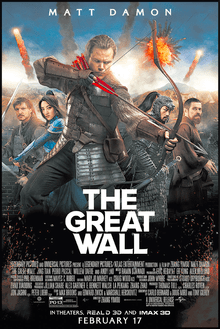
The Great Wall came out in February. Before it was released, I saw the trailer and I thought, “Well, that looks like it might be fun.” However, I never actually saw the film when it was in theaters. I think I was still recovering from Fifty Shades Darkerwhen The Great Wall was released so I put off going to see it. I thought to myself, “That’ll be around for a while.” Of course, I was wrong. The Great Wall played for two weeks and then it was gone.
That may not sound like a big deal when you consider the reviews that The Great Wall received. If not for the fact that Fifty Shades Darker was released a week earlier, The Great Wall would have been the first critical disaster of 2017. Seriously, the critics hated The Great Wall with a passion that took even me by surprise. The comments went beyond the usual snarkiness to outright hatred. Suddenly, The Great Wall — which, to judge from the trailer, looked like a harmless little monster movie — was being held up as an example of everything wrong with modern filmmaking.
The film was even attacked for starring Matt Damon. As I said before, I thought the trailer looked like fun but, apparently, other critics watched that trailer and found themselves asking, “How dare Matt Damon appear in a movie that’s set in eleventh century China!?” And you know what? I get it. Whenever I’m watching a movie about aliens invading the 11th Century, my immediate concern is whether or not the film is historically accurate. It’s bad enough that Americans are being taught that Matt Damon could survive on Mars. Do they also have to be told that Matt Damon saved China from the space lizards!?
Even though I missed The Great Wall when it was playing in theaters, I knew that it was a film that I would see eventually. Whenever a film gets totally slaughtered by the critics, I feel like I have almost a duty to watch the film and judge for myself. Some of that’s because I don’t trust the majority of critics. And some of it’s because, as a natural born contrarian, I’m always hopeful for any chance to go against the consensus. Last month, I finally watched The Great Wall and you know what?
It’s not that bad.
Now, it should be understood that being not that bad doesn’t necessarily mean that The Great Wall is a good movie. It’s a deeply silly movie and, occasionally, it’s also a profoundly dumb one. Matt Damon plays a European mercenary who is sneaking around China, searching for gunpowder. After he is captured by the Chinese and brought to the Great Wall, he is enlisted to help battle a bunch of space lizards. Apparently, the space lizards attack the wall every 60 years but, this year, they’re arriving early. Or something like that. I really couldn’t follow the mythology of the space lizards and that’s probably for the best. The Great Wall is not a film that demands or benefits from a good deal of deep thought. This is one of those films where the best plan is to not ask too many questions because the answers probably won’t make any sense anyway.
As dumb as The Great Wall may be, it’s an undeniably entertaining movie. Under the direction of Zhang Yimou, The Great Wall is a visual feast, full of epic landscapes and swooping cameras. When a seemingly limitless number of space lizards appear out of nowhere and suddenly charge the wall, it’s impossible not to get caught up in the exciting silliness of it all. When the Chinese army takes their positions on the Great Wall and prepare to repel the invasion, it doesn’t matter that none of the characters are particularly fleshed out. Instead, you’re just overwhelmed by the vibrant colors of their armor and the determined fierceness of their expressions. The Great Wall is shamelessly over the top and nicely self-aware. This a movie that knows that it is ludicrous and occasionally incoherent and you know what? The Great Wall is perfectly fine with that.
For all the criticism that he received for appearing in the movie, Matt Damon is ideally cast. Whenever Damon is on screen, it’s as if he’s entered into a conspiracy with the viewer. Matt Damon is one of the few actors who can maintain his balance while walking that thin line between drama and parody. With every arched eyebrow and slightly sarcastic line reading, Damon is saying, “Sure, this is all kind of stupid. But aren’t we having fun?”
When The Great Wall eventually shows up on the SyFy channel, it’s going to be fun movie to live tweet. Some films were just meant to be watched and appreciated with a group of your snarkiest friends. The Great Wall is one such film.
And then there’s Lars Von Trier’s Melancholia. Von Trier is always going to be controversial filmmaker but no one has ever matched his brilliance when it came to capturing the end of existence. In Melancholia, a depressed woman (played in a revelatory performance by Kristen Dunst) finds unexpected strength in the end of the world. As can be seen in the scene below, it’s a beautifully sad film, one that ends on a note of triumphant apocalypse:
When was the last time Aaron Sorkin really did anything to justify his sterling reputation? Yeah, he won an Oscar for The Social Network and he gave one of those annoying, “Daddy just won an Oscar so go to bed now, my daughter” speeches. And then he was nominated for Moneyball. Since he didn’t win, he was not allowed to use his daughter as a prop for a second speech.
He also gave us The Newsroom, a misogynistic television program that was so smug and tone deaf in its coastal elitism that it was probably a contributing factor to the election of Donald Trump. Sorkin also wrote an “open letter” to his daughter after the election, one that pretty much read like a parody of limousine liberalism.
In short, if Sorkin’s going to continue to be known as a great whatever he is, he needs to start delivering. His latest attempt will be Molly’s Game, which he not only wrote but directed as well. That’s right — no longer will Aaron Sorkin have to deal with meddling directors saying stuff like, “But all your female characters are portrayed as being simpletons who need a man to save them and tell them what to do…”
On the plus side, Jessica Chastain and Idris Elba are in the movie.
The Florida Project is the latest film from Sean Baker, who was responsible for last year’s acclaimed Tangerine.
The Florida Project, which was critically acclaimed at Cannes, has a much larger budget than Tangerine, a bigger star (in the form of Willem DaFoe), and some very real Oscar hopes. Let’s just hope that A24 doesn’t get so busy promoting The Florida Project, Baker, and DaFoe that they end up forgetting about The Disaster Artist and James Franco.
The Death of Stalin is not a film that’s been getting a lot of attention but, since it was directed and co-written by Armando Iannucci, I’m looking forward to seeing it. Iannucci, of course, created both Veep and The Thick Of It and it should be fun to see him turn his satirical sights to death of one of history’s greatest monsters.
Incidentally, in high school, I wrote a short story about a history student who was haunted by the ghost of Josef Stalin and a host of other dictators. Unfortunately, no one in the class knew who Stalin was so they didn’t really understand the story. Oh well. Story of my life…
You’re watching a movie called Song to Song. It’s about beautiful people in a beautiful city.
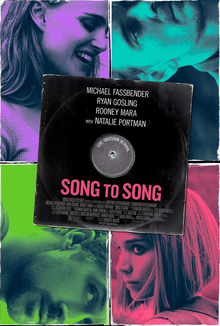
In this case, the city is Austin, Texas. The people are all involved in the Austin music scene and they’re played by actors like Ryan Gosling, Rooney Mara, Natalie Portman, Michael Fassbender, and Cate Blanchett. A good deal of Song to Song was filmed at the Austin City Limits festival and several real-life musicians appear as themselves, though only Patti Smith is on screen long enough to make much of an impression. To be honest, both the music and Austin are almost incidental to the film. Though the movie was sold as an Austin film and it premiered at SXSW, it could have just as easily taken place in Ft. Worth.
The film is made up of short, deliberately obscure shots. The camera never stops moving, floating over images of sunsets, sunrises, and oddly empty streets. Because the film was shot with a wide-angle lens, you’re never not aware of the expanse around the characters. At times, all of those beautiful film stars run the risk of become specks on the landscape, as if the film itself is taunting the characters for thinking that they are more important than nature.
Who are the characters? It’s not always easy to say. There are plenty of voice overs but it’s rare that anyone directly states what they’re thinking or who they are. When the characters speak to each other, they mumble. The dialogue is a mix of the banal and the portentous, a sure sign of a film that was largely shot without a script. Eventually, you turn on the captioning so that you can at least understand what everyone’s muttering.
Michael Fassbender plays Cook. Cook appears to be a music producer but he could just as easily be a businessman who enjoys hanging out with and manipulating aspiring stars. People seem to know him but nobody seems to be particularly impressed by him. Cook spends a lot of time standing in front of a pool. Is it his pool? Is it his house? It’s hard to say. Cook is obsessed with control or maybe he isn’t. Halfway through the film, Fassbender appears to turn into his character from Shame.
Ryan Gosling is BV. BV appears to be a lyricist, though it’s never made clear what type of songs that he writes. At one point, you think someone said that he had written a country song but you may have misheard. BV appears to have an estranged relationship with his dying father. BV may be a romantic or he may not. He seems to fall in love easily but he spends just as much time staring at the sky soulfully and suggesting that he has a hard time with commitment. BV appears to be Cook’s best friend but sometimes, he isn’t. There’s a random scene where BV accuses Cook of cheating him. It’s never brought up again.
Rooney Mara is Faye. Faye contributes most of the voice overs and yet, oddly, you’re never sure who exactly she is. She appears to be BV’s girlfriend and sometimes, she appears to be Cook’s girlfriend. Sometimes, she’s in love and then, just as abruptly, she’s not. She may be a singer or she may be a songwriter. At one point, she appears to be interviewing Patty Smith so maybe she’s a music journalist. The film is centered around her but it never makes clear who she is.
Natalie Portman is Rhonda. Rhonda was a teacher but now she’s a waitress. She might be religious or she might not. She might be married to Cook or she might not. Her mother (Holly Hunter) might be dying or she might not.
And there are other beautful people as well. Cate Blanchett plays a character named Amanda. Amanda has a relationship with one of the characters and then vanishes after four scenes. There’s an intriguing sadness to Blanchett’s performance. Since the first cut of Song to Song was 8 hours long, you can assume her backstory was left on the cutting room floor. (And yet strangely, it works that we never know much about who Amanda is.) Lykke Li shows up, presumably playing herself but maybe not. Berenice Marlohe and Val Kilmer also have small roles, wandering in and out of the character’s lives.
There’s a lot of wandering in this movie. The characters wander through their life, stopping only to kiss each other, caress each other, and occasionally stare soulfully into the distance. The camera seems to wander from scene to scene, stopping to occasionally focus on random details. Even the film’s timeline seems to wander, as you find yourself looking at Rooney Mara’s forever changing hair and using it as a roadmap in your attempt to understand the film’s story.
“I went through a period when I thought sex had to be violent,” Rooney Mara’s voice over breathlessly explains, “We thought we could just roll and tumble, live from song to song, kiss to kiss.”
As you watch Song to Song, you find yourself both intrigued and annoyed. This is a Terrence Malick film, after all. You love movies so, of course, you love Malick. Even if his recent films have been flawed and self-indulgent, he is a true original. You want to support him because he’s an artist but, as you watch Song to Song, the emphasis really does seem to be on self-indulgence. The images are beautiful but the characters are so empty and the voice overs are so incredibly pretentious. Should you be mad or should you be thankful that, in this time of cinematic blandness, there’s a director still willing to follow his own vision?
At times, Song to Song is brilliant. There are images in Song to Song that are as beautiful as any that Malick has ever captured. Sometimes, both the images and the characters are almost too beautiful. The music business is tough and dirty but all of the images in Song to Song are clean and vibrant.
At times, Song to Song is incredibly annoying. It’s hard not to suspect that the film would have worked better if Natalie Portman and Rooney Mara had switched roles. Mara can be an outstanding actress with the right director (just check out her performance in Carol) but, in Song to Song, her natural blandness makes it difficult to take her seriously as whoever she’s supposed to be. Portman has much less screen time and yet creates an unforgettable character. Mara is in 75% of the film and yet never seems like an active participant.
At times, the film is annoyingly brilliant. Malick’s self-indulgence can drive you mad while still leaving you impressed by his commitment to his vision.
And then, other times, the film is brilliantly annoying. Many directors have mixed overly pretty images with pretentious voice overs but few do so with the panache of Terrence Malick.
Even fans of Terrence Malick, of which I certainly am one, will probably find Song to Song to be his weakest film. Even compared to films like To The Wonder and Knight of Cups, Song to Song is a slow movie and there are moments that come dangerously close to self-parody. Unlike Tree of Life, where everything eventually came together in enigmatic poignance, Song to Song often feels like less than the sum of its parts. And yet, I can’t totally dismiss anything made by Terrence Malick. Song to Song may be empty but it’s oh so pretty.


 Through the Shattered Lens